who will be king?

Have you ever wondered what it would be like to call the shots over your boss? Or be the principal in your school? Or even the king of the whole world? I certainly have wasted more than one afternoon daydreaming about my royal plans.

We are constantly surrounded and bombarded with the message that I am in charge of my little world, I have the right to own it all, I am the master of my fate, and I am the king of my domain. The world wants you to believe, “You are god, don’t let anyone convince you otherwise.” MTV Cribs, Lifestyles of the Rich and Famous, and celeb TV send us the message that you have not made it unless you have made yourself the ruler of your realm. Is this what life is all about? Work and play-play-play? Make mounds of money? Make a name for yourself?

In the Bible there are many examples of people who had more than most—Joseph [2nd in command of Egypt], Moses [leader of 2+ million], Solomon [richest & wisest], Esther, and many others. How did they deal with it? Did it go to their head? We see that at times their possessions, popularity, and power did affect their pride. It took the King-of-Everything to pop their big bubbleheads. As you read through the Bible it asks you a very important question: who will be your King? You or God?

Curious? Read more here…

Trinity File

Over the past month I have been studying the Trinity. Here are all the resources in one place touching upon the theology and practicality of the Trinity:

what does the Trinity teach us about relationships?

Within the Trinity there is both unity and diversity: unity without uniformity, and diversity without division. This unity and diversity is at the core of the great mystery of the Trinity. Unity without uniformity is baffling to our finite minds, but there are demonstrations of this truth all around us; like a symphony, the human body, ecosystems, the church, the human race, a delicious meal, or a sporting event. Unity and diversity are woven into the fabric of the world by multiple images of the One who made it with unity and diversity.

Our human relationships uniquely and divinely reminisce the relationship between the Persons of the Trinity. This is no mistake, since man’s Maker stamped each man in His image. Most people never consider where this similarity has originated, but God has innately marked His creation with creative features that mimic Him—including our relationships. Today we will look at three distinct relationships that the Bible demonstrated both the unity and diversity of the Trinity:

Marriage is a relationship that demonstrates the Trinity’s unity and diversity [Ephesians 5:22-33]

Marriage is a wonderful picture that God uses to demonstrate His character as an unconditional, faithful, and sacrificial Lover. From the beginning of Creation God made man equal in His image [Genesis 1:26-27]. Though man and woman are quite diverse in appearance and God-given roles [Genesis 2; 1 Peter 3:1-7], they are both equally made in the image of God. If only man and woman within marriage would consider one another images of God, much of the conflict and chauvinism would dissipate.

The unifying love that Jesus has for His church is a beautiful demonstration of marriage [Ephesians 5:22ff]. Marriage is pictured in Christ sacrificing Himself for His church and the church submitted to Christ, which is paralleled by the husbands love his wife, the wife submitted to her husband, and both out of reverence towards Christ.

Church Body is a relationship that demonstrates the Trinity’s unity and diversity [Ephesians 4:1-16]

There is a glorious union between the Father, Son and Holy Spirit. Biblical Christianity stands or falls with the doctrine of the Trinity. Within the doctrine of the Trinity there are practical Implications. First, the Trinity makes God known in Christ [John 1:18; Exodus 33:20; 1 Timothy 6:16]. Second, the Trinity makes the salvation possible [Hebrew 9:14]. Third, the Trinity is fully dependent upon Himself [Acts 17:25]. Fourth, The Trinity provides the ultimate model for relationships within the body of Christ [1 Corinthians 11:3; 12:4–6; Ephesians 4:4–7].

When believers enter into a saving relationship with Jesus Christ they are adopted into God’s family—the church. The church body is made up of members who are all equal in the eyes of God. God in His divine purposes designed the church to function locally as a means for each member to grow spiritually through mutual relations and gift-oriented ministry with one another. Within His Body, God has given all a diverse role in order for the church to be unified in its display of God’s glory. God gave to the church offices: elders and deacons from the membership who are equal, but the elders are supposed to lead, the deacon’s serve, and the membership minister. When each one is doing their part the Body is a beautiful reflection of God’s unity and diversity.

Leadership (i.e. parenting & governing authority) is a relationship that demonstrates the Trinity’s unity and diversity [Ephesians 6:1-9]

The Trinity—God the Father, God the Son, God the Spirit—one God, three persons, all equal but submissive. God the Son submits to God the Father and recognizes Him as the leader. There is leadership within the Trinity. This is called relational subordination.

Jesus, though He is equal with God, willfully submits Himself to the Father. He submits to the Father out of love [John 4:34; 14:31; 15:9-10], reverence for His divine authority [1 Corinthians 11:3; 15:25-28; John 3:16-17; 10:36; 6:38], and reliance upon the Holy Spirit for power and direction [Luke 4:1-2, 16-21]. Likewise, it is marvelous how the Father shines His spotlight on the Son as He purposes all things to be subject to Jesus [Psalm 2:7-9; Ephesians 1:9-10; 5:21; 1 Corinthians 15:27-28; Revelation 5:1-5, 8-9]. Likewise, the Holy Spirit pours forth the message of Jesus in the Word of God [2 Timothy 3:16-17, 2 Peter 1:20-21, Luke 24:24-27, 44, 1 Corinthians 1:18, 23, 2:2, Galatians 6:14].

Submission to leadership practically plays itself out in two ways: through parenting and governing authorities. In the government of a home: mom, dad, and the children are equal made in God’s image, but dad’s are supposed to lovingly, humbly, and sacrificially lead [Ephesians 6:1-4]. Also, God appoints government leaders and bosses, and our response is to joyfully submit as if we are laboring for God [Ephesians 6:5-9; Romans 13:1-7]. This can be difficult especially in a world that is filled with crooked politicians, unreasonable employers, and passive fathers, but we have an awesome example to follow in God the Father, Son, and Holy Spirit.

In conclusion, the Trinity gives us a multifaceted look at relationships. Whether, in a marriage, church, home, business or nation God has demonstrated to us unity within diversity. Imagine if in each arena of your life you were to embrace the diversity rather than run from it, what unity could there be?


meet the taters

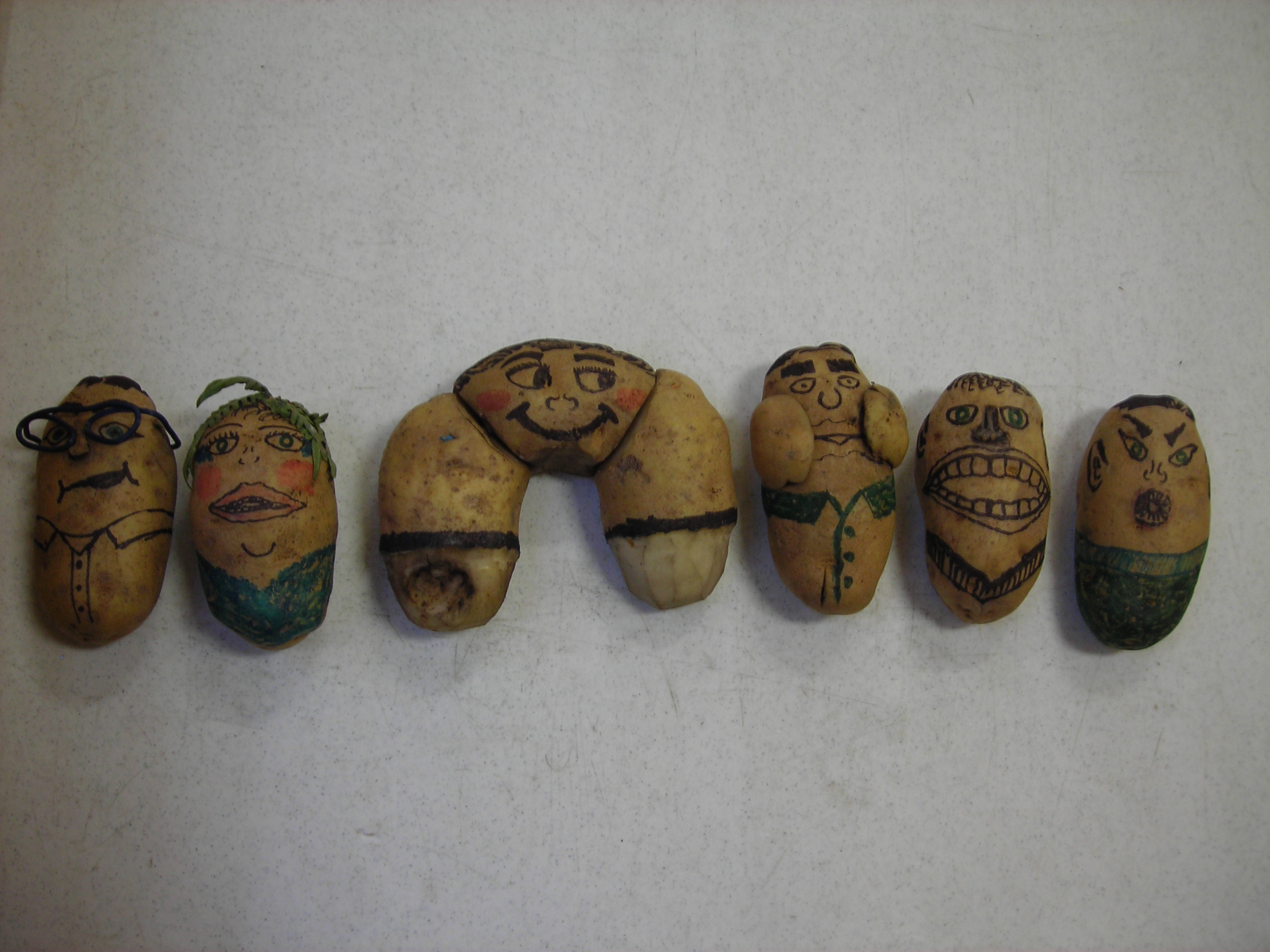
The Tater’s family are a memorable family. I was introduced to the highly dysfunctional Tater family and their ongoing saga through Travis Huseby at Checkpoint Bible Camp. Here is a glimpse of the Tater Family:

Uncle Common Tater

He is no common Tater!? Common has the gift of gab. He makes a living in broadcasting and is good at communicating. He is certainly a chatter box outside the press box. He always has a story to share, and people are interested in hearing him ramble about random happenings.

When you get to know Common you will quickly observe that he does a lot of talking, but not a lot of walking. His bark is louder than his bite. In fact, he is a Sweet Tater, never saying anything bad about anyone. He is certainly a people pleaser. Common could be a mighty spokemen for God’s glory, rather he is ashamed of the gospel of Christ [Romans 1:16-17; 10:14-17].

Speck Tater

Speck is the father of the family. He is intelligent, dedicated to his job, pays the bills, but is not particularly outgoing on the home front. He is the dad you see on the sidelines. Speck is not doing much to support his Tater’s, much like his father Hesi Tater. He is one dud of a spud.

Speck, as Pa-Tater, needs to get off the bench and into the game before time runs out and life has past him by. His family is his most important responsibility. His greatest impact as a father is to train up his children in the ways of God [Proverbs 22:6], and modeling Christ’s through his loving and committed marriage. This cannot be done by passive spectating [Ephesians 6:4], but by active husbandry and priority parenting.

Ima Tater

Ima is the decorated daughter of the family. She is no darling. She models and mimics the world. Her friends often sway her opinions. Roe Tater, her best friend, switches boyfriends weekly, complains about not having enough, and brags about spoiled habits. She is swoon by current fads, trends, and teen idols [aka: Idol Tater].

An idol is anything you worship, and what we worship we become. An idol can be a material possession, a feeling, a person of interest, a place of comfort, or anything that captivates your heart. The Bible says to imitate Christ [1 Corinthians 11:1], and to destroy all idols before they destroy you [Isaiah 40-49].

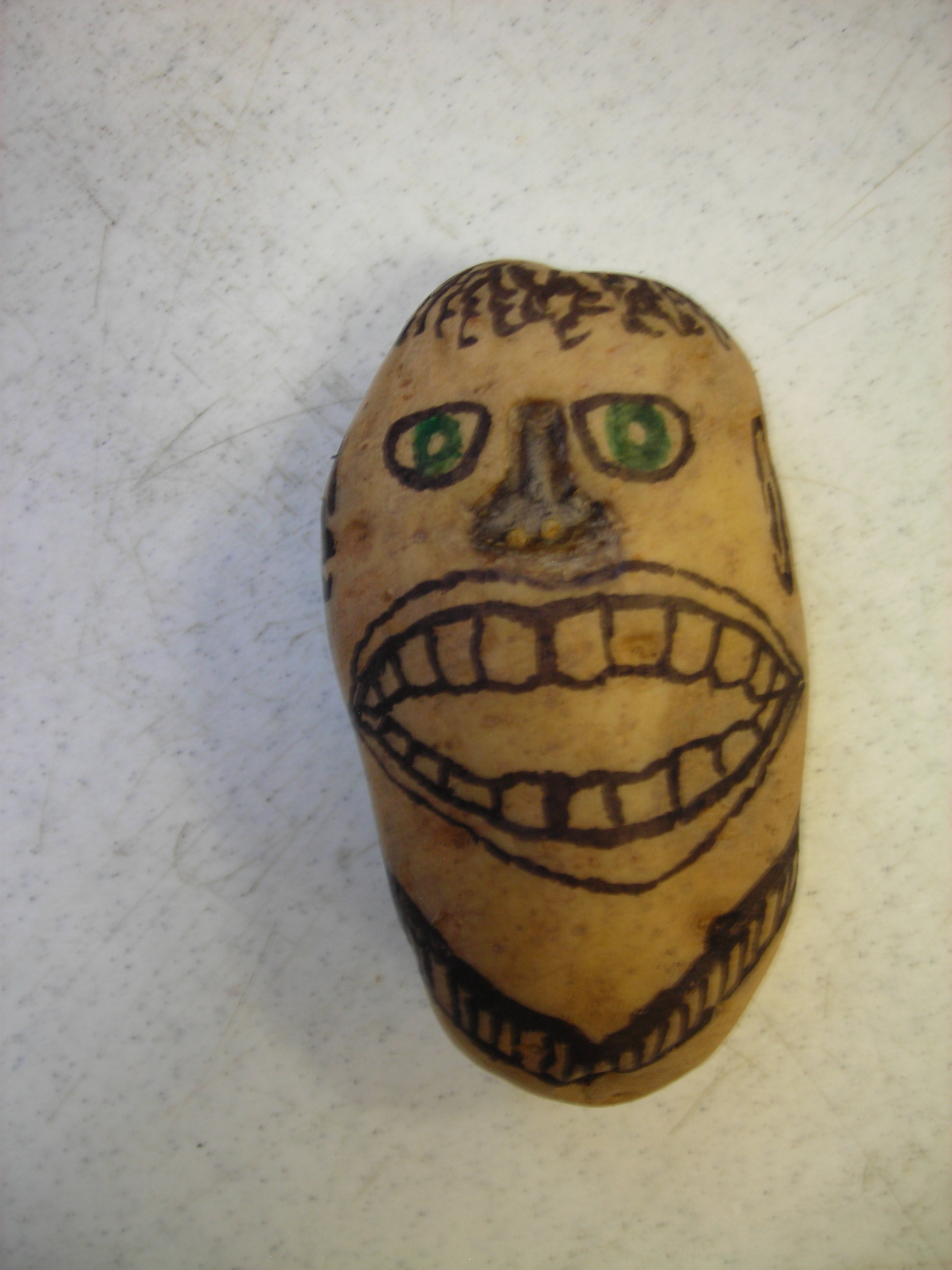
Agi Tater

Agi is the always angry son who must have inherited the spicy Irish Tater genes. He tends to mash, scalp, or fry any Tater that gets in the way of his plans. His parents blame his bad behavior on Iri Tator, a bullish friend at school.

Agi is self-centered, never wrong, and a big-headed boaster. When things are not going his way you will surely hear about it. Can Agi gain control of his anger? Anger itself is not sinful [Ephesians 4:22ff]. In fact, anger is a God-given emotion that can be used for glorious means in defeating sin and choosing righteousness. Followers of Christ can learn how to control their anger [Titus 2:11-15].

Regurgi Tater

We all call him, Reggie. He is the younger brother [aka: Tater Tot] who tends to tattle tail. He hurls up information quicker than a baby spews up their bottle. Reggie’s feed off of gossips and lies for his own satisfaction [1 Peter 2:1]. The tongue is like a wild fire. A little spark can do a lot of damage [James 3:1-12].

In the Scripture the word often referring to regurgitation is meditation. The Bible says as followers of Christ we must meditate on God’s Word by: reciting it [Psalm 119:11], reviewing it [2 Timothy 2:15], and renewing our minds by it [Romans 12:1-12]. When we think about God’s Word and chew on it we are reminded that other people are created in God’s image and defaming them offends God.

Gravi Tater

Gravi is the mama of the spud bunch. She is large and in charge. If mama ain’t happy, nobody’s happy. Big mama has control and stay out of her way. Everyone agrees that she takes after her father, Dick Tater. She can certainly be a Sweet Tater when she wants to be. Even as her family is falling apart, she finds a way to contribute by butting herself into everybody’s business. She could be using her magnetizing clout to bring everyone together in unity [Ephesians 4:1-16].

The Tater family does have serious issues. If we were honest we probably see some of the Tater family in our families. My suggestion is that the Tater’s go to Counsel Tater [aka: Pastor Ed U. Tater]. Their they will discover the root issue is sin. Sin is like a bruise or spoil that needs to be cut off or it will infect the the Tater if not the batch of Tater’s. Unfortunately our sin affects others around us, especially those in our immediate family or church [cf. Romans 12; 1 Corinthians 12]. Deal with sin swiftly by lovingly confronting it and helping in the change process. Through God’s grace the Tater family can begin to learn from their Creator how to live in His image [Genesis 1:26-27].

portraits of the Trinity

Let’s say I have a really beautiful snapshot of a rock. You might say, “Wow, that is a really interesting rock.” Yet you would not know where the snapshot was taken, why it was of a rock or for whom it was for. You come to find out that the snapshot of the rock is a part of a larger photo book cataloging pictures of similar rocks. When the snapshot is zoomed out to a panoramic you can see clearly that the rocks are placed in the panorama of the Grand Canyon.

In a similar fashion, God gave revelation to His people in snapshots [aka: progressive revelation]. Progressive revelation simply means that when Adam and Eve were in the Garden, God did not give them a completed Scripture. Likewise, Abraham did not know as much as Moses or David, Isaiah or Jeremiah, even Peter or Paul about redemption. He knew some components, but very few details.

Progressive revelation is closely related to the historical nature of Scripture and God revealing Himself, His purposes to His people. It can be very simply defined as God’s revealing His will in successive snapshots, each founded upon and making clearer the previous snapshots.

God’s redemptive acts were progressive, preparing the way for Christ who should come in the fullness of time [Gal.4:4]. Christ is the panoramic picture of the Bible. He is the rock and the Grand Canyon. God graciously unfolded the snapshots of His redemptive plan and His revelation in ways that fit His people’s ability to receive them.

When it comes to interpretation it is important to have the panorama in view. Each snapshot of revelation builds and defines the previous one. For example, Exodus builds on Genesis, Kings builds on Judges, and Hebrews builds on the OT. We must study in a way that builds on what was revealed by God in progressive snapshots to see the panorama more clearly. As we study the Trinity from Genesis to Revelation we must have the category of progressive revelation in mind.

SNAPSHOT #1: The OT on the Trinity’s Plurality

We find hints of the Trinity in Genesis. However, a good question to ask is: did the Old Testament Jews believe in a triune God? Did they understand the complexity of the Trinity as we do today? Not completely. The OT Jews were not as clear about the nature of God in the way that we are clear with the incarnation and the teaching about the Holy Spirit that comes with Jesus. However, you be careful not to deny that they believed in the triune God because they believed in the God of the Messiah [Jesus Christ].

In Genesis 1:26-27 [cf. 3:22; 11:5-7], there is a hint from the beginning that the Jews believed in a God with plurality. There are many ways to look at the pronoun for God here, but one cannot escape the interesting tidbit—God is spoken of in the plural. There are many allusions to the God’s plurality [Ps.45:6-7; 110:1; Is. 6:8; 11:1-2; 44:6; 48:16; 61:1; Jer. 23:5-6; Dan. 7:13-14; Mal.3:1].

The OT is animate about the fact that the Spirit of God was real, and that the Messiah who was to come is no ordinary man. Therefore I tend to lean towards the fact that the OT Jews did believe in the triune God. However, they did not have a complete panorama that He was a triune God.

SNAPSHOT #2: The OT on the Trinity’s Oneness

Discovering references to the oneness to God in the OT is not as complicated as studying the Trinity’s plurality. Jews had grown up in Sabbath School learning to prayerfully memorize the Shema [Deuteronomy 6:4] declaring God Oneness I the midst of a world of polytheist pagans. God’s oneness in the OT is quite common. In fact God’s uniqueness is a repeated pattern seen through the OT: “Who is like God?” or “There is none like God” [Ex.8:10; Ps.35:10; 71:19; Is.43:10; 45:5; Jer.10:6-7; Micah 7:18; Zech. 14:9].

SNAPSHOT #3: Jesus on the Trinity

Jesus’ favorite song must have been Psalm 110:1. He quoted it a lot. The question I have is whose son is the Messiah? And whose Lord is the Messiah?  I just don’t think it was a catchy tune stuck in His head, rather it was meaningful in relating Himself to the God as more than a mere man. Jesus compares Himself to the Trinity’s oneness by quoting the Hebrew Shema [Mark 12:28-29] and plurality [Mt.3:16-17; 28:19; Lk.1:30-35; 11:13; Jn.6:27, 57; 10:30; 14:16-26; 15:26; 17:11, 21-23]. In overabundance Jesus Christ is affirming Himself as God and being One with God.

SNAPSHOT #4: The NT on the Trinity

The are numerous places in the NT following the Gospels of Christ that describe God’s Oneness [Rom.3:30; 10:12; 1 Cor. 8:4; 1 Tim. 1:17; 2:5; Js. 2:19] and Plurality [Acts 5:3-4; Rom.1:1-4; 9:5; 1 Cor. 2:10-11; Eph. 1:3-14; Gal. 4:6; 2 Thess.2:13-14; 1 Pt.1:2-3]. As the revelation of God unfolds through history we gain a clearer and more complete picture of God. God is complex, but He graciously and patiently reveals Himself to His people over a long period of time.

When you pull the snapshots of God together from OT to NT you have a true portrait of the Trinity as seen from the whole panorama of Scripture. Today we are blessed to have a completed Canon of Scripture that gives us a wonderful and beautiful picture of God’s character and His story of redemption. Let us behold Him in all His glory—God the Father, God the Son, and God the Holy Spirit—three in One.

T – 3 months = baby

Mama Hutts belly is growing and growing. Right now it looks like a seedless watermelon is growing in Sarah’s tummy. It is amazing to feel the headbutts and crazy kickboxing at random moments day or night [not so sure mama likes it so much though]. To think that in a matter of three months a little miracle will come screaming into the world astonishes our socks off.

I really look forward to being a daddy. Here are a few realities that excite me about being a father:

Disciplining my child into a faithful follower of Christ. Sharing the gospel story with my children brings me the most excitement. Sarah and I have been praying long before we found out that she was pregnant that our children will exceed us as parents in living faithfully for God. This is a huge parenting priority, but its a load we do not bear alone.

Taking my child fishing. Last week, I spent time with my dad and brother fishing in northern Wisconsin. I learned how to fish as a kid because of the patience training of my father. Even if my child does not like to fish, just being able to spend quality time with them will be a treasure.

my most favorite book

Reading and telling stories. We already have a stash accumulating of our favorite children’s books and stories for bedtime, car trips, camp fires, and more. Not to mention all the stories to share about baby Hutts’ journey, mom and dad’s histories, and memories of those who have come before baby Hutts. [Note: You can help towards our book and story collection at our Amazon baby registry or for other baby items Target. Also Sarah’s baby shower is September 11 at BGBC]

Growing deeper in love with my wife. My wife will be a wonderful mother. I know this because she is an amazing wife and has a tremendous love for little ones. There are certainly unforeseen challenges and curve balls that we will learn about one another as a child is brought into our family. Yet the newness of parenthood I foresee strengthening our love for one another.

There is so much more that excites me that soon will be a reality. It is good that God gives you 9 months to stew over parenting.

why does the Trinity matter?

Is the trinity a concept for people who are really intelligent like philosophers and theologians? The Trinity to many people seems like an egg-headed doctrine that is distant from the everyday lives of people. How is the Trinity important for me today? Why does the Trinity matter?

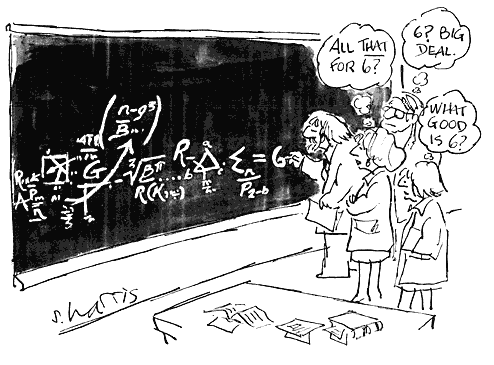
Why the Trinity matters is like asking why does gravity matter? Or why is oxygen all that important? Or do we really need to know anything about anything? I remember sitting in Algebra as a high-school student and thinking to myself, “Is this at all practical?” Indeed, it is practical. For without mathematics the very school building I was sitting in would not have been architected, planes could not fly, time and space could not be measured.

Just because something does not matter to you does not mean it does not matter. In fact, many things we do not think about matter. Imagine you stepped onto an airplane and the stewardesses did not give a safety talk before the plane took off. You would not know what to do in an emergency. If there is information about God that is important shouldn’t we seek to know and understand Him? Why does the Trinity matter?

The Trinity strengthens our relationship with God.

Can you really love something you do not know much about? This is a good question to consider. Take something you love and test it [write a list of things you love]. I love cheese. I am not an expert coinsure on cheese, but I have grown up in Wisconsin, I’ve tasted many kinds of cheeses, I have friends who work in cheese factories that cut cheese for a living, therefore, I know cheese and can appropriately love it. As lame of an illustration as that is the things we love we often learn, study, consume, relate to, experience, and take time and energy to know and understand. This in turn strengths our love and affection for it. To love God is to know and grow daily in all His ways.

God desires us to know and understand Him [Jeremiah 9:23-24; John 16:7-15]. That’s why He was given us His Word. Knowing God might not be the priority of every human being, at least right now, but it we will all one day come to the realization that knowing God is what matters the most.

The Trinity is not about ME.

I cannot wrap my melon around the scope of the Trinity, but that does not mean the Trinity does not exist. Just because I cannot fully understand something does not nix it from being real or truth.

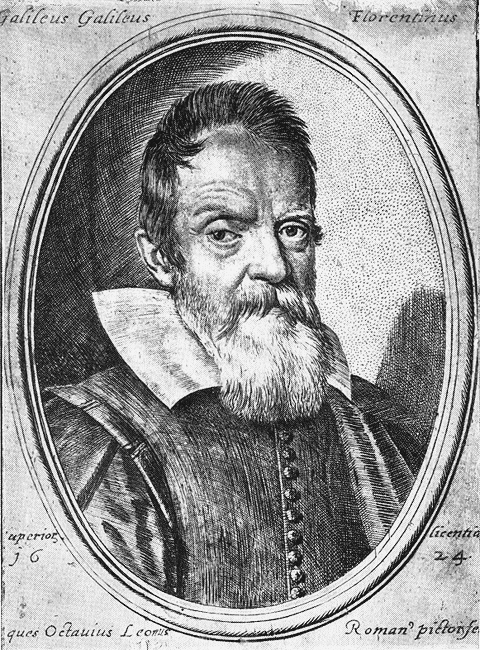
We live in a me-centered culture that thinks everything revolves around “me”. You can spend an entire day thinking about yourself, but oblivious to the realities surrounding you. Like people prior to Galileo concluded our world was flat, but in reality it is a globe. We must face the truth that human beings are part of a larger cosmos that God created, sustains and revolves solely around Him. He is the blazing center of our universe. Man is on earth a blip on the radar screen of history, but God remains eternally. God does not exist to meet our needs, nor did He create us because He was lonely and needed little friends to keep Him company. He did not save man by sending Christ so that we could be with Him forever. Eternity exists so that we can know God—the Trinity [John 17:3].

The Trinity shows the uniqueness of Christianity.

Christianity is not like other world religions. It’s not even kind of the same. Not all religions believe in the same God [that is a contradictory statement]. It is radically different than all world religions. What separates Christianity from other belief systems? According to Christianity God became man [Matthew 1:18-23]. This God-man became the sacrifice for man’s sin. At Christianity’s core the Trinity—God the Father, Son and Holy Spirit—is unique to Christianity. Without the Trinity Christianity is dead. That truth alone helps me to understand that the Trinity matters.

3 amazing and mysterious truths about the Trinity

I remember when I first started talking with my wife in the early days of our relationship. I wanted to know everything about her: what she loved, desired, disliked, favorite foods, most inspirational books, greatest memories, fears, and more. Our phone conversations would go on for hours, as we would learn new things about one another. I really got to know a lot about Sarah and loved it. Now that we have been together over 3 years and have know each other more than 10 years we are still learning new things about each other, but not quite at the pace we did in the early years. We are familiar with one another. Imagine one day I woke up and said to Sarah, “I don’t want to know more about you.” Something is very wrong when the learning about my loved one stops.

There is a difference between knowing about someone and really knowing them. Likewise you can know more than just know something about God. You can know Him. He speaks to you and you can speak to Him. You can actually have a growing relationship with God. Like a marriage or family this relationship is a lifelong endeavor, if not an eternal adventure. Forever you will be learning something new about God.

God is a mystery, but there are things you can know for certain about God. You will never be able to solve the mystery about God or know everything about Him. It is impossible to know all about God. People often think that the Trinity mystery is contradictory. A contradiction is when two truth statements exist that cannot logically coexist. For example: “God exists” and “God does not exist.” Both of these statements cannot be truth at the same time. One must be true and the other false. The Bible declares 3 amazing and mysterious truths about the Trinity of God [John 1:1-14]:

1. God is 3 Persons.

How does John 1:14 define what the “Word” is in 1:1? The Word is defined as God who “became flesh and dwelt among us.” We would know the Word as referring to Jesus Christ. What is the significance of calling Jesus “the Word”? To a Jewish person the Word of God was spoken, not necessarily seen. God spoke the universe into being, God spoke to Adam and Eve in the Garden, God spoke to Moses in the bush and Wilderness, and God spoke to the prophets. When God spoke, man listened. John says that Jesus is the Word—the Word in visible flesh. When people look at Jesus and hear from Him they see God with skin on. He is just as God as God the Father; in fact Jesus displays the “glory” of God the Father.

According to John 1:1 notice “the Word was with God.” Why is that statement important? It means that Jesus and the Father are distinct. God is distinct in persons. The Bible clearly shows that the persons of God—Father [1 Cor.8:6; Rom.15:6; Mt.11:27], Son [John 1:3; 5:27-30; 8:58], and Holy Spirit [Acts 5:3-4]—are indeed God, yet distinct from one another [Mt.3:13-17; 12:32]. In fact, the persons are subordinate to one another [John 14-16]; the Father planned salvation [John 3:16], the Son submits to the Father [1 Cor.11:3; 15:28], and the Holy Spirit glorifies the Son [John 16:14].

How is the distinctness and oneness of God reflected in our human relationships? Marriage relationships are considered one flesh, but with two persons [Hutts / Justin & Sarah]. A family is considered a unit with many members [Hutts / Justin Hutts]. A team is typified as one with 5 or 11 players [Colts / Peyton Manny]. So it is with God—He is 3 persons.

2. All 3 Persons are Fully God.

According to John 1:1 Jesus was with God in the beginning. Jesus took part in the creation of all things. Do you notice that John 1:1 and Genesis 1:1 have a lot of similarities? “In the beginning God created the heavens and earth.” Jesus is equal with God at creation. Jesus is fully God. John 1:14 tells us that He became flesh, which means that He was once not flesh. Jesus is God who became a man. [Note: The whole Trinity is involved in Jesus’ incarnation—God send Him and the Holy Spirit caused the womb to be; John 3:16; Luke 1:35]

The 3 persons of the Godhood are distinct in person, but one in essence. The 3 Persons have eternally existed as One God. Jesus is not merely with God, not merely like God, He is God.

3. All 3 Persons are 1 God.

All Jews from the time they little children learn about God—One God. Even the disciples believe in One God [monotheist] and believed that Jesus was God too [not one of many god, polytheist]. Hebrew children much like children today attended “Saturday” School at the synagogue and learned important lessons from the Old Testament. By heart a Hebrew would know the Shema: “Hear, O Israel the LORD our God, the LORD is One.” [Deut.6:4] The three-ness and oneness of God do not exist in the same respect—God has one essence and plurality of persons.

How has your view of God been too limited? How have you been reminded in your life of your limitations? When I think about the Trinity I come to a realization of my own limitations. We are the creation and God is the Creator [Isaiah 55:8-9]. Thinking about God puts Him in His place and me in mine. He is God and I am not. I am not, but I know I AM!

In my relationship with Sarah there are things I will learn about her the rest of our marriage. She is a woman—she thinks differently and is wired differently by God. She is so complex. So it is with God. He is infinitely more complex and there is an endless vat to know about our beautiful God and Savior. What a joy it is to search the mysteries of our God and get a glimpse of Him in His Word and in the world.

hiking up a mountain with a pregnant wife

Sarah and I just got back from our wonderful vacation filled with family, friends, and new memories of glorious mountains. We were able to spend a few days hiking and exploring the back country of Rocky Mountain National Park. We climbed up to the base of Mummy Peak and tented at the treeline basin nestled below Fairchild and Hagues Mountains. We did not encounter any bears at 11000 feet, but we did have plenty of encounters with chipmunks. They don’t warn you at the park office about those pesky varmints!?

When standing within the virgin forests gazing up at the sharp rocks jetting into blue skies one cannot help but think, “God is powerful and mighty to have created this natural art.” The picturesque mountains are certainly contagious. I miss the sounds of mountain birds singing and wind whirling in the tall evergreens, the smell of the crisp snow capped air mixed with ointment of perfuming flowers. God is so creative in the way He attracts our senses to His beauty and majesty within creation.

Much of this vacation was imagined and planned by my wife Sarah. Even though she is 5 months pregnant she did not complain much about the elements. Sarah is perched for adventure. Next week she departs for over a week with a group from our church to Haiti. There she will again hike a mile up a mountain to serve faithfully in a forgotten village 6 months after the devastating earthquake. Some say Sarah is crazy for going overseas this far into her pregnancy, while others have offered her money to stay home, but she presses on with the support of her husband.

I have confidence that Sarah will do be just fine in Haiti, especially after climbing the 6.2 mile trail up and down Lawn Lake. Our baby is going to be a little climber and adventurer just like mama. Our God is a protector and provider. He is the God who has given us our child and He is the God who will also hedge my wife and child as they go to unknown places spreading the fame of His name.

spiritual vitality, cross and tongue, peace of mind

spiritual vitality

When people lose their global vision, they begin to lose their spiritual vitality. And of course all this affects their values. – Tom Julien, Antioch Revisited, 23.

cross and tongue

When the message of the Cross captures our hearts and captivates our imaginations, our tongues, stammering, halting, insulting, awkward, sarcastic, imperfect as they may be, won’t be far behind. As Jesus said, “Out of the overflow of the heart the mouth speaks.” [Matthew 12:34] – Mark Dever, Nine Marks of a Healthy Church, 144.

what’s to come

Christianity is not finally about anesthetizing us to life’s pain, or even about waking us up to it and teaching us to live with it. it is about teaching us to live with a transforming longing, with a growing faith, with a sure and certain hope of what’s to come. – Mark Dever, The Gospel and Personal Evangelism, 35.

The gospel, you see, is not simply an additive that comes to make our already good lives better. No! The gospel is a message of wonderful good news that comes to those who realize their just desperation before God. – Mark Dever, The Gospel and Personal Evangelism, 40.

peace of mind

baby Hutts’ first glamour shot

Nothing glamorous about the photo other than the glamorous price tag! Ultra sounds today are really neat with 3D effects. Sarah and I got to see every part of baby Hutts inside mama’s belly.

Is baby Hutts a boy or girl? That is a good question. One dad cannot answer here for you. You see, mama Hutts does not know yet. When the ultrasound tech was searching around the significant parts mom looked away and only dad got to see the money shot. Fun-loving mama Hutts wants to play a little game: how many people can Justin tell before Sarah finds out? So far it is working in Justin’s favor. If you want to find out you will have to contact me. Shh…please keep it a secret from Sarah.

Definite observations about baby Hutts [after 5 months]:

  • definitely has a Polish nose like dad.
  • definitely going to a dancer or runner with big kickin’ clod hoppers!
  • definitely a ham like mama
  • definitely cutest baby ever [of course].

football vs. soccer

Two things I really like: John Cleese and Word Cup soccer. Now I completely understand the differences between football and soccer! Why didn’t we have this dialogue earlier!? No wonder American’s don’t understand soccer.

marks of the messenger

This week I read through the book Marks of the Messenger by J. Mack Stiles. It is a concise book that’s not easy to put down. I highly recommend this book to any teacher, youth leader, missionary, church leader, or follower of Christ desiring to live a gospel-centered life. I am seriously considering the possibility of having our children’s ministry leadership read the book this coming year as we share the gospel with our community and core families.

A messenger is marked by his character–the character of Christ. Jesus asks His followers to be so concerned about what I am doing, but more about who I am becoming. people of faith [18]. Jesus is not. The greatest obstacle to healthy evangelism is pragmatism: “doing evangelism” before we ever think who we are meant to be as evangelists [19].

Living a gospel-centered life is God’s expectation for His followers. “The gospel,” in modern language, means, “Breaking News!” And the news is good news, because there was bad news before [27]. As Timothy Keller often says, “The gospel is not the ABC’s of the Christian faith, it is the A-Z’s.” The cross of Christ and the gospel message that streams from the cross is the river that rage my entire life. People need to see their sin in all its horror, not so they are motivated to “clean up their act,” but so they fall at the feet of Jesus knowing that He is their only hope [31].

Have you heard people say that Christianity is a crutch? They’re far too optimistic. We don’t need a crutch; we need spiritual defibrillators [27].

One of the greatest dangers is to assume those passing in the church hall, sitting in the pew next to you, or your small group companion understands the gospel. We must ask the hard questions, probe deeper, and see if the gospel is really taking root in peoples lives. Stiles, in his book, mentions Kevin Roose, a Brown University student going undercover at Liberty University all the while other students assuming he is a follower never asking him about his faith. A follower to many Christian is–one who goes to church, prays and says they believe in God–nothing more than moralism and cultural adaption. The gospel goes deeper than that. It changes the core of a man. At least that is what God intends for the gospel to do.

The challenge for healthy evangelism is to stop trying to clean people up through rules rather than bring them to the cross [44].

The imperative of the church and its followers is to display the glory of Christ as it shares the gospel. The church does not exist to make me happy; it demonstrates the truth of Christ to a watching world [103]. The church is the gospel made visible [Mark Dever, The Church, 767].

What is the gospel? Check out these posts about the gospel:

gospel gumbo

lies we believe about following Christ

5 terrifying truths about Christianity

plan G

what’s IT?

no more ties for fathers please

Happy Fathers day. This is the day when we honor our dads by giving they ties, gift cards to Menards, and cooking them brats or steak on the grill. We are thankful for our dads. Dad’s have a huge influence over the lives of their kids. This year more than ever the reality of becoming a father is hitting home. With my wife approaching 5-months of pregnancy, I am thinking seriously about being a dad.

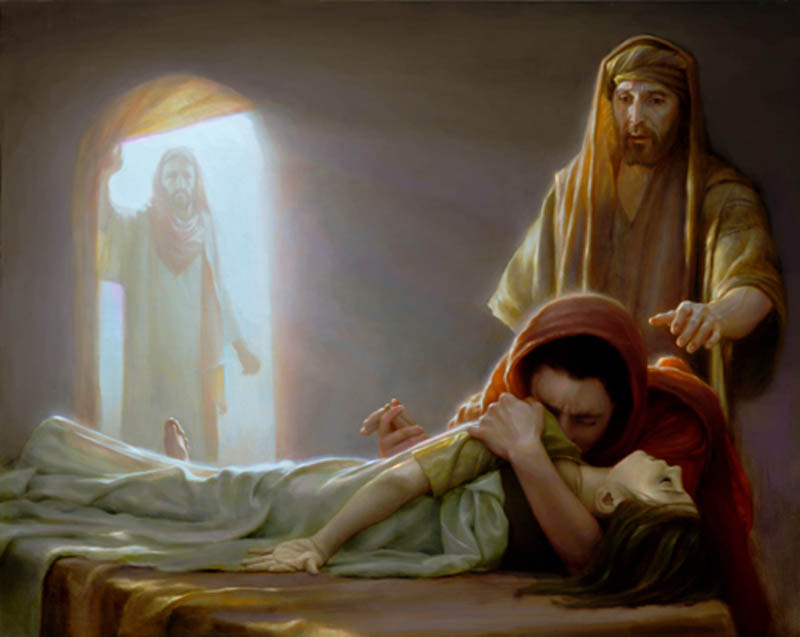
The name of the father in the story we are going to look at today is Jairus. He had quite the rap-sheet: he was a spiritual man being the “ruler of the synagogue.” He was a big cheese among the Jewish community. He possibly heard Jesus speak in the synagogue at Capernaum. But more importantly for this story he was a Dad.

We do not know the name of his daughter, but we do know that she was an only child (“only” cf.Jn.3:16), about 12 years old and was suffering a deadly illness. What do you suppose she saw in her dad? I wonder if she thought of him as being old-fashioned and out-of-touch like many today’s pre-teen daughters? I want to assume that she thought of her dad as a faithful man. What are the marks of a Faithful Father (Follower)?

Faithful fathers [followers] are not ashamed to worship Jesus [Luke 8:40-41]

“There came a man…and falling at Jesus feet.” Jairus approached Jesus during the day while many people were out and about [cf. this is opposite of Nicodemus who comes to Jesus in the middle of the night]. Jairus comes to Jesus because his daughter is sick. It is a hard thing for a father to see their children suffer. He approached Jesus without reservation and fell down at His feet [not out of exhaustion, but begging]. Matthew 9:18 “there came a certain ruler, and worshiped him” Notice: Jairus went himself. He did not send his wife, he didn’t send a servant, rather he went to Jesus Himself.

Oh, that dads would seek Jesus without shame. That they would take their priestly responsibility in the home. That they would seek Him without reservation. That they would seek Him boldly. A faithful father knows he has a faithful God.

Faithful fathers [followers] are not ashamed to invite Jesus to the house [Luke 8:41b-48]

“begged Him to come to his house.” Notice that the event that followed was “as He went,” the entire crowd followed on their way to Jairus’ house. Can you imagine that phone call? “Honey, everyone is coming over to the house.”

Oh, that God would give us Dads who would bring Jesus into the house. Men who would stand with Joshua and declare to the world, “as for me and my house, we will serve the Lord.” Men who would lead their families in prayer, speaking the truth of God’s Word, worshiping and living out their faith.

On the way to heal Jairus’ daughter, Jesus is touched by a woman suffering from a long-lived physical ailment that caused her to be ostracized by her community. According to Leviticus 15, she would have been labeled “unclean” and anyone who would touch her would also be unclean. In the crowd she rushed to Jesus, and believed that if she simply touched Jesus she would be healed. In that moment, Jesus stopped. He draws attention to the woman. She confesses. And Jesus comforts her by saying, “daughter,” (only time Jesus ever uses these words) “it was your faith alone that saved you.”

This parenthesis miracle was a tremendous lesson on faith for both the crowds and Jairus. Not only did Jesus’ healing of this woman stall the situation to heal Jairus’ daughter, but paved the way for His words. Jesus miracle now shifts from public to private. While Jesus was still speaking to the woman a messenger can to Jairus to let him know that his daughter died and not to bother coming home.

Faithful fathers [followers] are not ashamed to put the welfare of their child in the care of Jesus [Luke 8:49-56]

“Do not fear, only believe…” When Jairus received the news that his daughter was dead, he didn’t dismiss the Lord, rather he gave her into Jesus’ care. This reminiscent of Abraham’s willingness to sacrifice Isaac on the altar. Jesus’ response to the father, “Do not be afraid. Only believe.” [Note: aorist imperative tense, literally, act in belief, “trust me,” “hey you, have real faith!”] Jairus completely put his daughter in the hands of God’s care.

Faithful followers of Christ are not afraid. They completely entrust their children to God. Ungodly fears are directly linked to things we are thinking [Proverbs 4:23; Philippians 4:8). Oh that God would give us Dad’s who would commit their children into the hands of Christ.

As I think about being a father, I want to be a worshiper modeling a love for God to my children. I do not want to be ashamed to invite Jesus into our house. He is our special guest, always welcomed and honored. I also want to sacrificially give my children over to the care of their God who is ultimately their Creator and Sustainer.

get off your pedestal

This weekend I graduated from Faith Bible Seminary with a Master of Divinity. Sounds important, eh? No, I am not more divine! It was quiet the accomplishment 6-years in the making. I started taking classes in 2004 at BBS and finish the last 3 years at FSB. I am grateful for the spiritual growth from digging deep into God’s Word. However, the more that I study God’s Word the more I have come to realize and appreciate that there is a whole lot more to know about God and His Word. I have just touched the base of the mountain of God’s glory in His Word. I cannot wait to spend the rest of my life unpacking and applying His Truth to my life.

Now it could be really easy to sit on top of my puny pedestal boasting and bragging about my brains, brawn and bucks. Sure I might have expanded my brain since pre-school with books, papers, and higher education, but that doesn’t give me the right to flex those intellectual muscles [personally, I think they are quite flabby].

What does it mean to brag and boast? To think you are above others in attitude and action. Sure you may have Bucks, Brains or Braun, but compared to whom? Where is the ultimate source of all things? What about boasting in God?

This is a reason why most rap music drives me bananas. Some rap artists would say boasting about yourself is built into rap. It’s common for a rap artist to talk up his skills, his money, or his sexual conquests. Even some Christian rappers jump on the boasting bandwagon. However, there is some radical rap that rocks the name of Christ:

What is a boaster and bragger to do? Turn boasting about your own greatness into boasting about God’s greatness: “Let him who boasts boast in the Lord” [2 Corinthians 10:17]. Paul even went as far as to boast in how weak he was, because he knew God’s strength could fill in for his own failure [2 Corinthians 12:5].

I can’t claim bragging rights about everything I’ve done, am doing, or will do in my life [cf. Philippians 3:1-11]. Any accomplishment I claim must give glory to the God who is the source. Compared to God I see my imperfection and His perfection. Compared to God I see His holiness and my need for forgiveness. Compared to God I can only claim bragging rights about God. As Paul writes in 1 Corinthians 1:29-31: “It is because of [God] that you are in Christ Jesus, who has become for us wisdom from God—that is, our righteousness, holiness and redemption. Therefore, as it is written [in Jeremiah 9:24]: “Let him who boasts boast in the Lord.”

We see in these three short verses that God’s source of any significant spiritual change. “It is because of [God] that you are in Christ Jesus.” God Himself is the means and motivation for our salvation. He has claimed me, He called me, He comforted me, and by the faith “in Christ” He has given me salvation.

Now the Corinthians Paul was writing to were know for their boasting in wisdom. The Corinthians were consumed with wisdom, which they seemed to have equated with their salvation. However, Paul poo-poo’s their pride party by repeatedly emphasizing that Jesus Christ is God’s wisdom. If you love wisdom, you will love Jesus. Why? Because in Christ, God gives us “righteousness, holiness and redemption.”

In those three words [righteousness, holiness, and redemption], God has given us in Christ a reason to boast. First, righteousness is a legal metaphor meaning in Christ believers have been declared innocent of sin. Second, holiness is a religious metaphor meaning that in Christ believers are been set apart like God. Third, redemption is a marketplace metaphor meaning that in Christ He has purchased my freedom from the power of sin.

When I look at all that God has done for me in Christ I am awed. And so should our response be, “Let him who boasts boast in the Lord.” I have nothing to boast about before God, except what God has done for us in Christ. He is the source of all my bucks, brains and brawn. Only God is the omnipotent and omniscient Creator. He is the means, source and end of all things [cf. Romans 11:36].

“Let him who boasts boast about this: that he understands and knows me, that I am the Lord, who exercises kindness, justice and righteousness on earth, for in these I delight,” declares the Lord.” – Jeremiah 9:24

you become what you worship

Part 3 of 3 Why Worship Matters

We are imitators [1 Cor. 11:1]. From the time we are little kids we mimic what our parents say and do, much to their cringing. We reflect [Gen. 1:26, image bearers]. It is a matter of what or who you imitate and reflect. G.K. Beale says in his book, “What you revere you resemble for your ruin or restoration.” You either become like the idols or like God, you either reflect or imitate the Creator or something in creation. We are at worship war every day [Psalm 135:14-18].

Idolatry blurs the line between the Creator and creation, damaging creation [me] and diminishing God’s glory. Isaiah both reveres and reflects God to the nation of Israel amidst the nations idolatry. Idolatry = whatever your heart clings to and relies upon, other than God [What is your security?]. Idolatry is wasted worship.

I remember in college I really wanted to have a new Volkswagen Jetta. It was the hottest car for college students to have. I took one out for a test drive and was enamored. The sound system was pumping and the accelerator had some get up and go. I needed to have one. Need is a very strong word. Three years ago a family member was selling their Jetta and it was in my price range. I bought it. As I drove away I though I was hot stuff. In a matter of months the luster wore off, maintenance became an issue and a new model of the Jetta rolled off the line. Isn’t that how idols works? Idols cover as needs, but when you have it, they wear out quickly.

In Isaiah 6 God gives both a command with consequence concerning what we worship:

Command: “go and tell” [Isaiah 6:8-10]

Within God’s command He gives 3 imperatives—do not perceive, do not understand, render hearts insensitive. He says to tell the people that they will be like the idols they love: dumb, deaf and blind.”

God is judging a nation for centuries of sinful rebellion and Isaiah is chosen to deliver the bad news. His generation was the last straw. God had enough. God is slow to anger, but His patience does run out. Like Hebrew 6:1-3, God’s grace and justice are in the balance. He is gracious [slow to anger] and just [character demands consequences for sinfulness]. Isaiah would see the fulfillment of His people being destroyed. His family, childhood friends, men who sat in the cubical next to him at work would all feel the wrath of God. Can you see the tears well up in Isaiah’s eyes? What if these were your neighbors, kin or co-workers?

Did Isaiah know he would be preaching repentance 50 years to a rebellious people who would ignore His God-given message? Yes. He knew from the beginning he would be speaking to people who would be incapable of accepting correction. He knew God is gracious because His doctrine of God was inspired by God’s forgiveness.

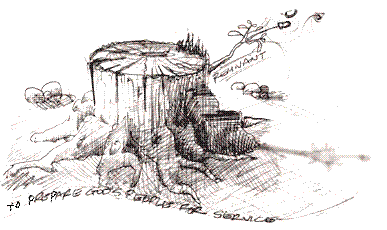
Consequence [vs.11-13]: spiritual stumps

Isaiah asks a heart-filled question, “How Long?” The response is grim, “until there is complete devastation.” The children of God—His chosen people—will be like stumps. In other words, they will be an illustration of a ruined life to the world. Can you think of some so-called followers of Christ who are pictures of a ruined life?

However, in the midst of the smoke and rubble a remnant remains [cf. v.10 “return and be healed”]. God promises restoration no matter how far gone or deep under water His people have become. In the midst of chaos there is always Cosmos. God is a Restorer [Note: in Isaiah 7-9, God promises a Restorer who will come to His people]. Jesus is the Seed that will sprout from the stump and Restore His people through His work on the cross [cf. Isaiah 7:14; 11:1-2; 53].

Making it real: Imagine next Sunday you go to church to attend the worship service and imagine yourself in the throne room of God because He is present. Since He is here how could that affect how the Word penetrates or what comes from your mouth? Who is on the throne in your life? Who rules and calls the shots? How can the characteristics of God give you hope in times of weakness or temptation? What idols are gripping your heart?

Worship is part of our God-given DNA. We are wired [pre-wired] to worship! We were made for God [cf. Roman 11:36]. Worship begins and ends with God. He is the center of our existence. Worship is what God is all about. Worship matters because it matters to God.

Worship matters because God is [alive, authoritative, omnipotent, majestic, revered, holy, and glorious], God is pursuing willing worshipers [STOP, DROP, and ROLL], and what you worship you will become for your ruin or restoration.