never the same: peace child

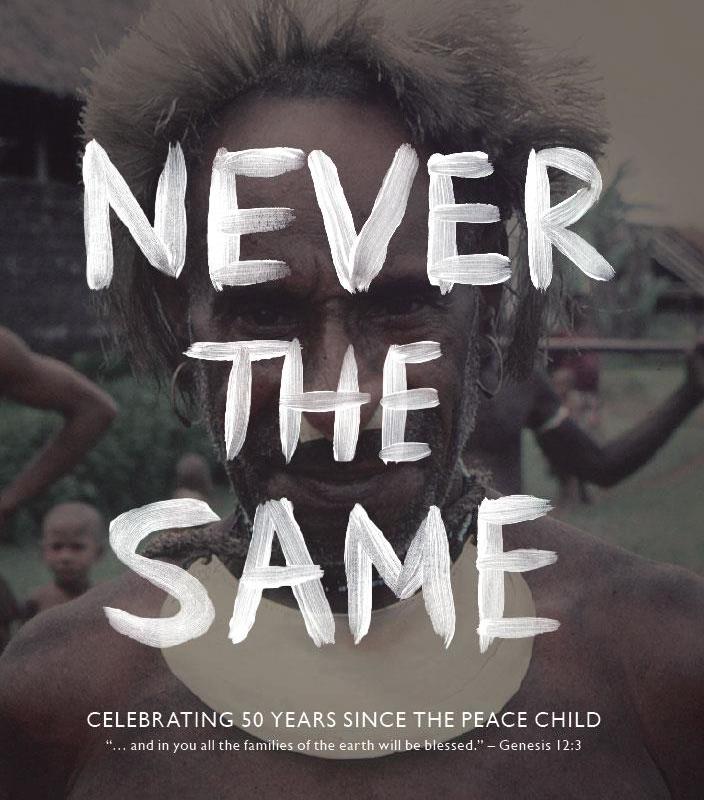
The Sawi were headhunters and cannibals when a young couple named Don and Carol Richardson arrived in their village carrying their seven-month-old boy Steve—and a message that would change the tribe forever. The year was 1962, and Steve—and later, three more children—spent their youth among the Sawi, learning the language and embracing the culture in ways that would shape the rest of their lives. Their story was immortalized in the best-selling book Peace Child and a feature film of the same name, inspiring a new generation to take the gospel to the remaining isolated tribes of the earth.

Fifty years later, Steve, now president of Pioneers-USA, joins his father, Don, and two brothers, Shannon and Paul, to visit the Sawi village where they grew up. What is the state of the church they planted among the Sawi? Are the friends they played with still alive? Did anyone remember the mark their family left on the tribe? Journey with Steve as he travels to the swamps of Papua, Indonesia, to introduce you to the Sawi, and explore the impact of the gospel among a previously unreached people group.

[HT] Preorder a hardcopy of this DVD by clicking here: Preorder Never the Same DVD

a smörgåsbord of Bible memory methods

The benefits of hiding God’s Word into your memory are innumerable. It’s a good cure for spiritual Alzheimer’s. Recently I have been challenged to get back into the daily habit of digesting the Word. It’s proved to be a delicious buffet that I am eager to go back to for seconds, thirds, and much more.One of the most unique and purposeful ways to memorize the Word is this suggested method:

Prepare – survey it, visualise it, see it, carry it

Repeat – read it, say it, write it, hear it, walk it, sing it

Recall – reread and check it, reflect and pray it, use it

Reinforce – trace patterns, know why, learn with others, study it, teach it

Review – forget it, review it

This method was taken from a post by at The Briefing on June 21, 2012. I encourage you to read the full version HERE. If you want more ideas here is a Smörgåsbord of helps for Bible memorization:

  1. App like Memorize Anything or Fighter Verses.
  2. Baa baa doo baa baa and Seeds has a collection of memory verses set to music. Also, check out Sons of Korah and Sovereign Grace’s Psalms.
  3. Nothing will help you more than Scripture memory.
  4. An approach to extended memorization of Scripture.
  5. Becoming Saturated.
  6. Memorize Now.

Do you have any ideas or resources?

Cure for Spiritual Alzheimer’s

My wife frequently praises my memory. That’s coming from one who misplaces items or thoughts daily (and that’s a compliment). What she thinks is a blessing, I often think is a curse. There are things I wish I could forget that are hardwired into the recesses my brain. Now I don’t have photographic memory. That would have been handy for the French exam I had last week. But like most people, I have selective memory. I remember ridiculous things like: sports stats (especially about the Green Bay Packers), song lyrics to bands with big hair from the 80’s, and phone numbers to every house I’ve lived at since I was 4-years old (and that’s a lot of houses).

I dread the day when my memory will decline. As a young child I’d visit my great grandmother who was suffering from Alzheimer’s disease. A once strong and jovial woman was now being spoon-fed from her tender-loving husband whom she had long forgotten. The pain of watching someone you love and care for deteriorate can sometimes be too much to bear.

I am not going to talk about Alzheimer’s today nor am I aiming to offend an elderly crowd. But I do want to talk about a spiritual form of Alzheimer’s that many Christians seem to be suffering.

Problem 1: Forgetting God

Remedy: Repentance

While wandering in the Wilderness, Moses told the children of Israel over and over again, “Whatever you do, do not forget God.” They had the attention span of a toddler. They had the best seats to God’s miracles and were still wishing for slavery in Egypt over the Promised Land.

There is a spiritual Alzheimer’s that sets in when you forget that God made you free but you are still live in bondage to this world. The Lord told the church of Ephesus, “But I have this against you, that you have abandoned the love you had at first. Remember therefore from where you have fallen; repent, and do the works you did at first. If not, I will come to you and remove your lampstand from its place, unless you repent.” (Revelation 2:4-5). This warning comes less than 40-years after the gospel first came to them. How quickly have you forgotten what the Lord has done? The good news is that while there is no cure yet for the disease of Alzheimer’s, the cure for forgetting God is repentance.

Problem 2: Forgetting God’s Word

Remedy: Rehearse it

There is another form of spiritual Alzheimer’s; it’s forgetting the Scripture you just read or heard. James the apostle said, “If anyone is a hearer of the word and not a doer, he is like a man observing his natural face in a mirror; for he observes himself, goes away, and immediately forgets what kind of man he was” (James 1:23–24).

My wife and I are in our 2nd month of French language school at Parole de Vie Bethel. We are learning French in preparation for serve in Chad. One of the aspects I really enjoy about our studies is the requirement to memorize Scripture, yes, in French. I began memorizing Bible verses as a teen after a challenge given by my youth pastor. Later I memorized a section of Psalm 119 each week with my South African friend Cal. Again, I am being reminded of the importance of treasuring God’s Word.

Speaking of Psalm 119, David understood the benefit of memorizing Scripture for the sake of his spiritual health. “How can a young man keep his way pure? By guarding it according to your word. With my whole heart I seek you; let me not wander from your commandments! I have stored (treasured) up your word in my heart, that I might not sin against you.” (Psalm 119:9-11) According to rest of Psalm 119 the Bible helps guard against sin (vs. 9, 11), brings life (25), strengthens (28), produces hope (49), comforts in affliction (50), gives good judgment and knowledge (66), gives understanding (99, 104, 130), gives guidance (105), and peace (165), and more.

Do you believe Word of God is a priceless treasure? You may doubt that you can put Scripture to memory, especially if you are older. If I offered you $1,000 for every verse you memorized in the next week, how many do you think you could memorize? Yet God says of his word in Psalm 19:10-11, “They are more desirable than gold, yes, than much fine gold; sweeter also than honey and the drippings of the honeycomb. Moreover, by them Thy servant is warned; in keeping them there is great reward.” The real value of the Word is far greater than $1,000 a verse. The cure for forgetfulness is to treasure reading the Bible and proactively rehearse it often.

Problem 3: Forgetting your need of God

Remedy: Daily Dependence

God creates you; He knows you have a finite memory. That is why He has given the greatest tool to aid your memory–His Spirit. Jesus said to the disciples in the Upper Room before His death., “But the Helper, the Holy Spirit, whom the Father will send in My name, He will teach you all things and bring to your remembrance all that I have said to you.” (John 14:26; cf. 15:26; 16:14) Do you remember how quickly they forgot it? Soon after Jesus’ death they were back to the boats fishing, and not for men.

One of the greatest joys in the universe is knowing that you are not alone–the God of the universe is your Helper. He is with you forever (John 14:16). And when you read and study Scripture He helping you understand and remember it. The more you read the more He will help you remember. Isn’t that amazing? He uses the Word to give you His peace (John 14:27), His love (John 15:9, 10), and His joy (John 15:11). These are profound truths that comfort and strengthen your hearts and minds in a troubled world.

Proverbs 22:18-19 says: “It will be pleasant if you keep [the words of the wise] within you, that they may be ready on your lips. So that your trust may be in the LORD.” How is your trust? Your confidence? Your peace and joy and assurance? Your faith? Your faith rises or falls to the degree that it feeds hourly on the treasure of God’s truth stored in the heart. The cure for forgetting your need of God is having a joyful dependence each day on His Word for your spiritual sustenance.

Forgetting God, His Word, or you need of Him happens. That why it is important to ask yourself often, “Do I have Spiritual Alzheimer’s?”
How to interpret the Book of Revelation?

The Book of Revelation can be a sticky book to interpret. George Weeber states, “No book in the New Testament—for that matter, in the whole Bible—has so many confusing and radically different interpretations as Revelation.”[1] The prophecies, visions, and unique illusions can lead to many different interpretations.

Scholars and theologians have differed on how to approach Revelation. There are four main views taken to the interpretation of Revelation: preterist approach, historicist approach, idealist approach, and the futurist approach.[2]

The preterist approach

The preterist approach interprets Revelation not as future prophecy, but as a historical collection of events from the 1st Century Roman Empire. Since, Revelation is treated as history,  John is describing people, countries and events of his day. For example, the first beast in Revelation 13 is often interpreted as the Emperor Nero and the second beast as the Emperor Domitian.[3] This view openly ignores Revelation’s own claim to be a prophecy (cf. 1:3; 22:7, 10, 18-19), nor can it account for the Return of Christ (cf. 19:1ff).[4] This preterist approach is common today and is also known as the contemporary approach.[5]

The historicist approach

The view historicist approach interprets Revelation as catalog of church history (or human history) from the days of the Apostles to the present time. This view finds its roots in the Middle Ages and with the Reformers who often characterized the beast in Revelation to the Papacy.[6] The historicist approach  often uses the book of Revelation to describe various historical seasons of persecution or trials in the early church and human history. This approach is subjective and has an allegorical bent on Revelation in order to place the events of prophecy fit into the events of church history. It is a view that no longer holds much ground in the biblical community.

The idealist approach

The idealist approach interprets Revelation not as history or prophecy, but as a symbolic battle between God and Satan and the forces of good and evil.[7] This idealist approaches Revelation as disconnected from reality, prophecy and/or historical events. It views Revelation simply as a book written to encourage suffering saints in the knowledge that God will someday conquer all evil and make things right. Revelation is reduced to a book of myths that teach spiritual truth and “great principles”.[8]

The futurist approach

The futurist approach interprets Revelation chapters 4-22 as a prophetic account of actual future events that are yet to happen (i.e. last days).[9] This interpretation has been the dominant and preferred view among biblical scholars and average readers.[10] This view is a natural result of a straightforward reading of Revelation. In other words, a literary historical grammatical contextual interpretation of Revelation breeds a futurist approach to interpretation.

Each approach may have a bit of truth in them or may raise more questions and doubts related to interpretation, but overall the first three approaches leave a lot of the interpretation of Revelation up to human subjectivity and often lead to allegorization or spiritualization. The safest approach that will really get to the root meaning of John’s prophecy is the futurist approach. The futurist approach is the approach that comes close to treating the interpretation of the Book of Revelation like other books of Scripture. The book of Revelation is an integral part of the Word of God, and we will not be able to explain it’s meaning unless we have the other books of the Bible.[11] Above all, the book of Revelation is to be shared (22:10), for there is a sense of urgency to John’s writing because “the end is near” and Christ is soon returning (22:7, 12, 20).


[1] George G. Weeber. The Consummation of History: A Study of the Book of Revelation. Grace Theological Seminary, Winona Lake, IN. 21.

[2] Merrill Tenney. Interpreting Revelation. Eerdmans Publishing, Grand Rapids MI. 1957. 135-146.

[3] Weeber, 21.

[4] C. Marvin Pate. Four Views on the Book of Revelation. Zondervan Publishers, Grand Rapids, MI. 1998. 17.

[5] D.A. Carson. An Introduction to the New Testament. Zondervan Publishing, Grand Rapids, MI. 2005. 719.

[6] Carson, 720.

[7] Pate, 18.

[8] Willaim Milligan. The Revelation of St. John, 2nd Edition. Macmillian, London, UK. 1887. 153.

[9] John MacArthur. Because the Time is Near. Moody Publishers, Chicago. 2007. 14.

[10] Pate, 18.

[11] Weeber, 26.

How to study the Book of Revelation?

I’ve just begun a study of the Book of Revelation. I am excited to study this most interesting book. Before studying a new book of the Bible I like to remind myself of some helpful tidbits when studying the Bible.

Pray for the Holy Spirit’s guidance.

Prayer is most important. When studying the Bible–including Revelation–you should humbly depend on God to give you wisdom and understanding. It is wise to pray before, during, and after your study, asking God to direct you. It’s a responsibility the Holy Spirit enjoys and takes seriously, “He will guide you into all truth. He will not speak on His own; He will speak only what He hears, and He will tell you what is yet to come” (John 16:13). How wonderful it is to have the interpreter dwelling within you as you read.

Understand the big idea of the book of Revelation.

Determining the meaning of Scripture is a very most important task. God says you must read and study the Bible with care (2 Timothy 2:15). When it comes studying the Book of Revelation it is critical to study verses in their context. Let the text speak for itself. Often, weird interpretations of Revelation are birthed by someone taking one verse out of its context. This is dangerous and a sign of very bad interpretation skills.

When determining the meaning of an entire book of the Bible it is good to have read through the entire book. It is too simple to say that the book of Revelation is about the future, that’s not the main purpose of the book. The main purpose of the book of Revelation is to reveal Jesus Christ. The book begins by stating “The Revelation of Jesus Christ.” To properly study the book of Revelation you must see Jesus as the main character.

Understand the flow of the book of Revelation.

Revelation is divided up into three main veins. Revelation 1:19 describes the divisions as:

(1) Past: “the things which you have seen.”
(2) Present: “the things which are.”
(3) Future: “the things which shall be hereafter.”

Understanding these veins will help you follow the flow of the book of Revelation.

Understand the difference between figurative and literal language.

The Book of Revelation is graphic, but it is not a graphic novel. You do not have to be a literary scholar to know the difference between figurative and literal language. The apostle John describes future things that did not exist when he was writing the book of Revelation. As a result, he described what he saw in terms that were used in his day. When John uses terms such as “like” or “as” he is using symbolic language to to describe what he witnessed. This is common with any prophetic literature. Be careful not to over interpret figurative language, but embrace it’s ambiguity and mystery.

Take scrupulous notes.

You are bound to stubble upon passages in Revelation that will make you scratch your head in wonder or awe. Anything you read that is confusing or meaningful jot it down in a journal. I love to use type notes on my computer and organize them by Scripture reference or theme. It is fascinating to look over previous notes I took and compare them to newer passages I study.

Expect to be blessed.

Revelation 1:3 says, “Blessed are they that read, and they that hear the words of this prophecy, and keep the things that are written therein.” As you study the book of Revelation, and marvel at Jesus Christ and obey what you learn from it, you can expect to be blessed. Revelation is one of the most fascinating books of the Bible. It will certainly stir you to worship Jesus Christ in a powerful and moving way.

preach or heal?

Missionaries are often divided into one of two camps: preachers or healers.

Healers are known for their compassion and love (Col.1:27; Mt.22:36-40; Lk.10:29-37; Js.2:15-16; Lk.12:48; Mt.25:31-46), but they must remember to teach (Mt.28:19-20). They often heal to get to the heart. Preachers are often known as good news messengers (Mt.24:14; Rom.10:14, 17; 1:16b; 1 Cor.9:16; 1 Tim.4:13; 2 Tim.4:2), but they must remember the poor (Mk.14:7a). They often get to the heart to heal. Both are needed; both are called of God; both are on the same mission; both can be one.

Our engagement tactics are largely born out of our bias; preachers engaging with preaching tactics and healers engaging with healing tactics (13).

ONE COMMAND

Was Jesus a preacher or healer? (Lk.4:40-43; Mt. 9:35) He was both. He benefitted the needy as he preached (Mt.10:7-8; Mk.6:7, 12-13; Lk.9:2; 10:1, 9). The apostles in Acts continued to preach and heal. Jesus modeled the preach and heal tactic, He commanded it, and the disciples obeyed Him by using it as they went out (17; cf. Acts 3:6-8, 12-13, 19-20; 4:4, 9-10, 33-35; 5:16, 29-33). Jesus sent out all of His disciples to preach and heal. They were given one command, because the two ministries work together in God’s master strategy.

GO WITH WHAT WE KNOW

We need to leave our identity compartmentalization (or specialization or professionalization) at the door when we do the work of the gospel. You might be a doctor, farmer, engineer,tent-maker, homemaker, or pastor, but don’t let that become your total identity. The disciples were not Jedi Masters, they were fishermen, taxmen, politicians, doctor, and ordinary men commissioned to do something greater than their own identity. They took on a new identity in Christ. The problem with compartmentalization is that we often leave participation in the gospel at the door for the sake of our specialization or profession. As our engagement tactics are largely born out of our bias, our bias is largely born out of our educational background. The disciples all performed services as the Holy Spirit enabled them–not with in those realms for which they had been schooled. The identity of the disciples was being a follower of Jesus Christ.

Preaching and healing is a two-handed plow. Both handles must be held with equal pressure and commitment for the one plow blade to dig deep into the ground and transform the soil into a place best prepared for the seed. A hoe or one-handed tool is much less effective and requires more dependence.

IS STRATEGY A BAD WORD?

Most of Jesus’ disciples traveled widely and planted churches extensively: John Mark (Egypt, Libya, Rome), Peter (Jerusalem, Babylon, and more), Andrew (Georgia, Caspian Sea, Istanbul, Russia, Greece), John the son of Zebedee (Rome, Asia Minor, Ephesus, Turkey), Phillip (Asia Minor, maybe France), Bartholomew (Asia Minor, Armenia), Thomas (India, maybe iraq, Iran and China), Matthew (Palestine, Persia, Macedonia, Syria, Ethiopia), Jude (Armenia, Syria, Persia), Simon (Egypt, North Africa, Syria, Persia, Rome), Matthias (Armenia), and Paul (note:3 missionary journeys).

There are two kinds of people: strategy lovers and strategy leavers. It is always our prayer and expectation that our projects and programs will be hijacked by God and driven in His direction. Making disciples and church establishment are the work of God, not men (Acts 19:20). So strategy is simply a starting place that identifies where we are, where God says to go, and how to make intentional step froward, trusting Him for all the process and everything that we need. We cannot predict or control what God will do. But by positioning apostolic ministers and the peoples of unreached nations together, we do provide a venue for God to do something great (38).

What we see happening in Acts is a people movement towards Christ (i.e. church planting movement) or a multiplication of disciples and churches (cf. Mt.13:33; yeast). Indigenous movements of disciples and churches is not our measure of success; only obedience is. Our objective is indigenous movement of reproducing churches (42).

All strategies include two components: meeting the needs of hurting people, providing daily opportunities for preaching, and positioning the apostolic workers so that God can use His power to bring about a Christward movement (43).

Adapted from Preach and Heal by Charles Fielding

4 benefits of regular intake of the Word through memorization

1. It feeds biblical meditation (Ps.1:1-3; 19:14; Josh.1:8-9). To think deeply about the Truth. To purposefully mull over and over the Truth throughout the day until it grips your heart and changes you within.

2. It flushes the mind of sinful thought patterns (Eph.4:22-24; Rom.12:1-2). The Word encourages us to replace worldly thought with godly ones.

3. It forces our emotions to submit (Ps.42:3-11). Talk to yourself, hear your thoughts, and hear yourself speak of God’s authority.

4.It fortifies the will to choose God’s way (1 Cor.10:13; Ps.119:11; Mt.4:1-11; Eph.2:3; 4:23). We are at war. And the war is within and without. Submit to the victor.

Adapted from Chapter 6 of Counsel One Another by Paul Tautges

Surgery from God’s Word

For the word of God is living and active, sharper than any two-edged sword, piercing to the division of soul and of spirit, of joints and of marrow, and discerning the thoughts and intentions of the heart. (Hebrews 4:12 ESV)

1. It is a divine book (“the Word of God”). God thinks, He has spoken, and it is recorded for you in Scripture (Gen.1, 2, 12, 15, 31; Jn.1:1-14; Heb.1:2; Mt.4:4; 1 Pt.1:19-21).

2. It is a living book (“constantly actively alive”). Because Jesus Christ is the Living Word. (Js.1:21; Jer.15:16; Ps.119:50; Jn.17:17)

3. It is an active book. It is productive; it is the instrument for the production of spiritual results (Is.55:9-11). God never sends His Word without accomplishing something for His glory. It takes time for fruit to become visible, but God’s Word will change lives. You don’t have to ‘doctor’ (manipulate) it up to make it more appealing or relevant (i.e. plastic surgery), just speak it in love and let God do His work.

4. It is a penetrating book (“sharper”). The Word has cutting power (Acts 2:36-38; Phil.1:6; Ps.103:8). His Word is the divine scalpel used by the Divine Surgeon to cut and expose the cancerous sin that must be dealt with in order to gain spiritual health.

5. It is a discerning book (“judge”; cf. Jer.17:10; Ps.119:130; Eph.6:17; 2 Cor.10:4-5).

Adapted from Chapter 6 of Counsel One Another by Paul Tautges

pouring Miracle-Gro on sin

A friend reminded me the other day,

“Moving to another culture is like pouring Miracle-Gro on sin.”

Our family just moved to Quebec and in 8-months we will move again to North Africa. Transition has been our middle name for the past year. Transitions or changes in life can be like pouring Miracle-Gro on sin; sin grows more intense and gives a way to old weeds–you thought were dead–to come back with rabid enticement.

For the last 8-years I’ve lived in the same place, had a stable job, but this month we moved to a new country filled with cultural differences and language barriers. This has caused Sarah and I to uncover dirt about ourselves–until now–-we had been ignoring successfully. Sins like pride, self-reliance, and fear of failure keep popping up like dandelions on what we thought was well manicured Astro Turf.

Normally my sins are like Post-It notes stuck to my back. everyone else can see them but me. In this present season I am seeing my sin and my limitations more clearly. It is here the gospel message shines most brilliantly. Christ gets on eye level, embraces me as His brother, and reminds me that He has taken my punishment (or Post-It notes) upon His back.

How do you handle change?

Change happens. It can be a promotion at work, lay-off, move to a new house, crisis, trauma, stepping into an abnormal situation, or a host of other scenarios. Your response to said situations can determine your vulnerability to sin. The key to handling change is rooting yourself in the character of God.

Do you prepare your heart for times of transition?

Sarah and I have been through enough of these seasons in the past year to understand that we have to be prepare seriously for the next season. We have found that if unprepared our marriage and parenting can quickly become full of gnarly weeds. Small attitudes quickly become ugly, temptations become more tempting, and the Light increasingly is choked out.

Here are some ways Sarah and I have been able to deal with changes and transitions (especially new moves or new cultures) while in the process of pulling out the weeds:

1.    Review the gospel daily.
2.    Write down promises of God that give you hope.
3.    Resolve to obey Christ through the season of change or transition.
4.    Cultivate godly friendships and allow them to ask you the hard questions unexpectedly.
5.    Prepare for the changes and transitions with a band of prayer partners.
6.    Keep communication channels open and confess sin quickly.
7.    Ground yourself in the Word and resting in its Truth.

The LORD is my portion;
I promise to keep your words.
I entreat your favor with all my heart;
be gracious to me according to your promise.
When I think on my ways,
I turn my feet to your testimonies;
I hasten and do not delay
to keep your commandments.
Though the cords of the wicked ensnare me,
I do not forget your law.
At midnight I rise to praise you,
because of your righteous rules.
I am a companion of all who fear you,
of those who keep your precepts.
The earth, O LORD, is full of your steadfast love;
teach me your statutes!
(Psalm 119:57-64 ESV)

challenges to conversion

Conversion is the child produced by the marriage of faith and repentance (43).

In order to fully appreciate the necessity of conversion, we need to understand the depth of man’s sinfulness and the nature of the human heart to live in rebellion against God’s authority and to resist or replace His demand for singular worship.

Challenges to conversion:

1. Willful independence. This is in fact a definition for sin (Is.43:7; 53:6; Gen.2:7-25; 3:8-24). “Sin is first and foremost a rejection of the supremacy of God and His lordship over our lives” (Thomas Schreiner) “Sin is a deification of self and dethronement of God.” (Charles Horne) Sin is self-worship.

2. Selfish cruelty. Man is more inhumane that wild animals because we are about self-exultation although made in the image of God. (i.e. The Brothers Karamazov; Gen.9:6; Js.3:9)

3. Total Depravity. Our autonomous heart is rooted in our depravity (i.e. continually under the influence of sin).

4. Spiritual unresponsiveness. Without Christ we have total inability to save ourselves and left to ourselves sin will rule us to the grave (Rom.5:6; 3:11; Eph.2:1-3; 1 Cor.2:14). Regeneration is the supernatural imparting of spiritual life to the sinners hear by the Holy Spirit alone. (Eph.2:1; Rom.3:10-18; 5:6; Col.2:13)

Adapted from Chapter 3 of Counsel One Another by Paul Tautges

walking like Christ

“Therefore be imitators of God, as beloved children. And walk in love, as Christ loved us and gave himself up for us, a fragrant offering and sacrifice to God.” (Ephesians 5:1-2)

The game Simon Says is a game we play as children. But it is a game that we are never too old to play. The idea of following a leader is ingrained in our core being. We are hardwired to imitate from the womb.

Paul said, “Be imitators of God, as beloved children.” (Ephesians 5:1) What can we learn about imitating from children? Children are natural born imitators. They are masters at mimicking their parent’s. Often children imitate quickly, enthusiastically, and without embarrassment. God loves children, especially His children. Therefore, Paul is challenging adult followers, as a child adopted into the family of God, imitate your Father.

Let’s look at what God says to imitate and copy. This text is especially important for ministry partners, church members, and doing life with other Christians. Read Ephesians 5:1-2. Within these two verses I have three questions and two application:

Q1: What about God are we called to imitate?

We are called to “walk in love” (cf. 3:17-19). That’s our goal. What does it look like to walk in love? “When He had gone out, Jesus said, “Now is the Son of Man glorified, and God is glorified in Him. If God is glorified in Him, God will also glorify Him in Himself, and glorify Him at once. Little children, yet a little while I am with you. You will seek Me, and just as I said to the Jews, so now I also say to you, ‘Where I am going you cannot come.’ A new commandment I give to you, that you love one another: just as I have loved you, you also are to love one another. By this all people will know that you are My disciples (you smell like Christ), if you have love for one another.” (John 13:31-35)

Q2: Who is my model for walking in love?

Jesus. Ephesians 5:2 is God’s list of values. #1 on God’s list of personal values is Jesus. He values Himself. Since He values Himself, He desires His children to walk like Him. The goal of imitating God is Christlike love, “walk in love as Christ loved us and gave Himself up for us.”

Q3: How is the example of Christ a good enough motivation to walk in love?

I asked this question to a group of children this week. Without hesitation a six-year old Eden raised her hand and said with a sweet smile, “God’s love.” In the simple words of a child she was so on target. God’s love is enough. The love God gives His children is demonstrated in the sacrificial love of His Son. Christ’s love—true love—is built on sacrifice.1 He loves sinful people because He has a perfect, sacrificial, and unconditional love [cf. 4:32]. You and I have received that love as beloved children. Being receivers of His love is motivation enough to continue living in His love, “I have been crucified with Christ. It is no longer I who live, but Christ who lives in me. And the life I now live in the flesh I live by faith in the Son of God, who loved me and gave himself for me.” (Galatians 2:20) Bind on your heart this truth: God is my Father and I am His child.

Since it is clear that God values His Son and desires His community of followers to walk like His Son, I have two applications for us as ministry partners:

1. Remember, the way we walk models the gospel.

How we deal with our difference speaks loudly (cf. Ephesians 4:25-32; 5:3-5). Sooner or later what you think about someone in your heart will come out of your mouth. It might be a small jab, behind the back slander, the silent treatment, or an outburst of rage, Usually it starts with a small personality or preferential issue that builds over time until it becomes big and ugly and out of control. Deal with it before before the rash spreads.

4 years I got the the worst case of poison ivy. The problem was, I did not know what it was at first. I thought it was a small bug bite. Within 48-hours a rash covered my body and I was a miserable itchy pussy mess. It was so bad that I wore pajama pants to work for 2-weeks. If I only caught it early, it would not have been bad at all. So it is with differences between ministry partners: deal with it quickly and biblical.

Last year Sarah and I were talking to long time missionaries to Brazil. They openly shared about a season of conflict on their team. They were part of a multicultural team and misunderstanding between one another were common. At one point the differences were so great they considered leaving the team, but were torn because they loved the people to whom they were ministering and did not want to abandon the work. Sadly, their differences were also known by the people. The testimony of the gospel was tarnished by the missionaries conflict.

The team decided rather than splitting ways to deal with the heart of the issue. They gathered together for a meeting. Outside the locals had also gathered around to see what would happen expecting tempers to flare and machetes to fly. The meeting began with prayer, then they read Scripture, confessed their sin to one another, had communion, and in tears embraced one another. The community watched dumbfounded.

Fast forward 20 years. The missionaries stayed the course and a church is planted. The church has hundreds of members and strong leadership. Time comes the new church an issue between its own leaders. A certain sect of the church is committed to leave the church. Tempers are flared and machetes are ready to fly. Until one leader stepped in and said, “Do you remember that evening 20-years ago, when we gathered around the missionaries meeting and we saw the pray, read Scripture, have communion, weep and reconcile?” So God desires to use our differences for unity and the glory of the gospel.

2. Let us encourage one another to value Christ supremely more than anything.

He is the treasure of our church. He is the One we adore. He is our goal for missions. It is His fame we desire to spread. Together let us make Him great. Even greater than ourselves and the things we value that are lesser than Him. He is supreme. He is the value we hold high.

thumb licks [9.27.12]

So you still think God is a merciful God?

Life’s little mysteries. I always wanted to know that!

10 Commandments for flying.

When God pulls the rug out.

Throw the ball like a girl.

What will Disney think of next? Their creativity reminds me of Someone else!

Some things to think about before you criticize your pastor.

3-2-1 how the Trinity teaches us the gospel:

a short story of the gospel

1. Where sin came from.

Holy creator God. Righteous Judge. He created angels (including Satan). Satan was prideful and wanted to be god (Is.14:13-14), but instead became and enemy of God and was cast from heaven.

2. How we became the children of Satan.

God created heavens and earth and mankind. Adam and Eve were tempted by Satan in the garden to eat the fruit to be as wise as God. A lie. They bit the fruit. God cast them from the garden and were accursed and not allowed to come into His perfect heaven (Rom.6:23; 3:23). They obeyed Satan’s voice rather than God’s.

3. How God adopted us into salvation.

God came to earth in the form of a man. His names was Jesus.He came to live a perfect life and die as the sacrifice for sin. After He died He resurrected from the grave and ascended into heaven conquering sin and defeating death. Jesus brought eternal life to all who believe on Him and follow Him (John 3:16; Mt.28:19-20; 11:28-30). You receive His Holy Spirit and become a new creation.

4. What will happen when Jesus returns.

He will come back as judge. Until He returns we must be a part of His church, be willing to suffer for His name, and live as His child.

Adapted from Preach and Heal by Charles Fielding (Appendix E)

Oh, that I would decide to give thanks

by kylie j lloyd

“Thankfulness is the attitude that perfectly displaces my sinful tendency to complain and thereby release [God’s] joy and blessing into my life.” (James MacDonald, Lord Change My Attitude, p.45)

It is easy to shift from being thankful to being unthankful. For me, it only takes a moment. I’ve already caught myself saying, “I am tired of speaking in French today. I can’t even order the right thing at the restaurant. Am I ever going to see my wife and kids? It’s cold outside already? What? No appliances are provided from my friends new apartment! That’s bogus.”

But then God used a verse of a song written a few thousand years ago. Psalm 107:1, “Oh, that men would give thanks to the LORD for His goodness.” (cf. vs. 8, 15, 21, 31) God, like a master chef, using this verse to tenderize my heart with 3 important truths:

1) Thankfulness is a decision: “Oh, that men would give thanks…”

Notice that the psalmist did not say, “COULD”. What difference would it make if it said could? “Could” makes being thankful contingent on my ability, “I could if be thankful if my situation were better.” Would is a word used to agree or be okay or to be willing to comply. No matter my day, circumstance, or influences from people around me, I have the capability to be thankful. I have the responsibility to be thankful. I must decide to be thankful.

I remember the year after college I visited a friend in Ukraine. He took me to a small town where we popped in on a Sekret family to encourage them. I remember being greeted at the door by the Alexander and wife and their 7 children. Their home was a 1-bedroom shack that was cold and smelled musty. Immediately the husband excused himself and left the premises for about 10 minutes. When he came back, his wife excused herself and they were doing something in the kitchen for about 10 minutes. Meanwhile I was sitting on a wooden chair looking at the 7 children staring at me. Neither of us could speak each other’s language. After minutes of awkward silence Alexander and his wife entered with bread, spicy mustard, Russian sausage, cooked cabbage, and beets. They asked me to come to the table. I stood by a bed near the cramped table and Alexander prayed, I don’t remember much Ukrainian, but I do remember, “Slava Bog, doosha smachna” (meaning: Praise God for this food…) My friend told me after we left that the style of meal they made for us was equivalent to our Thanksgiving. I will never forget the spirit of thankfulness in the eyes of the Sekret family.

Why are we not more thankful? Could it be we are use to having so much? Emerson once said, “If the stars would come out only once a year, everyone would stay up all night to behold them.”

B.B. Warfield said,

“We are frequently told, indeed, that the great danger of (Christians) lies precisely in his constant contact with divine things. They may come to seem common to him, because they are customary. As the average man breathes the air and basks in the sunshine without ever a thought that it is God in His goodness who makes the sun to rise on him. Other men, oppressed by the hard conditions of life, sunk in the daily struggle for bread perhaps, distracted at any rate by the dreadful drag of the worlds work, find it hard to get time and opportunity so much as to pause and consider whether there be such a God, and religion, and salvation from the sin that compasses them about and holds them captive. The very atmosphere of your life is these things; you breathe them in at every pore; they surround you, encompass you, and press in upon you from every side. It is all in danger of becoming common to you! God forgive you, you are in danger of becoming weary of God!”

2) Thankfulness is a decision based on divine reality: “give thanks to the Lord for His goodness.”

“I will give thanks to the LORD because of his righteousness and will sing praise to the name of the LORD Most High.” (Psalm 7:17) “We give thanks to you, O God, we give thanks, for Your Name is near; men tell of Your wonderful deeds.” (75:1) Praise the LORD. Give thanks to the LORD, for He is good; His love endures forever.” (106:1)

Giving thanks is a decision based on Divine Reality. When I consider the character of God and believe He is true and acknowledge His ways are good, my perspective of the situation is different than the worlds. If you’ve read Robinson Crusoe you see how his perspective changes as He reads about the God of the Bible. His demeanor says, “I have been on this deserted island for 28 years…but it is beautiful. I am sick of these coconuts…at least it’s food! I am all alone…but at least I don’t have to worry about traffic or lines or loud neighbors.”

3) Thankfulness is a life-changing decision: “Oh…”

“Oh” is a word that comes “from the gut.” It’s a word you say when you really want to express deep emotion. Let’s say it together, Oh!” Say it like you mean it.

Moses said, “I will proclaim the name of the LORD. Oh, praise the greatness of our God!” (Deut. 32:3)
Isaiah said, “Oh, look upon us, we pray, for we are all Your people.” (64:9)
David sang, “Oh, how I love Your law! I meditate on it all day long.” Psalm 119:97
Job said, “Oh, how I wish that God would speak,” (11:5)
Elisha prayed, “Oh, my lord, what shall we do?” the servant asked.” (2 Kings 6:15)

I desire Psalm 107:1 and Psalm 105:1 be my prayer,“Oh give thanks to the Lord; call upon His name; make known His deeds among the peoples” Oh, that I be thankful for Your Word. Oh, that I be thankful for my salvation. Oh, that I be  thankful for Your provisions. And make it known to all how good You are.