opulence, philanthropy, and giving

Image from Forbes.com

In the photo above you have a gathering of $126 billion dollars. It is probably the single richest gather in modern history. These men and women have given money and time to make the world a better place. These peoples lives are marked by giving rather than receiving.

It is indeed honorable what these billionaires have done with their pocket books. You truly see what one values by the way they spend their money and time. These billionaires have set a high standard for those of us who have less to consider.

As I pursued Forbes 400 Summit articles a few questions teetered in mind: Is he who give the most always the most honored? What about the little old lady who lives below the poverty line that gives kisses and cookies to cheer children? Is giving money the most helpful solution to the worlds issues? What does money buy? What is the definition of “better” in making the world a better place?

When I consider the most opulent Giver of all time, he was not rich with monetary wealth, he did not own a large corporate empire, he was not well liked even by religious persons. Rather, he lived a frugal life, the son of two teenage parents. His hands were calloused from carpentry. He did draw crowds and heal many sick. He did make outrageous claims, like, being God and the universe was his inheritance. He was considered a criminal and blasphemer. Ultimately he sacrificed his life, ending it in public humiliation, giving it up for the sake of the name and glory of His Father’s.

His name: Jesus. Without his divinely foreordained gift to humanity, no one in the world would have enough brains, bucks or brawn to conger up a better solution to the problems created by sin. His gift of forgiveness and reconciliation is free for all who believe. It won’t cost you 99% of your accumulated wealth, but it might just cost you to die to yourself.

I am not sure I’d ever see Jesus picture or name mentioned in Forbes, but I will surely hear and see Him worshiped throughout eternity.

thumb licks [9.11.12]

Why should I give it my all to teach a small Sunday School class or clean the church toilets?

Are you attracted to legalism?

How the government spends its money.

The gospel impacts your parenting.

Love is stupid.

I want this new VW bus!

Why disabilities?

Not your average Youth Group.

Top 10 blogs for women.

Worlds Greatest Drag Race

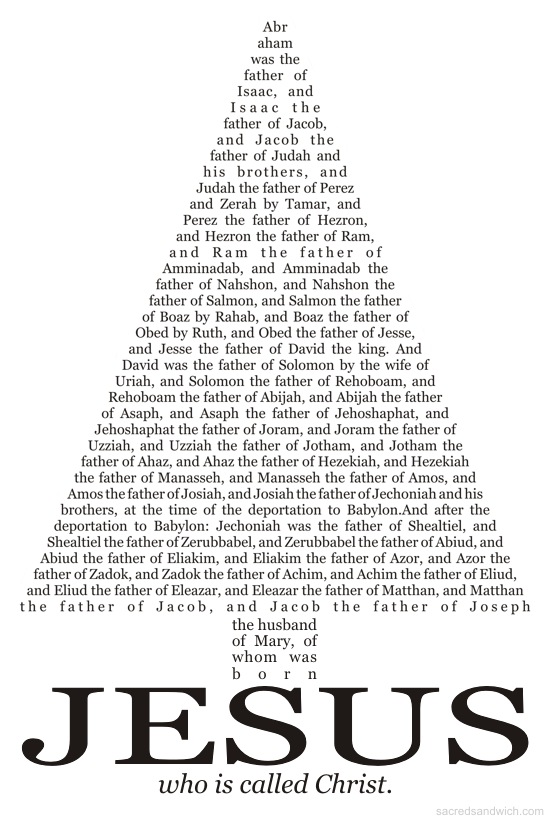
Will Jesus’ grandpa please stand up?

Dealing with the problem in the genealogies of Matthew 1:16 and Luke 3:23

It is clear from the Bible, Jesus was supernaturally conceived by the Holy Spirit (Luke 1:34ff) and His earthly, legal father was Joseph. However, sometimes you come across a sticky question from within the Bible where an apparent contradiction appears that there doesn’t seem to have an immediate answer in the text or context. One such sticky question is, who really was Jesus’ grandpa? Heli or Jacob?

Both Matthew 1 and Luke 3 contain genealogies of Jesus. But there is one problem—they are different. Luke’s genealogy starts at Adam and goes to David. Matthew’s genealogy starts at Abraham and goes to David. When the genealogies arrive at David, they split with David’s sons: Nathan (Mary’s side of the family tree) and Solomon (Joseph’s side of the family tree). And the point of contention for some is when Luke says that Joseph is the son of Heli (3:23), while Matthew says that he was the son of Jacob (1:16).

How do you reconcile the two genealogies? Who is right? Is the Bible wrong? How do we handle contradictions in the Bible? What do you say to skeptics who point out contradictions like this and say, “See, here is another reason why we cannot trust the Bible. Christianity is a farce.” We will seek to tackle these questions as we look at the two texts from the gospels of Luke and Matthew.

Why Are Matthew and Luke so Different?

When you compare Matthew’s genealogy with Luke’s between David and Jesus, are they almost completely different. First, for example, all the names but two are different (Shealtiel and Zerubbabel). How are these differences to be explained? The differences between these lists stem from the purposes for which the gospels were compiled and the meanings they were intended to convey to their audience.

Second, Matthew places his genealogy at the very beginning of his Gospel (1:1–17), Luke placed his genealogy between the accounts of Jesus’ baptism and temptation. There is OT precedent for this in Moses’ genealogy (Exodus 6:14–25), which is not recorded at the beginning of His life but just before He started His ministry.

Luke doesn’t stop with Adam but goes on to say that Adam was son of God. Luke does not want his readers to think of Jesus as the Son of God in the same sense that Abraham and David and all the other descendants of Adam were. Luke 1:35 shows that His sonship depends on His unique creation in Mary’s womb by the Holy Spirit. This then calls to mind Paul’s teaching that Christ is a second Adam, the beginner of a new humanity. Paul says,

“The first man was from the earth, a man of dust; the second man is from heaven. As was the man of dust, so are those who are of the dust; and as is the man of heaven, so are those who are of heaven. Just as we have borne the image of the man of dust, we shall also bear the image of the man of heaven.” (1 Corinthians 15:47–49)

Luke was not ignorant of this idea since he was a companion with Paul. Therefore, like Adam, Jesus was man and uniquely created by God. He is a new and second Adam whose ministry will be to create and assemble a new race of humans who are not marked by Jewishness or Gentileness, but by the character of the Holy Spirit.

Third, Luke’s list is a lot longer than Matthew’s. Luke’s genealogy goes back to Adam while Matthew’s stops at Abraham. Why is Luke’s genealogy longer? It might seem that there is some genealogy rivalry going on that Luke has to out do Matthew. It’s plausible, but just silly.

To understand why Matthew only goes to Abraham and Luke goes beyond to Adam, you have to know each gospel writers audience. Matthew is writing for Jews who are interested in Jesus’ connection with father Abraham, but Luke is writing for Gentiles and is more interested in Jesus’ solidarity with all humanity through His descent from Adam. And this runs parallel to Jesus message of coming to bring the gospel to all men. Jesus is not just a son of Abraham—more importantly He is a son of Adam—He is a man. His humanity, not his Jewish ethnicity, is the crucial thing. And that seems to be Luke’s point in connecting Jesus to Adam.

Fourth, the most contested difference between Matthew and Luke is that Luke says that Jesus’ earthly father Joseph is the son of Heli (3:23), while Matthew says that he was the son of Jacob (1:16). There are suggested solutions for this assumed contradiction:

First suggestion: The gospel of Matthew,

“gives the legal descendants of David—the men who would have been legally the heir to the Davidic throne if that throne had continued—while Luke gives the descendants of David in that particular time to which finally Joseph, the husband of Mary, belonged”.[1]

So, for example, Luke says in 3:31 that the son of David was Nathan (2 Samuel 5:14), while Matthew in 1:6 says the son of David was Solomon, who was heir to the throne. The two lines could easily merge whenever one of Nathan’s descendants became the rightful heir to the throne. According to J. Gresham Machen,

“The Lucan genealogy, in other words, starts with the question, ‘Who was Joseph’s “father”?’ the answer to that question is, ‘Heli.’ . . . In the Matthean genealogy, on the other hand, we start with the question, ‘Who was the heir to David’s throne?’ The answer is, “Solomon,’ and so on down to Joseph.”[2]

Jesus’ family tree in Matthew is meant to establish that He was legally a descendant of David (cf. 1:27, 32, 69) through His relationship to Joseph, and also to demonstrate that He was a member of the human race. It is not meant to show that Jesus was the Son of God by descent from Adam, since that would be true of all descendants of Adam.

Luke’s family tree compared to Luke’s is in reverse order, and it goes back beyond Abraham to Adam, and thus places Jesus in a wider context than does Matthew.

“Many have suggested that the regressive order in the genealogy is probably Luke’s instrument to focus attention on Jesus. The fact that Luke traced Jesus’ ancestry back to Adam, “the son of God,” was probably due to the fact that he wrote for Romans and Greeks. By tracing Jesus’ ancestry back to Adam, he shows Jesus to be related to the whole human race. In Luke’s genealogy Jesus and Adam are both “sons of God”; Jesus, of course, is the son of God by nature; Adam, the son of God by having been created in God’s image. Jesus is a member of the race to which all people belong.”[3]

Second suggestion: Luke gives Mary’s genealogy and Matthew gives Joseph’s as Jesus’ legal father. The key to this interpretation is extending the parenthesis of verse 23 to include Joseph. So it would read, “Jesus was about 30 years old, being the son (as was supposed of Joseph) of Heli.” By including “of Joseph” in the parenthesis the point is made that Jesus is really the son of Mary, not Joseph, and Heli is his grandfather (Mary’s father). D.A. Carson says,

Both lists give the descent of Jesus through his supposed father Joseph (so it was thought; 23). The theory that Luke really gives us the family tree of Mary rather than of Joseph is improbable. The theory with least difficulties is that Matthew gives the descendants of David down the royal line (i.e. who was heir to the throne at any given time), but Luke gives the particular line to which Joseph belonged. Even so there are still problems, and in the absence of fuller information the problems of explanation and harmonization with Matthew remain insoluble.[4]

There are a few other suggestions,[5] and both of these solutions are possible; the first is more probable; but neither can be completely proven. It is beyond human reach to discover for certain the full solution to the differences between Matthew and Luke’s genealogies of Jesus, or the actual relationship of Jesus to them. Enough has been said to show that they are reconcilable, and the purposes of each, suggested here, indicate that either of the ways outlined above does full justice to the Davidic descent of Jesus, as rightful heir to His ancestor’s covenanted throne, and also to His virgin birth by Mary.

Why is it so important to dig into such questions like this related to the family tree of Jesus? Perhaps the best lesson one can gather from  sticky questions is simply that apparent contradictions in the Bible do have plausible and possible solutions and we should be slow to throw out a book that has proved itself over and over for thousands of years as the mighty, saving, transforming word of God.


[1] J. Gresham Machen, The Virgin Birth of Christ, New York: Harper Brothers, 1930, 204

[2] Ibid. 207

[3] Walter A. Elwell and Philip Wesley Comfort, Tyndale Bible Dictionary, Tyndale reference library (Wheaton, Ill.: Tyndale House Publishers, 2001), 520-21.

[4] D. A. Carson, New Bible Commentary : 21st Century Edition, 4th ed. (Leicester, England; Downers Grove, Ill., USA: Inter-Varsity Press, 1994), Lk 3:23–38.

[5] I.e., Luke followed the Davidic line through Nathan (cf. Zech 12:12–13), whereas Matthew (cf. 1 Chr 1–3) followed the line through Solomon. The Matthean genealogy thus gives the legal line of descent from David, whereas the Lukan genealogy gives the actual physical line of descent. Or both Jacob and Heli were in some sense Jesus’ grandfathers. Variations of this explanation include: (a) Jacob (Matt 1:16) and Heli (Luke 3:23) were brothers, and upon Jacob’s death Heli assumed the role of husband via a Levirate marriage (cf. Deut 25:5–10) and fathered Joseph. Heli was thus Joseph’s natural father, whereas Jacob was the legal father. According to Eusebius (Eccl. Hist. 1.7.1–15), Julius Africanus (ca. 225) claimed that he knew this from information that came from the descendants of James, the brother of Jesus. However, whereas the father of Joseph and Heli for both Matthew and Luke was Matthat/ Matthan, the father of Matthan in Matthew is Eleazar, while in Luke, it was Levi. (See R. E. Brown, The Birth of the Messiah [Garden City: Doubleday, 1979], 503–04.) (b) Matthew’s genealogy was that of Joseph, whereas Luke’s genealogy was that of Mary. This depends upon how one reads “so it was thought, of Joseph” (Luke 3:23). The phrase can be interpreted in two ways: “Jesus was the son (supposedly) of Joseph, who was the son of Matthat” or “Jesus was the son (supposedly of Joseph but really) of Matthat,” who is then identified as the father of Mary. The major problem with this explanation is that in 1:27 Jesus’ Davidic descent via Joseph is stressed. (c) Heli was Mary’s father, but due to lack of a male heir, he adopted Joseph as his son in order to maintain the family line. Thus the Matthean genealogy was Joseph’s actual lineage, whereas the Lukan genealogy was his adopted lineage. This latter explanation lacks any evidence and can neither be proven nor disproven.

thumb licks [9.3.12]

Is Proverbs 22:6 a guarantee?

How the 50 States got their names.

Ministry: it’s not about you.

Sin wants to be your friend.

If snack labels told the truth.

Somethings we can learn from suffering.

10 happiest jobs. I knew it!

What is a Sikh?

Why is love so stupid?

Warsaw remembering the Holocaust:

running the wrong way

Ouch. How embarrassing? I am certain Andre Parker won’t make that mistake twice. Or he could risk being cut from the team.

In reality, all of us are like Andre Parker. Instead of a football field it is life. We are born from the womb running the wrong way. We don’t think anything of it because running the wrong way is our norm. By definition sin is running the wrong way. In fact, it is running the opposite way of God. It’s not that are coachless or are left to living without a playbook. God sent His Son into the world to be an example of running the right way. It is only when we repent of our way, have faith in Him, and submit to His way that we can begin running the right way. Hear the call of Christ and turn around.

7 year mission

It was 7 years before William Carey baptized his first convert in India; it was 7 years before Judson won his first disciple in Burma; Morrison toiled 7 years before the first Chinaman was brought to Christ; Moffat declares that he waited 7 years to see the first evident moving of the Holy Spirit upon his Bechuanas of Africa; Henry Richards wrought 7 years on the Congo before the first convert was gained at Banza Manteka. – A.J. Gordon, The Holy Spirit in Missions, pp.139-140

daily responding to the gospel

If there is no invitation to respond to the gospel by living in the light of it each day it is no gospel.

If you do not daily respond to the gospel it is wasted.

The gospel is not a collectors item or trophy your keep on the shelf or in storage to remind you of an event past. It is the classic car you drive. It is the little league game you relive every day. There are no such thing as glory days or good old days when it comes to the gospel. It’s everyday.

As Jerry Bridges says, “Preach the gospel to yourself daily.”

those who are given Grace give no excuses good enough to keep sinning

“What shall we say then? Are we to continue in sin that grace may abound? By no means! How can we who died to sin still live in it?” (Romans 6:1-2 ESV)

Grace gives no excuses to sin. If you give excuses for sinning after you’ve been given grace you do not completely understand grace. You don’t understand the grossness of sin. You don’t understand the glory of Christ.

Sin might look cute in kids. Sin might be expected in teens. Sin might be hidden by crafty adults. But that gives not excuse to sin. That only abuses grace.

thumb licks [8.22.12]

10 Tips on Solving Mysterious Bible Passages from Sherlock Holmes.

How to make the most of your mornings.

Glass Beach: a story of how God uses trash.

How reading literature can aid your worship.

How should your church respond to tragedy?

How to fold fitted sheets. I’ve always wanted to know this.

How to pray for your pastor.

Is it true Jesus never said anything about same sex marriage?

Lessons from the brain surgeon’s office: looking out the window at the top of my head.

Quick history of Mormonism:

grace offends us

“The law offends us because it tells us what to do; grace offends us even more because it tells us we can’t do anything!” – Pastor Tullian Tchividjian

Quoted while preaching through Galatians in a sermon series entitled Free at Last.

the God who knows it all

Have you ever been called a “know-it-all”? If so, it’s usually not a compliment. When someone calls you a “know-it-all,” they are sarcastically saying, “You don’t know as much as you think you do and I hope soon realize how little you actually know!” Ouch.

Does anyone really know it all? Yes, in fact there is One: God. God knows it all. His knowledge is instantaneous, total, and completely retentive. God knows what He knows without any kind of research, education, or strenuous study. He never had to go to school, take a test, or be informed about anything. You will never surprise Him with some new fact or beat Him at Trivia Pursuit. You can never tell God something He doesn’t already know; He knows it all. He knows when a sparrow dies, and He knows the number of the hairs on your head (Matthew 10:29–30). Even the number of hairs I am losing by the minute! In short, He is omniscient. His knowledge is eternal and infinite.

“Oh, the depth of the riches and wisdom and knowledge of God! How unsearchable are his judgments and how inscrutable his ways! “For who has known the mind of the Lord, or who has been his counselor?” “Or who has given a gift to him that he might be repaid?” For from him and through him and to him are all things. To him be glory forever. Amen.” (Romans 11:33-36′ cf. Psalm 139:17-18)

He knows you, even better than you know yourself.

David is king over all of Israel. Every person in his kingdom knows him as king. Although he is king, he doesn’t know everyone in his kingdom personally. However, He does know and honor the One who does know all and He knows David. He is God and He is King of kings.

In Psalm 139, David composes a song that grapples with God’s omniscience. He brings God—who many want to put at a distance—close to home. God’s knowledge of you is personal as it gets. To David, God’s omniscience is not just theological or philosophical—it’s relational and personal. Notice the personal pronouns: “Lord, you have searched me and known me. You know my sitting down and my rising up. You understand my thought afar off” (vs.1–2).

God knows your thoughts even before you think them (vs.3-4). God knows what you really believe about Him, not just what you say about Him. He knows where you stand. He knows your real opinions. He knows your motives. He knows your heart (2 Chronicles 6:30). He knows the real you.

He knows you better than you know yourself. He can see your blind spots; sins of which you are unaware (v.3, 24), or for which you make excuses. Proverbs teaches that God’s knowledge is personal: “All the ways of a man are clean in his own sight, but the Lord weighs the motives” (16:2); “Every man’s way is right in his own eyes, but the Lord weighs the hearts” (21:2). There is also a positive aspect to God’s omniscience: God also sees and approves of your service, even if no one else notices (Hebrews 6:10).

You will never know-it-all, but that is reason to worship.

Do you mind God knowing everything about you? Or do you feel that’s awfully intrusive? When David says “Search me, O God, and know my heart” (Psalm 139:23), it’s a prayer inviting God to know more (even though that’s not possible). That’s a humble and vulnerable prayer. It’s giving Him the key to your darkest parts and inner chambers of your heart.

You might be intelligent. You might be a 4.0 student and aced your SAT. You might be a Ken Jennings and be the best at Jeopardy. The world might label you a genius and honor you with the Noble Prize, but compared with God, you know nothing. Your knowledge is never comprehensive. Nor do you know what is best for your own sake. Ask God to show you the truth about yourself so that He might make you wise (Psalm 139:23–24).

When trying to wrap my brain around God’s omniscience—and all His divine attributes—it it easy to blow a fuse. God’s ability transcends my reality, therefore, it’s best to just bow to His immensity. God is always greater than my present knowledge of Him. If God were small enough for my brains, He wouldn’t be big enough for my needs (cf. Matthew 6:8, 32).

God indeed “knows it all.” By His very nature, without having to learn anything, He already knows everything—past, present, and future. My response to His knowledge: worship and adoration,

“Such knowledge is too wonderful for me; it is high; I cannot attain it.” (Psalm 139:6)

“How precious to me are your thoughts, O God! How vast is the sum of them! If I would count them, they are more than the sand. I awake, and I am still with you.” (Psalm 139:17-18)

clean

Clean.
Clean.
How beautiful. How free.
Jesus Christ dying on a tree.
Lonely. Lowly. Clean.
Red blood dripping. Purity.
Soldiers spitting mockingly.
Black sky darkening soberly.
Death of purity.
Blood. Water.
Clean.
Hear the women crying.
Thunder – paralyzing.
Death purifying.
Washing me
clean.

Poem by my wife Sarah

the God who is sleepless in Seattle

On Sunday afternoon I took a nap. I was not alone. My wife and two daughters also were tuckered out and took naps too. Sunday afternoon naps are almost traditions in our home. Some cultures have built-in siestas to rest midday. Scientists say I am asleep one-third of my our life.

God was the first Person to rest.

When God created the world He worked six-days and rested on the seventh. He rested not because He was tired or needed a day off to get His other work done, but set an example to His creation that would need rest. We humans are weak and need rest.

If it was up to mankind we would sleep less and work or play more. That’s why we say, “There are only 24 hours in a day.” But God knew our temptation would steer us into the direction of being either a workaholic or sloth, both being a distraction from true rest.

When God gave the Law to Moses, the fourth of the Ten Commandments said, “Remember the Sabbath day and keep it Holy.” Sabbath means rest. God knows we need a day of rest and refocus. Sometimes we think we might miss out on something in life if we do not cram-pack every minute of every day with something. Yet we can miss out on life itself if we do not obey this command.

Jesus confronted the religious leaders of His day about this very thing (Mark 2:27 “The Sabbath was made for man, not man for the Sabbath.”). They were so OCD about not working on the Sabbath that they wrote a ‘book of rules’ to protect themselves from disobeying the law, all the while they were missing the real purpose of the Sabbath: to worship God. We are over worked and under-worshipped. God created rest for worship.

Idols sleep, but God does not sleep.

In 1 Kings 18, there is a famous duel between the Prophet Elijah and hundreds of prophets of Baal. Elijah challenges the prophets to build an altar and call to their god to bring down fire upon the altar. The God who answers is God. Elijah urges the prophets of Baal to go first. They eagerly accept and spend all day trying to coerce their god into action. Nothing happens. Elijah cannot rest a poke: “Cry aloud: for he is a god; either he meditating, or he is pursuing, or he is away on a journey, or he is sleeping, and must be awakened.” When the prophets of Baal had given up Elijah stepped up to the altar, ordered it to be drenched with water, and then called to God prayerfully. Immediately God rocketed down flames of fire that utterly consumed the altar. The God of Israel reigned that day as the One True and Living God.

The idol Baal was asleep. Sooner or later the idols men create begin to mimic the men who created them; asleep. What’s the cure? Wake up and worship the One True and Living God. He has characteristics like men because men are made in His image. Yet He is not like men. Men are to be like Him.

God does not sleep. When the Scripture that God does not sleep it refers to His unceasing care for His people (Ps. 121:4). He does not grow weary or tired of passionately pursuing their hearts so that His people respond in faith (Isa. 40:28; 7:13; Mal. 2:17).

Jesus got tired and slept, but He was still sovereign.

Jesus was human. Therefore He was subject to human weaknesses like hunger (Mt. 4:2), thirst (John 4:7; 19:28), pain (1 Pt. 4:1), and weariness (John 4:6). When Jesus got tired He slept.

In Mark 4:35-41, Jesus and His discipled crawled into a boat after a long day of ministry. Jesus quickly found a spot to curl up and take a snooze. While crossing the Sea of Galilee a storm arose abruptly, which was common for this body of water, and their boat was being swamped by waves. The disciples were freaking out and could not understand why or how Jesus could be asleep.

I once was on a plane flying over the Sahara Desert at night. The plane was experiencing a lot of turbulence. Items were falling off tray tables and the stewardesses had worried faces. Across the aisle a man sound asleep like a baby being rocked by a giant 747. My stomach was in knots and I wondered, “How could this man be asleep?”

The disciples woke Jesus up and said, “Don’t you care? We’re going to die!” (4:39) Jesus did not say a word. What He did next did not need words. He immediately calmed the storm. Not only did it silence the wind and waves, but Jesus’ authoritative control over nature silenced the disciples. Though Jesus was sleeping in the torrent He still was sovereign over the storm.

There is a valuable truth to remember about God. Even when He seems to be resting or sleeping on the job, He is still in control of the world and your life. He never peters out. His tank does not get low on gas. He is not sleepless in Seattle, Singapore, Seoul, Sydney, Sudan or Sri Lanka. He does not rest from His sovereign work. He is always awake and alert to the affair of the universe and the actions on mankind.

After Jesus calmed the Sea He said to the disciples,“Why are you so afraid? Have you still no faith?” (4:40) At the moment they went from freaking from swallowing too of water in the storm to a holy fear because they were in the presence of the Son of God. When they could talk again they said to one another, “Who then is this, that even the wind and the sea obey Him?”

If you fear, fear the One True and Living God. Knowing that He never sleeps or slumbers, but is sovereign over all situations should bolster your faith.

who?

Who?
Who made the flowers white – more white than morning snow?
Who made the sound of water and the fireflies to glow?
Who put the brightness in the sun and made the moon to shine?
Who put the faith that saved my soul into this heart of mine?
Who shakes the mountains? Who quiets the seas?
Who whispers tales to tall, shivering trees?
It is my Jesus – strong and meek.
The One who washed disciples feet.

Poem by my wife, Sarah Hutts

Artwork used with permission from Calvin Carter Art.

the God who sees

I once had a friend who asked me, “If you were to lose one of your senses which one would you not want to lose?” At first I thought the question was quite strange, but the more I thought about it I realized how important all my senses are to me. To be blind to beauty, deaf to music, mute to saying simple words, or numb to touch would be an unpleasant transition.

I suppose if I could do without a sense it would be smell, but still I would for a lifetime miss the fragrance of spring flowers, my wife’s cooking, the forest after the rain, and countless other aromas. The sense I would least like to lose would be my sight.  I suppose I wouldn’t realize how valuable the eye organ is until I didn’t have it.

I have senses because God has senses. God hears, speaks, touches, enjoys sweet smelling aromas, and even sees (Ps. 94:9). Since He is an omnipresent God, He sees everything all the time. Nothing slips by His sight. And just knowing He watches over me can be a most fearful and wonderful thing all together.

God is Always Watching

There was a popular song iby Bet Milter in the 1990’s with the chorus, “God is watching us, from a distance.” I might contest the truth that God is not at watching us from a distance looking as if He were looking upon us through binoculars. But the truth that God is watching can bring an immense amount of safety and security especially in the midst of a world of ruin. His watchful eye reminds us He cares.

God sees all the earth.His eyes rove through the earth (2 Chr. 16:9; Zech. 4:10). He looks to the ends of the earth and sees everything (Job 28:24). There is no place on earth that is forgotten. His eye is on the desert and the jungle mountaintop, as it is on the rural village and densely populated metropolis. His eye is on all the earth at all times.

God sees all people. Job said, “you watcher of men.” (7:20). God’s eyes keep watch on the nations (Ps. 66:7), sees all a man’s steps (Job 34:21); and His eyes are on all their ways (Job 24:23). In Genesis 16, God promises Abraham’s servant Hagar will have a son. She responds by saying, “You are a God of seeing, truly here I have seen Him who looks after me.” She acknowledges He is the God who sees (El-Roi). She is shocked to have seen God and live, and is thankful and amazed that God cares for people in the most unexpected situations (cf. Ps. 139:1–12).

God doesn’t watch His people like an ogre or oppressive supervisor or parent waiting for His child to slip up, “I’m watching you!” When Isaiah was commissioned to speak on behalf of God the people of Judah were under the threat of attack. Within a matter of years Isaiah saw God’s people taken captive by the godless empire Babylon. While in captivity Isaiah encouraged the people to remember that God never relaxes; He is always watching them (40:27). God’s people should never think He has forgotten them even in uncomfortable or insufferable circumstance.

The Eye of God is upon you

An eye can often tell what someone is thinking or feeling. In other words, eyes speak. Eyes can smile, show tears of sorrow, and even glisten with deep concern or love. God’s eye(s) is often an image of His providential care over His people. He guides with His eye (Psalm 32:8) and gives counsel to those under His watch care.

The eyes of the Lord are inescapable. Proverbs 5:21 says, “a man’s ways are before the eyes of the LORD, and He ponders all his paths.” God sees all your wanderings. Some think they can run from God. Whatever you do or wherever you go you cannot escape His sight. Even when you feel as if He were far away His eye is still upon you.

The eyes of the Lord are focused towards His own. While God sees everything that happens on your street or the world at the same time, He pays special attention to His children. 1 Peter 3:12a says, “For the eyes of the Lord are on the righteous and His ears are open to their prayer.” If you are His child, He is all eyes and ears. He can pick out of the crowd. He never loses track of His children.

The eyes of the Lord are seeking what is right and good. Deuteronomy 6:18 says, “And you shall do what is right and good in the sight of the LORD, that it may go well with you.” When you read about the kings of Israel they are immediately labeled “did what was right in the eyes of the LORD,” or “did not do what was right in the eyes of the LORD.” The eyes of the Lord are constantly gazing on you and prodding you to move in the direction of what is good.

What about all the evil that God’s sees in the world? The eyes of the Lord do see the evil, wicked, and suffering. Nothing is hidden from God’s sight. He is the only one who can see through to a person’s heart. He has x-ray vision. All are naked and exposed to the eyes of Him to whom we must give account (Hebrews 4:13). And as Proverbs 15:3 says, “The eyes of the Lord are in every place, keeping watch on the evil and the good.”

The eyes of the Lord are gracious towards the righteous person. 2 Chronicles 16:9 says, “For the eyes of the Lord run to and fro throughout the whole earth, to give strong support to those whose heart is blameless toward Him.” An example is given in Genesis 6:8 when “Noah found grace in the eyes of the LORD.” This is both a great challenge and promise to live as though you know He’s watching. His watchful eye keeps you on mission.

Most people say they can’t imagine running for President, being a pastor, or holding a position of public leadership because of the kind of scrutiny you and your family receive from critical eyes of the public. And yet, all will face the most perfect, most thorough, most expert scrutiny of all time from God (Hebrews 9:27). We will have to account for every careless word we speak (Matthew 12:36). We may have habits hidden from our fellow man, but not from God.

God sees everything. He will lay everything bare. You will be laid bare.

God’s Son Sees too

What kind of eyes does God have? How does He see? Well, the answer is to simply look at His Son. He was 100% God and 100% man. Jesus, God’s Son, had human eyes. To better understand how God sees look at Jesus.

Jesus saw each of His disciples before they followed Him. He turned and looked at Peter (Luke 22:61; Matt. 4:18); Jesus looked at Simon Peter (John 1:42); He saw Nathanael coming to Him (John 1:47-48). His eyes were upon His own, even before they were upon Him. His eyes passionately pursue followers.

Jesus sees the heart. Jesus saw a man who had been disabled for 38-years and healed him (John 5:6). Often Jesus sees it is their faith that ultimately healed them. He sees the motives of our hearts. He not only sees open hearts, but also sees hard hearts (Mark 3:5).

Jesus saw the crowds and had compassion on them (Matt. 9:36) because they were like wandering sheep without a shepherd. When Jesus saw Jerusalem he wept over it (Luke 19:41) because of its impending destruction and its blindness to His purposes.

Jesus gives a hopeful promise to His followers. Though He would leave, they would see Him again, “You have sorrow now but I will see you again and your heart will rejoice.” (John 16:22) This is hope for all who put their faith in Christ. In response, we are to wait with watchful eyes for His return.

In His redeem act for mankind, Jesus had His eyes fixed upon the will of His Father. Nothing could thwart His vision and eternal focus. And, “Let us fix our eyes on Jesus, the author and perfector of our faith, who for the joy set before Him endured the cross, scorning its shame, and sat down at the right hand of the throne of God.” (Hebrews 12:2)