spreading the fame

It is unbelievable to think that there are hundreds of people groups around this planet that do not know the name of Jesus or bowed their knee to His name. Unreached people are all around you. They might be in your family, at your work, next door to your home, or even in your church.

In our nation you do not have as many unreached as you do have unengaged. Unengaged are people who do not hear or see a gospel. Instead, you see people busy building their names and kingdoms. Personal fame is the name of their game. However, what you observe from history is that it takes one to two generations before your name disappears and becomes forgotten. This land has acres of rectangle lots where people are buried, but few know anything about those 6 feet below those tombstones. What will be remembered about you 100 years from now? Where will you be 100 years from now? That’s what matters. There is One whose fame will last the test of time. Do you know Him?

In Psalm 145, we hear a majestic masterpiece. It is a song that is composed of beautiful Hebrew acrostic hidden to our English eyes.  This psalm is what is called a doxology. A doxology is praise based on doctrine—worshiping God from in spirit and truth. People praise God based on what they know about Him. What you can know about Him is revealed to you in His Word through His Spirit.

This is David’s last psalm recorded in the Book of Psalms. It is his crescendo of praise—his swan song. It is like that of a powerful rock ballad that hammers an explosive ending that just when you think it is coming to an end there is encore multiplied by encore. Praise [Heb.Hallel] means to radiate and shine—boast and brag. This is a song needs to be integrated in our souls and ringing in our ears. No matter where you are at today—discourage, overwhelmed, confused, bored, ready to worship—this song is for you.


Prelude [1-2]: David begins his song with a high and low. In the high David says to God, “I extol You, my God and King.” To extol means to lift high. It is to make God’s name the highest, greatest, best, most known and most famous. In the low he says, “Bless Your name” To bless [Heb. barak] means to make low—to literally bow the knee. It is an expression of humility to God’s authority. This reverent kneeling is not just a one-time deal. David says, “I will bless You everyday… forever and ever” Now not everyday is the same. Some days are harder than others. Some days have challenges. He says, “I will bless God no matter the circumstances.” The idea of praising God is to lift Him higher and bow me lower. This is worship. How do we spread the fame of God’s name? Note these 5 stanzas of praise to God:


Stanza 1: Greatness of God [3-7]. God’s greatness is seen in His power and authority. His greatness cannot be contained. His greatness is limitless and awe-inspiring. Even your greatest thought about God is puny compared His reality. He cannot be fully realized or comprehended. He boggles our minds. His greatness is unsearchable and indescribable [v.3]. Trying to comprehend Him is like floating on a raft in the middle of the ocean. You can not know its depth, width, breadth or height. So it is with God.

The greatness of God is spread by “One generation shall declare your mighty acts to another.” [v.4] Do you share what God has done in and through you? There is a mandate for parents in these verses—that parents would declare God’s mighty acts to their children. Do you tell your children about the great things God has done? This fires me up about being a parent. Tell and retell God’s great works. Don’t be the last link in your family. Pass the spiritual torch to the next generation. What is the greatest inheritance you can give to your children?

There are many ways we can declare God’s greatness. You can begin by declaring it to yourself [v.5]. Meditate means to ponder, to converse aloud with yourself, to remind yourself, to stir up your memory, to preach to yourself. The idea of meditation is to hear your own thoughts make statements about God. Take a moment to think about His greatness. What does David meditate upon? The “glorious splendor of God’s majesty.” [vs.6-7] He weighs in on the worthiness of God’s greatness. Do you need peace and comfort for your soul, counsel through a tough marriage, rough workweek or nagging sin issue? Meditate upon God’s great power and work.

The more I know about God the more I amazed that I do not know very much about God. Getting my Masters Degree taught me that I could spend the rest of my life just scratching the surface of God’s greatness. As I learn about God it cannot keep silent. The greatness of God is too exciting to keep secret. David needed to talk about God. It was on the tip of his tongue Does your conversation lead to God? If you were to map out your talk do they funnel towards God? This is the basis of our fellowship in this church. Our unity and community is in our talk about the greatness of God.


Stanza 2: Grace and Mercy of God [8-9]. These verses are a classic expression of praise for God’s character.[1] God’s grace is His favor that He gives to those who do not deserve it. His mercy is withholding of His wrath from those who do deserve it. He is patient with those who arouse His anger with their sin. He is loyal with a long-lasting love. God is a good King. He does not rule with dread to those who are in His kingdom and escape His wrath by the blood of His Son. God’s grace is not cheap little gifts from the dollar store, but priceless gifts poured out from a warehouse stocked full to the ceilings. In response, all of His works and all His people will praise Him [v.10].

Stanza 3: Sovereignty of God [10-13]. God is enthroned in the heavens and His kingdom remains forever. He rules over all things. He has the authority to do as He pleases. He has the power to carry out all He promises to do. Does that bring comfort to your soul? God is not a maverick. He is not random. He doesn’t second-guess Himself. He does not make mistakes. He holds all things together.

The sovereignty of God is key to evangelism. Since, God is your Creator that makes Him your absolute authority. You are responsible to Him. He owns you. Stop your rebellion and return to Jesus Christ. You will stand before Him as your King. That is the essence of the gospel.

Stanza 4: Faithfulness of God [14-16]. God is generous. God is a provider. He comforts those in need [v.14]. He nourishes the needs to those He has a covenant relationship [vs.15-16]. Considering the faithfulness of God can be the greatest counsel to your needy, broken, and empty spirit. He will fill your hand and satisfy the hunger in your soul. As I think about the people of North Africa and reaching them with the gospel I am overwhelmed by their physical needs. However, the gospel will provide them more satisfaction than drilling a well for fresh water, protecting from radicals, rapists and terrorists, or reforming nations with decent dictators who will care for their own people. The gospel changes somebody from the inside out, forever.

Stanza 5: Righteousness of God [17-20]. God is working all things together for your good and His glory [cf. Romans 8:28-29]. There are many people around the world that consider their current circumstances: sisters and mothers raped, families displaced by genocide, immense poverty and suffering at the hands of tyrants, “Is there any justice?” Does it seem like Satan is winning the war? In the Lord, justice is at home in His righteousness. Everything the Lord does is right [v.17]. His righteousness looks for your sincerity [18], your reverence [19], and your love [20] even in the face of worldly danger. God’s righteousness will deal with injustice.

Coda [21]: The coda is the final movement of a musical piece. The coda of David’s psalm answers the question: How do we spread the fame of God’s name? By proclaiming His praise to every person [v.21; cf. Revelation 5:6-10]. How will they believe if no one tells them?

So this is why our hearts are set the unreached. Why not stay in North America? Good question. The answer from Psalm 145 is simple; Have a passion for God and compassion to make the name of Jesus famous to the forgotten and unengaged peoples of the world. 100 years from now we will not be remember, but God’s name will still remain. Will they know Him?


[1] Cf. Exodus 34:6; Nehemiah 9:17; Psalm 86:15; 103:8; Joel 2:13; Jonah 4:2.

man is responsible to God

There are many different views about what God is like. He can be depicted as a nice old man upstairs or an ogre under the toll bridge. We often make God what we want Him to be like rather than who He really is. The God of the Bible is often different than the popular persona of Him. The way we—including many Christians—like to picture God is not the way God. What is God like to you? Here are some common views of God voiced by people today:

God is like a Grandpa. The grandpa-God is popular, forgiving, and a generous giver. Whenever we do something wrong he smiles and says, “It’s okay, I understand, don’t worry, I love you. Here’s some ice cream.” He is positive and reluctant to punish—sometimes forgetful. Grandpa God loves to spoil and send home his grandchildren satisfied.

God is like Santa Claus. Some think God is like a Cosmic Easter Bunny, Mr. Rogers, or jolly old St. Nick. “He sees you when your sleeping, He knows when your awake, He knows if you’ve been bad or good, so be good for goodness sake.” He likes to give lots of gifts; blessings to all good kids and coal to the bad kids. All we have to do is ask and He will give us whatever we desire, like a genie in a bottle. The problem with the Santa Claus God is that the older we get the harder it is to believe that He is real.

God is like my Buddy. Some think God is like a casual friend. We go together like milk and cookies or macaroni and cheese. We text and Facebook each other often, but it is nothing more than casual and fun conversation. We like to call on Him when we need a friend because he is non-judgmental and low-maintenance. He will look out for us, but doesn’t interfere with our personal business.

God is like an Unfair Judge. Some think God is commonly known as the overbearing, always anger judge. He wears a long flowing judicial robe and carries a gavel waiting to inflict punishment and pain on sinners. He keeps a list of our tardies and demerits. This God is overly involved in our daily lives and world events. He is angry at sin and rightfully punishes the unfaithful. Feeling guilty?

Is God like some of these characteristics? God is loving, forgiving, and blessing. He is a friend. He is just and angry at sin. God is very different—compared to you and than most popular concepts of Him. As we read through the Bible we see that God is not like us. We have already discussed that I believe the Bible is absolutely true, which includes what that Bible says about God. He is set apart. He is in a class of His own. He is not untouchable or unattainable; rather He is distinct in His divine attributes. Here is what the Bible says God is like and humanity’s responsibility to Him:

Man is responsible to God because He is an indefatigable Creator

In the first verse of the first book of the Bible it declares, “In the beginning God created the heavens and the earth.” [Genesis 1:1] Everything exists [i.e. mountains, mammals, microorganisms, Milky Way] because God is—including you and me [cf. Genesis 1:26-27]. God spoke and it was. The Bible says that the creation itself sings of it Creator, “The heavens declare Your glory” [Psalm 19:1; cf. Romans 1:19-20].

God is a beautiful Creator. As the Creator of the universe and everything He does not get tired, “Have you not known? Have you not heard? The everlasting God, the Lord, the Creator of the ends of the earth, neither faints nor is weary.” [Isaiah 40:28] It is true God rested the seventh day of creation not because He was tired, but as a model for His creation who is not omnipotent. As Creator, there is not a job God cannot handle, “Ah, Lord God! Behold, you have made the heavens and the earth by your great power and outstretched arm. There is nothing too hard for you.” [Jeremiah 32:17]. The affairs of seven billion people on this planet are not outside His job description either.

Now there are some people that argue, “So what if God made all that is and me? That doesn’t mean He is intimately involved in the affairs of His creation nor govern over it? Even if He is governing, He is not doing a very good job!” This is easily debunked when we look at the remainder of the Scripture that follows Genesis 1. From Genesis 2 through Revelation 22—even now—God is intimately involved in the lives of His people. God is alive and at work. Since He is my Creator and Originator, He owns me and expects me to obey.

Man is responsible to God because He is infinitely Holy

Not only is God a Creator—He is infinitely holy. In other words, God cannot sin. It is not that He doesn’t know the nature of sin; rather His holy character prevents Him from sinning. When getting a glimpse of God, Isaiah see angelic beings praising God saying, “Holy, holy, holy is the Lord of hosts; the whole earth is full of his glory!” [6:3] God is holy, which means He is sinless. When Isaiah saw God for who He was [holy], he also saw himself for who he was [unholy].

Since God is sinless He cannot be prejudiced [Acts 10:34-35]. He cannot break a promise [Psalm 89:34]. Therefore, He does not know of a sin He cannot not forgive nor think of a better plan of salvation than His own [Exodus 34:6-7]. God is who He says He is—perfect and infinitely holy. Since God is holy, He expects holiness from His creation. There is no sin in His heaven. Those whose sin is not covered by the blood of Christ will not be in heaven either.

God is not a garbage man throwing out our sinful trash without a cost and delivering to the local dump never to be recovered again. Our sin does have a severe cost: death [Romans 3:23]. Sin must be judged. Yet in God’s grace He sent Jesus Christ to pay the ransom for my sin and He stands as my advocate before the throne. When I commit my life to Christ His blood declares me, “Not guilty!” He loves righteousness and justice.

In Summary, what is God like? He is not like us. He is Creator and Holy. He is perfect and without sin. Since God is my holy Creator I am responsible to Him. He owns me. I report to Him. He is the standard by which I live by and will be judged. If you want to know about what God is like look at Jesus [Read the accounts of Matthew, Mark, Luke, and John]. Is this your God? Do you know Him?

breaking news

Have you ever received any breaking news? The kind of news that startles you for a moment and your life is never the same. Maybe you received news that your lover has just broken off the relationship, your father passed away suddenly, you failed the test, you are pregnant, you lost your job, or you watch a tragedy unfold on the breaking news today.

This is not the kind of news we want to hear, but inevitably we will all here some bad breaking news. How do you normal respond to bad news? Brace yourself; I have some more bad news for you. Ready? You are going to die. 100% of people who are born into this world will one day die. Do you know where will you go when you die? The answer to this question might be even worse news to you. The thought of death and the perplexity of an afterlife cause many to be fearful or anxious.

Not all breaking news is bad news. I have some wonderful breaking news for you: the gospel. What is the gospel, you ask? The gospel is good news. It is earth shattering, life-altering breaking news. When I am confronted with the gospel I see myself for who I really am and the way I respond to the gospel can have eternal ramifications.

The Gospel is the center of Christianity. Without a right understanding and application of the gospel you do not have a true picture of Christianity. The gospel is what makes Christianity distinct and exclusive from other faith-based systems. The gospel to Christianity is like a wrench to a mechanic or a flower to a florist. The mechanic does not sit around and ponder, “What is this wrench used for?” Nor does a florist wonder, “What is a bouquet of roses?” Without the gospel one does not understand the core of Christianity.

How good a grip do you have on the gospel? What is the good news that Christians blaa-blaa-blaa about? What is so good about good news anyway? We do know what the gospel is not, or at least what the gospel is not alone.

  • The gospel is not Jesus alone.
  • The gospel is not Jesus death, burial and resurrection alone.
  • The gospel is not a belief in Jesus alone.
  • The gospel is not being forgiven of my sins alone.
  • The gospel is not God loves you alone.
  • The gospel is not God has a special plan for you alone.
  • The gospel is not changing my life to be a better [loving] person alone.

The gospel is a belief that the Bible is absolutely true: God is a loving creator, and man has sinfully disobeyed God, therefore Jesus graciously and sacrificially died for man that they might respond to Christ’s forgiven and have a means to become right before God. The gospel is not only something I believe in for a moment that will change my life eternally, but its also the means for me to live righteously all throughout my life.

How do I know this is the gospel? How do I know this gospel is true? How do I know this gospel is for me? Could it be as simple as Bible tells me so? YES. It comes down to whether I believe God wrote a book and that this book is Truth.

How can I know that the Bible is absolute truth and authoritative? Is the Bible reliable? Other than the Bible we have three sources of so-called reliable truth. The first source of truth we have is tradition. Tradition tells us what has be true passed down from generation to generation. Some say tradition is not reliable because traditions change or generations might distort the truth to another generation. A second source of truth is reason. Reason uses mans thinking to proven or make understandable what is true. Does everybody agree on what is true? Reason often leads to skepticism and more questions rather than understanding truth. A third source of truth is experience. Some measure truth by what I can seems or feels right. What we know from experience is the experience is not a good measurement for truth. Tradition, reason, and experiences fail us more often then not. What is your standard of authority? Is it reliable? Are you sure?

So where can we find truth? I believe that God authored His Word and spoke these words to called men who recorded them in what we know as the Bible. I also believe since God is perfect and holy, the Bible is infallible and authoritative [2 Timothy 3:16; Psalm 18:30]. Therefore, the overall plan of salvation for sinful men that God lays out through His Word is absolutely true.

In the letter to the Romans the apostle Paul writes about the Gospel. He gives a concise and clear explanation of God’s purposes in Christ. He writes this letter to people who would consider themselves Christians, but Paul wants to make sure they really do understand the Gospel of Jesus Christ, “For I am not ashamed of the gospel, for it is the power of God for salvation to everyone who believes.” [Romans 1:16]

If Paul were alive today he would share the gospel with his mailman, garbage man, X-Box buddies, bowling league, and bullies at work or school. We know this because he was unashamed of the gospel in his time when Christians were killed for their faith. He was beaten, bullied and put into jail, but this did not stop him from sharing the gospel with the prison guards. The gospel was life to Paul.

What is the Gospel according to the Bible?

First, I am responsible to God. I am responsible to God because He is my Creator and Sustainer. Without God I would not be breathing. Since He is Creator He has say so over His creation. He did not just create you and leave you alone. He created you for fellowship with Him. You cannot have fellowship with a God who is far off playing Parcheesi in another planetary system. The God of the Bible says He is with us and He has made His presence know quite plainly.

ROMANS 1:18 For the wrath of God is revealed from heaven against all ungodliness and unrighteousness of men, who by their unrighteousness suppress the truth. 19 For what can be known about God is plain to them, because God has shown it to them. 20 For his invisible attributes, namely, his eternal power and divine nature, have been clearly perceived, ever since the creation of the world, in the things that have been made. So they are without excuse.

God is visible through His creation. When I look at Mount Everest, the Grand Canyon, the vastness of the Pacific Ocean, and the myriads of stars in the summer sky I am left to ponder: Could not have been created by mere chance? Could there be a greater power behind this? God says we are without excuse. It is as if He has written in the clouds, “Look around you, I am with you.” Since God is your Creator, He owns you. On that basis alone you are obligated to obey Him. Yet that is not always what happens, which brings us to the next point.

Second, I have rebelled against God. Rather than obeying our Creator and thanking Him we spit in His face and in a sense tell Him by our words and actions we do not think He is doing a good job running this world. Therefore we sin against God.

ROMANS 1:21 For although they knew God, they did not honor him as God or give thanks to him, but they became futile in their thinking, and their foolish hearts were darkened.  22 Claiming to be wise, they became fools, 23 and exchanged the glory of the immortal God for images resembling mortal man and birds and animals and creeping things. 24 Therefore God gave them up in the lusts of their hearts to impurity, to the dishonoring of their bodies among themselves, 25 because they exchanged the truth about God for a lie and worshiped and served the creature rather than the Creator, who is blessed forever! Amen.

Have you ever blamed you messes on someone else? That is exactly what we do to God. We say to God, “If you really loved me and if you were really good, my life would not be like this!” Thus we pretend to be God and create our own truth system that makes us feel good. When we replace God we think we are wise, but God says this is foolish. You cannot play pretend god for long because God is jealous and wants to be our King and True Vine. Those who do not praise God will be rejected from His kingdom and cut off as dead branches.

Since, God is Creator, He has the right to judge His creation [cf. Romans 2:1-5]. My sin condemns me to death and eternal separation from my God. This is bad news. Do you see how bad your sin really is? Sin is life altering. Yet in the shadow of this bad news there is breaking news that shines as a beacon of light to our rescue.

Third, I can be redeemed by the blood of God’s Son who died and resurrected for the sins of humanity. What is God’s solution to our sin problem? God took action. Since God is a good and loving Creator He made a way for His creation to be forgiven—by faith in the work of Jesus Christ.

ROMANS 3:21 But now the righteousness of God has been manifested apart from the law, although the Law and the Prophets bear witness to it— 22 the righteousness of God through faith in Jesus Christ for all who believe. For there is no distinction: 23 for all have sinned and fall short of the glory of God, 24 and are justified by his grace as a gift, through the redemption that is in Christ Jesus, 25 whom God put forward as a propitiation by his blood, to be received by faith.

God sends Christ to earth as visible a message: “My creation, you are not okay. You are not as good as you think you are. In fact, you are wicked. You need Me. You need My help. I have come to the rescue. Repent of your sin and follow Christ.” Now this is good news!

Fourth, I must respond to the gospel. My response is to turn from my sin and believe Christ. It’s an all-in-Jesus-is-my-King choice. There is no turning back. When we give our life over to God we are saying to God I no longer want to be enslaved to sin, but now I want to be a slave of righteousness [cf .Romans 6-8]. God draws me to the message of the gospel in His grace and I must respond in faith. Salvation is not based on how good I am, can be, or wish to be, but solely on the work of Christ. “Now to the one who works, his wages are not counted as a gift but as his due. And to the one who does not work but believes in him who justifies the ungodly, his faith is counted as righteousness [Romans 4:4-5].

You now have come face to face with the breaking news of the gospel. The gospel is indeed life-altering and earth shaking. Your response to the gospel is a matter of life and death eternally. In review the gospel is: God is a loving creator, and man has sinfully disobeyed God, therefore Jesus graciously and sacrificially died for man that they might respond to Christ’s forgiven and have a means to become right before God.

Trinity File

Over the past month I have been studying the Trinity. Here are all the resources in one place touching upon the theology and practicality of the Trinity:

what does the Trinity teach us about relationships?

Within the Trinity there is both unity and diversity: unity without uniformity, and diversity without division. This unity and diversity is at the core of the great mystery of the Trinity. Unity without uniformity is baffling to our finite minds, but there are demonstrations of this truth all around us; like a symphony, the human body, ecosystems, the church, the human race, a delicious meal, or a sporting event. Unity and diversity are woven into the fabric of the world by multiple images of the One who made it with unity and diversity.

Our human relationships uniquely and divinely reminisce the relationship between the Persons of the Trinity. This is no mistake, since man’s Maker stamped each man in His image. Most people never consider where this similarity has originated, but God has innately marked His creation with creative features that mimic Him—including our relationships. Today we will look at three distinct relationships that the Bible demonstrated both the unity and diversity of the Trinity:

Marriage is a relationship that demonstrates the Trinity’s unity and diversity [Ephesians 5:22-33]

Marriage is a wonderful picture that God uses to demonstrate His character as an unconditional, faithful, and sacrificial Lover. From the beginning of Creation God made man equal in His image [Genesis 1:26-27]. Though man and woman are quite diverse in appearance and God-given roles [Genesis 2; 1 Peter 3:1-7], they are both equally made in the image of God. If only man and woman within marriage would consider one another images of God, much of the conflict and chauvinism would dissipate.

The unifying love that Jesus has for His church is a beautiful demonstration of marriage [Ephesians 5:22ff]. Marriage is pictured in Christ sacrificing Himself for His church and the church submitted to Christ, which is paralleled by the husbands love his wife, the wife submitted to her husband, and both out of reverence towards Christ.

Church Body is a relationship that demonstrates the Trinity’s unity and diversity [Ephesians 4:1-16]

There is a glorious union between the Father, Son and Holy Spirit. Biblical Christianity stands or falls with the doctrine of the Trinity. Within the doctrine of the Trinity there are practical Implications. First, the Trinity makes God known in Christ [John 1:18; Exodus 33:20; 1 Timothy 6:16]. Second, the Trinity makes the salvation possible [Hebrew 9:14]. Third, the Trinity is fully dependent upon Himself [Acts 17:25]. Fourth, The Trinity provides the ultimate model for relationships within the body of Christ [1 Corinthians 11:3; 12:4–6; Ephesians 4:4–7].

When believers enter into a saving relationship with Jesus Christ they are adopted into God’s family—the church. The church body is made up of members who are all equal in the eyes of God. God in His divine purposes designed the church to function locally as a means for each member to grow spiritually through mutual relations and gift-oriented ministry with one another. Within His Body, God has given all a diverse role in order for the church to be unified in its display of God’s glory. God gave to the church offices: elders and deacons from the membership who are equal, but the elders are supposed to lead, the deacon’s serve, and the membership minister. When each one is doing their part the Body is a beautiful reflection of God’s unity and diversity.

Leadership (i.e. parenting & governing authority) is a relationship that demonstrates the Trinity’s unity and diversity [Ephesians 6:1-9]

The Trinity—God the Father, God the Son, God the Spirit—one God, three persons, all equal but submissive. God the Son submits to God the Father and recognizes Him as the leader. There is leadership within the Trinity. This is called relational subordination.

Jesus, though He is equal with God, willfully submits Himself to the Father. He submits to the Father out of love [John 4:34; 14:31; 15:9-10], reverence for His divine authority [1 Corinthians 11:3; 15:25-28; John 3:16-17; 10:36; 6:38], and reliance upon the Holy Spirit for power and direction [Luke 4:1-2, 16-21]. Likewise, it is marvelous how the Father shines His spotlight on the Son as He purposes all things to be subject to Jesus [Psalm 2:7-9; Ephesians 1:9-10; 5:21; 1 Corinthians 15:27-28; Revelation 5:1-5, 8-9]. Likewise, the Holy Spirit pours forth the message of Jesus in the Word of God [2 Timothy 3:16-17, 2 Peter 1:20-21, Luke 24:24-27, 44, 1 Corinthians 1:18, 23, 2:2, Galatians 6:14].

Submission to leadership practically plays itself out in two ways: through parenting and governing authorities. In the government of a home: mom, dad, and the children are equal made in God’s image, but dad’s are supposed to lovingly, humbly, and sacrificially lead [Ephesians 6:1-4]. Also, God appoints government leaders and bosses, and our response is to joyfully submit as if we are laboring for God [Ephesians 6:5-9; Romans 13:1-7]. This can be difficult especially in a world that is filled with crooked politicians, unreasonable employers, and passive fathers, but we have an awesome example to follow in God the Father, Son, and Holy Spirit.

In conclusion, the Trinity gives us a multifaceted look at relationships. Whether, in a marriage, church, home, business or nation God has demonstrated to us unity within diversity. Imagine if in each arena of your life you were to embrace the diversity rather than run from it, what unity could there be?

portraits of the Trinity

Let’s say I have a really beautiful snapshot of a rock. You might say, “Wow, that is a really interesting rock.” Yet you would not know where the snapshot was taken, why it was of a rock or for whom it was for. You come to find out that the snapshot of the rock is a part of a larger photo book cataloging pictures of similar rocks. When the snapshot is zoomed out to a panoramic you can see clearly that the rocks are placed in the panorama of the Grand Canyon.

In a similar fashion, God gave revelation to His people in snapshots [aka: progressive revelation]. Progressive revelation simply means that when Adam and Eve were in the Garden, God did not give them a completed Scripture. Likewise, Abraham did not know as much as Moses or David, Isaiah or Jeremiah, even Peter or Paul about redemption. He knew some components, but very few details.

Progressive revelation is closely related to the historical nature of Scripture and God revealing Himself, His purposes to His people. It can be very simply defined as God’s revealing His will in successive snapshots, each founded upon and making clearer the previous snapshots.

God’s redemptive acts were progressive, preparing the way for Christ who should come in the fullness of time [Gal.4:4]. Christ is the panoramic picture of the Bible. He is the rock and the Grand Canyon. God graciously unfolded the snapshots of His redemptive plan and His revelation in ways that fit His people’s ability to receive them.

When it comes to interpretation it is important to have the panorama in view. Each snapshot of revelation builds and defines the previous one. For example, Exodus builds on Genesis, Kings builds on Judges, and Hebrews builds on the OT. We must study in a way that builds on what was revealed by God in progressive snapshots to see the panorama more clearly. As we study the Trinity from Genesis to Revelation we must have the category of progressive revelation in mind.

SNAPSHOT #1: The OT on the Trinity’s Plurality

We find hints of the Trinity in Genesis. However, a good question to ask is: did the Old Testament Jews believe in a triune God? Did they understand the complexity of the Trinity as we do today? Not completely. The OT Jews were not as clear about the nature of God in the way that we are clear with the incarnation and the teaching about the Holy Spirit that comes with Jesus. However, you be careful not to deny that they believed in the triune God because they believed in the God of the Messiah [Jesus Christ].

In Genesis 1:26-27 [cf. 3:22; 11:5-7], there is a hint from the beginning that the Jews believed in a God with plurality. There are many ways to look at the pronoun for God here, but one cannot escape the interesting tidbit—God is spoken of in the plural. There are many allusions to the God’s plurality [Ps.45:6-7; 110:1; Is. 6:8; 11:1-2; 44:6; 48:16; 61:1; Jer. 23:5-6; Dan. 7:13-14; Mal.3:1].

The OT is animate about the fact that the Spirit of God was real, and that the Messiah who was to come is no ordinary man. Therefore I tend to lean towards the fact that the OT Jews did believe in the triune God. However, they did not have a complete panorama that He was a triune God.

SNAPSHOT #2: The OT on the Trinity’s Oneness

Discovering references to the oneness to God in the OT is not as complicated as studying the Trinity’s plurality. Jews had grown up in Sabbath School learning to prayerfully memorize the Shema [Deuteronomy 6:4] declaring God Oneness I the midst of a world of polytheist pagans. God’s oneness in the OT is quite common. In fact God’s uniqueness is a repeated pattern seen through the OT: “Who is like God?” or “There is none like God” [Ex.8:10; Ps.35:10; 71:19; Is.43:10; 45:5; Jer.10:6-7; Micah 7:18; Zech. 14:9].

SNAPSHOT #3: Jesus on the Trinity

Jesus’ favorite song must have been Psalm 110:1. He quoted it a lot. The question I have is whose son is the Messiah? And whose Lord is the Messiah?  I just don’t think it was a catchy tune stuck in His head, rather it was meaningful in relating Himself to the God as more than a mere man. Jesus compares Himself to the Trinity’s oneness by quoting the Hebrew Shema [Mark 12:28-29] and plurality [Mt.3:16-17; 28:19; Lk.1:30-35; 11:13; Jn.6:27, 57; 10:30; 14:16-26; 15:26; 17:11, 21-23]. In overabundance Jesus Christ is affirming Himself as God and being One with God.

SNAPSHOT #4: The NT on the Trinity

The are numerous places in the NT following the Gospels of Christ that describe God’s Oneness [Rom.3:30; 10:12; 1 Cor. 8:4; 1 Tim. 1:17; 2:5; Js. 2:19] and Plurality [Acts 5:3-4; Rom.1:1-4; 9:5; 1 Cor. 2:10-11; Eph. 1:3-14; Gal. 4:6; 2 Thess.2:13-14; 1 Pt.1:2-3]. As the revelation of God unfolds through history we gain a clearer and more complete picture of God. God is complex, but He graciously and patiently reveals Himself to His people over a long period of time.

When you pull the snapshots of God together from OT to NT you have a true portrait of the Trinity as seen from the whole panorama of Scripture. Today we are blessed to have a completed Canon of Scripture that gives us a wonderful and beautiful picture of God’s character and His story of redemption. Let us behold Him in all His glory—God the Father, God the Son, and God the Holy Spirit—three in One.

why does the Trinity matter?

Is the trinity a concept for people who are really intelligent like philosophers and theologians? The Trinity to many people seems like an egg-headed doctrine that is distant from the everyday lives of people. How is the Trinity important for me today? Why does the Trinity matter?

Why the Trinity matters is like asking why does gravity matter? Or why is oxygen all that important? Or do we really need to know anything about anything? I remember sitting in Algebra as a high-school student and thinking to myself, “Is this at all practical?” Indeed, it is practical. For without mathematics the very school building I was sitting in would not have been architected, planes could not fly, time and space could not be measured.

Just because something does not matter to you does not mean it does not matter. In fact, many things we do not think about matter. Imagine you stepped onto an airplane and the stewardesses did not give a safety talk before the plane took off. You would not know what to do in an emergency. If there is information about God that is important shouldn’t we seek to know and understand Him? Why does the Trinity matter?

The Trinity strengthens our relationship with God.

Can you really love something you do not know much about? This is a good question to consider. Take something you love and test it [write a list of things you love]. I love cheese. I am not an expert coinsure on cheese, but I have grown up in Wisconsin, I’ve tasted many kinds of cheeses, I have friends who work in cheese factories that cut cheese for a living, therefore, I know cheese and can appropriately love it. As lame of an illustration as that is the things we love we often learn, study, consume, relate to, experience, and take time and energy to know and understand. This in turn strengths our love and affection for it. To love God is to know and grow daily in all His ways.

God desires us to know and understand Him [Jeremiah 9:23-24; John 16:7-15]. That’s why He was given us His Word. Knowing God might not be the priority of every human being, at least right now, but it we will all one day come to the realization that knowing God is what matters the most.

The Trinity is not about ME.

I cannot wrap my melon around the scope of the Trinity, but that does not mean the Trinity does not exist. Just because I cannot fully understand something does not nix it from being real or truth.

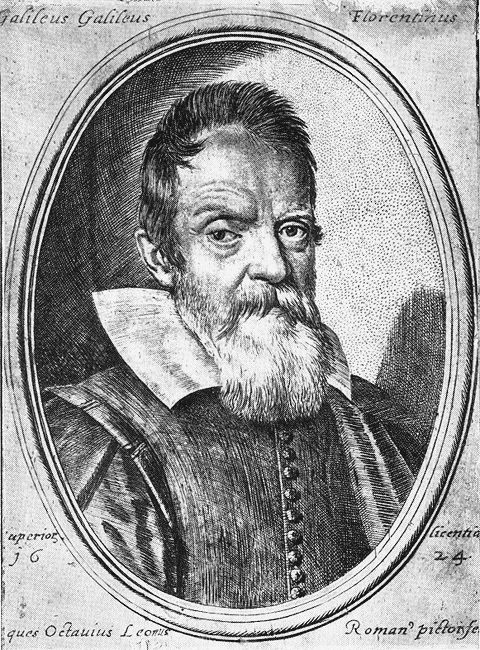
We live in a me-centered culture that thinks everything revolves around “me”. You can spend an entire day thinking about yourself, but oblivious to the realities surrounding you. Like people prior to Galileo concluded our world was flat, but in reality it is a globe. We must face the truth that human beings are part of a larger cosmos that God created, sustains and revolves solely around Him. He is the blazing center of our universe. Man is on earth a blip on the radar screen of history, but God remains eternally. God does not exist to meet our needs, nor did He create us because He was lonely and needed little friends to keep Him company. He did not save man by sending Christ so that we could be with Him forever. Eternity exists so that we can know God—the Trinity [John 17:3].

The Trinity shows the uniqueness of Christianity.

Christianity is not like other world religions. It’s not even kind of the same. Not all religions believe in the same God [that is a contradictory statement]. It is radically different than all world religions. What separates Christianity from other belief systems? According to Christianity God became man [Matthew 1:18-23]. This God-man became the sacrifice for man’s sin. At Christianity’s core the Trinity—God the Father, Son and Holy Spirit—is unique to Christianity. Without the Trinity Christianity is dead. That truth alone helps me to understand that the Trinity matters.

3 amazing and mysterious truths about the Trinity

I remember when I first started talking with my wife in the early days of our relationship. I wanted to know everything about her: what she loved, desired, disliked, favorite foods, most inspirational books, greatest memories, fears, and more. Our phone conversations would go on for hours, as we would learn new things about one another. I really got to know a lot about Sarah and loved it. Now that we have been together over 3 years and have know each other more than 10 years we are still learning new things about each other, but not quite at the pace we did in the early years. We are familiar with one another. Imagine one day I woke up and said to Sarah, “I don’t want to know more about you.” Something is very wrong when the learning about my loved one stops.

There is a difference between knowing about someone and really knowing them. Likewise you can know more than just know something about God. You can know Him. He speaks to you and you can speak to Him. You can actually have a growing relationship with God. Like a marriage or family this relationship is a lifelong endeavor, if not an eternal adventure. Forever you will be learning something new about God.

God is a mystery, but there are things you can know for certain about God. You will never be able to solve the mystery about God or know everything about Him. It is impossible to know all about God. People often think that the Trinity mystery is contradictory. A contradiction is when two truth statements exist that cannot logically coexist. For example: “God exists” and “God does not exist.” Both of these statements cannot be truth at the same time. One must be true and the other false. The Bible declares 3 amazing and mysterious truths about the Trinity of God [John 1:1-14]:

1. God is 3 Persons.

How does John 1:14 define what the “Word” is in 1:1? The Word is defined as God who “became flesh and dwelt among us.” We would know the Word as referring to Jesus Christ. What is the significance of calling Jesus “the Word”? To a Jewish person the Word of God was spoken, not necessarily seen. God spoke the universe into being, God spoke to Adam and Eve in the Garden, God spoke to Moses in the bush and Wilderness, and God spoke to the prophets. When God spoke, man listened. John says that Jesus is the Word—the Word in visible flesh. When people look at Jesus and hear from Him they see God with skin on. He is just as God as God the Father; in fact Jesus displays the “glory” of God the Father.

According to John 1:1 notice “the Word was with God.” Why is that statement important? It means that Jesus and the Father are distinct. God is distinct in persons. The Bible clearly shows that the persons of God—Father [1 Cor.8:6; Rom.15:6; Mt.11:27], Son [John 1:3; 5:27-30; 8:58], and Holy Spirit [Acts 5:3-4]—are indeed God, yet distinct from one another [Mt.3:13-17; 12:32]. In fact, the persons are subordinate to one another [John 14-16]; the Father planned salvation [John 3:16], the Son submits to the Father [1 Cor.11:3; 15:28], and the Holy Spirit glorifies the Son [John 16:14].

How is the distinctness and oneness of God reflected in our human relationships? Marriage relationships are considered one flesh, but with two persons [Hutts / Justin & Sarah]. A family is considered a unit with many members [Hutts / Justin Hutts]. A team is typified as one with 5 or 11 players [Colts / Peyton Manny]. So it is with God—He is 3 persons.

2. All 3 Persons are Fully God.

According to John 1:1 Jesus was with God in the beginning. Jesus took part in the creation of all things. Do you notice that John 1:1 and Genesis 1:1 have a lot of similarities? “In the beginning God created the heavens and earth.” Jesus is equal with God at creation. Jesus is fully God. John 1:14 tells us that He became flesh, which means that He was once not flesh. Jesus is God who became a man. [Note: The whole Trinity is involved in Jesus’ incarnation—God send Him and the Holy Spirit caused the womb to be; John 3:16; Luke 1:35]

The 3 persons of the Godhood are distinct in person, but one in essence. The 3 Persons have eternally existed as One God. Jesus is not merely with God, not merely like God, He is God.

3. All 3 Persons are 1 God.

All Jews from the time they little children learn about God—One God. Even the disciples believe in One God [monotheist] and believed that Jesus was God too [not one of many god, polytheist]. Hebrew children much like children today attended “Saturday” School at the synagogue and learned important lessons from the Old Testament. By heart a Hebrew would know the Shema: “Hear, O Israel the LORD our God, the LORD is One.” [Deut.6:4] The three-ness and oneness of God do not exist in the same respect—God has one essence and plurality of persons.

How has your view of God been too limited? How have you been reminded in your life of your limitations? When I think about the Trinity I come to a realization of my own limitations. We are the creation and God is the Creator [Isaiah 55:8-9]. Thinking about God puts Him in His place and me in mine. He is God and I am not. I am not, but I know I AM!

In my relationship with Sarah there are things I will learn about her the rest of our marriage. She is a woman—she thinks differently and is wired differently by God. She is so complex. So it is with God. He is infinitely more complex and there is an endless vat to know about our beautiful God and Savior. What a joy it is to search the mysteries of our God and get a glimpse of Him in His Word and in the world.

no more ties for fathers please

Happy Fathers day. This is the day when we honor our dads by giving they ties, gift cards to Menards, and cooking them brats or steak on the grill. We are thankful for our dads. Dad’s have a huge influence over the lives of their kids. This year more than ever the reality of becoming a father is hitting home. With my wife approaching 5-months of pregnancy, I am thinking seriously about being a dad.

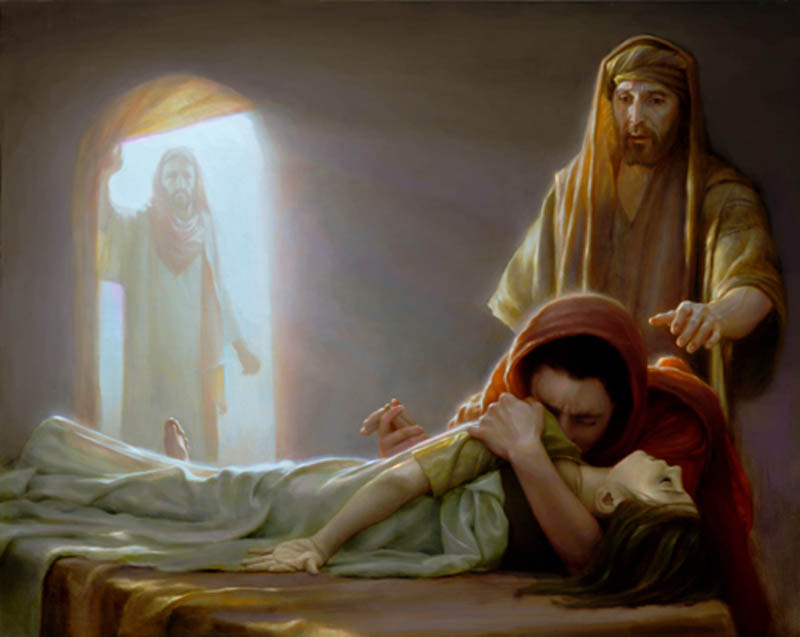
The name of the father in the story we are going to look at today is Jairus. He had quite the rap-sheet: he was a spiritual man being the “ruler of the synagogue.” He was a big cheese among the Jewish community. He possibly heard Jesus speak in the synagogue at Capernaum. But more importantly for this story he was a Dad.

We do not know the name of his daughter, but we do know that she was an only child (“only” cf.Jn.3:16), about 12 years old and was suffering a deadly illness. What do you suppose she saw in her dad? I wonder if she thought of him as being old-fashioned and out-of-touch like many today’s pre-teen daughters? I want to assume that she thought of her dad as a faithful man. What are the marks of a Faithful Father (Follower)?

Faithful fathers [followers] are not ashamed to worship Jesus [Luke 8:40-41]

“There came a man…and falling at Jesus feet.” Jairus approached Jesus during the day while many people were out and about [cf. this is opposite of Nicodemus who comes to Jesus in the middle of the night]. Jairus comes to Jesus because his daughter is sick. It is a hard thing for a father to see their children suffer. He approached Jesus without reservation and fell down at His feet [not out of exhaustion, but begging]. Matthew 9:18 “there came a certain ruler, and worshiped him” Notice: Jairus went himself. He did not send his wife, he didn’t send a servant, rather he went to Jesus Himself.

Oh, that dads would seek Jesus without shame. That they would take their priestly responsibility in the home. That they would seek Him without reservation. That they would seek Him boldly. A faithful father knows he has a faithful God.

Faithful fathers [followers] are not ashamed to invite Jesus to the house [Luke 8:41b-48]

“begged Him to come to his house.” Notice that the event that followed was “as He went,” the entire crowd followed on their way to Jairus’ house. Can you imagine that phone call? “Honey, everyone is coming over to the house.”

Oh, that God would give us Dads who would bring Jesus into the house. Men who would stand with Joshua and declare to the world, “as for me and my house, we will serve the Lord.” Men who would lead their families in prayer, speaking the truth of God’s Word, worshiping and living out their faith.

On the way to heal Jairus’ daughter, Jesus is touched by a woman suffering from a long-lived physical ailment that caused her to be ostracized by her community. According to Leviticus 15, she would have been labeled “unclean” and anyone who would touch her would also be unclean. In the crowd she rushed to Jesus, and believed that if she simply touched Jesus she would be healed. In that moment, Jesus stopped. He draws attention to the woman. She confesses. And Jesus comforts her by saying, “daughter,” (only time Jesus ever uses these words) “it was your faith alone that saved you.”

This parenthesis miracle was a tremendous lesson on faith for both the crowds and Jairus. Not only did Jesus’ healing of this woman stall the situation to heal Jairus’ daughter, but paved the way for His words. Jesus miracle now shifts from public to private. While Jesus was still speaking to the woman a messenger can to Jairus to let him know that his daughter died and not to bother coming home.

Faithful fathers [followers] are not ashamed to put the welfare of their child in the care of Jesus [Luke 8:49-56]

“Do not fear, only believe…” When Jairus received the news that his daughter was dead, he didn’t dismiss the Lord, rather he gave her into Jesus’ care. This reminiscent of Abraham’s willingness to sacrifice Isaac on the altar. Jesus’ response to the father, “Do not be afraid. Only believe.” [Note: aorist imperative tense, literally, act in belief, “trust me,” “hey you, have real faith!”] Jairus completely put his daughter in the hands of God’s care.

Faithful followers of Christ are not afraid. They completely entrust their children to God. Ungodly fears are directly linked to things we are thinking [Proverbs 4:23; Philippians 4:8). Oh that God would give us Dad’s who would commit their children into the hands of Christ.

As I think about being a father, I want to be a worshiper modeling a love for God to my children. I do not want to be ashamed to invite Jesus into our house. He is our special guest, always welcomed and honored. I also want to sacrificially give my children over to the care of their God who is ultimately their Creator and Sustainer.

God is pursuing willing worshipers

Part 2 of 3 Why Worship Matters

Are you willing? Are you willing to do hard things? Are you willing to admit and acknowledge who God is and who you are? Being a willing worshiper is like knowing—what to do when you are on fire: Stop, Drop and Roll. When Isaiah gets a glimpse of God He not only sees God for who He is, but sees Isaiah for who He is. Isaiah responds to God. Isn’t that true when you see the God of the Bible He wows you?

Those who have seen God are never the same. The children of Israel asked to see the Lord of Moses, but when they saw the Lord they were afraid and ask Moses never to allow them to see God like that again. In Revelation 1:9-18, John saw the awesomeness of Christ and fell as a dead man. People who see God are left with an awesome and unforgettable impression. A willing worship will:

STOP and take a long look at who you are and who God is [Isaiah 6:5]

Isaiah is deeply impacted by God as he watches this unfold before him. He feels unworthy to be in the presence of the GOD who IS. He says, “Woe is me.” In other words he is saying, “I’m dead, I’m done for, I am silenced.” It is as if you got to peak under the curtain of the holy of holiest and you were found out. I’m caught. I’ve offended the King. I’m ashamed. Now I’m toast.

In a sense Isaiah asks, “How can I speak on behalf of God? I am unclean and I live with people who are unclean.” Don’t ever think that you are some holy Joe or Jane! Sure compared to the person in the pew next to you maybe, but not compared to God. May God forgive us our pride and arrogance, and give us a holy sense of who we are and who He is.

DROP to your knees and receive God’s forgiveness [vs.6-7]

The natural response to gazing upon the greatness of God is to drop to our knees for forgiveness. There is something interesting at work here. In Isaiah’s day their was a pagan practice called the “washing of the mouth” ritual that took an inanimate idol and made it inhabited by a god. The image would be purified and cleansed to be ready for a god to dwell in it. The cleansing ceremony Isaiah experiences is quite similar, but irony as the True God chooses Isaiah to cleanse and become His spokesmen to the pagan idolaters.

Have you felt the forgiveness of God? Guilt should not handicap you; rather motivate you not to go there anymore and rest in God’s forgiveness. I am so glad the passage does not end in verse 5. In God’s holiness we see our sinfulness. Yet God calls and commissions us to holiness too [1 Peter 1:14-19]. From guilt to grace, Isaiah is cleansed from His sinfulness and experiences God’s forgiveness. God’s holiness is unattainable, but His forgiveness is not. In the midst of chaos there is always Cosmos. God is a Restorer. God’s pursues forgiveness in Isaiah and you too. He pursues you through the work of Christ on the cross that shed His blood as your substitute so that you might be forgiven and free.

ROLL up your sleeves and get to work [v.8]

Forgiveness is never passive, it is active. After the cleansing God calls Isaiah to a difficult task: see to it that My people know I am forgiving too. After forgiveness I am called to share the good news and warning to others. Can you hear God call you to serve Him? Will you respond? Commissioning follows cleansing. In God’s economy worship = serving. Worship = life.

Worship matters because GOD IS and His character demand my worship. GOD IS PURSUING WILLING WORSHIPERS and my presence is expected.

God Is

Part 1 of 3 Why Worship Matters

We live in a culture [as others before us] willing to worship anyone and anything. We will pack arena’s to sing our favorite songs from our favorite band. We will be first in line at the movie theatre to see the next biggest summer blockbuster. We will pack sports stadiums and worship teams and players with loud cheers and waving our banners. Last December Sarah and I went to our first fridged Packer game at Lambeau Field. There was some worship going on that day! Later we thought, as great as the game was, “Heaven is going to be awesome!”

We are about all worship. It is not easy to define real worship in a culture that readily worships anyone or anything. Worship is about what we live for [who we are]. Every day, all day, everywhere you go, you worship. It’s what you do. It’s who you are. You can’t stop it or live without it. Worship is a way of life. It is a whole-life response to God’s greatness and glory. You are a worshipper before you are a father, mother, sister, brother, boss, employee or student. Worship is simply about value. Worship is our response to what we value most.

Why does worship matter? Why must worship matter to me? Why is it so important? Worship matters because GOD IS and His character demands my worship [Isaiah 6:1-3].

God is alive.

Isaiah says, “I saw the Lord.” Uzziah is dead, but God still lives. “From everlasting to everlasting, You are God” [Psalm 90:2]. God has no beginning or end. He does not depend anything or anyone to exist. God was alive when this universe banged into existence. He was alive when the Buddha and Muhammad walked the earth. He was alive when JFK was shot. He was alive when a tsunami sweep away Indonesia, and earthquakes rocked Haiti and Chile. He will be alive ten trillion ages from now when all the puny people in power are long forgotten. But not God, He always has been and always will be alive.

God is authoritative.

“I saw the Lord sitting upon a throne.” He is the Supreme Court, the Legislature, and the Chief Executive. Heaven is not coming apart at the seams. He holds it together. He sits on a throne. He rules with peace and control. He has authority over our lives even though we may never acknowledge Him.

God is omnipotent.

“I saw the Lord sitting upon a throne high and lifted up.” God’s throne is higher than every other throne signifies God’s superior power to exercise His authority. No opposing authority can nullify the decrees of God. What He purposes, He accomplishes. “My counsel shall stand, and I will accomplish all my purpose” [Isaiah 46:10].

God is majestic.

“I saw the Lord sitting upon a throne high and lifted up, and the train his robe filled the temple.” You have seen pictures of brides whose dresses are gathered around them covering the steps and the platform. What would the meaning be if the train filled the aisles and covered the seats and the stage, woven all of one piece? That God’s robe fills the entire heavenly temple means that he is a God of incomparable splendor and honor. His creative fullness spills over in excessive beauty. God loves to wow us.

God is revered.

“Above him stood the seraphim; each had six wings: with two he covered his face, and with two he covered his feet, and with two he flew.” No one knows what these strange six-winged creatures are [not some chubby winged angel babies], and they never appear again in the Bible. When one of them speaks, the foundations of the temple shake [v.4]. These are magnificent creature that most of us would be wowed by, but God wows them.

God is holy.

“And one called to another, ‘Holy, holy, holy is the Lord of hosts!” God is in a class by Himself. When asked for His name in Exodus 3:14, He said, “I am who I am.” What is God’s holiness? [Hebrew Qadesh, Greek Hagios, separate/different] 1 Samuel 2:2, “There is none holy like the Lord, there is none besides You.” Isaiah 40:25, “To whom then will you compare me, that I should be like him? says the Holy One.” Hosea 11:9, “I am God and not man, the Holy One in your midst.” And repeated throughout the Scripture is the theme: “YHWH alone is God” [Ex.22:20; 34:14; 20:5].

God is incomparable, unfathomable. It determines all that He is and does and His ways are not determined by anyone. His holiness is what He is as God, which no one else is or ever will be. Getting a glimpse of God’s holiness will rock your world to the core. There is no way to scale mountain and heights of God’s holiness [not even in this message or our lifetime]. “The Lord is in his holy temple; let all the earth keep silence before him” [Habakkuk 2:20].

God is glorious.

“Holy, holy, holy is the Lord of hosts, the whole earth is full of his glory.” The glory of God is the seen of God’s holiness. God’s holiness has gone public in His glory. When God shows himself to be holy, what we see is glory. In Leviticus 10:3 God says, “I will show Myself holy among those who are near Me, and before all the people I will be glorified.”

Worship matters because GOD IS. His character demands my worship.

anything, 5 stones, and whiners

Lick it, flip it, clip it, quote it. A thumb lick is a term used to describe the action taken when turning the page of a book. Have you ever know someone who licks their thumb to grip the pages of a new book? While reading I often find great one-liners, statements and paragraphs that are golden nuggets of biblical wisdom. These thumb licks are quotes that must be shared:

anything

“Anything God has ever done, He can do now. Anything God has ever done anywhere, He can do here. Anything God has ever done for anyone, He can do for you.”- A.W. Tozer, What do you want God to do for you today?

5 stones

“There are five stones that will bring down any giant. They are: God is, God has, God can, God will, God does.” – Charles Fox

a nation of victims and whiners

“We are a nation of victims and whiners and pouters to a large degree. That is, if someone says something negative about us—no matter how constructive they may try to be—we either slump into a fit of self-justifying woundedness, or we file a harassment suit. We are a very thin-skinned people in America these days. Easily offended and easily provoked.

This is not good. And followers of Jesus Christ should be different. We don’t need to be thin-skinned and vulnerable. We are chosen by God, loved by God, forgiven by God, accepted by God, indwelt by God, guided by God, protected by God, strengthened by God—and God is more important than anyone else in the universe. We do not have to feel vulnerable or insecure. We do not have to be self-justifying or self-defensive or self-pitying. We can be quick to listen, slow to speak, slow to anger, as James says [James 1:19]. We can be like Paul who said, ‘When we are reviled, we bless; when we are persecuted, we endure; when we are slandered, we try to conciliate’ [1 Corinthians 4:12-13].” – John Piper

a consuming fire

Getting a glimpse of God

I remember as a young whipper-snapper that a group of us went to Green Bay to see the Packers practice. As a little boy this was a big deal, a real cheeseheads dream. You could see the big stars practice. The players would ride in on their bikes, high five the kids, stop for autographs. I got to meet actual players. I still haven’t washed my right hand!? Thousands of people would flock around the practice field just to get a glimpse of their favorite football player. We are all excited to get a glimpse into the lives of the rich and famous, get a sneak peak at the summers hot new blockbuster, and more.

I wonder what would your response be to getting a glimpse of God?

1. Fear God’s Holiness (Hebrews 12:18-21)

Modern people are not accustomed to fearing God. Fearing God is something primitive people do—along with bowing down to the sun and sacrificing virgins to volcanoes.

Even Christian people are not used to fearing God. You might say, “That sounds way too Old Testament. What about the love and grace of God? After all, John says: “Perfect love casts out fear.” Fear is for the spiritually immature, right?”

There’s a tendency for modern folk to think in terms of God offering man a contract—agreement between equals. “You’re ok, I’m ok. Every thing is ok.” NOT!! Ancients did not make that mistake. The 10 Commands were like terms of a treaty—the kind made between the conqueror and the conquered. No complaining or bargaining. Accept the terms unconditionally.

SHOULD WE FEAR THE LORD?

Let’s look at what the Bible says:

  • “The Fear of the Lord is the beginning of wisdom” (Prov.1:7; 5:21; 8:13; 9:10).
  • “The end of the matter; all has been heard. Fear God and keep His commandments, for this is the whole duty of man.” (Ecc.12:13)
  • “Do not call conspiracy all that this people calls conspiracy, and do not fear what they fear, nor be in dread. But the LORD of hosts, Him you shall regard as holy. Let him be your fear, and let Him be your dread” (Isa. 8:12-13)

You say, “That’s all from the OT!” What about Phil.2:1? “work out your salvation with fear and trembling”

The meaning of fearing God comes into clearer focus if we can imagine what it would be like to actually see God. This hasn’t happened too many times, but it is awesome to have an unfiltered experience with the living God! Isaiah said, “woe is me. I am a man of unclean lips,” (6:1-5) and when John saw the awesomeness of Christ and fell at His feet as a dead man (Rev.1:9-18).

When I was a kid I randomly bumped into things. My mom finally realized after multiple bruising that I needed glasses. I where glasses to see and protect me from potential danger. Fearing the Lord protects me from destruction. Sin makes me dumb. Following God is so smart.

The Bible clearly commands us to fear the Lord. It is a mixture of terror and awe, not just reverence and respect. Fear of the Lord is an appropriate response to the practical awareness of who I am before God. John Piper says, “To fear God is to view God as so powerful and awesome that I would not dare run from Him, but to Him.”

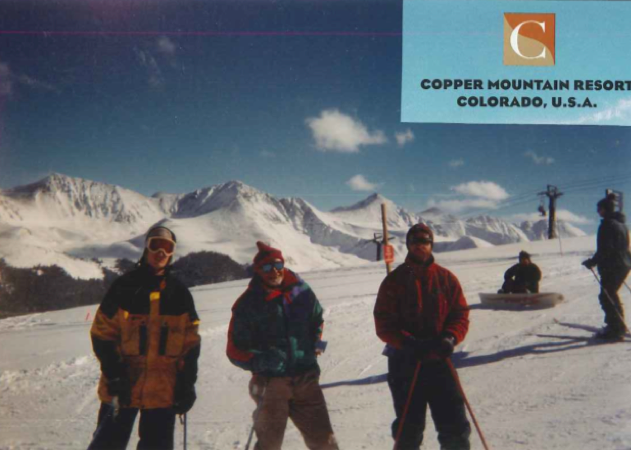
copper 1copper 2When I was in high school I took a ski-trip with my step-dad out West. We skied a lot. I have one memory that sticks out in my mind. On our last day we went to Copper Mountain (12,300ft.) We decided to take a trip to the summit. The ski lift got us close, but we still had about a half-mile climb to get to the peak. I thought I was going to die. When we got to the summit it was an amazing experience (“This is the sanctuary of God”). You could see for miles, the air was brisk, and God’s glory was awesome. I remember crying out to God. Then it dawned on me we had to go down this mountain. The only way down was to jump about a 20-foot cliff to the powdery slope. I had the feeling of terror mixed with wonder was one of the most exhilarating experiences of my life. This must have been something like the Israelites’ experience with the living God–terror mixed with wonder. It was something God did not want Israel to forget.

Who is your God? Is He feared? One day you will appear before this God. Every person who has ever lived will appear before Him. You think you will tell Him how you’ve been a good boy or girl; or give Him a piece of your mind for how your live went on earth. No, you will approach Him in fear and trembling. You will be there, we will all be there. This is the God we will meet. The story doesn’t end there. Ready for some good news? There is this holy God “but…”

2. Gratitude for God’s Grace (12:22-24)

The amazing grace showered on you when you come to the God:

  • to Mount Zion—we may come to a literal mountain in Jerusalem that represented the heavenly Zion
  • to the city of the living God, the heavenly Jerusalem—but we come to the dwelling of God.
  • to innumerable angels in festal gathering—we come backed by a 10,000 x 10,0000=100,000,000 (minimum) member choir of angels in their party clothes.
  • and to the assembly of the firstborn who are enrolled in heaven—the believers, church (ecclesia), any firstborns here today? All receive a special rank and privilege. We will be “enrolled in the Book of Life (Rev.3:5; 13:8; 17:8; 20:12, 15) If you are not enrolled you are not there!
  • and to God, the judge of all—God is there.
  • to the spirits of the righteous made perfect—we will be like Christ! All that things that bug me about you, and you about me will not be there!!
  • and to Jesus, the mediator of a new covenant—HE IS THE CENTERPIECE OF HEAVEN. We come to see the One and Only, the Supreme, who gave us the New Covenant. We come to our Savior and Redeemer.
  • and to the sprinkled blood that speaks a better word than the blood of Abel—we come through the Atoning blood of Christ through which we have forgiveness of sins. Christ’s sacrifice was better than Abel’s (cf. Gen.4:10). Though Abel’s sacrifice (and ours) is acceptable to God because of faith—it has no atoning power (it represented judgment and vengeance). Jesus’ is (Col.1:20).

Whoohoo! That will be the day!! Are you grateful for the work of Christ? Do you know the God of Mount Zion? (1 Jn. “These things were written that you might know you have eternal life through Jesus Christ”) Do you know that you know that you know Him. Forgiveness and repentance in Christ!

How should I respond to this holiness and grace of God?

3. Worship by Total Submission (12:25-29)

My Response (v.25): I will do what He says. When He says jump, “I will say how high?”

My Response (vs.26-29): I will worship. I give my best to God, I give my first to God, I reserve the most to God. I honor Him, respect Him, awe Him. I do not walk through life casually, placing a checkmark on my fridge that I went to church today. I totally submit to Him and worship for our God is a consuming fire.

Getting a glimpse of God means…
I fear God’s holiness: Do you fear God? Does it show up in your actions?
I have gratitude for God’s grace: Are you thankful for His mercy?
I worship by total submission: Do you worship Him as a living sacrifice?

real men cry

man weeping

Real men cry: a study of lamentation

Sure men cry. I am not talking about the tear shed from watching Bambi, a favorite chick flick, seeing your team lose the Super Bowl or cutting an onion for dinner. What about the true gut wrenching weep of sorrow. Men can be painfully shy. To pouring out their hearts before God to be seen as less than masculine.

What I am talking about is sacred sorrow. The kind of sorrow you have at injustice or self-inflicted judgment and the only thing you can turn to is God. The book of Lamentations is a fitting thesis for sacred sorrow. The theme of Lamentations is the God who is Righteous and Faithful. The author of these poems is a real dude who is really crying. And you can see why:

The scene depicted in Lamentations is so bad that the author has to find some simile to relate to what is reality. He can still smell the rot and hear the wailing of horrific bloodshed. Jerusalem is desolate. Jerusalem is pictured as a lonely widow, weeping the death of her beloved. She once was a queen, full of splendor, invisible to attack, but now is a abandoned as a slave. She is like a raped virgin that has been rejected and cannot find anyone to comfort her. No one is invincible to God’s wrath, not even His own people. The question is not “why” has this affliction occurred for the people know God is punishing their sin.

God who was seemingly absent is now back with vengeance as an angry “enemy” who has “cast down the splendor of Israel” and “in his anger has set the daughter of Zion under a cloud!” (2:1) God who had once protective presence upon His people had now become a fierce storm cloud of anger. He use to fight for them, but now He is against them as their enemy as He has “thrown Israel down without pity” (2:17).

And then in the midst or ruin and rubble comes the turning point of the lament. A glimmer of hope. Exhausted towards God His enemy (3:18) the author pours out one of the richest lines of hope in God (3:22-24):

“The steadfast love of the LORD never ceases; his mercies never come to an end; they     are new every morning; great is your faithfulness. The LORD is my portion,” says my soul, therefore I will hope in him.”

The author praises God despite being bruised and bloody, hungry and destitute. “It is good to wait quietly for Him…to hope in Him…to seek Him.” Can you get any more realistic than this? There is hope in a God who is his enemy, but whose “compassion never fails.” The author may be left alone in silence, may have to bury his face in the dust or give his cheek to the one who strikes, but God promises “men are not cast off by the Lord forever.” (3:28-31)

The author acknowledges that they are now orphans, weary, hungry, bearing the punishment for their fathers sins, women are ravished, princes hung by their hands, ruled by slaves, joy has ceased, and their dancing has turned to mourning. He pleads in prayer to the the LORD to “remember” them (5:1) that they might be “restored” (5:21). In the midst of their cataclysmic circumstances there is hope in the LORD who “reigns forever” and whose “throne endures to all generations” (5:19). This God, the only God, is again to begin again with the people.

What can we learn from Lamentations?

A theology of Suffering from A to Z. Lamentations reveals a complete and exhaustive expression of sorrow. The suffering of Lamentations explains the ways of God to humanity. Human suffering always brings about probing questions about God. The faith of many Jews must have been shattered by the events of Jerusalem’s destruction for they believed that Jerusalem was invisible and that God’s temple could not be destroyed because He dwelt there.

Lamentations gives us a glimpse into individual suffering (Ch.3) and national suffering (Ch.5). Lamentations that helps us gain a perspective on suffering when we see the famine, warfare and genocide in places like Cambodia, Columbine, Congo, and countless others. Suffering can make you bitter towards God or better understand God’s purposes.1 From the personalization of the author and front-row-seat depictions of the nations suffering we see suffering mixed with hope. Lamentations is a “theodicy”: despair amid suffering should always give root to hope in the presence and rule of God. Here are some principles Lamentation offers as a theology on suffering, when suffering comes:

  • Confess your sins (1:5, 8, 18, 20, 22).
  • Recognize who is the Judge (2:1-8, 17).
  • Give special attention to God’s leaders (4:16).
  • Pray for the future (5:1, 21-22).
  • Hope in God (3:21-42).

A Balance between God’s Righteousness and Hesed. Throughout the painful memories of Lamentations God’s righteousness is never throw to the wayside. God’s judgment is not viewed as wrong by those who strolled through Jerusalem’s ashes, rather they see their sinful ways. God keeps His promises of punishment for disobedience. “The LORD has done what he purposed; he has carried out his word, which he commanded long ago” (2:17).

His righteousness demands that sin be dealt with fairly. He is also faithful to Israel and will be their hope for the future (3:22-23; cf Deut.30; Is.65-66; Jer.30-33; Ezek.36-37). His faithfulness (hesed) demands His promises to be kept. God’s righteousness and faithfulness are equally relevant facets to the nature of God, which are illustrated horrifically and beautifully in Lamentations.

Sacred sorrow is okay as long as one acknowledges that God is righteous and faithful. Praise God in the midst of pain (3:21-42). There must come a point in our lamenting that is it turned to joy. In the case of Lamentations, out of the destruction rose a song of praise for the faithfulness of God.

“How” not “why”. When sin is in the “camp” we must not question God’s vengeance for it is the inevitable promise for disobedience. Rather we must access the consequences of how His vengeance is displayed in our lives and how we will will respond. Jerusalem’s wounds were self-inflicted. The book of Lamentations is one long illustration of the eternal principle that “a man reaps what he sows.” (Gal.6:7b)

When all is gone, all you have is all you need. Everything is destroyed, the days seem dark and God distant He is still there. We have a hope in the God who reigns forever. God does not abandon those who turn to Him for help.

image is everything

god-of-hand

In our world today, image is everything. What seems to matter is what you represent and what image you portray. People spend lots of money on creating an image for themselves. A picture of a mountain doesnt compare to the beauty of beholding in reality. Images or representations cannot be compared to the real thing.

We often do this with God. We try to make Him into something we can see, touch, feel or experience, and it never compares to who He really is.

The 2nd commandment seems harmless at first, but God views them differently: “You shall have no other image of God.” (Exodus 20:3-6)

The Second Commandment seems like a repeat of the First. This commandment addresses something that hits the core of humans: our concept of God. We all have different concepts of God, and our concept of God shapes who we are. Anything we use to mirror the majesty of our Maker will fall miserably short of Him and will minimize Him. Man’s finiteness cannot create something infinite.

Now is it wrong to have a cross or a masterpiece of art that portrays God? Of course not, but when that image replaces God or becomes your sole representation of God that is when it bucks the 2nd commandment. In your mental picture album, what is your image of God?

How people often imagine God:

picture-11. Grandpa God: this God is popular, forgiving, and giving. Whenever we do something wrong they smile and say, “It’s okay, I understand, don’t worry, I love you.” No offense, I love my grandparents!

picture-32. Santa Claus God: this God is like a Cosmic Easter Bunny or Mr. Rogers. He is deeply involved in our daily lives and world events. He is positive and reluctant to punish. He likes to give lots of gifts; blessings. All we have to do is ask, and He will give us whatever we desire, like a genie in a bottle. The old we get the more faint He becomes.

picture-43. Buddy God: this God is distant, but our buddy. He does not interact with the us. We can call on Him when we need Him. He will look out for us, but doesn’t interfere with our lives.

picture-24. Texas Justice God: this God is like an evil mother-in-law, deeply involved in our daily lives and world events. He is angry at sin and punishes the unfaithful. He wears a long flowing robe and carries a gavel waiting to inflict punishment on sinners. Feeling guilty?

picture-55. Emo God: this God loves to be emotional. We haven’t met God until we have tears on our faces, lumps in our throats, a chill down our spine, and butterflies in our stomachs. Probably, just ate too many Mexican beans. We think we have to be in touch with our emotions before we can be with God.

Is God some of these? Yes, in fact He is all and more, but if we characterize Him only these ways we are missing out on who He really is. God is loving, forgiving, giving, blessing, a friend when we need one, He is just and angry at sin, and God desires us to come before Him with truthful emotions. God is very different, different compared to you and different than our concept of Him.

Why shouldn’t we have any other image of God? He is jealous (Exodus 20:5; 34:14; Deuteronomy 32:16; Psalm 78:58; 1 Corinthians 10:22). He doesn’t want to share the top spot with anyone or anything. For God to step down and acknowledge something greater than Him, would be to step down as God. The fact is, we do not need to create images of God because He has create us in His image (Genesis 1:26-28 ) and we are to represent Jesus Christ who is the exact representation and perfect image of God (Hebrews 1:3; Colossians 1:15ff).

no other

God didn’t just casually hand over a posted note of “10 Thoughts” one day and suggest His people read them when they have time, then pick and choose which ones they like. God set the stage, and they never forgot that day…God meant business with these tablets (Exodus 19:16-19; 20:1-21).

The First Commandment: “You shall have no other gods before me.”

no-other

We are to let God be God. We are to make Him #1. We are to affirm His power. We are to acknowledge His presence in our lives. We are to obey His rules. We are to honor and worship Him alone. The parking space for worship in our lives is to be reserved for God alone. We are not to waste our lives worshipping anything else but Him.

Ancient worshipers were not monotheistic (believed in one God), they were polytheistic (believed in many gods). The more gods the better, they had gods for everything (sun, moon, war, weather, food, parties, etc). Today, this is not necessarily the case; we are more likely to find people who don’t believe in a god. Yet we are worshipers. We all worship something. Worship is giving your heart, desires, and adoration to someone or something. We follow after other gods, but they often operate under different disguises:

4 disguises for other gods:

1. Self-ismwe become our own idol. We follow after the selfish trinity: me, myself and I. We ask ourselves, “What’s in it for me? What makes me look good? What makes me feel good?” It is hard to avoid this god when our cultures mantra is, “You have to do what is good for you. Follow your heart.” This self-centered god always leaves us empty and needy.

2. Sense-ismwe seek the rush, high, experience that will give us pleasure or relief. For some it is spending, shopping, traveling, sex, pornography, drugs, cutting, binge-drinking, etc. Now God loves pleasure, but we abuse it. We can overdose ourselves on pleasure, but we settle for the weak-sauce-pleasure compared to the riches of knowing and obey our God.

3. Stuff-ismwe dream and scheme for ways to collect more things. We professionals at stalking stuff. We fill our closets with fashion, pimp out our cars, Gig-ify our computers, multiply our media libraries, lavish our homes to be like mini-castles, and more. The key word for stuff is: more. Just a little bit more. Our desire to acquire has gone all haywire. Possessions are fine when they do not possess us. God loves to give good gifts, but when we just get to get, we got it all wrong.

4. Smart-ismwe download facts to fill our fat heads. We have more informaiton at our finger tips than possibly all generations before us combined and we are not satisfied with our factoids. Next time you are in the game isle at the store check out how many trivia games there are. Knowledge says, “I want to know more than you because knowledge is power.”

All these -ISM gods and goddesses waste our worship and will not come through when we need them the most. When we feel cruddy they offer nothing, but temporary satisfaction. When our world is crumbling, they crumble too. Only God is much bigger than we are, only He can fill the void left by these other gods, and only He is worthy of worship (Psalm 115:1-13).

The first commandment of having no other gods is the foundation for all other commandments that follow. If we put God in the top slot of your life and worship Him as God, then we will know the greatest thrill and have the greatest possession.