
Each of the “one another” is challenging, even controversial. Consider how you respond when someone is encouraging, loving, bearing, forgiving, serving, or greeting someone else that you don’t like. None is more challenging and controversial than the one we will look at today.
Last month, I listened to the London Symphony at St. Paul’s Cathedral playing Handel’s Messiah. It was on YouTube, but wow, still. Just listen to the Overture. What instruments did you hear? Can you pick out any one instrument? With 106 musicians it isn’t easy. The beauty of a symphony is that each musician doesn’t showboat their individual talents; instead, they showcase their collective talent. Like today’s text, they are submitting to one another.
Submit to one another out of reverence for Christ. (Ephesians 5:21) I don’t need to take a poll to know that this is NOT your life verse, even one of your favorites, probably not in your Top 100. It’s certainly not a coffee cup verse.
Let’s talk about the elephant in the room. This word—submit—gets people riled up. It has been the brunt of church controversy and filled biblical commentary. The word can carry negative baggage. How many of you right now have a tinge of discomfort? Like when someone says the word Mufasa? At the least, you likely wonder where I will take this text today.

The word submit combines two Greek words hupotasso, which literally means to put under. It’s used around 40 times in the Bible and carries a metaphor of a battalion voluntarily serving under a commanding officer. The heart of submission aims to make someone else’s thing a way bigger thing than my thing. In other words, to submit is the spiritual discipline of letting go of my addiction to have my own way, knowing if I continue to act that way, then it’ll kill me and destroy my connection with others near me. It’s the practice of putting death to self and living out the prayer “not my will but Yours.” To submit, I am willing to give up my seat (of comfort, power, prestige) for someone else without expecting more.
Let’s be honest, it’s a struggle to submit to anyone, let alone, one another. It doesn’t come naturally, especially coming from individualistic cultures. I submit to no one. I am born with a Wild West mentality. At the root of it, I buck against submission because I think I know those around me…and I know me. I see someone who is flawed and selfish. Who wants to submit to that?

It’s important to consider how the phrase “submit to one another” sits within its context. It is preceded by and connected to a list of qualities of one who is ”filled with the Spirit” (Eph. 5:18b-21). Notice the worship-filled language? Then it flows into three examples that show what Spirit-filled submission to one another looks like in real life:

- Marriage (5:22-33): Wives submit to husband. Husbands submit to Christ. Spouses try to outdo one another in a submission competition—“No, you first!” even when it’s inconvenient and my partner wants me close. Pointer: Jesus is the Groom and we are His Bride.
- Family (6:1-4): Children submit to parents. Parents submit to the needs of their kids even if it’s the middle of the night and it’s the fifth time my child needs me. Pointer: God is our Father and we are all His kids.
- Workplace (6:5-9): Employees speak well of their leader. Leaders care for those they lead. Pointer: God is our boss and He sits atop the org chart of the cosmos.

Submission in marriage tends to take the spotlight, v.21 gets glanced over, and the emphasis becomes out of balance. What happens is an overemphasis on v.21 and under-emphasis on v.22, or the opposite, an under-emphasis on v.21 and overemphasis on v.22. Now, before you throw stones, I am simply presenting the issue and will leave you to wrestle with it. What I find peculiar, is that the issue is usually presented as an either/or interpretation. Either we submit under an yielded mutuality or we submit under an aligned authority. It is easy to see how those who emphasize harmony push for egalitarianism and those who emphasize order push for complimentarianism. Oh, boy, there’s so much to say there! I will give my three brief observations.
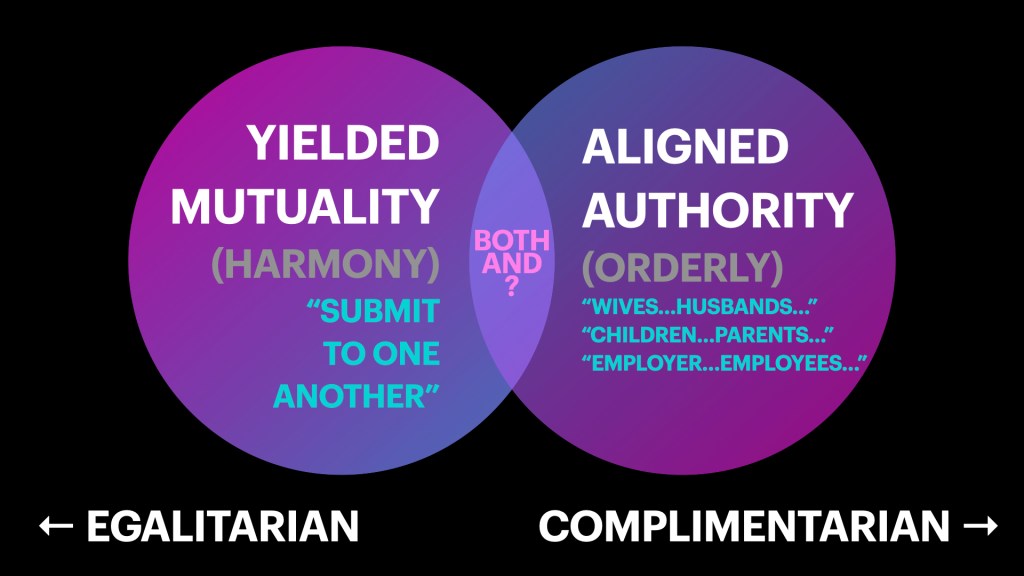
First, I will propose that the interpretation might not be either/or but both/and. Could mutuality and authority co-exist together and not be a cop-out interpretation? When one takes the Meaning of “submit” + Meaning of “one another” + Examples in the Text = Yes, it appears to be both/and!
Second, I have observed how fear pushes both interpretations. Fear pushes egalitarians to defend injustice, demand freedoms, and protect abuses, while fear pushes complimentarians to retain authority, demand rights, and guard weaknesses. These are noble acts when balanced with the character of Christ, but undoubtedly they get pushed to extremes. When submission becomes destructive or fear-based, then it violates the royal law of love.
Third, the Pattern of Paul in Ephesians 5 encourages each member of the church to say No to self-indulgence, self-service, self-centeredness, and self-aggrandizement and to say Yes to self-sacrifice (like Jesus). In other words, we have a growing 🩶-centered commitment to submit to one another. Rather than saying “I’ve got it all together,” I’m becoming more prone to saying “We are better together”. Let’s turn back to our text for today.
Submit to one another = We humbly yield & align to the interests of those around us.
The heart of submission is humility. This is seen all over the Scripture (cf. Micah 6:8; 1 Cor. 4:7, Gal. 5:13-14, Phil. 2:3-5, 1 Peter 5:5b). In 1 Peter 5:5 both submission and humility are contrasted with pride, which is a theme also seen in James 4:6, “God resists (antitassō, to put away or against) the proud but gives grace to the humble.”
Relationships flourish when clothed with humility rather than hierarchy. Submission is ultimately a posture of the heart. When I cease to submit, when I wait for others to serve me first, and when I feel superior to others, it says more about my heart. My heart is misaligned to the heart of God towards others.
Truth is, your church (team) is likely full of people that you wouldn’t go on vacation with, but you find a way to make it work—putting up with one another, putting yourself under one another—for the greater good. If you took this matter of humbling yourself towards one another seriously, what might it look like in your marriage, family, workplace, team, and church?
What we see throughout the Bible is that humility is not for the other person first, but it is for you. So important is humility that Jesus modeled it. Let’s see how Jesus submitted (humbly yielded and aligned)
- his Father: he surrendered his plans and words, for greater glory.
- his parents: he was dependent from birth through adolescence.
- his disciples: he leaned on them and many of them weren’t even believers yet!
- his creation: he took on a human body and he felt hunger, thirst, tiredness, and pain.
- his govt authorities (law of the land): he rendered to Caesar what was Caesars.
- his religious leaders: who didn’t “do justice, love kindness, and walk humbly with their God.”
- your need, he took your cup of wrath (sin), he humbled (lowered) himself to death.
We expect humility from Jesus, but what about me? As I gave ‘mutual submission’ some thought, what came to mind was my relationship with Blue. I am Blue’s appointed leader. I also lead a media project, and with that, I am under Blue’s authority as he serves as leader of the team with the media project. It’s not complicated. We just have to determine who is wearing what hat. On top of that, Blue and I are brothers in Christ. Almost every Wednesday, I meet with Blue and a band of warriors to pray and submit to one another through accountability. In that space, these men have the authority to speak into my life.
Another example of mutual humility was when Bob Shankly retired from Liverpool Football Club in 1974 with a showcase of 10 trophies. He handed the reigns of the team to a reluctant Bob Paisley. Shankly wrote a letter to Paisley and left it on his desk. It read, “Bob Shankly says Bob Paisley is the best manager in the game.” Paisley took the letter, added two commas, and sent it back to Shankly. It read, “Bob Shankly, says Bob Paisley, is the best manager in the game.” Paisley built on Shankly’s success and added 20 trophies (x2 Shankly). In his biography, The Quiet Genius, it was said that Paisley was a shy and thankful fellow who gave others confidence. His genius was being an ordinary man who fostered an extraordinary team.

Out of reverence for Christ = We rally together around the Greatness of Jesus.
Greatness is not achieved through power or prestige. Greatness is not won by force of arms or superior intellect. Greatness is not showing that I got it all together. Greatness comes through humble reverence. It comes when we rally together around the Greatness of Jesus.
Jesus turns upside-down the way the world measures greatness. Remember the mom who begged Jesus to give her two boys the best seats in heaven? When other disciples caught wind of it they were miffed, but they also wanted their shot at the special seats too. So Jesus got them together to settle things down. He said, “You’ve observed how godless rulers throw their weight around, and how quickly a little power goes to their heads. It’s not going to be that way with you. Whoever wants to be great must become a servant…That is what I have done. I came to serve, not be served. I came to give my life as a ransom for many.” (Mt. 20 cf. Phil. 2:7-11; Col. 1:15-18)

Herein is my power and motive to submit—I revere Christ (phobos, awe-inspired love). When I submit to Jesus first, from that flows a heart willing to submit to others. Submission to others is not based on worth—whether they earned it or deserved it, but solely on seeing Jesus is worthy and everyone that he created is made in His image. How does a reverence for Christ make a difference in your relationships? Your family? Your workplace? In your community? Among members of your church? What might it look like for you to submit? To one another? To a Chadian brother or sister? To the Chadian govt? I’m just putting it out there.
One of the most irony-filled stories in Scripture about submission is in the garden of Gethsemane (John 18). There we see Judas submitted to the will of the enemy. He turned Jesus over to the authorities. When the authorities arrived (who themselves submitted to religious leaders), they asked Jesus to identify himself. Jesus stepped forward and said, “I AM He.” At that moment, the guards fell on their faces in fear and submission. Peter decided submitting was for him, so instead he got out his sword and cut off the guard’s ear. In the end, Jesus silently yielded himself both to local authority and divine authority (“not my will but Yours be done.”) Thank God, for our sake, Jesus submitted to Father!
How often have you regretted yielding to your own way? My guess is a lot. How often have you regretted submitting to the Lord? Maybe never. What do you need to yield to the Lord today?
The distinguishing feature of a Spirit-filled follower is their growing reverence for Jesus’ greatness AND humbleness towards others around them. The temptation of power is greatest when intimacy is feared. When I bow my knee to Jesus, I can also bend to the interests of others. This isn’t self-deprecation. Rather, like Jesus, it’s self-sacrifice.
Imagine you’re a violinist and a conductor approaches you and says, “I want you to play in the first chair.” It would be self-deprecating to respond by saying, “No way! I don’t play. I’m no good at all,” when everyone knows that you’re an able and gifted musician. On the other hand, it would be self-sacrificing to respond by saying, “Absolutely, I can play! And I will play my best. I will make this orchestra and everyone around me better.”
I remember hearing Handel’s Messiah being played in an open city square by a university orchestra. I didn’t know about it beforehand, but the concert was free of charge. It was the harmony and authority of the music that drew me to want to stop and listen.
So it is with us. Think about it. You and I are members of a world-renowned orchestra. Each of you has a part to play. You didn’t come to the stage with your own gifts but supernaturally given to you. Being Spirit-filled, it is like you to humbly yield and align to the interests of those around you. With Jesus as your conductor, you rally together around His Greatness to make him shine. When you do it testifies to the mysterious way He brings such a motley crew together.
Lord, You are Great. There is not like You. Help us to rally around Your greatness. We need Your help. Please help us put off our pride and rebellion and put on humility. Teach us to live in submission—by putting ourselves under You and seeking to put the interest of others above our own. Make us servant-leaders like You. In the name of Jesus, amen.















 spreading the fame