thumb lick thursday [3.31.11]

Lick it, flip it, clip it, quote it. A thumb lick is a term used to describe the action taken when turning the page of a book. While reading I often find great one-liners, statements and paragraphs that are golden nuggets of biblical wisdom. So Thumb Lick Thursday is a way to pass along great tidbits of truth.

Is Mandated Bible Reading Healthy for Kids?

This is probably one of the most common questions  I hear from parents wanting to establish Christian disciplines in their kids. Every Christian parent deals with this at some point. They struggle with what they should mandate vs just encourage their kids to do. And with this, how much? At what point will we defeat our purpose and discourage them?

Hope for hurting marriages

There are far too many marriages in our Churches and communities that are hanging together by very thin threads. When marriages are like this, patterns of neglect are almost always part of the reason. It takes commitment and work for a marriage to be the mutually satisfying relationship it was intended to be (Note: 5 key commitments for a good marriage).

Worth-ship

Worship is “worth-ship”, an acknowledgement of the worth of Almighty God…It is therefore impossible for me to worship God and yet not care two cents whether anybody else worships Him too…Worship does not beget witness is hypocrisy. We cannot acclaim worth of God if we have no desire to proclaim it. – John Stott, Our Guilty Silence. 27-28

Suffering & Death

The Greatest single secret of evangelistic or missionary effectiveness is the willingness to suffer and die. It may be a death to popularity (by fatefully preaching the unpopular biblical gospel), or to pride (by the use of modest methods in reliance on the Holy Spirit), or to radical and national prejudice (by identification with another culture), or to material comfort (by adopting a simpler lifestyle). But the servant must suffer if he is to bring light to the nations, and the seed must die if it is to multiply. – John Stott, The Cross of Christ, Leicester: IVP, and Downers Grove, IL. 1986. 322.

What are you Sinking about?

It is easy for communication to be lost in translation. This commercial by the German Coast Guard and their new recruit emphasize this point.

the colossal compromise

A city family bought a ranch out West where they intended to raise cattle. Friends visited and asked if the ranch had a name.  “Well,” said the would-be cattleman, “I wanted to name it the Bar-J. My wife favored Suzy-Q, one son liked the Flying-W, and the other wanted the Lazy-Y. So we’re calling it the J-Q-W-Y Lazy Suzy Flying Bar Ranch.” Their friends asked, “But where are all your cattle?” In disbelief they responded, “None survived the branding.”

Compromise is a part of life. Everyday you are faced with decisions where you have to give up something good for another good. Do I study or do I play soccer? Do I visit this family member or do I visit this old friend? Do I go out to eat for pizza or a hamburger? Do we go on vacation to the beach or the mountains? Compromise is simply changing the question to fit the answer.[1] Sometimes you cannot have both and you must compromise. Sometimes compromising is not this simple. Sometimes compromises can have a great affect on you and others depending on which option you choose. Sometimes people compromise deep-rooted beliefs or sacrifice morals to get what they want.

Why do people compromise their faith? Why do people fall away from their faith? The answer: people give into the colossal compromise. What is the colossal compromise? It is choosing to worship creation or the created thing rather than the Creator [cf. Romans 1:19-23]. Or it’s choosing to worship a man-made god or made-over god in the place of the real God.

Giving God a Makeover [Isaiah 44:6-20]

How do you give God a makeover? As the French philosopher Voltaire said, “God made man in Hus image, and man returned the favor.” In other words, giving God a makeover is to create a god in your image—a god that looks a lot like you. Creating a user-friendly god is not something that is new, since the beginning of creation man has been trying to recreate God to look more like man. Since, God is infinite, man tries to make Him more finite. Man desires a designer deity custom-made to suit out individual needs.

Have you created a god that fits your liking? People tend to cut-and-paste Scripture piecing together a nice and comfy-cozy god that puts up with their messes [by passively overlooking offenses], minds his own business [unlike a pesky parent], approves of their choices [of premarital sex, rebellious friends, and additive tendencies], and gives into their desires [like a genie in a bottle]. Thomas Jefferson made up a god like this with his Bible. He could not believe that Jesus could do supernatural miracles, so he cut out those passages in the Bible and made a version of god to his own liking that fit his own belief. Now known as the Jefferson Bible.

The Bible warns about a time when good religious Christians will compromise their faith to teachers who will tickle their ears and tell them what they want to hear, rather than speaking the truth [1 Timothy 4:1-6]. These false teachers are master sculptures at creating false caricatures of God that morphs from crowd to crowd pleasing particular peoples fancies. Like a chameleon they adapt to your ever-changing desires, helping you give God a makeover. People will go to great length to get the god of their liking [i.e. Isaiah 44:12-17]. Instead of listening to compromisers or sinful-sympathizers, challenge teachers words with the truth of God’s Word in its context—look for yourself and see if it is true.

What is the problem with giving God a makeover? You are not God. Remember, God made you. You cannot make God. Making over God is making an idol of your own god. God does not need a makeover, you do. God is a jealous God and desires no rival god, in fact, He puts your gods up for an old Western-style dual, “I am the first and the last; besides Me there is no god. Who is like Me? Let him proclaim it. Let him declare and set it before Me…Is there a God besides Me? There is no Rock; I know not any.” [Isaiah 4:6-8]

The problem with making over your own god to fit your own image is that your god is nothing [Isaiah 44:9-11]. You become deaf, dumb and blind just like the gods you worship [44:18-20].[2] You become what you worship for ruin or restoration.[3] You always lose out when you try to compromise with sin. It will consume you in the end. Let’s observe this consuming compromise from an illustration within the Bible.

What is your golden calf of compromise? [Exodus 32:1-24]

Remember when the children of Israel were wandering in the desert and they created for themselves an idol of gold in the shape of cow? This was a colossal compromise. God commanded His people though Moses in Deuteronomy 5:7, “You shall have no other gods before me.” [cf. Exodus 20:3-4] Once Moses was out of range the people caved into to their created idols. Their idol was big and noticeable. Not all idols are so easy to spot. Here are some golden calves that might go undetected to the human eye:

Idol of people. People can become idols. Moses was idolized by the Israelites. When Moses went up to the mountain their man was gone, and Israel freaked [vs.1-20]. They looked for a loophole, “Moses is a good guy and all, but he’s gone, who knows if he’s coming back? We just can’t live up to his godly standard. He’s so spiritual. Let’s lower the bar a bit. Aaron’s a softy, surely he will cave in.” Thus people look for others who will sympathize with their sinfulness and help them to compromise. Like playing Jenga, stacking more bricks on an already unstable structure doesn’t offer a solution. Sooner or later the tower will crumble, and Christians look no different than their worldly counterparts. If your relationship with God depends upon another person, friend, or pastors that is not a good sign. People are great for growing spiritually, but your key relationship must be Jesus.

Idol of possession. Do you see stuff as an idol? Instead of owning your possessions, your possessions own you. This began in the Garden of Eden, when your first parents wanted to possess God’s wisdom. Believing a lie they had to eat the fruit to be like God. According to your world, possessing money is power. The world’s motto and mantra is, “gotta have it.”  1 Timothy 6:10 says, “For the love of money is the root of all evil.” Like the rich young ruler, money and material possessions can lead to an improper love and a distorted image of God [Mark 10:21; Matthew 6:24].

Idol of provision. Whether it is food, sex or additive tendencies mans desire for peace, comfort, and ease are all provisions that man idolizes [Philippians 3:18; Ecclesiastes 2:10-11]. Advertisers make millions off of products you are led to believe will make you feel better, run faster, climb higher, accomplish quicker, or make your life easier. What you find out moments after getting the thing doesn’t quite meet the hype, and its off to the next thing. Men and women are pleasure junkies, but we seek pleasure in lesser pleasures [1 Timothy 5:6; Galatians 6:7-8].

Idol of pride. Pride prizes you as the idol. In fact, all idolatry comes down to you. Idolatry of pride is Insidious—little by little, over a long period of time you become pompous and self-serving. Pride takes many shapes and comes in many sizes, most of which our culture promotes, “Love yourself. Believe in yourself. Be proud of yourself.” All balloon our heads to the size and shape of planets that we sit enthroned upon as the most-high-galactic-ruler.

Idol of piety. Being religious can be a ginormous idol. Even those who go to church regularly, read the Bible and pray everyday, and know the religious lingo to make great idolaters. Their religious habits become idols colored by stain glass windows. They say to God and others, “Look at me. Look how committed I am.” They are great actors that play the part of the second coming of the messiah. All the while under their mask they are rotten to the core riddled with pride and self-centered piety [cf. Isaiah 29:13].

God does not let idolatry go on unnoticed. He hates idols. What did God call these cattle-loving idol worshipers? [v.9] He said they were a stiff-necked people. Why would God call them stiff-necked? They had become like cow they worshiped. Have you ever noticed how stiff a cow’s neck is? Cows look like people who have seriously thrown their backs out. Worse yet, they were like stupid cows [vs.21-24; cf. Psalm 106:19-21]. They stray away from the herd like ornery calves too cool for corral. Moses asked Aaron, “What did this people do?” And Aaron responded, “You know these people, they are set on evil…I took their gold, threw into the fire, and out came this calf!” Doesn’t sin make us moooo-cho grande morons?

Can a god-compromiser be salvaged? [44:21-28]

A god-compromiser can be salvaged because God is a Redeemer,

“Remember these things, O Jacob, and Israel, for you are My servant; I formed you; you are my servant; O Israel, you will not be forgotten by Me. I have blotted out your transgressions like a cloud and your sins like a mist; return to Me, for I have redeemed you…Thus says the Lord, your Redeemer, who formed you from the womb: ‘I am the Lord, who made all things, who alone stretched out the heavens, who spread out the earth by Myself, who frustrates the signs of liars and makes fools of diviners, who turns wise men back and makes their knowledge foolish.” [Isaiah 44:21-28]

God uncovers our colossal flaws, but covers them up with His redemptive plan. Like a potter can fix a leaky or cracked pot, so can God reshape us into His image [cf. Isaiah 64:8]. He reverses us from reflecting our idols to reflecting His image. It begins with repentance and restoration. Flee idolatry. Idolatry is a matter of the heart. Compromise reveals the commitment of your heart. The antidote is Jesus. Jesus is an idol crusher or killer. If you love Jesus solely you will flee from idolatry [1 Corinthians 14:14-22].

Jesus does not settle for cheap imitations or substitutes of God, He wants you to imitate God whose image you created in [Genesis 1:26-28]. Why settle for a substitute, when you can have a relationship with the real God?


[1] Merrit Malloy, Things I Meant to Say to You When We Were Old

[2] cf. Isaiah 6:9-14, 29:9-16; 32:1-4.

[3] Note: G.K. Beale, We Become What We Worship. IVP, Downers Grove, IL. 2008.

modesty is a matter of the heart

When it comes to clothing I don’t care very much. I do like style, but I value comfort more. Now my wife on the other hand likes style. And I am glad she is. There are a lot of opinions on what is appropriate or inappropriate style of clothing. Should I wear a black burke [legalism] or Brazilian bikini [license]? This is not a message giving you a list of what you should or should not wear, but in grace we are going to pursue godliness through modesty. What is modesty, you ask? Modesty is humility expressed in dress.[1]

What does the Bible say about dress? [1 Timothy 2:8-10]

Modesty is a Matter of the Heart. Clothing is a concern for God. How can clothing be a matter of the heart? How do you discern the sometimes fine line between proper dress and dressing to be the center of attention? The answer starts in the intent of your heart. You should examine the motives and goals for the way you dress: Is it to reveal a humble heart devoted to worshipping God? Or is it to call attention to you or attempts to lure others sexually or provocatively? A godly heart that focuses on worshipping God will consider carefully how you dress, because your heart will dictate your wardrobe and appearance.[2]

Mind-set of a Modest Heart [v. 9, “with modesty and self-control].

Modesty is centered in the heart. Modesty should always address the heart before the hemline.[3] Your wardrobe is a public profession or your private motivation. In other words, the way you dress is motivated by your hearts desires.

To dress immodestly is to dress in a way that is flashy, catching, lures lustfully, and sexually revealing. Fashion designers motive is sexual and provocative senses. Sex sells. Immodesty comes from a heart rooted in pride—desiring to draw attention to you. Immodesty is pride on display by what you wear. Immodesty stretches the boundaries of being too tight, too short, and too much information on it [i.e. writing on the butt, ungodly bands, drug paraphernalia, etc.].

To dress with modesty and self-control is to dress with restraint for the purpose of purity and protecting your heart and others. Modesty makes the decision to worship God and make Him know rather than self. Modesty is humility expressed in dress.

Questions to consider about your wardrobe: What statement do your clothes say about your heart? Whose attention do you crave? When you shop for clothes are you informed and governed by modesty and self-control? Do you take God to American Eagle, Abercrombie, Aeropostle, The Buckle, Hot-Topic, or Zumez?

Façade of a Modest Heart [v.10, “women should adorn themselves in respectable apparel…not with braided hair, and gold or pearls or costly attire”]

To understand this verse properly we have to step into the first century church. Remember, Paul is writing to a local church. He is concerned how their behavior in the church doesn’t match their belief in God. The men were arguing causing disruptions in church [v.8] and the women were dressing sensually [i.e. like the wealthy or whores] causing distractions in church [vs.9-10]. The issue is not so much about the façade of cultural clothing as it is about heart of the worshiper.

Paul is not promoting frumpiness or looking like Plain Jane with no make-up, jewelry or modern haircuts. If the barn needs painting, paint it. God values beauty and personal care for your body [cf. Proverbs 31; i.e. Esther]. Modesty is most attractive. Church should be a safe haven from the barrage of lusts and sinful temptations.

Women, do not misunderstand modesty. As your pastor, I care that you follow God with your whole self. God wants the attention of your heart. I am grateful for our youth leaders who dress modestly modeling grace and beauty. Know if someone comes to our church with immodest clothing we will love her and give her a warm welcome in Christ. We will humbly confront her clothing after we access her relationship with Christ. Not with condemnation or self-righteousness, but genuine care for her growth in Christ. The church’s responsibility is to care and correct a person who is immodest by modeling and teaching modesty. What is most important is your attitude towards Christ.

Many girls who dress immodesty are ignorant that guys battle with lust. In the mind of a man he struggles with the woman’s body and beauty. The heart of men are sexual stimulated by what they see. To serve you ladies, following this series you are no longer ignorant.

Men, do not pass the blame on the way women dress. Combat your lusts. Here are three ways to proactively defeat lust: first, look, don’t see. To see is to dwell on an object to think about it. If you pick a beautiful flower to enjoy, you will kill it. Second, look women in the eyes. Looking in the eyes looks at the women as a women rather than an object for your enjoyment. Some guy once said to me, “What about looking at a woman for her God-given beauty?” To this I would respond, “How would you define beauty?” Usually outward physical features and culture determine beauty, rather than inward characteristics. Love the women you see as one made in the image of God—a sister in Christ—beloved of God. Third, run like hell [i.e. Joseph and Potiphar’s wife].

Questions to consider: Is your wardrobe more like the world or the God you worship? Is the appearance of your dress distracting or manipulating to others? Who inspires the way your dress? Who are you identifying with when you dress? [i.e. Lady Gaga, Kay Perry, Lindsay Lohan, or Debra, Sarah, Ruth and Esther?]

What makes a woman most attractive in appearance is not her clothing, but her good works. What attracted me my Sarah the most was her contagious love for God, sensitivity to sin, and care for others more than herself. As a bonus I think she is the most gorgeous gal on planet earth, for the sake of modest conversation I will stop right there!

Loyalty of a Modest Heart [the gospel, vs.1:12-17; 2:3-6].

Being rooted in the gospel gives you the purest motivation that defines who you are [vs.8-10]. If you love Christ, you will watch the way you look and the way you live before the world because you want them to see the gospel in and through you. The gospel message is the motivation for modesty.

These verses are not an appeal for virtuous living, charm courses, or religious rules, but to show the transforming effect of the gospel. Where your loyalties lie, will rule the way you think, speak, and live. Dress yourself in the garments of the gospel.

“All of us have become like one who is unclean, and all our righteousness acts are like filthy rags.” [Isaiah 64:6]

“I rejoice greatly in the Lord; my soul rejoices in my God. For He has clothed me with garments of salvation and arrayed me in a robe of righteousness, as a bridegroom adorns his head like a priest, and as a bride adorns herself with her jewels.” [Isaiah 61:10]

Modesty Resources:

Resources to Fight Lust:


[1] Worldliness, C.J. Mahaney, Crossway Books, Wheaton, IL. 2008. p.120

[2] Adapted from John MacArthur, 1 Timothy, The McArthur New Testament Commentaries, Chicago, IL. Moody, 1995. Pgs.80-81.

[3] Worldliness, 119.

key to understanding your heart

Have you ever had a set of keys that you just did not know what they unlocked? I use to have a small box of mysterious keys I no longer knew what they unlocked. I still keep many of them around just incase I have a door or padlock that I cannot open. Hopefully you are not missing a key to something important that I’ve borrowed and forgot to give back to you? It is frustrating not having a key to unlock something valuable to you [i.e. home, car, safe, etc.]. Sometimes it might feel like your heart is locked and you do not have the right key to understand.

In review, last week was a discovery of what is the matter with your heart. Luke 6:43-46 describes your heart like roots. Whatever you root yourself in that is the fruit you will grow. If you are rooted in evil you will bear evil fruit. If you are rooted in Christ you will bear Christlikeness. The only way you can change your heart is to understand what rules it. According to Ezekiel 14:1-5, your heart is infected by idols. The Bible is like a locksmith that opens the door to your heart and remedies its perilous condition. Today, let’s allow the Bible to be like a locksmith.

An examination of the condition of your heart shows a serious inner conflict [James 4:1-10]

James 4:1-10 is an expansion of the fruit and root illustration. James begins with the fruits and makes his way down the tree trunk to the roots. James reveals the fruit that hangs from everyone’s life is: conflict. Humans have a huge amount of conflict in their lives. You might not realize the amount because you are so used to it. Conflict might be as casual as who gets to use the bathroom first, who gets the last donut in the box, or what pizza toppings you want. Or the conflict might be as colossal as an abusive spouse, disgruntled boss, or rebellious children.

James calls you to do something radically different with your angry responses to human conflict. Rather than looking outside yourself to explain your anger, look inside your heart. James says your fights and quarrels “are at war within you.” You are angry and fight because that is what you desire and what you allow to rule your heart [i.e. idolatry]. Desires come from your heart. Desires of the heart are not all wrong nor are the fights always evil. The ability to desire was designed by God for good. However, human desires have become distorted through sin because you exchange worship of Creator for creation, which is spiritual adultery [4:4]. You give away your love for God to something else.

The heart is your control center. Your heart thinks, remembers, feels, desires, craves, experiences, makes choices, and acts. In other words, your heart is the base of operation for your cognition, affection, and volition. What your heart believes will affect your attitude, behavior and actions. Relationships, society, and culture might all influence your heart, but they are not the cause of your hearts control. You are in control of your internal responses to what is happening externally. What should your response be to sinful external influences? “With confidence draw near to the throne of grace, that you may receive mercy and find grace to help in the time of need.” [Hebrews 4:14-16]

There are a few common influencers on your heart that if not examined carefully can cause damage swiftly: anger, foolishness, despair and fear. Anger is like a like a hot flame that can inflict pain in its path and forgets about forgiveness and service. Foolishness does not think about the consequences of immediate satisfaction and forsakes seeking wisdom. Despair is like a wandering vagabond that gives up too soon on the path to paradise and foregoes trusting Gods promises. Fear has a firm grip on the opinions of man and an eye on the trial, rather than being unleashed by the love of God. How do desires take control of your heart? Let’s discover a deeper look at how our desires can be influenced towards sinful responses. Here is the digression how desires take the escalator downward:[1]

Changing your desires does not begin with controlling your temper, watching your tongue, or 4-step conflict resolution. Change is initiated when you “submit to God.” [4:7] You have to give up bowing your heart to foe-gods. Smash those idols and restore your allegiance to the One True God. Wash your hands clean and purify your hearts. When you radically destroy your idols and humbly restore with your Creator by drawing near to Him, He draws near to you [4:8].

Your heart problem can only be remedied by the power of Christ [Galatians 5:13-26]

God is like a master physician who knows your greatest need, gives your heart a true diagnosis, and provides you ultimate healing through the gospel. Do not be swayed by the allure of an alternate gospel, cheap grace or self-help. These will wreak havoc on your heart filling you with bondage, darkness and desperation. It is only the power of Christ that will remedy the sinful condition of your heart and give you the motivation for future healthy heart change. Christ does not desire you to be conformed to the image of this world, but to be transformed in the renewing of your mind. How does this transformation take place?

First, serve one another in love [5:13-14]. It is much easier to stir up a conflict that to serve another in love. “I want that donut,” is a natural response fighting for the right to eat the lonely donut in the empty box. It shouldn’t sound so Sesame Street to share that donut because you desire to serve someone else. To serve is the reason Jesus came. He did not come to be served. That makes Jesus strange. What King would stoop so low as to be a servant? Jesus did.

Second, understand the conflict is between your flesh and the Spirit [5:15-23]. Your flesh still desires to be rooted in the old dirt of your former sinful life [vs.19-21, 26], but your new life desires to be rooted in Christ [vs.22-25]. The fight is over the sacred territory of your heart. Who will you allow to be king, captain and champion of your heart—you or God?

Third, if you serve only yourself you will destroy all your relationships [5:14, 26]. Living in the flesh will crush others faith, break others hearts, crush their spirits, and grieve the Holy Spirit. The way you respond to conflict can either devastate or rejuvenate your relationships. Use your conflicts as an opportunity to influence others towards restoration.

Fourth, saying “no” to sinful desires is possible through the cross of Christ [v.24]. As a follower of Christ you have been united with Christ through His crucifixion. In other words, you died with Christ. When Christ rose you were raised to new life. In Christ, you have been given a Samurai Spirit, which in whom your have the daily help and power to resist the control of your sinful desires.

It is wise to ask yourself tough heart questions as if you are getting a thorough examination from the heart doctor.[2] You would not want to be careless because your condition could be as serious as an impending heart attack. When you ask questions of the heart do not rebuttal. Willingly accept the facts as they are and use them to motivate you towards change. Heart change sometimes seems like you are rowing upstream, but don’t stop midstream because you will swiftly drift backwards [cf. 1 Peter 3:18].

In conclusion, the gospel, particularly the cross, is the only remedy for your sinful heart condition. If you have never opened up the door to your heart to God today is the day. He holds the keys to your kingdom. He is the door to new life. Only He can give you a new heart that is fully satisfied in Him. Make Christ the passion of your heart today.

For further reading on the heart check out:

Idols of the Heart and “Vanity Fair” [David Powlison]

Understanding Influences on the Human Heart[Mike Emlet]

4 Common Heart Themes [Garrett Higbee]


[1] Chart is adapted from How People Change, Paul David Tripp, P.??

[2] 5 Heart Revealing Questions to Ask Yourself: 1) How important is ____ to you? 2) What do you like about ____? 3) How does ____ help you deal with life? 4) How is ____ helping you with God? 5) How can God and other help you with ___?

the heart of the matter

Why do I do the things I do? Why am I so angry? Why is my friend so depressed? Why was my family awesome one day, but now it seems like guerilla warfare? Why do I get angry in traffic? Why is she so critical and controlling? Why is he so ungrateful? Why is she so afraid? Why won’t he talk? Why am I the way I am? The simple answer is: the heart.

What is the heart? The heart is not just a muscle that pumps blood, the shape of a card you receive on Valentines Day, nor where romantic feelings come from. It is said that you cannot understand a human until you understand the heart. The Bible describes the heart as your inner man [spirit, soul, mind, emotions, passions, will, etc.]. The heart is the real you, where your beliefs affect your behavior. It is the control center of a your life.

There is something seriously wrong with your heart. Your control center has a glitch in the main frame. What is the matter with the heart? It is stained with sin. Sin is like the fat that clogs your heart from functioning properly. Sin is like eating a constant diet of junk that will eventually kill you if you do not do something about it. Sadly, there is nothing you can do about it. However, God has done something about it. He has given you Christ whom if allowed will do surgery on your heart opening up the clogged arteries and capillaries so His life-giving power can clean you from the consequences of sinful living.

The Bible Uses a Tree to Illustrate Heart Change: Fruits & Roots [Luke 6:43-46]

When the Bible speaks about fruit, it is usually referring to the responses to your behavior [what you do and think based on what you believe]. The fruit is what speaks in Luke 6:43-46. Jesus says something very powerful about words [i.e. fruit]: they flow from the heart [cf. Matthew 5:21-30].

Now it is important to understand that people and situations do not cause you say what you say or do what you do. Why can’t people cause you to sin? This may fly in the face of modern psychology and self-esteem talk, but you alone are responsible for the way you respond to people and situation. People and situations might influence you to sin because you are being blamed, threatened, manipulated, piled on with guilt, or spoken to unjustly, but you are the root causer of your responses to these influencers. Your words and responses are revealed in the fruits of your heart.

You can recognize a tree by the fruit it bears. If you plant apples what do you expect to take root? What if you plant giant pumpkin seeds? How about an acorn? The type of seed you plant is the plant that will grow. It is unnatural to plant a pumpkin seed and discover a few years later an oak tree. When you are dealing with plants you recognize there is an organic connection between the roots and fruit. The same is true with people—the roots of your belief bear the fruits that resemble

When the Bible speaks about roots, it is usually referring to your heart [where beliefs are born, incubated and grow]. You have the kind of fruit you bear because of your roots. You will speak and act the way you do because of what is in your hearts. The heart is how you function. Your sin problem is a result of our heart [cf. Matthew 23:25-26; clean cup]. You cannot change your behavior until you change your heart.

How can you change your heart? It begins by a change of belief [roots], which will affect your behavior [fruit]. When I was growing up my gramps had an apple tree. The apple tree didn’t produce many apples. It began to produce dry, wrinkled, brown and mushy apples. Knowing my gramps he would try to remedy this problem. Let’s say gramps went out to the tree with trimmers, a staple gun, stepladder and a box of Washington apples he bought from the grocery store. He decides to cut off the bad apples and puts on the new store bought ones. Did he fix the tree? Stapling apples will not help because the new apples will rot too. Change that doesn’t reach the heart [roots] does not last. Cosmetic changes never satisfy. Are you stapling? What kind of fruits are you trying to staple in place of actually changing?

To Change Your Heart You Need to Understand What Rules Your Heart [Ezekiel 14:1-5]

In Ezekiel, the spiritual leaders of Israel come to the prophet because they have questions they want to ask of God. As they come to the prophet he sees something is wrong with them. What is wrong with them? [Idolatry] What kind of idols? [In their hearts] These idols run deeper than cultural or religious idols they are idols inside the heart of man.

What is God’s response? Idols in the heart are a ”stumbling block before the face” Ezekiel 14:3 If you put your hands in front of face and walk about the room you will not make it far without stumbling. That is exactly God’s point about idols of your heart; eventually, they will cause you to sin.

An idol is anything that rules me other than God. Sin is fundamentally idolatry [cf. Romans 1:21-25 & Matthew 6:19-24]. Idolatry is the great exchange: creation for the Creator. Here is a great truth from this passage: Whatever rules your heart will exercise inescapable influence over your life and behavior. You live for some kind of treasure. Whatever you treasure will control your heart, “where your treasure is your heart will be also.” [Matthew 6:21] Whatever controls your heart will control your behavior, “no one can serve two masters.” [Matthew 6:24]

Isn’t it impossible to know the heart of another man? Yes, you can only see the outside of a man [behavior]. However, Hebrews 4:12-13 tells you that the Bible is like a scalpel. It cuts through layers of flesh and exposes the condition of your heart. Although you do not have x-ray vision to any mans heart, God and His Word do. The Bible is a heart-revealer. The Word of God has the power to change your heart. That is the Bible compares itself to a surgical tool that can cut to the innermost part of your soul—the heart. For without heart change, there is no real change. Here are some great x-ray questions to ask to see the condition of your heart, preparing you for potential heart change:

What do you love? Hate? What or who do you trust? Who do you seek to please? Whose opinion matters most? Who are your role models? Who do you want to be like? What makes you tick? If this were your last day on earth what would you do? How would others describe you on your deathbed? What is your definition of success? What would make you feel rich? What brings you greatest joy? What do you desire, crave, lust, and wish for? What desires do you serve and obey? What is your life aim? Goal? Purpose? Where do you bank your hopes? What do you fear or worry about? Where do you find refuge, safety, comfort, escape or security? What do you pray for? How do you live with yourself? Where do you find your identity? How do you define what you are?[1]

Next week we will talk more about understanding your heart and in the weeks that follow how to guard your heart from influencers in our world seeking to distract you from giving all your heart toward God.


[1] Taken from an article by David Powlison, X-ray Questions: Drawing Out the Whys and Wherefores of Human Behavior, The Journal of Biblical Counseling, Volume 18, Number 1, Fall 1999. Pgs. 2-9

love & relationships 101

QUESTIONS TO CONSIDER WITHIN RELATIONSHIPS

  1. Who’s in your drivers seat?
  2. Why preparing for marriage matters?
  3. What about sex before marriage?
  4. Dating, courting, or waiting?
  5. Is true love possible?
  6. How to choose the right relationship?

GOD’S ANSWER & HIS HIGH STANDARDS FOR RELATIONSHIPS

  1. Both of you must be faithful followers committed to Jesus Christ
  2. Marriage is a picture of a divine and permanent relationship
  3. Sexual intimacy is for the marriage bed only
  4. Every relationship is to be viewed as sacred
  5. You cannot get a refund on your relationships
  6. Seek someone with Christlike character

JUST FOR FUN

When Vince Lombardi took over the Green Bay Packers as Head Coach the team was a mess. The team did not function as a team. They were confused by complicated schemes and lack of discipline. During one of the first practices Lombardi gathered the men together and said, “This is a football.” It is not that they didn’t know what a football was, but they had forgotten the basics of the game. That summer Lombardi gave his men a 101 course in the fundamentals of football and their dedication helped them to become world champions.

Bookstores are lined with relationship advice. The internet is bogged down with sites sharing the newest dating and marital tips. You could spend over a thousand lifetimes reading all the love and relationship information in the saturated media-sphere until every orifice of your body is oozing relationship factoids. You might be a self-proclaimed expert on relationships and win the love and romance categories on Jeopardy, but in real life your relationships are flunking.

More information is not the answer, rather it is living as your were called within your relationships. Let’s make it simple, pull off your dusty Bible from the shelf and see what the wise inventor of human relationships has to say. God has high and helpful standards for our relationships. If God’s has a high standard for relationships so should you.

walking in forgiveness

By 5th Grade, I had enough of the loud-mouthed short-statured classmate who sat behind me on the school bus. Year after year, he hurled hateful words at me that half the time I had never heard before. The other kids would snicker, mostly because they didn’t want to be his next verbal target. This Smurf-sized bully knew how to push buttons. I thought to myself, “Isn’t anyone going to do anything about this kid?” I did not have any soap or earplugs, but I did have a plan.

Now being as skinny-as-a-toothpick didn’t help me much, but I was taller than him by a mere foot, which in 5th Grade says a lot. I decided to stand up and stare him down. I could beat a blind man in a staring contest. My plan was not working, it was time for a quick plan: either I could turn my other cheek by sitting down in so-called defeat or wipe the smirk off his cheek. I chose the later. I charged to the back of the bus and started wailing on him. It did not take long before the bus driver took notice and slammed on the breaks. I flew forward. The bus driver marched to the back, grabbed us both by our shirts, and ushered us up to the front of the bus. We didn’t make it to our homes that day; instead, we both pouted as we waited for our parents at the bus barn.

Have you felt the cut of a sharp word, been scalded by a heated exchange, or battered by an abuser? The hurt from such situations should not be belittled since they can be so handicapping because the pain can be paralyzing. People do not like pain. There are two sinful responses when dealing with offenses: First, hiding the hurt by stuffing it into secret places. This person keeps their relationships under serious surveillance and is cautious to not get burned again.

Second, heaving the hurt back in hell-fury. This person pursues payback by inflicting more punishment fit for the crime, which in the mind of the offended will cause the offender feel their pain with hopes they will come begging for mercy. Have you ever played the board game Battleship? Doesn’t it feel good to get a hit, especially if your opponent got a hit on you? This is the reason why you are glued to your favorite reality TV show, which is built on the premise of backstabbing, one-upping, reckoning, and revenge seeking. Now, I am a fan of some reality TV shows too. However, retribution on our terms is always sinful, and sin never leaves you completely at peace. Only God can best play the part of God. It is not our prerogative to take out vengeance

Within both of the sinful responses to offenses above forgiveness was not a viable option, even if it was it may have been misused or misunderstood to manipulate the situation. Unforgiveness is controlling. Unforgiveness in a sense makes you like a dog on chain and your master is the one who has offended you. Forgiveness does not have strings attached, rather it is a willingness to treat the offense as if it never happened. A mark of new life in Christ is walking in forgiveness [v.24], and Christ is our example [v.32]. Here are four practical truths about walking in forgiveness:

1. Speak the Truth [4:25]. Unforgiving people love to latch onto lies, especially if they have been offended. There are three root reasons why people why—to get something they want, to enhance who they are, or to protect themselves. We would rather risk covering our tracks with a well-choreographed lie, than humbly speak the truth. Putting away falsehoods would make our offenses far less painful and more loving, since those who walk in new life speak the truth in love and do not follow the father of lies anymore [cf. 4:15; Genesis 3:1-4; John 8:44].

2. Solve Today’s Situations Today [4:26-28]. When you let the sun go down on your anger you do not deal with anger quickly. Not dealing with anger is not a way of dealing with it. Adding time to anger multiplies the problem. Sin loves to multiply itself with more sin. How does anger lead to sin? Unresolved anger leads to the sin of bitterness, rage, and wrath, which can continue the sinful snowball barreling down the mountain until the angry avalanche has left mass devastation.

Now is there such a thing as righteous anger? Yes, anger is not sin, “be angry and do not sin.” [cf. Psalm 4:4, Why would this psalm here be so important?] God created anger and the right use of anger. To have righteous anger is to have a deep seeded conviction about evil [v.27]. In other words, righteous anger doesn’t add to the situation, it seeks to solve as soon as possible after the offense before unrighteousness sets into the place anger. Those who walk in new life are timely problem solvers.

3. Slay the Problem not the Person [4:29-30]. Words can pierce people to their core. Words have caused wars and killed million [Proverbs 18:21, cf. Matthew 5:21-26]. “Corrupting talk” is when we use words to disintegrate others [v.29]. Like Goliath we have a big mouth that gets us into trouble, but the David championed over Goliath by letting God fight for him. David attacks the problem by trusting in the strength of his God, and God comes through with vengeance upon Goliaths injustice. 

Hurtful, harmful and hateful words do not only grieve you [Matthew 15:11], but also God [v.30]. Why? Each person is made in the image of God. When you murder another persons character it tarnishes the God who created them [cf. Isaiah 63]. You will have to stand before the throne of God and give an account of how you treat one another. Those who walk in new life in Christ build up, rather than tear down what Christ came to redeem.

In the book/movie, How to Train a Dragon, the Vikings made a living slaying the dragons and the dragons lived to slay Viking villages. As the movie progresses, Hiccup, a boy Viking, wounds a dragon, but does not have the heart to slay it. Thereafter a friendship between the boy and Toothless the dragon begins. What they both come to learn through their friendship is that the slaying between the Vikings and dragons was a big not as it appeared. This is also true in the arena of anger—the issue is not the one attacking you, but your self-controlled response to the attack. A gentle answer does turn away wrath, and an attitude of understanding can keep you far away from messy misunderstandings.

4. Stay Proactive, not Reactive [4:31-32]. In other words, act—don’t react. People have a tendency to justify our primary sin with a secondary sin [i.e. Genesis 3:8-13]. Fire does not put out fire, it just makes a bigger fire. When someone offends you firing back in anger declares the offender as the winner. Do not throw in the towel that easy.

Years later after the school bus brawl I had a similar situation occur, but this time it was on a larger scale within the church. Someone raised false accusations against me, which slandered my character. Instead of heading over to their house and letting them have it, I quietly confronted them in love and grace. In time, God did the fighting for me and I did not have to prove myself. I extended forgiveness to the offender as if the offense never happened. This is certainly something I could not do in my own power. The kindness of the God and the forgiveness that God had given me was used as an instrument of brokenness in this person’s life. Forgiveness is a mighty weapon of restoration in the hands of our powerful God [Romans 12:21].

Walking in forgiveness follows the example of Christ [v.32] by speaking the truth, solving today’s situations today, slaying the problem not the person, and staying proactive not reactive. Walking in forgiveness shines the light of the gospel to an unforgiving world [Luke 6:45].

What is a Christian’s motivation to forgive one another? Can someone be too sinful to not be forgiven? In Christ, you have the only pure motive to forgive one another and His death paves the way saying, “Forgiveness is available to all!” When Jesus was ushered to His death sentence as an innocent man He never defended Himself. It is not that He was a weenie or wimp, or that He was too cowardly to stand up to His accusers. He was, in fact, more courageous because He did not retaliate. He let God fight for Him. In the midst of unfair and unforgettable circumstances He remained kind, compassionate and forgiving [i.e. Isaiah 53:4-12]. He has forgiven your sins as far as the East is from the West.

Resources on Forgiveness:

cross-centered relationships

What is at the center of your of your life? Your center is what is your main thing, your top priority, and the thing you most passionate about. It is what defines you. Your center is clearly seen in what do you talk about or what is on your mind the most. Commonly it is a relationship, passion, career or cause. Have you seen your center change over the years?

What is the one thing God says must be our center? In 1 Corinthians 15:3 Paul says that our first importance is the cross of Christ—the gospel. The cross is like a hub with spokes to a wheel. It affects everything you do—your passions, career, causes and relationships. It wasn’t until I came to know Christ and begin a relationship with the God of the universe that I realized my relationships with my parents, friends, and authorities could be different.

For those who do not know God the cross is silly and stupid. “The cross is foolishness to those who are perishing, but to those who are being saved it is the power of God.” [1 Corinthians 1:18] People hate the work of Christ because it runs so contradictory to the way people think and live. The cross is foolish because people do not make the connection from what Christ did on the cross to how it impacts their life. The cross is crucial to all our relationships. If you say you have a relationship with God, the proof of it is how you view your relationships. How does the cross impact my relationships: with my parents, friends, authorities, or dating partners?

1. The cross is the means to change my motives within relationships [2 Corinthians 5:14-15]. Jesus went to the cross not because he thought it was going to be fun or a vacation to the beach. It was hard, painful, and torturous. He could have backed down, but He didn’t. He was motivated by love and joyful obedience, even when people mocked Him and beat Him and bullied Him.

First, my relationships must be motivated by Christ’s love. This is often difficult because we are motivated by getting things from people. We are consumers. We view our relationships as people owing us attention, love, and respect [note Pharisees: John 12:43; Luke 7:47]. We say to our parents, “You owe me a nice room with privacy. You owe me new clothes for school and respect for my possessions.” We think our authorities and friends should treat us fairly and respectably. If you think people owe you it will frustrate you because you often do not get what you want.

My esteem does not come from self or others, but comes from Christ. I have Christ-esteem [v.15]. The question is not what do people owe me, but what do I owe them? “Owe no one anything, except love each other.” [Romans 13:3] “Walk in love as Christ loved you.” [Ephesians 5:2] “The love of Christ controls us.” [v.14] I owe others love because God commands me to love one another [Colossians 3:12-17]. If I am a genuine follower of Christ I am able to love others because He has loved me [1 John 3:7-21]. The cross is proof of His love [1 John 3:16]. The cross shows just how horrendous my sin is, but how immense is God’s love. The cross puts me on equal terms with everyone else. I am no better, and no worse.

Second, my relationships must be motivated by joyful obedience. I am willing to submit to others authority in my life because I see it has benefitted me to submit to God’s authority. God protects and provides. No longer do I need to live in the frustration of being a man pleaser, but in the joyfulness of becoming a God pleaser. My motivation as a follower of Christ is not what other people think about me, but is God pleased with me [2 Corinthians 5:9].

2. The cross is the means of dealing with conflict in relationships [2 Corinthians 5:16-19]. The cross challenges my attitude towards those I have something against [v.17; cf. Titus 3:1-11; Colossians 3:8-15]. Often when I have something against another person I want to control the situation by letting them feel my pain or know my hurt. However, God says that vengeance is not yours and when we take wrath into our hands we make a mess of the situation [Romans 12:19]. Only God can be God. So how does God desire us to deal with conflicts?

What if I have sinned against someone? What if I have blow it and messed up a relationship? As a new creation in Christ I seek reconciliation and forgiveness for your sin. What if they do not accept my forgiveness? You cannot control their response. You have done your part. Trust God to minister to them [v.18-19]. What if it is physically impossible to ask for their forgiveness because of death or distance? If death take your unforgiveness to God, but if not write a letter or call the person you have something against.

What if someone sinned against me? If someone has wronged you and you are struggling with thoughts of bitterness or rage seek their forgiveness for your sinful attitude. You can, “Forgive as Christ forgave you.” [Ephesians 4:32] because “Love covers a multitude of sins.” [1 Peter 4:8] Love is powerful.

What about those who don’t seem to deserve my love? Have you heard it said, “Hurt me once shame on you, hurt me twice shame on me”? The Bible says, “See that no one repays another with evil for evil, but always seek after that which is good for one another and for all men.” [1 Thessalonians 5:15] What does it say about you if God can forgive sins eternally, but you cannot forgive someone? The proper response is to confront in love pointing them to the cross. In the cross, there is no one undeserving of God’s love.

Some people are fire starter while others are fire extinguisher. Who are you? An attitude of humility, gentleness, and understanding can diffuse many arguments, tensions and disagreements. “If any man is caught in any sin, you who are spiritual, restore such a one in a spirit of gentleness; each one looking to yourself, lest you too be tempted.” [Galatians 6:1ff] “Let all be harmonious, sympathetic, brotherly, kindhearted, and humble in spirit; not returning evil for evil, or insult for insult, but giving a blessing instead; for you were called for the very purpose that you might inherit a blessing.” [1 Peter 3:8-9]

3. The cross is the means to restore broken relationships [2 Corinthians 5:20-21]. The cross makes our relationship right with God and gives us the ability to reconcile our earthly relationships because we are ambassadors of reconciliation [v.20]. The cross attacks the issues that hurt relationships. The cross attacks and defeats sin. The cross does not tear down a relationship with God it builds up. Teenagers are champs at knocking others down with their teasing and tearing words. This has no place in the life of a Christian, “Let us pursue the things which make for peace and the building up of one another.” [Romans 14:19]

How has the cross impacted your relationships with God and others? The proof of your relationship with Heavenly Father is seen and heard in your earthly relationships.

Quick Q&A on Cross-Centered Communication in my Relationships:

Q: What does a cross-centered relationship look like at home with my parents? What if my parents are on my case? What if we do not get along What if they have does something to you that scarred you really deep? Begin with the road towards reconciliation and obey joyfully as to the Lord [Ephesians 6:1-3]. As you honor your parents you are really honoring God.

Q: What does a cross-centered relationship look like at school with my teachers or at work with my boss? Trust God who appoints all your authorities [Ephesians 6:1-9; Titus 3:1ff] Even if some are unfair or unreasonable God has placed them into their positions of authority. Remember your boss is ultimately God. The way you work can be a shining light for God’s glory.

Q: What does a cross-centered relationship look like with my friends? If you see your friends sinning be willing to confront their sin [cf. Matthew 18:15-17]. This is what good friends do—they hold one another accountable. A loving friend does not sympathize with sin; rather they help their friends overcome sin. Also, humbly accept confrontation for your sin too.

Q: What does a cross-centered relationship look like in my future marriage or dating relationships? [More on this the next few weeks] Check out: 1 Peter 3:1-7, Ephesians 5:22ff, and 1 Corinthians 7.

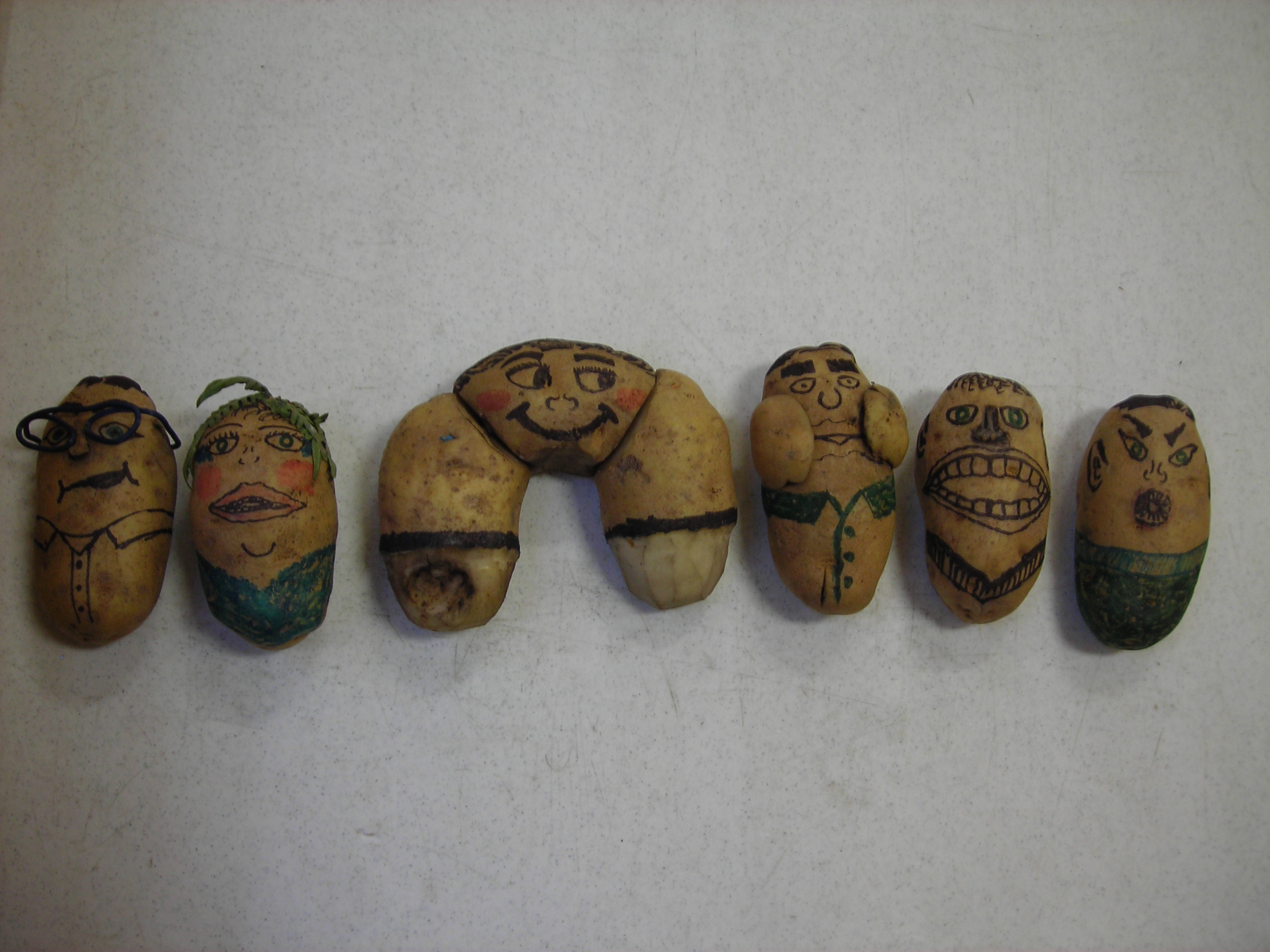
meet the taters

The Tater’s family are a memorable family. I was introduced to the highly dysfunctional Tater family and their ongoing saga through Travis Huseby at Checkpoint Bible Camp. Here is a glimpse of the Tater Family:

Uncle Common Tater

He is no common Tater!? Common has the gift of gab. He makes a living in broadcasting and is good at communicating. He is certainly a chatter box outside the press box. He always has a story to share, and people are interested in hearing him ramble about random happenings.

When you get to know Common you will quickly observe that he does a lot of talking, but not a lot of walking. His bark is louder than his bite. In fact, he is a Sweet Tater, never saying anything bad about anyone. He is certainly a people pleaser. Common could be a mighty spokemen for God’s glory, rather he is ashamed of the gospel of Christ [Romans 1:16-17; 10:14-17].

Speck Tater

Speck is the father of the family. He is intelligent, dedicated to his job, pays the bills, but is not particularly outgoing on the home front. He is the dad you see on the sidelines. Speck is not doing much to support his Tater’s, much like his father Hesi Tater. He is one dud of a spud.

Speck, as Pa-Tater, needs to get off the bench and into the game before time runs out and life has past him by. His family is his most important responsibility. His greatest impact as a father is to train up his children in the ways of God [Proverbs 22:6], and modeling Christ’s through his loving and committed marriage. This cannot be done by passive spectating [Ephesians 6:4], but by active husbandry and priority parenting.

Ima Tater

Ima is the decorated daughter of the family. She is no darling. She models and mimics the world. Her friends often sway her opinions. Roe Tater, her best friend, switches boyfriends weekly, complains about not having enough, and brags about spoiled habits. She is swoon by current fads, trends, and teen idols [aka: Idol Tater].

An idol is anything you worship, and what we worship we become. An idol can be a material possession, a feeling, a person of interest, a place of comfort, or anything that captivates your heart. The Bible says to imitate Christ [1 Corinthians 11:1], and to destroy all idols before they destroy you [Isaiah 40-49].

Agi Tater

Agi is the always angry son who must have inherited the spicy Irish Tater genes. He tends to mash, scalp, or fry any Tater that gets in the way of his plans. His parents blame his bad behavior on Iri Tator, a bullish friend at school.

Agi is self-centered, never wrong, and a big-headed boaster. When things are not going his way you will surely hear about it. Can Agi gain control of his anger? Anger itself is not sinful [Ephesians 4:22ff]. In fact, anger is a God-given emotion that can be used for glorious means in defeating sin and choosing righteousness. Followers of Christ can learn how to control their anger [Titus 2:11-15].

Regurgi Tater

We all call him, Reggie. He is the younger brother [aka: Tater Tot] who tends to tattle tail. He hurls up information quicker than a baby spews up their bottle. Reggie’s feed off of gossips and lies for his own satisfaction [1 Peter 2:1]. The tongue is like a wild fire. A little spark can do a lot of damage [James 3:1-12].

In the Scripture the word often referring to regurgitation is meditation. The Bible says as followers of Christ we must meditate on God’s Word by: reciting it [Psalm 119:11], reviewing it [2 Timothy 2:15], and renewing our minds by it [Romans 12:1-12]. When we think about God’s Word and chew on it we are reminded that other people are created in God’s image and defaming them offends God.

Gravi Tater

Gravi is the mama of the spud bunch. She is large and in charge. If mama ain’t happy, nobody’s happy. Big mama has control and stay out of her way. Everyone agrees that she takes after her father, Dick Tater. She can certainly be a Sweet Tater when she wants to be. Even as her family is falling apart, she finds a way to contribute by butting herself into everybody’s business. She could be using her magnetizing clout to bring everyone together in unity [Ephesians 4:1-16].

The Tater family does have serious issues. If we were honest we probably see some of the Tater family in our families. My suggestion is that the Tater’s go to Counsel Tater [aka: Pastor Ed U. Tater]. Their they will discover the root issue is sin. Sin is like a bruise or spoil that needs to be cut off or it will infect the the Tater if not the batch of Tater’s. Unfortunately our sin affects others around us, especially those in our immediate family or church [cf. Romans 12; 1 Corinthians 12]. Deal with sin swiftly by lovingly confronting it and helping in the change process. Through God’s grace the Tater family can begin to learn from their Creator how to live in His image [Genesis 1:26-27].

jealousy

Jealousy is as old as Cain and Abel (cf. Genesis 4). Man has often displayed jealous behavior to get what he wants, when he wants it; usually in spite of a person or situation. Jealousy is a strong response that can be used for extreme harm or extraordinary good. The letter of James (4:5) touch’s on the topic of jealousy with reference to a certain Old Testament quotation. What is jealousy? Is jealousy godly? Is the jealousy of God in the OT the same or different as that seen of God when mentioned in the New Testament?

James 4:5 says, “Or do you suppose it is to no purpose that the Scripture says, “He yearns jealously over the spirit that He has made to dwell in us”?” James 4:5 specifically states he is quoting Scripture, but when scanning the OT, one observes there is no passage that it directly quotes. However, there are many OT texts that it could be alluding or echoing.

The God of the Bible is a jealous God. Theologically speaking, the theme of God’s jealous love for His people is tied to the exclusiveness of his claims like the exclusiveness of a spouse’s claims in marriage. This claim is ratcheted up because God is not only the metaphorical husband of His people but also their God. He alone is God. Since He is personal, God is jealous when His followers commit adultery because of the betrayal of idolatry. God longs for His follower’s faithfulness with a jealous longing.

Teaching God’s Jealous Character from Exodus 20:5 & 34:14.

From the decalogue and the Law we see teachings of a jealous God (Exodus 20). God is jealous within a concrete context of covenant infidelity (Exodus 34). James describes a jealous God who has not changed in His demand of absolute devotion to Himself by obedience to His commandments. The Hebrew word for jealous [קַנָּא] is used only of God with the focus on punishing those who hate Him (Ex 20:5; 34:14; Dt. 4:24; 5:9; 6:15) and demanding exclusive service (Ex 34:14).

The second Commandment expands and explains the first commandment. It deals with the heart, rather than the object of worship. This commandment becomes the gauge that measures the spiritual vitality of God’s people. God desires worship above all else. Commands against idols and pagan gods appear throughout the OT. Although James is so practical in structure, the doctrine of God is vital to the teaching of the letter. Throughout James’ letter there is an emphasis on a monotheistic God who is One (cf. 2:19). Within the doctrine of God is the doctrine of His character. James emphasizes His jealousy. God is jealous because He desires His people to adhere to the law and likewise abstain from being worldly. God’s jealousy is seen in the Law and through James’ command to His people to obey Him exclusively through their faithfulness and denial of worldly pleasures.

Analogy of Worldly Friendship from Deuteronomy 6:14-15.

The character of a jealous God who desires faithfulness in His people continues throughout the OT Torah. God is jealous for His people and desires them to worship Him exclusively. In the Septuagint [LXX] the word for jealousy is ζηλωτής–where we get our English word ‘zealous,’ or better translated ‘envy’. Within James 4:4-5, a discussion exists of worldly attitudes rooted in fights and quarrels among believers. These attitudes were from envy and selfish ambition in the pursuit of worldly pleasures (cf. James 4:2a, ζηλοῦτε). These selfish motives led to worldly lifestyles (cf. James 3:14-16). Selfish living is the antithesis of a faithful relationship with God. Selfish ambition is considered rebellion and adultery against God (Deut. 6:14-15).

The call to reject pagan idolatry in the OT was primarily against the cultic worship and gods of other nations like Babylon and Assyria. However, the idolatry in the NT brings friendship with the world to the level of being an enemy of God. Worldly living is against that which God teaches and expects of His people. One either loves God or loves the world. Loving the world to James means not only that you don’t love God, it means you are His enemy

The idea of friendship in OT and NT culture was not the shallow depiction that we see in today’s culture. God intended friendship to encourage spiritual unity and accountability against idolatry and worldliness. With a deeper understanding of friendship it becomes clear that—as James says—love for God and love for the world are mutually exclusive (cf. Luke 16:13; 1 John 2:15-16; Matthew 6:24). To be friends with the world is to be God’s enemy. Love for the world or other gods is treason toward God. God is a jealous God and does not tolerate compromising relationships, especially with the gods and idols of this world.

Analogy of Adultery from Ezekiel 16:38, 42.

Ezekiel continues the theme of the Law by echoing that God is jealous for His own honor. Ezekiel compares the rebellion of his day to that of the Exile during Moses’ day (cf. 20:1-26). Ezekiel pleads for God’s grace and restoration in the light of His jealous dealings throughout time (20:42-44). Ezekiel also touches on the adultery of his people and the jealousy of a God who desires their faithfulness (16:38, 42). God keeps His covenantal wedding vows and expects His bride—the nation of Israel—to uphold them too.

Ezekiel continues in the vein of James by relating God’s jealousy to that of an adulterous relationship. It is very likely James is thinking of the OT view that God—the jealous lover—is married to His people and His bride is adulterous and unfaithful. The reference to women in Ezekiel adheres to God’s people being His bride. James’ readers are the church, which is the Bride of Christ. Jesus also used this marriage analogy to call His followers to faithfulness.

In a godly marriage, there is a healthy form of jealousy which a husband should have for his wife. If he found out that she was having affections for another man he would rightly be jealous of her love. If he did not, one would question the husband’s love for his bride. James and the OT reinforce this analogy. God loves His people though they have committed spiritual adultery. God is gracious to restore them if they repent and turn back to Him.

James 4:5 demonstrates in the NT that God desires total allegiance as He did in the OT. God is a righteously jealous Husband who tolerates no rivals. We cannot be friends with the world without provoking the jealousy of God. We cannot claim to be the bride of Christ and then run to the worldly “man next door” for comfort. James supports the OT texts that command His people to turn from all spiritual adultery and be exclusively devoted to God. Living for self and seeking pleasure apart from God is to commit spiritual adultery. To James, active faith is tested by the world and God expects His followers to be faithful to Him alone.

To view a more technical paper with sources see JEALOUSLY intertextuality paper [James 4.5]

nearly perfect forgiveness

On the last out of the last play of a perfect game Umpire Jim Joyce emphatically signaled safe setting off a roar of groans echoing through the stadium. Everyone who saw the play could see that Jason Donald of the Cleveland Indians was out at first base.

The call could not be reversed. It was final. No instant replay. Just a bad call leaving a bad taste in the mouths of Detroit Tigers fans who have never seen a pitcher in their pinstripes pitch perfect game in the entire teams existence.

Joyce later admitted that it was a bad call. It is rare for an umpire to acknowledge a mistake. It really shows genuine humility and character. The veteran umpire personally apologized and hugged the prospective perfect pitcher Armando Galarraga after the game. In the locker room following Joyce said, “It was the biggest call of my career, and I kicked the [stuff] out of it. I just cost that kid a perfect game.”

Today at the game the team awarded Galarraga with a brand new Corvette. Joyce and Galarraga met at home plate and the pitcher presented the umpire with the Tigers’ lineup card. Joyce shook hands with Galarraga and patted him on the shoulder. Joyce wiped away tears and and went to work. The MLB gave Joyce the option to not work today’s game, but Joyce chose to stick with his job behind the plate.

Joyce later said to reporters, “I wish my family was out of this. I wish they would direct it all to me. It’s a big problem. My wife is a rock. My kids are very strong. They don’t deserve this.”

This is a wonderful lesson of forgiveness and restoration. Joyce’s willingness to admit fault was courageous, but Galarraga smile despite being ripped a perfect game was priceless.

Ephesians 4:32 says, “Be kind to one another, tenderhearted, forgiving one another, as God in Christ forgave you. Therefore, be imitators of God, as beloved children. And walk in love, as Christ loved us and gave Himself up for us, a fragrant offering and sacrifice to God”

a fruitful look at forgiveness

We have defined forgiveness as a decision to treat an offender as if the offense never happened at all. Forgiveness is a choice. Forgiveness is an event, not a process [i.e. Jesus on the cross]. Forgiveness is not forgetting, rather it is not dwelling. Forgiveness is like taking a trash bag full of pain and hurt and throwing it away. However, many people like to go to the dump and dig through their old dirt, but that gets you more messy and stinky.

The Bible paints a picture of forgiveness as a tree with deep roots and healthy fruits. The Bible uses this illustration to say that what comes out of a man’s mouth shows you what is in his heart [cf. Luke 6:43-46]. The root of the matter is the heart. The fruit is our behavior. Ephesians 4 gives a practical principle of how to test the quality of fruit by getting at the root issue. God has not called us to be fruit inspectors; rather we are to be root investors.

When I hold onto unforgiveness I will produce destructive fruit [Eph 4:31].

We often ignore or fail to realize the cost of unforgiveness. The cost of unforgiveness is loss of intimacy with God, loss of relationship with others, and stunted spiritual growth [i.e. put off—bitterness, rage, anger, etc.]. If I do not deal with my ungodly anger quickly it will soon be snowball that ends in a deadly avalanche.

I want you to get a real look at forgiveness [Is.55:8-9 “For my thoughts are not your thoughts, neither are your ways my ways, declares the Lord. For as the heavens are higher than the earth, so are my ways higher than your ways and my thoughts than your thoughts.”]. This is not just a passage about the bigness or smartness of God, in the context it is about His forgiveness. You see we measure our forgiveness with a yardstick: Are they worthy of my forgiveness? And how much am I suppose to forgiven them? God’s forgiveness cannot be measured or compared to our view of forgiveness. Our forgiveness is so little compared to God’s. We cannot conceive the boundaries on God’s forgiveness.

When I unleash forgiveness I produce delightful fruits [4:32a]

“Be kind to one another, tenderhearted, forgiving one another.” When I put off the fruits of the old man and begin to live as the new man Christ created me to be I begin to bear fruit that is in His likeness [cf. Gal.5:16ff]. His image has rub off on me. You cannot fake this kind of fruit for long. It is the result of an intimate relationship with the maker and sustainer of the universe.

Growing up my grandpa Dale had a few apple trees. The apple tree didn’t produce much. It just produced dry, wrinkled, brown and mushy apples. Let’s say gramps decided to fix the tree one year. He went out to the tree with trimmers, a staple gun, stepladder and a box of apples he bought from the store. He cuts off the bad apples and puts on the new store bought ones. Did he fix the tree? Stapling apples will not help because they will just rot too. Forgiveness that doesn’t reach the heart [roots] does not last. Cosmetic changes never satisfy. Are you stapling fruit? You can know if you are forgiving person if you have the freedom to give your best, most, and greatest to God and others without reservation.

Why do I need to be forgiving? What is my motivation? [4:32b-5:2]

“As God in Christ forgave you…” When I forgive I am most like God [cf. Matthew 6:12]. I want to be forgiving because I realize how much I have been forgiven. Stop for a moment. Think about all God has forgiven you. Are you amazed? How can you not be impacted by that truth? Think about those you are having a difficult time forgiving. How can God’s forgiveness motivate you to forgive today?

I am certainly no trekkie, but in conclusion we are going to take forgiveness through to the fourth dimension. Here is how we must deal with unforgiveness: First, defer to God. All forgiveness is from God—He is the final frontier [John 20:22-23]. Second, decide to take the initiative. God gives the grace, and you must you decide to enter the race [cf. Lk.15:20; Rom.12:18]. Third, disengage from your emotions. Even if you don’t feel like forgiving that is not an option [Gal.5 “fruit of the Spirit”; Is.43:25]. Fourth, the final dimension is to deliver your enemies to God through much prayer [cf. Luke 6:27-28].

speak forgiveness

Have you ever said anything that you regretted? This week, instead of saying the word song or tong, I said the word thong both in very awkward church related settings. When I refer to regretful words I am not speaking of embarrassing moments but to purposeful things you say that are hurtful and harmful to others.

In 5th Grade I was riding home from school on the bus. Behind me there was a classmate who was making fun of me by saying things that were rude and crude. I had enough and there was a decision to be made: turn the other cheek or wipe the smirk off his cheek. I chose the later. I charged back there and started wailing on him. The bus driver slammed on the breaks. I flew forward. The bus driver rushed to the back of the bus and grabbed us both by our shirts and ushered us up to the front of the bus. We didn’t make it to our homes that day; instead, we waited for our parents at the bus barn. My mother was not a happy camper.

When someone offends us we want to hold onto the hurt and anger. Or we want to pursue payback, seek revenge and retribution. Unforgiveness is controlling. When we choose to not forgive we put the perpetrator in the drivers seat and say in a sense, “You are in control, you call the shots.” Unforgiveness is like a dog leash and its master is the one who has offended you.

God knows that we struggle with forgiving and being forgiven. That is why He has given us His Bible. He communicates with us and gives us an example of how to communicate with others. He knows it is our mouths that get us into the most trouble. He builds a bridge and gives us the means to get over it. Let’s look at four fascinating truths God gives on how to be forgivers and godly communicators. If we seek to live by these it will save us from a lot of conflict.

1. Speak the Truth [4:25]. Unforgiving people love to latch onto lies. People who do not put off falsehoods will tend to say things like, “You always ____. You never _____. Every time I ____, you _____.” Rather than speaking in absolutes; gather the facts, never assume anything always ask for what is true [cf. 1 Cor.2:11; Phil 2:1-3]. Speak the truth in love to build up, not to break down [cf. 1 Cor.13:1-3; Eph.4:15]. Do not burn your bridges, rather seek to build them back.

2. Solve Today’s Situations Today [4:26-28]. Don’t let the sun go down on your anger because you more than likely will not deal with it. Not dealing with it is not dealing with it. We tend to hold off on dealing with confrontation or forgiveness until a better day when it feels right or the timing is right. But digging up the past should be left to archeologists and projecting on the future is for prophets. Adding time to anger multiplies the problem. Unresolved unforgiveness or anger leads to bitterness. Deal with your situations today by keeping current.

Here are some good questions to ask before you speak:

  • Do I have my facts right? Proverbs 18:13
  • Should love hide this? [i.e. Is it “sinful” or preferential?] 1 Peter 4:8,
  • Is my timing right?  Proverbs 15:23
  • Is my attitude right?  Ephesians 4:15
  • Are my words loving?  Ephesians 4:15
  • Have I prayed for help?  Proverbs 3:5

3. Slay the Problem not the Person [4:29-30]. Words pierce people to their core. Words can bring life or kill [Proverbs 18:21, cf. Mt.5:21-26]. Corrupting talk is when you your words, statements and tone to disintegrate others. We can be champions at putting other people down. Like Goliath we have a big mouth that gets us into trouble. David let God do the fighting for him.

Hurtful, harmful and hateful words do not only grieve the offended, but also God. Do you know why? Each and every person was made in the likeness and image of God. When we break apart peoples character it tarnishes the very God who created them. Corrupting talk does not help the situation, however, edifying words search for a solution [cf. Eph.4:15; Col.4:5-6].

4. Step ahead, don’t step back [4:31-32]. Be proactive in your speech rather than reactive. In other words, act—don’t react. We have a tendency to justify our primary sin with a secondary sin [i.e. Gen.3:8-13]. When someone offends us and we fire back in anger, wrath, bitterness, and slander we are letting them get the upper hand. God says as followers of Christ we are to step it up by putting on the character and communication of Christ.

When Jesus was ushered to His death sentence as an innocent man He never defended Himself. It is not the He was a weenie or wimp, or that He was too cowardly to stand up to His accusers. In fact, He was more courageous because He did not retaliate. He let God do the fighting for Him. In the midst of unfair and unforgettable circumstances He remained kind, compassionate and forgiving [i.e. Is.53:4-12].

Years later after the school bus brawl I had a similar situation occur. Somebody was accusing me a things that were false, slandering my character, spreading lies and gossip. Instead of heading over to their house and letting them have it, I quietly confronted them in love and grace. In time, God did the fighting for me and I did not have to do anything to prove myself. I extended forgiveness to the offender and treated them as it never happened. Do you know what happened? The kindness of the God had taught me, and the forgiveness that God had given to me was used as an instrument of brokenness in this person’s life. Forgiveness is a mighty weapon of restoration in the hands of God [Romans 12:21].

The way you communicate and extend forgiveness to others reveals your relationship with God [Luke 6:45].

unleashing forgiveness

I had just turned 16. My parents were away for 4th of July weekend and I had my step-dads truck all to myself. He had the coolest looking Mitsubishi Montero. Looking back, the man who gave oversaw my drivers test earlier that March was more into the 4×4 gadgets inside than how I was driving outside. I passed. I do not recall having permission to take out Mike’s truck that weekend, but it was the 4th of July, and my friends were banking on me taking them to the fireworks on the Rib Mountain in the Montero. So with the moon-roof down, music cranked and the 4-wheel on we head up the mountain in the Montero.  All was good and we had a great night.

The next day I had to work. Since we got in late the night before and I had to work so early I decided I would take the Montero [I usually took the bus or road my bike]. No harm, right? As I was pulling into the mall-parking ramp my foot got stuck on the accelerator and the car rammed into the concrete ramp. Cars were lining up and honking behind me. I put a $5000.00 dent into the truck. My sin had just found me out. My parents called that night and ask how I was doing? I did not mention a thing. When my parents got home a few days later my step-dad opened the garage viewed him damaged Montero and was furious. That 4th of July I had to learn a valuable lesson about forgiveness.

Forgiveness is unnatural. We want to hold onto the hurt and anger, payback, seek revenge and retribution. Have you ever been there? Have you been on the offended end of hurt, blame, finger pointing, or collateral damage? Do you really want to live like this? Who are you having a difficult time forgiving?

what is forgiveness?

It is a decision to treat an offender as if the offense never happened at all.

why should I forgive?

Peter asks this very question to Jesus and you sense he is struggling with unforgiveness [Matthew 18:21], since earlier Jesus had taught about what to do if a person offends you [18:15-20]. In Jesus’ day Jewish rabbi’s taught that if you forgave someone three times you were really forgiven, but super spiritual Peter trumps that number to seven. Jesus is going to answer the haughty question using a simple story [18:22-35].

Unforgiveness is foolish [Matthew 18:22-27]. God is like the king who forgives the servants $10 million dollars debt. In those days filing bankruptcy was not an option. If you could not pay, off to the slave market you went. What a forgiving king. God says there are endless reasons to forgive. However, we have endless excuses for not forgiving someone who has offended us. Sin is always irrational, full of excuses and deceitful. I have heard people say, “The hurt is too big.” We believe that there is no possible way to forgive ____ for doing ____ because the wound is deep, fresh and still bleeding. I have heard others say, “Time will heal it,“ “They are bound to do it again.” “I cannot forgive until I forget.” We humans have a hard time forgetting. The problem is forgiveness is the process God uses to help us forget.

Unforgiveness is like a cancerous tumor. The longer it is left unchecked the harder it is to remove, and the messier and more complicated it becomes. Unforgiveness is controlling. It is like a dog leash and its master is the one who has offended you. Unforgiveness will continue to become a weight that becomes heavier and heavier until you deal with it. When we harbor unforgiveness we are saying, “Okay, you control my life. I’m the puppet. You have the strings.” I have lived that way before, for years I was leashed to unforgiveness to my divorced parents who I blamed for my anger and sin issues.

Unforgiveness is dangerous [vs.28-30]. If we decide not to forgive it can destroy people. Think about it: the forgiving servant was forgiven $10 million dollars, but he was bent out of shape over someone who owed him $11 dollars. Ridiculous!? The same is true for one who is a child of God. If Christ has forgiven you of all your sins and you cannot forgive another for one sin, ridiculous. Unforgiveness will destroy you and others.

Unforgiveness is Godless [v.31-33]. Question: How much has God forgiven you? What does it say about God’s forgiveness if we cannot forgive an offender? It slaps God in the face. It says His forgiveness does not cut it. Unforgiveness is anti-God.

Unforgiveness is torturous [v.34-35]. If we do not deal with forgiveness it will deal with me. Ultimately it will destroy me and separate me from the Forgiver.

how do I know if I am forgiving?

Going back to Peters original question do you notice Jesus’ response? [v.22] “I tell you, not seven times, but seventy-seven times.” Jesus is not saying you should forgive 77 times, but forgiveness is over and over again. Forgiveness is to be a habit. Now I am not going to minimize how bad someone has hurt you, but do you realize what forgiveness God has given you? Forgiveness starts and ends with God. I learn forgiveness from Him, and I give forgiveness in Him. How do I know if I am a forgiving person?

First, I am not deceived by my pride. You are quick to admit what you did was wrong and seek forgiveness, or you are quick to offer forgiveness by not harboring unforgiveness. Unforgiveness is not your mother’s fault, your friend’s fault, rather own up to it yourself. Second, I am not defensive or protective. You do not have to pay back, pick that fight, or rebel to prove you are right. Instead you leave that up to God [Romans 12:19]. Third, I am motivated by Christ’s forgiveness, so I forgive. It is freeing to allow God to fight the battles for you and to rely upon His forgiveness to forgive others.

Forgiveness is unnatural, but necessary. As followers of Christ forgiveness should come more naturally. Unleash unforgiveness before you are lynched by it.

transformodification

Does God want to change my sinful behavior into behavior that glorifies God? You bet. However, you must be careful that you do not make behavior modification the goal of discipleship. God desires transformation in His followers.

“When morphing [transformation] happens, I don’t just do the things Jesus would have done; I find myself wanting to do them. They appeal to me. They make sense. I don’t go around just trying to do the right things; I become the right sort of person.”[1]

People will come to your church to know more about God [in fact, this was the number one survey reason why teens come to FUEL]. People are curious how God fits into their life. They take the bits and pieces they like or pick and choose the ideas they are convinced will change their situation. However, viewing God like this is no different that believing He is a psychologist, medical antidote, or genie-in-a-bottle.

Changing the outside of a man doesn’t mean his insides are changed [cf. Matthew 23:25-26]. In other words, asking an unbeliever to be like Christ is similar to asking an alcoholic to quit drinking cold turkey. The alcoholic may go to AA, find community, and successfully quit his/her drinking addiction, but often trade addictions [i.e. begin smoking] because they are not encouraged to deal with the root issue of their addiction. Encouraging a non-follower to change attitudes and actions without the heart motivation doesn’t lead to lasting or permanent change. They will eventually fail because they do not have a relationship with Christ or true connection to the community of Christ [His church].

If we teach change before teach about Christ we are setting our disciplees up for disaster. Changing behavior to be like Christ without having a relationship with Christ can feed pride, give false assurance, and create an I-am-all-right-with-this-now attitude. Behavior on the outside might appear Christ-like, but on the inside they have a twisted and wicked heart. Whatever rules the heart will exercise inescapable influence over the person’s life and behavior.[2] I am reminded often that God is solely after obedient hearts.

“These people come near to Me with their mouth and honor Me with their lips, but their hearts are far from Me. Their worship of Me is made up only of rules taught by men.”[3]

Don’t piecemeal God into your life; He wants to break you so that you give Him everything. I want to encourage those I am discipling to or in Christ to stop fitting God into their plans and start fitting their life into God’s plan. I want to help them count the cost of commitment to Christ. Help facilitate change of the heart first and foremost to see God bring about transformodification [and yes, I did make the word up].


[1] John Ortberg, The Life You’ve Always Wanted, Grand Rapids, MI. Zondervan, 1997. 23.

[2] Paul Tripp, Instruments In the Redeemer’s Hands, P&R Publishing, Phillipsburg, NJ, 2002, 68.

[3] Isaiah 29:13

followership unmasked


Are disciples looking for perfect leaders or authentic leaders? As Christian leaders, it is tempting to want to put on a mask that hides the fact that at times you struggle with sin and fail in your faith too. Now I must never give glory to my sin, but glory in the grace I have in overcoming sin. Here are some biblical ways we can build trust and increase deeper counsel with those you are discipling:

Transparent prayer. Our prayers can be vague and lifeless. Learn to pray honestly and humbly. Pray expresses our neediness of God and that He is the only One able to meet our needs. Psalm 32 and 52 are great examples of transparent prayers that express need for God.

Share your life story. I am sure you have been through some valleys and climbed some mountains. Like the apostle Paul we have a story dotted with dark spots [cf. Acts 22:1-21], but those times make God really big. Sharing how you have been transformed by the power of God and continue to battle against sin take be a tremendous encouragement to those you are ministering.

Ask for Help. You are never self-sufficient or independent of your need for accountability and ministry from others. It is helpful to get others believers to pray for you and hold you accountable. You have not arrived yet, nor are you invincible. I need your help in the partnership of the gospel [cf. Philippians 1:3-18].

Admit you don’t know it all. What do I do if someone asks me a difficult theological or practical questions I do not know how to answer. I say, “That is a good question, I do not know, but I will find it out for you. I believe the Bible has the answers. Can I get back to you on that question?” [cf. 2 Tim. 3:16; Isaiah 55:9]

Be real. Do not hide your pain, sorrow, joy, heartache or frustration [cf. Romans 12:9-21]. God gave you emotions to use for His good [cf. Jeremiah and Lamentation]. Real men cry.

Point to the promises of God. Putting on the mask of sinlessness fails to help others to see the God’s faithfulness [Deuteronomy 7:9; 1 Corinthians 1:9]. Whatever good I have in my life was put their by God. I am not holy, but He that is holy has helped me to become Holy by the Power of His Spirit [cf. 1 Peter 1:13-25]. People need to see and hear that from you. Pull off the mask and let people see how God is at work in and through you.

True followers are seeking other genuine followers who are following hard after God.