Killing Sin: Mortification

“Be killing sin, or sin will be killing you.” (John Owen)

You cannot tame sin, it will turn on you at the first opportunity. You cannot get the wild out of sin simply by caging it. Sin will never be domesticated. It’s a wolf, not a dog; it’s a piranha, not a goldfish. Evil is untamable. Sin is wired to destroy.

Mortification Misunderstood

1. Mortification does not produce perfection. While sinless perfection and holiness are the goal you realize it is not possible (Gal.5:17). The Bible describe the Christian life like a walk, you are moving in the direction of holiness, increasing in Christlikeness, and pressing on for the prize (Phil.3:12-14).

2. Mortification is not furthered by asceticism. You cannot remove yourself from the world and expect to be unworldly (1 Tim.4:1-5; Col.2:21-23). God created the world good. The problem lies within your heart.

3. Mortification is more than behavior modification. It is possible to change what you do, even reduce the frequency of certain sins, without actually becoming more pure of heart.

Mortification’s Meaning

Mortification is killing sin (crucifying the flesh). It includes putting to death sinful actions and their sinful motivations. The image of mortification does not suggest finality, but the vehemence, enmity, and total-war mentality to be had towards sin. Mortification is not a once and for all action, but a process. (Cf. Romans 8:12-14; Colossians 3:5-10; Galatians 5:24)

10 Ways to Kill Sin (not exhaustive, but helpful)

1. Yield yourself to God. Surrender (Rom.6:12-13; 12:1). “We try to hold at bay the gnats of small sins while swallowing the camel of self.” (David Wells) To win the war on sin you’ve got to first dethrone yourself. Deny self-rule for God’s rule (Mk.8:34).

2. Accept that the battle never ends. “You must always be at it while you live; do not take a day off from this work; always be killing sin or it will be killing you.” (John Owen; Rom.8:12-13) There is no cease-fire in this war.

3. Take God’s side against your sin. Act on holiness; act against sinfulness. It takes a discipline of ongoing repentance.

4. Make no provision for the flesh. Fire starts small, then gets bigger. Put out the matchstick flame before it becomes a forest fire. (Rom.13:14) Light few matches and snuff out the ones already lit. “Rise mightily against the first sign of sin. And do not let it gain the smallest ground” (John Owen) Sin is subtle and it sneaks up on you like soft-soled slippers. Be ruthless and radical with sin (Mk.9:43-48).

5. Use your spiritual sword. “Either this Book will keep you from sin, or sin will keep you from this Book.” (Ps. 119:9-11; Cf. Eph.6:17; Rom.8:13; Mt.4:1-11). Sharpen your skills within the Word of God, your spiritual sword.

6. Aim at the heart. Sin is a matter of the heart (Lk.6:45; Mt.23:25-26). Stomping on the fruit of sin, won’t kill the tree. You got to hack the roots out. Hypocrites fail to grow in holiness.

7. Replace sin with grace. The most practical way to kill specific sin is to cultivate the particular virtue that counters it.

8. Stay in community. Battles are best fought with armies, not individuals (Ecc.4:9-10; Heb.3:12-13). Perseverance in the faith is a community project. “Lone rangers are dead rangers.” (Joshua Harris) Cherish the “one another” commands and be willing to confess your sins to one another (Js.5:9).

9. Look to the cross. “There is no death to sin without the seat of Christ.” (John Owen; Rom.8:1-13; Gal. 6:14) Because of the death  resurrection of Christ, we fight from a position of victory.

10. Depend on the Spirit. (Rom.8:13; Gal.5:16) Mortification from self-strength, carried by ways of self-invention, to the end of self-righteousness, is the soul and substance of all the false religions of the world.

The battle is not against our joy and happiness, but for our maximum pleasure, pleasure in God.

Adapted from Brian G. Hedges, Christ Formed in You: The Power of the Gospel for Personal Change. Shepherds Press, Wapwallopen, PA. 2010. p.77-96

How God uses Suffering

The cross and the resurrection are the ultimate answer to suffering. And we really can trust the good purposes of God in suffering to make us more like Jesus.

1. God uses suffering to teach us His Word.

Suffering makes us more receptive to God’s transforming Word. “Though the word and the Spirit do the main work, yet suffering so unbolts the door of the heart, that the word hath an easier entrance.” (Richard Baxter) Thomas Watson called afflictions our “preacher and tutor,” and “A sickbed often teaches more than a sermon.” (Ps.119:67, 71, 75, note: Matin Luther said Psalm 119 follows the pattern of prayer > meditation > trial)

2. God uses suffering to wean us from idols.

“Sinful desires can lurk in our hearts unnoticed because those desires are neither threatened nor thwarted. But suffering stirs the calm waters of latent sinful desires. It reveals the true state of our hearts. It’s God diagnostic tool, preparing the way of the medicine of gospel truth.” (Tim Chester, Ps.119:50, 92, 107, 153; Ecc. 7:13-14)

3. God uses suffering to discipline us.

Suffering through discipline is a badge of sonship. There is a distinction between God’s father discipline and punishment for guilt (Ps.103:10-13). Suffering is part of our training (Heb. 12:5-11). “God’s rod is a pencil to draw Christ’s image more lively on us.” (Thomas Watson)

4. God uses suffering to test and purify our faith.

Endurance is essential, not optional (Mt. 10:20; Rom. 5:3-5). Rejoicing in trials reveals the genuineness of our faith (Js. 1:2-4; 1 Pt. 1:3-7) Suffering refines our faith (Ps.12:6; Prov.27:21; Job 1:13-19; 2:7-8; 23:1-10). Like a Damascus blade, a believer is strengthen only by sleeping in the flames. The refiners fire is hot–but it burns away the dross and tempers the metal of our faith, making it stronger.

5. God uses suffering to increase our usefulness.

“Let a Christian be but two or three years without an affliction and he is almost good for nothing.” (John Flavel) God uses suffering to work on our character to become dependent on Christ and useful to others (Jn.15:1-2). Sometimes, God positions us in difficult circumstances that paradoxically make us more effective (i.e. Paul, Philippians 1:12-14; 2  Cor. 1:3-7; 4:7-12). The gospel achieves victory through our apparent defeat.

6. God uses suffering to prepare us for glory.

Present afflictions actually work for our future glory (Rom.8:18; 2  Cor. 4:16-18). “They say of some temporal suffering, ‘No future bliss can make up for it,’ not knowing that Heaven, once attained, will work backwards and turn even that agony into a glory.” (C.S. Lewis) View your trials as seeds of eternal glory planted in the soil of your present lives. God is using our trials to make us better, more beautiful creatures than we could ever otherwise become. Demolishing our old cottage is painful, but God is building a palace is you allow Him.

Suffering is not good in itself. It is the result of sin and brokenness in our world. Yet God promises to weave dark threads of affliction and trial into the tapestry of His ultimate saving plan. He is a sovereign God, but His ways involve suffering. With wisdom, love, and goodness, He designs our difficulties and assigns our afflictions to conform us to the character of Christ (233).

My greatest comfort comes from knowing that, because of the suffering, death, and resurrection of Jesus; the suffering will someday cease once and for all, and that God’s ultimate purpose to glorify Himself in bringing many some and daughters to glory will be fulfilled (234).

Adapted from Brian G. Hedges, Christ Formed in You: The Power of the Gospel for Personal Change. Shepherds Press, Wapwallopen, PA. 2010. p.222-234

Sophia Helena [part 2]

I believe God gives us children and their sole purpose as infants is to bring their parents and everyone else joy. Baby’s are bundles of joy.

We are so thankful for our new daughter. Some has asked how did we chose to give her name  Sophia Helena Hutts?

Sophia. It is a classic name that’s made a recent comeback. Sophia is not only a name but it is a word rooted in the ancient Greek word for wisdom. The Bible often uses the word sophia to describe the divine wisdom of God (Romans 11:33; 1 Corinthians 1:21, 24; Ephesians 3:10; Colossians 2:3; Revelation 5:12; 7:12).

Helena. Since Sophia was born just west of Philadelphia, Sarah thought that it would be fitting to name her after a woman she deeply respects who lived nearby. Helen Evans was a long time member at Marcus Hook Baptist Church and Sarah met her the year she ministered at the church. Helen was a school teacher in the rougher areas of Philly, an avid student of God’s Word, a memorable Sunday School teacher, and faithful follower of Christ. Helen was an example of divine wisdom. Two years ago Helen passed away, but her name will live on through Sophia.

Our Prayer for Sophia Helena. Father, we are grateful for the beautiful life You have created and blessed us as her temporary caregivers. To the best of our abilities we will raise her under the knowledge of Your Word and the guidance of your Spirit. Sophia already brings us joy and brings You glory. You are all-wise and we ask that You would fill her with Your divine wisdom in Christ. May her life be marked by Your wisdom from the day of her salvation until the day of her death. In Jesus name. Amen.

Jesus is

He is.
Jesus holds me closer than a friend.
He is my defender – Whose love will never end.
He is all my smiles.  He is all my tears.
Jesus is the truth that swallows all my fears.
Jesus is my light. Jesus is my path.
He it is Who carries me and pacifies God’s wrath.
Jesus is the merciful. Jesus is the law.
Both now and through eternity, He remains my All.

by my wife, Sarah

Sophia Helena Hutts

This morning at 9:10am God brought a new life into the world.  Our daughter Sophia. She is hearty and strong. 7.5 pounds and 19.5 inches long.

Sophia came quickly once Sarah’s body was ready. But getting to ready took time. Early Friday morning around 4:30am Sarah’s water broke, but no strong contracts came until the evening. The midwife came to our home about 9:00pm and stayed until 4:30am when she recommended that we go to the hospital since no baby had come within 24 hours of her water breaking.

So we hopped in the car and drove to the hospital in the wee hours of the dawn and Sarah was able to kick start some contractions. Within minutes Sophia was born.

Justus is now a big sister to a little sister. She doesn’t know what to think quite yet, but interest in this new person taking up her parents attention.

Sarah and Sophia are resting from a long day of waiting.

More to come…

How does Jesus fulfill the 10-Commandments?

“Do not think that I have come to abolish the Law or the Prophets; I have not come to abolish them but to fulfill them.” (Matthew 5:17; Cf. Rom. 10:4; Gal. 3:24).

Jesus said these words. He has come to fulfill the Law and the Prophets. He has come to to bring about that to which Bible pointed in the Old Testament, and that is what Jesus has done. The word fulfill means “to fill out, or expand.” It does not mean to bring to an end. Jesus was not taking away from the Law, contradicting it, nor was He adding to it. The Law remains wholly authoritative and demands the fullest respect of all followers of Christ (5:18–19).

Jesus came and clarified the Laws original meaning and goal. After all, He was its author. And we must not forget that Jesus, as a Jew, related well to the Law. Through His teaches and example He also clarifies God’s eternal desire for His people be characterized by obedience and holiness from the inside and out. Fulfilled Law is written on the heart (Jer. 31:31–34; Ezek. 36:26–27). Jesus Himself fulfilled the law in several ways: by keeping it perfectly; by fulfilling the Old Testament messianic types and prophecies; and by providing the way of salvation that adheres to all the righteous requirements of the Law.

When we think about the Law, our mind often jumps to the 10 Commandments, which are a summary of all of God’s Law as is Matthew 22:37-40, “Love the Lord your God with all your heart and with all your soul and with all your mind.’ This is the first and greatest commandment. And the second is like it: ‘Love your neighbor as yourself.’ All the Law and the Prophets hang on these two commandments.”

How does Jesus fulfill the 10 Commandments?

As you read the 10 Commandments given to Moses recorded in Exodus 20:1-17 and read the New Testament there is evidence from the life and work of Jesus Christ that points to His fulfilling all of the Law. Notice how Jesus is seen in the Commandments from first to last:

1. Jesus is the Way, the Truth and the Life (John 14:6; cf. 8:58).

2. Jesus is the exact image of His Father (Col. 1; Heb. 1:1-3). If you want to know what God looks like, look at Jesus.

3. Jesus is the Word in flesh (John 1:1). He says what comes out of your mouth reveals your heart (Mt.15:18) be careful what promises you make because God keeps His promises (Mt.5:34-35; James 5:12).

4. Jesus is the Head of the Church (Col. 1:18). He is our Sabbath Rest (Mk. 2:27).

5. Jesus honored His Father. The Trinity submits to authority too (John 4:34; 5:30; 6:38; cf. 1 Cor. 3:23; 15:24–28).

6. Jesus creates life (Col. 1:16-17) and ordains life and death (Acts 3:15). He also gives eternal life (John 10:10). He has sanctity for life.

7. Jesus demonstrated His unadulterated love for the church (Eph. 5:22-33), which is like a husband loving his wife.

8. Jesus is the Great Provider (Mt. 6:11; John 6:30-58; Cf. Ex.16:32-35). He does not take, but gives.

9. Jesus is the Truth, and the Truth sets you free (John 8:32). He commands you to love your neighbor as yourself (Mt.22:39Rom.13:9).

10. Jesus desires to be the treasure of your heart (Mt. 6:19-21; Heb.13:5).

Jesus is seen in all Law, even the 10 Commandments. The Law, bears witness to the grace of God, pointing ahead to its fulfillment, and climaxing in the gospel of Jesus Christ. The gospel does not abolish the Law, but fulfills it, by allowing it to be seen in its proper light.

“Don’t suppose for a minute that I have come to demolish the Scriptures—either God’s Law or the Prophets. I’m not here to demolish but to complete. I am going to put it all together, pull it all together in a vast panorama. God’s Law is more real and lasting than the stars in the sky and the ground at your feet. Long after stars burn out and earth wears out, God’s Law will be alive and working. Trivialize even the smallest item in God’s Law and you will only have trivialized yourself. But take it seriously, show the way for others, and you will find honor in the kingdom. Unless you do far better than the Pharisees in the matters of right living, you won’t know the first thing about entering the kingdom.” (Eugene Peterson, The Message)

5 Characteristics of Spiritual Growth

But I say, walk by the Spirit, and you will not gratify the desires of the flesh. For the desires of the flesh are against the Spirit, and the desires of the Spirit are against the flesh, for these are opposed to each other, to keep you from doing the things you want to do. But if you are led by the Spirit, you are not under the law. Now the works of the flesh are evident: sexual immorality, impurity, sensuality, idolatry, sorcery, enmity, strife, jealousy, fits of anger, rivalries, dissensions, divisions, envy, drunkenness, orgies, and things like these. I warn you, as I warned you before, that those who do such things will not inherit the kingdom of God. But the fruit of the Spirit is love, joy, peace, patience, kindness, goodness, faithfulness, gentleness, self-control; against such things there is no law. And those who belong to Christ Jesus have crucified the flesh with its passions and desires. If we live by the Spirit, let us also keep in step with the Spirit. Let us not become conceited, provoking one another, envying one another. (Galatians 5:16-26 ESV)

The mystery of the Christian life is how the Spirit works in and through us. Our role is to keep in step with Him (Gal.5:25).

1. Spiritual growth is always relational.

The passage is framed with “one another” commands. Love one another (v.13) but do not provoke one another (15, 26). The fruit of the Spirit are very relational. Spiritual growth does not take place in isolation from other believers. Genuine transformation will affect how you treat and relate to one another.

2. Spiritual growth involves conflict.

It never happens in ideal conditions. Expect a fierce conflict between the Spirit and the flesh (vs.15-16, 24; cf. 1 Pt.2:11; Rom.8:13-14). Conflict is normal in the Christian experience.

3. Spiritual growth is inside out.

Spiritual growth is organic, not mechanical; fruit is grown, not built. Notice that the fruit are not “works of the Spirit” like the “works of the flesh” (vs.19-21; Cf. 2:16; 3:2,5,10; 2:20; Jn.15:1-17). Compare a Christmas tree to a real tree. You can hang ornamented suit on the Christmas tree but that does not make it alive, but the real tree bears real fruit, which shows that it is alive. We are dependent upon the Spirits work of renewed life to bear fruit at all.

4. Spiritual growth is symmetrical.

The nine qualities of fruit listed grow together. (note: singular form of “fruit”) There is a unity to the fruit like a bunch of grapes instead of a bunch of separate fruit in a basket. All the fruit are found in all Christians. You cannot discern spiritual growth by the presence of one or two fruits of the spirit; all must be present. “You are only as spiritually mature as your weakest trait.” (Tim Keller; cf. 6:1-2) Genuine spiritual growth is balanced, symmetrical growth.

5. Spiritual growth is supernatural.

Spiritual growth and holiness is the role of the Holy Spirit in our lives. We will not grow if left to ourselves. We must depend on the Holy Spirit. Everything depends on the Spirit. Even Jesus, our example, depended on the Spirit (Rom.8:9).

Spiritual growth leads us to greater humility. The process of growing up turns out to be the process of growing down (163-164).

Adapted from Brian G. Hedges, Christ Formed in You: The Power of the Gospel for Personal Change. Shepherds Press, Wapwallopen, PA. 2010. p.158-164

Questions for skeptics and contradiction seekers

I realize skeptics are the ones with questions. However, wise Christians should have good questions too, especially for skeptics. Questions help those with questions to think and reason out loud. Here are some good questions to consider when dialoging with a skeptic or contradiction seeker:

1. In the light of modern science, can you give reasons why Christians can continue to believe the Bible? This question turns the science debate on its head and seeks to help them think how is the Bible and Christianity is logical and rational scientifically.

2. Do you have a hard time accepting history as fact? Do you have a hard time believing that old things can be as true as new things? If so, why? This questions tries to get the hearer to consider new is not always better and old is not always bad.

3. Have you recently read the Bible through in its entirety? How have the alleged contradictions affected the theology or overall message of the Bible? This is a good question because most skeptics have not read the Bible through completely or chronologically. The Bible has an amazing cohesiveness when read altogether.

4. How do you explain the preservation and reliability of the Bible? Can that help answer some of your questions? If not, why? This question gets people thinking about how the Bible has stayed around so long and changed so many lives through the centuries.

5. What would make the Bible and Christianity more believable to you? This question helps you see where their doubts or questions really are rooted.

I am sure there are more questions you could ask. Do you have other questions that you’ve asked that help open up the heart of the skeptic or contradiction seeker.

is it better to know Jesus or love Jesus?

I grew up in central Wisconsin. As a teenager, I was a big fan of Brett Favre (along with 5 million other people in the State). I know his stats starting from 1992 to present. I would pretend to throw like him my backyard. I’ve read all his Sport Illustrated cover stories. I worked at a Sporting Goods store so I could collect his memorabilia. I can even tell you the name of the town he lives in down south (Kiln, Mississippi). I have never met Brett, yet I feel like we’re buds. I know a lot about Brett Favre (probably more than most of you), but I really don’t know him. I love to watch him fling a football, but I don’t really love him like those closest to him.

Sadly, some in the church think of Jesus like I thought of Brett Favre. Now I am not comparing Jesus to Brett Favre (although I know some fanatics who might). You can be just a fan of Jesus. You can know a little about Him, and love things about Him. But you might not really know Him or love Him as He desires. This leads to the question in the title: Is it better to know Jesus or love Jesus? No, it’s not a trick question, but the answer may surprise you.

When Jesus came He called for faith and followership from the least to the greatest, the poor to the rich, the sinner and the religious. Jesus came to save the good, bad, and ugly. We see this in Luke 7. As we step into the story it begs us to ask another question: Who am I most like in the story?

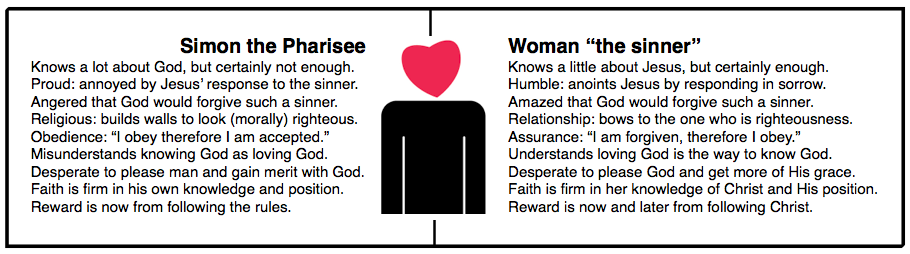
1. Am I like Simon the Pharisee? He’s got a lot knowledge of God, but no intimacy [Luke 7:36].

In Luke 7, Jesus is invited over for dinner by a Pharisee named Simon [v.36]. Ironically, Simon invited Jesus over just after He scolded the Pharisees for not accepting either John or Himself. And the Pharisees just accused Him of being a party boy with the tax collectors and sinners [7:34]. But Jesus didn’t play favorites. He accepted dinner invitations from the Pharisees too, without asking about their motives [cf. 11:37; 14:1].

What is a Pharisees? In the Bible, they are a group of Jewish religious leaders. In its title, Pharisee, means, “separated ones.”  They built ‘fence laws’ (traditions) around God’s law to help them keep God’s law and to protect their personal image so that they appeared holy and separate from the sinful world. They hung holiness around their neck like Mt. T wore gold chains. Their fence laws were often stricter than God’s law. They were good law keepers and made sure others saw it. Their fence was painted and polished on the outside, but inside it would not meet any inspection codes. Pride and hypocrisy are the failures of fence law’s. They knew a lot about God, but they really didn’t know Him. In Matthew 15:8. Jesus describes the Pharisees as “people who honor Me with their lips, but their hearts are far from Me.”

Simon invitation to have the traveling rabbi over for a meal would have been considered a religious brownie point. Jesus should have been considered the guest of honor. In the Middle East during those days there were certain rules of etiquette. First, a customary greeting would be given of a kiss on the cheek or hand. To neglect the kiss of greeting would be like having a person come into your home and not saying, “Hello!” or shaking their hand. Second, in a shoeless culture, the washing of feet was mandatory before meals. Normally the host or his servant would wash the feet or at the very least they would give water to the guests to wash their own feet. Third, for an especially distinguished guest, some (inexpensive) olive oil was given for anointing their head.

When Jesus comes to the house of Simon, there is no kiss (greeting), no washing of feet, and no oil for his head. The reason is not certain why Simon did not do these courteous gestures. But from Jesus’ words later on, Simon didn’t really know Him. If Simon really knew who He was he would have honored Jesus more extravagantly.

It’s not that Simon did not know God. He knew a lot about God. As a Pharisee, he spent his life studying the Scriptures. By the age of 12 he had memorized the first 12 books of the Bible. He would squash the kids in your AWANA ministry! By the age of 15 he had memorized the entire Old Testament. Sadly, he committed to memory more than 300 OT prophecies about the coming Messiah, yet he didn’t even realize it is the Messiah who sat at his dinner table. He knew about Jesus, but he didn’t know Jesus.
He’s all knowledge, but no intimacy.

When I graduated from Bible College I had quite the chip on my shoulder. I read the Bible backwards and forwards many times for class. The Bible became a textbook. I knew enough Greek and Hebrew to look smart. I knew the Bible, but my head was the size of a hot air balloon and it was filled with pride. God used a lot of patient people in my first ministry to chisel away at my pride. And it’s still a temptation.

Pharisees often confused knowing God for loving God. In church, it is easy to get this confused too. We build systems that cater towards knowing about God, but not necessarily loving God. We have endless Bible studies with workbook and Bible curriculum with homework. Sermons notes with fill in the blanks. If you grew up in the church, you probably go to Sunday school, where you have a teacher. In the summer the kids may go to Vacation Bible school. All these programs help you know, but not always love God.

Hear me out (before you throw stones); I wholeheartedly encourage studying, teaching, and preaching God’s Word. It is a biblical mandate. It’s my calling. Even our example, Jesus, read and quoted Scripture as proof that He knew God’s Word. The problem isn’t knowledge. The problem is that you can have knowledge without having intimacy. In fact, knowledge can be a false indicator of intimacy. Obviously where there is intimacy there should be a growing knowledge of God, but too often there is knowledge without a growing intimacy.

Think about it this way, the proof that I love my wife is how much I know her. I know what kind of deodorant she uses. I know her favorite kind of Thai food. I know what makes her laugh or cry. So knowledge is part of intimacy, but just because there is knowledge doesn’t mean there is intimacy.
Probably the best biblical word for intimacy is the word “know.” But this knowing goes much deeper than knowledge. The Bible first uses this word to describe a relationship in Genesis 4:1, “Adam knew Eve his wife.” The Hebrew word for “knew” here is the word yada, which means ‘to know completely and to be completely known.’ Unabashedly, Genesis 4:1 is an intimate moment between a husband and wife. It’s a beautiful picture to help see what it really means to know God.

In Psalm 139, David uses this word yada to describe how God knows us, “O Lord, you have searched me and known me! You know when I sit down and when I rise up; you discern my thoughts from afar. You search out my path and my lying down and are acquainted with all my ways. Even before a word is on my tongue, behold, O Lord, you know it altogether. You hem me in, behind and before, and lay your hand upon me. Such knowledge is too wonderful for me; it is high; I cannot attain it.”

So the word used to describe a husband and wife is also used to describe how God knows you and wants to be known by you. This changes the way I think about knowing God. He’s not interested in a let’s-just-be-friends relationship; a noncommittal dating relationship; or a relationship where you define the terms; He is seeking the kind of commitment and intimacy best illustrated in a marriage relationship. Do you just know about Jesus or do you really know Him? Are you like Simon the Pharisee? He’s got a lot of knowledge of God, but no intimacy

2. Am I like the woman?  She’s got little knowledge of Jesus and lot’s of love [Luke 7:37-38].

While Jesus is eating at Simon’s house a woman comes on the scene. She comes uninvited. To better comprehend the awkwardness of this moment, you must understand that she wasn’t just any woman. She’s “a woman of the city, who was a sinner.” [vs.37] Her reputation negatively precedes her. She’s done bad things that have damaged her reputation. Maybe she slept with her boyfriend, cheated on her husband, is in a same-sex relationship, or was a prostitute in the small town.

We are uncertain the specifics that drew her to Jesus. But in desperation she came to Him at Simon’s dinner party—a dinner she would never be invited to attend nor would she have interest in attending anyways. As she wandered in she felt the condemning glares from “holy men”. Nervous as she might be, she brushes off the glares and stares at Jesus.

Apparently she had heard Jesus teaching, maybe earlier that day. What about Jesus teaching made such an impact? Was it forgiveness? Perhaps while listening to Jesus she thought, “Can He really forgive my shameful past?” Was it redemption? Maybe as Jesus spoke she realized that only He could put back together the broken pieces of her life and make her whole. Was it love? Maybe she wondered, “Certainly Jesus knows how messed up I am; how the guilt of my sin stains me so deeply. Could He love me too?”

What she does next is impulsive, extravagant, and culturally unthinkable, especially to someone who did not know Jesus [v.38]. Can you feel the tension? The woman approaches the dinner table and stands at the feet of Jesus. The table is silent. Everybody is watching. Everybody knows who she is. They are thinking, “What is she doing here?” She looks around at the guests. She gets glares of judgment. She looks at Jesus. He looks at her. She looks to Him in faith seeking forgiveness for her shame. He looks back with a loving smile. She says nothing. Nothing needs to be said.

She is so overwhelmed, tears of repentance rain down. She falls and begins to kiss Jesus’ feet. Her tears begin to drip onto the dirty feet of Jesus. She sees the muddy streaks and suddenly realizes that His feet haven’t been washed. She can’t ask for a towel, so she lets down her hair. The dinner guests gasp out loud at her disgrace. Then she takes a costly alabaster jar of ointment. Perhaps in the past she used it drop-by-drop for many men. But now she empties it. She will not need it anymore. She pours out, her life, on His feet, and she kisses them over and over.

The woman does a gutsy and glorious thing, all at the same time. She faced her sin. Rather than running from it she runs to the only one who can forgive her. She is broken, grieved, and repentant. Her offering of worship is a sweet smelling aroma. In a moment, she moved from a life of shame to a member of the Fellowship of the Unashamed.

When is the last time you had a moment with Jesus like this woman? Repentant? Broken? Honest before God? When’s the last time you’ve poured yourself out before Him? When is the last time the shed tears over your sin and shame? When is the last time you demonstrated unashamed and extravagant worship?
Can you relate to this woman?

This sinful woman is a mentor to us all of a repentant heart and worshipful response towards Jesus. Unlike the Pharisee, who loves himself too much, she sees herself for who she is—a sinner needing forgiveness. Do you remember who you were before Christ? Do you see the seriousness of your sin? The closer I get to Jesus, the more sinful I recognize myself as being. I am the Pharisee when I forget I am like the woman. The woman didn’t know a lot about Jesus, but she knew He could forgive her sins. She didn’t love a bunch of things about Jesus. She really loved Him. Proof of her love was over-the-top worship. Do you love things about Jesus or do you really love Him?

3. Am I like Jesus? He’s got unbiased love and unconditional forgiveness [Luke 7:39-50].

It is easy to look at the two characters of the story and say, “I definitely don’t want to just know God like the Pharisee. I want to love God like the woman.” But you can assume or zoom by the third character in the story—He’s most important. His name is Jesus. He is the main character of not just this story but also the Bible. He is the one you most need to emulate. “Therefore be imitators of God, as beloved children. And walk in love, as Christ loved us and gave himself up for us, a fragrant offering and sacrifice to God.” [Ephesians 5:1-2]

Notice how Jesus responds to Simon’s statement whispered under his breath [v.39 “If Jesus were a prophet He would know what kind of woman this sinner she is]. Jesus doesn’t blast him out of his boots by saying, “I heard that! Why would you say such a stupid thing, Simon! How dare you judge me? I am the Judge here.” No. But He doesn’t ignore Simon either. Listen to the tenderness in His voice: “Simon, I have something to say to you…” [v.40] In answer to Simon’s statement, Jesus uses His prophetic powers to read Simon’s heart. He told him a short parable. It is one of the smallest parables of Jesus (only two verses long), but it is hugely significant [vs.41-42].

In summary, a banker loans money to two men, one receives two year’s wages and the other receives two month’s wages. Neither man can pay back the banker. Unexpectedly, the banker shows grace and removes the debts from both their records. When each man should be bankrupt and file chapter 7 they are given a new start to life. Obviously, both gain new affection for the banker. But Jesus asks a crucial question, “Which man loved the banker the most?” Simon being no intellectual slouch has a ready answer [v.43]: “the one with the larger debt.” And Jesus acknowledged Simon has the right answer as a religious person would, but it did not mean he saw he was the one with the small debt.

Jesus’ story is not just for Simon, but it’s for all the ears at Simon’s table (including you and me). What is your place in the parable or Simon’s table? How would you respond to Jesus’ story? Would you sit beside Jesus and acknowledge only a small debt, or would you fall down at His feet and, in tears, begging for the forgiveness you do not deserve?

Now Jesus is ready to make His point [vs.44-47], “Do you (even) see this woman?” Jesus did not dispute the woman’s condition. They both agreed she was sinful. That’s not the point. The point: how acceptable is she before God? Simon is disgusted with her. He is also inhospitable with Jesus. But Jesus lets her touch, kiss, and wash His feet. Why? She loved much. She was a human in need of divine grace. She needed what only Jesus had to give—forgiveness and salvation. Ignoring any reply or reaction from Simon, Jesus spoke to the woman, “Your sins are forgiven.” [v.48]

Can you hear the dinner party guests gasp again? They began chattering around the table, “How could He forgive sins? That is God’s job. Who does this man Jesus claim to be?” [v.49] Precisely! God. As God, He can forgive. And Jesus’ words here are ultimately what get Him hung on the cross by religious people, like Simon. Again Jesus ignores them, and focuses solely on the woman, “Go on without worry. Live a new life. Your faith has saved you.” [v.50]

Jesus’ words are an invitation to Simon, and us all, to open our eyes to people around us who have been marginalized or ostracized. Before this moment, Simon failed to really see anything at all; he saw neither Jesus nor the woman. He was blind to her act of repentance and love. He only saw her sin. We don’t know if Simon changes. But we do know Jesus loves Simon as much as He loves the woman. He longs for Simon to see her not as a category (sinner) but as a person who, above all else, needs God’s love and forgiveness, “He who is forgiven little, loves little.”

The question of this text remains still remains, who am I most like? Simon? The woman? Jesus? The Pharisee and the woman are both sinners on opposite extremes of the pendulum. And Jesus gives them both what they need. The Pharisee needed truth in love. The woman needed forgiveness and assurance of His love. Jesus’ call to faith reaches out to people society deems as despicable (even the rapist, molester, cereal killer, stripper, or terrorist). But the church, unlike society, must show the sinner the way to Jesus and show His forgiveness and unconditional love. What can we do as a church or followers of Christ?

First, understand that faith often appears in the most unexpected places. It could be at your Sunday lunch and your waitress at Red Lobster, or the guy outside the bar, or the young pregnant gal walking to the clinic, or the uncomfortable and awkward outcast sitting in the pew near you. Let God bring salvation the way He chooses to the people He chooses. God can transform the worst of sinners and the greatest of the religious [cf. 8:1-3].

Second, beware of religious taboos such as never associating with sinners or shooing them away from the church. Yes, there is a place for protecting your church from false teachers, confronting sin, and “being in the world, but not of the world.” But how will they know unless you show love and forgiveness of the Light of the world? Our church creed must read: we are all equal in Christ who is our Head, though messy and sinful we are still His glorious Bride, everyone is welcome, for we are One in Him.

Third, cherish the truth that no one is worthy to receive what Jesus offers the woman. Know your place among the unworthy. What if God sent you a bill every month for your sin, what would you owe God? What would your debt be? Too much! Thank God, He sent Christ to forgive your debt. If you are in Him, He’s paid it all. Don’t you think that Jesus’ coming to earth, being obedient to the Father, even to the point of death on the cross is rather extravagant? My response is to pour out over-the-top gratitude. Be proud to be a member of the Fellowship of the Unashamed.

Fourth, believe Jesus alone has the power and authority to forgive sins and offer salvation. You can be the most religious or most sinful. The distance between you and God is repentance. Respond to Jesus in humble faith and accept His forgiveness and salvation. Today.

Is it better to know Jesus or love Jesus? It is best to know and love Jesus from your head all the way to your heart. Jesus said when asked by a Pharisee the greatest commandment, “Love the Lord your God with all your heart and with all your soul and with all your mind.’ This is the first and greatest commandment. And the second is like it: ‘Love your neighbor as yourself.’ All the Law and the Prophets hang on these two commandments.” [Matthew 22:37-40]
6 suggestions when talking to skeptics or someone with doubts

If you care about people and risk talking to the doubting, the skeptical, the confused, and the angry, you will soon run into a person who says to your counsel: I’ve tried that. Whatever you say, they will minimize it and say it doesn’t work or is unbelievable. Do not be surprised at this response. This is what it means to be doubting, skeptical, confused, and angry. It means that whatever they hear sounds pointless. Here are six suggestions when dialoging with people like this:

1. Keep Calm.

Resist the temptation to be offended. Don’t pout or take your ball and go home. That’s what you may feel like. They wanted to talk; in many cases, they gave you a question airing their doubts or concerns. Don’t leave. Don’t give up. Not yet. “Love suffers long” (1 Corinthians 13:4). Be humble and teachable too. God might have something to teach you through their questions and doubts.

2. Listen.

Listen to their responses. This is the number one way to show you care about what they are saying. Part of your power is not only what you say, but how they feel about the way you listen. If your truth produces empathetic ears, it will feel more compelling. This listening will be a witness. In 2 Timothy 2:24–26, Paul describes the kind of engagement that may set people free from sin and error. One feature is “patiently enduring evil.”

3. Don’t Panic.

Sometimes we don’t have the answers, or easy answers. As Christians we think we should have all the answer because we have the Bible and the Holy Spirit, but there are a lot of things the Bible does not explain fully or the Holy Spirit does not reveal. Some answers will have to be left undone. If there is an answer, but your just don’t know or remember be humble enough to say, “I don’t know, but I will get back to you on that.” Just make sure you do get back to them on that.

4. Let the gospel lead your answer.

It is tempting to try to win an argument, but that’s not winning them to Christ. In fact, you might be driving them away. Being defensive and saying the doubters doubts are stupid repels people away from your message. Let the gospel Christ’s amazing grace shine through your words and actions more than your polished answer to their question. When you have spoken all the counsel you can think of, and they seem to have no effect, don’t let them have the last word of despair. You leave the last word of hope.

You might consider saying some like, “I know that you don’t feel very helped by what I have said. I think I understand some of what that’s like. I don’t mean to be offering a quick fix, as though your questions or doubts can be turned around that easily. But I have more hope than you do that God’s truth is powerful and will have its good effect in due time. May I share one more thing before you go?

I simply want to make sure you hear the best news in the world. Jesus said He spoke so that we would have peace (John 16:33). And Paul said that faith comes by hearing the word of Christ (Romans 10:17). You don’t feel this right now. But God says peace and faith come from hearing. I will pray that the obstacles to peace-filled faith in your mind will be overcome by these truths. Jesus said, “You will know the truth and the truth will set you free.” Meditate on these verses. May the Lord give you light.”

5. Pray.

Remember, it is not your savvy answers or smooth oratory that will convince the skeptic or contraction seeker of the truth. It is solely the Word of God by the Spirit of God that can change a heart and mind. It is difficult to understand truth if one does not have the indwelling Holy Spirit. Pray for the blinders to be lifted from their eyes and His light to come into their darkened understanding.

6. Pray and pray again.

thumb licks [7.4.12]

When Are We Going to Grow Up? The Juvenilization of American Christianity.

How big is the Universe? BIG! (check out this infographic).

One indispensable rule for using social media.

Cheesiest man cave. If I weren’t a Christian, I might be this man.

16 Ways to find a wife according to the Bible.

How cereal transformed American Culture.

Dirty Car slide show. Car wash lately?

Jarrod Dyson, Rollie Fingers, and How We View the World.

Get rich slow. Biblical bean counting.

Generous Testimony.

I’m pressed like a grape

from a good friend Hugo Butts


I’m pressed like a grape

Not crushed like a stone;


I’m perplexed like the Sphinx

Not in despair like grief


I’m persecuted like Jesus

Not abandoned like an orphan


I am struck to my knees

But my head is not hacked off


Life and death both live in me

But the life of Christ will win;


I believe therefore I have;

I pray because I believed


He will present me perfect before You

In a crowd that will bring glory


Grace in great quantity

Piled up glowing as in gold and precious stones.


An eternal thanksgiving where

The outer person is destroyed

And the inner person renewed


Light afflictions producing

An eternal weight of glory

As I worship the Unseen.


2 Corinthians 4:7 But we have this treasure in jars of clay, to show that the surpassing power belongs to God and not to us. We are afflicted in every way, but not crushed; perplexed, but not driven to despair; persecuted, but not forsaken; struck down, but not destroyed; 10 always carrying in the body the death of Jesus, so that the life of Jesus may also be manifested in our bodies. 11 For we who live are always being given over to death for Jesus’ sake, so that the life of Jesus also may be manifested in our mortal flesh. 12 So death is at work in us, but life in you.

13 Since we have the same spirit of faith according to what has been written, “I believed, and so I spoke,” we also believe, and so we also speak, 14 knowing that he who raised the Lord Jesus will raise us also with Jesus and bring us with you into his presence. 15 For it is all for your sake, so that as grace extends to more and more people it may increase thanksgiving, to the glory of God.

16 So we do not lose heart. Though our outer self is wasting away, our inner self is being renewed day by day. 17 For this light momentary affliction is preparing for us an eternal weight of glory beyond all comparison, 18 as we look not to the things that are seen but to the things that are unseen. For the things that are seen are transient, but the things that are unseen are eternal.


Why do people have difficulty trusting the Bible?

The Bible is an ancient book.

It was written in Hebrew, Greek, and Aramaic by prophets, kings, tax gatherers, fishermen, and scholars. In various genres narratives, poetry, songs, apocalyptic literature, promises, stories, commands, wisdom literature, history (although not exhaustive), and letters. R. Laid Harris adds about the historical setting of the Bible,

Its historic setting changed from the Bronze Age to the Iron Age to Roman times. Its events occurred in Canaan, Egypt, Greece, and Asia Minor. No wonder it has puzzled some readers. These supposed difficulties are the result of ignorance of Bible lands, customs, and languages. Most problems fade away under deep, earnest, and prayerful Bible study.[1]

Christians do not believe that the Bible dropped out of the sky or was dictated to men who scribbled down furiously to catch every word from God. Christians believe that the Bible is both fully inspired by God and fully written by humans. Christians believe that Bible is inerrant in its original manuscripts, not the copies and translation. Christian doctrines of the Bible allows for the human elements of style to be present in the writing process and accounting for the inevitable human error that occurs in textual transmission. Some of the supposed contradictions are because of obvious copying errors. But many of the contradictions are because many skeptics or contradiction seekers do not seem to know the basics of how to read an ancient text.

The Bible is a strange book.

It is different from all other books. It deals with spiritual things that cannot be understood “naturally.” Spiritual things are “spiritually discerned” (1 Corinthians 2:14–16). Unfriendly critics and skeptics, therefore, discover problems even where no real problems exist. Nicodemus exclaimed to Christ, “How can these things be?” (John 3:9). People unwilling to accept the Bible’s spiritual message cannot understand it. So we must help them find answers through wisdom, spiritual discernment, and godly character.

People have a difficult time trusting the Bible because it is ancient and strange. But that is not what makes it most unbelievable. What makes the Bible most difficult to trust is what it says about God redemptive plan and that God calls you to believe it. The message of the Bible might just change your life, and for some self-ruled people that is too hard to swallow.


[1] R. Laird Harris, Exploring the Basics of the Bible, Wheaton, Ill.: Crossway Books, 2002), 72.

the God who reveals

Recently I visited Muir Woods just north of San Francisco. My wife and I were celebrating our third anniversary walking among God’s creation. As amazed as I was by the Redwoods, all the people taking pictures of the trees equally amazed me. If you think about it, doesn’t it seem weird that people are flocking to take pictures of big trees? Why do people take pictures of trees? Why is my brother in awe of the open horizon of New Mexico? Why does our jaw drop at the Grand Canyon or Teton Mountains? Simply, creation wows us and fills us with wonder. It’s amazing.

In the 1998 film The Truman Show, Jim Carrey plays Truman Burbank, a generally cheerful insurance adjuster in a cozy island town whose days run like clockwork—until the day a stage light falls out of the heavens and crashes near his car. Little by little his world begins to give him clues that later help him discover the truth about the world (stage) in which he is really living. Likewise, your world is giving you clues that tell you something about God. He is not hiding.

1. God reveals He is through creation (Psalm 19:1-6)

People often wonder, “Where did all this come from? Why are we here?” What are some of the hints and clues you see in creation that point you to the existence of a Creator? And what are some of the aspects of creation that cause some people to believe that no Creator exists? Whether we understand creation or not it continually shouts out that God exists (1 Chronicles 16:31-34). Creation never presses pause on praise God. The picture you receive from this psalm is that the world acts as a loudspeaker, a stage, and an art gallery—all pointing to God’s glory.

However, man’s response to creation can be foiled (Psalm 19:3). First, people ignore the communication of creation (Isaiah 6:9-10; Matthew 13:15). Second, people can miss or not hear God through creation because the communication of creation is not audible. In other words, general revelation (i.e. creation) is indirect communication unlike special revelation, which is written Scriptures or spoken through the God-Man Jesus Christ.

Think about the ways people attempt to guard themselves from God’s revelation. What are some of the most common ways we try to hide from God’s voice? What are some of the common ways we try to drown it out? God wants to be heard. General revelation goes further than just telling us that God exists. It also tells us what kind of God exists.

2. God reveals who He is through creation (Romans 1:19-20)

Suppose you came home one day to find a box at your door with a note attached: “These are the personal belongings of your twin brother.” Once you got over the initial shock of having a twin brother you never knew about, you’d open the box and look inside, hoping the contents might tell you something about him.  If the package contained keys to a Harley Davidson, a knife, and a tin of chewing tobacco, that wouldn’t tell you everything about your brother, but it would certainly give you an impression. But if the box contained a set of watercolor paints, a beret, and a tin of organic breath mints, that might give you an entirely different impression, wouldn’t it? The box’s existence would tell you that you had a brother, but the box’s contents would tell you a bit about him.

In the same way, the created world says you have a God, and what you see in the created world tells you some general things about Him. By seeing the general revelation of “the heavens” and the rest of the world, you can get a sense of God’s glory, the sum of His attributes. What knowledge of God’s attributes do you gain by looking at creation? The universe shows His eternality. The sun and rain show His goodness and grace. A volcano and hurricane show His power. When we look at His creation we see who He is and who we are too. Matt Chandler says, “Nobody stands at the base of the Rocky Mountains and says, ‘Remember that time I benched 300 pounds in high school?’”

Nor can anyone say, “I have never heard the gospel before. No one told me I am sinful and God is holy.” His attributes are seen in all humanity—sense of fairness, longing for justice, compulsion to create, etc. But what can and cannot God’s general revelation do? Romans 1:19-20 teaches about responsibility. General revelation is sufficient to hold us accountable for our sin, but not able to save us.

3. God reveals what His plans are through creation (Acts 14:11-18)

What did Barnabas and Paul want the people of Lystra to know? As the pagan demand for more sacrifices to a dead god continued, Barnabas and Paul desperately wanted these people to know the good news that Jesus has made the sacrifice to end all sacrifices, and He did so to honor the will of a Heavenly Father who had been far better to the unsaved people of Lystra than Zeus had been. The missionaries pointed to the evidence: “You have a witness that this is true!” they cried. “He has given you rain and harvest and good food and happiness.”

Acts 14:17 gives you an aspect of the gospel story. When looking at the world around you it is easy to recognize that this place is broken but there are visible aspects of God’s grace. In Matthew 5:45: “For He causes His sun to rise on the evil and the good, and sends rain on the righteous and the unrighteous.” The benevolent heart of God is made visible through common grace, which is available to every man on this planet. God intends for the happiness you experience in marriage, parenting, and His other good gifts to point you back to Him. The gifts everyone enjoys lead to the Giver.

In Romans 8:22, Paul writes, “For we know that the whole creation has been groaning together with labor pains until now.” The image is that of the earth giving birth, but the focus is on the pain as it gives way to newness. We look forward to the return of Christ and the new heavens and the new earth (2 Peter 3:13). The brokenness we see in “the whole creation,” is signaling to us that something is wrong and there is something better beyond this.

In conclusion, the world is a grand theater in which God showcases His glory. One thing we must say about this theater, of course, is that it is not itself the story but the stage for it. Like a good stage set, it tells us something of the story before the players even enter and begin reciting their lines. But it is the script (i.e. the Bible and Jesus) that really reveals. God is not hiding. He is in plain sight.

bringing the gospel home (book review)

I ordered this book out of curiosity.

Sharing the gospel with family is tough!

First, I have unsaved family members that I really desire to share the gospel with, but direly fall short of doing regularly. I really love and care for them and want to see them in heaven someday too. This is a book on evangelism that hits close to home.

Second, there are not many books out there on the subject of evangelize friends and family, but never have I read one quite like this. I am certainly surprised by what I am reading. It is not your ordinary book on evangelism with step my step or play by play approaches for witnessing to different kinds of people. It is not methodological or programmatic. It is simply a book about the gospel and it’s ramifications on me and my family. The illustrations are refreshingly honest and easy to relate to. I heavily recommend it to anyone interested in sharing Christ with their loved ones (which should be everyone).

Third, the book has a beautiful explanation of the gospel. Although I wished the book explained the gospel clearer the implications of the gospel could not have been more clearer. That is the beef of the book. And it is good to eat!

The chapters flow is unexpected, but once immersed you quickly see how they flow in a biblical and natural sort of way:

Chapter 1: FAMILY, a beatitude and yet a burden. All here in this chapter is a theology of the family from the Scripture. THe theology of the family includes two opposing angles; God and Satan. Both have their strategy and purpose for your family. It is good to understand both since one strategy is established before time the other is to destroy what’s always been. And there is hope to redeem what’s been destroy.

Chapter 2: GRACE, Amazing and yet breaking. A very important chapter on putting yourself on the same plain as your family in need of grace, rather than letting pride put you above them. Grace is one of the most neglected components when sharing the gospel, but one of the key components to understanding the gospel.

Chapter 3: TRUTH, liberating and yet narrow. In Acts 17, Paul is communicating with intelligent and religious people. People who are proud and think they’ve nailed the meaning of truth. That is until Paul introduces them to the gospel of truth. Some mocked, but some believed. Is that a familiar response in your family? In a truth starved world we need to understand where it went wrong and rightly meet it with the gospel. That’s where this chapter begins.

Since gospel truth has substance, we should think deeply about it. Since it draws lines, we should stand boldly in it. Since it illuminates all of life, we should celebrate its fullness. Since it prompts a response, we should ask for one. Since it’s easy to get wrong, we should reflect carefully about how to communicate it. (102-103)

Chapter 4: LOVE, always craved and yet seldom conveyed. Love is a mysterious and romanticized word. Defining love can be hard, but the Bible makes it easy. Learning to love your family with a gospel-love will help them see the initiative and sacrifice of Christ in action. This chapter helps you not only with the content of the gospel message but your context of sharing it.

Chapter 5: HUMILITY, divinely modeled and yet difficult to find. I can extend grace, truth and love to my family, but humility? Are you serious? Yes. And so is Jesus. He had humble holiness. This chapter helps you not only dish your pride and eat humility, but serves up Christ on a silver platter.

Humility us to see ourselves as God sees us in Christ–hopelessly sinful but graciously saved, rebellious yet redeemed, incapable of producing any righteousness on our own yet empowered to do all that God calls us to, appropriately bold yet taking no credit for the basis of that boldness. (136, Titus 3:3-8)

Chapter 6: TIME, freeing and yet fleeting. What time you ask? With eternity as our deadline we feel the pressure to dump the gospel on those we love and press them for a decision like life insurance agents. Sometimes the simple yet so heavy truths of the gospel need time to settle and marinate. This chapter helps us not to rush, but let God do His work in His time.

The God who calls us to live in time lives outside of time. We feel the burden of deadlines, but He never does. We grow impatient, while He knows nothing of that weakness. (155) Witnessing to family takes wisdom…and all that takes time.

Chapter 7: ETERNITY, comforting and yet terrifying. 100% of the people reading this will die. That truth can either cause your jaw to drop or draw you into unfathomable joy. Death is not the end only the beginning. This chapter touches on lives reality while giving you hope in the gospel as you share it with those you love the remainder of their days.

The distinct nature of the finished work of the gospel delivers people from fear, denial, and false hope. When we point people to Christ, we show them a way that takes the sting out of death, thus making it something to anticipate instead of dread. As Dietrich Bonheoffer once preached, “Death is grace, the greatest gift of grace that God gives to people who believe in Him.” (182; John 3:16-18)

Two dominant world views vie for our affections: One sees this life as all there is. The other sees life as preparation for the next. One thinks only in terms of the temporal. The other values the temporal because it sees it in light of the eternal. The first way does all that it can to avoid thinking about death. The other faces death squarely. The first speaks only of people “living in our hearts” after they die. The other envisions Revelation 7:9-10. (205-206)

the God who reveals (general & special revelation)

I am fan of games. My wife and I enjoy playing strategy games together and with friends. I suppose my love for games was bred into me from a young age. I got my first Nintendo when I was about 12 years old. But I think my love for games even goes back earlier to tag on the elementary school “playground” or peek-a-boo with my parents as a toe-headed toddler. Peek-a-boo is a fun game. My 19-month old daughter loves to play by covering her little eyes with her little hands.

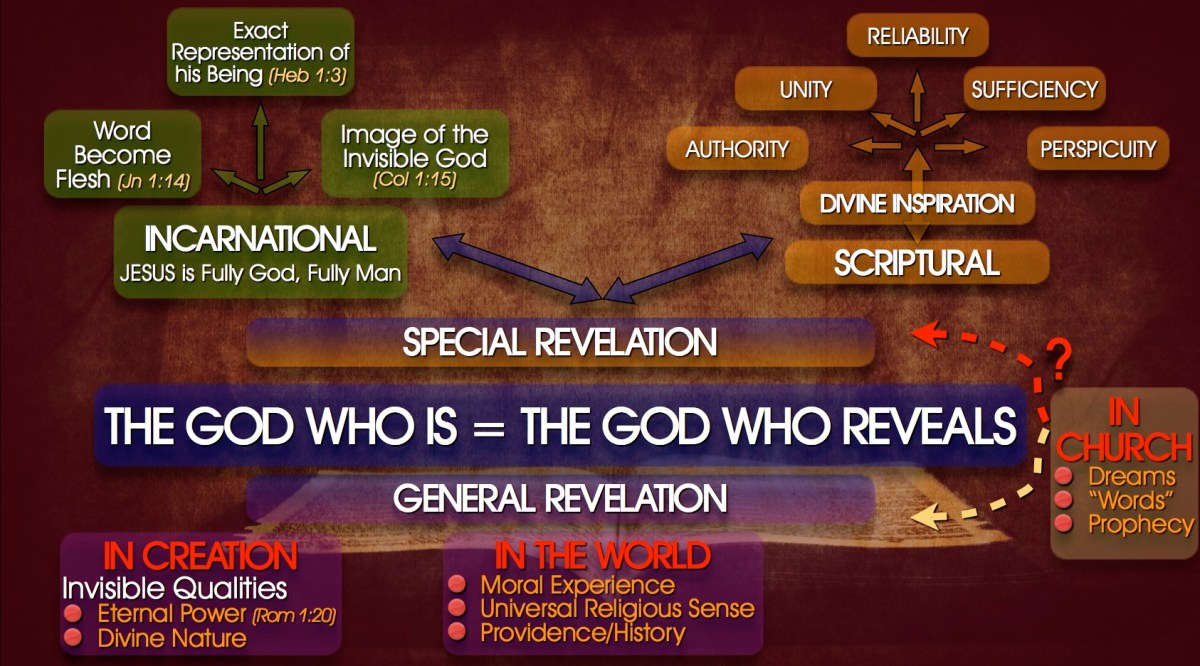
Peek-a-boo is the first step towards playing Hide-and-seek. It is interesting that Hide-and-seek is a game that we love to play with our children, but God never plays with us. He is always with us and He has revealed Himself plainly to mankind. You can summarize the ways God reveals Himself to man in two ways: general revelation and special revelation. General revelation refers to the general truths that can be known about God through nature. Special revelation refers to the more specific truths that can be known about God through the supernatural.

The God who reveals Himself through nature (general revelation)

First, God is seen in creation. God’s existence and power can be seen throughout the vastness of the universe, in the order of the animal kingdom, in the rules of gravity or thermal dynamics, and in the details or structures of plants and cells. The wonder of creation declares it must be made and just did not happen by mere chance, “The heavens declare the glory of God; the skies proclaim the work of His hands. Day after day they pour forth speech; night after night they display knowledge. There is no speech or language where their voice is not heard. Their voice goes out into all the earth, their words to the ends of the world.” (Psalm 19:1-4)

Romans 1:20 says, “For since the creation of the world God’s invisible qualities—His eternal power and divine nature—have been clearly seen, being understood from what has been made, so that men are without excuse.” God’s eternal power and divine nature are “clearly seen” and “understood” from what He has made, and there is no excuse for denying these facts. This is was I wrote about a few weeks ago, when I was on a hike with my family through the Muir Woods just north of San Francisco.

Second, God is seen in humanity. He is not only seen in your biological makeup, but also your psychological[1] makeup too. God has placed within every man a moral compass that that points us True North, a radar system that warns us of evil and harm, and a homing beacon that deep down gravitates us towards God (Jeremiah 31:33). How is it that sinful men still have a bearing of what is right and wrong? Did that just didn’t happen? No, it is imbedded within your DNA as a gift from God. It is divine proof that your Maker has marked you with His image (Genesis 1:28).

God reveals Himself through nature. He has put redemptive themes all throughout the universe, planet earth, and humanity, which point the creation back to its Creator. You do not have to look far or wide to find it, but most people choose to ignore it or redefine it.

The God who reveals Himself through supernatural (special revelation)

God doesn’t just reveal Himself through nature, but also through supernatural means. Special revelation is when God reveals Himself miraculously. He revealed Himself through physical appearances (Genesis 3:8, 18:1; Exodus 3:1-4, 34:5-7), dreams (Genesis 28:12, 37:5; 1 Kings 3:5; Daniel 2) , visions (Genesis 15:1; Ezekiel 8:3-4; Daniel 7; 2 Corinthians 12:1-7), the written Word of God, and most importantly—Jesus Christ.

One of the primary means God reveals Himself supernaturally to man is through the writing of His Word—the Bible. Think about it, God wrote a book. He did have to, but God decided to reveal everything that you need to know about Him, what He expects from you, and what He has done for you in the Bible. He spoke in a way that is clearly understood. He miraculously guided the original authors of Scripture to accurately record His redemptive message to mankind, but He still used their own styles and personalities. The Word of God is inspired, profitable, and sufficient (2 Timothy 3:16-17). The Word of God is living and active (Hebrews 4:12).

Where special revelation is seen in its ultimate form is in the Person of Jesus Christ. God became a human being (John 1:1, 14). He came as the Word within human skin, “In the past God spoke to our forefathers through the prophets at many times and in various ways, but in these last days he has spoken to us by his Son … The Son is the radiance of God’s glory and the exact representation of his being.” (Hebrews 1:1-3) God became a human being, in the Person of Jesus Christ, to become the atoning sacrifice for your sin on the cross (Philippians 2:6-8). Human sin needed a perfect human substitute for His sin, which is Jesus. He is the ultimate “special revelation” from God.

Why is general and special revelation so important?

First, God makes Himself known so that you can know Him. God wants to be known. He is not silent. He has given you a glimpse of His character, His purposes and plans, and has given you many avenues to know Him. Simply read the Bible and look to Jesus and you will get to know an amazing God.

Second, not only does God reveal Himself to you, but He also reveals who you are too. He makes Himself known because He knows that you need Him. He is Creator and you are His creation. He is perfect and you are imperfect due to sin (Romans 1-9). He is Savior and you need redeemed. He takes the initiative to reveal Himself to you so that you would respond and join in a relationship with Him.

God does not play peek-a-boo. He does not want you to be left in the dark as to who He is and His purposes for humanity. Instead He has revealed Himself to all people, at all times, and in all places that proves that God exists and that He is intelligent, powerful, and transcendent. You can know Him and have a relationship with Him today.


[1] And I mean the true sense of the word psychological, which means the study of the soul.