what does the Trinity teach us about relationships?

Within the Trinity there is both unity and diversity: unity without uniformity, and diversity without division. This unity and diversity is at the core of the great mystery of the Trinity. Unity without uniformity is baffling to our finite minds, but there are demonstrations of this truth all around us; like a symphony, the human body, ecosystems, the church, the human race, a delicious meal, or a sporting event. Unity and diversity are woven into the fabric of the world by multiple images of the One who made it with unity and diversity.

Our human relationships uniquely and divinely reminisce the relationship between the Persons of the Trinity. This is no mistake, since man’s Maker stamped each man in His image. Most people never consider where this similarity has originated, but God has innately marked His creation with creative features that mimic Him—including our relationships. Today we will look at three distinct relationships that the Bible demonstrated both the unity and diversity of the Trinity:

Marriage is a relationship that demonstrates the Trinity’s unity and diversity [Ephesians 5:22-33]

Marriage is a wonderful picture that God uses to demonstrate His character as an unconditional, faithful, and sacrificial Lover. From the beginning of Creation God made man equal in His image [Genesis 1:26-27]. Though man and woman are quite diverse in appearance and God-given roles [Genesis 2; 1 Peter 3:1-7], they are both equally made in the image of God. If only man and woman within marriage would consider one another images of God, much of the conflict and chauvinism would dissipate.

The unifying love that Jesus has for His church is a beautiful demonstration of marriage [Ephesians 5:22ff]. Marriage is pictured in Christ sacrificing Himself for His church and the church submitted to Christ, which is paralleled by the husbands love his wife, the wife submitted to her husband, and both out of reverence towards Christ.

Church Body is a relationship that demonstrates the Trinity’s unity and diversity [Ephesians 4:1-16]

There is a glorious union between the Father, Son and Holy Spirit. Biblical Christianity stands or falls with the doctrine of the Trinity. Within the doctrine of the Trinity there are practical Implications. First, the Trinity makes God known in Christ [John 1:18; Exodus 33:20; 1 Timothy 6:16]. Second, the Trinity makes the salvation possible [Hebrew 9:14]. Third, the Trinity is fully dependent upon Himself [Acts 17:25]. Fourth, The Trinity provides the ultimate model for relationships within the body of Christ [1 Corinthians 11:3; 12:4–6; Ephesians 4:4–7].

When believers enter into a saving relationship with Jesus Christ they are adopted into God’s family—the church. The church body is made up of members who are all equal in the eyes of God. God in His divine purposes designed the church to function locally as a means for each member to grow spiritually through mutual relations and gift-oriented ministry with one another. Within His Body, God has given all a diverse role in order for the church to be unified in its display of God’s glory. God gave to the church offices: elders and deacons from the membership who are equal, but the elders are supposed to lead, the deacon’s serve, and the membership minister. When each one is doing their part the Body is a beautiful reflection of God’s unity and diversity.

Leadership (i.e. parenting & governing authority) is a relationship that demonstrates the Trinity’s unity and diversity [Ephesians 6:1-9]

The Trinity—God the Father, God the Son, God the Spirit—one God, three persons, all equal but submissive. God the Son submits to God the Father and recognizes Him as the leader. There is leadership within the Trinity. This is called relational subordination.

Jesus, though He is equal with God, willfully submits Himself to the Father. He submits to the Father out of love [John 4:34; 14:31; 15:9-10], reverence for His divine authority [1 Corinthians 11:3; 15:25-28; John 3:16-17; 10:36; 6:38], and reliance upon the Holy Spirit for power and direction [Luke 4:1-2, 16-21]. Likewise, it is marvelous how the Father shines His spotlight on the Son as He purposes all things to be subject to Jesus [Psalm 2:7-9; Ephesians 1:9-10; 5:21; 1 Corinthians 15:27-28; Revelation 5:1-5, 8-9]. Likewise, the Holy Spirit pours forth the message of Jesus in the Word of God [2 Timothy 3:16-17, 2 Peter 1:20-21, Luke 24:24-27, 44, 1 Corinthians 1:18, 23, 2:2, Galatians 6:14].

Submission to leadership practically plays itself out in two ways: through parenting and governing authorities. In the government of a home: mom, dad, and the children are equal made in God’s image, but dad’s are supposed to lovingly, humbly, and sacrificially lead [Ephesians 6:1-4]. Also, God appoints government leaders and bosses, and our response is to joyfully submit as if we are laboring for God [Ephesians 6:5-9; Romans 13:1-7]. This can be difficult especially in a world that is filled with crooked politicians, unreasonable employers, and passive fathers, but we have an awesome example to follow in God the Father, Son, and Holy Spirit.

In conclusion, the Trinity gives us a multifaceted look at relationships. Whether, in a marriage, church, home, business or nation God has demonstrated to us unity within diversity. Imagine if in each arena of your life you were to embrace the diversity rather than run from it, what unity could there be?

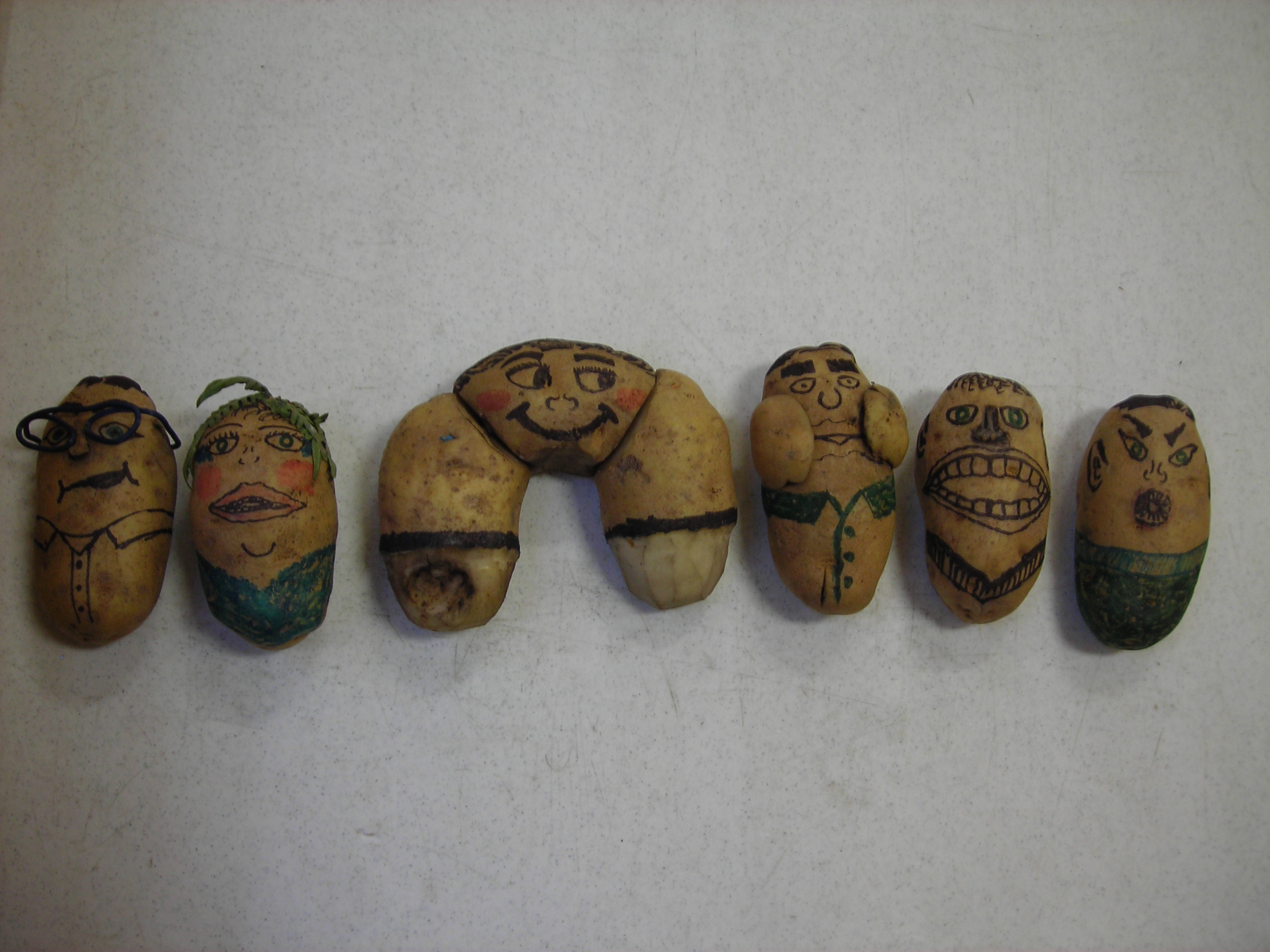
meet the taters

The Tater’s family are a memorable family. I was introduced to the highly dysfunctional Tater family and their ongoing saga through Travis Huseby at Checkpoint Bible Camp. Here is a glimpse of the Tater Family:

Uncle Common Tater

He is no common Tater!? Common has the gift of gab. He makes a living in broadcasting and is good at communicating. He is certainly a chatter box outside the press box. He always has a story to share, and people are interested in hearing him ramble about random happenings.

When you get to know Common you will quickly observe that he does a lot of talking, but not a lot of walking. His bark is louder than his bite. In fact, he is a Sweet Tater, never saying anything bad about anyone. He is certainly a people pleaser. Common could be a mighty spokemen for God’s glory, rather he is ashamed of the gospel of Christ [Romans 1:16-17; 10:14-17].

Speck Tater

Speck is the father of the family. He is intelligent, dedicated to his job, pays the bills, but is not particularly outgoing on the home front. He is the dad you see on the sidelines. Speck is not doing much to support his Tater’s, much like his father Hesi Tater. He is one dud of a spud.

Speck, as Pa-Tater, needs to get off the bench and into the game before time runs out and life has past him by. His family is his most important responsibility. His greatest impact as a father is to train up his children in the ways of God [Proverbs 22:6], and modeling Christ’s through his loving and committed marriage. This cannot be done by passive spectating [Ephesians 6:4], but by active husbandry and priority parenting.

Ima Tater

Ima is the decorated daughter of the family. She is no darling. She models and mimics the world. Her friends often sway her opinions. Roe Tater, her best friend, switches boyfriends weekly, complains about not having enough, and brags about spoiled habits. She is swoon by current fads, trends, and teen idols [aka: Idol Tater].

An idol is anything you worship, and what we worship we become. An idol can be a material possession, a feeling, a person of interest, a place of comfort, or anything that captivates your heart. The Bible says to imitate Christ [1 Corinthians 11:1], and to destroy all idols before they destroy you [Isaiah 40-49].

Agi Tater

Agi is the always angry son who must have inherited the spicy Irish Tater genes. He tends to mash, scalp, or fry any Tater that gets in the way of his plans. His parents blame his bad behavior on Iri Tator, a bullish friend at school.

Agi is self-centered, never wrong, and a big-headed boaster. When things are not going his way you will surely hear about it. Can Agi gain control of his anger? Anger itself is not sinful [Ephesians 4:22ff]. In fact, anger is a God-given emotion that can be used for glorious means in defeating sin and choosing righteousness. Followers of Christ can learn how to control their anger [Titus 2:11-15].

Regurgi Tater

We all call him, Reggie. He is the younger brother [aka: Tater Tot] who tends to tattle tail. He hurls up information quicker than a baby spews up their bottle. Reggie’s feed off of gossips and lies for his own satisfaction [1 Peter 2:1]. The tongue is like a wild fire. A little spark can do a lot of damage [James 3:1-12].

In the Scripture the word often referring to regurgitation is meditation. The Bible says as followers of Christ we must meditate on God’s Word by: reciting it [Psalm 119:11], reviewing it [2 Timothy 2:15], and renewing our minds by it [Romans 12:1-12]. When we think about God’s Word and chew on it we are reminded that other people are created in God’s image and defaming them offends God.

Gravi Tater

Gravi is the mama of the spud bunch. She is large and in charge. If mama ain’t happy, nobody’s happy. Big mama has control and stay out of her way. Everyone agrees that she takes after her father, Dick Tater. She can certainly be a Sweet Tater when she wants to be. Even as her family is falling apart, she finds a way to contribute by butting herself into everybody’s business. She could be using her magnetizing clout to bring everyone together in unity [Ephesians 4:1-16].

The Tater family does have serious issues. If we were honest we probably see some of the Tater family in our families. My suggestion is that the Tater’s go to Counsel Tater [aka: Pastor Ed U. Tater]. Their they will discover the root issue is sin. Sin is like a bruise or spoil that needs to be cut off or it will infect the the Tater if not the batch of Tater’s. Unfortunately our sin affects others around us, especially those in our immediate family or church [cf. Romans 12; 1 Corinthians 12]. Deal with sin swiftly by lovingly confronting it and helping in the change process. Through God’s grace the Tater family can begin to learn from their Creator how to live in His image [Genesis 1:26-27].

portraits of the Trinity

Let’s say I have a really beautiful snapshot of a rock. You might say, “Wow, that is a really interesting rock.” Yet you would not know where the snapshot was taken, why it was of a rock or for whom it was for. You come to find out that the snapshot of the rock is a part of a larger photo book cataloging pictures of similar rocks. When the snapshot is zoomed out to a panoramic you can see clearly that the rocks are placed in the panorama of the Grand Canyon.

In a similar fashion, God gave revelation to His people in snapshots [aka: progressive revelation]. Progressive revelation simply means that when Adam and Eve were in the Garden, God did not give them a completed Scripture. Likewise, Abraham did not know as much as Moses or David, Isaiah or Jeremiah, even Peter or Paul about redemption. He knew some components, but very few details.

Progressive revelation is closely related to the historical nature of Scripture and God revealing Himself, His purposes to His people. It can be very simply defined as God’s revealing His will in successive snapshots, each founded upon and making clearer the previous snapshots.

God’s redemptive acts were progressive, preparing the way for Christ who should come in the fullness of time [Gal.4:4]. Christ is the panoramic picture of the Bible. He is the rock and the Grand Canyon. God graciously unfolded the snapshots of His redemptive plan and His revelation in ways that fit His people’s ability to receive them.

When it comes to interpretation it is important to have the panorama in view. Each snapshot of revelation builds and defines the previous one. For example, Exodus builds on Genesis, Kings builds on Judges, and Hebrews builds on the OT. We must study in a way that builds on what was revealed by God in progressive snapshots to see the panorama more clearly. As we study the Trinity from Genesis to Revelation we must have the category of progressive revelation in mind.

SNAPSHOT #1: The OT on the Trinity’s Plurality

We find hints of the Trinity in Genesis. However, a good question to ask is: did the Old Testament Jews believe in a triune God? Did they understand the complexity of the Trinity as we do today? Not completely. The OT Jews were not as clear about the nature of God in the way that we are clear with the incarnation and the teaching about the Holy Spirit that comes with Jesus. However, you be careful not to deny that they believed in the triune God because they believed in the God of the Messiah [Jesus Christ].

In Genesis 1:26-27 [cf. 3:22; 11:5-7], there is a hint from the beginning that the Jews believed in a God with plurality. There are many ways to look at the pronoun for God here, but one cannot escape the interesting tidbit—God is spoken of in the plural. There are many allusions to the God’s plurality [Ps.45:6-7; 110:1; Is. 6:8; 11:1-2; 44:6; 48:16; 61:1; Jer. 23:5-6; Dan. 7:13-14; Mal.3:1].

The OT is animate about the fact that the Spirit of God was real, and that the Messiah who was to come is no ordinary man. Therefore I tend to lean towards the fact that the OT Jews did believe in the triune God. However, they did not have a complete panorama that He was a triune God.

SNAPSHOT #2: The OT on the Trinity’s Oneness

Discovering references to the oneness to God in the OT is not as complicated as studying the Trinity’s plurality. Jews had grown up in Sabbath School learning to prayerfully memorize the Shema [Deuteronomy 6:4] declaring God Oneness I the midst of a world of polytheist pagans. God’s oneness in the OT is quite common. In fact God’s uniqueness is a repeated pattern seen through the OT: “Who is like God?” or “There is none like God” [Ex.8:10; Ps.35:10; 71:19; Is.43:10; 45:5; Jer.10:6-7; Micah 7:18; Zech. 14:9].

SNAPSHOT #3: Jesus on the Trinity

Jesus’ favorite song must have been Psalm 110:1. He quoted it a lot. The question I have is whose son is the Messiah? And whose Lord is the Messiah?  I just don’t think it was a catchy tune stuck in His head, rather it was meaningful in relating Himself to the God as more than a mere man. Jesus compares Himself to the Trinity’s oneness by quoting the Hebrew Shema [Mark 12:28-29] and plurality [Mt.3:16-17; 28:19; Lk.1:30-35; 11:13; Jn.6:27, 57; 10:30; 14:16-26; 15:26; 17:11, 21-23]. In overabundance Jesus Christ is affirming Himself as God and being One with God.

SNAPSHOT #4: The NT on the Trinity

The are numerous places in the NT following the Gospels of Christ that describe God’s Oneness [Rom.3:30; 10:12; 1 Cor. 8:4; 1 Tim. 1:17; 2:5; Js. 2:19] and Plurality [Acts 5:3-4; Rom.1:1-4; 9:5; 1 Cor. 2:10-11; Eph. 1:3-14; Gal. 4:6; 2 Thess.2:13-14; 1 Pt.1:2-3]. As the revelation of God unfolds through history we gain a clearer and more complete picture of God. God is complex, but He graciously and patiently reveals Himself to His people over a long period of time.

When you pull the snapshots of God together from OT to NT you have a true portrait of the Trinity as seen from the whole panorama of Scripture. Today we are blessed to have a completed Canon of Scripture that gives us a wonderful and beautiful picture of God’s character and His story of redemption. Let us behold Him in all His glory—God the Father, God the Son, and God the Holy Spirit—three in One.

T – 3 months = baby

Mama Hutts belly is growing and growing. Right now it looks like a seedless watermelon is growing in Sarah’s tummy. It is amazing to feel the headbutts and crazy kickboxing at random moments day or night [not so sure mama likes it so much though]. To think that in a matter of three months a little miracle will come screaming into the world astonishes our socks off.

I really look forward to being a daddy. Here are a few realities that excite me about being a father:

Disciplining my child into a faithful follower of Christ. Sharing the gospel story with my children brings me the most excitement. Sarah and I have been praying long before we found out that she was pregnant that our children will exceed us as parents in living faithfully for God. This is a huge parenting priority, but its a load we do not bear alone.

Taking my child fishing. Last week, I spent time with my dad and brother fishing in northern Wisconsin. I learned how to fish as a kid because of the patience training of my father. Even if my child does not like to fish, just being able to spend quality time with them will be a treasure.

my most favorite book

Reading and telling stories. We already have a stash accumulating of our favorite children’s books and stories for bedtime, car trips, camp fires, and more. Not to mention all the stories to share about baby Hutts’ journey, mom and dad’s histories, and memories of those who have come before baby Hutts. [Note: You can help towards our book and story collection at our Amazon baby registry or for other baby items Target. Also Sarah’s baby shower is September 11 at BGBC]

Growing deeper in love with my wife. My wife will be a wonderful mother. I know this because she is an amazing wife and has a tremendous love for little ones. There are certainly unforeseen challenges and curve balls that we will learn about one another as a child is brought into our family. Yet the newness of parenthood I foresee strengthening our love for one another.

There is so much more that excites me that soon will be a reality. It is good that God gives you 9 months to stew over parenting.

why does the Trinity matter?

Is the trinity a concept for people who are really intelligent like philosophers and theologians? The Trinity to many people seems like an egg-headed doctrine that is distant from the everyday lives of people. How is the Trinity important for me today? Why does the Trinity matter?

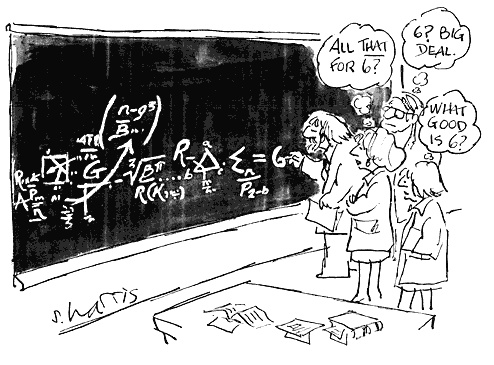
Why the Trinity matters is like asking why does gravity matter? Or why is oxygen all that important? Or do we really need to know anything about anything? I remember sitting in Algebra as a high-school student and thinking to myself, “Is this at all practical?” Indeed, it is practical. For without mathematics the very school building I was sitting in would not have been architected, planes could not fly, time and space could not be measured.

Just because something does not matter to you does not mean it does not matter. In fact, many things we do not think about matter. Imagine you stepped onto an airplane and the stewardesses did not give a safety talk before the plane took off. You would not know what to do in an emergency. If there is information about God that is important shouldn’t we seek to know and understand Him? Why does the Trinity matter?

The Trinity strengthens our relationship with God.

Can you really love something you do not know much about? This is a good question to consider. Take something you love and test it [write a list of things you love]. I love cheese. I am not an expert coinsure on cheese, but I have grown up in Wisconsin, I’ve tasted many kinds of cheeses, I have friends who work in cheese factories that cut cheese for a living, therefore, I know cheese and can appropriately love it. As lame of an illustration as that is the things we love we often learn, study, consume, relate to, experience, and take time and energy to know and understand. This in turn strengths our love and affection for it. To love God is to know and grow daily in all His ways.

God desires us to know and understand Him [Jeremiah 9:23-24; John 16:7-15]. That’s why He was given us His Word. Knowing God might not be the priority of every human being, at least right now, but it we will all one day come to the realization that knowing God is what matters the most.

The Trinity is not about ME.

I cannot wrap my melon around the scope of the Trinity, but that does not mean the Trinity does not exist. Just because I cannot fully understand something does not nix it from being real or truth.

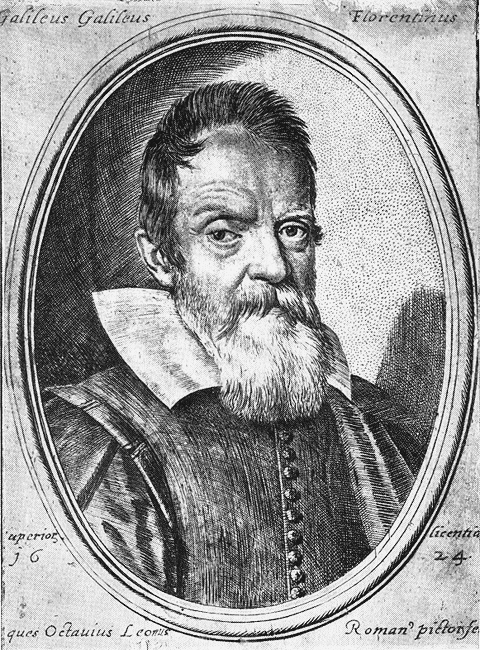
We live in a me-centered culture that thinks everything revolves around “me”. You can spend an entire day thinking about yourself, but oblivious to the realities surrounding you. Like people prior to Galileo concluded our world was flat, but in reality it is a globe. We must face the truth that human beings are part of a larger cosmos that God created, sustains and revolves solely around Him. He is the blazing center of our universe. Man is on earth a blip on the radar screen of history, but God remains eternally. God does not exist to meet our needs, nor did He create us because He was lonely and needed little friends to keep Him company. He did not save man by sending Christ so that we could be with Him forever. Eternity exists so that we can know God—the Trinity [John 17:3].

The Trinity shows the uniqueness of Christianity.

Christianity is not like other world religions. It’s not even kind of the same. Not all religions believe in the same God [that is a contradictory statement]. It is radically different than all world religions. What separates Christianity from other belief systems? According to Christianity God became man [Matthew 1:18-23]. This God-man became the sacrifice for man’s sin. At Christianity’s core the Trinity—God the Father, Son and Holy Spirit—is unique to Christianity. Without the Trinity Christianity is dead. That truth alone helps me to understand that the Trinity matters.