challenges to conversion

Conversion is the child produced by the marriage of faith and repentance (43).

In order to fully appreciate the necessity of conversion, we need to understand the depth of man’s sinfulness and the nature of the human heart to live in rebellion against God’s authority and to resist or replace His demand for singular worship.

Challenges to conversion:

1. Willful independence. This is in fact a definition for sin (Is.43:7; 53:6; Gen.2:7-25; 3:8-24). “Sin is first and foremost a rejection of the supremacy of God and His lordship over our lives” (Thomas Schreiner) “Sin is a deification of self and dethronement of God.” (Charles Horne) Sin is self-worship.

2. Selfish cruelty. Man is more inhumane that wild animals because we are about self-exultation although made in the image of God. (i.e. The Brothers Karamazov; Gen.9:6; Js.3:9)

3. Total Depravity. Our autonomous heart is rooted in our depravity (i.e. continually under the influence of sin).

4. Spiritual unresponsiveness. Without Christ we have total inability to save ourselves and left to ourselves sin will rule us to the grave (Rom.5:6; 3:11; Eph.2:1-3; 1 Cor.2:14). Regeneration is the supernatural imparting of spiritual life to the sinners hear by the Holy Spirit alone. (Eph.2:1; Rom.3:10-18; 5:6; Col.2:13)

Adapted from Chapter 3 of Counsel One Another by Paul Tautges

walking like Christ

“Therefore be imitators of God, as beloved children. And walk in love, as Christ loved us and gave himself up for us, a fragrant offering and sacrifice to God.” (Ephesians 5:1-2)

The game Simon Says is a game we play as children. But it is a game that we are never too old to play. The idea of following a leader is ingrained in our core being. We are hardwired to imitate from the womb.

Paul said, “Be imitators of God, as beloved children.” (Ephesians 5:1) What can we learn about imitating from children? Children are natural born imitators. They are masters at mimicking their parent’s. Often children imitate quickly, enthusiastically, and without embarrassment. God loves children, especially His children. Therefore, Paul is challenging adult followers, as a child adopted into the family of God, imitate your Father.

Let’s look at what God says to imitate and copy. This text is especially important for ministry partners, church members, and doing life with other Christians. Read Ephesians 5:1-2. Within these two verses I have three questions and two application:

Q1: What about God are we called to imitate?

We are called to “walk in love” (cf. 3:17-19). That’s our goal. What does it look like to walk in love? “When He had gone out, Jesus said, “Now is the Son of Man glorified, and God is glorified in Him. If God is glorified in Him, God will also glorify Him in Himself, and glorify Him at once. Little children, yet a little while I am with you. You will seek Me, and just as I said to the Jews, so now I also say to you, ‘Where I am going you cannot come.’ A new commandment I give to you, that you love one another: just as I have loved you, you also are to love one another. By this all people will know that you are My disciples (you smell like Christ), if you have love for one another.” (John 13:31-35)

Q2: Who is my model for walking in love?

Jesus. Ephesians 5:2 is God’s list of values. #1 on God’s list of personal values is Jesus. He values Himself. Since He values Himself, He desires His children to walk like Him. The goal of imitating God is Christlike love, “walk in love as Christ loved us and gave Himself up for us.”

Q3: How is the example of Christ a good enough motivation to walk in love?

I asked this question to a group of children this week. Without hesitation a six-year old Eden raised her hand and said with a sweet smile, “God’s love.” In the simple words of a child she was so on target. God’s love is enough. The love God gives His children is demonstrated in the sacrificial love of His Son. Christ’s love—true love—is built on sacrifice.1 He loves sinful people because He has a perfect, sacrificial, and unconditional love [cf. 4:32]. You and I have received that love as beloved children. Being receivers of His love is motivation enough to continue living in His love, “I have been crucified with Christ. It is no longer I who live, but Christ who lives in me. And the life I now live in the flesh I live by faith in the Son of God, who loved me and gave himself for me.” (Galatians 2:20) Bind on your heart this truth: God is my Father and I am His child.

Since it is clear that God values His Son and desires His community of followers to walk like His Son, I have two applications for us as ministry partners:

1. Remember, the way we walk models the gospel.

How we deal with our difference speaks loudly (cf. Ephesians 4:25-32; 5:3-5). Sooner or later what you think about someone in your heart will come out of your mouth. It might be a small jab, behind the back slander, the silent treatment, or an outburst of rage, Usually it starts with a small personality or preferential issue that builds over time until it becomes big and ugly and out of control. Deal with it before before the rash spreads.

4 years I got the the worst case of poison ivy. The problem was, I did not know what it was at first. I thought it was a small bug bite. Within 48-hours a rash covered my body and I was a miserable itchy pussy mess. It was so bad that I wore pajama pants to work for 2-weeks. If I only caught it early, it would not have been bad at all. So it is with differences between ministry partners: deal with it quickly and biblical.

Last year Sarah and I were talking to long time missionaries to Brazil. They openly shared about a season of conflict on their team. They were part of a multicultural team and misunderstanding between one another were common. At one point the differences were so great they considered leaving the team, but were torn because they loved the people to whom they were ministering and did not want to abandon the work. Sadly, their differences were also known by the people. The testimony of the gospel was tarnished by the missionaries conflict.

The team decided rather than splitting ways to deal with the heart of the issue. They gathered together for a meeting. Outside the locals had also gathered around to see what would happen expecting tempers to flare and machetes to fly. The meeting began with prayer, then they read Scripture, confessed their sin to one another, had communion, and in tears embraced one another. The community watched dumbfounded.

Fast forward 20 years. The missionaries stayed the course and a church is planted. The church has hundreds of members and strong leadership. Time comes the new church an issue between its own leaders. A certain sect of the church is committed to leave the church. Tempers are flared and machetes are ready to fly. Until one leader stepped in and said, “Do you remember that evening 20-years ago, when we gathered around the missionaries meeting and we saw the pray, read Scripture, have communion, weep and reconcile?” So God desires to use our differences for unity and the glory of the gospel.

2. Let us encourage one another to value Christ supremely more than anything.

He is the treasure of our church. He is the One we adore. He is our goal for missions. It is His fame we desire to spread. Together let us make Him great. Even greater than ourselves and the things we value that are lesser than Him. He is supreme. He is the value we hold high.

thumb licks [9.27.12]

So you still think God is a merciful God?

Life’s little mysteries. I always wanted to know that!

10 Commandments for flying.

When God pulls the rug out.

Throw the ball like a girl.

What will Disney think of next? Their creativity reminds me of Someone else!

Some things to think about before you criticize your pastor.

3-2-1 how the Trinity teaches us the gospel:

a short story of the gospel

1. Where sin came from.

Holy creator God. Righteous Judge. He created angels (including Satan). Satan was prideful and wanted to be god (Is.14:13-14), but instead became and enemy of God and was cast from heaven.

2. How we became the children of Satan.

God created heavens and earth and mankind. Adam and Eve were tempted by Satan in the garden to eat the fruit to be as wise as God. A lie. They bit the fruit. God cast them from the garden and were accursed and not allowed to come into His perfect heaven (Rom.6:23; 3:23). They obeyed Satan’s voice rather than God’s.

3. How God adopted us into salvation.

God came to earth in the form of a man. His names was Jesus.He came to live a perfect life and die as the sacrifice for sin. After He died He resurrected from the grave and ascended into heaven conquering sin and defeating death. Jesus brought eternal life to all who believe on Him and follow Him (John 3:16; Mt.28:19-20; 11:28-30). You receive His Holy Spirit and become a new creation.

4. What will happen when Jesus returns.

He will come back as judge. Until He returns we must be a part of His church, be willing to suffer for His name, and live as His child.

Adapted from Preach and Heal by Charles Fielding (Appendix E)

Oh, that I would decide to give thanks

by kylie j lloyd

“Thankfulness is the attitude that perfectly displaces my sinful tendency to complain and thereby release [God’s] joy and blessing into my life.” (James MacDonald, Lord Change My Attitude, p.45)

It is easy to shift from being thankful to being unthankful. For me, it only takes a moment. I’ve already caught myself saying, “I am tired of speaking in French today. I can’t even order the right thing at the restaurant. Am I ever going to see my wife and kids? It’s cold outside already? What? No appliances are provided from my friends new apartment! That’s bogus.”

But then God used a verse of a song written a few thousand years ago. Psalm 107:1, “Oh, that men would give thanks to the LORD for His goodness.” (cf. vs. 8, 15, 21, 31) God, like a master chef, using this verse to tenderize my heart with 3 important truths:

1) Thankfulness is a decision: “Oh, that men would give thanks…”

Notice that the psalmist did not say, “COULD”. What difference would it make if it said could? “Could” makes being thankful contingent on my ability, “I could if be thankful if my situation were better.” Would is a word used to agree or be okay or to be willing to comply. No matter my day, circumstance, or influences from people around me, I have the capability to be thankful. I have the responsibility to be thankful. I must decide to be thankful.

I remember the year after college I visited a friend in Ukraine. He took me to a small town where we popped in on a Sekret family to encourage them. I remember being greeted at the door by the Alexander and wife and their 7 children. Their home was a 1-bedroom shack that was cold and smelled musty. Immediately the husband excused himself and left the premises for about 10 minutes. When he came back, his wife excused herself and they were doing something in the kitchen for about 10 minutes. Meanwhile I was sitting on a wooden chair looking at the 7 children staring at me. Neither of us could speak each other’s language. After minutes of awkward silence Alexander and his wife entered with bread, spicy mustard, Russian sausage, cooked cabbage, and beets. They asked me to come to the table. I stood by a bed near the cramped table and Alexander prayed, I don’t remember much Ukrainian, but I do remember, “Slava Bog, doosha smachna” (meaning: Praise God for this food…) My friend told me after we left that the style of meal they made for us was equivalent to our Thanksgiving. I will never forget the spirit of thankfulness in the eyes of the Sekret family.

Why are we not more thankful? Could it be we are use to having so much? Emerson once said, “If the stars would come out only once a year, everyone would stay up all night to behold them.”

B.B. Warfield said,

“We are frequently told, indeed, that the great danger of (Christians) lies precisely in his constant contact with divine things. They may come to seem common to him, because they are customary. As the average man breathes the air and basks in the sunshine without ever a thought that it is God in His goodness who makes the sun to rise on him. Other men, oppressed by the hard conditions of life, sunk in the daily struggle for bread perhaps, distracted at any rate by the dreadful drag of the worlds work, find it hard to get time and opportunity so much as to pause and consider whether there be such a God, and religion, and salvation from the sin that compasses them about and holds them captive. The very atmosphere of your life is these things; you breathe them in at every pore; they surround you, encompass you, and press in upon you from every side. It is all in danger of becoming common to you! God forgive you, you are in danger of becoming weary of God!”

2) Thankfulness is a decision based on divine reality: “give thanks to the Lord for His goodness.”

“I will give thanks to the LORD because of his righteousness and will sing praise to the name of the LORD Most High.” (Psalm 7:17) “We give thanks to you, O God, we give thanks, for Your Name is near; men tell of Your wonderful deeds.” (75:1) Praise the LORD. Give thanks to the LORD, for He is good; His love endures forever.” (106:1)

Giving thanks is a decision based on Divine Reality. When I consider the character of God and believe He is true and acknowledge His ways are good, my perspective of the situation is different than the worlds. If you’ve read Robinson Crusoe you see how his perspective changes as He reads about the God of the Bible. His demeanor says, “I have been on this deserted island for 28 years…but it is beautiful. I am sick of these coconuts…at least it’s food! I am all alone…but at least I don’t have to worry about traffic or lines or loud neighbors.”

3) Thankfulness is a life-changing decision: “Oh…”

“Oh” is a word that comes “from the gut.” It’s a word you say when you really want to express deep emotion. Let’s say it together, Oh!” Say it like you mean it.

Moses said, “I will proclaim the name of the LORD. Oh, praise the greatness of our God!” (Deut. 32:3)
Isaiah said, “Oh, look upon us, we pray, for we are all Your people.” (64:9)
David sang, “Oh, how I love Your law! I meditate on it all day long.” Psalm 119:97
Job said, “Oh, how I wish that God would speak,” (11:5)
Elisha prayed, “Oh, my lord, what shall we do?” the servant asked.” (2 Kings 6:15)

I desire Psalm 107:1 and Psalm 105:1 be my prayer,“Oh give thanks to the Lord; call upon His name; make known His deeds among the peoples” Oh, that I be thankful for Your Word. Oh, that I be thankful for my salvation. Oh, that I be  thankful for Your provisions. And make it known to all how good You are.

opulence, philanthropy, and giving

Image from Forbes.com

In the photo above you have a gathering of $126 billion dollars. It is probably the single richest gather in modern history. These men and women have given money and time to make the world a better place. These peoples lives are marked by giving rather than receiving.

It is indeed honorable what these billionaires have done with their pocket books. You truly see what one values by the way they spend their money and time. These billionaires have set a high standard for those of us who have less to consider.

As I pursued Forbes 400 Summit articles a few questions teetered in mind: Is he who give the most always the most honored? What about the little old lady who lives below the poverty line that gives kisses and cookies to cheer children? Is giving money the most helpful solution to the worlds issues? What does money buy? What is the definition of “better” in making the world a better place?

When I consider the most opulent Giver of all time, he was not rich with monetary wealth, he did not own a large corporate empire, he was not well liked even by religious persons. Rather, he lived a frugal life, the son of two teenage parents. His hands were calloused from carpentry. He did draw crowds and heal many sick. He did make outrageous claims, like, being God and the universe was his inheritance. He was considered a criminal and blasphemer. Ultimately he sacrificed his life, ending it in public humiliation, giving it up for the sake of the name and glory of His Father’s.

His name: Jesus. Without his divinely foreordained gift to humanity, no one in the world would have enough brains, bucks or brawn to conger up a better solution to the problems created by sin. His gift of forgiveness and reconciliation is free for all who believe. It won’t cost you 99% of your accumulated wealth, but it might just cost you to die to yourself.

I am not sure I’d ever see Jesus picture or name mentioned in Forbes, but I will surely hear and see Him worshiped throughout eternity.

thumb licks [9.11.12]

Why should I give it my all to teach a small Sunday School class or clean the church toilets?

Are you attracted to legalism?

How the government spends its money.

The gospel impacts your parenting.

Love is stupid.

I want this new VW bus!

Why disabilities?

Not your average Youth Group.

Top 10 blogs for women.

Worlds Greatest Drag Race

Will Jesus’ grandpa please stand up?

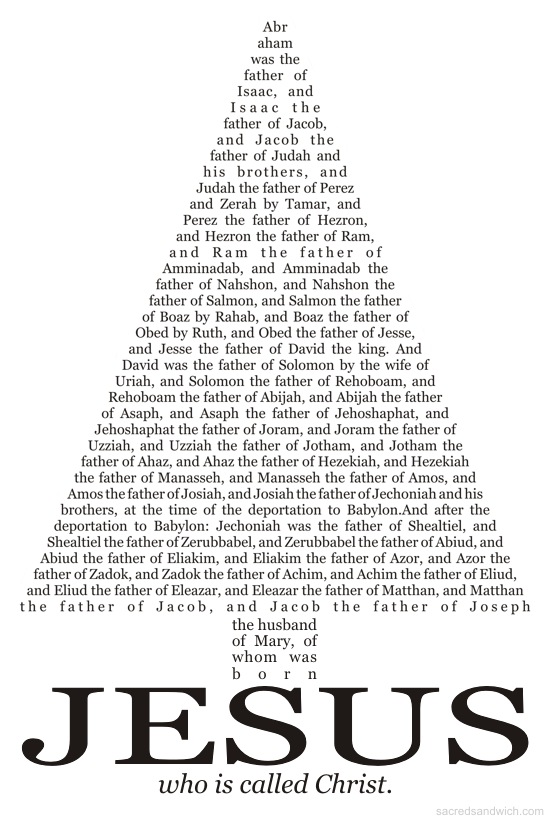
Dealing with the problem in the genealogies of Matthew 1:16 and Luke 3:23

It is clear from the Bible, Jesus was supernaturally conceived by the Holy Spirit (Luke 1:34ff) and His earthly, legal father was Joseph. However, sometimes you come across a sticky question from within the Bible where an apparent contradiction appears that there doesn’t seem to have an immediate answer in the text or context. One such sticky question is, who really was Jesus’ grandpa? Heli or Jacob?

Both Matthew 1 and Luke 3 contain genealogies of Jesus. But there is one problem—they are different. Luke’s genealogy starts at Adam and goes to David. Matthew’s genealogy starts at Abraham and goes to David. When the genealogies arrive at David, they split with David’s sons: Nathan (Mary’s side of the family tree) and Solomon (Joseph’s side of the family tree). And the point of contention for some is when Luke says that Joseph is the son of Heli (3:23), while Matthew says that he was the son of Jacob (1:16).

How do you reconcile the two genealogies? Who is right? Is the Bible wrong? How do we handle contradictions in the Bible? What do you say to skeptics who point out contradictions like this and say, “See, here is another reason why we cannot trust the Bible. Christianity is a farce.” We will seek to tackle these questions as we look at the two texts from the gospels of Luke and Matthew.

Why Are Matthew and Luke so Different?

When you compare Matthew’s genealogy with Luke’s between David and Jesus, are they almost completely different. First, for example, all the names but two are different (Shealtiel and Zerubbabel). How are these differences to be explained? The differences between these lists stem from the purposes for which the gospels were compiled and the meanings they were intended to convey to their audience.

Second, Matthew places his genealogy at the very beginning of his Gospel (1:1–17), Luke placed his genealogy between the accounts of Jesus’ baptism and temptation. There is OT precedent for this in Moses’ genealogy (Exodus 6:14–25), which is not recorded at the beginning of His life but just before He started His ministry.

Luke doesn’t stop with Adam but goes on to say that Adam was son of God. Luke does not want his readers to think of Jesus as the Son of God in the same sense that Abraham and David and all the other descendants of Adam were. Luke 1:35 shows that His sonship depends on His unique creation in Mary’s womb by the Holy Spirit. This then calls to mind Paul’s teaching that Christ is a second Adam, the beginner of a new humanity. Paul says,

“The first man was from the earth, a man of dust; the second man is from heaven. As was the man of dust, so are those who are of the dust; and as is the man of heaven, so are those who are of heaven. Just as we have borne the image of the man of dust, we shall also bear the image of the man of heaven.” (1 Corinthians 15:47–49)

Luke was not ignorant of this idea since he was a companion with Paul. Therefore, like Adam, Jesus was man and uniquely created by God. He is a new and second Adam whose ministry will be to create and assemble a new race of humans who are not marked by Jewishness or Gentileness, but by the character of the Holy Spirit.

Third, Luke’s list is a lot longer than Matthew’s. Luke’s genealogy goes back to Adam while Matthew’s stops at Abraham. Why is Luke’s genealogy longer? It might seem that there is some genealogy rivalry going on that Luke has to out do Matthew. It’s plausible, but just silly.

To understand why Matthew only goes to Abraham and Luke goes beyond to Adam, you have to know each gospel writers audience. Matthew is writing for Jews who are interested in Jesus’ connection with father Abraham, but Luke is writing for Gentiles and is more interested in Jesus’ solidarity with all humanity through His descent from Adam. And this runs parallel to Jesus message of coming to bring the gospel to all men. Jesus is not just a son of Abraham—more importantly He is a son of Adam—He is a man. His humanity, not his Jewish ethnicity, is the crucial thing. And that seems to be Luke’s point in connecting Jesus to Adam.

Fourth, the most contested difference between Matthew and Luke is that Luke says that Jesus’ earthly father Joseph is the son of Heli (3:23), while Matthew says that he was the son of Jacob (1:16). There are suggested solutions for this assumed contradiction:

First suggestion: The gospel of Matthew,

“gives the legal descendants of David—the men who would have been legally the heir to the Davidic throne if that throne had continued—while Luke gives the descendants of David in that particular time to which finally Joseph, the husband of Mary, belonged”.[1]

So, for example, Luke says in 3:31 that the son of David was Nathan (2 Samuel 5:14), while Matthew in 1:6 says the son of David was Solomon, who was heir to the throne. The two lines could easily merge whenever one of Nathan’s descendants became the rightful heir to the throne. According to J. Gresham Machen,

“The Lucan genealogy, in other words, starts with the question, ‘Who was Joseph’s “father”?’ the answer to that question is, ‘Heli.’ . . . In the Matthean genealogy, on the other hand, we start with the question, ‘Who was the heir to David’s throne?’ The answer is, “Solomon,’ and so on down to Joseph.”[2]

Jesus’ family tree in Matthew is meant to establish that He was legally a descendant of David (cf. 1:27, 32, 69) through His relationship to Joseph, and also to demonstrate that He was a member of the human race. It is not meant to show that Jesus was the Son of God by descent from Adam, since that would be true of all descendants of Adam.

Luke’s family tree compared to Luke’s is in reverse order, and it goes back beyond Abraham to Adam, and thus places Jesus in a wider context than does Matthew.

“Many have suggested that the regressive order in the genealogy is probably Luke’s instrument to focus attention on Jesus. The fact that Luke traced Jesus’ ancestry back to Adam, “the son of God,” was probably due to the fact that he wrote for Romans and Greeks. By tracing Jesus’ ancestry back to Adam, he shows Jesus to be related to the whole human race. In Luke’s genealogy Jesus and Adam are both “sons of God”; Jesus, of course, is the son of God by nature; Adam, the son of God by having been created in God’s image. Jesus is a member of the race to which all people belong.”[3]

Second suggestion: Luke gives Mary’s genealogy and Matthew gives Joseph’s as Jesus’ legal father. The key to this interpretation is extending the parenthesis of verse 23 to include Joseph. So it would read, “Jesus was about 30 years old, being the son (as was supposed of Joseph) of Heli.” By including “of Joseph” in the parenthesis the point is made that Jesus is really the son of Mary, not Joseph, and Heli is his grandfather (Mary’s father). D.A. Carson says,

Both lists give the descent of Jesus through his supposed father Joseph (so it was thought; 23). The theory that Luke really gives us the family tree of Mary rather than of Joseph is improbable. The theory with least difficulties is that Matthew gives the descendants of David down the royal line (i.e. who was heir to the throne at any given time), but Luke gives the particular line to which Joseph belonged. Even so there are still problems, and in the absence of fuller information the problems of explanation and harmonization with Matthew remain insoluble.[4]

There are a few other suggestions,[5] and both of these solutions are possible; the first is more probable; but neither can be completely proven. It is beyond human reach to discover for certain the full solution to the differences between Matthew and Luke’s genealogies of Jesus, or the actual relationship of Jesus to them. Enough has been said to show that they are reconcilable, and the purposes of each, suggested here, indicate that either of the ways outlined above does full justice to the Davidic descent of Jesus, as rightful heir to His ancestor’s covenanted throne, and also to His virgin birth by Mary.

Why is it so important to dig into such questions like this related to the family tree of Jesus? Perhaps the best lesson one can gather from  sticky questions is simply that apparent contradictions in the Bible do have plausible and possible solutions and we should be slow to throw out a book that has proved itself over and over for thousands of years as the mighty, saving, transforming word of God.


[1] J. Gresham Machen, The Virgin Birth of Christ, New York: Harper Brothers, 1930, 204

[2] Ibid. 207

[3] Walter A. Elwell and Philip Wesley Comfort, Tyndale Bible Dictionary, Tyndale reference library (Wheaton, Ill.: Tyndale House Publishers, 2001), 520-21.

[4] D. A. Carson, New Bible Commentary : 21st Century Edition, 4th ed. (Leicester, England; Downers Grove, Ill., USA: Inter-Varsity Press, 1994), Lk 3:23–38.

[5] I.e., Luke followed the Davidic line through Nathan (cf. Zech 12:12–13), whereas Matthew (cf. 1 Chr 1–3) followed the line through Solomon. The Matthean genealogy thus gives the legal line of descent from David, whereas the Lukan genealogy gives the actual physical line of descent. Or both Jacob and Heli were in some sense Jesus’ grandfathers. Variations of this explanation include: (a) Jacob (Matt 1:16) and Heli (Luke 3:23) were brothers, and upon Jacob’s death Heli assumed the role of husband via a Levirate marriage (cf. Deut 25:5–10) and fathered Joseph. Heli was thus Joseph’s natural father, whereas Jacob was the legal father. According to Eusebius (Eccl. Hist. 1.7.1–15), Julius Africanus (ca. 225) claimed that he knew this from information that came from the descendants of James, the brother of Jesus. However, whereas the father of Joseph and Heli for both Matthew and Luke was Matthat/ Matthan, the father of Matthan in Matthew is Eleazar, while in Luke, it was Levi. (See R. E. Brown, The Birth of the Messiah [Garden City: Doubleday, 1979], 503–04.) (b) Matthew’s genealogy was that of Joseph, whereas Luke’s genealogy was that of Mary. This depends upon how one reads “so it was thought, of Joseph” (Luke 3:23). The phrase can be interpreted in two ways: “Jesus was the son (supposedly) of Joseph, who was the son of Matthat” or “Jesus was the son (supposedly of Joseph but really) of Matthat,” who is then identified as the father of Mary. The major problem with this explanation is that in 1:27 Jesus’ Davidic descent via Joseph is stressed. (c) Heli was Mary’s father, but due to lack of a male heir, he adopted Joseph as his son in order to maintain the family line. Thus the Matthean genealogy was Joseph’s actual lineage, whereas the Lukan genealogy was his adopted lineage. This latter explanation lacks any evidence and can neither be proven nor disproven.


thumb licks [9.3.12]

Is Proverbs 22:6 a guarantee?

How the 50 States got their names.

Ministry: it’s not about you.

Sin wants to be your friend.

If snack labels told the truth.

Somethings we can learn from suffering.

10 happiest jobs. I knew it!

What is a Sikh?

Why is love so stupid?

Warsaw remembering the Holocaust:

running the wrong way

Ouch. How embarrassing? I am certain Andre Parker won’t make that mistake twice. Or he could risk being cut from the team.

In reality, all of us are like Andre Parker. Instead of a football field it is life. We are born from the womb running the wrong way. We don’t think anything of it because running the wrong way is our norm. By definition sin is running the wrong way. In fact, it is running the opposite way of God. It’s not that are coachless or are left to living without a playbook. God sent His Son into the world to be an example of running the right way. It is only when we repent of our way, have faith in Him, and submit to His way that we can begin running the right way. Hear the call of Christ and turn around.

7 year mission

It was 7 years before William Carey baptized his first convert in India; it was 7 years before Judson won his first disciple in Burma; Morrison toiled 7 years before the first Chinaman was brought to Christ; Moffat declares that he waited 7 years to see the first evident moving of the Holy Spirit upon his Bechuanas of Africa; Henry Richards wrought 7 years on the Congo before the first convert was gained at Banza Manteka. – A.J. Gordon, The Holy Spirit in Missions, pp.139-140

daily responding to the gospel

If there is no invitation to respond to the gospel by living in the light of it each day it is no gospel.

If you do not daily respond to the gospel it is wasted.

The gospel is not a collectors item or trophy your keep on the shelf or in storage to remind you of an event past. It is the classic car you drive. It is the little league game you relive every day. There are no such thing as glory days or good old days when it comes to the gospel. It’s everyday.

As Jerry Bridges says, “Preach the gospel to yourself daily.”

those who are given Grace give no excuses good enough to keep sinning

“What shall we say then? Are we to continue in sin that grace may abound? By no means! How can we who died to sin still live in it?” (Romans 6:1-2 ESV)

Grace gives no excuses to sin. If you give excuses for sinning after you’ve been given grace you do not completely understand grace. You don’t understand the grossness of sin. You don’t understand the glory of Christ.

Sin might look cute in kids. Sin might be expected in teens. Sin might be hidden by crafty adults. But that gives not excuse to sin. That only abuses grace.

thumb licks [8.22.12]

10 Tips on Solving Mysterious Bible Passages from Sherlock Holmes.

How to make the most of your mornings.

Glass Beach: a story of how God uses trash.

How reading literature can aid your worship.

How should your church respond to tragedy?

How to fold fitted sheets. I’ve always wanted to know this.

How to pray for your pastor.

Is it true Jesus never said anything about same sex marriage?

Lessons from the brain surgeon’s office: looking out the window at the top of my head.

Quick history of Mormonism:

grace offends us

“The law offends us because it tells us what to do; grace offends us even more because it tells us we can’t do anything!” – Pastor Tullian Tchividjian

Quoted while preaching through Galatians in a sermon series entitled Free at Last.