
HOW TO MULTIPLY FROM THE START
The history of Christianity is not static; it is a dynamic tapestry woven with moments of growth, deep reformation, and radical new expressions of faith. These moments are often ignited by movements—organic, self-propagating communities driven by a shared vision, supernatural power, and a distinct set of theological and missional practices. From the Desert Fathers to the Mendicant Orders, from the Protestant Reformation to the rise of global missions, movements have proven to be the catalyst of change, constantly pushing the boundaries of what the church can be and do.
We will delve into the fundamental principles that govern gospel movements. We will explore the theological underpinnings that give them life, the pioneer spirit that fuels their launch, and the practical disciplines required to sustain them beyond their initial spark. By dissecting the DNA of movements, we aim to equip the modern pioneer to not merely manage existing mission institutions, but to unleash a multiplying, world-changing force for the Kingdom of God.
Yung and his team labored for eight years among a highly resistant, religious people group, seeing zero baptisms and minimal spiritual interest. Yung constantly struggled with the fear that their mission was a failure, contrasting their barren reports with the multiplication stories of other mission teams. During their eighth year, their team was forced to evacuate due to political unrest. They returned five years later to find that while no organized church existed, seven individuals—who had watched the team’s faithful presence, integrity, and eventual forced exile—had quietly come to Christ independently, using the few Scripture portions Mark had left behind. Mark learned that true movement often involves an unseen, foundational work of the Spirit.
BIBLICAL REFLECTION ON MOVEMENTS
To you, pioneer mission workers, the mission you undertake is not just about isolated conversions or church buildings; it is about participating in the Gospel Movement—the irreversible, divine force unleashed by the Holy Spirit to expand the Kingdom of God among all nations. Understanding this dynamic is crucial for setting effective strategies and maintaining hope amidst sometimes mundane ministry days.
God is a God on the Move (Motus Dei). God has always moved towards His people, and God has always commanded His people to go towards others to bring them in. The Bible is a story of God’s movement of redemption among humanity.
- God made a covenant with Abraham, and the command was to go. God would bless Abraham to be a conduit of blessing to the nations (Genesis 12:1-3). This pattern of God’s desire for the nations to know Him would be repeated throughout the Old Testament (e.g., Psalm 67:1-7).
- God commanded the nation of Israel to be a light to the nations that would both draw them in and cause them to reach out (Isaiah 42:6). Israel was to be a holy nation and a “light to the nations,” drawing all peoples to worship the one true God. This is often referred to as a “centripetal” (inward) mission, where the nations come to Jerusalem. As God did signs and wonders and showed his power among His people, the other nations marveled and recognized that God was with them (e.g., Exodus 18:8-11, 1 Kings 8:41-43).
- God’s people were repeatedly admonished for failing to be a more intentional light to the nations (Isaiah 42:6, 49:6). Instead of standing out as distinct servant of the world, they often imitated the world and surrounding cultures, which displeased God (Ezekiel 16:44-50; 20:32). Through the prophets like Isaiah, the Lord promised to intervene by doing a “new thing” and sending a Messiah to bring the good news to all nations (Isaiah 43:19; 52:10; 60:1-3).
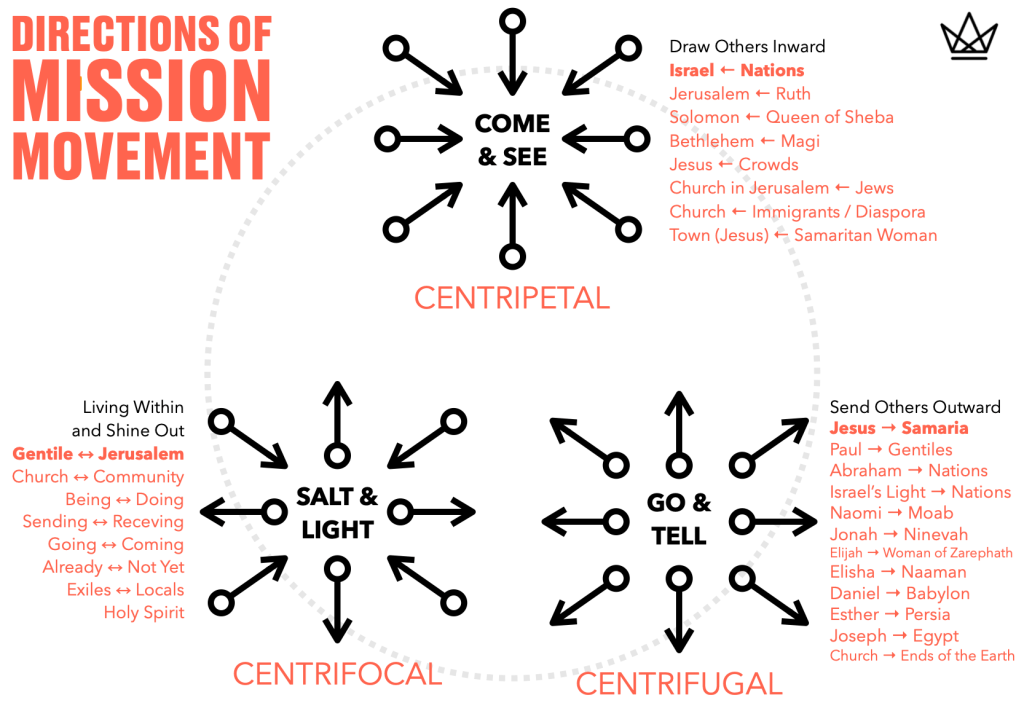
Jesus Shows Us How God Moves Towards Humanity. Jesus was God with skin on (John 1:14). He showed us the compassionate and evangelistic heart of God (centrifugal outreach). He moved towards the outsiders, foreigners, and sinners (Mark 2:15-17; Luke 7:34). He demonstrated God’s original and ongoing intention to bless all people (Genesis 12:3; Isaiah 61:1-2). This often offended the religious leaders as they wanted to restrict access to God and hoard God for themselves (Matthew 9:11; Luke 15:1-2).
The Gospel and Church are Meant to Expand and Multiply. The gospel is designed to be reproduced, shared, and replicated across geographic, cultural, and generational lines. The Church is intended to be a sending body that continuously expands, multiplying disciples, leaders, and new churches. Both evangelism and discipleship are inherently moving forward.
- The Expanding Kingdom: Although the kingdom of God is not equated with the church, the church is the main instrument today that advances God’s kingdom as a sign and witness to Jesus’ saving work (Matthew 5:13-16).
- The Command to Multiply and Make Disciples (Great Commission): The imperative for movement finds its roots in the creation account (Great Mandate) and reaches its fulfillment in the Great Commission. Jesus sends out His followers in the same way the Father sent Him out to incarnate the mission-heart of God. (John 20:21; Genesis 1:28; Matthew 28:19; Luke 24:46-48)
- The Command to Love in Action (Great Commandment): Jesus summed up the law by saying we are meant to love God wholeheartedly and love others sacrificially. Love can’t help but cause us to take action and draw near to the needs of those around us. When we love God and those around us, even our enemies, it is a reflection of God and contagiously draws people to us (and repeals some, too). (Matthew 22:37-40; 5:43-44; 1 John 4:20)
- The Command to Glorify God (The Great Calling): At the end of the day, we are worshipers. It is what we will be doing for all eternity. So we go to call people to worship the one true God now and later. Missions is an expansion and multiplication of worshipers. (Ephesians 1:3-14; John 15:5-8; Romans 12:1; 2 Corinthians 2:14-15; Revelation 7:9-17)
- The Need to Sow and Reap: Jesus calls His followers to spread the seeds of His Word. The Word itself is powerful and living. The important elements for gospel movement are the Spirit, Seed, Sower, and Soil. The rate and growth of the kingdom would depend on people’s response to the gospel seeds sown and God’s supernatural work (Matthew 13:1-35; Mark 4:26-29; Isaiah 55:9-13).
- The Urgency of Gathering Worshipers: Jesus shared the story of the harvest field and emphasized the need to gather true worshipers through prayer, sending out, and bringing in people from all around (John 4:22-42; Luke 14:23).
- The Church as a Movement through Dispersion and Multiplication: The early Church was not defined by its location, but by its apostolic mission and continuous expansion outwards from Jerusalem. It is important to note that persecution became a catalyst for movement dispersion, and multiplication. (Acts 8:4; 9:31; 11:20-21; 12:24; 13:49; 19:10; 1 Thessalonians 1:8)
The Engine of Movement is God, Prayer is Fuel, and People are His Vehicle. Gospel movements are ultimately an act of God, powered by the Holy Spirit, channeled through the prayers of the faithful, and activated by obedient people who are willing to go to the least reached.
- Movement is an Act of God: We are not responsible for initiating the movement, but for aligning ourselves with the Holy Spirit already at work. Acts of the Apostles should really be called Acts of the Holy Spirit. God grants the growth and sets the strategic direction. (1 Corinthians 3:6-7; Acts 16:6-10)
- Powered by Prayer: Movement is initiated by asking the Sovereign Lord of the Harvest. Prayer is the indispensable spiritual work that invites and sustains movement. (Matthew 9:37-38)
- Activated by People Going: Movements require people to cross barriers (cultural, geographical, linguistic) to deliver the message. (Romans 10:14-15)
Simplicity and Succession. The gospel and church are meant to be reproduced. The gospel isn’t meant to be hoarded or die with any one generation, but each generation is responsible for passing on the greatest treasure to the next generation. Pioneer workers must focus on creating simple, reproducible structures that local believers can rapidly adopt, ensuring the movement is indigenous and not reliant on foreign presence. The goal is succession—handing off leadership and responsibility so the movement can continue in their absence.
- Focus on Reproduction and Succession: The goal is not to gather people to one missionary, but to equip disciples who can, in turn, make disciples. This reflects the four-generation transfer discipleship model (Paul → Timothy → faithful men → others), ensuring the message continues (2 Timothy 2:2). This focus shifts from simply counting disciples to multiplying disciples (Matthew 9:37-38) and establishing reproducible patterns (1 Corinthians 4:17).
- Planting Imagery. Paul used planting imagery to convey that growth was a natural byproduct and outflow of the gospel and the church’s mission. He spoke of planting the seed of the gospel, where God gives the growth, emphasizing that human effort is secondary to divine action (1 Corinthians 3:6-7; Mark 4:1-20, 30-32)
- Simplicity and Unity: The structures adopted must promote unity, health, and ease of multiplication of the mission across all kinds of people This requires diligent effort to maintain the spiritual oneness (Ephesians 4:3), focusing on the core doctrines and practices that unite believers (1 Corinthians 1:10), and avoiding unnecessary complexity that could hinder the spread of the gospel to all people (1 Corinthians 9:22).
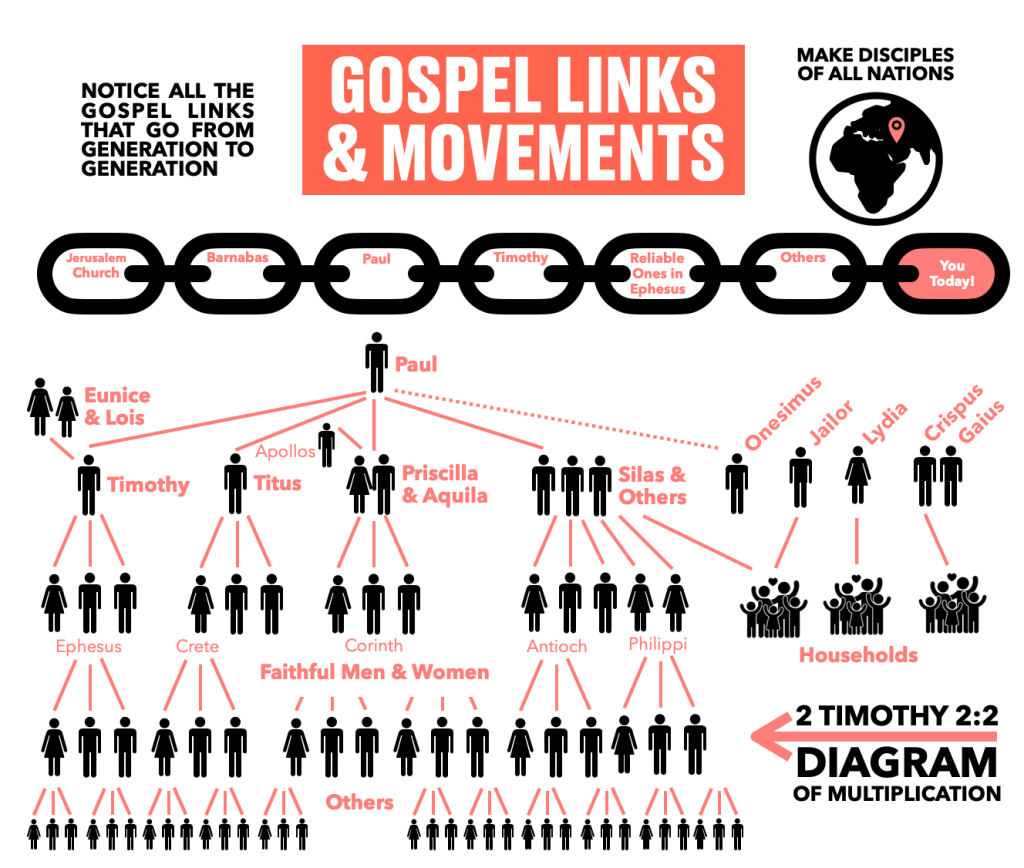
Jesus and his disciples didn’t just plant trees; they planted a forest that are still growing today, generations later. Each disciple today can link themselves back to another disciple before them. They are also responsible to continue the link in the chain. Planting a forest is a huge, awesome project that takes a ton of work. If we get going today, we’ll be old before we see the fruit. We will look back and say all that time and effort was totally worth it. Before new movements fully emerged, Jesus and his disciples frequently established small, faithful remnants.
- What other Scriptures or biblical aspects come to mind when you consider a “Movement”?
“Therefore, those who had been scattered went about proclaiming the Word.” — Acts 8:4
WHY MOVEMENTS ARE IMPORTANT
Gospel and church movements are the essential engine for fulfilling the Great Commission, ensuring the message of Christ is communicated, embodied, and rooted in every community and nation. They are dynamic, adaptive flows of people united by a shared vision, a compelling mission, and a deep conviction that the status quo is insufficient.
Ensure Global Saturation: A focus on multiplication ensures the gospel reaches a broad range of people and penetrates every stratum of society more rapidly than a model based solely on addition.
Fulfill the Apostolic Mandate: They are the practical outworking of the Great Commission, shifting the focus from maintaining existing institutions to continuously advancing the Kingdom into new territory.
Demonstrate the Spirit’s Power: Movements are undeniable evidence that the gospel is a self-propagating seed, requiring divine power, not merely human organization, to thrive.
Promote Indigenous Sustainability: By prioritizing simple, reproducible structures and local leadership from the start, movements ensure the local church can survive and flourish without foreign support, leading to true indigenous ownership of the mission.
Cultivate Shared Ownership and Empowerment: When the structures are simple, and the focus is on discipleship and replication, all believers are mobilized as missionaries, not just a professional few, leading to faster, healthier growth.
Encourage Broader Impact: The gospel movement is not satisfied with one person, family, neighborhood, town, tribe, or nation, but must grow beyond its borders and spread. The goal is not total numbers but the transformation of souls.
The true significance of a theology of movements, therefore, lies in its capacity to transform the pioneer’s perspective from simply managing a church plant to actively releasing a self-sustaining, self-multiplying force for the Kingdom. It is the realization that multiplication—God’s math—is not just a strategic option but the divine design for global saturation, ensuring that the gospel’s power, led by the Holy Spirit and owned by local disciples, continues to spread until Christ is known and worshipped among every unreached nation.
PRAYER ACTION
Consider the Scriptures you cling to above. Consider money. Write a prayer for the kind of person you want to be as you pursue movements.
REFLECTIONS ON BUILDING A PRACTICAL MINI-THEOLOGY OF MOVEMENTS
Take some time to prayerfully draft your practical mini-theology of “movements” by responding to these questions:
- What is a movement? How does movement relate to making disciples or planting churches? What is God’s math? Is it 1-to-1 or 2×2? How does this relate to the creation mandate? (be fruitful and multiply)
example: God is… We are the kind of people who… It is most like us/me to… We/I will… We/I hold to…
- If God’s purpose is multiplication (Acts 8:4), then how does your ministry currently measure success? Is your success measured by Addition (how many people attend your meeting) or Multiplication (how many people your disciples are discipling)?
- If you and your team left the field tomorrow, what specific structures, leadership, and discipleship have you entrusted to local disciples that would ensure the Gospel movement continues to multiply and sustain itself?
- Once you finish, share your responses with your mentor. Ask for feedback. Adjust your draft as needed.
- Complete a one-page practical mini-theology.
RESOURCES FOR GOING DEEPER:
- God’s Expanding Family: The Social Architecture of Ekklēsia Movements, by Trevor Larsen
- Comparing the Primary Approaches to Church Planting Among Muslims in the 19th through 21st Centuries, by Don Little
- The Living Pyramid Model for Relational Communal Discipling, by Don Little
- Global Church Planting, by Craig Ott
- Defining a Gospel Movement, by Tim Keller
- Reformed Theology and Movements: What Can We Learn from Each Other? By J.R. Stevenson
- Leadership Multiplication, by Four Fields
- What Starts Movements? An Ephesiology Master Class
- The Church as Movement, by JR Woodward
- Reactivating the Church as Movement, from Motus Dei
- Church Planting Saturation and Multiplication, by Lausanne

 spreading the fame