Jesus Gives Greater Access to God

I live only a few blocks from the sultan’s palace. The sultan is a king who rules over his tribe. Most days he is sitting in his palace, giving counsel, and ruling over matters concerning his people. When visiting the sultan there is a certain protocol. One cannot burst in and demand what he wants without consequences. In order to gain access to the king you first approach the palace and wait for permission to see him. If permission is granted you remove your shoes and hat and sit at a distance. If you wish to speak you wait until you are invited. The sultan is not always accessible. Some days you have to come back and try again.

When gaining access to the King of kings it is different. While he is holy and to be revered, he invites anyone to approach him anytime. He is never too busy to give ear to what you have to say. Isn’t that is incredible? The King of the universe is always accessible.

“Since then we have a great high priest who has passed through the heavens, Jesus, the Son of God, let us hold fast our confession. For we do not have a high priest who is unable to sympathize with our weaknesses, but one who in every respect has been tempted as we are, yet without sin. Let us then with confidence draw near to the throne of grace, that we may receive mercy and find grace to help in time of need.” – Hebrews 4:14-16

How is accessing God possible. First, Jesus makes accessing God possible through his sacrifice (v.14). Without Jesus access to God would be impossible because of sin I am too unholy to be in the presence of the King of kings in the holy of holies. Ironically, the high priest and intercessor for sin also became the sacrifice for sin.

Second, Jesus makes accessing God possible because he is my sympathizer (v.15). Jesus knows what its like to walk in my shoes. He knows the temptations I face, yet he never succumbed to them. Therefore he knows the full weight of temptation because he overcame temptation without sinning. Knowing that God is a sympathetic King means accessing him is a joyful thing not a fearful one.

Finally, Jesus makes it possible to stand before God’s throne with confidence, particularly in my time of need. I may be tempted to think I need a better something, but what I need most is a better Someone. I need Jesus.

One of the greatest stories in the Bible that shows the accessibility of God is in Luke 7:36-50. The main character is a woman who had a sinful reputation. When she learned that Jesus was eating at a Pharisee’s house she confidently enter the room with an alabaster jar of perfume. As she stood behind Jesus at his feet weeping, she began to wet his feet with her tears. Then she wiped them with her hair, kissed them and poured perfume worthy of a king on them. As the religious leaders balked, the woman bowed knowing who Jesus was. She knew Jesus was her forgiver and sympathizer. She needed Jesus and he was accessible. Through Jesus you too have unlimited access to God anytime, anywhere.


Questions for reflection:

  • What does God see as our greatest need if Jesus is given the title great high priest?
  • How is Jesus a greater high priest than the OT priests? How were OT priests inadequate? How does Jesus fulfill what they could not? (Leviticus 16)
  • How can Jesus be sympathetic towards our temptation yet never have succumb to it?
  • Where does the confidence come from to draw near to the throne of God?
  • Read Luke 7:36-50. What does this story teach you about what kind of King Jesus is? How will you approach the him today confidently?

Jesus offers rest to rebels

Western culture has made rebellion an “in” thing. Just listen for a few seconds to the news media talk about the nations leaders or watch how Hollywood portrays the bad guy as the likable hero. Rebellion isn’t just the product of the Roaring 20’s or Rockin’ 50’s and 60’s, but youth and adult alike from every generation are prone to private and public disrespect of authority.

Israel had been slaves in Egypt for hundreds of years. Yet God did not forget them (Ex. 2:23ff). In fact, he showed them immense mercy by raising up Moses to lead the people of Israel out of Egypt through extraordinary miracles. It didn’t take long for the people of Israel to forget all the miraculous things God had done to free them from the hardships in Egypt. You’d think after all they saw God do it would be enough to keep them on the straight and narrow, but within three days they were already complaining. Their hearts became hard. And for 40 years they wandered in the Wilderness until they reached the border of the Promised Land. Many, including Moses, did not enter “[God’s] rest” because of the people collective rebellion (vs.7-11, 16-19)

Therefore, as the Holy Spirit says,
“Today, if you hear his voice,
do not harden your hearts as in the rebellion,
on the day of testing in the wilderness,
where your fathers put me to the test
and saw my works for forty years.
Therefore I was provoked with that generation,
and said, ‘They always go astray in their heart;
they have not known my ways.’
As I swore in my wrath,
‘They shall not enter my rest.’”

Take care, brothers, lest there be in any of you an evil, unbelieving heart, leading you to fall away from the living God. But exhort one another every day, as long as it is called “today,” that none of you may be hardened by the deceitfulness of sin. For we have come to share in Christ, if indeed we hold our original confidence firm to the end. As it is said, “Today, if you hear his voice, do not harden your hearts as in the rebellion.”

For who were those who heard and yet rebelled? Was it not all those who left Egypt led by Moses? And with whom was he provoked for forty years? Was it not with those who sinned, whose bodies fell in the wilderness? And to whom did he swear that they would not enter his rest, but to those who were disobedient? So we see that they were unable to enter because of unbelief.” – Hebrews 3:7-19

When the author of Hebrews says, “Take care,” it is meant to be a warning to all generations who follow Jesus (v.12). Like Israel, we are prone to wander. Our hearts gravitate towards hardness and anti-authority. We are bent towards unbelief in God’s character and promises. No one is exempt.

At the heart of every problem is the problem in the heart. The heart grows hard. Yet there is a cure: a tender teachable heart. Intentionally surround yourself with brothers and sisters who will frequently challenge and correct your heart and be open to changing the attitude of your heart (vs.13-14; 10:23-25). If not we will fall into the same mindset as Pharaoh, who heard from God’s servant and saw many supernatural wonders, but rejected God flat out and became hardhearted.

A rebels heart is never at rest. Rest is found when you joyfully trust God, willingly submit yourself to the community of faith, and lovingly exhort one another. Enter his rest.


Questions for Reflection:

  • What is the meaning of “rest” (v.11)?
  • Why are people, even Jesus followers, prone to wander, hardheartedness, and bent on unbelief?
  • What leads to a hard heart? What are the dangers of developing a hard heart?
  • Why is the responsibility of all Christians to share the load in encouraging one another to have a tender and teachable heart?  Who do you allow to ask tough questions of your heart?
  • How can we exhort one another every day, stir one another in their faith and confidence, and share the load of helping one another not to be hardened by sin?

God is King

“God is king over the whole earth” (Zechariah 14:9; Psalm 47:7)

God is King
with

A kingdom without natural border in the universe
A domain relished the hearts of Your subjects
A duration without conception or culmination
A reign characterized by justice and righteousness

God is King
by

A dominance unshakeable, regal and kind
A vaunted power above all nations and people
A Name renown throughout all generations
All praise is due him. My lips declare it.

God is King
but

Peoples and the leaders oppose You
You laugh at it, yet your heart breaks
You press forward without wavering Your hope
Honoring the High King of heaven, a Son.

God is King
and

The Hope of Nations you endowed.
A priceless inheritance beyond the grave.
The Rock that will shatter every empire
Until every one of them returns to dust.

God is King
yet

You are sent a Suffering Servant.
A Sovereign who can turn the soul homeward.
Whether king or subject You humble .
Worship the King in reverence and awe.

God is King

May I cease rejoicing in my feeble feats
Take the crown from my grip.
For I revel in Your glorious deeds.
Now and Forevermore.

“Your God reigns” (Isaiah 52:7)

Does church make a Christian?

Or in other words, can someone really be a “Christian” but never go to church? In short, “Yes” and “No” but before you roll your eyes because of a flip-flopped answer, let me explain.

Someone does not have to go to church to be a Christian. The Bible does not directly say, “Thou shalt go to church or thou art not Christian.” Yet to not go to church does not make Bible-sense. Its like a train saying, “I don’t need tracks,” or a fish saying “I don’t need the water.” The longer a “Christian” separates himself from the community the less like Jesus he becomes. Just like a train without tracks becomes derailed and fish without water becomes deadly.

My step-father is a carpenter. One day while on the job his table saw slipped and it sliced through his finger. That finger was dead, but at the hospital the doctor did surgery and reattached it to his hand. It healed and grew strong again. That is the miracle and power of being connected to the body.

You can’t take your finger off and on without consequences. Some might prefer to have a prosthesis that can be removed whenever, yet if you ask a person who has a prosthesis, like my friend Darrell, they will agree the real thing is so much better. To have real blood pumping through your veins connected wholly to the body is in our design (cf. 1 Corinthians 12:12-26).

“Let us hold fast the confession of our hope without wavering, for he who promised is faithful. And let us consider how to stir up one another to love and good works, not neglecting to meet together, as is the habit of some, but encouraging one another, and all the more as you see the Day drawing near.” (Hebrews 10:23-25)

A Christian who doesn’t care to gather and connect with other Christians in the church is no different from a football fanatic who thinks his best view of the game is from the comfort of his couch. He will cheer for his favorite team or player though he is missing out on the amazing reality of rubbing shoulders with others other fans, even players on the team. As Kyle Idleman echoes in his radical book Not a Fan,

“The biggest threat to the church today is fans who call themselves Christians but aren’t actually interested in following Christ. They want to be close enough to Jesus to get all the benefits, but not so close that it requires anything from them.”

There is more to “encouraging one another” than saying kind words and cheering each other on. Encouraging means I will get off the bleacher and onto the field. I participate in the action. I will listen to the calls from the coach and the Playbook. I will hold a block or run a screen. I will cart an injured team mate to the locker room and help him rehabilitate. I will commit to being a team player and show up week in and week out, even bulk up between games.

I think I have overused that illustration, but I did so to make a point. That’s what followers of Christ do. Christians, church going Christians, are not passive or solitary. That makes the church wonderful and wonder-filled, especially when you got more fingers than toes and other complications that naturally come with a body. Being part of a community is more than just being a card carrier with benefits.

Yes, you can be a Christian and not go to church. However, a self-proclaimed Christian who does not belong to the church is not practicing biblical Christianity at all.

UNADJUSTEDNONRAW_thumb_6792

kneel to appeal

How I wonder, where I wonder
Is a place so far away
A place I wish to stay
And sin never causes sway.

Help me show and don’t say No
To life ever happy
Living without tragedy
And alone designed for me.

Does it exist beyond our bliss
Of reality this afternoon?
My nativity’s evil gloom
And worldly sorrowful tune.

Now is the time to find
Light in darkness’s way.
How beautifully shone today
As knees bend and tongues pray.

The fight is won, glory to the Son
To whom all is given fully
The Sacrifice nailed to a tree
and painfully done for me.


Revised from a poem I wrote on October 7, 1999
Source: Philippians 2:1-11


Jesus, the I AM, calls for your attention

To get my attention, my daughters will repeat a phrase over and over again, “Daddy, daddy, daddy!  Come see this.  Come see this.  Come see this.”  It can be a new ballet twirl to Sophia getting a boo-boo.  It can be highly annoying, but it is often a good of getting my attention.

When a phrase is repeated over and over again in Scripture it a clue that is is immensely significance.  It is calling for your attention.

Throughout the Gospel of John, Jesus makes many I AM statements. There are eight specific statements that John writes about.

  1. “I AM” [John 8:58].  Jesus makes a statement about his identity.  He makes a direction correlation with himself and the covenant God [Exodus 3:13-14].  It is a statement of his the deity.
  2. “I am the Bread of Life” [John 6:35].  This statement is a metaphor directly connected to the miracle of feeding the crowds.
  3. “I am the Light of the world” [John 8:12].  This statement is a metaphor directly connected to the miracle of healing the blind man.
  4. I am the Door [John 10:9].  This statement is a metaphor directly connected to the parable, in which Jesus is the Door that the sheep must enter.
  5. “I am the Good Shepherd” [John 10:10].  This endearing statement is a metaphor directly connected to the parable, in which Jesus describes himself as the Good Shepherd that lays His life down for His sheep.
  6. “I am the Resurrection and the Life” [John 11:25].  This statement is a metaphor directly connected to the miracle of raising Lazarus from the dead.
  7. “I am the Way the Truth and the Life” [John 14:6].  This statement is a metaphor directly connected to Jesus claim of equality with the Father and way to the Father.
  8. “I am the True Vine” [John 15:1].  This statement is a metaphor directly connected to the parable of Jesus being the source of all spiritual fruit.

Each metaphor is jam-packed with theology.  Each “I Am” statement of Jesus’ is incredibly vivid and practical for the salvation and Christian living.  They are useful for counseling believers or aid as stepping-stones to help unbelievers cross the river of unbelief.

An “I am” statement that came alive to me this week was “I am the Bread of Life.”  I met an Syrian refugee living in Chad, Africa.  He was alone.  No family except a niece who he was caring for indefinitely because her parents are missing.  They were hungry and desperate.  I was near a large religious center in the throngs of Ramadan, a time when alms giving is at its peak, but still these Syrians were without.

I am the bread

I had very little to give and very little to say.   Frankly, I wish I was more prepared and more to give.  In the moment, I was able help meet a physical need, but like Jesus I wanted to meet a greater need.    John 6:35 came alive and I pray he will nourish this Syrian family inside out.  He can.  And he’s capable.

Jesus provides.  Without him we are hopeless and hungry.  Without him we are gospel-starved and faith-famished.

The real miracle wasn’t Jesus transforming a little boys lunch to feed thousands of people, but that he gives a glimpse that he is the Life that can transform the world.

That should arrest your attention today too!  And that’s just what Jesus’ I AM statements are meant to do.

Jesus as the Bookends of John’s Gospel

Bookends hold upright and support a row of books from end to end.  Often times bookends are solid and sure.  John’s Gospel has literary bookends that hold upright the content of his writing.

John begins his Gospel with this intended purpose: Jesus Christ has always been and He will always be.  The Creator God is Jesus Christ.  In contrast to the other gospels, John begins from eternity past by saying, “In the beginning was the WORD and the Word was with God and the Word was God.” [John 1:1]

John concludes the gospel with this intended purpose: Jesus is and will always be human’s means for eternal life. The gospel of John is through and through a call to believe that Jesus is who He says He is.  For John says, “But these are written that you may believe that Jesus is the Christ, the Son of God, and that believing you may have life in His name.” [John 20:31]

All the content in-between the bookends of John 1:1 and 20:31 is proof that what John says about Jesus, the Son of God, is truth.  There is no other source of writing in the Scripture that so clearly and effectively declares Jesus Christ as God than the Gospel of John.  From beginning to end John helps us see the Jesus is God.


More on this in the weeks to come.

5. bold and brave image-bearers

Men are designed to be IMAGE-BEARERS.

The final aspect of masculinity is seen in the fact that men are the glory of God.  “Then God said, “Let us make man in our image, after our likeness.” (Gen. 1:26)  Here we come full circle.  To be made in God’s image is to be a dominioneer or lord like him over the earth.

As an image-bearer we are representative of God, responsible to God, and reflect God to the world around us, namely our closes relationships.  “For a man ought not to cover his head, since he is the image and glory of God, but woman is the glory of man.” (1 Cor. 11:7; cf. v.3; Eph. 5:23-24)

What is the significance of a man leaving his head uncovered before God represent?  Just as the woman covers her head to respect man, the man uncovers his head to show there is nothing between him and God.  Man uncovered respects God position and authority.  An uncovered head is a symbolic gesture that takes the hat or crown from man’s head and honoring the hat or crown upon the King of kings.

It is the image of God that man bears and no other.

Us men are prone to bear many images.  We sport jersey with our favorite team, we wear polo’s with our company name, we represent our roles as parents or grandparents with special t-shirts.  Yet the most important image we bear is God’s.  It’s an image you can’t wear.  It’s what you are.  You are a walking, talking billboard of God’s glory.

Putting this all together, we should have a good idea of where we are going or where we are to go.  Throughout the remainder of Genesis we see Adam, Noah, Abraham, Isaac, Jacob, and Joseph struggling to adhere and apply these aspects.  Men are lords—lovingly conquering and subduing, husbandmen—patient and hardworking, saviors—hating and fighting evil, sages—learning from the wise, and image-bearers—worship with our heads uncovered.  Together those aspects show us what biblical masculinity looks like.  I want to look like that.  You too must want to look like that.  With God’s power we can.

DISCUSS:

  • How does man reflect the image of God and woman the image of man? 
  • What does it mean for a man to worship God with his head uncovered, but for a woman to worship God with her head covered? 

REVIEW: 5 Aspects of Biblical Masculinity

  1. lords of the earth
  2. tillers tending the earth
  3. saviors delivering from evil
  4. sages seeking wisdom
  5. bold and brave image-bearers

4. sages seeking wisdom

Men are expected to grow in wisdom, becoming SAGES.

Wisdom is something men and women want from day one.  We just go to find her in the wrong place or we listen to the wrong voice,  “But the serpent said to the woman, “You will not surely die. For God knows that when you eat of it your eyes will be opened, and you will be like God, knowing good and evil.”

So when the woman saw that the tree was good for food, and that it was a delight to the eyes, and that the tree was to be desired to make one wise, she took of its fruit and ate, and she also gave some to her husband who was with her, and he ate” (Gen. 3:4-6)

Chad has a respect for elders, authority, and wisdom passed down from men.  This is something absent from Western society.  In fact, authority and trusting the previous generation is forsaken. When making decisions in Chadian culture or whenever I enter a new town I will consult with the sage.  He is usually the oldest, wisest, and must trusted person in the village.  This man typically has white whiskers, sits on a mat most of the day, and is resolves disputes or gives out advice to a myriad of situations.

Wisdom in Scripture is personified as a Lady.  Boys and men are called to listen to her.  As you read Proverbs, particularly the first nine chapters you see that wisdom is a woman who disciplines boys.  When a man has grown up under Lady Wisdom and trusts her words he becomes a sage.

Proverbs is written for men and boys.  There are two things King Solomon emphasizes over and over to his son that are often struggles and for men.  First, be teachable (Prov. 1:7-8; 2:1; 3:1-2, 20; 4:1-3, 10, 20; 5:1; 6:20-21; 7:1-3).  Men are called to be students of many things: students of their wives (1 Pt. 3:7); students of their children (Eph. 6:4); students of God (1 Peter 4:1-5; 2 Tim 3:16-17; Psalm 119:9ff).  Second, be a good listener (13:1; 19:27).  Selective hearing starts as a boy, but men grow into it too.  Third, be thoughtful (e.g. instruction on women, folly, discipline, work, companionship, etc.).

A Christian man thinks.  He seeks lady wisdom.  He is to be a sage that other come from a far to hear.

DISCUSS:

  • What does wisdom look like? 
  • Why is wisdom an aspiration seldom achieved? 
  • At what age do men often become unteachable?  
  • In what domains to men need to be better learners, listeners and thinkers? 
  • What can you do to grow in those areas?

REVIEW: 5 Aspects of Biblical Masculinity

  1. lords of the earth
  2. tillers tending the earth
  3. saviors delivering from evil
  4. sages seeking wisdom
  5. bold and brave image-bearers

3. saviors delivering from evil

Men are equipped to be SAVIORS, delivering from evil.

Men have a deep desire to deliver and save.  Men have a deep desire to defend something; to represent someone in battle.  That is why we are drawn to the examples of William Wallace and Maximus.

Jesus is the great example of a Savior.  His deliverance was promised from the beginning of creation, “The Lord God said to the serpent, Because you have done this, cursed are you above all livestock and above all beasts of the field; on your belly you shall go, and dust you shall eat all the days of your life. I will put enmity between you and the woman, and between your offspring and her offspring; he (Jesus) shall bruise your head, and you shall bruise his heel” (Gen. 3:14-15)

The serpent—dragon—was the tempter and deceiver that tricked Adam and Eve to sin.  God promised here a curse on the serpent, and in that curse we see the salvation of the world.

Men who follow Jesus follow the dragon slayer.  Jesus has promised to you he is defeated and he has promised you all the weapons you need to defend the serpent until Jesus delivers his final blow.

The Christians man is not a pacifist.  The battle is not over.  There is a Chadian proverb that says, “The camel is running and you bring luggage?” Which means, do not speak about reconstruction if the war is not over.  The Christian man is an activist for the kingdom of Christ to reign in this world, in his life, marriage, and family.  The Chadian also say, “You cannot collect fruit, sitting in a shade.” Meaning: You need to suffer in order to enjoy the fruit of your work or fight. In other words, “No pain no gain”. The peace that our Prince promises was fought for by his blood.  Jesus sacrificed himself in the war.  He laid down his life as an example for you to continue in his armor.

I have seen this battle through new eyes living in Chad.  The challenges and transitions of living in a new place were like adding miracle grow on my sin.  I didn’t realize how angry, impatient, and self-serving I was.  Same struggles in new skin.  I was on enemy turf and the dragon doesn’t go down easily.

In the Scripture, God calls us to fight evil on two fronts.  First, God charges us to fight tolerated sin or open sin.  It is the sin which we know we often do but confess we don’t want to do.  Second, God charges us to fight secret sin.  Why fight secret sin?  Because God is omniscient and omnipresent and holy.  Secret sin is built on a false theology of God.  He sees all and knows all (Num. 32:23; Heb. 4:13; Lk. 12:1-3).  God is invasive and he hates sin.  Secret sin is only temporary secret sin. Tolerating a little secret sin is like being a little bit pregnant (2 Sam. 11:3-4, 14-15).  You can’t tolerate too much before it is seen.  Sin breeds sin.  Hidden sin breeds more hidden sins.  Until it becomes too big to handle or manage.  Hidden sin grows and as it grows it becomes a form less pleasant than the sin originally was.  In other words, the initial sin commits other sins it didn’t intend to commit.  If not stopped it will destroy.

Proverbs 28:13 “Whoever conceals their sins does not prosper, but the one who confesses and renounces them finds mercy.”  The principle is this: What I cover, God uncovers, but what I uncover, God covers with his mercy.

I have learned a lot about saviors and warriors living among the northern Chadians.  I have heard many stories about bravery in battle.  The people are a warrior people group.  They pride themselves on their toughness.  They train their children to defend themselves from a young age.  They enjoy find strength through testing, challenges and competitions of strength and endurance.   The way to their heart is stories about courage, victory and doing what is needed.

What is needed for Christian men is to band together with other men.  The I-can-do-this-on-my-own mentality is a quick way to die.  That is to drink diesel fuel.  Men need other men.  Jesus is the only hero who can do it alone.  He made us to need community.  When sin is wounding you fight with you Band of Brothers,

“Therefore confess your sins to each other and pray for each other so that you may be healed. The prayer of a righteous man is powerful and effective.” (James 5:16)

“Take care, brethren, lest there should be in any one of you an evil, unbelieving heart, in falling away from the living God. But encourage one another day after day, as long as it is still called “Today,” lest any one of you be hardened by the deceitfulness of sin.” (Hebrews 3:12-13)

DISCUSS:

  • What are the characteristics of a savior? (strong, sacrificial, courageous, good) 
  • What do you learn about being a savior from Jesus? 
  • Why must men never keep their guard down from sin? 
  • How is having a wartime mentality necessary for men? 
  • What are common tolerated sins for men? 
  • Why is their healing in confessing your sins to God AND other men?

REVIEW: 5 Aspects of Biblical Masculinity

  1. lords of the earth
  2. tillers tending the earth
  3. saviors delivering from evil
  4. sages seeking wisdom
  5. bold and brave image-bearers

2. tillers tending to the earth

Men are fitted as HUSBANDMEN, tilling the earth.

Where does the term husbandmen come from?  It is a farming term.  It is one who tills the land.  A husbandman gets his hands dirty and works the earth to make something of it. “The Lord God took the man and put him in the garden of Eden to tend it and keep it” (Gen. 2:15)

Man was created, not only to conquer new worlds, but to make those worlds grow and flourish.  If being a man stopped at being lords and dominioneers we would simply be pirates or marauders.  But God called us also to settle the earth—to settle gardens, families, and towns—to tend and keep it.

One of my favorite things to do is to putter in the yard.  It’s almost therapeutic.  I love to make my yard look beautiful.  I like to make my plants grow strong and healthy.  I haven’t been so successful yet in the southern Sahara desert, but give me a few years and I will.

Some of the best gardeners are men.  It’s in a mans blood to till and cultivate; to work hard.

Cain is identified as the first farmer (Genesis 4:2). A tiller or farmers is closely associated with God in Scripture, since it is God who works closely with him in producing the crops.  So it is with domain God gives you.

Jesus said, “The kingdom of God is as if a man should scatter seed on the ground. He sleeps and rises night and day, and the seed sprouts and grows; he knows not how. The earth produces by itself, first the blade, then the ear, then the full grain in the ear. But when the grain is ripe, at once he puts in the sickle, because the harvest has come.” (Mk. 4:26-29) And, “The harvest is plentiful, but the laborers are few; therefore pray earnestly to the Lord of the harvest to send out laborers into his harvest.”  (Mt. 9:37-38)

Jesus teaches us that God produces the success. Us men are simply called to work the field–to keep it and to tend it.

DISCUSS:

  • How is a farmer or tiller a fitting example of biblical masculinity?  
  • What are characteristics of a good husbandman, farmer or gardener? (patient, careful, hard-working; trust God for results) 
  • What terrains or domains does God place men to till? 
  • What does that tilling look like from day to day or season to season?

REVIEW: 5 Aspects of Biblical Masculinity

  1. lords of the earth
  2. tillers tending the earth
  3. saviors delivering from evil
  4. sages seeking wisdom
  5. bold and brave image-bearers


1. lords of the earth

Before taking a road trip it is a good idea to know where you are going.  Have you ever just got in a car and thought, “I don’t need to plan, I think I know the way”?  That is not a good idea in Chad.

I have a friend who drove a bus or semi through the Sahara desert from Sudan to Libya.  He worked with a team of chauffeurs who knew the sand covered road well.  They’d pack double the amount of food, fuel, and spare parts they thought they’d need.  They knew the route well.  They even buried barrels of water every 50 kilometers along the route in case of future emergencies.  One trip he saw an abandoned bus that had broken down.  It wasn’t broken down long, but in the desert you may not see another vehicle on the road for weeks.  What he saw shocked him.  There were 80 people dead.  The little food they had was scattered about, but they got so thirsty they drank the diesel fuel.  They were desperate.  What they thought would prolong their life only shortened it.

I have been lost in the bush once at night.  It was one of the most nerve-racking experiences of my life.  My trust was in a bush taxi driver and his knowledge of the bush roads, which are almost like reading a Choose Your Own Adventure novel.  Thankfully I am here to tell you about the adventure!

Sometimes life as a man can feel a lot like a Choose Your Own Adventure novel.  Yet it is a good idea to know where we are going.  It’s not wise to think,  “I don’t need a plan. I think I know the way.”   What men end up doing is drinking the diesel fuel of their cultures definition of a man and dying a quick death.  God doesn’t want you to be dead, but alive.  Let’s be sure we know God’s idea of manhood and masculinity.

We will look at Five Aspects of Biblical Masculinity from the beginning chapters of Genesis.  While this isn’t an exhaustive list it is a basis for understanding God’s idea where a man should be going.  When these are neglected or resisted the consequences for you, your marriage, and you family are very harmful. Today we will explore the one aspect and the next 2-weeks we’ll discover the other four.

Men are created to exercise LORDSHIP over the earth.

Man was created to exercise dominion in the earth (Gen. 1:26-28).

Then God said, “Let us make man in our image, after our likeness. And let them have dominion over the fish of the sea and over the birds of the heavens and over the livestock and over all the earth and over every creeping thing that creeps on the earth.” So God created man in his own image, in the image of God he created him; male and female he created them. And God blessed them. And God said to them, “Be fruitful and multiply and fill the earth and subdue it, and have dominion over the fish of the sea and over the birds of the heavens and over every living thing that moves on the earth

These verses describe WHO created us, WHY we were created, HOW we were created, and WHAT we were created for.  God created the world but He mandated that men be the dominioneers over the world that God created.  That doesn’t mean we are the lords and everyone or everything else is the serf or peasant.  That is domineering, God’s idea is dominioneering.

Did you have a fort or tree fort as a boy?  My first fort was in a willow tree.  It was low to the ground but well hidden.  There is something within every boy and man to want to conquer and subdue.  As a boy the terrain might begin in the backyard, but as a man that terrain expands to endless places.

In Genesis, the domain starts in the garden with man.  Adam is set there to take care of the garden, name the animals and walk with God.  The domains gradually expand to a woman, children, family, field (work), nation, and heart. The amount of domains to care for can be complicated for most men. For many Western men the Lazy-Boy and office are their easiest domains, while they struggle to have lordship over the other domains.

I see the abuse and neglect of the lordship mandate at its extremes everyday in Africa.  Many African men can be passive, distant, self-righteous, abusers, and womanizers.  Women in Africa have a very hard life.  They carry the wood, cut the wood, carry the water miles from the well to their home, till the hard earth, care for their children while their husbands are gone for weeks and months at a time.  All the while the majority of the men do as little work as possible.  The same man will complain to me that their life is very hard and they have no money.

Men were made for more than this.  God-hardwired within men is a desire to conquer and subdue.  Yet countless men abuse it or neglect that desire.  Some will say that man’s responsibility to exercise dominion ended with the Fall, but that is not true since God repeats the mandate again after the flood (Gen. 9:1-3).  While sin seriously affects our ability to fulfill this command, it doesn’t remove the responsibility placed on you by the command.

Jesus repeats the mandate himself when he said in Matthew 28:18-20, “And Jesus came and said to them, “All authority in heaven and on earth (his domains) has been given to me. Go therefore and make disciples of all nations (your domain), baptizing them in the name of the Father and of the Son and of the Holy Spirit, teaching them to obey all that I have commanded you. And behold, I am with you always, to the end of the age.”

Men, your mandate is to conquer and subdue the world, the office, the home, your marriage for Jesus name.  You are lords of the earth following the Lord of the earth.  As you let him be Lord of your life, you will be a better lord over your domains.

DISCUSS:

  • How do see men abusing or neglecting the mandate to be lords over the earth? 
  • Where are the most difficult terrains for men to gain lordship and why? 
  • What do you learn from God about the right way to exercise lordship or dominion?  
  • How is a Christian man even more responsible to be a lord of the earth? 
  • What would you share with the African man I meet?

Jesus on Trial: Injustices, Ironies, and Barabbas

free barabbas

Can you name a movie or story where the main character is innocent, but is framed, tried and punished for a crime they didn’t commit? There are many. My favorites include: The Shawshank Redemption, The Green Mile, Double Jeopardy, The Fugitive, North By Northwest, The Wrong Man, The 39 Steps, An Innocent Man, and Hang ‘Em High.

In high school Minorities class, I heard the story, Cry Freedom. It is a real-life story of Steve Biko, a black South African and activist during the apartheid, and his white journalist friend Donald Woods. Woods learns about the discrimination, political corruption, and the repercussions of violence. After seeing the injustices, he risks his life to expose those stories to the world.

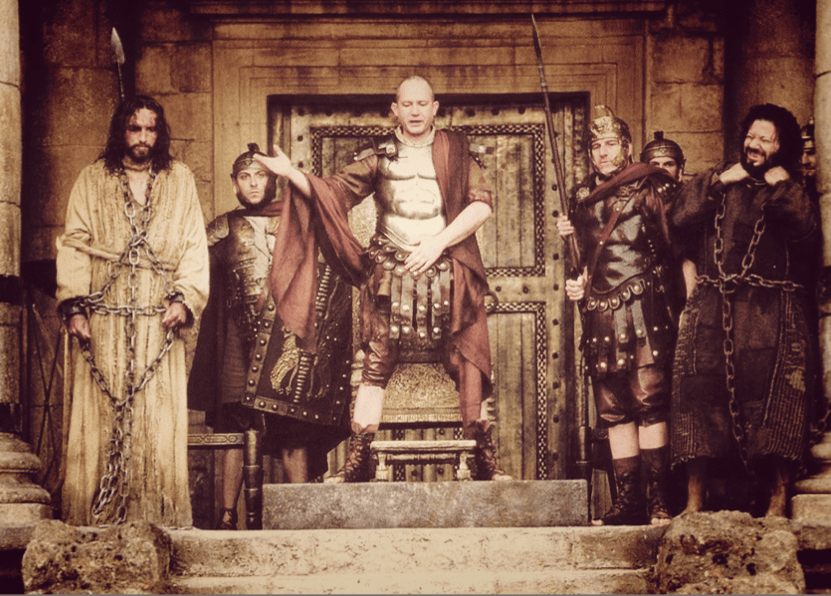
How do these movies or kinds of stories make you feel? We want justice! We cheer for the victims. We fear how we’d respond in a similar situation. It is natural to recoil at the punishment of the innocent. So it is with passages like Luke 23:1-25, we want to stand up for injustices against Jesus, but would we?

INJUSTICES AND IRONIES STAIN JESUS’ TRIAL (vs.1-16)

What makes something unjust (or ironic)? It’s when something unfair or plain wrong happens to someone. In other words, what should happen to Jesus is not (i.e. a fair trial or set free). In fact, the opposite takes place. The trial of Jesus is brimming with injustice and irony. Can you spot it? (I spot at least 6 instances).

First, the religious rulers accuse Jesus of misleading the nation by telling people not to give tribute to Caesar (v.2), when a few days earlier Jesus taught the exact opposite (cf. 20:19-25).

Second, the religious rulers try to ruffle the feathers of the political leaders by saying Jesus claims to be king of the Jews (v.3). Jesus has not directly said so, though He is, but not as they think. He has claimed to be the Son of God who will sit at God’s right hand (cf. 22:68-70); the seat of supreme authority.

Third, the religious rulers accuse Jesus of stirring the people through His teachings (v.5). He did stir crowds with the “truth” and the people were astonished by His teachings (cf. 4:32; 9:43).

Fourth, neither Pilate nor Herod find Jesus guilty of any crime that would deem punishable by death (vs.14-15). He is, in fact, innocent and without sin.1 Ironically, Herod dresses Jesus in gaudy royal robes making a mockery of His and the claim.

Fifth, the religious rulers will trade Jesus’ life for Barabbas, the murderer (v.18). I’ll say more on this later.

Sixth, Pilate volleys for Jesus without success. In a moment, Pilate throws Roman law out the window and give Jesus over to crowd. Unbeknown to him or the crowd, Jesus is being delivered over by the divine will of God. Pilate and the crowd are simply pawns in the hands of God bringing about redemptive history.

Surprisingly, this passage says nothing about Jesus’ friends or family. There aren’t Human Rights activists or picketers holding signs for Jesus release. The only one who stands up for Jesus is Pilate. He’s the highest man in Jerusalem, but he has little power over the cankerous crowd and the hand of God.

The events of Jesus’ trial expose the equal danger of denial and indifference towards Jesus. The religious people are in denial of who Jesus says He is. They say they worship God, but they have placed God incarnate, the Creator of the universe on trial. Pilate is indifferent towards Him. Neither the crowd nor Pilate fear God. The crowd fears the influence of Jesus and Pilate fears Tiberius charge to keep Pax Romana, which is being threatened by the rabble-rousing crowd. In their hearts, they both fear man, and the denial and indifference towards Jesus led to His unjust treatment.

This begs me question my heart too. Have I treated Jesus fairly or justly? Do I see any fault in Him? Do I resemble this sort of denial and indifference towards Jesus? If so, I am just as guilty as the crowd. If I were honest, there are times each day when denial and indifference creep in and kill the authority and power of Jesus that desires to reign in my life. If I were in the crowd that day, I probably wouldn’t cry freedom. I would be joining the crowd chanting, “Crucify, crucify Him!”

While reading this passage, I mustn’t feel guilt, rather I must reveal in the grace of God. No amount of torture, pain, loneliness, mockery, suffering, or injustice stops Jesus from following through with His divine call. Jesus bears God’s wrath, pays for my punishment, so that I will have eternal life, forever freedom, forgiveness, and redemption. Jesus’ injustice bought my shalom.

JESUS’ RESPONSE TO THE INJUSTICES IS SURREAL

Why doesn’t Jesus cry freedom? Why doesn’t Jesus save Himself? Surely, He can. Even during the onslaught of scorn from religious rulers, soldiers, and a criminal hanging next to Jesus, He willingly remains fixed on the cross (cf. 22:35-39). Oddly, all throughout Jesus’ trial and crucifixion He doesn’t say many words. He’s remains silent and confident. He doesn’t save Himself. He willingly goes along with His own death sentence. He could call for swift justice and will, but not yet. An injustice must happen to Jesus for justice to prevail.

Jesus’ response should give us courage to fear God rather than man. In difficult situations or under pressure to speak, sometimes no response is needed, only trust and obedience in God’s providence. Often Christians are the worlds justice police. We see an injustice and we fight for right.  We want to see the innocent freed and the criminal hanged. We’ve established organizations like World Vision or International Justice Mission, which do great things throughout the world to give a voice to abused, neglected, enslaved, and imprisoned. Yet it was one of the worlds greatest injustices has ever seen has set us free.

YOU ARE MORE LIKE BARABBAS THAN YOU THINK (vs.18-25)

One of the wildest ironies within Jesus’ trial is the exchange for Barabbas. How crazy and idiotic is the crowd to free a convicted murderer? This shows the irrational trajectory of fearing man. They would rather live with a murderer on the loose than have Jesus in teaching and healing in their streets.

I’ve always detested for Barabbas. I picture him as a scar faced, chip-toothed, scraggly-eyed villain. The kind of guy mom would want you hanging around. However, as I read through this text again a question lingered on my mind. How is the exchange for Barabbas a perfect picture of the exchange of my life for Jesus? It dawned on me for the first time. My sin is just as detestable and punishable by death as Barabbas’, but instead of the crowd it was the Righteous Judge, Jesus, who set me free to live another day. I, like Barabbas, have been released in exchange for the blood of an innocent man.

This passage really hits home. We live among a people in Africa who are all too familiar with injustices and unfairness. Some have seen family members and friends beaten, raped, and/or killed. They are crying for freedom. Only Jesus will minister hope to their fear and despair. He too faced injustices and yet responded with confidence and trust in His Father. And God had mercy on us all through the death of His only Son. Therefore, let us boldly proclaim the Hope of Nations as ones who have experienced and benefit from the beautiful exchange.2

Questions for Application & Reflection: How is the exchange for Barabbas the perfect picture of the great exchange of our life for Jesus? How has Jesus set you free? What gives you the strength to resist fear of man and pressures in your life? How can Jesus be displayed in injustices you face in your ministry? In what ways do you relate to the crowd calling for the death of Jesus?

Lessons learned from God’s Creatorhood

What can we learn from the way God imagines and makes, and how must we change our ways of imagining and making because of what we observe in His ways?

1. What we call strange or abstract art may be closer to God’s way of creating.

When God created the first giraffe He did not have one to imitate or to copy. It came out of His imagination and, in the finest sense of the word, was abstract, because it did not look like anything else; it had no exterior reference point.

When people grouse about a painting that does not look like anything kindly refer them to God and what He did in starting up creation. Ask them to take a microscope and telescope and note the countless oddities, dazzlements, flashes and sublimities—abstractions all, nothing imitating anything else.

2. With God, there is a difference between replication and continuation.

Our reasoning might go this way, “Yes, I can agree that God was the first abstract artist, but He acted this way only once, to start things up. After the first giraffe, there were billions of giraffes, and I know they are giraffes because they look like each other. So why should we not continue to the parade by drawing giraffes that look like giraffes?” There is a simple answer: even though God may repeat an action, He does not replicate the object of His action. The genius, if you will, of God’s repeated creational acts lies in the deeper fact that giraffes dramatically vary from each other in ways that go beyond their seeming similarities. And it is the variation that not only brings delight but also allows us to tell one from the other. All giraffes have spots.

3. God’s inside workmanship is as exquisite as His outside workmanship.

When God makes something, it is marked by structural integrity and impeccable craftsmanship through and through. There is no such thing as rough work and finished work with God.

4. God’s idea of quality is the same whether He makes something for quick or for long-lasting use.

When God makes something, He does not pay less attention to it or make it less carefully if He knows that it will be quickly used up.

5. God’s handiwork is not divided between great things for magnificent display and doing average things for ordinary circumstances.

Do we have a concept of creativity that is divided between museum mentality and a workplace mentality—great art for the ages and so-so art for the worship place? Look at a rose or look once at the lowly, eatable mango, and you will see inherent beauty at the same time you notice that each has work to do. God saw to it, in His ways of putting things together, that inherent worth, intrinsic beauty and usefulness quietly and humbly merge. Everything we imagine and make should be put to some work, and everything that is put to work should have inherent comeliness.

6. The Creator is not the creation, and the artist is not the art.

God is superior to what He makes, sovereign over it and separate from it. He is everywhere at once, at the bottom of the deepest sea and in the midst of a primrose. But He is none of these, nor can He be. He made the creation; He did not beget it. By the same token, we are not what we make. We are superior to it; we are sovereign over it and separate from it. A potter no more begets a piece of pottery than God begets a salamander.

7. God is not especially interested in straight lines, perfect circles and geometric tidiness; His work is more chaotic than symmetrical.

A statement like this flies in the face of our neatly packaged, superficial and often spiritualized ideas about order, symmetry, harmony and balance in creation. Walk into a meadow and see if you can locate a straight line of buttercups all exactly the same height, each with exactly replicated pedals. Or try to find a strictly triangular stand of perfectly symmetrical trees foregrounding a mountain range the left side of which is a mirror image of the right side. There is no landscape in which we can find any semblance of order, no storm, at sea in which the waves are the same shape, height, creaminess or momentum. Nothing repeats and nothing is predictable. But here’s an odd twist on it all: underlying the asymmetry and the randomness, there are governing laws that do not randomly fluctuate, even though the outward workings of the laws allow unpredictability and fluctuation. With God, “chaos theory” is nothing other than infinitely varied rightness.

8. God has the jump on anyone who thinks that cultural diversity is the greatest thing since the automobile.

For instance, I must be willing to die for the absolute truth that Jesus is the Christ, the Son of the living God, but I can live comfortably with the belief that Beethoven symphony is but one song among many songs, no one of which is the true song. The biblical defense for cultural diversity lies in the way God speaks, the way He creates and especially the way He clarifies the fundamental difference between His Word and what He creates. God is the most complete diversifier we know of. His handiwork is endlessly varied; all of it is good and each particle fits easily into its ordained place. While everything has its own worth, nothing exists independently of the other, for the entire creation is a community of substance and interchange.1

Adapted from Harold M. Best, Unceasing Worship: Biblical Perspectives of Worship and the Arts. InterVarsity Press, Downers Grove, IL. 2003. 129-137

girls eat bugs

The best part of this week is the opportunity to dress up and eat so much candy that your teeth fall out. I swear Halloween was invented by dentists for the sole reason: having job security. I do have proof for that, but it sure does seem logical!

For Halloween this year I was a bug catcher (not the unibomber as it may appear). Sarah was a butterfly.

deep

I cannot believe that our summer has already evaporated. Where did it go? Tonight, we kick off our FUEL school year. I am so excited. This is going to be a great fall!!

Our theme of getting DEEP has its roots in Colossians 2:6-7, “So then, just as you received Christ Jesus as Lord, continue to live in Him, rooted and built up in Him, strengthened in the faith as you were taught, and overflowing with thankfulness.”

I am reminded of the willow tree in my grandparents backyard in Greendale or the tree stand my dad and I would hunt out of in Presque Isle. These trees were ginormous. It is said that trees have as many roots underground as there is tree above ground. It takes a lot for big trees to stand upright especially through storms and seasons. I am particularly drawn to lonely trees that tower above empty fields. They have to weather the elements. Their roots must be strong and deep.

As children of God we also must have deep roots. The world is full of doubts and questions about God and Christianity. Is there any truth? Is faith reliable? Can I trust anything? Over the past few months I have seen in many of our young people desire to know the truth and live a substantial faith. We all want answers to deep questions, but more so, we desire answers that affect the way we think and live. I desire answers that keep me rooted when the storms of doubt hit hard like a hurricane.

This fall we will be answering real deep questions about the faith. If you could ask God one question what would it be?

DEEP: getting deep with God & God getting deep in me.