How to Stay Christian in College
Author(s): J. Budziszewski
Publisher: Navpress
Price: NO LONGER FREE
DOWNLOAD TO KINDLE
Get more FREE Kindle E-Books or low-priced E-Books at gospelebooks.net

How to Stay Christian in College
Author(s): J. Budziszewski
Publisher: Navpress
Price: NO LONGER FREE
DOWNLOAD TO KINDLE
Get more FREE Kindle E-Books or low-priced E-Books at gospelebooks.net
Baptizing Heathen Words. What words have Christians redefined?
How to Get the Most Out of Your Pastor’s Preaching.
50 Rules for Dads of Daughters. As a new father for a daughter these perked my attention.
Acts and Baptism: Implications for Parents. Before baptizing your children consider this.
Four Steps to Kill Sin. Sinclair Ferguson tackles the mortification of sin.
Homeschooling Blindspots. Some interesting insights as we consider homeschooling overseas.
Love Tap. Encouragement for the timid [watch video below].
O God, have mercy on the churches in the United States…continue and perpetuate the heavenly revivals of religion which they have begun to enjoy; and may the time soon come when no church shall dare to sit under the Sabbath and sanctuary privileges without having one of their number to represent them on heathen ground.
Have mercy on the theological seminaries, and hasten the time when one half of all who yearly enter the ministry shall be taken by Thine Holy Spirit, and driven into the wilderness, feeling a sweet necessity laid upon them, and the precious love of Christ and the souls constraining them.
Hear, O Lord, all the prayers which are this day presented in all the monthly concerts throughout the habitable globe, and hasten the millennial glory, for which we are all longing, and praying, and laboring…Come, O our Bridegroom; come, Lord Jesus!
– Adoniram Judson, quoted in J.D. Greear’s Breaking the Islam Code: Understanding the Soul Questions of Every Muslim, page 141
The cross work of Christ is not just a payment for the wages of sin, but it is man’s means for cleansing from and victory over sin and death. In essence, that is the doctrine of penal substitution. The doctrine of penal substitution is one of the glorious truth’s of the Bible.
From beginning to end penal substitution is central to the message of the Bible [cf. Genesis 9:6; Exodus 21:24; Leviticus 1:4; 17:11; Isaiah 53:5-6; Hebrews 9:22]. The truth that Jesus Christ satisfied the justice of God and took upon Himself the wrath due sin.
God cannot waive the wrath due sin. It is out of line with His character to do so. He cannot sweep sin under the rug. Justice demands a consequence. Sin robs the bank of God’s justice [Psalm 97:2; Proverbs 17:15]. The only remedy is to seek forgiveness, but forgiveness always has a cost. Injustice must be made right. For my sin the cost was the death of Jesus Christ. My cost is that without Christ I cannot escape death. He made up what I owed. I sinned, but Jesus suffered for it so I would not have to suffer the hellish consequences of my sin.
An injustice against God unpunished with would make the nature untrue. If it were not true He would be a liar. His name would be tarnished. In my place condemned Jesus hung pun the cross to demonstrate the justice of God. Therefore my response is to put faith in my Merciful Justifier Jesus Christ [Romans 3:25-26].
God has said that the the soul that sins must die [Genesis 2:17; Ezekiel 18:20]. Since He declared it, it is decreed. Therefore, from the beginning of man’s sin God has provided a sacrifice. For Adam God sacrificed an animal to cloth his shame. For Cain and Abe;, God honored the righteous sacrifice. For Abraham God provided a substitute sacrifice in the place of his son [Genesis 22]. For the sins of Israel God atoned through the blood of animals. For my sin and yours God sent the Lamb of God, Jesus Christ, to the cross as my sins sacrifice.
Glory to God for the gift of penal substitution. May it humble us to the core and motivate us to serve Him for life.
10 Questions Leaders Should Be Asking. Great for leaders and anybody for that matter.
Without the Gospel, It’s Not Missions.
Why Doesn’t Anybody Talk About Sin? A good question with good insight.
Who is Responsible for a Child’s Education? Is it the parent or the school?
Just like water comes to a boiling point and steams, so does a mans emotions. Anger is a God-given emotion intended to help one solve problems. There are many examples where people use anger to solve their problems in a godly way (Galatians 2:11; 2 Samuel 12; John 2:13-18). The Bible describes anger as a passion (orge, Ephesians 4:26; James 1:20; Mark 3:5) and an agitation boiling within with an outward result (thumos, Luke 4:28; Acts 19:28; Ephesians 4:31).
According to the Bible, anger is not a sin: God becomes angry (Psalm 7:11; Mark 3:5; John 3:36), and believers are commanded to be angry and not to sin (Ephesians 4:26). Anger is good, since it is manifested righteously by God. However, anger is an emotion that mankind can selfishly abuse, therefore, anger becomes a sinful response to problems in our lives.
There are many ways in which people deal with anger sinfully. Some do not admit that there is a problem and they clam up (Ephesians 4:26-27). Some lash out in rage and they blow up (Proverbs 6:34; 14:17). Some stir up anger and strife in others (Proverbs 15:1, 18). Some become destructive and destroy anything that gets in their way (Proverbs 22:24-25; Proverbs 27:4). Some retaliate by getting even (Romans 12:17-21). Anger becomes sinful when it is motivated by selfish desires, when God’s goal becomes distorted (1 Cor.10:31; Rom.8:28-29), when the emotion lingers (Eph.4:26-27), and when it attacks a person rather than the problem (Eph.4:15, 29). These are all ways that one can deal with anger in a way that is not God’s way.
What is God way of dealing with anger?
By dealing with your anger in God’s way you become God’s kind of person.
Jacob left home a 40-year old virgin and now he returns with two wives, twelve children, and countless wealth. Jacob is content settle in Schechem, but God speaks to Jacob and says, “Get up, go to Bethel and live there.” And like Abraham [cf. Genesis 12:4], he obeyed. God not only wants Jacob to leave his place of comfort, but also to cleanse his home of impurities. God point out that their home was filled with spiritual lethargy and idolatry. Jacob surprisingly responds with obedience.
This is the first time we see Jacob rise up and become the spiritual leader of his home. After cleansing his household Jacob worships God.[1] In response to his faithfulness God protects Jacob’s family as they pass through the land. When Jacob enters his homeland God blesses him and reminds him of his new name [Israel, cf. 32:28], His creation mandate [35:11; cf. 1:28], and the covenant promises of land and lineage given through his father and grandfather.
Why does God repeatedly ask Abraham [12:1-3], Isaac [17:4-6], and Jacob to “be fruitful and multiply”? Does God simply love babies and enjoy the families? Yes, but there is more to it than that. God begins with a promise, “I am God Almighty” [El Shaddai, 17:1] and ends with the command to fill the earth. He is not God Almighty merely in general, but Almighty in relation to Israel. His Almightiness is there for Him and His children. The promise enables the command, “You can be fruitful and multiply because I am God Almighty. I am the covenant God of Abraham and Isaac. My Godness and my Almightiness are covenant Godness and covenant Almightiness. And if you will trust me as God Almighty, you can and you will be fruitful and multiply. And companies of nations and kings will come from you.”
The promise God mentions here, Paul the Apostle later extends to the Gentiles. Through Jesus Christ the Gentile Christ followers inherit the blessings of their father Abraham [cf. Romans 4:16-18; Galatians 3:6-8,16,29]. This is the very same logic that Jesus uses in Matthew 28:18–19 when He says, “All authority has been given to me in heaven and on earth. Go therefore and make disciples of all the nations.” In other words, “I am Christ Almighty; go and be fruitful and multiply my disciples.” Our confidence to share the message of Christ comes from the authority and the Almightiness of Christ.
As Jacob’s life comes to his final refrain we are now seeing a rhythm of regular worship and intimacy with God that was lacking in his life. This new foundation of faith would be tested as his beloved wife, Rachel, dies giving birth to his son Benjamin, and as his youngest son Reuben has an affair with his stepmother [Bilhah]. This great sin against his father cost him his position as the firstborn son [Genesis 49:3-4; 1 Chronicles 5:1]. In God’s sovereignty He uses this sin of Rueben to open His promised line through the line of Judah.
Finally, after at least twenty long years away from home Jacob alas returns to see his father Isaac. Jacob’s sons got to meet their grandfather just before he dies at the age of 180 years old [35:28-29]. His two reconciled sons Esau and Jacob bury him. And the genealogy listed at the end of Genesis 35 through chapter 36 illustrates that God will keep what He promised to Jacob. The names of Jacob’s 12 sons roll off our lips with ease [Ch.35], but the sons of Esau are unfamiliar to our ears [Ch.36]. God is faithful to follow though and bless those He calls. Bank on it, if He is your God He will do all that He says He will do.
Jacob Comes Home and God Comes through Just as He Had Said.
[1] Note: Jacob builds an altar in Schechem to honor the God who appeared to him, he builds an altar after God cleanses his home, and he builds an altar and pillar at Bethel because God has provided, protected, and fulfilled all His promises. Jacob once a wanderer is now a worshiper.
[HT]
To all those who love Christ and his gospel,
Without the gospel
everything is useless and vain;
without the gospel
we are not Christians;
without the gospel
all riches is poverty,
all wisdom, folly before God;
strength is weakness, and
all the justice of man is under the condemnation of God.
But by the knowledge of the gospel we are made
children of God,
brothers of Jesus Christ,
fellow townsmen with the saints,
citizens of the Kingdom of Heaven,
heirs of God with Jesus Christ,
by whom
the poor are made rich,
the weak strong,
the fools wise,
the sinners justified,
the desolate comforted,
the doubting sure, and
slaves free.
The gospel is the Word of life.
– John Calvin [in his preface to Pierre-Robert Olivétan’s 1535 translation of the Bible.]
[HT]
5 Early Warning Signs Your Shields Should Be Up
From a Beggar to the Nations: The Name of Jesus Spoken With Boldness
Grow Up. Settle Down. Keep Reforming. Advice for the Young, Restless, Reformed from John MacArthur..
How to Talk to God When You are Suffering
The Danger of Defining Yourself by What You Are Against. Are you an angry prophet?
Freshman 15. Great tips for those heading to college.
Have you ever been away from home for more than a few months? Or long enough that you miss home sweet home? I have. I remember going to college in West Virginia and being a long way from my family in Wisconsin. I did not get home other than Christmas or summer breaks. After final exams, I would hop into my car and sometimes drive through the night to get home. The last hour always seemed the longest. I was so close, but not there yet.
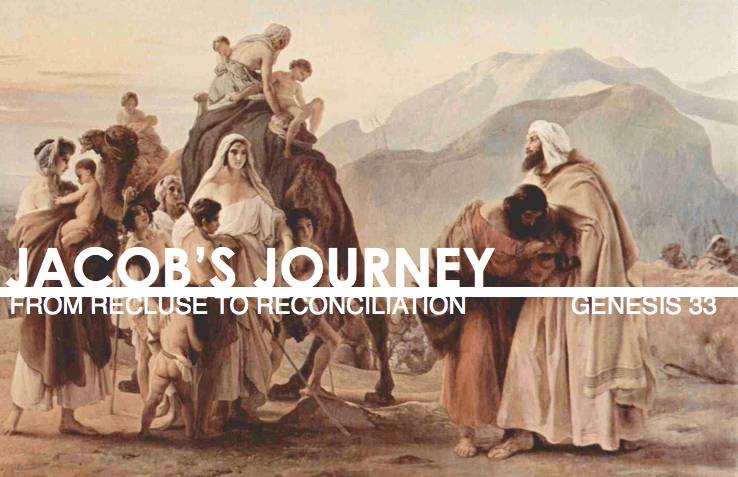
Jacob must have felt the same way. He had just met his brother on his way home. He reconciled their relationship, which was mangled by lies and deceit. Now after 20 years away from home he can almost see it. He can taste in his mind his mothers home cooked meals. He can smell the farm. He can hear the breeze that carries his father’s voice. Jacob was so close, but not home yet. He decided to settle in Schechem. However, his decision to stay there was as devastating as Lots decision to stay in Sodom rather than traveling on to Bethel [cf. Genesis 13-14].
Jacob’s journey of faith has not ended. The last hours before coming home are still yielding lessons of faith. It is a reminder to all that God is not done with you until He is done with you.
Jacob’s faith has dramatically changed [cf. Genesis 32–33], but his son’s faith would remain nonexistent [Genesis 34]. They were deceitful [34:8–24], murderous [34:25–26], greedy [34:27–29], and proud [34:31]. There were probably characteristics passed down from their parents. However, despite Jacob’s new faith, new name, and found distress over his son’s bad behavior [34:30], Israel could not change his boys. God would have to bring them to a crisis of their own, as we will see later.
Jacob had eleven sons and only one daughter named Dinah. One day Dinah went out to visit other women in the region her parents lived. While out and about the son of the man who ruled that area saw her. He wanted her, but could not have her legitimately. Therefore he raped or seduced her. His act defiled and took her virginity dishonorably. To make matters more complicated he was pagan and he desired to marry her. Intermarriage between believers and unbelievers is condemned throughout Scripture.[1]
Jacob kept the situation a secret until Dinah’s brothers came home. Like protective brothers, they were grieved, disgusted, and furious over the vile action done by an idolatrous man. Dinah’s brothers devised a plan to seek revenge by creatively using the covenant of circumcision [cf. Genesis 17]. Like father like sons these boys learned to be tricksters. They told the men of Schechem a strategic lie, “You can happily intermarry our women and share our great wealth, but you will need to be circumcised.” The men were determined to get beautiful foreign women as brides that after three days all were circumcised.
Two of Dinah’s brothers, Simeon and Levi, were perturbed by men’s swift response. They were certain they would not buy into their plan. So out or rage and intensified revenge they strapped their swords to their sides and entered Schechem to slaughter every man and deliver their sister home safely all the while they looted the entire city, taking all the women and animals. Seeing what his sons had done, Jacob rebuked them for putting his family in danger of attack from the surrounding Schechemite allies. However, the brothers replied praising their heroics and took sides with their sister saying, “Should he have treated our sister like a prostitute?”
Why didn’t Jacob do anything? Is he a passive father? First, it is clear that Jacob hated his wife Leah, and Dinah was the daughter of Leah [30:19-21]. Jacob’s silence and indifference during her defilement indicates that he was not much of a loving father. Second, Jacob’s leadership was filled by the devious plans of his sons. Third, Jacob’s response to his son’s question has a selfish overtone that states on only “me” and he makes no mention of his poor daughter. Like his forefathers we see his imperfection after transformation—we see yet another mini-fall not unlike Adam, Noah, and Abraham. However, in God’s gracious sovereignty He uses Jacob’s sin for His purposes and preserves the line of the covenant family from intermarriage with the Schechemites through the murderous actions of Simeon and Levi.

Also, this is a reminder that faith—unlike the temporary blessings that passed from Abraham to Isaac to Jacob, and then to Jacob’s sons—is not passed down genetically. You cannot be born a Christian. Even though you may have godly parents, be part of a great church, and have good Christian friends you still have to encounter Jesus yourself. God encounters people individually, and people must place their faith in Him individually. Like their father, Jacob’s sons committed their own sins and like Jacob they would have to make God their own God. You cannot inherit faith; you must get it from God. There is no other way.
This journey home for Jacob is a rough road that paves the way for a future of faith in God’s promises. He is not there yet. Likewise God is not finish with you either. The pressures of life and family struggles are opportunities for you to trust in the promises of God. Next week we will see more about how God keeps His word and journey with Jacob to his home sweet home.
[1] Abraham was worried that Isaac would marry outside of the covenant as Ishmael had (Genesis 21:21, 24:3-4), and Esau’s intermarriage with the unbelieving Hittites which was a source of great trouble (Genesis 26:34-35, 27:46, 28:8).
Have you ever sung a song dozens of times in church it became old? Or sung a song enough to forget the meaning of the song because you are too familiar with the lyrics? Today I was singing a song I’ve sung many times before, but became enraptured by on of the words in the song. The word was unstoppable. It stuck and pierced me to the soul. The object of the song is a beautiful lover. Not any ordinary lover, but a Lover who defines and exemplifies love.
There is no one like our God. Many have come to the realization that God is God and we are not. Moses warned [Exodus 8:10], Hannah prayed [1 Samuel 2:2], David worshiped [1 Chronicles 17:20; Psalm 86:8], Asa reformed [2 Chronicles 14:11], and Jeremiah challenged [10:6-7]. That is why people consider who God is they tend to use absolute terms to describe Him.
He is indescribable, incomparable, unchangeable, uncontainable, unshakeable, and utterly unstoppable. God is as passionately romantic and relentlessly pursues you with His love for His Creation. He bears patiently with tireless compassion despite the ways you ignore His love or neglect to show love for Him. The greatest example of His love is when His Son came down from Heaven as a human to die in my place [Romans 5:8], bearing my wrath, taking my shame, and giving me a new name.
God’s like a freight train with no brakes. He has more compassion than I could ever imagine or comprehend barreling down on us. Whether you acknowledge it now or later. Sooner or later all will know who is greater. His name is above every name, and at His name every knee will bow [Philippians 2:9-11]. There is no like Him. He is unstoppable.
My grandmother had a cross-stitch in her kitchen that read, “Home is where the heart is.” There is a lot of truth this common cliche. For me, the truth is beyond what is easily suggested.
My idea of home is changing as I am on the road away from home without a home. The change has been a good change. Since saying “yes” to God’s call and going global for Christ’s mission, I have visited numerous homes in dozens of countries from urban Europe to rustic Africa. Living in homes all over the world will change you. As I have exchanged stories and photos with families in these homes I see how different my home and how foreign my home experiences are from theirs.
During a prison sentence the Apostle Paul had time to think about what mattered in his world. He sat in a cell far from home. Far from earthly comforts. Far from security. He encouraged the church saying, “For I am hard-pressed between the two, having a desire to depart and be with Christ, which is far better. Nevertheless to remain in the flesh is more needful for you…For our citizenship is in Heaven, from which we also eagerly wait for the Savior, the Lord Jesus Christ” [Philippians 1:23-24, 3:20].
Paul knew that Heaven is home. Heaven is an unfading, incorruptible, and infinite home [1 Timothy 6:6-7]. Jesus taught this too [Matthew 6:20-21]. And His closest followers understood it [James 4:13-15; 1 Peter 1:4; Hebrews 10:34] and longed to dwell there with Him.
Home is a place I long to be. There is a sense of comfort and security about being home. The danger is that I will begin to see my temporary home as comfortable or secure and not see my Heaven as incomparable and glorious. This world is not my home. God in heaven is my home. He has a better country. He is preparing a place that makes our home seem like a squared camp. To desire God is to desire a better country, that is a heavenly home.
This world is not my home I’m just passing through
my treasures are laid up somewhere beyond the blue
the angels beckon me from Heaven’s open door
and I can’t feel at home in this world anymore.
Yes, of course. But can you explain what morality is and where it comes from without God? That’s the key problem for an atheist worldview. Craig Hazen explains in this Biola Magazine article. Here’s the conclusion…
How the Gospel Makes Us Generous and Content with Our Money
I’m afraid the framing of this discussion leads us to ask the wrong questions. Like the junior high boy who wonders how “far is too far” with his girlfriend, we are quickly caught up in questions about how rich is too rich, how poor is too poor, and the like. Where is the line?
Letter to an Incomplete, Insecure Teenager
Four years ago a teenager church wrote pastor Piper for advice about life in general, and identity in particular. Here is what he wrote, with a big dose of autobiography for illustration…
Marriage: The Happy, Holy, Beautiful Mess
Ever hear the old adage: “Marriage isn’t primarily intended for your happiness, but for your holiness?” Well, it’s true and it’s a glorious thing.The growing in holiness part doesn’t always seem blissful. But it means that God isn’t finished with you yet, either. The purpose and hope in marriage isn’t defined by you or your spouse, but by God.
Paul refers to himself numerous times as worth “imitating” when it comes to spiritual growth and maturity (1 Cor. 4:16, 11:1; Phil. 3:17, 4:19; 1 Thess. 1:6; and 2 Thess. 3:7, 9). What do we see when we look to Paul as an example? He makes three significant statements about himself throughout his years in ministry that are helpful insights into his view of spiritual growth.
Spiritual Depression [D. Martyn Lloyd Jones]
What does it mean to reconcile a relationship? What are some of the greatest stories of reconciliation you have ever seen or heard? Elizabeth Barrett was involved in a childhood accident that caused her to be an invalid. She also had a tyrannical father that treated her with disrespect. When she became older she met Robert Browning. Elizabeth’s father disapproved of the relationship and request for marriage. So in 1846 they married in secret and sailed to Italy where they lived for the rest of their lives. Her parents disowned her, but she did not give up on trying to communicate and reconcile with her parents. Almost weekly she wrote her parents letters. Not once did they reply.
After 10 years of writing her parents Elizabeth received a large box in the mail. Inside the box she found all her letter; not one had been opened. Today Elizabeth Barrett Browning’s letters are among the most beautiful in classic literature. Had her parents only read a few of the forgiveness packed poems their relationship with Elizabeth might have been reconciled.
Jacob is now a new man with a new name and new future of God’s blessings and faith. After wrestling with God he is now empowered to meet his brother. While he sees his brother coming with a posy of 400 men, Jacob puts his people in ranks. He put his servants on the frontline, Leah and her children in the middle, and Rachel and her children in the back of the pack. Rachel gets the safe spot because he loved her and Joseph.
Jacob does hide out in the rear to take cover; rather he steps up to the front line. He doesn’t know if he will be killed, but it is a rick he’s willing to take believing in the promises of God. He has faith in God’s protection enough to put himself in harm’s way for the first time in his life. As a sign of humility and apology he bows his body before his brother. What we see is a complete change in character for Jacob.
In one of the most forgiving moments in Scripture the prodigal brother comes home. Esau responds like a mature older brother, “But Esau ran to meet Jacob and embraced him; he threw his arms around his neck and kissed him. And they wept.” [Genesis 33:4] The reunion between Jacob and Esau comes after twenty long years of separation. It is a beautiful portrait of forgiveness. Esau runs to Jacob and lovingly embraces him in forgiveness and welcomes him home.
Jacob blessed his brother with generous gifts that he attributed to God’s provision. Esau did not need them because he too had become a wealthy man. Also, he releases any and all claims on his birthright. Jacob compares seeing Esau like seeing God [cf. Genesis 32:30] because both now and when he wrestled God Jacob is graciously spared. It is obvious that God had been working on the hearts of both men.
Because of his many animals and young children Jacob was not able to go jump fast in making the journey all the way home. Esau offered to leave some men to protect Jacob’s household, but by faith he declined stating that God would indeed protect him. Jacob then worshiped God by building an altar at Shechem, which was the first place where his grandfather Abraham had been visited by God and built his own altar [cf. Genesis 12:6-7; 28:20-22; 31:5]. What a wonderful portrait of a transformed man now worshiping the God of Abraham and Isaac, but also now the God of Jacob.
Put yourself in Esau’s shoes for a moment. It is not often that we think about the situation from his perspective. What would you have done? Would you have been hesitant to reconcile your relationship with your brother? What should you do if you are hesitant to reconcile? Look to the example of Jesus Christ. He reconciles man to God and is our means and motivation to reconcile with one another [2 Corinthians 5:11-21]. Jesus is the Reconciler. And you might also consider:
1. Be honest about your motives. Make sure your desire is to please God and not get revenge [cf. Joseph and his brothers].
2. Be prayerful about the situation. Jesus said that you must pray for those who mistreat you [Luke 6:28; cf. Hebrews 4:16].
3. Be willing to admit how you have added to the problem [cf. Matthew 7:1-6].
4. Be mindful that God is sovereign over the situation [1 Corinthians 10:13].
This is the first day I step off the pastoral staff of Battle Ground Bible Church, but it is also the first day I step onto your mission outreach team. Although the role of my family will change within BGBC, we will still be an outreach arm linked to this church in North Africa.
For the last 6-months I have been thinking about this day. I am reminded of Paul the Apostle’s third missionary journey when he gave his farewell message to the elders at Ephesus [Acts 20:17-38]. I can feel what he feels. I can understand his heart for the church. If I could I would make this my farewell address to my church too.
Paul had little time left to talk to the elders of the church in Ephesus [vs.16-17].
I only have one hour left with you.
Paul spent 3 years in Ephesus, which is longer than he spent in anyone place [vs.18,31].
I have spent almost 8 year with you [began September 21, 2003].
Paul wears his emotions on his sleeve. He cares for this church as a shepherd who suffers with his sheep [vs.19,31].
I wouldn’t consider myself a stiff board.
Paul was bold in his preaching. He did not hold back [vs.20-21].
I did not shrink back either.
Paul leaves Ephesus under the conviction of the Holy Spirit [v.22].
I take my family to North Africa by the call of God. Our family is gripped by the glory of God.
Paul anticipates the journey ahead to be difficult and full of trials, but worth the risk [vs.22-23].
I know it will not be easy in the desert among the unreached peoples.
Paul views himself as nothing and Christ as everything. Even his ministry is of Christ and for Christ [v.24].
I am humbled by the ministry of Christ and ministering for His namesake.
Paul encourages the church to preach the gospel with boldness [vs.25-31].
I have sought to protect this church and uphold the doctrine on which it stands.
Paul has worked hard, earned his keep, and challenged the church to give to the mission of Christ [vs.32-35].
I have labored hard for you because Christ is my boss.
Paul, not knowing if he would see them again, was sorrowful because he loved their faces [vs.36-38].
I know I might not see you soon, but we will see each other again if we are eternal friends!
In summary, Paul is saying to the church in Acts 20, FAITHFULNESS IS WAY BETTER THAN LIFE [vs. 24-25]. As missionary Bill Bentley to Mexico said, “I don’t want make a living, I want to make a [faithful] life.” Faithfulness to my call is far more important than whether I live—whether I live at all or live comfortably. Faithfulness is better than life because the rewards are literally out of this world and God is gracious.
I am grateful that I am not leaving BGBC because of disgruntlement, conflict, joylessness, tiredness, or unfaithfulness. I am leaving BGBC with joyful sorrow because I will severely miss the immediateness fellowship, worship and mutual ministry of this Body of Christ. I have not viewed being a pastor at BGBC as being a job, but a joy. I love my church.
1. Jesus sacrificially loves it. [Ephesians 5:25] He built it, established it, died for it, and is still the Head over it.
2. God is glorified through it. [1 Timothy 3:15] He is working out His eternal plan through it.
3. I am a member called to it. [Hebrews 10:24-25] It is the most precious reality on earth [and a glimpse of heaven].

When I first arrived at Battle Ground Bible Church I was 23 years old. I was green. I had just graduated from Bible College. I spent the year before serving in South Africa as a church planting apprenticeship and then served at Montrose Bible Conference for a summer leading evangelism workshops. While at Montrose I had a conversation over lunch with a missionary from Bangladesh named Sam Smoker. We were exchanging funny names churches we had attended. In the course of that conversation he mentioned the name Battle Ground Bible Church. That week I found BGBC’s name on a pastoral search placement list and the rest is history.
I have grown exponentially since coming to BGBC. Not only have I grown facial hair and a little belly, but also more importantly I have grown up in my faith. That didn’t just happen. Growth doesn’t happen in isolation. It happens in a community of likeminded Jesus followers. God designed growth to happen in togetherness. As a church you have stirred me, shaken me, encouraged me, matured me, prepared me, and helped me to want to be more like Jesus Christ.
You have prayed for me. Bore patiently with me. You have prodded me to continue to dig deep into the Word. You have sent me to pastor conferences for spiritual encouragement. You sent me to seminary to continue my education. And now, you are ready to send me oversees as a light for Christ. Thank you for not holding back in stirring my growth. “Let us consider how to stir up one another to love and good works, not neglecting to meet together, as is the habit of some, but encouraging one another, and all the more as you see the Day drawing near.” [Hebrews 10:24-25]
Your pastors need to be stirred. Thank you for stirring this one!
God has used many of you to stir me to love and good works. Like Paul, you have helped guard my heart from carelessness [v.31], shallowness [v.32], covetousness [v.33], laziness [v.34], and selfishness [v.35].
I have been spiritually and physically refreshed from bike rides with Steve “Z”. I have enjoyed friend chicken and birthday cakes with Edith. I look forward to Sunday hugs from motherly Karen O’Leary. Every Tuesday I hunger lunchtime talks with Brent Childs. I will miss slugging bats with Rollie and praying with the sweaty men on my softball team. I will miss random calls and quirky questions from Sheila Norton. I will miss having a secretary like Joyce [aka: boss]. I will miss the ministry of music played by the fingers of Greg and Alana.
I have cherished prayerful cards from Linda Wheat, Arnetta Berenda, and the Turpin’s. I am grateful for the roof top talks with Steve Fry while hammering shingles onto my home. I will miss praying with Granny Dee Marion [and watching how she did not waste her illness]. I have learned how to suffer graciously by watching Charlie Haines. I am blessed by the visual expression of the Zinn’s and Miller’s when the Word of God is preached. And I could go on and on listing VIP’s [Very Important Partners] in this church.
Fellowship is partnership. Partnership is more than just a liking of a sports team, talking about the weather, or ranting about the warts of our church. Fellowship is having a common partnership is what matters the most—the gospel of Jesus Christ. Paul said, “I thank my God in all my remembrance of you, always in every prayer of mine for you all making my prayer with joy because of your partnership in the gospel from the first day until now. And I am sure of this, that He who began a good work in you will bring it to completion at the day of Jesus Christ.” [Philippians 1:3-6]
Those who know Kenny know he proclaims the Word of God with boldness. He is not an ear tickler. He does not hold back out of fear of man or a desire to please people. He faithfully and meticulously exegetes the Word of God, and delivers meat that I am forced to gnaw on. Steak is hard to swallow sometimes, but I’d rather chew on steak than suck blended spiritual food out of a straw of baby bottle.
You have expanded my vocabulary. In my Bible I have a list of words that I still need to go to the dictionary for a definition. I have learned how to use the word flagellation and ghastly without sounding boyish. I suppose I will now need to subscribe to Readers Digest and enrich myself with Word Power.
You have also expanded my love for the church, the Word of God, and living a real faith. I have had the privilege of seeing you work from behind closed doors. I have seen you wrestle through sermon preparation trying to apply the truth to your life, your family, and your church family. I have watched you suffer with your people, weep for them, pray over them, losing sleep because of them, and unconditionally loving them [even the difficult ones].
Kenny, I will miss you. You are my pastor. You have been just the pastor I’ve needed. You have shepherded my heart.
As a pastor, it is humbling to know that the money I have to buy groceries comes from the generosity of faithful givers. You have given above and beyond.
When I first arrived at BGBC, as a single guy, I had nothing to my name other than a few books, a folding chair, and an extra pair of glasses. The church had a pantry party and afterwards I literally had enough boxes of Mac & Cheese to last me through a famine. A few Christmas’ ago an unknown group of people bought me a new wardrobe, a suit coat, neckties, and really sweet Super Man PJ’s. The gifts were individually wrapped with encouraging verses and letters. Each day in December I was able to open a new gift. When Sarah and went to North Africa earlier this year we got news that Emma Lawson was having a bake sale to support our vision trip. We were so blessed that the kids of our church get ministry and Christ’s mission.
The first Sunday Sarah came to visit our church you lovingly encouraged our blossoming relationship. When I asked for her hand in marriage you came alongside us with generous support. When you learned that we were having our first child you showered us with baby clothing, diapers, wet wipes, and other baby goodies. I think we are still working through all the diapers and we have only bought Justus one original outfit.
Your generosity over the years has been overwhelming, but an incredible blessing. I challenge you to continue to be a blessing to the next assistant pastor and his family. As you have blessed me, I would hope you would also bless him. I have bragged about you to Pastor Jeremy and Jen. I am excited to see how you will come alongside them in the days ahead. A generous church is a Jesus-centered church.
Young people keep you real. You cannot hide or fake your spiritual walk around them. I have enjoyed ministering to and being ministered by the teens of our church. Though sometimes they make me want to pull out my hair I have enjoyed praying with many of them through difficult times, discipling them through a critical life stage, and learning the great privilege of partnering with their parents to serve the whole family. It truly takes a church to raise a child!
The student leaders have been a source a spiritual growth for me. Hannah Starrett, Betsy Goodale, Amy Stratton, Brittany Ristau [Scheiner], Debbie Hill [Fights], Greg O’Leary, Andrew Ristau, Emily Ristau, Levi Starrett, Kyle Miller, and Wonho Rhee are just a handful of student leaders that have challenged me to live more like Jesus, love Jesus, and model servant leadership like Jesus. Many of these youth have been a source of spiritual conviction to many adults because of their love for Christ and willingness to serve Him.
The youth leadership team is a family to me. Many of you have served together with me for years. Some since the day I started [i.e. Starrett’s and Norton’s]. You have struggled and suffered alongside the youth teaching, modeling, and discipling them in the truth of the Bible and reaching out to them the gospel. I am incredibly proud of our young people and I know the students and youth leaders will be a blessing to our new assistant pastor.
I love how the church supports and spiritually invests in the youth. I am grateful for the slew of older ladies who faithfully pray over the youth. We never have a shortage of scholarships for retreats or camps. We never have a shortage of homes will to host events or fellowships. We never have a shortage of volunteers willing to pour themselves into the lives of the young people of this church. We never have a shortage of opportunities for our young people to serve in the church [1 Timothy 4:12]. Thank you for loving the youth who are the younger generation of this church. Keep it up and our church will live long into the future.
Missions and gospel outreach is in the DNA of BGBC. You love what God is doing globally and are willing to invest locally. You have encouraged and supported the youth of the church to consider short-term missions, which has spurred some to go out or be sent out. Bethany has gone to Dominican Republic and Costa Rica. Hannah has a heart to do linguistics work where people have no Word of God. And you have fueled my passion for global gospel outreach. Continue to go, sent, pray to the Lord of the harvest!
The people in our small group are so different, but yet we so much the same. We are all a work in progress that is willing to work hard to help each other be more like Christ. Anand David has blessed me through his passion for Christ and longing to live for him. He asks me hard questions that keep me sharp and vulnerable. I have learned a lot about perseverance from him as he has waited for a godly bride.
It has been a joy to see Brad Kerns and Pete and Brittany Ristau own their faith and explode spiritually as young adults. Both Pete and Brad have move from being boys to being men! Austin & Hannah Mattern have become great new friends. Even though I know little about farming and country living their passion for Jesus has brought life to our group.
Janel Haines has been a rock to both Sarah and me. There is not one person in this church that does more behind the scenes in this church than her. She has her hands in almost every ministry it [i.e. youth ministry, children’s ministry, Children’s church, gardening, VBS, writing cards, prayer support, counseling, and more] and she obviously loves it. Her growth in Christ has been nuclear and the radiation from her spiritual walk has leaked into the lives of many in our church including the Hutts!
I remember the first time I met the leaders of Battle Ground Bible Church. I was sitting across the dinner table with them at The Hour Time. Immediately I had a respect for these men who dedicated themselves to the church. These men absolutely love this church, and they sincerely care about one another. These men have been used by God to trim my young, rough, and thorny branches.
These men have held me accountable through some spiritually challenging days. They have held the frontlines with me—a man who sometimes lacks confidence—helping me gain a backbone. I have appreciated it when they have confronted sin, rebuking at times, and challenging my vision to make sure it meshes with the Word of God and the spiritual direction of the church. These men have certainly stirred me to godliness.
I love meeting with Mike Fights over a tasty breakfast. He is my David and I am his Jonathan. His wear-it-on-your-sleeve kind of love for the Word and God is contagious. Cort Starrett is a software engineer for a living, but he has been used of God to do some hardware engineering on my heart. Cort intimidated me for a long time, until realized he is wired as one who likes to get to the point of matters. Now I want to be like him. I enjoy Phil Kerkoff’s generosity and knack for the practical. Dave Criswell is simply a rock and prayer champion. Gary Elliott and Todd Rice are full of wise insights and keep our long meetings sane. Deacons meetings—though long—have never been a drudge but a delight.
Together, us leaders have walked through some difficult minefields casting vision for the church, while upholding the doctrinal and theological integrity of the church. We have made some decisions that have met opposition. Yet these men would rather stand before God and give an account to him than please man.
I will miss praying over and pouring over Christ’s church with them men. I will miss caring for and coaching our church to be more like Christ with these men. I will miss the bond of brotherhood with these men. By the way these men lead this church they have reminded me that FAITHFULNESS IS BETTER THAN LIFE.
“And now, behold, I am going to Jerusalem [North Africa], bound in the Spirit, not knowing what shall befall me there; except that the Holy Spirit testifies to me in every city that imprisonment and afflictions await me. But I do not account my life of any value nor as precious to myself, if only I may accomplish my course and the ministry which I received from the Lord Jesus, to testify to the gospel of the grace of God. And now, behold, I know that all you among whom I have gone preaching the kingdom will see my face no more.” [Acts 20:22-25]