4/14 Window

What is the 4/14 Window?

The 4/14 Window refers to all children between the ages of 4 to 14. During this decade or “window,” most children in this demographic develop their moral and spiritual foundations.

Why is this age group so important?

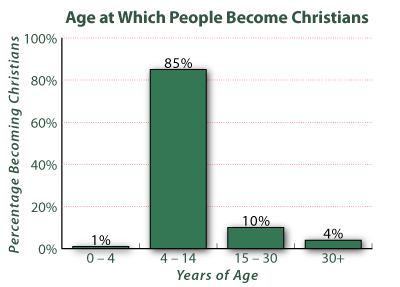
There are 2.3 billion children on earth under age 15 and they represent the largest unreached people group in the world. Boys and girls in the 4/14 Window are given priority because they are more open and receptive to the gospel than older youth and adults. Nearly 85% of people who make a decision for Christ, do so between the ages of 4 to 14!

What is the 4/14 Window Initiative?

The 4/14 Window Initiative is “to raise-up a new generation from the 4/14 Window to transform the world for Christ.” This is simply the mission statement of the 4/14 Window Movement.

Who oversees the 4/14 Window Movement?

The 4/14 Window Movement is a partnership of Christ followers and Christian leaders from the Body of Christ around the world. While many denominations and ministries are represented, the 4/14 Movement is non-denominational. Many who serve within the movement are employed by local churches or other ministries. The 4/14 Movement has no headquarters, no formal organization and no paid staff. Everyone who serves, does so out their love for Jesus Christ and the children in the 4/14 Window.

Find out more about at the 4/14 Window website. Download the prayer and fasting guide.

not alone

Have you ever been picked last during the gym class lineup? In elementary school, I used to be skinnier than a twig, but as fast as a gazelle. You’d think I would be an ideal candidate for dodge ball, but all the strong guns and smack mouths got picked above me.

Or have you ever been ignored from participating in an important project at work when you thought you’d be the one for the job? Or have you been left out of a discussion at church when you thought you had the gifts to help? It might be that in a similar situation it is common for you to become angry, fearful, or lonely.

When Jesus died. He left the disciples all alone, but not really. Though He promised a Helper would come, He was nowhere to be found, at least to their eyes. So they did what anyone would do. They went back to work, mending the nets. They did not know they were supposed to carry on the work of Christ ASAP. Like little kids, who had just been asked to do their jobs might have thought, “You mean when you said, “Go therefore and make disciples,” You meant, right now? Oh!”

So after Jesus rose from the grave He came to His followers and gave them some last words. His last words were a charge to the troops, an assignment to His students, and order from the throne,

“Go therefore and make disciples of all nations, baptizing them in the name of the Father and of the Son and of the Holy Spirit, teaching them to observe all that I have commanded you. And behold, I am with you always, to the end of the age.” (Matthew 28:19-20 ESV)

Like the disciples, you are not alone. You have the power. The power and the presence of the Holy Spirit. He goes with you always until the end of your life.

thumb licks [4.9.11]

Parenting: how eternity shapes the mundane.

Not so fast. The sometimes slow and steady process of sanctification.

The importance of writing letters.

Praying past our preferred outcomes.

Forget Kevlar, use liquid armor. This stuff is sweet!

15 grammar goofs that make you look silly.

Love is… (for you married folk)

Lottery is a suicidal craze.

Funny comments to the mega millions winner.

Dirt. Not your ordinary music video.

echoes from the tomb

Leaning forward, you strain to hear. The fresh, cool breeze of the garden morning brushes your cheek. Bending, you look into that open, black-dark mouth of the tomb, its only light the sun’s thin finger reaching past your shoulder to touch the corner of a bone box. But the bones for which it waits have changed, gotten up and walked away. No smell of death; only the sweet scent of burial spices hanging in the air.

Bouncing off the walls of this vacated tomb, you may hear echoes from another garden where the lie, “Has God really said?” prevailed, and death was ushered in. But now, in this garden the lie has been silenced with a resounding, “Yes!! His Word lives!” and death has been driven out, the curse of Eden swallowed up in this empty space.

And do you hear the echo of righteous Noah, who built a deliverance to carry God’s creations through the judgment, or Father Abraham, through whom all the peoples of the earth would be blessed? Do you hear the echoes of Egypt’s oppressive slavery turned inside-out in powerful salvation, and at its peak an innocent lamb slain so that death would pass over? Do you hear the echo of new life found through parting waters, or of bread, water, and the Shekinah tent given in a wilderness? Do you hear the death-dealing law, unable to give life, at once fulfilled and filled full by the Life? Do you hear these echoes?

As you now kneel on this rough-hewn path leading into where Hope was dead for a moment, do you hear Joshua’s name, bouncing ’round these walls, the same name as “Yeshua,” “Jesus,” whose very name shouts “Salvation!”? Walls have crumbled. Evil has been judged, banished from the land. Joshua led God’s people to a promised place, a place flowing with all good things, as does now his namesake, who takes us to a promised rest harder bought. And the chaos of Judges too rings through this darkened grave, its “every man did what was right in his own eyes” now crushed under a staggering obedience, one Man having done what was right to give us new hearts, making us right with God.

King David’s words, “You will not allow your Holy One to see decay,” hang in this sweet air, and His Son, the ultimate Man, the ultimate King, receives the coronation song and, finally, dominion of the world and of a different kind of Kingdom. And this Easter tomb, having become a temple of sorts, housing God, echoes with the words of blessing over Solomon’s temple, its walls now torn down but built up in flesh and bone, stone by stone, to go walking through the world, taking the Light of the Gospel, the Presence, to all the black corners of the earth. The temple decisively cleansed by one Offering, the Great High Priest intercedes, never to offer another sacrifice, the way into the holiest place forever opened by His trail-blazing life.

Here too, in this now-hollow crypt ring full the words of Isaiah, “On this mountain … He will destroy death forever,” and Jeremiah’s “they will all know Me,” and do you hear Ezekiel’s bones rattle with hope? Exile having been exiled, this now is the true return, the Kingdom come, God’s people ruled by one ever-living King.

A baby’s cry, warbling out from a dusty trough, warbles here too, for the birth of Salvation always was leading to death, thus to this place. Vulnerability led to and ended here. The Jordan with open sky and loving Voice, the temptation to bow down, gain dominion, and avoid the terrible fate, and the transfiguration, shining and telling of his Exodus — events that all anticipate this shaking of the earth, this shattering of our assumptions. Echoed in every inch of this tomb are Love’s words, “no greater love,” and Love’s power that shushed a storm and raised a child. You hear them here in this cavernous glory.

And now you turn looking from this garden to the outpouring, the Spirit come, and to the church spreading down the ages, and to those who die in Hope, and you see us. For all these echoes from the Easter tomb, you realize, are our Story, and we, at the mouth of this conquered grave, stand at the center of His Story.

[HT]

hanged on a tree (for me)

Part of the curse Jesus would bear for us on Golgotha was the taunting and testing by God’s enemies. As he drowned in his own blood, the spectators yelled words quite similar to those of Satan in the desert: “Let the Christ, the King of Israel, come down now from the cross that we may see and believe” (Mark 15:32). But he didn’t jump down. He didn’t ascend to the skies. He just writhed there. And, after it all, the bloated corpse of Jesus hit the ground as he was pulled off the stake, spattering warm blood and water on the faces of the crowd.

That night the religious leaders probably read Deuteronomy 21 to their families, warning them about the curse of God on those who are “hanged on a tree.” Fathers probably told their sons, “Watch out that you don’t ever wind up like him.” Those Roman soldiers probably went home and washed the blood of Jesus from under their fingernails and played with their children in front of the fire before dozing off. This was just one more insurrectionist they had pulled off a cross, one in a line of them dotting the roadside. And this one (what was his name? Joshua?) was just decaying meat now, no threat to the empire at all.

That corpse of Jesus just lay there in the silences of that cave. By all appearances it had been tested and tried, and found wanting. If you’d been there to pull open his bruised eyelids, matted together with mottled blood, you would have looked into blank holes. If you’d lifted his arm, you would have felt no resistance. You would have heard only the thud as it hit the table when you let it go. You might have walked away from that morbid scene muttering to yourself, “The wages of sin is death.”

But sometime before dawn on a Sunday morning, a spike-torn hand twitched. A blood-crusted eyelid opened. The breath of God came blowing into that cave, and a new creation flashed into reality….

The following is my favorite excerpt from: Tempted and Tried: Temptation and the Triumph of Christ by Russell Moore, Crossway, 2011. pages 124-125.

righteous extravagance

What would you do if you had one week to live? This is a question posed in the movie, One Week, in which a young man named Ben is faced with the reality from doctors he has end-stage cancer and will soon die. He impulsively buys a motorcycle, leaves his job and fiancée, and takes off on a solo trip across Canada. In a scene with his fiancée he argues, “It’s not about the cancer; it’s about the life I built for myself. Why am I over-insured? Why do I care so much about being responsible all the time? Why do I give a $%&* about the appliances we’re putting into our kitchen?”

Society conditions us to believe life is about a nicer house, a prestigious high paying job, and granite countertops. Yet when you are faced with the reality that you only have one week to live those things you use to covet, fear, worry about, or fixate upon take a backseat to what’s most important.

What would you do if you had one week to live? Would you live extravagantly? When we think about extravagance we think of money and spending lots of it. There is a Facebook page dedicated to asking people what they would do the last week of their life. The answers reveal what we value. Here are some of the responses:

  • I would quit my job, buy a boat and get a tattoo. I would get married as quickly as possible.
  • I would travel by helicopter to Ireland, the Grand Canyon, and end at a beach spa on Bora Bora.
  • I would pig out on all the cheese fondue and chips and guacamole I could stomach.
  • I would max out my credit cards and spend it on frivolous things like renting a convertible Ferrari.
  • I would write letters to all my children or people who touched my life and spend time with them.
  • I would go out and get a second opinion from another doctor.

Today is Palm Sunday. It is the day we celebrate the beginning of Jesus’ last week of earthly life. Within a week He is praised by the crowds, lynched on a cross, and raised from the grave. Like Ben, Jesus knew He had one week to live. What do you see Jesus do differently the last week of His life compared to the 33 years before? Nothing. What you do see is an expectation of His followers to live extravagantly the remaining days of their earthly life. Not extravagant, as in spending frivolously or living recklessly, but extravagant as in living out your faith with excessive elaborateness that people are sure to hear and see the Savior in your speech and actions.

1. If you truly know Jesus, you will respond with extravagant worship [John 12:1-8]

Within 6-days Jerusalem will celebrate the Passover. People are flocking from all over the region. This Passover will be different. Jesus will die. He will become the Passover lamb. Jesus is moves towards danger not away from it. He does not hide. In fact, He goes to the Bethany—the location of one of Jesus’ greatest miracles—the resurrection of Lazarus. He knows His time is near. The chief priests and Pharisees have already sent out a warrant for Jesus’ arrest [11:57].

When Jesus arrives in Bethany He is honored with a sinner party. It is a thank you celebration for Jesus miraculous power raising Lazarus from the dead. Gathered are the disciples. Lazarus is reclining at the table with a big smiling to the one who gave him new life. Martha is in her usual place organizing the meal and making sure it’s well served. And Mary is about to express her heart to Jesus in a lavish way. This is the same Mary who sat at Jesus’ feet soaking in every word He said and to whom He said, “Mary has chosen what is better, and it will not be taken from her.”

The time comes when Mary presents Jesus with an extravagant gift. Perhaps the whole family planned this moment. Perhaps they pooled their savings together to buy the gift fit for a king [Songs 1:12]. Perhaps it’s a family heirloom that has been passed on for years. Or perhaps Mary heard about the “sinful woman” at Simons house who poured perfume at Jesus feet and also desired to honor Jesus [Luke 7:36-50]. We are uncertain her reasons, but Mary poured out about 11 ounces (the size of a soda can) and anointed the feet of Jesus and wiped His feet with her hair. The fragrance filled the house. It’s an unforgettable moment of extravagant worship from hearts filled with gratitude.

Not all who were at the party thought Mary’s scene of extravagant worship was such a wise idea. Judas Iscariot thought it was a waste of good perfume. And as if he were ‘Mr. Spiritual’ asks why the expensive perfume was not sold and given to the poor. This is quite the blow coming from the tightwad who is robbing from the disciple’s moneybox.

If Judas wasn’t over exaggerating the 11-ounce flask of spikenard was worth about $26,000 (300 days pay at minimum wage). Judas makes us aware that it is easy to be the judge of another persons worship, rather than just worshiping Christ. His values were so deeply different from Mary and Martha and Lazarus’ that in a few days he would do the opposite. Instead of giving $26,000 for Jesus he would sell him for a thousand bucks (30 pieces of silver). Judas’ heart is full of dollar signs, but Martha, Mary and Lazarus’ hearts valued what money could not buy, a relationship with God.

What do you treasure? If you treasure the things of this world you will hang by them, as did Judas. If you treasure Christ above all things you will live. Jesus said to Martha after He raised Lazarus, “I am the Resurrection and the Life. Whoever believes in Me, though he die, yet shall he live, and everyone who lives and believes in Me shall never die.” [John 11:25–26] Jesus wants to make sure that in six days at another grave—His own—they do not lose their sense of worship that He is indeed the Resurrection and the Life, but that they would “keep it” even on the day of His burial.

Jesus does not rebuke Mary’s gift, instead He approves of her extravagantly beautiful worship. Jesus loves extravagant worship. The only thing that matters in worship is God’s approval. He created you for His glory and praise. “For of Him and through Him and to Him are all things, to whom be glory forever.” [Romans 11:36] “For by Him all things were created that are in heaven and that are on earth…All things were created through Him and for Him.” [Colossians 1:16] “Everyone who is called by My name, Whom I have created for My glory.” [Isaiah 43:7]

According Romans 3:23, “All have sinned and fallen short of the glory of God.” But Jesus has come to live to die so that you might give Him “praise for His glorious grace” now [Ephesians 1:3-14] and throughout all eternity.[1] He came to be worshiped. He created you as a worshiper. And He has called you to make worshipers. Worshiping God is your mission.

“Missions is not the ultimate goal of the church. Worship is. Missions exists because worship doesn’t. Worship is ultimate, not missions, because God is ultimate, not man. When this age is over, and the countless millions of the redeemed fall on their faces before the throne of God, missions will be no more. It is a temporary necessity. But worship abides forever. Worship is, therefore, the fuel and the goal of missions.” – John Piper, Let the Nations Be Glad. Baker Books, Grand Rapids, MI. 2003. p.17

2. When you worship extravagantly, you are Jesus’ witness to the world [John 12:9-22]

Palm Sunday was an event of great understanding and misunderstanding. The great understanding is that this Jesus really is “the King who comes in the name of the Lord” [Luke 19:38]. He is the Messiah, the Son of David, the long-awaited Ruler of Israel, and the fulfillment of all God’s promises. But the great misunderstanding was that He would enter Jerusalem take His throne and make Israel free from the oppression of Rome.

The understanding of the crowd that day gave joy, but the misunderstanding brought about destruction that led to the murder of Jesus a few days later and the destruction of Jerusalem 40 years later. Jesus saw it all coming as He came into Jerusalem. And as Jesus entered into Jerusalem there were a two interesting cultural nuances to the event:

First, Jesus makes a kingly entrance. Why did Jesus choose a donkey? It demonstrated Jesus’ humbleness; and it showed that Jesus’ entry was part of God’s plan [Zechariah 9:9]. During Jesus’ day, donkeys were part of the peasant life. However, Hebrew kings rode the ‘beasts of burden’ when they traveled throughout their kingdoms in times of peace [1 Kings 1:33–35]. And the king always had a donkey reserved for him that no one else had ever ridden.

Second, the people proclaim Jesus as king. Not only are the people singing Messianic psalms. According to Luke 19:35–36, the people spread their cloaks on the donkey and the road. Cloaks were of great importance. The cloak was so important to the owner that it would never have been loaned out to someone else. Compare it to something important to you like your home, car, or favorite dress or suit. Hence the parable when Jesus says when one asks for you tunic, give him your cloak as well [Matthew 5:40-42].

The disciples did not understand the purposes of the events that day, until after Jesus death and resurrection. Now the Pharisees completely misunderstand what is happening. Their pride blinded them, and they refused to bow to Jesus ‘the blasphemer.’ In disgust they mumble to each other, “Look, the world has gone after Him!” [12:19] In the crowd, Greeks gathered with the join the crowd, which is ironic proof that the world had come to see Jesus.

The idea of world (kosmos) in John is not a negative term [3:16–19]. Neither is it just geographical, but it’s a reference to the population or people of the world. Jesus is called the light of the world [1:9; 8:12] and “the Savior of the World” [4:42]. His coming into the world [1:10] was to take away the sin of the people of the world [1:29]. But because of hard hearts and rejection, the coming of Jesus also meant the judgment of the world [9:39].

Within a few days those same crowds shouting “Hosanna!” would shout, “Crucify Him!” Jesus knew what was about to happen. The Pharisees would get the upper hand. The people would be fickle and follow their leaders. And Jesus would be rejected and crucified. And within a generation the city of Jerusalem would be obliterated,

“Now as He drew near, He saw the city and wept over it, 42 saying,  “If you had known, even you, especially in this your day, the things that make for your peace! But now they are hidden from your eyes. 43 For days will come upon you when your enemies will build an embankment around you, surround you and close you in on every side, 44 and level you, and your children within you, to the ground; and they will not leave in you one stone upon another, because you did not know the time of your visitation.” [Luke 19:41-44]

This is sobering news for Jerusalem. But it made way for the good news to reach the ends of the earth [John 3:16].

In Luke 19:39 the Pharisees ask Jesus, “Teacher, rebuke your disciples.” But He answered and said to them,  “I tell you that if these should keep silent, the stones would immediately cry out.” [Luke 19:40] How can stones cry out that Jesus is Lord? All nature, just by being, testifies about the God who made the world.

Do you remember pet rocks? Companies must have made a millions selling rocks with felt feet and beady little eyes. It’s silly to think that a rock could talk, much less shout the praises of Christ. But if you’ve ever been to the Grand Canyon or the Rocky Mountains, you realize that the rocks do cry out praises to their creator. All of His creation makes His presence and praise known. Why would mankind, the crown of His creation, choose to be silent? He’s called you to be His witness to the world!

3. As a witness of Jesus, God honors your service with unfathomable extravagance [John 12:23-26]

These verses mark a turning point in Jesus ministry. He sounds the alarm saying, “My hour has come that the Son of Man should be glorified.”[2] Using an agricultural story of a dying seed that gives life to the following years harvest, so Jesus must die in order for the world to have eternal life. Only by understanding Jesus’ death and resurrection can you make sense out of what seems to be the senseless waste of life. Jesus will sacrifice His life so that all may have life.

Jesus is not just talking about Himself but is giving a template for everyone of His followers. Following Jesus may involve the ultimate cost of discipleship, namely the death of the disciple. There are hard things in these verses for Jesus followers. It is not easy to die to sin and self, hate you life in this world, follow Christ, and serve Him. But there are glorious things for followers who do hard things for His name sake. If you die, you bear much fruit. If you hate your life you will keep it for eternity. If you follow Christ you will be where He is and He will be there too. And if you serve Christ the Father will honor you.

If you had 7 days to live how would you make His name known? How would you spend and be spent for the sake of His fame? The way you live the last week of you life reveals your priorities or what you value. When Martin Luther was asked what he would do if he knew when he would die he responded, “If I thought the world were going to end tomorrow, I would plant a tree.” He gets to the heart of the matter, that when the end comes the Lord should catch you doing the things you were called to do all along.

There is great honor for serving in your church. No matter if you are a deacon, Sunday school teacher, nursery helper, or sanctified toilet scrubber, God is honored with selfless service. There is great honor in sharing your faith out loud to your unbelieving classmates, coworkers, and family members. As Jim Elliott said and lived to his death, “He is no fool who gives up what he cannot keep to gain what he cannot lose.”

Mark was part of a team of two families serving Muslims. Late in August, the team received death threats. The families were evacuated, but Mark stayed for one last meeting with believers before joining them. The night after the meeting while at home preparing his dinner, Mark was shot. He was discovered the next morning in his home, but he had lost too much blood to survive. At his passing, Mark left a young wife and two infant twin daughters. Mark’s agency feared the possibility of legal action from Mark’s father, who was not a believer and who vocally opposed his son’s service among Muslims. But at Mark’s funeral, Mark’s father was among fifteen people who gave their lives to Christ. His wife plans to minister in the same region where her husband was killed.

I think of the five men who lost their lives in Ecuador to reach the Auca Indians. A wife and a sister returned to the village and the wife raised her daughter among the tribe that killed their husband. Many in the tribe converted because of the similarity between Christ sacrifice and the five men. The risk versus rewards for extravagantly following Christ is literally out of this world. You are guaranteed to be an heir of everything that God has created and eternally be at home with Him. God is lavishly, excessively, exuberantly, graciously, outrageously loving. In a word, He is extravagant. When His extravagance registers in your hearts and minds, extravagant devotion flows towards Him.


[1] Cf. Revelation 4:11; 5:8-14; 7:9-10; 15:4

[2] Cf. 2:4; 4:21, 23; 7:30; 8:20; 16:4; 13:1; 17:1

the beginnings: study of Genesis

The Beginning [Genesis 1:1-2:3]

Beginning Questions [intro]

Beginning Word on God [1:1-3; 2:1-3]

Beginning of Everything (except God) [1:4-25]

Beginning of Mankind [1:26-31; 2:4-25]


The Fall of Man: The beginning of the end [Genesis 3-4]

Believing a lie from the wrong voice [3:1-6]

How sin infects [3]

The Consequences of Sin [3:7-24]

Creations need for Reconciliation with its Creator [3:15, 21]

Raising Cain: the Call for Repentance [4]


Noah [Genesis 5-9]

Walking in Obedience [5:1-7:1]

God is Faithful through the Flood [7-8]

The Covenant [9]

Babel [10:1-11:9]


Abraham & Sarah [Genesis 11:10-23:1ff]

The Call [11:10-12:9]

Honest Abram [11:27-32]

Journey of Faith [12-22]

Melchizedek [14]

God will Provide [21-23]

A Bride for Isaac [24]


Jacob & Esau [Genesis 25-36]

The Tale of Two Brothers [25-27]

Jacob’s Dream [Genesis 28]

Jacob’s Journey to Reconciliation Part 1 [29-31]

Jacob’s Journey to Reconciliation Part 2 [32]

Jacob’s Journey to Reconciliation Part 3 [33]

Jacob’s Journey Home Part 1 [34]

Jacob’s Journey Home Part 2  [35-36]


Joseph [Genesis 37-50]

Just your Average Joe [37]

Judah & Tamar: Faithful Deception [38]

Secret of Success Part 1: Faithfulness & Favor [39]

Secret of Success Part 2: Workmanship & Wisdom [40-41]

Life Hurts but God Heals [42-45]

A Reunion to Remember [46-47]

For Dads & Granddads [48-49]

God’s Purpose from the Beginning [50]

What is it like to go from being on staff at a local church to being on preparation for the foreign mission field?

First, my goal for this answer is to educate the church on the life of it’s mission. It is not so the church will “feel sorry for the missionary”, but give a window to peer through helping the church pray more effectively and engage more purposefully. It is also to help the church understand the seriousness of the call of God, in the same manner as the Apostle Paul let us in on his difficulties. Second, my goal for this answer is to help the church catch a vision to where God has called them.

I think the transition from pastor to Jesus’ mission is a natural transition. Both the pastorate and mission field have the same goal in mind. To see the church of Christ and His fame grow among the nations. As a pastor (or church member your task is to do so locally, and as a missionary your task is to do so globally.

Being a pastor and member of the local church has given me a love for Jesus’ church. The church I grew up in and the church I’ve been an assistant pastor at for the last 8-years have both encouraged and cultivated my love for Jesus and His mission through the church. As a teenager, I was discipled purposefully by two mission-minded deacons and a team of youth leaders. They got me involved in serving Christ as a teenager. It is important to look at the young people in your church not as the future of the church, but as the church now.

Before becoming the assistant pastor of Battle Ground Bible Church, I was on a yearlong church planting apprenticeship in South Africa. It was a turning point in my life. For the first time I could honestly see myself sharing the gospel on the foreign field. Also, I being in Africa I got a bug for Africa [maybe more than one bug!]. I wanted to go back. So when I interviewed for the position at BGBC, they were aware they might release me in the future to go to the mission field. They cultivated that desire by giving me opportunities to lead short trips overseas to help our missionaries, to spear-head their own vision to plant churches locally, and explore opportunities to serve in Africa. When Sarah and I married, they funded a trip we took to the Congo to equip youth leaders and pastors. Then a year later when we desired to take a vision trip to Chad, they were excited to support us. BGBC gave us a lot of freedom to follow Christ call and prepare us for that call.

In August, we were commissioned from BGBC to begin raising prayer and financial partners. That last Sunday on staff was incredibly emotional. We shed a lot of tears. It was an Acts 13 moment I will remember the rest of my life. We left a lot of friends, spiritual family, and our small group which was our major source of spiritual accountability. When we drove away there was a huge void of constant fellowship.

To be honest, the first few weeks I was in a spiritual funk. I did not take a course on how to succeed transitions. While on staff I was use to a great schedule–a routine I understood–and an office where I could have some quiet study time. That changed while we were on the road. I guess, I can understand what it is like when a retired couple is around each other after working their entire lives, only we were 3 years into our marriage. It’s been a good adjustment being around Sarah and our daughter 24-hours a day, 7-days a week. I realized I am pretty blessed to have this opportunity. It’s had it’s challenges and learning curves. You really get to know someone on a long road trip. Although for our family the road trip has been 6-months long.

An emotional day came when we sold our home in December. We were ecstatic that we were able to find a buyer so soon and not lose a load of money, which is surprising in our current housing market. Although excited we were a bit sad. It was the first time we’ve felt homeless. We could no longer go back to the comfortable living room we created, play in our grassy backyard, or pick veggies from our summer garden. Our home is now a Honda Element. We’ve enjoyed the generous hospitality of friends, family and churches while being on the road, but it can be exhausting. We’ve really been living our life on display for all to see. That’s difficult when you’re not feeling good, tired, or having a difficult day with your spouse or teething child.

It took me about a month to pull out of that funk. We’ve found a crazy schedule that’s worked for us on the road. More importantly we’ve found times to be in the Word and pray together. And we’ve discovered creative ways to keep accountable to our church while being so far away.

Sarah and I have been surprised by God’s grace. We would have never dreamed we would be at the place we are 6-months into our preparation for the mission field:
•    We have reached 85% of our required support goals. On our way to 100% by June.
•    We have acquired over 250 prayer partners.
•    We have added 3 families to our team [including 13 children, but soon to be 14].
•    We have sold our home without going into debt.
•    We have signed up for language school beginning in August.

Not that we seek confirmation from God for the steps we take, but God has been expediting the  road that leads to Chad. We take it that He really want the gospel starved “Z” to hear the good news and see the church of Jesus rise where it is not.

from wonder to witness

I’ve had a few Turning Points in my life, as I’m sure you’ve had too. My first turning point came when I was 12. I grew up in a normal American dysfunctional home. My parents divorced before I could understand and we were nominal churchgoers. I was a troubled and angry kid. I rode the short bus and was labeled a special kid. I was so embarrassed. After my mom remarried, our family moved for work reasons to a small town in the middle of Wisconsin. We began attending a Bible Church. They used Bibles. So the next week mom went to Sam’s Club and bought Bibles. We grew like weeds. Within months, both my mom and I came to Christ. A few years later we got baptized together.

My second turning point came when I was 18. Since my salvation leaders in my church took me under their wing and helped me to grow in God’s Word and the gifts of the Spirit. I was encouraged to consider fulltime Christian service. That led me to Bible College, then a yearlong church planting apprenticeship in South Africa, then ministry for the past 8-years as an assistant pastor in Indiana, and then marriage to [Congolese] Sarah who I had met years before in Bible College.

My third turning point came on a vision trip Sarah, Justus, and I took to Chad last year this time. I clearly remember walking the dry dusty roads of northeast Chad, the hot sun beating on my face, and a sense of thirst on my tongue. While walking through the abstract streets I could hear the calls from the local mosque, donkeys laughing, and the Spirit of God convicting me. I though to myself, “You got Someone these people do not. 100% of the people in this town do not know your Jesus. Who will help bring the church to unreached Chad?”

The book of Acts is full of turning points.  Today I want to draw your attention to a turning point in Acts 1. Here the disciples are getting some last words from the resurrected Jesus. He had spent many hours, days, and years teaching these men who they were. He called them God’s servants, friends, beloved children, and brothers. Sometimes they seemed to understand who they were, but at other times they seemed clueless. And just before Jesus is about to leave them and ascend to heaven, He says, “You are my witnesses.” [Acts 1:8]

What is a witness? A good Christianese word. When the word witness appears in the book of Acts it most often refers to the role the 11-apostles had as legal eye-witnesses of Jesus’ death and resurrection.[1] At the end of the book, Paul uses the word of himself because he also had heard and seen the resurrected Jesus. But in Acts 1:8, when Jesus uses the word witness, He alludes to Isaiah 43. There the word witness applies broadly to all of God’s people:

Isaiah 43:10You are my witnesses,” says the LORD, “and My servant whom I have chosen, so that you may know and believe Me and understand that I am He. Before Me no god was formed, nor shall there be any after Me. 11 I, I am the LORD, and besides Me there is no savior. 12 I declared and saved and proclaimed, when there was no strange god among you; and you are My witnesses,” says the LORD.

How does Isaiah give meaning to witness in the book of Acts? First, being a witness is not something any of these people chose. It is something God chose for them. Israel was God’s chosen people; likewise, Jesus chose His disciples. We often talk about witnessing as if it is something you choose or don’t choose, but it is not. You are witnesses by God’s choice. And you cannot help but be witnesses when you are identified with Jesus. Either you’re a witness or you’re not. It’s like my wife saying she’s kind of pregnant. Either she is or she is not.

Second, what made them witnesses was not something they did, practiced or earned; it was something they were. It was a relationship with God that made the apostles witnesses. You are a mom/dad because you have children; you are a son/daughter because you have parents; you are a man/women because that’s how you were born; or you are a student because you are in school. You are a witness because you are a follower of Christ.

A witness is not a passive role you fulfill. Rather the biblical idea of witness is quite active. Jesus says you can bear witness or you can even bear false witness. There were specific things Israel did and did not do which affected their testimony as witnesses. So it is with a witness of Christ. What does your witness say about Jesus?

As a witness of Christ, I openly and publicly demonstrate what I have learned and seen while with Jesus. But my witness is much more than words; it is a whole way of life. The Greek word for witness is μαρτος, where you get the word martyr. As the early Christian gave up their lives for what they had seen, the word martyr began to mean “one who choose to suffer or die for his or her beliefs.” [i.e. Stephen, cf. Acts 7:58] To be a witness, means giving my whole life, even giving up my life for what I have seen and heard from Christ. To be a witness is not a fatalist. But as a witness I am unwilling to bow to the god of comfort and safety or muzzle my mouth because the gospel will offend someone. Jesus says the cross is foolishness to unbelievers. Recently, I’ve been challenged by the story of Mark, a brother serving in North Africa,

Mark was part of a team of two families serving Muslim. Late in August, the team received death threats. The families were evacuated, but Mark stayed for one last meeting with believers before joining them. The night after the meeting while at home preparing his dinner, Mark was shot. He was discovered the next morning in his home, but he had lost too much blood to survive. At his passing, Mark left a young wife and two infant twin daughters. Mark’s agency feared the possibility of legal action from Mark’s father, who was not a believer and who vocally opposed his son’s service among Muslims. But at Mark’s funeral, Mark’s father was among fifteen people who gave their lives to Christ. His wife plans to minister in the same region where her husband was killed.

Third, being a witness is first “so that” you may know God and then “so that” others may know your God. Being a witness is about knowing God, seeing His steadfast love, observing His work in creation, hearing His voice. Being a witness is not something directed only toward others—though it has implications for those around you. Being a witness begins by being grounded in your relationship with God.

“Witness-ship” is a mark borne by getting near God. There is something so powerful about God’s character that it is impossible to get near what He is doing without being marked. The closer you get the more profound the mark.

Not only can you see God at work in historic acts, but also if you keep your eyes open you keep seeing him at work today. You see God at work in your life, in your friend’s lives and in the world around you. You still see God doing things that you long for but can’t make happen on your own. You see God’s forgiveness and love. You see how God transforms messed up lives and redeems them through His Son.

You—His witnesses—play a huge role in God’s plan.[2] You are the evidence of God’s work. The Bible tells the story of ordinary people so you can learn about an extraordinary God. How do you know God’s love is steadfast? By looking at the story of God’s people. How do you know God keeps His promises? By looking at His people. How does the world hear about God’s salvation? By hearing and seeing the witness of God’s people, like you and me. God has made His people messengers of His love, ambassadors of His kingdom, lights on a hill, salt in society. God has called you to be His witnesses.

The disciples stood on the mount starring with wonder into the sky, like a crowd at Cape Canaveral watching the shuttle launch or Superman making his classic exit, only this was no space shuttle or superhero it was the coronation of Jesus Christ. And with the rest of our time today, I want to uncover what Jesus expects from you, His witnesses.

1. You are commanded to live in the power of the Holy Spirit [Acts 1:4–5, 8a]

The book of Acts is often referred to as the Gospel (or autobiography) of the Holy Spirit. If you want to learn about the person and work of the Holy Spirit read Acts. In Acts 1:2-8 Jesus gives a concise theology of the Holy Spirits work. And amazingly Jesus receives the instruction from the Holy Spirit on the Holy Spirit.

First, His followers are guaranteed baptism by the Holy Spirit, which fulfills the promise Christ gave of the Helper who would come after He ascended [vs.4-5, cf. Luke 24:44-49].[3] For the first time, God would not dwell in a temple, but His temple would now continually dwell in His people. Jesus cautioned the disciples not to leave Jerusalem without the Holy Spirit. Why? If they did not waited they would be powerless.

Second, His followers are guaranteed power from the Holy Spirit to do miraculous works among the people [v.8a].[4] Jesus has completed His earthly ministry and now inaugurates the apostle’s earthly ministry.[5] These men witnessed Jesus’ teachings and miracles, and now they would continue on His ministry after Him. Although you might not exercise signs and wonders quite like the apostles, His ministry through you is still powerful and miraculously changing lives.

In Martin Lloyd-Jones’ book Joy Unspeakable he uses an illustration to describe the difference between common Christian living and what happens when the Holy Spirit comes upon a person with this unusual and unmatched power.

It is like a child walking along holding his father’s hand. All is well. The child is happy. He feels secure. His father loves him. He believes that his father loves him but there is no unusual urge to talk about this or sing about it. It is true and it is pleasant.

Then suddenly the father startles the child by reaching down and sweeping him up into his arms and hugging him tightly and kissing him on the neck and whispering, “I love you so much!” And then holding the stunned child back so that he can look into his face and saying with all his heart, “I am so glad you are mine.” Then hugging him once more with unspeakable warmth and affection. Then he puts the child down and they continue their walk.

This is what happens when a person is baptized with the Holy Spirit. A pleasant and happy walk with God is swept up into an unspeakable new level of joy and love and assurance and reality that leaves the Christian so utterly certain of the immediate reality of Jesus that he is overflowing in praise and more free and bold in witness than he ever imagined he could be.

The child is simply stunned. He doesn’t know whether to cry or shout or fall down or run, he is so happy. The fuses of love are so overloaded they almost blow out. The subconscious doubts—that he wasn’t thinking about at the time, but that pop up every now and then—are gone! And in their place is utter and indestructible assurance, so that you know that you know that you know that God is real and that Jesus lives and that you are loved, and that to be saved is the greatest thing in the world. And as you walk on down the street you can scarcely contain yourself, and you want to cry out, “My father loves me! My father loves me! O, what a great father I have! What a father! What a father!” [cf. Acts 2:11]”

The Holy Spirit’s all-consuming passion is to exalt Christ to the end of the earth. And the reason He has a white-hot passion is to empower you to witness to the ends of the earth:

  • “All the earth shall be filled with the glory of the Lord.” [Numbers 14:21; Habakkuk 2:14]
  • God brought His people into Canaan “so that all the peoples of the earth may know that the hand of the Lord is mighty” [Joshua 4:24, cf. 1 Samuel 17:46].
  • David commands, “Sing to the Lord all the earth…Declare His glory among the nations, His marvelous works among all the peoples!” [Psalm 96:1–3]
  • “I will give you as a light to the nations, that my salvation may reach to the end of the earth.” [Isaiah 49:6]
  • Jesus himself said, “Go make disciples of all nations” [Matthew 28:19].
  • “This gospel must be proclaimed to all the nations” [Mark 13:10].
  • “You are worthy to take the scroll and to open its seals, for You were slain and by Your blood did ransom men for God from every tribe and tongue and people and nation.” [Revelation 5:9–10]

The Holy Spirit wants the world for Christ. So He equips you as His witness with power to do it. He gives you absolute confidence that as you go out making disciples in His authority  nothing will thwart His name from reaching the nations.

2. You are called to share the gospel with people near and far, and similar or different than you [Acts 1:6–8]

Imagine you had the opportunity to ask Jesus any question. What would you ask? The disciples have an honest question for Jesus. Since Jesus and the OT prophecies talked a lot about this coming kingdom, and many anticipated a Messiah who would reign and release His people from the oppressive Roman Empire they ask, “Will you now restore your kingdom?” Jesus does not belittle their question, but reminds them that the timing is not for them to know. Instead, He refocuses them on being ready for the great task of sharing the good news with the known world.
The geography boundaries mentioned becomes an outline for the remainder of Acts as the apostles take the gospel from Jerusalem [1-7], to Judea and Samaria [8-12], and to the edges of the globe [13-28]. Jesus calls them to share the gospel with people like them in Jerusalem, the hub of the Jews. But He also calls them to share the gospel with people on the other side of the tracks in Judea and Samaria. These were people the Jews did not like. But God loved. For centuries the Jews had a sour spot for the “half-breed” Samaritans. But God intended Israel to be a light to the Gentiles. Since, Israel failed in this mission, Jesus is calling the apostles to carry His torch to their lost neighbors and be a bright light to the world. This is also the reason for your church and you: be a light locally and globally.

As witness we are team players. We are no longer just bystanders on the bleachers. We’ve been trained by the Master to carry the ball (gospel) up and down the field. I think of the five men who lost their lives in Ecuador to reach the Auca Indians. One wife and sister returned to the village and the wife raised their daughter among the tribe that killed their husband. Many in the tribe converted. Months ago, I met a man from North Africa whose church had been bombed a dozen times by Muslims. These are people on the front lines of Jesus’ mission shining the light in darkness. Near, far, similar, or different there are not boundaries to the gospel.

Who are your Samaritans? Is it your annoying co-worker or boss? Is it a relative? Is it a sassy celebrity like Lady GaGa or Katy Perry? Is it the Hispanic or black down the street? Is it the poor person you see on the corner always seeking a hand out? Is it your fellow Democrat? If you’re from Ohio, could it be people from Michigan? You know your Samaritan. It’s the one who makes your skin crawl and you avoid them like the plague. Jesus died for them too and He is calling you to be a witness to them.

3. You are urged to be diligent, even as you long for Christ’s return [Acts 1:9–11]

The purpose of God and the passion of the Spirit are not yet completed. We might question why, but Jesus’ answer will always be, “It is not for you to know the times and seasons which the Father has fixed by His own authority.” The great danger we face in the American church is the illusion that the purpose of God is complete, that the world has been evangelized. But there are over 2.7 billion (that’s billion!) people in the world who have not heard the gospel; they have no missionary, no church, and not enough Christians in their own people group to reach themselves.

That boggles me, as I am sure the apostles were boggled that day they starred into the sky wondering when Jesus would return. I love what happens next. Two messengers dressed in white came to the apostles. What message did say to the apostles? Why do you wonder? Witness! Jesus will come back. Not yet. So get to it”

Proof of the disciples diligence is in the remaining 28 chapters of Acts. They confidently expected Jesus’ return, but didn’t twiddle their thumbs in the meantime. With their own ears they heard their calling from the lips of Jesus: you are witnesses not stargazers. Owning the Spirits passion they spread the name of Jesus to the ends of the known world.

Turn to Acts chapter 29. Ah, this chapter does not exist! This is your chapter or appendix. The apostles are gone, but the work is unfinished. There are still billions of lost people lined up to hell all around you. 99% of Yemen, Libya, and Pakistan are unbelieving, unchurched, and lining up to the gates of hell. The picture of the young boy looking to the sky is a reminder of a need for a Savior. Who will tell him? As you wait in line for Heaven or Jesus’ return, people next to you need a turning point. Be a witness. Speak up for Jesus. Remember how He was the greatest turning point in your life?

Jesus died on the cross for the people of your church. He is returning for you soon. Jesus is worthy of your absolute surrender. God opened your eyes so you could believe in Him. When God saved you He gave you His Spirit. He has clothed each of your with His power. You live among a world of sin, darkness, and great need. God has charged you to take the gospel to these people and ends of the earth. The stakes are high. But Jesus says, “You are my witnesses.” To whom will you share?


[1] Cf. 1:21-22; 2:21-33; 3:14-16; 5:31-32; 6:13-14; 7:58; 10:37-41; 13:30; 22:13-15, 20-21; 26:15-16

[2] You and I are an indispensable link in the chain of redemption. See how the Spirit deploys people in Acts 8:29, 39; 9:17, 31; 10:19–20; 11:12; 13:4; 16:6–9; 19:21.

[3] Cf. Luke 3:16; cf. Mark 1:8; Matt 3:11; John 1:33; Acts 2:3

[4] Power, δυναμις, is used almost exclusively in Acts to describe the supernatural, miraculous power of God through them to confirm they are from God, representing Christ, and their work is from the Holy Spirit. Note: Acts 2:22; 3:12; 4:7-9, 33; 6:8; 8:10, 13; 10:38; 19:11; cf. Hebrew 2:4.

[5] During Jesus’ ministry, there is no reference to the Holy Spirit being upon anyone except Jesus. The Spirit descended upon him at his baptism (Luke 3:22), filled him as he returned from the Jordan (Luke 4:1), led him both in and out of the wilderness (Luke 4:1, 14), and rested upon him in his sermon at Nazareth (Luke 4:18).

thumb licks [3.14.12]

Fight sin is tiring.

The gospel of art.

8 ways to protect your children from sexual abuse.

5 reasons God said “NO.”

Why daylight savings time is pointless.

Harold Camping admits sin and doomsday predictions.

Be careful what you say to your pastor.

Why imposters love church.

3 Little Pigs. If it were told today in today’s world.

Kony 2012. I hope this movement does not make this man famous, but that justice would be taken. I appreciate this letter from a fellow brother in Africa to a lady who has questions about Kony.

Is the book of Acts descriptive or prescriptive?

Acts tells the story of how His church began and how the message Christ spread. Christians who read the book of Acts are inspired by the explosive expansion of the early church. Thousands of people were coming to Christ, people were being miraculously healed, supernatural gifts like speaking in tongues were heard, and believers preached the gospel with boldness. Honestly, many desire this kind of outpouring of the Holy Spirit for the church today.

It is certain that Luke, a disciple of Christ, wrote the book of Acts. He writes the book as history in action,[1] particularly related to redemptive history and the spread of the message of salvation to the world.[2] Luke adds further details and personality sketches that help us understand what happened in the first century church.[3] He tells us the outcome of the story of Jesus contained in the Gospels and introduces the apostolic writings and their historical context, especially those of Paul.[4] He tells us what is happening during the early church days, but he rarely indicates what should happen today.

A Descriptive and Prescriptive View of Acts

Is the Books of Acts descriptive or prescriptive? In other words, are the facts in Acts for the church today? In Acts 6:1-6, Luke describes seven men who were chosen to wait on tables these men became the leaders of their churches. Then there are some amazing events like the extraordinary miracles God did through Paul (19:11-12), striking claims that caused people to perish (5:9-10), speaking in tongues after the filling of the Spirit (2:2-3), and so much more. Are we supposed to follow these orders within the church today? How are suppose to know if we are to follow them or not?

Much of the material in the New Testament falls into two categories: descriptive or prescriptive. Descriptive is a narration of what took place (i.e. Acts 10:45,46). Prescriptive are commands about how to live the Christian life through direct teaching on spiritual truths (i.e. 2 Timothy. 4:2; Colossians 2:9). Readers must be cautious to identify the type of passage they are reading, especially in the book of Acts. John Stott gives some great wisdom on how to deal with such texts:

What is described in Scripture as having happened to others is not necessarily intended for us, whereas what is promised to us we should appropriate, and what is commanded us we are to obey . . . What is descriptive is valuable (in determining what God intends for all Christians) only in so far as it is interpreted by what is didactic . . . We must derive our standards of belief and behavior from the teaching of the New Testament . . . rather than from the practices and experiences which it portrays.”[5]

A good principle is to interpret the descriptive in light of the prescriptive. We are not commanded to copycat what the Bible describes unless it is prescribed in direct teaching of timeless spiritual truth. In other words, we must interpret descriptions in the book of Acts in light of what the Gospels and Epistles prescribe and teach as timeless truths.[6] For example, Christians today cannot be witnesses in the same foundational sense that the apostles were (8:4; 11:19-21), but we can share in the task of testifying and witnessing Jesus’ redemptive message (1 Corinthians 15:15; 1 Thessalonians 2:10; 1 Peter 5:1; 1 John 1:2; 4:14).

The books of the Bible were written occasionally, which means they were written to particular people in particular places at particular times. Acts must be read as a history of God’s redemptive work in the early church, and only follow theological and doctrinal “patterns” that are clearly repeated and/or commanded within the text also appearing in the Gospels and Epistles. There is no one sentence of the Bible addressed to me today telling me what to do. However, this doesn’t mean they don’t apply to me today. This means that we must do theology with every book of the Bible, regardless of its descriptive or prescriptive character.

Since Acts is a narrative it is primarily descriptive telling us what the apostles did, and not necessarily prescriptive telling us what we should do.[7] There are numerous sermons in Acts, many of which record the basic message of the early church. Many of these sermons teach spiritual truth that transcends time. Just as Acts 1:8 gives a rough geographical preview of the book of Acts, so Luke gives us a preview of the theological message (Luke 24:46-49). Several sermons in Acts contain a portrayal of the gospel. These particular sermons argue that Jesus is the Messiah, that He fulfilled Old Testament prophecies, that God raised Him from the dead, and that He is the answer to Jewish and Gentile hope. These sermons are timeless truths placed within history.

Read the book of Acts Purposely

The purpose of Acts is not to serve as a model in every area of practice or experience for what individual believers or the church should do now. Acts is descriptive, not prescriptive—it is history, not law. However, there is much to learn from the experience and history of the early church. As Gordon Fee sates,

“We must not lose sight of the fact that Acts purports to narrate historical events such as: the founding and growth of the church, the career of Paul, and without Acts we would knowing nothing of the pouring out of the Spirit at Pentecost, Stephens martyrdom, the early Jerusalem church and how the gospel first came to the Gentiles.”[8]

What we read in Acts does serve as a model for us in areas that are mandated in the rest of the New Testament when it comes to such dogma as evangelism, missions, prayer, sacrificial giving, church leadership, ministry and more. Acts overarching purpose that the church today can take home is that we must be risk takers for the sake of Christ redemptive message.


[1] Graeme Goldworthy shares that “Acts is a highly selective history and the presentation is carefully controlled by the author’s summary statements and transitional notes. The New Dictionary of Biblical Theology. Intervarsity Press. Downers Grove, IL. 2000. 286.

[2] Frank Theilman. Theology of the New Testament. Zondervan Publishers, Grand Rapids, MI.  2005. 114.

[3] “Luke is probably writing in the manner of the Greek historians Xenophon and Plutarch. What this means is that a selection of the hero’s acts…, historical vignettes which set forth the hero’s character, are his major concern. The Book of Acts, then, is not a mere chronicle of events, but a portrayal of the kinds of people and kinds of things that were taking place in the early church” William H. Baker, Acts: Evangelical Commentary of the Bible, edited by Walter Elwell, page 884).

[4] Goldworthy, 290.

[5] John R. W. Stott, Baptism and Fullness. Downers Grove: InterVarsity Press, 1975, pp. 15-17.

[6] Examples of interpreting the descriptive in light of the prescriptive:

Narrative: Acts 2:42 // Prescriptive:

Apostles’ teaching // Col. 3:16; 1 Pet. 2:2

Fellowship // Heb. 10:24,25

Breaking of bread // 1 Cor. 11:23-34

Prayer // Eph. 6:18; 1 Thess. 5:17

Narrative: Acts 2:43 Wonders and signs were taking place through the apostles (2 Cor. 12:12).

Prescriptive Scripture: The phrase “signs and wonders” is used in connection with the apostles and their close associates to validate the truth of their message.

Narrative: Acts 2:44,45 Those who believed were together and had all things in common. They began selling their property and possessions and were sharing them with all, as anyone might have need.

Prescriptive Scripture: The New Testament never prescribes communal living. Rather it affirms the legitimacy of private property (1 Thess. 4:11,12; 2 Thess. 3:11,12) and teaches us to be generous (1 John 3:16,17).

[7] Gordon Fee. How to Interpret the Bible for All It’s Worth.

[8] D.A Carson. An Introduction to the New Testament. Zondervan Publishers, Grand Rapids, MI.  2005. 316-317.

Lessons learned from God’s Creatorhood

What can we learn from the way God imagines and makes, and how must we change our ways of imagining and making because of what we observe in His ways?
1. What we call strange or abstract art may be closer to God’s way of creating.

When God created the first giraffe He did not have one to imitate or to copy. It came out of His imagination and, in the finest sense of the word, was abstract, because it did not look like anything else; it had no exterior reference point.

When people grouse about a painting that does not look like anything kindly refer them to God and what He did in starting up creation. Ask them to take a microscope and telescope and note the countless oddities, dazzlements, flashes and sublimities—abstractions all, nothing imitating anything else.

2. With God, there is a difference between replication and continuation.

Our reasoning might go this way, “Yes, I can agree that God was the first abstract artist, but He acted this way only once, to start things up. After the first giraffe, there were billions of giraffes, and I know they are giraffes because they look like each other. So why should we not continue to the parade by drawing giraffes that look like giraffes?” There is a simple answer: even though God may repeat an action, He does not replicate the object of His action. The genius, if you will, of God’s repeated creational acts lies in the deeper fact that giraffes dramatically vary from each other in ways that go beyond their seeming similarities. And it is the variation that not only brings delight but also allows us to tell one from the other. All giraffes have spots.

3. God’s inside workmanship is as exquisite as His outside workmanship.

When God makes something, it is marked by structural integrity and impeccable craftsmanship through and through. There is no such thing as rough work and finished work with God.

4. God’s idea of quality is the same whether He makes something for quick or for long-lasting use.

When God makes something, He does not pay less attention to it or make it less carefully if He knows that it will be quickly used up.

5. God’s handiwork is not divided between great things for magnificent display and doing average things for ordinary circumstances.

Do we have a concept of creativity that is divided between museum mentality and a workplace mentality—great art for the ages and so-so art for the worship place? Look at a rose or look once at the lowly, eatable mango, and you will see inherent beauty at the same time you notice that each has work to do. God saw to it, in His ways of putting things together, that inherent worth, intrinsic beauty and usefulness quietly and humbly merge. Everything we imagine and make should be put to some work, and everything that is put to work should have inherent comeliness.

6. The Creator is not the creation, and the artist is not the art.

God is superior to what He makes, sovereign over it and separate from it. He is everywhere at once, at the bottom of the deepest sea and in the midst of a primrose. But He is none of these, nor can He be. He made the creation; He did not beget it. By the same token, we are not what we make. We are superior to it; we are sovereign over it and separate from it. A potter no more begets a piece of pottery than God begets a salamander.

7. God is not especially interested in straight lines, perfect circles and geometric tidiness; His work is more chaotic than symmetrical.

A statement like this flies in the face of our neatly packaged, superficial and often spiritualized ideas about order, symmetry, harmony and balance in creation. Walk into a meadow and see if you can locate a straight line of buttercups all exactly the same height, each with exactly replicated pedals. Or try to find a strictly triangular stand of perfectly symmetrical trees foregrounding a mountain range the left side of which is a mirror image of the right side. There is no landscape in which we can find any semblance of order, no storm, at sea in which the waves are the same shape, height, creaminess or momentum. Nothing repeats and nothing is predictable. But here’s an odd twist on it all: underlying the asymmetry and the randomness, there are governing laws that do not randomly fluctuate, even though the outward workings of the laws allow unpredictability and fluctuation. With God, “chaos theory” is nothing other than infinitely varied rightness.

8. God has the jump on anyone who thinks that cultural diversity is the greatest thing since the automobile.

For instance, I must be willing to die for the absolute truth that Jesus is the Christ, the Son of the living God, but I can live comfortably with the belief that Beethoven symphony is but one song among many songs, no one of which is the true song. The biblical defense for cultural diversity lies in the way God speaks, the way He creates and especially the way He clarifies the fundamental difference between His Word and what He creates. God is the most complete diversifier we know of. His handiwork is endlessly varied; all of it is good and each particle fits easily into its ordained place. While everything has its own worth, nothing exists independently of the other, for the entire creation is a community of substance and interchange.1

Adapted from Harold M. Best, Unceasing Worship: Biblical Perspectives of Worship and the Arts. InterVarsity Press, Downers Grove, IL. 2003. 129-137

God’s purpose from the beginning

I was struggling to keep up with my high school chemistry class. I just wasn’t getting it. I was too proud to ask the teacher for help. I was failing. When it was time to take midterms I looked at the exam and thought, “Am I in the wrong class, this looks like German?” I turned in the exam disheartened. A few days later I got my graded exam back and in big red letters the teacher wrote on it, “PLEASE SEE ME TO RETAKE!”

Wouldn’t it be nice to retake life, start over a bad relationship, remake a painful experience, or to rewrite the past? Sometimes you have to live with the pain of the past or deal with hurtful relationships. And it is common to ask, “What is the purpose of suffering in our life? Is God really in control of every situation?” You may not get a second chance or an opportunity to retake the test, but your perspective of the situation may need to change. I trust the text today will answer these questions and more.

1. You can live free of regrets and unforgiveness despite all the hurts [Genesis 50:15-21]

In an important scene that closes Genesis, Joseph’s father Jacob dies. Joseph’s brothers fear he will hold their past hurts over their head since dad is not around anymore, but Joseph calms them with words of grace and forgiveness, “You intended to harm me, but God intended it for good to accomplish what is now being done, the saving of many lives.” [Genesis 50:20] Joseph has a unique perspective of God’s sovereignty played out amidst his brother’s actions.

If you were to step back and look at Joseph’s life, it would look more like a roller coaster ride than a cushy bed of roses. His life is a series of ups and downs mostly at the hands of others:

That’s quite the ride! Most people strapped in a seat similar to Joseph would live with loads of bitterness, unforgiveness, regrets, or a desire to get even. Is Joseph superhuman? Or does he have a thick shell? I don’t think so. He simply shows fruit of a godly perspective of man’s attempt to hurt, but God’s heroic hand. He did not hold on to the hurts. Nor do you have to. Be free.

2. God works all things together for His glory and for your good [Genesis 50:19-21]

Joseph is the Romans 8:28 of the Old Testament, “For God works everything together for good to them that love God and are called according to His purposes.” The story of Joseph is a lesson of God’s sovereignty and human responsibility. His brothers are responsible for the actions they inflict on Joseph, but God uses it for His purposes in Joseph [cf. Ephesians 1:11]. In other words the brothers tried to put hurdles and hindrances in their brother’s path, but God used the hard road to prepare and strengthen Joseph for a position He had planned for him. The brothers had their purposes, but God also had His.

Through the way of suffering, by the hand of God, Joseph was being prepared for a position that led him to become the 2nd in command over Egypt [50:22, 26] and he served in that position with humility and integrity. Through Joseph millions of lives were saved across the region [50:20] and God’s people were preserved [45:7]. And ultimately, God gets the glory for fulfilling all of His promises [cf.15:13-14, Hosea 11:1; Matthew 2:15].

This is how the sovereignty of God works and how you can have hope through trials. God knows first hand how suffering and His sovereignty go hand in hand. A good, wise, and sovereign God brought about pain in the life of Jesus [Isaiah 53:10]. Jesus’ unimaginable pain and suffering lead to unimaginable joy and glory. You and I reap the rewards of His sufferings. He suffered a great evil so that you might be gifted a great good.

There is an uncanny connection between Genesis 1 and 50. The God who created the universe continues to rule over the affairs of His creation. He is not distant from His creation, nor is His creation autonomous and self-sufficient from his Creator. I can plant a healthy tree in my yard, but if God doesn’t send rain and sunshine the tree will whither and die. Likewise, I am utterly dependent upon God for life and breathe. He oversees my ups and downs. Even the droughts and floods have their purpose—they can bring me to my knees. He works all things together for His glory and your good.

3. Your life is too short to waste away [Genesis 50:22-26]

Chariots of Fire is a movie known more for its sound track than its main character. The one running in slow motion on the beach is Eric Liddell, Olympic Champion-turned-missionary to China. In a gripping scene in the movie, Liddell falls to the ground just a few strides into a 440-yard race. The crowd gasps. His hopes for any medal seem dashed. But to everyone’s amazement, he rises to his feet, leans back his head with mouth wide-open, strides with supernatural speed, and catches his opponents from twenty yards back to win the race.

The lesson learned from Liddell, “It’s not how you begin the race but how you finish that is important.” How true that is in life. As humans, we don’t begin well. We begin as sinners, desperately needing God’s grace. But even when we come to Christ, receive His grace and forgiveness, and begin running the race set before us [Hebrews 12:1] our race is often characterized by fits and starts. The way we run the race is important, but it is most important how we finish.

When you consider Joseph lived to be 110 you would think you would have a lot of time to waste. But 110 years compared to eternity is still extremely short. King Solomon lived life to the fullest, but described life as a vapor that appears for a second and is gone the next second [cf. Ecclesiastes]. James echoes, “You are just a vapor that appears for a little while and then vanishes away.” [4:14b]

Joseph lived long enough to bounce his great-grandsons on his knee. And before he was about to die he told his family one last story—a true story about his faith in God’s promises to Abraham [Genesis 15:13]. About four hundred years later his family would leave Egypt under God’s mighty hand and return to the Promised Land. On that day, Joseph requested his bones to be carried back and buried with his dad, granddad and great granddad [cf. Joshua 24:32]. Joseph finished well. He did not consider the ups and downs a waste.

25, 50 or 100 years from now will you be able to say, “I have trusted in God’s purposes all the way”? After this life is over there is no retaking the course or rescheduling the exam. There is no more time to improve your grade from a “D” to and “A”. There is no restarting to the race. This life ends at death. Joseph gives you and a glimpse of God’s purposes for living with purpose this side of eternity. He also gives us a glimpse of something else.

Joseph gives you an Old Testament glimpse of the redemptive qualities seen in Jesus Christ

Like Joseph, Jesus loved those who hated him and suffered unjustly at the hands of those who were jealous of His fame and glory.

Like the days of Joseph, God used what sinners meant for evil for good as He originally intended creation to be, and the saved of many lives through Jesus.

Like the end of Joseph’s life, Jesus spoke words of kindness, blessing, and forgiveness from the cross to His enemies thereby making them friends and brothers.

Like Joseph, Jesus was buried in a tomb. But, unlike Joseph who remains buried today, Jesus rose from dead victorious over sin. He became the second Adam who redeemed all that the first Adam had lost. And Jesus fulfilled the covenant promise given to Abraham, Isaac, and Jacob. And one day soon, Jesus will return as the King of Kings from the line of Judah with the scepter of sovereignty in His hand [cf. Genesis 49:10]. On that day, He will call His covenant people home to the Promised Land forevermore.

Since God is in control let’s live like it.