what time is it?

Lately, there hasn’t been enough days in a week or hours in a day. As a wise man once told me keeping busy also keeps me “off the street and out of trouble”. Yes, but my mind has been troubled with the thought of ‘time’.


Time. I love it and hate it. Time means deadlines, appointments, curfews, and other so-called restrictions. However, time means being with those you care about, accomplishments, usefulness, and more. Time can be wasted or valuable.


What does God think of time? Does He have a watch?


What is time to God? Psalm 90:4II Peter 3:8. Isaiah says that God “inhabits eternity” (Isaiah 57:15), so time to God takes on different dimensions. He can function outside of time if He so desires.


Time is always and only a gift from God. The clock causes me to forget that.


God is never seen to be in a hurry. Jesus refused to be hustled and He lived on the same time-laden planet we do. 


If that’s so, all the more should I find liberty in affirming I am made to be finite.


Of course, that’s the rub: I hate my finitude. My DayTimer (or “brain-in-my-butt” as our secretary calls it) is a human invention to try and avert that fact. I simply don’t want to admit the basic limits of my time.


Time is not primarily for the sake of doing more. Time is God’s gift for being and doing what matters. For this reason, my goal should not necessarily be to manage my time in order to do more, but perhaps to gratefully honor God’s gift by doing less. This is no excuse for laziness.


We live in the active acknowledgement of the God who holds all things, which means the Lord holds whole lives, not just individual moments. I do not hold eternity, but eternity holds me, and those I am called to serve.


Psalm 39 gives us some perspective. In David’s complaint to God, he said, “You have made my days as handbreadths, and my age is as nothing before You” (V. 5). He meant that to an eternal God our time on earth is brief, but under the guidance of the eternal God (Ps.90:2).


On frantic days, this helps me breathe. It helps me daily to drink in the simple assurance that God has created a world in time, and that today, as every day, there will be enough of it for what matters. Not enough for all I could imagine doing. Or for all that is needed. Or for all that will be asked of me. I am made to be finite, so I am free to live in a finite way. Only my insanity about time says otherwise.


What matters is that the God of all time breathes eternity into our moments.


“A life once spent is irrevocable. It will remain to be contemplated through eternity. The same may be said of each day. When it is once past, it is gone forever. All the marks which we put upon it, it will exhibit forever. Each day will not only be a witness of our conduct, but will affect our everlasting destiny. How shall we then wish to see each day marked with usefulness?! It is too late to mend the days that are past. The future is in our power. Let us, then, each morning, resolve to send the day into eternity in such a garb as we shall wish it to wear forever. And at night let us reflect that one more day is irrevocably gone, indelibly marked.” – Adoniram Judson


restricters and reformers

I have been reading some Reformers stuff lately. Reformers are guys that lived a long time ago that were used by God to changed the Christian world (Luther, Zwingli, Calvin, Knox, etc.) I have been challenged by their writings. They were so bold, so radical, so fed-up with the status-quo, so unreligious.
 
What is a Reformer?
 
A Christian reformer is one who takes their beliefs in God and changes culture or norms to fit Him.
 
What is seen in the Christian world today is “Restriction” which is to take their beliefs in God and fit Him into culture. A restriction of God is to restrict His ability to change anyone or anything. It is erradicating real truth. Jesus said, I am the Truth…and the Truth will set you free. 
 
Jesus changed the world. He changed economies, politics, philosophy, psychology and more.
 
Must I restrict Him?


i HOPE so

Hope. It is one of those words that has lost its meaning. True? Hope used to mean a strong or urgent anticipation of the future. For example “I hope Christ will come soon to really take me home”. However, through time words have either increased or decreased in meaning. Hope is one that has decreased. “Jimmy, do you think you’re going to heaven when you die?” And the answer, “I hopeso”.
 
I hope so? More like I don’t know-so or I don’t care-so. I mean, who cares about Heaven…I am concerned about the NOW, today. And do I really know if I am going to heaven? Who knows? Yikes, do you realize what I just said?
 
Your definition of ‘hope’ is seen in and through your life. Hope. Believes the best is yet to come. It is confident in the reality of the future. Hebrews 11:1 says, “Faith is being sure of what we hope for and certain of what we do not see.”
 
C.S. Lewis said, “the Christians who did most for the present world were just those who thought most of the next.” (Mere Christianity, 134) Sure we have heard it said that someone could be too Heavenly minded to be any earthly good. Is this really true? I beg you to think not. We cannot hope enough for the afterworld because it will affect how we live in this world. “Aim at Heaven and you will get earth ‘thrown in’: aim at earth and you will get neither.”
 
We have been trained to think in this world. Heaven is one of those places that doesn’t seem appealing. I desire to marry, have a family to raise, career to boost, vacation to take…there is no time or thought of Heaven yet. Sure I will be reunited with friends and family, but who wants to strum a harp and sit on clouds all day. Sounds silly, eh? That really isn’t what Heaven is about. Is it?
 
Answer these questions and Heaven becomes more appealing. Do I deserve to go there? (Rom.5:2; 2 Cor.1:10) How do I get there? Do I get to take anything with me? (Eph.1:18; Lam.3:1-19) Will He be there? Will I see Him? (Titus 2:13) Will I ever get off of my face worshipping Him? (Rev.19:1-10) This world is not my home; I’m just passing through.
 
Father, give me a taste of what is to come, so that I might crave it more.
 
Heaven. Hope. I HOPE so.


obsession

OBSESSION FOR GOD


OBSESSION = “an abnormal or intense pre-occupation–an irrational reverence or attachment”
 
Is there something that compels and constrains you in daily life? Is there an irrational reverence or attachment to something in your life? That is an OBSESSION.
 
Some 21 times the Psalmist refers to God in eleven short verses (Ps.63:1-11). He could have been OBSESSED with His enemies, for they were many. But rather than being pre-occupied with them he had an irrational reverence and attachment to God.
 
The OBSESSION of the Psalmist was to meet with and to know God in a very deep and spiritually intimate way. Someone has called Ps.63 the “soul of the psalms.”
 
The early church sang this psalm every morning. The song came out of a personal experience from the one who wrote it. Sometimes circumstances leave us with nothing in life but God alone. David had been betrayed by his own son, exiled from his throne, and humiliated in the desert. Out of those experiences, he expressed here his desire for God and God alone.
 
You may have heard about the man whose neighbor has a rooster that crowed during the day. The man who heard the rooster crow during the day, got to the point he could not sleep well at night, because he was afraid that the rooster might crow at night and wake him up, so he just stayed awake so the rooster would not wake him up. He was OBSESSED with that rooster to the point that it controlled his life and his sleep patterns.
There is nothing wrong with an OBSESSION as long as it is in God.
 
The psalmist David reveals an overwhelming passion for God Himself. Too often we get OBSESSED with what God can give to us, rather than the person of the Lord Jesus Christ.
 
We need God more than we need anything else in life.


Keeping Your Eye on the Goal

Launching Out Your Eternal Vision
 

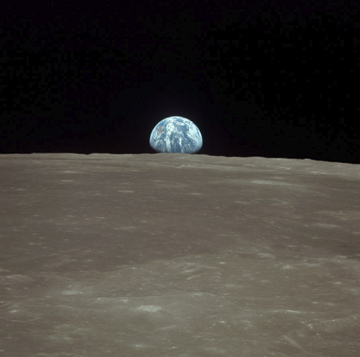
In 1957, the Russians launched Sputnik, America was shocked and the space race was on. In 1961, America was jolted again when the Russians sent the first man into space. In response, President Kennedy set the goal to send a man to the moon and return him safely to earth by the end of the decade. It was a clear and concise goal. Our aim was to get there before the Russians. It was the height of Cold War (full of rumors and fears) and it was a vision the entire nation could share in.
 
The rest of the story is history. On a July night in 1969, Neil Armstrong and Buzz Aldrin (Light-Year), climbed down from the lunar module and stepped on the moon! “One small step for man, one giant leap for mankind.”
 
A nation cheered and the world watched in amazement.  America fullfilled the vision to go to the moon and returned safely before the end of the decade.
 
A vision represents a purpose for being. A vision says what you want to achieve. It is glue that holds things together.
 
Since the 1960’s the NASA program has stalled. Visions fall short because we lack commitment. However, today there is a new Vision to send people back to the Moon by 2018, then to Mars. Their eye is on the goal.
 
Just like there was a vision to go to space, so must Christians have a vision of how we are to live our lives. If your vision is in YOURSELF, you think only about the NOW, but if your vision is in GOD, you think only about ETERNITY. In Philippians 3:12-14, Paul talks about a vision for life that is out of this world. 
 
The Vision: Keeping Eye on Goal
Seek what is out of this world – “straining forward to what lies ahead” 
Keep first things first – “Press on toward the goal” (x2)
Look toward the Judgment Seat – Start there and work backwards; “For the prize of he upward call of God in Christ Jesus”
 
How do I keep my eye on the goal?
1. Set time aside to talk to God.
2. Write a personal mission statement. (My personal mission has been Phil.2:5 “your attitude should be that of Jesus Christ”)
3. Make a list of what you want to accomplish before you die.
4. Assess the eternal value of my personal mission statement and list to accomplish.
5. Put the Big rocks first.
6. Launch out with your eye on the goal.
 
as11-44-6549.jpg 

Stu Pididiot

Story about Stu
 
There was once a man named Stu Pididiot. He lived all by himself and took no advice from anyone. Everything he did do was already done by someone else, and anything that they did wasn’t really original anyways. Stu spent his life alone trying to figure out the meaning of life and everything. He studied really smart people, but never followed any. He found what was comfortable to him and struck with it his whole life. “Happiness,” he thought, “is what is logical to me.” In the end Stu Pididiot was still miserable and confused, and dumbfounded about the meaning of life and everything.
 
A recent poll sheds light on this paradox of increased religiosity and decreased morality. According to sociologist Robert Bellah, [81 percent of the American people also say they agree that “an individual should arrive at his or her own religious belief independent of any church or synagogue.”] Thus the key to the paradox is the fact that those who claim to be Christians are arriving at faith on their own termsterms that make no demands on behavior.
 
The man named Stu, embodies this attitude. “I believe in God,” he says. “I can’t remember the last time I went to church. But my faith has carried me a long way. It’s ‘Stu Pididiot-ism.’ Just my own little voice.”


He can do…

God is incredably awesome. So much bigger than anything or anyone. I really needed to hear this today…”Anything GOD has ever done, HE can do now. Anything GOD had ever done anywhere, HE can do here. Anything GOD has ever done for anyone, HE can do for you.” – A.W. TozerOh, how I give up so easily and too quickly. “Ye of little faith” can be my motto. Sad, but true. May your prayer for me be this week to be an I CAN DO person because HE CAN DO.

Is God for me or for Himself?

I would like to try to persuade you that the chief end of God is to glorify God and enjoy himself forever (also the historic first point of the Westminster Confession). Or to put it another way: the chief end of God is to enjoy glorifying himself.

The reason this may sound strange is that we tend to be more familiar with our duties than with God’s designs. We know why we exist – to glorify God and enjoy him forever. But why does God exist? What should he love with all his heart and soul and mind and strength? Whom should he worship? Or will we deny him that highest of pleasures? It matters a lot what God’s ultimate allegiance is to!His allegiance is utterly and only to Himself. Sound egotistical. Yes. But He has the right to be. We worship Him as He wants to be worshipped.