no “easy” path

IMG_1066_Fotor

There is no “easy” path to fellowship with Jesus.  Today I need him.  Again.  I don’t want to lay down my desire for relaxation and pleasure in order to gain fellowship.  I’d rather have my cake and eat it too.  But, it just doesn’t work.  It takes faith to get back down on my knees and believe that my Father gave me limitations in love.  He gave me weakness and tiredness – not as punishment, but as reminder.  “There is only so much I have planned for you in each day.”  Why don’t you seek my face for wisdom so that you can rejoice and not feel guilty at the end of the day?

Sometimes it doesn’t feel exciting to seek God’s face.  It feels tedious.  That is a lack of faith in my heart.  I don’t believe what he has “planned for today”  can be all that much more exciting and meaningful than the laundry and diaper changing he had “planned” for yesterday.  That is a lack of humility in my heart.  And, after awhile my pride doesn’t like feeling bombarded by these flashing neon signs that come on when I get on my knees: “You’re a doubter!  You aren’t humble! How do expect to get anywhere in your relationship with God, I mean really!”  And I can cling to my flesh or crucify it.

I crucify it by using the word of truth which is a sword.  “My God says that a sparrow doesn’t fall to the ground without His noticing, so he notices that I feel tired. My God says that ‘Blessed are those who are broken and contrite in heart for He will not despise them. Come to me all you who are weak and heavy laden and I will give you rest.”  Show me, God, how to come to you.  I believe that Your joy – even the joy you have over my life – gives me strength.  You rejoice over me with songs.  You might even dance.  One day soon I will be with you and you will wipe away every tear.  Hallelujah.

You have come to overcome the world.  You have poured out your blood to make an end to death.  You have risen and erased the accusation of the accuser.  You are God and you are good.  Hallelujah.

Come, and be my shepherd.  Here, I give you my frail heart.  Oh, be careful with it, won’t you? Give me strength to seek your face.  I can’t do it enough.  I can’t offer the quality you deserve.  I can only ask you to make me into something that will please you.  And you have.  How I long for that first look and touch of yours.  And then – forever.  All will be done except for goodness.  It will go on and on and on.  Hallelujah.

Jacob: coming home [part 1]

Have you ever been away from home for more than a few months? Or long enough that you miss home sweet home? I have. I remember going to college in West Virginia and being a long way from my family in Wisconsin. I did not get home other than Christmas or summer breaks. After final exams, I would hop into my car and sometimes drive through the night to get home. The last hour always seemed the longest. I was so close, but not there yet.

Jacob must have felt the same way. He had just met his brother on his way home. He reconciled their relationship, which was mangled by lies and deceit. Now after 20 years away from home he can almost see it. He can taste in his mind his mothers home cooked meals. He can smell the farm. He can hear the breeze that carries his father’s voice. Jacob was so close, but not home yet. He decided to settle in Schechem. However, his decision to stay there was as devastating as Lots decision to stay in Sodom rather than traveling on to Bethel [cf. Genesis 13-14].

Jacob’s journey of faith has not ended. The last hours before coming home are still yielding lessons of faith. It is a reminder to all that God is not done with you until He is done with you.

Jacob’s faith has dramatically changed [cf. Genesis 32–33], but his son’s faith would remain nonexistent [Genesis 34]. They were deceitful [34:8–24], murderous [34:25–26], greedy [34:27–29], and proud [34:31]. There were probably characteristics passed down from their parents. However, despite Jacob’s new faith, new name, and found distress over his son’s bad behavior [34:30], Israel could not change his boys. God would have to bring them to a crisis of their own, as we will see later.

Jacob had eleven sons and only one daughter named Dinah. One day Dinah went out to visit other women in the region her parents lived. While out and about the son of the man who ruled that area saw her. He wanted her, but could not have her legitimately. Therefore he raped or seduced her. His act defiled and took her virginity dishonorably. To make matters more complicated he was pagan and he desired to marry her. Intermarriage between believers and unbelievers is condemned throughout Scripture.[1]

Jacob kept the situation a secret until Dinah’s brothers came home. Like protective brothers, they were grieved, disgusted, and furious over the vile action done by an idolatrous man. Dinah’s brothers devised a plan to seek revenge by creatively using the covenant of circumcision [cf. Genesis 17]. Like father like sons these boys learned to be tricksters. They told the men of Schechem a strategic lie, “You can happily intermarry our women and share our great wealth, but you will need to be circumcised.” The men were determined to get beautiful foreign women as brides that after three days all were circumcised.

Two of Dinah’s brothers, Simeon and Levi, were perturbed by men’s swift response. They were certain they would not buy into their plan. So out or rage and intensified revenge they strapped their swords to their sides and entered Schechem to slaughter every man and deliver their sister home safely all the while they looted the entire city, taking all the women and animals. Seeing what his sons had done, Jacob rebuked them for putting his family in danger of attack from the surrounding Schechemite allies. However, the brothers replied praising their heroics and took sides with their sister saying, “Should he have treated our sister like a prostitute?”

Why didn’t Jacob do anything? Is he a passive father? First, it is clear that Jacob hated his wife Leah, and Dinah was the daughter of Leah [30:19-21]. Jacob’s silence and indifference during her defilement indicates that he was not much of a loving father. Second, Jacob’s leadership was filled by the devious plans of his sons. Third, Jacob’s response to his son’s question has a selfish overtone that states on only “me” and he makes no mention of his poor daughter. Like his forefathers we see his imperfection after transformation—we see yet another mini-fall not unlike Adam, Noah, and Abraham. However, in God’s gracious sovereignty He uses Jacob’s sin for His purposes and preserves the line of the covenant family from intermarriage with the Schechemites through the murderous actions of Simeon and Levi.

Faith is not inherited paternally, but only through a decision personally.

Also, this is a reminder that faith—unlike the temporary blessings that passed from Abraham to Isaac to Jacob, and then to Jacob’s sons—is not passed down genetically. You cannot be born a Christian. Even though you may have godly parents, be part of a great church, and have good Christian friends you still have to encounter Jesus yourself. God encounters people individually, and people must place their faith in Him individually. Like their father, Jacob’s sons committed their own sins and like Jacob they would have to make God their own God. You cannot inherit faith; you must get it from God. There is no other way.

This journey home for Jacob is a rough road that paves the way for a future of faith in God’s promises. He is not there yet. Likewise God is not finish with you either. The pressures of life and family struggles are opportunities for you to trust in the promises of God. Next week we will see more about how God keeps His word and journey with Jacob to his home sweet home.


[1] Abraham was worried that Isaac would marry outside of the covenant as Ishmael had (Genesis 21:21, 24:3-4), and Esau’s intermarriage with the unbelieving Hittites which was a source of great trouble (Genesis 26:34-35, 27:46, 28:8).

journey of faith

Have you ever been on a road trip when you got lost taking a wrong turn? I remember back in college after finals I drive home for the holidays. Back then I did not have a GPS or cell phones. I had a few college buds with me along for the ride via Chicago. I drove while the 13-hour trek while the one sitting shotgun navigated with an old Randall McNally map. When we reach Indianapolis we got on the I-465 beltway. It was sometime after midnight, we were getting tired. With the windows cracked, Mountain Dew running through our veins, the music cranked to DC Talk, and sunflower seeds all over the car seats we made our way around the beltway. I do not think any of us were paying attention to the road signs and detours because of the construction on the beltway. We missed our exit. For the next 2-hours we drove around and around the Indy beltway before we realized that we were just going in circles.

I am sure you have been there, right? Sometimes life can be like that too. You seem to be going somewhere and then you find yourself lost, spinning in circles, and delaying the journey. Life is a journey, especially if you are living a life of faith. Abraham is on that journey of faith. His journey of faith might not be that much different than yours.

DIRECTION FROM GOD FOR THE JOURNEY: A Call to Faith [Genesis 12:1-9]

God calls Abram out of a sinful people and nation to go to a place he does not yet know. As Abram goes, God makes a promise to him that He will make him a great nation. At this moment Abram is 75 years old, without an heir because his wife is barren, and attached to his father’s possession. Abram does know how God is going to fulfill His promise, but in faith he goes. When he reaches Canaan [a dead end for a nomad] he sets up an altar of worship for God will give him this land. As Abram and his family settle in the land they face a series of obstacles that from the human perspective seem like major detours.

DETOUR #1: Making up your own story is not part of God’s story [Genesis 12:10-20]

As Abram settles in Canaan, another challenge arises for Abram and his family. There is no food. So Abram, being the man of his house, takes action and heads south to Egypt. Afraid that he will lose his beautiful wife he crafts a story, “Sarah, babe, those Egyptians are going to think you are a smokin’ hot! Surely they will kill me to get you. Let’s pretend you’re my sister.” Lying is never part of God’s plan; truth is always the best option. Truth is part of God’s plan.

Indeed, when Abram and Sarai roll through town, Pharaoh’s prince’s gawk at Sarai—like men whistling at a passing girl next to a construction sight. They ran back to the palace bragging about her beauty to Pharaoh. And what Pharaoh wants, Pharaoh gets. Lucky, for Abram, Pharaoh is feeling particularly nice and spares Abram’s head. Unlucky for Pharaoh, he and his house get stuck with a plague. Knowing something is wrong he calls for Abram, “You have some explaining to do? Everything was groovy around here until you can around. Is there something you want to tell me about this woman? Why did you lie to me?” God had his hand on Abram. He should have been executed for lying to the ruler of Egypt, but God had grace on him through Pharaoh. Abram must have learned a valuable lesson that day: speak the truth and let God deal with the possible obstacles.

DETOUR #2: Sometimes the most obvious choice is not the right choice [Genesis 13]

I am not sure Abram and Sarai did much talking on the way home from Egypt. So Abram worships at the altar [13:4, maybe seeking forgiveness; cf. 12:8] and then goes back to work with Lot among their herds. Both men have large herds. Their herds are so large that their workers were not getting along [over turf, pooper scooper duties, etc.]. As a peacemaker, Abram asks Lot to leave, but gives him first choice of the land. Lot chose the greener grass, eastward [towards Sodom].

I am sure this was a hard decision for Abram. God gives him a nephew—possible heir—but they are forced to separate. Could Lot be the seed God was promising? According to Abram, the choice was not working out as he planned. He sits and sulks about his conflicted family separation, but God is working out His plan. In fact God says to Abram, “Lift up your eyes and look from the place where you are, northward and southward and eastward and westward, for all the land that you see I will give to you and to your offspring forever. I will make your offspring like the dust of the earth [i.e. countless], so that if one can count the dust of the earth, your offspring can be counted. Arise, walk through the length and the breadth of the land, for I will give it to you.” [13:14-17; cf. 12:7] God has a different choice for Abram’s seed in mind, but He also reaffirms His promise to Abram it will happen,

DETOUR #3: Expect unexpected challenges with unexpected results [Genesis 14]

A great war breaks, Lot’s city is taken captive, and Lot becomes a prisoner of war. Word gets to Abram through an escapee, and he pulls together 318 of his own men who are trained warriors. This gives you an idea of the wealth of Abram that he had his own personal army and defeated those holding onto Lot. Abram was not alone in this battle. He ultimately won this battle by the blessing of God who promised to protect him and curse those who cursed him [cf. 12:3]. Abram then praised by kings [i.e. Melchizedek, more on him next week] who also recognized that it was God who won the day [14:20].

COURSE DIRECTION FROM GOD: The Seed will come from through Abram [Genesis 15]

Following these three divine detours God sheds some light onto the path for Abram. God tells Abram in a dream that the promised seed would come through his seed. There is just one major problem: Abram has no children and he’s really old. Notice For the first time Abram speaks up, and asks God a question, “What about Eliezer?” God responds and reaffirms His covenant with Abram, “I will not use Eliezer [a non-related heir], but one of your own children.”

Again, with radical faith, Abram believes God [15:6; cf.12:4], and God “counted it to him as righteousness.” Genesis 15:6, becomes central to Paul’s doctrine of justification by faith [Romans 4:3; Galatians 3:6]. Also, James quotes this verse to teach that true faith in God results in good works in life with God [2:23-24]. God’s covenant with Abram was confirmed with a sacrifice and the shedding of blood, which foreshadows the New Covenant confirmed with Jesus’ sacrifice of His own life on the cross and the shedding of His blood.

DETOUR #4: Ignoring the possibility of the impossible [Genesis 16]

Sarah is not mentiond in the promise [cf. 15:1-6]. Abram does not even consider Sarai. Sarah is old and barren, and too old for it to be humanly possible for her to carry a child. They had waited a long time on God to come through with His promises. What options did Abram have? Taking matters into his own hands, he logically concludes that Hagar—one of his servant girls—is a prime candidate to carry his seed. Of course, Sarai spearheaded the faithless idea. So Abram slept with Hagar and she bore him a son [Ishmael, the son of Islam].

Is Abram immoral? Is he doing what he thinks God wants him to do? Impatience on God is never right the option.[1] If you are unsure waiting on God is always the best option. Ironically, Sarai bitterly blamed Abram for the split in their family because he slept with Hagar, and Hagar flees from the Sarai’s fury. Again, God intervenes.

COURSE DIRECTION FROM GOD: God gives a sign and specifics to His covenant [Genesis 17:1-18:21]

God reaffirms who He is and how He will fulfill His promises through Abram. Abram immediately worships [17:3, maybe seeking forgiveness; cf. 12:8; 13:4]. First, God confirms his covenant by giving Abram a new name and give a symbol for the covenant between God and Abraham, circumcision.[2] Second, God confirms his covenant with Abraham through Sarai by giving her a new name and saying the promised seed will be born through her barren womb. In one moment, God’s promise becomes very specific to Abraham and Sarah. And with a miraculous divine intervention God will open Sarah dead womb at 90 years old and give her a son who will be the living Seed of Promise [cf. 21:1-7].

DETOUR #5: Failing to see trials that purify your faith [Genesis 19-21]

In short, God sends His wrath upon Sodom and Gomorrah for their perverse sexual sin, which leaves a salty crater where the cities once stood [Genesis 19]. Lot and his daughter are not much different than the community he lived and farmed [19:30-38]. Again, Abraham lies and gives Sarah away to another man, almost identical to the situation with Pharaoh [20:1-18; cf. 12:10-20]. God in His grace and sovereignty intervenes preventing Sarah from getting pregnant by another man. Then tensions stir between Hagar son, Ishmael, and Sarah’s son, Isaac. Ishmael is the one favored by everyone in the passage, except Sarah; however, God does not favor him in relationship to the covenant promise, but cares and provides for him. These detours are looking more like construction zones where God is at work growing your faith.

FINAL COURSE DIRECTION FROM GOD: God uses sacrifice as the proof of faith [Genesis 21-23]

25 years after the promise and nearly losing his wife twice, God gives Abraham and Sarah a son. He finally has his boy. They name him, Isaac, meaning laughter, which is fitting for a boy born from an old lady. Isaac is the promised seed. However, in a climatic twist God tests Abraham’s quarter century churned faith. God asks Abraham to sacrifice his one and only son.

Up to this point in the narrative, Abraham has seen God fulfill promise after unbelievable promise and made a womb that was dead-dead alive. Echoing his call [12:1-3], he immediately responded in faith. Was he really going to kill his son on the altar? I think so. I think he knew God would raise his son to life because He has already done it through Sarah’s dead womb.

God answers by providing a sacrifice caught in the thicket. In doing so He fulfills all His promises just as He said. What about the land? The last promise that we do not see fulfilled is the land promise. In an obscure way, Sarah’s small and insignificant burial plot was the only property Abraham own in the Promised Land [Genesis 23]. The land that was promised to his heirs would not arise as a nation until God would call another man, Moses, who would take God’s people to the Promised Land [cf. Exodus & Joshua].

In Hebrews 11:8-12, Abraham went where God asked, even though he did not know how God would work it out, but his faith believed God would work it out. God blessed his faith then and offers it to you now through His Promised Seed—His Son—Jesus Christ. The story that climaxes with Isaac, ultimately climax with Christ:

  • Isaac and Jesus were both sons promised many years before their birth.
  • Isaac and Jesus were both born to women who could not have conceived apart from a miracle.
  • Isaac and Jesus were both firstborn sons.
  • Isaac and Jesus were both loved by their father/Father.
  • Isaac and Jesus both carried wood to their sacrifice.
  • Isaac and Jesus both willingly laid down their lives to their father/Father.
  • Isaac and Jesus both laid down as a burnt offering for sin.
  • Isaac was resurrected figuratively and Jesus was resurrected literally.
  • Isaac was just a man, but Isaac was the God/Man who came to save mankind.

[1] Abram marries Hagar while married to Sarai. The result of this polygamy is truly tragic, as is the case with other instances of adultery and polygamy in Scripture. God’s intention is that each man would have one wife [Genesis 2:18; Matthew 19:4-6]. The first man to take more than one wife was the godless man Lamech [Genesis 4:19-24]. Two women is two too many. Polygamy is wrought with favoritism, fighting, jealousy, and mistreatment [i.e. Genesis 25:28, 27:1-45, 35:22, 38:18-28; 2 Samuel 3:2-5, 13:1-29, 15:1- 18:33; 1 Kings 11:1-4]. In the New Testament church elders serve as the pattern for Christian families are to be one-woman-men [1 Timothy 3:2,12].

[2] It is uncertain why God chose circumcision as the sign of the Abrahamic Covenant. Possibly the seed comes from the male organ and/or Headship is an important concept to God. God used symbols to convey his covenant with mankind [i.e. a rainbow was a sign of covenant between God and Noah; Genesis 9:14]. Throughout the rest of Bible the concepts of covenant and circumcision are built upon to include Christian who are the descendants of Abraham by new birth. Circumcision points to the circumcision that God brings to our hearts through His covenant relationship with us [Deuteronomy 10:16, 30:6; Jeremiah 4:4; Ezekiel 44:7-9; Romans 2:25-29; 4:1-12; Colossians 2:11; Galatians 3:6-8].

the call of Abram

A few years ago Sarah and I began to grow a garden. Gardens do not just grow over night by mere happenstance. You have to till the ground, plant seeds, water, and harvest. It takes work and a lot of initiative. In Genesis 12, God takes the imitative to nurture the seed of humanity; He readies the land and blesses the growth. He does it all through an ordinary man named Abram.

An Unexpected Call: God intersects with man [Genesis 12:1-3]

Can you image the day, Abram is out in the field tending to his herds and he hears a strange voice calling to him. Remember, God had not spoken verbally His covenant with Noah. It is God, again, who initiates a covenant relationship. Like Noah, Abram was a sinner living with sinners, but found favor [grace] in the eyes of God from among all the scatter people on the earth.

What was God calling Abram to do? First, Abram was called to leave the land that he was used to traveling around. Second, he was to leave his family and specifically his father’s house. Third, he was to go to a strange land that is not specifically named. God simply calls Abram to leave his homeland to journey to a new land that God would show him. Do you sense the radical measure of this call and the details left out? Put yourself in Abram’s sandals. How would you respond to such a radical call?

Why was Abram called to do something so radical? God promised to bless Abram’s faith and obedience beyond just him and his tribe. Abram was called by God to become the father of a new nation, become an example of living faith, and become one of the Bibles most mention patriarchs of Gods promise [i.e. over 300 times in the OT & NT].

Here in this short, three verse—text message sized—call, God rehearses some of the major themes of Genesis. First, God promises land [12:1b]. Second, God promises seed [12:2a; cf. 4:25-26; 6:5; 9:20ff; 11:4]. God says later his seed will be like the dust of the earth [13:16; 28:14]. In a real sense God promised Abram he would be a father and through his son a great nation blessed by God would be a blessing to all nations.[1] Third, God promises blessing [12:2b; cf. 22:17; 26:3; 28:3] of His presence, protection and covenant. Fourth, another theme arises that has not been mentioned until now, nation [12:3; 18:18; 22:18; 26:4; 28:14]. God promises to make Abram’s name great,[2] which ironically is the same thing the Babylonians failed to achieve for they pursued it apart from God.

Abram Answers the Call: a faith that grows on [Genesis 12:4-9]

You don’t see a long deliberation in between the call of God and the answer of Abram. You do not see him lying in his bed at night thinking about his conversation with God, or talking with his wife over dinner, or asking God some clarifying questions like, “Where did you say I was going?” The amazing fact is: Abraham believes God and goes [12:4]. No questions. No hesitations. He goes, in spite of leaving everything he knew behind and not knowing specifically how God was going to do all that He promised. It is as if he says to God, “Alright, God, I’ve got nothing else to lose.” At 75 ears old, a guy who at his age should be enjoying retirement and grandchildren takes his wife, their household, and his Nephew Lot to an unknown land.

This is the first step of faith in Abram’s life. It is a step that will affect not only him but also all of mankind. God will use Abram’s mustard seed sized faith. Have you ever been where Abram is in your life?  You decide to trust God, doing things His way, even in the face of the impossible. Abram starts off his journey with faith. No excuses, like “I forgot to lock the front door honey?” No turning back to feed the goats and camels, he takes them all with them.

As Abram goes, he comes to a land where people are living; a brick wall for a nomad. What does Abram do? Does he decide to go back home deciding this must be a dead end and not a part of God’s plan? No. Abram reacts by trusting God. He owns his faith and praises God on this blind journey of faith. His faith in the One True God is coming alive. For the first time Abram is offering praise to a God who speaks and is loyal to those trust in Him. He dedicates the land to God [cf. Leviticus 20:22-24; Psalm 72:8, 17-19]. By worshiping Abram is saying, “There is no other god, but You!”[3]

From this point forward, the lens of Genesis focuses in on the descendants of Abram as God’s covenant people raised up to be blessed nation and a be blessing to all other nations and people who follow. If you contrast Abram with Babylon, both the story, which preceded his call and the city that was the location he was called from [Genesis 11]. The Babylonians sought to be a great nation, blessed people, and great in name, but they pursued this apart from faith and apart from God. So, God called one of them, Abram, out from the land and into covenant with Himself and promised to give to Abram all that the Babylonians had strived for by His gracious provision. Therefore, God is demonstrating that our hope is not in the efforts of sinners who save and bless themselves, but only in entering into covenant relationship with God by faith.

What lessons about faith do we learn from Abram? How does his faith point us to Jesus?

First, your obedience to God is always connected to your faith in God. If you trust God you will obey God. The more you obey God the greater your faith will grow. Though Abram’s faith is incredible it is not complete. Only Jesus’ faith and obedience were complete.

Second, any time you obey God expect opposition through seeming dead ends, speed bumps, or foggy roads ahead. Faith helps you press on when the road ahead is hard or uncertain. The disciple’s obedience led to persecution [Matthew 5:3, 5, 10]. Jesus obedience led to a suffering cross.

Third, God calls ordinary people to carry out His extraordinary plans. Abram was a sinner, but God’s grace was upon him. The covenant promises carried out by Abram’s faith point to the New Covenant in Christ.

Finally, the seed of Abram that will bless all nations points to Jesus, the promised seed, who will redeem the sinfulness of mankind [Matthew 1:1; 24:14; Romans 4:13]. Those who obey and have faith in Him will live with him in the Promised Land in the Eternal Kingdom [Hebrews 11:10; Revelation 22:1-4].


[1] This promised seed is singular, which points to Jesus [cf. Genesis 3:15; Matthew 1:1, 1:17; Galatians 3:16].

[2] Abram was also told he would that his descendants would receive the Promised Land if he in faith go from the land God called him to. Reaching the Promised Land was not fulfilled in Genesis because Genesis ends with Joseph requesting his bones to be taken from Egypt to the Promised Land in the day that God’s people finally entered that place. Also, Exodus ends with the expectation that one day the Promised Land will be entered [Exodus 40:34-38], which is not realized until after the death of Moses [cf. Joshua 1-4].

[3] Abram responds by worshiping God in faith by building an altar other times in Genesis [12:7, 8, 13:18, 22:9].

the role of the sent one

BRIEF HISTORY OF THE HUTTS: Before coming to BGBC, I spent a year in South Africa doing a church planting apprenticeship. There I gained a vision for the church, church planting, global mission, and a heart for Africa. Coming to BGBC I sought a church that loved church planting and global missions. It has been a joy the last 8 years to watch this church with a long history of missions-mindedness send out missionaries to the foreign field. Sarah and I will be the next ones sent out from this church.

BRIEF HISTORY OF SENT ONES IN THE NT: We see 4 examples of churches in the New Testament that sent people out for Christ’s mission. First, Jerusalem was hub of the first church where gospel preaching, fellowship, and suffering together led to remarkable growth and expansion of the church. Second, Antioch a hub of missions to the north and west because the church was well-mixed ethnically and well-led spiritually. Third, Philippi was a church that financially supported and encouraged Paul. His letter to them is more of a thank you letter for their support. Paul brings up an important principle in the mission of the church: the mission is a partnership in the gospel. Finally, we see a community [near Ephesus] tucked away at the end of the Bible in 3 John.

BRIEF HISTORY OF JOHN AND THE SENT ONES: The church to which the apostle John wrote seems to have problems and divisions [what church doesn’t?]. John sent messengers of the gospel to the church and they were met with a mixed reception. Gaius welcomed and supported them [vs.1-5], while Diotrephes [a self-appointed leader; false teacher] thwarted and evicted them [vs.9-11]. 3 John could be a case between two types of missionaries. I will place most of my emphasis on Gaius. What John says to Gaius is informative and is a biblical model for what [TO ME] is the mission of sending out.

1) SENT ONES ARE SENT OUT THROUGH THE CHURCH [3 John 6]

The church is the hub of Jesus’ missions. Missions and sent ones must be doing ministry through the church, for the church, by the church, in the church, because of the church, for the sake of Christ’s glory who is the Head of the church. If sent ones are doing anything other than planting the church, they are parachurch [i.e. alongside the church; orphanage, bookstores, seminaries, etc]. Sent ones are faithful to the mission of the church.

3 WAYS FAITHFUL FOLLOWERS ARE SENT OUT:

By the Holy Spirit. According to Acts 13:1-3, the Holy Spirit of God sends out qualified servant-leaders from local churches to plant new churches in new lands. God’s Spirit gives witness of this calling both to the sent one and the sending church. In recognizing how God wants to use the sent one, the church then “releases” them.

Through the call of Christ. In John 20:21, Jesus says to all his disciples, “As the Father has sent me, so I am sending you.” Jesus was sent into the world to become the Savior. You are sent into the world to proclaim what Christ has done and call people to faith in Him. Therefore, every Christian should evangelize locally and, if possible, support the work of bringing the gospel globally.

Through local churches. The local church, again, is the vehicle God uses to send out people to preach the gospel with the goal of establishing new local churches wherever they go [Acts 13:4-5; Acts 14:21-23]. This means that local churches are responsible to raise up, send out, and support missionaries whose goal is not merely to see individuals come to Christ, but to see local churches established in regions where there are none.

The church “does well to sends them on their journey in a manner worthy of God.” What does that mean? It could mean cutting them checks, it could mean having a beautiful commissioning service, or waving good-bye at the airport. However, I would hold that it means more than that! To send one in a manner worthy of God is to support them in such a way that God would approve: Arrange all hospitality with lodging and meals while home [Romans 15:24; 1 Corinthians 16:6-11; 2 Corinthians 1:16], offer transportation and accompaniment [Acts 20:38; 21:5], and freely give resources and encouragement [Titus 3:13; Acts 15:3]. Servants of Christ should be treated like we were sending Jesus on His journey. When a missionary calls your church asking for support do you hear their story, encourage them, and pray with them even if you know you cannot support them financially? You do well to send them on their journey in a manner worthy of God.

2) SENT ONES GO OUT FOR THE SAKE OF THE NAME [3 John 7]

Most missionaries tend to be Type-A kind of people. When sending out people from your church aim to cultivate character over mere skills. The person you are considering might be gung-ho, super-skilled, have a sweet resume, look like leadership-material, wears Christian T-shirts and is quite evangelistic, but he or she could be corrupt in their core. Spend time with them in the testing fields, before you unleash them to the mission field. Sent ones spent a long time with their sending church serving [Acts 18:22-28].

ESSENTIAL EXPECTATIONS [AS ONE BEING SENT] CONCERNING HOW MY CHURCH PREPARES ME:

Surrendered.  Look for one overwhelmed by their own salvation, committed to Christ, consumed by the message of His gospel, and championing the One Name [Philippians 2:9; Romans 1:5; Acts 5:40-41]. Period. [Galatians 2:20; 6:14; Colossians 1:24-27]. The power, authority, and glory for the mission is in the name of our Lord Jesus Christ!

Servanthood. Do they choose the towel over the robe? Giving one a robe is a special honor [Luke 15:22]. When one was given an important task or office they received a robe. The disciples often aspired for the robe, but Jesus sought the towel [Matthew 20:20-28]. The greatest missionary is a one who takes the position of the least [Luke 22:24; Matthew 20:26]. Sent ones are servants of Christ first and foremost.

Humility. This is the posture of a servant. They “accept nothing from the Gentiles.” This was not arrogant humility or false humility; rather they only accepted support from Christians and churches that understand the mission. Humble servants understand the results in ministry come from God, not from the human instrument. “I planted, Apollos watered, but God gave the growth. So neither he who plants nor he who waters is anything, but only God who gives the growth” [1 Corinthians 3:6-7].

Full of Integrity. God expresses far more interest in what we are than in what we do or where we go. Here are some good questions to pry into the life of new or old missionary: Are they financially responsible? Are they pure of heart and mind? Do they have a pattern of good relationships? Do they deal with conflict biblically? Are they faithful to their family? Ministry should not destroy the family and the family should not destroy ministry. Integrity is important at home, work and the ministry. Since, distance makes it easier to hide, as one sent, I am responsible to be proactively communicating with my sending church with openness and honesty.

Faithfully Bearing Fruit. [vs. 3-4, faithful to the church & others] If someone wants to evangelize in China, are they already evangelizing Chinese people? If someone wants to be a Bible translator, are they already studying the biblical languages? Sending someone out to minister on behalf of a church is a serious matter. “So then, men ought to regard us as servants of Christ and as those entrusted with the secret things of God. Now it is required that those who have been given a trust must prove faithful” [1 Corinthians 4:1-2]. In Acts 13:1-3, the church sends out only those who have proven themselves in godly character and ministry effectiveness, who are sound doctrinally and equipped for ministry, who show the fruit of the Spirit, and who have remained steadfast under trial. Consequently true success in missions is measured by faithfulness to the task, not by immediate, visible results.

Biblically Minded. A missionary will face all kinds of new challenges and unorthodox beliefs/worldviews. He or she will need to be able to confront these unexpected challenges biblically. Sometimes they return from the field tired, discouraged and depressed, and a biblical framework would be helpful. Also, on the field, exegetical skills are important for training church leaders, counseling, planning, team working, evangelizing, discipling, spiritual warfare, and so much more.

Love for the church. According to the Scripture there is no such this as a rogue missionary, Lone Ranger Servants, Christians Tourists or Commercial Travelers/Charlatan. The missionary represents the church and its mission. A sent one should willingly submit to the elders of the local church that sends him [1 Peter 5:1-5; Hebrews 13:17], and more importantly they submit to Christ who is over the church [Ephesians 5:21; 1 Corinthians 11:3]. Remember, missionaries are sinners too. They need accountability and counsel. It is important the missionary be a member of the church. Not just a member, but also an active member, a fruitful member, and a theologically and methodologically minded member. Your sent one is part of the mission of your church, planting like-minded churches through your church.

3) SENT ONES HAVE THE SUPPORT OF THEIR SENDING CHURCH [3 John 8]

“We ought” is rather weak. It would be better translated, “we are obligated to support people like this.” The church and the ones they send are partners [i.e. fellow workers] in the gospel of Jesus Christ [i.e. truth]. Therefore, together we must do all we can to support one another in the growth of the church and the continuance of the gospel message. It is not about what the church does for the missionary, but what it does through the missionary. Likewise, It is not about what the missionary does for the church, but what he does through the church.

In conclusion, as one who is being sent from the church I recognize first of all that it is the church that sends me out. Second, I must go out for the sake of the name and no other. My character as an ambassador of Christ and representative of His church seriously matters. Third, I must encourage the support [receive] and be willing to support [give] the church sending me out. Together, the sent one and the senders lift high Christ and His church.

This is how we do missions as a church. John helped start all these churches, and then, he sends people and money to go to those churches to get more people and more money to go start yet more churches. When they are up at that church, who greets them? Gaius, Gaius is the guy that John will send a letter ahead and say, “I’ve got Missionary Mike and I’ve got Servant Sally and I’m sending them down, and they’re going out from Fellowship Bible Church, and they’re going go plant New Bible Church, and here they come, and Gaius, you know they’re coming.”

So then, Gaius waits, and here comes Mike and his wife, and they show up, and Gaius says, “Hey, good to have you. Come stay at my house. Have some soup. You guys need money? Let me get my checkbook. How can we be praying for you? My Bible study gets together every week, and if you could let us know what to pray for, we’ll pray for it.” That’s Gaius. Gaius gets behind their work, and is really happy to be involved, and John says why, “So that we may work together for the truth.”

Don’t be a Diotrephes.

Let’s go Gaius!

don’t waste your sports

Most people love sports. Its ingrained within the fabric of our American culture. Sports are in the Bible. The Apostle Paul spoke about sports regularly in his letters to Christian churches.

If you enjoy playing sports, watching sports or have a child that plays sports you need to take an hour and sit down with your family and watch this video. See what God and the Bible has to say about sports. C.J Mahaney says, “I had the opportunity to glorify God in my sports and I fumbled it. I wasted my sports. You have the opportunity, by the grace of God, not to waste yours.”

For more information, including an MP3, visit DontWasteYourSports.com.

your faiths firm foundation

What do these names have in common? Marilyn Monroe, Frank Sinatra, John F. Kennedy, Abraham Lincoln, Babe Ruth, J.R.R. Tolkien, Beethoven, Mozart, Elizabeth Taylor, and Michael Jackson. The only thing in common among all the names is that they are all dead. Now if I were to add the name “Jesus” to this list would it change your answer? Jesus died, but He didn’t just die—He conquered death. He conquered death through His resurrection.

There are many modern attacks on the truthfulness of Christ’s resurrection. Have you watch documentaries on the Discovery Channel or History Channel that dispute the facts of the resurrection? There are also many books like The God Delusion [Richard Dawkins], God is Not Great [Christopher Hitchens], or the popular book The Da Vinci Code [Dan Brown] that do not buy the idea of the resurrection of Jesus. Some people think Jesus disappeared to Hawaii where Elvis, Hitler and JFK are all hiding out in a bunker playing poker. Others seem to think that Jesus was swooned or asleep; He couldn’t have been dead and then resurrected.

How would you address theses attacks? What difference does it make if Christ had a bodily resurrection? Without a bodily resurrection all of Jesus’ claims would be false and followers of Christ would have no hope of eternal salvation. His resurrection is the foundation of the gospel and your faith. Without the resurrection of Jesus Christ, Christianity and its core truth claims would not hold any weight nor would your faith. Paul faced a similar situation with the church that he planted at Corinth.

You can have complete confidence in the reality of Jesus & His message [1 Corinthians 15:1]

Gospel. What comes to mind when you see that word? Gospel literally means “good news” or “breaking new.” Before discussing the good news, let’s discuss the bad: You deserve death; there’s nothing that you can do to earn salvation because sin condemns you to eternal death and separation from God. But the Good News is the gospel!

What is the gospel? The good news is that God loves His creation so much that He came down from heaven for you [Philippians 2:5–11], lived for you [John 14:19], died for you, and rose from the dead for you [Romans 4:25]. And if you respond through repentance of sin and have faith in Christ, He blesses you with eternal life [John 3:16]. Paul says that you must “take your stand” on the gospel. What does he mean? You must base your life on its truth [cf. 15:58]. By taking a stand for the gospel you are demonstrating confidence in both the Messenger and His message.

You can know the reality of the gospel because you can experience it now [15:2]

When Paul said, “by this gospel you are being saved,” he wasn’t speaking about something just in the past but something present too. The idea that one is “being saved”—while salvation is instantaneous—means you can still experience the power of the gospel on a daily basis. How is your life different since you became a Christian? Today you can experience the gospel in your decisions, your relationships, your school activities, your work, and your life—right now. The gospel not only changes your future destiny, but your present realities.

What do you think Paul meant when he said, “Otherwise, you have believed in vain”? He was emphasizing that true faith endures over time. In Hebrews 3:14 it says, “For we share in Christ, if indeed we hold our original confidence firm to the end.” An enduring commitment to the gospel shows genuine faith in Christ. Real followers of Christ do not give up when life gets hard, or doubts come like a flood, or you just don’t feel like following today.

Your faith has significant evidence for the case of the resurrection [15:3–8]

The detective shows on TV [i.e. NCIS, Monk, Psyche, etc.] solve cases by following evidence and eyewitnesses, and that’s what Paul did too—he followed evidence of the dead and of the living. When Paul referred to the witness of the dead; he read the prophets from long ago who foretold what Jesus would accomplish. Can anyone say with confidence who will be the president of the United States in 20 years? Who will be the hit band or movie star in the year 2145? Prophets foretold in detail Jesus’ birth, life, death, and resurrection hundreds of years beforehand.

Fulfillment of Old Testament prophecies: Genesis 3:15 (the seed of the woman will crush the serpent), Genesis 12:3 (the seed of Abraham will bless all nations), Psalm 2 (the supremacy of God’s Son), Psalm 22 (the description of His death), Isaiah 7:14 (the virgin birth), Isaiah 9:6 (the deity of the Messiah), Isaiah 52:13–53:12 (the specifics of His death, including taking on our sins), Isaiah 53:11 (His resurrection), Micah 5:2 (the place of His birth), and Zechariah 9:9 (His entering Jerusalem on a donkey). These prophecies show us that Jesus is God and Savior.

Paul adds another line of evidence—the evidence of the living. What effect do eyewitness testimonies have on a court case? It usually serves to prove or disprove an event. In 1 Corinthians 15:5–8, we see other eyewitnesses to Jesus resurrection: Peter, the Twelve, more than 500 others, James, the apostles, Paul himself. Why do you think that Paul emphasized the testimony of these eyewitnesses? Eyewitness testimony is always more powerful than secondhand information, and some of these were still alive and could tell their stories [one eyewitness could be duped, but over 500?]. Both the living and the dead come together to build a case for the resurrection of Christ.

You can have the hope of being raised from the dead, just as Jesus was [15:20–24]

Let’s say I had a mystery bag full of food. Without knowing what it was would you be willing to try it? No body wants to be the first one to try it. This is like what Christ did. He tasted death, so you would have to be afraid. His death and resurrection give you hope.

Paul calls Christ the firstfruits. This phrase has its roots in the Old Testament, usually refers to the Jewish practice of offering the first of a crop to the Lord in recognition that the entire harvest belongs to Him [cf. Leviticus 23:9–14; 1 Thessalonians 4:14–17].  During the Feast of Unleavened Bread, the priest waved the firstfruits of the harvest before the Lord, and a perfect lamb was sacrificed [Mark 14:12]. Jesus’ death and resurrection occurred during the Feast of Unleavened Bread. Jesus Christ was the perfect Lamb of God who was sacrificed to pay the price for your sins. His resurrection was a sign of the future resurrection of all believers.

Christ’s resurrection marked the beginning of a heavenly harvest of the kingdom of God. When Christ comes again, all who belong to God’s kingdom will be resurrected. How does that truth offer hope? Christ was raised, so you will be too. Death is not final for believers. Jesus said, “I am the resurrection and the life. Whoever believes in me, though he die, yet shall he live, and everyone who lives and believes in me shall never die. Do you believe this?” [John 11:25-26]

“Without the belief in the resurrection the Christian faith could not have come into being. The disciples would have remained crushed and defeated men. Even had they continued to remember Jesus as their beloved teacher, His crucifixion would have forever silenced any hope of His being the Messiah. The cross would have remained the sad and shameful end of His career.” William Lane Craig

Jesus’ bodily resurrection is the heart of the gospel. Because God raised Jesus from the dead, the hope that you have in Him is certain. The evidence for Christ’s resurrection is clear. You can be confident in your faith. Make know the reality of His resurrection as you live out the gospel.

Many times in His earthly ministry, Jesus brought hope to hopelessness. Every day, you see people who feel hopeless and need the gospel. Paul wrote a letter to the Corinthian church to remind them of the gospel. Write a letter to someone who needs to hear about the resurrection. Instead of writing what they need to do, tell them what you know about Jesus—and how the gospel has impacted you. Take ownership of what you know; write to encourage others in the gospel.

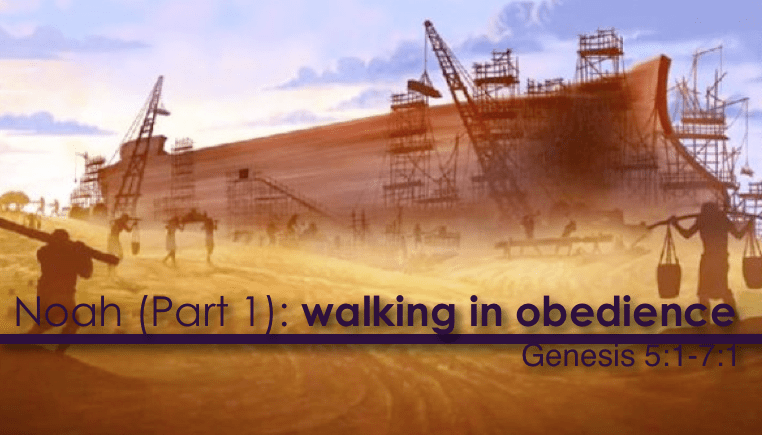
Noah (Part 1): walking in obedience

If you grew up in Sunday School as a child [unlike me] you learned silly Bible songs about characters like Noah. Maybe you sang this song, “God told Noah to build him an arky, arky. God told Noah to build him an arky, arky. Build it out of gopher barky, barky. Children of the Lord.” Now there is nothing wrong with this fun song, but it is silly for kiddies. Today we are going to take a big boy and girl approach to God’s call to Noah to build the ark.

Obedience is the very best way to show that you believe

Before jumping into the life of Noah, let’s look at Genesis 5. This is an interesting chapter in the Bible that leads up to Noah. It’s a genealogy of men from Adam to Noah. If you like tracing your family tree you will love this chapter. The chapter covers a time span of 1600 years, which is almost the same amount of time covered in the remainder of the Old Testament. The primary theological purpose of this genealogy is to show that every generation and person descended from Adam were sinners who lived and died [cf. Romans 6:23]. Notice how the phrase “and then he died” lingers and looms like a dreadful chorus through the genealogy [cf. 5:5,8,11,14,20,27,31].

This genealogy includes two curious characters. First, Methuselah, who lived to be 969 years old [5:27], which is possibly the Guinness Book world record for the oldest man to ever live. Second, Enoch, who is supposedly the only godly man w129ho lived during these generations [5:22-24]. Enoch “walked with God,” which means that he had a lifestyle of wholehearted worship and obedience to God. Enoch is the Bible’s first prophet who predicted the coming flood [cf. Hebrews 11:5-6; Jude 14-16]. Enoch is also the only man in the genealogy that did not die, but was spared from death [cf. Elijah, the only other man in the Bible that did not die]. The only way to avoid death and have eternal life is to “walk with God,” like Enoch. No better place to be than with God!

Now, we arrive to Genesis 6:1-9, which is one of the most controversial passages in the entire Bible. Here therein are posed four difficult questions: Who are the sons of God who marry the daughters of men? What is the meaning of 120 years? Who are the Nephilim? And why did God choose Noah to build the Ark?

Who are the sons of God that married the daughters of men? [Genesis 6:1-2]

Biblical scholars and theologians have argued two major opinions: First, angels had sex with women [cf. Job 1:6; Numbers 13, Ezekiel 28:11-17]. This theory collapses because the judgment for sin by the flood was upon people, not angels. Also, Jesus taught that angels do not marry or breed [cf. Matthew 22:30], and in the days of Noah people were simply marrying each other [cf. Matthew 24:37-39]. Jesus’ teaching follows the flow of context in Genesis 5 genealogy. The second opinion [that I embrace] is that the godly line of Seth had sex with attractive ungodly women. In other words, the sons of God—the line of the covenant people mentioned in Genesis 5—intermarried the daughters of men who were from ungodly families.

What is the meaning of 120 years? [Genesis 6:3]

In response to the sons of God intermarrying with the daughters of men [6:1-2], God limits their life to 120 years. There are two possible explanations for the meaning of this verse: First, God no longer allows people to live as long as they had previously [i.e. 300-900 years old] and determines that no human being would live longer than 120 years. An interesting factoid that supports this is Moses died at 120 [cf. Deuteronomy 34:7] and today the longest living people die around 120.

Second, God promised judgment by flood, but waited 120 years to give people an opportunity to repent. 1 Peter 3:20 says, “God waited patiently in the days of Noah while the ark was being built. In it only a few people, eight in all, were saved through water.” God is gracious because He gives mankind 1600 years, gives examples of people who walked with God, and gives Noah who preaches for 120 years [2 Peter 2:5]. No one repents or responds to God’s patience. 120 years gives Noah enough time to obey and build the ark, and after the 120 years the rains of judgment fell upon the earth.

Who are these huge Nephilim? [Genesis 6:4]

In short, we are do not know. In Numbers 13:33 the word Nephilim is used and also refers to an oversized race of people. This has caused scholars to speculate that the Nephilim in Genesis 6:4 are the same people mentioned in Numbers. Genesis does not say they were gigantic in size, but it does say they were gigantic in status, “They were the heroes of old, men of renown.” Therefore, the Nephilim could be a group of ungodly men in that day that reach celebrity status like the gigantic reputations given to athletes, rock stars, and media moguls in our day.

Why did God choose Noah to build the Ark? [Genesis 6:5-9]

Let’s be clear, God did not chose Noah to build the ark because he was sinless or better than the guy next to him. Sometimes teachers paint Noah to be this overly sanctified character living in an excessively wicked world. God does not just like good people and annihilate bad people. This teaching is contrary to the Bible’s story of redemption. What this introduction to Noah teaches is that every man is totally depraved. Other than Romans 1:18-27, the description of man given in Genesis 6:5-7 is one of the most sin-saturated images of man in all of Scripture. God gazes upon man’s pervasive evil and grieves that He had made man, which would include Noah and his family.

The reason God chooses to save Noah is given in Genesis 6:8, “But Noah found favor [grace] in the eyes of the LORD.” Noah did not begin his life a blameless and righteous man, “walking with God,” but he began as a sinner. The only difference between Noah and the other sinners who drowned in the flood of judgment was that God was gracious to Noah. God choose undeserving Noah to be an object of His grace. The word favor [6:9] in Hebrew means grace. This is the first time in the grace appears in word form in the Bible. Paul the apostle carries this word in his New Testament teaching on salvation by grace through faith alone. Noah was a favored because God saved him by grace and he had faith in God alone.

The joy of obedience [Genesis 6:10-7:1]

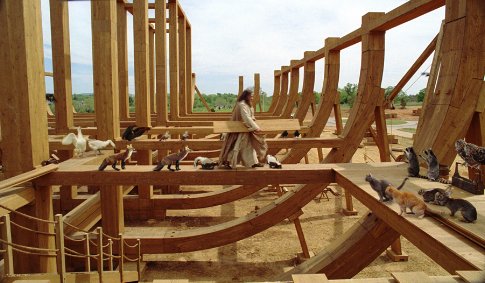
Noah believes God; therefore, God shares with Noah His plan to judge sin through a catastrophic global flood. In His grace, God will preserve Noah, his family of six, and two of each animal on earth. To house this floating zoo, Noah is commissioned to build a huge wooden boat. It is the largest wooden ocean cargo carrier recorded in history. It has space for more than 500 containers. Compare that with the modern day Maersk Triple E that carries over 2500 containers.

Noah obeyed God’s commands and built the ark [6:22], probably with only the help of his three boys. In the hall of faith, Hebrews 11:7 says that Noah did so in holy fear as a man of faith who believed God would bring the flood even while others continued in sin without repentance. After completing the construction of the ark, Noah, his family, and the animals board the boat and wait for God to fulfill His promised judgment. God’s patience towards man’s sin runs out, but His grace runs strong through Noah’s Ark.

In conclusion, through the Noah narrative we learn many practical lessons concerning obedience. First, you are called to obey God in tough times [Genesis 6:1–9]. Despite rampant sin all hope was not lost. God’s grace is still available. Second, walking closely with God develops faith for an unsure future [11–13]. Noah believed God, walked with God, and lived contrary to the evil world around him. God makes the difference in Noah’s story. Third, obeying God will often require sacrifice and hard work [14–22]. Noah obeyed by building a big boat with mocking neighbors. Scripture gives no indication that Noah doubts God or wavers in his faith, no matter how long it took or how hard it was to obey. Obedience is to walk with God through wholehearted worship.

Rain is coming. Instead of raining water, it will rain fire. A final judgment day is coming [Revelation 20:7-15], when God will ultimately deal with the total depravity of man. God did not ask you to build an ark like Noah, but He does ask you to obey in faith and bring people to the ark He provides—through His Son—Jesus Christ.

it takes a village [to build up a follower]

When I think about Old Europe I am drawn to the massive cathedrals. These marvelous monuments to Christendom took hundreds of years, thousands of man-hours, and millions of dollars to build. Dedicated craftsmen have embossed cathedrals with ornate artwork, colorful stain-glass, meaningful sculptures, and rich relics, which all add to the message of Scriptural themes. To this day these cathedrals are engineering marvels.

The church is often misunderstood and misapplied. As beautiful as these cathedrals and churches may be they are not the church. The church is not a building—it is people. The church is built up by followers of Christ displaying the glory of God and discipling one another to godliness.

The purpose of the church is quite important as it relates to the growth of the people within the church. Discipleship is often described as a one-on-one personal if not private endeavor. As we disciple someone in Christ the first things we teach them is about private growth: practicing devotions, private prayer life, and personal obedience. This is good and true, however, the personal growth in Christ also happens biblically through community within the Body of Christ [1 Corinthians 12:7; Ephesians 4:12]. Seldom is discipleship viewed as a community project.

EPHESIANS 4:11 And He gave the apostles, the prophets, the evangelists, the shepherds and teachers, 12 to equip the saints for the work of ministry, for building up the body of Christ, 13 until we all attain to the unity of the faith and of the knowledge of the Son of God, to mature manhood, to the measure of the stature of the fullness of Christ, 14 so that we may no longer be children, tossed to and fro by the waves and carried about by every wind of doctrine, by human cunning, by craftiness in deceitful schemes. 15 Rather, speaking the truth in love, we are to grow up in every way into him who is the head, into Christ, 16 from whom the whole body, joined and held together by every joint with which it is equipped, when each part is working properly, makes the body grow so that it builds itself up in love.

Ephesians 4:11-16, teaches us about the corporate aspect of discipleship. Once a follower commits to Christ they can immediately contribute to the Body of Christ [cf. Romans 12:6-8; 1 Corinthians 12:1-10; 1 Peter 4:11]. Without contribution to the Body of Christ we fail to mature in our faith or have accountability to continue in our faith. Christian growth does not happen in isolation, rather growth happens in community. According to verse 13 there are three aspects of discipleship that cannot happen in isolation: unity, mature in knowledge, maintaining a measure of fullness of Christ.

Unity of the faith is the first and most obvious aspect of community discipleship. Communities have common goals for the benefit of one another. God’s people are moving towards the goal of one faith. Faith is not just personal, but it is a public way to stir one another to faith and good works [cf. Hebrews 10:22-25; Philippians 1:27]. This means followers are using their God-given gifts for His glory and the growth of the community. New believers need to see the unified community of faith [cf. Colossians 2:7].

The second aspect of community discipleship is maturing in the knowledge of the Son of God. Knowledge is not only a personal entity, but refers to the community of followers [cf. v.12]. The knowledge of Christ is the core of the church. Together we encourage one another know Christ and make Him known. This maturity of knowledge is illustrated by infants of who are immature and unstable, like a storm-tossed boat blown in all directions by the winds of false teaching [v.14]. Mature followers are able to discern more clearly what is true and false, but new followers need to grow in their knowledge of Christ. Knowledge of Christ is not an end in itself, rather being transformed by Christ is the goal of this knowledge [cf. 1 John 2:3-4].

The third aspect of community discipleship is maintaining a measure of fullness of Christ. This is the end result of community discipleship—being like Christ.[1] Now the church is already the fullness of Christ [1:23; cf. 4:10], but the future element is still present in our need to be like Christ. The maturity of this growth is measured by nothing less than Christlikeness.

Community discipleship is critical to the growth of the individual followers. Rechargeable batteries do not power up by themselves. They need to be plugged into a power source in order to be recharged. So it is with Christian maturity—followers cannot grow apart from being plugged into the church.

Christ is both the Builder and the Foundation of the church [2:20; cf. 1 Timothy 3:15]. Without a connection to the community of Christ—the local church—we cannot grow, as we ought. If we do not encourage new believers or immature believers to be connected to the Body of Christ they will remain immature, if not disillusioned by true Christian growth. A believer can growth through Bible Study, prayer and personal obedience, but more complete growth happens in the context of the church community. When this is happening the members of the body are being built up and growing the way God intended.

It takes a village to disciple a follower. The church is that village, and together we can encourage one another to unity, mature knowledge, and fullness of Christ. As John Stott says, “Maturity in unity which comes from knowing, trusting, and growing up in Christ.”[2]


[1] John Koessler, True Discipleship. Chicago, IL. Moody Publishers, 2003. 180.

[2] John R.W. Stott, God’s New Society. Downers Grove, InterVarsity, 1979, 169.

jealousy

Jealousy is as old as Cain and Abel (cf. Genesis 4). Man has often displayed jealous behavior to get what he wants, when he wants it; usually in spite of a person or situation. Jealousy is a strong response that can be used for extreme harm or extraordinary good. The letter of James (4:5) touch’s on the topic of jealousy with reference to a certain Old Testament quotation. What is jealousy? Is jealousy godly? Is the jealousy of God in the OT the same or different as that seen of God when mentioned in the New Testament?

James 4:5 says, “Or do you suppose it is to no purpose that the Scripture says, “He yearns jealously over the spirit that He has made to dwell in us”?” James 4:5 specifically states he is quoting Scripture, but when scanning the OT, one observes there is no passage that it directly quotes. However, there are many OT texts that it could be alluding or echoing.

The God of the Bible is a jealous God. Theologically speaking, the theme of God’s jealous love for His people is tied to the exclusiveness of his claims like the exclusiveness of a spouse’s claims in marriage. This claim is ratcheted up because God is not only the metaphorical husband of His people but also their God. He alone is God. Since He is personal, God is jealous when His followers commit adultery because of the betrayal of idolatry. God longs for His follower’s faithfulness with a jealous longing.

Teaching God’s Jealous Character from Exodus 20:5 & 34:14.

From the decalogue and the Law we see teachings of a jealous God (Exodus 20). God is jealous within a concrete context of covenant infidelity (Exodus 34). James describes a jealous God who has not changed in His demand of absolute devotion to Himself by obedience to His commandments. The Hebrew word for jealous [קַנָּא] is used only of God with the focus on punishing those who hate Him (Ex 20:5; 34:14; Dt. 4:24; 5:9; 6:15) and demanding exclusive service (Ex 34:14).

The second Commandment expands and explains the first commandment. It deals with the heart, rather than the object of worship. This commandment becomes the gauge that measures the spiritual vitality of God’s people. God desires worship above all else. Commands against idols and pagan gods appear throughout the OT. Although James is so practical in structure, the doctrine of God is vital to the teaching of the letter. Throughout James’ letter there is an emphasis on a monotheistic God who is One (cf. 2:19). Within the doctrine of God is the doctrine of His character. James emphasizes His jealousy. God is jealous because He desires His people to adhere to the law and likewise abstain from being worldly. God’s jealousy is seen in the Law and through James’ command to His people to obey Him exclusively through their faithfulness and denial of worldly pleasures.

Analogy of Worldly Friendship from Deuteronomy 6:14-15.

The character of a jealous God who desires faithfulness in His people continues throughout the OT Torah. God is jealous for His people and desires them to worship Him exclusively. In the Septuagint [LXX] the word for jealousy is ζηλωτής–where we get our English word ‘zealous,’ or better translated ‘envy’. Within James 4:4-5, a discussion exists of worldly attitudes rooted in fights and quarrels among believers. These attitudes were from envy and selfish ambition in the pursuit of worldly pleasures (cf. James 4:2a, ζηλοῦτε). These selfish motives led to worldly lifestyles (cf. James 3:14-16). Selfish living is the antithesis of a faithful relationship with God. Selfish ambition is considered rebellion and adultery against God (Deut. 6:14-15).

The call to reject pagan idolatry in the OT was primarily against the cultic worship and gods of other nations like Babylon and Assyria. However, the idolatry in the NT brings friendship with the world to the level of being an enemy of God. Worldly living is against that which God teaches and expects of His people. One either loves God or loves the world. Loving the world to James means not only that you don’t love God, it means you are His enemy

The idea of friendship in OT and NT culture was not the shallow depiction that we see in today’s culture. God intended friendship to encourage spiritual unity and accountability against idolatry and worldliness. With a deeper understanding of friendship it becomes clear that—as James says—love for God and love for the world are mutually exclusive (cf. Luke 16:13; 1 John 2:15-16; Matthew 6:24). To be friends with the world is to be God’s enemy. Love for the world or other gods is treason toward God. God is a jealous God and does not tolerate compromising relationships, especially with the gods and idols of this world.

Analogy of Adultery from Ezekiel 16:38, 42.

Ezekiel continues the theme of the Law by echoing that God is jealous for His own honor. Ezekiel compares the rebellion of his day to that of the Exile during Moses’ day (cf. 20:1-26). Ezekiel pleads for God’s grace and restoration in the light of His jealous dealings throughout time (20:42-44). Ezekiel also touches on the adultery of his people and the jealousy of a God who desires their faithfulness (16:38, 42). God keeps His covenantal wedding vows and expects His bride—the nation of Israel—to uphold them too.

Ezekiel continues in the vein of James by relating God’s jealousy to that of an adulterous relationship. It is very likely James is thinking of the OT view that God—the jealous lover—is married to His people and His bride is adulterous and unfaithful. The reference to women in Ezekiel adheres to God’s people being His bride. James’ readers are the church, which is the Bride of Christ. Jesus also used this marriage analogy to call His followers to faithfulness.

In a godly marriage, there is a healthy form of jealousy which a husband should have for his wife. If he found out that she was having affections for another man he would rightly be jealous of her love. If he did not, one would question the husband’s love for his bride. James and the OT reinforce this analogy. God loves His people though they have committed spiritual adultery. God is gracious to restore them if they repent and turn back to Him.

James 4:5 demonstrates in the NT that God desires total allegiance as He did in the OT. God is a righteously jealous Husband who tolerates no rivals. We cannot be friends with the world without provoking the jealousy of God. We cannot claim to be the bride of Christ and then run to the worldly “man next door” for comfort. James supports the OT texts that command His people to turn from all spiritual adultery and be exclusively devoted to God. Living for self and seeking pleasure apart from God is to commit spiritual adultery. To James, active faith is tested by the world and God expects His followers to be faithful to Him alone.

To view a more technical paper with sources see JEALOUSLY intertextuality paper [James 4.5]

are you sick?

Do you need a spiritual check up? As ministers of the gospel I find that we invest spiritual nourishment and resources into so many people and we often neglect our own spiritual health. If we are not careful we can leave ourselves depleted and drained spiritually. How do I know if I need a spiritual check up?

Meditate upon these questions and know they are not meant to drive you to despair, rather they are meant to direct you to God. God has wired me to be dependent upon Him. We will never arrive at some sacred status where we are not in need of dependence upon God. We will always need God and we will always be growing in the grace of God and His gospel. Here are Ten Questions to Diagnose Your Spiritual Health [adapted from Donald Whitney’s book]:

1. Do you thirst for God? [Psalm 42:1-2]
 What do you run to instead of God to fill your longings?
How can you grow in hunger and thirst for God? [Psalm 34:8]

2. Are you governed increasingly by God’s Word? Do you love God’s Word? Do you long to obey what God says? [Psalm 119]
 How can you foster love for God’s Word in your life? [Hebrews 4:12; 2 Timothy 3:16-17]

3. Are you more loving? [John 15:12, 17; Romans 12:10; Hebrews 10:24; 13:1]
 Have you grown in love in the past years of your Christian life?
 How would you like to grow in love in the next year?

4. Are you more sensitive to God’s presence? [Psalm 139:5-12; Jeremiah 23:24; Matthew 1:23; John 14:16-17]
 Describe how you listen for God’s gentle voice through His Word or in your spirit. [Genesis 28:16; Proverbs 15:3]
 How have you grown in sensitivity to God’s presence and work in your life?

5. Do you have a growing concern for the spiritual and temporal needs of others? Who (besides your family) is in your life right now that you are taking care of spiritually or physically? [Acts 4:33-34; Galatians 2:10; Mark 6:34-44]

6. Do you delight in the Bride of Christ? [Ephesians 5:25-27]
 Are you bitter or angry at Jesus’ church?
How are you growing in love and delight for Jesus’ church? [1 Corinthians 3:16; 6:19; 2 Corinthians 6:16; Ephesians 2:22]

7. Are the spiritual disciplines increasingly important to you? How important do you see the spiritual disciplines as being in your life right now? [1 Timothy 4:7]

8. Do you still grieve over sin? [Matthew 5:4; Psalm 51]
 When is the last time that you were broken over your own sinfulness?

9. Are you quicker to forgive? Are you still quick to hold grudges? [Mark 11:25-26; Matthew 18:21-35]
 How do you need to grow in forgiveness? [Jeremiah 31:34]

10. Do you long for heaven and to be with Jesus? How often do you meditate on heaven and the promises that will be reality to us when we pass from this life to the next? 
Do you get excited about heaven? [2 Corinthians 5:2; Romans 8:22-23]
 What about heaven do you long for?
 How do you long to grow in what Paul is talking about in these verses?

1:19 for I know that through your prayers and the help given by the Spirit of Jesus Christ, what has happened to me will turn out for my deliverance. 20 I eagerly expect and hope that I will in no way be ashamed, but will have sufficient courage so that now as always Christ will be exalted in my body, whether by life or by death. 21 For to me, to live is Christ and to die is gain. 22 If I am to go on living in the body, this will mean fruitful labor for me. Yet what shall I choose? I do not know! 23 I am torn between the two: I desire to depart and be with Christ, which is better by far; 24 but it is more necessary for you that I remain in the body. 25 Convinced of this, I know that I will remain, and I will continue with all of you for your progress and joy in the faith, 26 so that through my being with you again your joy in Christ Jesus will overflow on account of me. – Philippians 1:19-26

can you rewind the tape please?

I used to live with my grandparents during my elementary years. I remember my reward for good behavior was a trip with grandma to the mall and visit to McDonalds. Now McDonalds back in the day was not like the massive metro-play-lands that they are today. It was just a sit-down meal in a box with a toy, commonly known as a Happy Meal. I would always get the fish filet, fries, with orange High-C. I loved those Happy Meals with grandma.

The Bible talks about another Happy Meal [John 6:1-14]. Jesus had performed a fish filet and French fry Hebrew Happy Meal miracle for 5000 people. His popularity was at an all-time high. After this miracle everyone wanted to crown Jesus King [not the burger King, v.15]. Jesus had something else in mind. How about taking a boat trip? What? So Jesus’ 12-followers boarded a boat across the Sea of Galilee to Capernaum and Jesus meets them later taking a stroll on the water [6:16-24].

Meanwhile all the people who received the Happy Meal were looking for Jesus. What about another free meal? The crowds caught up with Jesus on the other side of the sea. Jesus was not looking to draw a big crowd. When crowds showed up Jesus would get all OCD [Operation Crowd Deduction]. Jesus says something really strange, “I know why you are here. You want another free meal.” [6:25-26] I could imagine what the disciples were thinking, “Jesus cool it. You got all these crowds captivated and you go ahead and say something crazy like this?” Jesus continues to talk about food, rather spiritual food and what really matters is relying on eternal food that on He can offer [6:27-29]. This brings about some serious questions in their minds:

“What miraculous sign then will you give that we may see it and believe you? What will you do? Our forefathers ate the manna in the desert; as it is written, ‘He gave them bread from heaven to eat.’” [6:30-31] This brings up a Hebrew History 101 lesson. Do you remember the Sunday School lesson when the people of Israel were wandering in the wilderness and God miraculously feed them? The manna miracle proved to the Jewish people that Moses was their leader. The people were making the same connection with Jesus, but wanted more proof. However, Jesus was not interested in being some miracle producing David Copperfield, rather he answered their doubts and corrected their wrong thinking [6:32-33]. Doubts or questions either draw us to God or away from Him.

Jesus now gets controversial by removing the cape from a Jewish superheroes: Moses. And makes one of the most radical claims of all that either labels Him a lair, lunatic and/or Lord: He says He is the cosmic carbohydrate [6:35]. The disciples must have thought He flipped out. He even goes on to say cannibalistic things like, “eat my flesh and drink my blood.” Surely Christ’s career is over.

Sometimes it would be nice if life and God’s plans were recorded on DVD. Could I have season 8 please? There are times when watching a movie that I miss an important line or did not completely understand something. It is easy to rewind and replay. At times you want to fast forward to the good part. What happens when God does something you do not understand? What on earth are you doing here God? How should we respond?

Don’t press pause [6:60]. Don’t get all bent out of shape over unanswered questions. For Jesus’ followers it was a tough day. They had a lot of questions. I have felt like that after reading some of Jesus’ words. Pausing in our questions and doubts can handicap us. If you are in a boxing match and you pause for a moment you will become a TKO. Why pause? Is it because you do not want God to look under your hood and see all that is broken?

Don’t push eject [6:66-67]. Many bailed on Jesus even after they saw His miracles and heard His teachings. They were not ready to commit after counting the cost. Stay to the course.

Press fast forward [6:68-69]. Look ahead. Consider the long-term benefits of following Christ: Life eternal. What are the alternatives? “The only thing more difficult than having a personal relationship with an invisible God is having no such relationship”—Phillip Yancey. Is it a personal relationship? Yes, really personal.

Press rewind. Look back. Remember what God has done. He has a proven track record. For Peter the changes were dramatic—from fish to following Jesus. What is your story? How has God changed your story? [ie. David; 1 Sam.17:37 & Ps.77:11-12]

Push play. Press on. The best remedy for questions and doubt is “faith.” In the boxing match and blows to your faith, when you are against the ropes faith is the where we can regain strength. Sometimes God and our faith are difficult to understand. Like many who have gone before you and will come after have said, “God this is hard for me to accept, but I have faith you are who you say you are and you will do what you say you will do because you have already done so much.”

Does God really care for me? Even when my life seems to be falling apart? He cares more about me than I care about myself [1 Pt.5:7]. During my freshmen year of college I had major doubts. Why am I here? Does it really even matter? I have distant friends, my grades are collapsing, my family is splitting again, and God seems distant. I was to the point of taking my own life to escape the misery. I was at a crossroads: I am either going to throw away my faith and life or come running to God. I had a heart to heart with a professor. In that moment, my pride crumbled, I didn’t have the answers. I wept in relief, broken before God. God has given us the church to encourage our faith, to ask questions to one another and build on our faith.

a plastic faith

Doubt can be a good thing. Some are taught never to question God or their faith. That is silly. Even Billy Graham had doubts. Doubt can strengthen and secure your faith. They can also drive you away if you are unprepared. Stats say that 50% of Christian teens will abandon their faith by the end of college. Jesus was more comfortable with doubt than most Christians are.

You can take some major blows your can take for your faith. Like a boxing match we can take intellectual upper cut, this is when you are sitting in science class at school and your view of creation is challenged, or in philosophy faith is reasoned as irrational, or spirituality is stated as not for the smart. Then there are psychological gut checks, which can happen when you experience a flawed view of fatherhood, have a bad church situation, or observe hypocritical Christians. The most common is the sinful right and left hook. By its very nature sin separates us from God. Sin fuels pride, arrogance, or invincibility from God.

When we receive these blows it can leave our faith damaged, bruised, and scarred. When I was in high school I took a baseball to the face. My nose was even more crooked and broken than it was today. I visited my doctor Rocky, and the he said the only way to fix my face was through plastic surgery and a face-lift. When we take blows to our faith we need a faith lift. As a messenger of truth I need to help bandage and repair sagging faith and God’s Word comes into your life like a surgical knife. How do I know if I need a faith lift? Can you answer ‘yes’ to any of these questions?

Are you convinced God doesn’t listen to doubters? God never says doubting is dumb. He never calls us stupid for using our brains to question or consider our faith and relationship with God. It really takes faith to enter a relationship with Him. God is more comfortable with our doubts than many Christians are. Take the example of Thomas from the Bible [John 20:24-27]. Thomas had good reason to doubt. His friend, teacher and Savior had been unrecognizably beaten to death and executed on the cross. People were saying Jesus was alive. How could he believe that after all we saw? Jesus didn’t give Thomas all the answers for how He rose from the grave, but He did give Thomas enough to believe and relieve him of doubts.

Are you searching for absolute proof? You want every questioned answered to satisfaction before you make the leap of faith. Truth is, having every questioned answered removes the need for faith. Jesus did not answer all of Thomas’ questions [John 20:28-29]. Doubt and faith go hand in hand. If you have no doubt, you have faith. If you doubt, you do not have faith. [note: Abraham had endless examples faith mixed with doubt.]

Faith is attached to trust. I have faith every day and I often take it for granted: I have faith my alarm will wake me up in the morning because the electricity works. I have faith my car will start. I trust my office chair will keep me sitting up straight. All of these have failed me from time to time, but over time they have been faithful. I do not understand electricity, mechanics or the engineering behind an office chair, but I trust they will work. I do not have to have all the proof before I trust. That is faith.

We may not have proof that Jesus rose from the grave, but we do have evidence. What is some of the proof or evidence we have that Jesus rose from the grave? Christianity has some very compelling evidence, but what it comes down to is do you have faith that it is all truth? What I have found is that sometimes people can have all the facts before them, all the proof and evidence to their questions, but they still doubt because they want to keep their lives hidden from God. They do not want to change their lives because they are too comfortable in their sin and keeping God distant.

Are you waiting for a miracle? You say, “If God would just speak to me, or write it in a book, or come down here to my level, then I would believe.” Do you really? People posed that same question in Jesus’ day. God did speak to them, He did write them a Book and He did come down to their level, and many did not believe [note: miracle of Lazarus; John 12:9-11]. A miracle does not guarantee faith, but assists it [John 20:30ff].

Are you waiting until it feels right? You might think to yourself, “It just doesn’t feel right. I will know in the moment. If Jesus is really for me then I will feel it.” As a good friend once told me, if you are looking for a warm and fuzzy feeling, wet your pants. Feelings are often a byproduct of faith, but not always. Feelings can be freaky. There are some songs and movies that really move me, but they do move me the same as my wife. The other night I was watching Rudy with Sarah, I was in tears at the end, Sarah said with a straight face, “He should have quit the team.” Does that mean I have more feelings than her? No. We are all wired differently. God is emotional and emotions are not wrong, but faith is not anchored in feelings.

Are you bargaining with God? You might think that if you have faith you will get everything and more from God. Just because you have faith doesn’t mean you will all of a sudden ace all your future exams, your family will be pieced back together, you will never again struggle with sin, and a new car will show up in the driveway with you name on it. You cannot use faith to bully God to get what you want. So what is in faith for me? Life. Eternal life. Being with God forever, and being spared from His ferocious wrath that would shun me out of His presence forever.

So tell me what I need to do to get a faith lift? Get off the couch of doubts and talk to someone who has a strong faith. Get into good books: Bible, apologetics, and more. Go to church and immerse yourself into some good teaching and relationships. Faith is a gift [Eph.2:8-9]. You do not earn it or deserve it. God gives it to you because He infinitely loves you. From God it is a gift, but for us the decision is to take it or leave it, to receive it or reject it, to give up on trying yourself, and give your life over to God in faith. Is your faith borrowed from your parents? Is your faith real? Do you see your faith lived out everyday? Do you love the world more than your faith? Will you keep your faith?

faith TKO

Do you ever feel like your faith is getting a gut check? Or that doubts and question plague your mind? I like to ask questions. When I was younger my mom would get so annoyed with all my questions, “Why…?” “What if….?” “How come…?” At times she would pleasure me by giving answers, but when it just got to be too much 20-Questions she would say, “That’s enough.” I still ask a lot of questions. Just ask my wife and she will agree. I am curious.

I am glad that God does not say, “That’s enough,” when we come to Him with questions. He doesn’t get annoyed or have a question quota. He welcomes our questions and doubts. The older I get I ask God more and more questions. Truth be known, many of our heroes of faith in the Bible had serious questions and doubts they poses to God. If you were honest, I would guess you struggle with doubts at times. What are your biggest doubts?

There are different levels of doubters. First, there are doubters with the little “d” who do not have major doubts they are fight with at the moment, but they might one day. Second, there are Doubters with a big “D” who actively doubt, doing battle with nagging questions that come in like a ferocious front line attacking over and over again. Third, there are those who are dead. The only way to not have doubts is when you kick the bucket.

Since God is invisible we bound to have periods of doubt. We will have times in our life when our have has gone flat like a 2-liter bottle of Coke or when our faith has the full-blown flu. We ask questions like: Does God really love me? Can He really forgive the bad I’ve done? Why does He allow such pain and suffering? How can evolution and biblical creation be at odds? What about other gods from other religions? What if I were born somewhere else in the world? These are real and good questions.

Overcoming doubt is all about what we do with our questions and where we take our questions. Dealing with doubt can electrify our faith. Here are some truths about doubt:

Doubt is different than unbelief. Doubt does not mean you do not believe. I seriously believe in a God that saves, but I do have some serious doubts about God at times. The word doubt comes from the Latin, “dubet re” which means wavering between two issues or bouncing back and forth between two options. The word, believe means to be in one mind about something I agree or trust. The words are different in nature.

Doubts can become unbelief. If we do not deal with our doubt in the right way it can become unbelief. Doubts can become like bunnies, you might have two today, but tomorrow you will have a thousand if not deal them urgently. Doubts can choke out your faith like an uncontrollable weed. Remember, it is where we take our doubts. If all your questions were answered there would be no need for faith. Faith says, “I do not have all the answers, but I know One who does.” [Mark 9:24, “Immediately the boys father exclaimed, “I do believe; help me to overcome my unbelief!”]

Doubts are not a cosmic crime. Doubting is not the same as sinning. When John the Baptist saw Jesus he said, “Look, the Lamb of God who takes away the sins of the world.”  He saw the Holy Spirit descend like a dove. Later he was thrown into prison. For Johnny-B this is where the rubber met the road. How did the baptizer of Jesus respond? He doubted [Luke 7:18-19]. I love the way Jesus responded to John’s questions [7:28]. Note where John goes with his doubts and questions, to Jesus. Remember, it is what we do with our doubts that matter. Who do you go to?

Doubts can distance us from God or can draw us to Him. I love my wife. I definitely take her for granted when we are together. I do not concentrate on her character, voice, beauty, her sweet spirit, and all that has drawn me to her. I do not fully appreciate her until we are apart. It is when I am sitting in my office working or away on a trip and she is not there, then I appreciate her fully. It is the same way with doubt. When we feel distant from God, He uses those times to draw us near to Him.

What are you doing with your doubts? Are you allowing them to defeat you? Or are you allowing God to deepen your faith? How can you win the bout with doubt when your faith fizzes flat? First, Go to God. Ask God, “What is my driving doubt?” Admit you do not understand, but are willing to listen. Second, if you have not already, receive Jesus Christ. Beginning a relationship with God brings you close to Him. Sin separates you from Him, but forgiveness brings you freedom. Third, get off the island. Don’t doubt alone. As a kid I would watch Gilligan’s Island. It was the same story every week. Even thought the Professor could build satellite dishes our of bamboo and radios with coconuts they could not get off the island. They tried too much on their own. Do doubt in church, small group, with others you trust in the faith.

If you don’t deal with doubt it will deal with you. The result will be a TKO punch to your faith.

inside the fire: an action plan to live by

feiry furnace

Most everyone knows the universal action plan if you are on fire. STOP, DROP & ROLL However, not many know the universal action plan for living for God inside the fires of life? There are times in life were the heat is poured on and the fires of life get hot. What are we to do? How are we to respond? What is their purpose?

To illustrate this I will be shring a common story from the Bible. The story of Daniel and the fiery furnace. You might have heard this story in Sunday School as a kid and can still visualize the flannal graph. To give a brief History 101 lesson: the nation of Israel had once again rejected God and were living their own way rather than God’s way. Since they disobeyed God, He allowed a pagan nation [Babylon] to capture them. The ruler of this nation was Nebuchadnezzar. He was powerful and very prideful [Daniel 3:1-7]. When he captured Israel he took all their treasures and brightest men. He was strategic and put these men in places of leadership among his empire. Three of these men were Shadrach, Meshach and Abednego. These men took some heat for a heroic action to stand up for what they believed in. This is where we will begin to look at the action plan these men had inside the fire…

1.  Expect flaming words that will throw you inside the fire [Daniel 3:8-15].

Nebby built a big statue to boast in his pride [and god-likeness] and required all to bow to it. These men did not bow, instead they stood out like the squeaky tuba in the marching band. The men didn’t get away with a thing. In fact, some verbal flamethrowers [arsonists] came onto the scene, and accused the 3 men before the king. If you stand up for truth and stand out for Christ you will experience the harsh words of critics, skeptics and bullies. In middle school I was a professional flamethrower. I could cuss people out and cut them down like a lumberjack on steroids. It did not get me anywhere except being labeled among the bullies. Bullies, tattletales, flamethrowers or whatever you want to call them are all-words and no-impact.

We live in a day and age where people think they have a right to be flamethrowers. Just look at some of the examples from the news this week: Joe Wilson said “You Lie!” in congress to Obama, Serena Williams blasting a line judge for a bad call, and Kanye West belittling Taylor Swift at the MTV Music Awards.

Flamethrowers can be large and in charge, but we must rise above their flaming words. Do not stoop down to their level of immature speech, even though revenge is the norm. Be a fire extinguisher. Your priority is to please God and seek His approval. Being a man pleaser will only lead to disappointment. God can use your character in the heat of word battles to shine His glory.

2. Walk inside the fire with confidence [vs.16-18].

The 3 knew the cost of their obedience to God—their jobs and their LIVES. They did not care. They obeyed God and left their lives in His hands. They had confidence [humility], not cockiness [pride]. They weren’t too sexy for Nebby’s shirt. They knew, “Our God can save,” because they had a relationship with Him. They didn’t know if God would rescue them or not.

Dykstra familyThis week my aunt, Lori Dykstra, died of cancer. She was only 40, leaving behind 4 children and a husband. Yet her faith and perseverance inspired be. She had confidence that her cancer was from God and that He wanted her home soon. She impacted many in her church and family. Last night we attended her funeral. It was the best funeral I have ever attended. It was more of a celebration and worship service. She served God selflessly and confidently. She looked cancer in the face and said, “I do not fear.”

3. Don’t compromise when standing inside the fire gets hotter [vs.19-23].

Some say, “True worship comes from the heart, right? If I bow down and pretend that I am worshipping on the outside, but really worshiping God on the inside, then it doesn’t count. It can happen.” Sure, it can happen, but do not allow your circumstances to compromise you. What you believe on the inside will dictate how you live on the outside Remember the story of Braveheart? It wasn’t a happy ending; he stood up for that was right in the heat of the moment. Obeying God could mean sacrificing your friends, career, reputation, success, etc.

4. Grab hold of God while inside the fire [vs.24-26a].

What is disturbing is that Nebby was watching the 3 men burn. Yet that day he observed something miraculous. A fourth Man [Jesus] appeared in the fire and all the men were alive, walking around. When you go inside the fire others are watching your walk. They might want see you burn or end up getting a glimpse of God. God will sometimes use the fire to burn away things that bind you. Like Job we can say, “I’ve learned that the fire can purify me like gold. It was tough, but I would not trade it. I know God deeper now.” Remember, inside the fire God is with you.

5. Standing inside the fire is not forever [vs.26b-30].

The king was impressed. He had just witnessed the power of God. The character of the 3 men out shined the too-hot-to-handle fire. He immediately restored the 3 to their jobs and gave them a promotion. The greater reward inside the fire is the promotion we receive from God, “Well done. You have been a faithful servant, and I am pleased with you.” That will be amazing!!

In conclusion, a follower of God will undoubtedly spend sometime inside the fire. The question I must ask is not “Will I win? Will everybody see that I am right?” Rather, “Am I obeying God?” The consequences of our obedience are in the hands of God.