
Download PDF Version.


The first information we have about God is obvious, God is [Genesis 1:1]. There is not a long argument, just a statement of fact, “In the beginning, GOD.” He is. God exists as He is. He always was and is. God simply is.
Shortly after God’s statement of existence we hear from God Himself, “Let there be light” [Genesis 1:3a]. God speaks. God speaks His creation into existence with the power of His words. God said and it was. He speaks first.
God is verbal. He is a God of language. God uses language to communication with His creation. It is clear that God uniquely gave language for mankind. Since God spoke we can understand Him, relate to Him, and plainly know is purposes for man. But what God intended to be a beautiful expression of His character man abused. Instead of praising their Creator with their lips, man curses Him with their lips.
But God in His creative redemptive plan entered our soil as the Word in flesh [John 1:1]—Jesus—God with skin on. If we want to see and hear what God is like, look at Jesus. When Jesus’ ministry began God spoke from the heavens, “This is my son in who I am well pleased.” [Matthew 3:17; 17:5] Jesus said, “I am the Light of the world. Whoever follows me will not walk in darkness, but will have the light of life.” [John 8:12] With words He was mocked, scoffed, scorned, and slandered, but from the cross with three simple words He redeemed sinful man, “It is finished.” [John 19:30]
All this is written about in the Word of God—the Bible. From the beginning to end the Bible records the written words and spoken words of God. It opens with “and God said” and closes with “I, Jesus have sent my angel to give you this testimony for the churches.” [Revelation 22:16]
Stop to reflect on the wonder of having a God who speaks—not just a distant deity who thunders orders from heaven, but one who actually wants to speak with you! Why would the God of all creation go to such lengths to communicate personally with each of us?
In our wordy world, it’s easy to take for granted the invaluable privilege of communication with God. If we are too busy or distracted to hear, His voice will not stop—but we’ll miss out on the riches of an intimate relationship available only to those with receptive ears.
If God has speaks then your highest aim must be to hear what He has said. You can hear Him today through His Word by His Spirit. Be still and listen.
Father, anoint my lips with praise. Use my words as an anthem of worship. Use me as a light to the nations drawing the darkened to the glory of Christ. I anticipate the day when I will gather before your throne hearing your beautiful voice and the voices of redeemed from every tribe and language and people and nation, praising your name.


Ways to build spiritual conversation.
8 profitable ways to read your Bible.
C.S. Lewis and the power of Story.
Don’t take it from me: reasons you should not marry an unbeliever.
How to disagree online without being a total jerk.
Atheism: lessons learned from Christopher Hitchens.
Free Run: I wish I could run like this.


While visiting the market in North Africa, especially in bigger towns, it does not take long before children come to you begging for money. It is hard to withhold helping them when they are so dirty, skinny and needy. However, to give them money is to give the mosque money. These boy and girl beggars are employees of the Imam. Therefore, we give them bananas or a drink of clean water. And what they really need money cannot buy; they need the riches of Jesus Christ.
As we arrive in Acts 3, we arrive to a church that is newborn. Peter has just preached his heart out, the Holy Spirit is at work, and thousands were added to the church. The infant church was booming with excitement. The day after Pentecost, Peter and John head to the temple for mid-afternoon prayer. On their way they pass by the local beggar. He’s in need of a turning point.
Doctor Luke gives careful details that this beggars been crippled since birth. He’s never walked. He probably slept near the gate and carried him up lots of stairs to his post at the gate each day where he hoped for a handout. He’s been doing this for 40 years. Isn’t it ironic that the beggar is by the beautiful gate? Can you see the contrast? The gate was a modern marvel and a symbol of wealth. It was an ordinary dirty bronze gate, but it was overlaid with silver and gold. In the light it glistened. And beggar sitting next to it as a stinky, dirty, and pitiful eyesore.
The two apostles make eye contact with the beggar. Have you ever made eye contact with a beggar? There is an unspoken vagabond code that says: ignore the beggar and he won’t bother you, but if you make eye contact expect to dish out. I have been around beggars. I am guilty of taking the long way around or looking the other way pretending to be fixed on something important. It is like being in class and your teacher asks a question that you do not know the answer therefore you dare not make eye contact lest you be chosen. Strangely Peter and John call the beggar to look at them.
Peter and John have literally sold everything they owned to serve Christ [2:44-47]. They do not have what the beggar wants, but they do have what he needs, “I have no silver and gold, but what I do have I give to you. In the name of Jesus Christ of Nazareth, rise up and walk!” [3:6] I am sure the man was disappointed or felt shortchanged at first, but Peter took his hand and helped him to his feet. The man not only began walking but also began jumping [Isaiah 35:6]. It’s something he’s never done before, even as a child. And like a child he’s not shy to show his joy in what God has done. He has just become a living, breathing, walking, and talking commercial of Jesus’ power and provision. I am sure he was an undignified spectacle within the temple.
I love the excitement of the beggar. He worships God and cares less what the crowd thinks. All the while the religious around him are thinking, “Settle down rookie. Your zeal will fade in time.” The religious are usually the most cantankerous. God detests the religious and their man-made rules and regulations. Long gone are the days their passion for God and joy in the transforming power of the gospel.
A similar event occurs in Luke 5:17-26. A crowd had gathered to see Jesus. A paralyzed man was lower through the roof of the packed house. Jesus healed the man. He got up from his mat, and walked home glorifying God. Imagine the reaction from his mother when he walked through the door that day! Not only was he healed, but also he forgiven by the Son of Man. The religious grumbled, but the crowd was amazed at what they saw and said; “We have seen extraordinary things today.”[1]
This story gives illustration to some biblical truths common to all. First, we are all beggars before we become Jesus worshipers. We are born beggars. We beg God to accept our good, which really is dirt and dung. “All of us have become like one who is unclean, and all our righteous acts are like filthy rags” [Isaiah 64:6] There is no good bone or blood in us. But those who humble themselves to Christ whose bones were crushed and blood was spilt for their sin will be healed. Jesus said, “Blessed are the poor in spirit, for theirs is the kingdom of heaven.” [Matthew 5:3]
Second, the way to Jesus is through a narrow gate, but the most beautiful gate. I used to have a poster that depicted this scene. “Enter by the narrow gate. For the gate is wide and the way is easy that leads to destruction, and those who enter by it are many. For the gate is narrow and the way is hard that leads to life, and those who find it are few.” [Matthew 7:13-14; cf. Luke 13:24; John 14:6]
Third, the riches of Christ are infinitely greater than the wealth of this world.[2] Salvation in Christ is the greatest rags to riches story of the universe. How amazing it is that God can rescue a soul signed to an unending lease within hell and pay his sin debt and freely offer him an opulent room and inheritance within His kingdom.[3]
When theologian Thomas Aquinas visited Rome he met with Pope Innocent II. Aquinas was amazed by the opulence of the Vatican in that day. And this was prior to the building of St. Peter’s, but even then it was a glorious headquarters for the Catholic church, filled with riches, and the pope was somewhat proud of the riches, and he said to Aquinas, “No longer do we say, ‘Silver and gold have we none.’” Thomas looked at the pope and said, “Maybe that is why we can no longer say, ‘Rise up and walk.’” Now the church’s riches were not why the church lost its power to heal people. The reason is that the power evidenced in the early days of the church was given by Christ to His Apostles to establish the church. Aquinas knew that, but I guess he did not want to miss the opportunity to jab the pope.[4]
Today the church has great wealth. Little of that wealth goes to global gospel ministry. In fact, 95% of the churches money, people, and resources go to Christians. All the while unreached worldwide remain heavily unreached.
Fourth, everyday you are surrounded by beggars who are unaware of their real need of Christ. As a Christ follower you have all they really need. Stop taking the long way around and quit looking the other way pretending to do something more important. Invite them to look into your eyes and say, “I have no silver and gold, but what I do have I give to you. In the name of Jesus Christ of Nazareth, rise up and walk!” [3:6]
I was confronted by this truth just this week. I attended a pastor’s conference with nearly 2000 pastors and missionaries. At the conference I met, Tyrone, an employee at the conference center. I watched as he opened doors for servants of God, but not one person acknowledged he existed. He was a beggar in our midst. You have beggars in your midst too.
Miracles make news travel fast. Soon a crowd gathers to see the healed man. He’s clinging to the apostles like a shadow. And the people are staring at Peter and John awaiting their next trick as if they were Penn and Teller. Since Peter’s got a crowd, why not preach? Peter is quick to deflect the attention, “Don’t look at me, look at Jesus!”
“The God of Abraham, Isaac and Jacob, The God of our Fathers who has glorified His servant Jesus” [3:13]. Just in case there was any doubt that Jesus is the focus of Peter’s message, the name of Jesus is named 9 times in chapters 3-4.[5] Peter lists five absolute exaltations of Jesus—that’s the essence of this sermon—to magnify Jesus. He is:
The sermon was also a scorching indictment of all who gathered. It’s as if Peter points a finger in their faces saying (with three pointed back at him), “You are the very people who betrayed Christ, who delivered Him, screamed for His blood, and are guilty of His murder. By the power of that same Jesus, this man was made whole. It wasn’t me, but Jesus.” Peter also a former denier acknowledges their ignorance [3:17], but they are no longer, so the only solution is to repent and turn to Jesus. Jesus on the cross, cried out, “Forgive them, for they do not know what they do” [Luke 23:34].
Doing ministry in name of Jesus is what got the apostles into trouble. Jesus and His growing group of followers were a sore subject for the Jews [4:2, 17; cf. Luke 20:27-40]. They thought Jesus was a joke, a fake, a blasphemer, and the same went for His followers. Earlier crowds convicted Jesus of a crime, which led to His death. Now the religious leaders threw the apostles in jail hoping they might think a bit. But the next day, they were brought out before the religious big wigs they did not back down from making Jesus known.
Jesus is the focus of the apostle’s ministry. So should yours. It’s not about the numbers in the crowd [cf. 4:4], coolness of the program, effectiveness of the event, or pat on the back for your faithful years of service. It’s about lifting high the majestic name of Jesus. This might not make you the most popular person, but it gives credit where credit is due. Peters words cut to the core of the issue: “Salvation is found in no one else, for there is no other name under heaven given to men by which we must be saved.” [4:12] These are not politically correct, tolerant, or sensitive words, but true words nonetheless. Christianity is exclusive: Jesus is the only way to God. But it is also inclusive: for all who would believe on Him.
There is even more here that you need to see. Sometimes people will say, “Yes, Jesus is the only source of salvation, but you don’t have to know Him in order to benefit from the salvation He offers.” In other words, “If you are a faithful Muslim or Hindu or Jew or animist, Jesus will save you. There is salvation in no one else, but you don’t have to believe on Him in order to be saved by Him.” That is modern day universalism. It’s heresy!
Is that what Peter said or meant? Peter focused on the name of Jesus, “There is no other name under heaven by which we must be saved.” He did not say there are some other names by which you can be saved and Jesus is one of them. “There is no other name,” and Jesus’ name is your only entrance into fellowship with God. Peter says in Acts 10:43, “Every one who believes in Him receives forgiveness of sins through His name.” The name of Jesus is the focus of faith and repentance. In order to believe on Jesus for the forgiveness of sins, you must believe on His name. That is, you must have heard of Him, know of His saving work on the cross, and understand He rose from the dead.
Paul echoes in Romans 10:13–15: “Everyone who calls on the name of the Lord will be saved. But how are men to call upon him in whom they have not believed and how are they to believe in Him of whom they have never heard? And how are they to hear without a preacher? And how are they to preach unless they are sent?” There is salvation in no one else—and that means there must be missionaries, who make Him known by name so that people can believe and call on His name for salvation. “Jesus is the way, the truth, and the life, apart from Him no one comes to the Father” [John 14:6].
Jesus is absolutely unique. He is absolutely supreme among all the gods and lords of the world religions. Knowing Him and believing on His name is absolutely necessary for salvation. Peter’s sermon is calling us to Christ.
It calls you to clarity. It calls you to understand your faith. If all sincere roads lead to an afterlife, then understanding the road you are on to make sure it is the right one is not very important. If there are not many ways to God, but only one way, then the highest priority in life is to understand Jesus and follow Him. The supremacy of Christ as the only way to God calls for clarity. This is important in a world of universalism. Make the message of Jesus clear!
It calls for courage. There is no point in dying for your faith if another way will lead you to God. What gets you killed is to believe Jesus is the only way. Around the world Christians are being martyred, I met some former Muslims who became Christian in North Africa. In the early days they were beaten, threatened, kick out of their families, fired from their jobs, and ostracized from their communities. Living for the name of Christ is difficult. It takes courage. It takes courage to speak to the beggars. Are you courageous?
It calls for humility. Humble yourself to the name of Christ. What is the use of making your name great when in a few generations it will be forgotten? The name that will last forever is the name of Jesus. Fan the flame of His fame. Humble yourself and give the credit for the good in your ministry to Jesus. You cannot pack your credentials in your coffin when you die. Work hard to deflect attention off you onto Christ.
It calls for joy. Let us stand to our feet and leap for joy at the transforming work of Jesus Christ. Peter could have said to the people, “Why aren’t you in the temple jumping, leaping, and praising God like the healed beggar? It is your God, the God of your fathers, the God of your heritage, who is glorifying His Son.”
This is the response of a beggar turned worshiper. Today can be your turning point!
[1] Cf. Luke 4:36; 5:9, 26; 7:16
[2] 2 Corinthians 8:9; Ephesians 2:7; 3:8; Philippians 4:19; Colossians 1:27; Titus 3:6; 2 Peter 1:11
[3] Romans 8:17; Galatians 4:7; Ephesians 1:18; 3:6; Titus 3:7; James 2:5; 1 Peter 1:4;
[4] Sproul, R. C. (2010-11-03). Acts: St. Andrew’s Expositional Commentary (pp. 76-78). Good News Publishers/Crossway Books. Kindle Edition.
[5] Cf. 3:6, 16, 4:7, 8, 12, 17, 18, 30


I was in a conversation with a middle-aged lay youth leader last week. He has been serving in his church with his wife for years. He has teenagers himself. He really cares for the teenagers and goes out of his way to love them and connect them with Christ, but he still appeared a bit discouraged that he himself was not connecting with them. Moments later he said, “I am too old to be a youth leader. I do not feel relevant.”
 Relevant is a word that is often overused and hard to define. It’s a buzz word. It is a word that gets tossed in the air but quickly evaporates into cultural jargon. Relevant supposedly has connotations towards how one generation relates to another, but is seemingly out of style or touch.
I like Webster’s definition of the word relevant, “closely connected or appropriate to the matter at hand.” Could older Christians be more relevant according to this definition than they get credit? I want to encourage all the older people serving in churches among teens, children’s Sunday school classes, young adults, and the man I met this week struggling to be relevant to today’s generation.
You might be old, but your faith is still refreshingly youthful. I think it is great when parents of teens serve their own teens in their church. My favorite servants as a youth leader were the old ladies in the church that would pray for and write cards to the teenagers. They loved it and the teens loved getting real mail. Faith does not have a sell-by-date expiration. Nothing stirs the faith of a church more than multi-generational ministry.
Youth are the same today as they were when you were a youth. I would also add, youth are the same today as when Jesus was a youth. Teens are sinners. When you were a teen you were a sinner too. Each generation of young people have the same temptations just disguised in new clothing: pride, lust, and issues with authority. Even though a decade or generation may have passed since you were a teen, as a sinner you have something in common, and together you can help each other look to Christ to fight your temptations.
 The struggle to be relevant is one of the great lie of our ministry-age. To think about the amount of ministry that has been missed or messed up because elder believers did not feel relevant enough to minister to younger believers. This is a tragedy. Satan’s strategy is to deceive and the church has bit into the fruit of the tree of relevance. Young and old need to stop believing the lie that they are not relevant enough.
The gospel message is always relevant. It has been for 2000 years and it will be for 2000 more. It never goes out of date. Sinners need a Savior. Stick to this truth. Stop trying to be so relevant. Teach about Jesus and seek to live like Jesus. What could be more appropriate or connected to the matter at hand than the good news of Jesus?
Now I might sound like an old codger myself, but I’m an advocate of being relevant and change for the sake of change. However, while being relevant I do not want to forsake the gospel or compromise biblical truth. I am encouraged that for more than two millennia Jesus and His message has been relevant enough to transform lives and communities. It will for two millennia more! In my opinion, working in youth ministry the past 8-years, being relevant has less to do with you and more to do with your message. I’ll stick with Jesus.

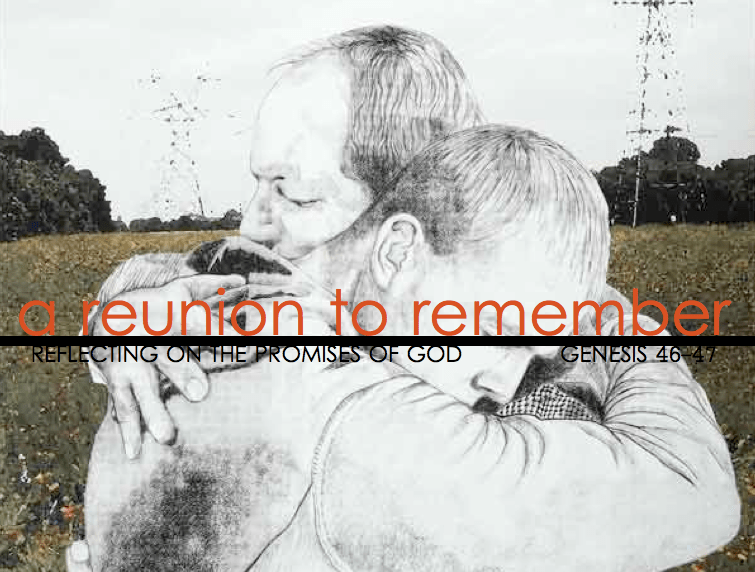

Have you ever been to a reunion for family or school? I have been to a few. There is usually some anxiety at first, since you have not seen these faces for eons and time hasn’t made you younger, flashier, or skinnier. Usually within minutes the awkwardness fades through the laughs and retelling of old memories.
The reunion of Joseph and his father is one of the most memorable of Scripture. However, at a quick glance what we do not catch is that this story is more about Jacob remembering His God and reunited with His promises.
Jacob is now an old man. He probably has some wrinkles and walks with a bowed leg. He has a few less hairs and it is clear from his eyes that he’s weathered life. He’s been asked to do something rather challenging even for someone half his age or tenth his age. In faith he is leaving his home, farm of his youth, and comforts. Like his great grandfather Abraham before him, in faith he’s trusting God to bless him in a new land.
Along the way Jacob stops to worship God in Beersheba. It’s a landmark site for his family. This was the same place where his father Isaac and grandfather Abraham, also worshiped God [21:33, 26:23-25]. There, God speaks to Jacob and gives him a command and promise. The command is the most common command in the Bible, “I am God, the God of your father. Do not be afraid to go down to Egypt, for I will make you in a great nation there.” [Genesis 46:3] Hear this sampling of other occasions throughout the Bible when God says the same 4-words:
When God says, do not be afraid. It is nothing like if I were to say the same thing. When I say, “Do not fear,” it sounds generic, even uncaring. God never says anything He doesn’t mean. He doesn’t say anything to get you off His back. Fears are not trivial to God. The sheer number of times He speaks to your fears is proof enough that He cares much more than you know.
Many wonder if God really cares. Past hurts still have a hold on you. You feel like you’ve been fooled once and you won’t be fooled again, so you trust no one but yourself. Or you believe that what God says is too good to be true. You feel unworthy of His care. In the midst of doubt God reveals more of Himself to you.
God is repetitive. He is happy to do so. Repetitive is supposed to aid learning. Ask the oral speaking Hebrews and they’d agree. Think of God repeating Himself like a parent daily telling His children, “Take your vitamins,” or “I love you.” God follows His command, “Do not be afraid” with one of the most precious promises of the Bible, “I myself will go down with you to Egypt, and I will also bring you up again, and Joseph’s hand shall close your eyes.”
When God ask you to do something He’s not going to leave you hanging. He has given you good reason to not be afraid. He will be with you no matter how difficult. I am certain Jacob remembers the stories from his childhood of God’s presence with Adam in the Garden [Genesis 2], with Noah in the Ark [Genesis 6-9], with Abraham [12:1-3], and with his father Isaac [26:24]. The ruler of the universe will accompany Jacob to a strange land. He promises his son Joseph will be there when he breathes his last breath. And God will see to it that he is buried back in the Promised Land.
When God says He will be with you He means it. You have all proof in the span of Scripture. Just look at the stories of Moses [Exodus 33:12-17; Deuteronomy 31:6], David [Psalm 23:4; 118:6-7], Isaiah [49:14-15], Haggai [2:4-5], Paul the apostle [Philippians 4:5-6], and Jesus and the Spirit [John 17:20-24; Matthew 29:19-20]. Jesus says, “And I will ask the Father, and He will give you another Counselor to be with you forever—the Spirit of truth. The world cannot accept Him, because it neither sees Him nor knows Him. But you know Him, for He lives with you and will be in you. I will not leave you as orphans; I will come to you.” [John 14:16-18]
Despite fears, Jacob obeys God in faith and moves to Egypt with his family. And, in one of the most touching occasions in the entire Bible, Joseph reunites with his father Jacob. The two men embrace and weep for a long time. It’s a reunion to remember.
Up to this point, Joseph has not asked for any sympathy, apologizes, or favors from his brothers. Even from a high position of authority in Egypt, he has the power to snap his finger or whisper a quick word and his brothers would instantly be lynched, enslaved, or tried for their dodgy past. But Joseph did none of it. Instead he demonstrates divine grace and unforgettable forgiveness.
Joseph takes five of his brothers before the Pharaoh to ask a favor on their behalf. As anticipated Pharaoh inquires about the kind of work his brothers did back home. They reply, “Shepherds.” To be a shepherd was like being a garbage man or burger flipper. It was a lower class job, especially to an Egyptians. Remarkably Pharaoh blesses them as Joseph’s brothers, and gives them the best grazing land amidst the famine. God uses the ruler of the known world to be a blessing. God holds the heart of the king in His hand.
Then, Joseph brings his 130-year old gray-haired father to meet the mighty Pharaoh. Jacob opens his mouth before the king. You never know what an old guy might say. But He doesn’t say anything brash or embarrassing. He gives Pharaoh two patriarchal blessings (47:7,10). In other words, he stands before the king and gives glory to the King of kings.
God ultimately sits on the throne and rules. He places those who reign over peoples and nation. God even uses unregenerate Pharaoh to carry out His purposes in preserving His people. Proverbs 8:15, God’s wisdom declares, “By me kings reign, and rulers decree justice.” This gives me a lot of comfort around election time. No matter who is in office or soon to be God is still on the throne. He is in control.
The last shall be first and the first shall be last. You see this without a doubt in Joseph’s story, which seems more like a rollercoaster ride than smooth sailing in a convertible Cadillac. Through it all, Joseph maintains an attitude of servanthood. He goes from favored son to slave to favored house servant to jail chains to second in command of the most powerful nation on earth. That just doesn’t happen. God makes it happen with his humble servant. God orchestrates these events because he reigns over humans, nations, and history.
Why Egypt? Aren’t Jacob’s people supposed to live in the Promised Land? Why would God take them from the land and bring them to a place where they would soon be slaves? Does God not remember His word to Abraham in Genesis 12:1-3 to bless him with a nation and land?
Earlier in Genesis God clearly gave Isaac the command to not leave the land. Here God clearly gives Jacob the command to leave the land. Is God playing games? Does he like to move his people around for fun? God is not a jester or monster. He has a loving purpose behind everything He does.
What we fail to see is that God is blessing Jacob and is keeping his word. The blessing comes from his obedience to God’s commands. It is not uncommon for people to reduce their faith to a series of rules and steps by which they live. Therefore, the Bible often confuses such people. They are prone to not recognize the difference between universal and particular commands.
The universal commands are applicable to everyone everywhere at all times, such as the command for us to love people and love God. However, the particular commands are applicable to a particular person or group of people in a particular place at a particular time in history, such as God’s command for Noah to enter the Ark with his family.
In Genesis 47:13-31, we see the results of both God’s blessing upon Pharaoh and Egypt because of Joseph. Joseph’s wise business dealings made the Pharaoh really rich during the seven years of famine. In this we see that God blesses His covenant people and blesses those who bless them.
Also during the time Joseph is in Egypt, Jacob’s family is growing to seventy people. This too is God’s covenant blessing of many children. The stage is now set by God’s providential hand to fulfill the prophecy God had given to Abraham. In Genesis 15:12-14, God had promised Abraham that his descendants would spend four hundred years enslaved in Egypt before God liberated them as a great nation. All of the prophecies given by God to Abraham are in the process of being fulfilled. In His unique ways, God is protecting and preserving His people. His providence in the matter will be clearer in the days of Moses [cf. Exodus 12:40].
God got the family to Egypt through Joseph and the famine. And, this small family will become a nation of a few million people some four hundred years when God crushes the Pharaoh in that day for mistreating His covenant people in accordance with His promise to Abraham to not only bless those who blessed His people but also curse those who cursed them.
Jacob remembered what God said to his grandfather Abraham. Therefore he calls his son Joseph to his side. And he makes Joseph promise not to leave his bones in Egypt, but carry them back to the land God had promised and bury him there together with Abraham and Isaac [47:29-31]. What we see is an amazing transformation in the life of Jacob. He was once the young trickster, but now he is an old God-fearer. As he looks back on his life he has seen and heard how the word of the Lord has come to pass. Keep has first hand proof that God keeps His word.
What a wonderful reunion this is for Jacob. Do not wait until you are old before you realize that God cares, reigns and keeps His word. Treasure these promises from our youth and may they spare you from many messes and uneasy days ahead. If you are having a hard time believing God look at His Son. All roads in Scripture lead to Jesus. And all of God’s promises and guarantees are fulfilled in Jesus [Hebrews 7:22; 2 Corinthians 1:20].
Jesus cares. He has compassion for all including the sick and sinner [Matthew 14:14; Mark 6:34; Luke 7:13]. “Cast all your cares upon Him because He cares for you” [1 Peter 5:7; cf. Matthew 6:25]. The greatest proof of Jesus care is shown on the cross, which paved the way toward the forgiveness of your sin [Hebrews 8:12].
Jesus reigns. He sits at the right hand of His Father. It is a seat of authority. What is He doing from the throne? He is interceding on behalf of His brothers [Mark 14:62; 16:19; Acts 7:55; Romans 8:34; Hebrews 12:2].
Jesus keeps His word. He is the Word that became flesh [John 1:1-17; Revelation 22:6-21]. His words are trustworthy and true. He is the Word. He is the truth.

5 Ways Wives Can Encourage Their Husbands.
An Open Letter to Christian Wives with Unbelieving Husbands.
20 Things a Husband Could Say to Defuse an Argument with His Wife.
Don’t Know How To Act When Someone Corrects You? Your Worries Are Over!
How to Honor your wife. Treating your woman like a queen.
Parenting Wisdom 101. Straight from Proverbs.
What Does God Want From Me? Some Important Thoughts For Children.
Why pray? Learning from the lips of Jesus.
Tom Hanks and Toddlers & Tiara’s:


“Trafficking” is modern-day slavery and is the fastest-growing criminal industry in the world. Human trafficking is defined as the recruitment, transportation, harboring, or taking of people by means of threat, force, coercion, abduction, fraud, or deception for the purpose of exploiting them.
The average age of entrance into sex trafficking is 13 years old. Members of every country and ethnic group perpetuate these crimes. It is hard to leave the trade when there are few places to put people who come out of trafficking. And few people are aware of this massive issue.
The United Nations estimates that 2.5 million people are trafficked annually and 27 million are in the trade right now. The U.S. State Department estimates an even higher number: about 12.3 million adults and children “in forced labor, bonded labor, and forced prostitution around the world.” It deprives people of their human rights and freedoms, is a global health risk, and fuels organized crime.
Victims of trafficking are forced or coerced into labor or sexual exploitation. Labor trafficking ranges from domestic servitude and small-scale labor setups to large-scale operations such as farms, sweatshops, and major multinational corporations. Sex trafficking is one of the most profitable forms of trafficking and involves any form of sexual exploitation, such as prostitution, pornography, bride trafficking, and the commercial sexual abuse of children.
January is Human Trafficking Awareness Month. As you stop at red lights this week, pray for the red light districts of the world to be shut down.
[HT]
Learn how you can be an advocate against human trafficking:


Religion that is pure and undefiled before God and the Father is this: to visit orphans and widows in their affliction, and to keep oneself unstained from the world.—James 1:27
Adoption 101: God’s heart and our call
Q&A on Adoption: Countries and More. Where should I adopt?
ABBA Fund. On funding adoptions.
Five Reflections on Evangelicalism and Adoption
Mandy Joy. Echoes of Mercy.


I am sure the untimely and inconvenient news was a shock to the two unwed teenagers the summer of 1979. The news, “You’re pregnant!” Abortion might have been an option, but both their Catholic parents discouraged it and encouraged the baby to be born. I am grateful my two parents decided on the side of life.
 Before my sister Samantha was born, my mother and step-dad were already aware she would be born with Spina Bifida. The doctors recommended an abortion thinking it would be laborious to bring a physically disabled child into the world. It is true, my family would have to adjust and Sam would not have the use of her legs, but no one would know the blessing of my beautiful, intelligent, and warm sister, now an incredible young woman.
Today is Sanctity of Human Life Sunday. I hate this day. I don’t hate it because I think it is unbiblical. I hate it because I have to say things in church that shouldn’t have to be said. Mothers shouldn’t kill their children. Fathers shouldn’t abandon their babies. No human life is worthless, regardless of skin color, age, disability, or economic status. The very fact that these things must be said is a reminder of the horrors of this present darkness.
I hate Sanctity of Human Life Sunday because I’m reminded that as preach there are babies warmly nestled in wombs that won’t be there tomorrow. I’m reminded that there are children—maybe even blocks from this church—who will be slapped, punched, and burned with cigarettes butts before this message is over. I’m reminded that there are elderly men and women whose lives are pronounced a waste and euthanasia is considered a viable option.
But I also love Sanctity of Human Life Sunday when I think about the fact that I am in a church with ex-orphans, adopted into loving families. I am in a church that supports local pregnancy centers for women in crisis. Like Proverbs 31:8-9 you, “Speak up for those who have no voice, for the justice of all who are dispossessed. Speak up, judge righteously, and defend the cause of the oppressed and the needy.” May the church continue to be a haven for men and women—who have aborted babies—find their sins forgiven and consciences cleansed by Christ.
Believe it or not the Bible is silent on the topic of abortion [as it is on the humanity of whites, blacks, Hispanics, etc]. Jesus never said, “thou shalt not abort,” even though it was practiced during His day too. Although the Bible does not condemn abortion does not mean it condones it. Likewise, just because culture or government condones it as legal doesn’t it mean it’s God-honoring. The Bible is clear: you are not to take innocent human life without justification.
Therefore, if a positive case can be made for the humanity of the unborn apart from the Bible you can logically conclude that Biblical commands against the unjust taking of human life apply to the unborn as they do other human beings whether they are red, yellow, black or white, young, old, skinny or fat, healthy or not. And to this point, science confirms theology. In other words, science gives the facts you need to arrive at a theologically sound conclusion. What the science of embryology makes clear is that from the earliest stages of development, human embryos and fetuses are human beings but just less developed than the adults they will soon become.
The question I pose this morning: at what point does the embryo begin to be made in the image of God? The answer to this question comes down to your view of God and human life in connection with God. The answer to this important theological question is packed into a little song that David wrote in Psalm 8.
The psalm begins and ends with its main point: “O LORD, our Lord, how majestic is Your name in all the earth!” [8:1, 9]
The two words for lord (O LORD, our Lord) are not the same in Hebrew. The first LORD, with all caps, is a translation of the name YHWH. It’s His personal name. The name He gives Himself. It is built on the statement in Exodus 3:14, “I am who I am.” It’s a name to remind us that He absolute exists. He simply is. He did not come into being, and does not go out of being. He never changes in His being, because He is absolutely exists in His being.
 His name is majestic in all the earth. There is no place in all the earth where God is not YHWH—where He is not the absolute One. Everything everywhere depends absolutely on Him. He depends on nothing, but everything depends on Him. He has no viable competitors anywhere. He has no challengers to His throne. He is above all things everywhere. He sustains all things everywhere. He is the aim and goal of all things everywhere. He is greater and wiser and more beautiful and wonderful than everything everywhere. “O YHWH, our Lord, how majestic is Your name in all the earth.” That’s the main point of the psalm.
In response you and I are to stand in awe of His majesty and worship. The majesty of God is awe-inspiring. Those who have seen His majesty have never been the same. John fell on His face in the presence of God. Isaiah cried, “I’m unworthy,” when in the thundering presence of God. Do you have a majestic view of God? If you have a majestic view of God you will have a majestic view of life. If you have a low view of God you will have low view of life.
We are going to skip over verse 2 for a moment. I promise we will come back to it. In verses 3-4 David responds to His majestic Creator, “When I look at your heavens, the work of your fingers, the moon and the stars, which you have set in place, what is man that you are mindful of him, and the son of man that you care for him?” The point of these two verses is to see God’s bigness and my smallness. God is infinitely great, and man, by comparison, is nothing. God creates stars with His fingers and I am so small compared to Earth, the sun, and the billions of suns that form up our galaxy, and the millions of galaxies that are laid out in our universe.
Have you ever stood underneath the night sky and thought, “Wow, I am small and insignificant?” That’s the point. God created all that bigness so you’d have a sense of smallness. Some consider it a lot of wasted space, but space God’s natural billboard proclaiming His praise. Worship is not found in feeling big, but rather in feeling small.
An honest question arises in verse 4, “Why do You consider man when You are so majestic?” The answer comes in verses 5-8: “You [O God] have crowned him with glory and honor…You have given him dominion over the works of your hands; you have put all things under his feet…” Now that is absolutely astonishing! John Calvin summarized it by saying, “Whoever, therefore is not astonished and deeply affected at this miracle—God being mindful of man—is more than ungrateful and stupid.” Although man is nothing compared to God, He makes man His supreme creation.
 God’s majesty is seen as He creates man in His image [Genesis 1:26-27]. One might ask when does the image of God begin in man? According to God, it begins even before one cell splits and multiplies in the womb. In the human embryo are found the marks of your Maker. No other creature in God’s creation is crowned with glory and honor like mankind.
God’s majesty is seen as He makes man dominioneers over all His creation [Genesis 1:28-31]. God gives you a job—care and protect life. However, when we read the Genesis account of Adam and Eve, their children, and observe history thereafter man does not do a good job caring for and protecting life. We don’t like our job. We want a new job. We’d rather redefine the job. Therefore we join a union and march with picket signs that say, “God, I have a rights!”
Do I have rights? Sure. In our society a woman has her rights. She can murder a child and get away with it. I am an advocate for civil and judicial rights, but not rights-gone-wild. The freedom and liberty to use our rights is not always right. Especially when it comes to shedding innocent blood. A human that demands, “I have rights!” Is saying what a sinner says when it rejects God’s moral rules. God determines what is right and wrong. He says we are to care for and protect life. Every man has the right to life.
You cannot starve an elderly human to death and worship the majesty of God. You cannot dismember an unborn human and worship the majesty of God. You cannot gas a Jewish human and worship the majesty of God. You cannot lynch a black human and worship the majesty of God. You cannot gossip, harbor bitterness, or curse a man to his face and worship the majesty of God. Jesus says to hate another human is commit abortion in your heart. You cannot worship the majesty of God while treating His supreme creation with dishonor.
You might be wondering what does this have to do with the sanctity of life or abortion? Let’s go back to verse 2. There is an incredible contrast between verse 1 and 2. Verse 1 says, “You have set your glory above the heavens.” And Verse 2: “Out of the mouth of babies and infants, you have established strength because of your foes, to still the enemy and the avenger.” The contrast is strange. God is highest of all beings. None could be stronger, wiser, or greater. But babies are weak; they seem to have no wisdom or knowledge. They are utterly dependent on others. They are insignificant in the world’s eyes.
So why does the psalm mention babies? Why are they here? What are they doing? The verse says what they are doing: They are defeating the enemies of God. They are opening their mouths and saying or crying something. And whatever they are saying or crying is powerful enough “to still the enemy and the avenger.”
God has enemies. His foes are those who rebel against His majesty [8:1,9]. They do not see Him as majestic, nor do they want to worship Him. They get far more pleasure out of getting praise for themselves than giving praise to God. Our world has been ruined because of these enemies. And in order for the world to return to its proper purpose, these enemies will have to be dealt with. And what verse 2 tells us is that God, in His majesty and greatness makes babies the means of His triumph over His enemies. Let the strangeness of this sink in. God conquers his foes through the weaknesses of the weak—the worshipful coo’s of baby’s lips.
To understand verse 2 in it’s fullness you have to realize God comes to earth in the form of a cooing and crying baby. Jesus, the God-man, came into the world in childlike lowliness and human weakness. God takes on skin. He’s born of a virgin in a barn. He grows into a man, lives a sinless life, but certain men convict Him of a crime He did not commit. He dies on a cross and 3-day later He rises crushing His enemies under His feet [cf. 1 Corinthians 15:27].
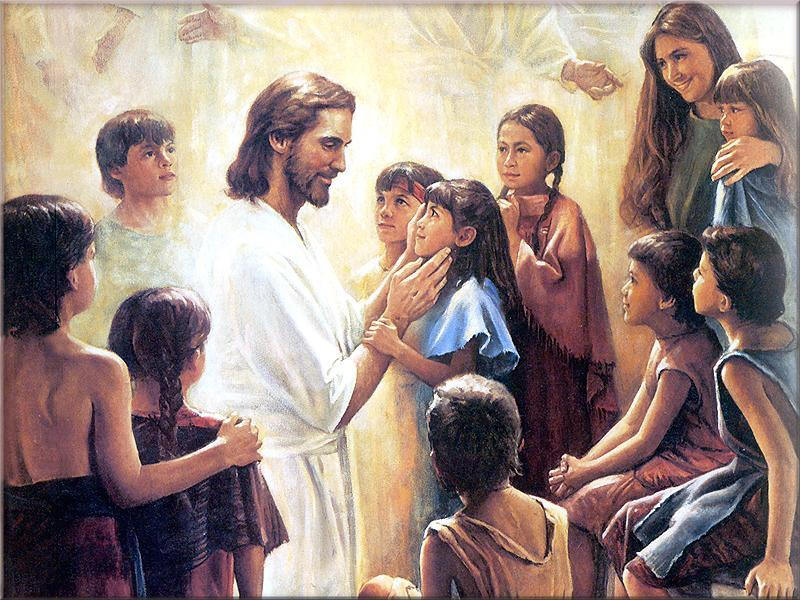 During His earth ministry He welcomed children when others wanted to shoo them away [Mark 10:13-16]. Jesus loves all the little children. Moreover, He said the measure of our love for Him would be measured by our love for children [Mark 9:36-37]. He took the children in His arms as if to say, “Honor these little ones, and you honor Me. Send them away because they are weak, socially insignificant, and bothersome, and you’ve demonstrated you don’t understand the values of the kingdom.”
In Matthew 21, Jesus draws near to Jerusalem. It is Palm Sunday. He enters the city riding on a donkey. The crowds see what this means and they cry out in verse 9, “Hosanna to the Son of David! Blessed is he who comes in the name of the Lord! Hosanna in the highest!” Hosanna means “salvation.” They are shouting that God’s salvation is coming. They see Him as a prophet or perhaps the Messiah himself—The king of Israel who would defeat the enemies of God.
Now there are children in the crowd. They see what’s happening. They hear their parents shouting. So they take up the chant in verse 15, “Hosanna to the Son of David!” These children are calling Him the king of Israel. The chief priests and the scribes cannot endure the ruckus any longer. They think it’s outrageous for Jesus to hear this kind of praise and not stop or correct them. So they say to Jesus in verse 16, “Do you hear what these are saying?” What they meant was, “We know you can hear what these are saying, but we cannot imagine why you don’t stop them, since you are most certainly not the Messiah.”
Jesus’ answer is as clear as crystal, and its connection to Psalm 8 is frightening. He simply says, “Yes, I hear.” With those few words He says, “Yes. I didn’t miss a word. They are not mistaken. They are not blaspheming. They are not foolish. They just seem foolish. I approve what they are saying” Jesus receives worship from children. And Jesus goes on to say to the chief priests and scribes: “Have you never read, ‘Out of the mouth of infants and nursing babies you have prepared praise’?” It’s a direct quote of Psalm 8:2.
Two things happen when Jesus quotes this Psalm. First, it comes true. His enemy is silenced. The chief priests and scribes are speechless. The praise of the children’s lips won the day. God is defeating His enemies through the weakness of children and man. Second, the meaning of psalm 8 is amplified. When these children cry out, “Hosanna to the Son of David !” Their praise was directed to Jesus. Jesus knew it. The chief priests and scribes knew it. And Jesus accepts their worship being God—the absolute One–Himself. On that day, the majesty of God had a face of flesh and a name. His name is Jesus.
In closing I want to share with you a story about my best friend, Ben. In high school our friendship grew through helping each other live for Christ. When I went to college I had less contact with Ben. While I went to Bible College, Ben was going to parties and sleeping with girls. His life became a mess. He got a girl pregnant. To cover it up she aborted. Although Ben had abandoned God, God did not abandon Him. He was relentlessly pursuing Ben.
I remember coming home on college break and visited Ben’s apartment. It looked like a disaster, smelled like beer, and felt dark. I asked Ben, “So what’s God been doing in your life?” I am sure he wanted to kill me for asking a question with an obvious answer. What Ben needed I could not give. He needed his enemies of pride and guilt and thinking “I have rights” to be defeated. In Christ they already were. I kept in contact with Ben. He left for Florida where he thought he’d be anonymous. The majesty of God prevailed, He would not leave him alone, pursuing his heart, and Ben repented of his sin.
“For as high as the heavens are above the earth, so great is His steadfast love toward those who fear Him; as far as the east is from the west, so far does He remove our transgressions from us. As a father shows compassion to his children, so the Lord shows compassion to those who fear Him.” [Psalm 103:11-13]
Jesus forgives sinners who come to Him with child-like faith. God redeemed Ben’s life. God has given him a godly wife and blessed him with two (so to be three) beautiful children. Today Ben is serving God in the ministry. Ben is an advocate for life.
Jesus can forgive you too. No matter how bad your sin or how dirty your past. He will not only forgive you but welcome you as His child in His compassionate arms. Come. He awaits you with an embrace.
Why do I need psalm 8? It inflames my heart with wonder, awe, and love for God. Seeing the majesty of God is the first step towards looking at myself and other humans rightly. In His majesty we see the sanctity of life.
LISTEN TO THE PODCAST OF THIS MESSAGE.


January 22nd is the anniversary of Roe vs. Wade. As a result, today in the US, 1 unborn child is killed every 23 seconds.
When you stop to realize that the US only accounts for 3% of abortions worldwide, you realize that there is a relentless global slaughter underway. May God exercise both his mercy and judgment, and may Christ return quickly.
Here are some articles I would encourage you to read or watch to equip you and your church for the sanctity of life:
One gospel, unabortable. Who are children?
Is there a connection between birth control and abortion?
What is the task of a pro-life pastor in the 21st Century?
Woman meets child born out of rape given up for adoption 77 year ago.
What should I do after abortion?
Does the Bible’s silence justify abortion?
How can I defend life in a new generation?
5 bad ways to argue about abortion.
Jesus loves the little children.
10 reasons I am optimistically pro-life.
Exposing the Dark Work of Abortion. Free book.
RESOURCES FOR THE CHURCH:
Abort 73
Case for Life
Prolife Training


I want to encourage you to take 5-minutes and watch this short video. It is a short project that Pioneers issued to mobilize servants to consider North Africa. The couple in the video are new friends we have made during our vision trip early last year. They will only live a few hours from where Sarah and I will soon live. Their people group is a neighboring people group to the one we will go share the good news. It will give you a perspective of life in a forgotten land. Pray with us for a Mighty movement of God among these forgotten people.



3 Things You Need to Know about Sin
Community idolatry. Are chasing false gods together? 8-idol shattering questions.
Abandoned by God. What to do when you feel alone or forsaken.
My dream vacation: move, learn, eat.
Nearer Heaven: a great 30-day devotional.
Religious views of 20-somethings.
Books on Christians and politics.
It’s amazing what artist can do with books, mailboxes, and more paper.
In our State they do not test parallel parking anymore. Maybe they need to rethink that:

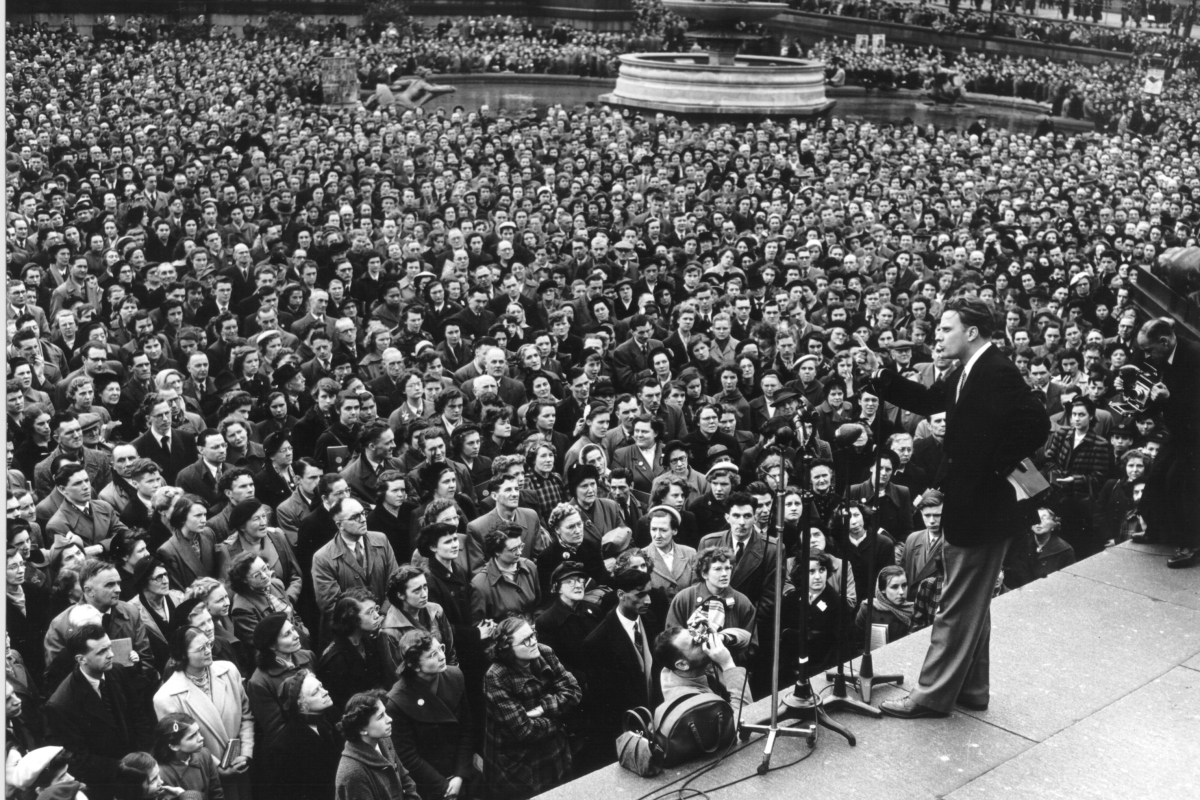
A younger Billy Graham had some insightful comments on the British Invasion, but also the eternal invasion of the gospel. Timeless.


What makes Christianity different that all other religions? It’s grace. A single word captures the difference between Christianity and all other religions. Grace.
Every other religion allows me to pay at least something for the tow. And if I pay anything at all then pride will wolf it down and the vines will begin to grow with a terrible ferocity. All my pride needs is credit for a single good thing. If I take credit for seeking God then my pride lives. But Christianity allows nothing of the sort. It is the shepherd who seeks the sheep. It is the sheep who is lost and hopeless and helpless. So it is the cross or it is nothing at all. That is why the cross is death before it it life. Even with Jesus it was the cross and only then the resurrection. Grace makes it the same for us.
It is true that pride is inflation of the soul then the only time we are the size of our true self is when we are devoid of pride.
Grace is the kryptonite to pride.
Taken from Red Like Blood by Joe Coffey and Bob Bevington. Shepherds Press, Wapwallopen, PA. 2011. 80-81.


 spreading the fame