Messiness

WHEN DISCIPLING ISN’T NEAT & TIDY

Romanticized visions of seamless ministry often collide with unpredictable, imperfect, and chaotic realities. From unexpected family feuds disrupting a church plant to logistical hurdles of unreliable infrastructure and the overwhelming chaos of a missionary mom, messiness is not an occasional inconvenience but a daily reality. Life and history are full of messes, describing much of our day-to-day experience. Engaging with a fallen world is a crucial arena for spiritual formation and encounters with the divine.

Zara had envisioned a neat, orderly church plant, growing steadily from Bible studies to a thriving congregation. Instead, her reality was messy. Her first disciple, a zealous young man named Yakoub, quickly brought his entire extended family to faith, but they also brought their deeply ingrained family feuds and loud, public arguments into the new house church. Meetings were chaotic, discussions often devolved into shouting, and the new believers struggled to apply biblical principles of forgiveness and unity. Zara spent more time mediating disputes and patiently re-teaching basic relational skills than she did anything else. It was far from the clean, linear growth she’d planned, but in the messy crucible of their raw, honest struggles, she saw the Holy Spirit slowly, painfully, but powerfully, forging a community utterly dependent on Christ’s transforming grace.

BIBLICAL REFLECTION ON MESSINESS

The mission field is rarely a clean, predictable, or perfectly ordered environment. Instead, it is often characterized by “messiness”. A biblical theology of messiness is essential for maintaining sanity, fostering authenticity, and recognizing God’s profound work amidst imperfections.

We are in a world of a mess. We are in a fallen world. Humans do not need to be taught how to make a mess. Look at what Ephesians says about the mess we were in: We were dead and disobedient, we were living in sin like the rest of the world, we were fathered by the enemy, and his spirit directed our hearts and had unhinged desires. (Ephesians 2:1-3) 

Jesus’ cross was messy. The cross looks neat and tidy on a church wall or necklace. But there is no tidying up the splintered wood, the blood, the shame, and the raw agony of the cross on which Jesus died. The crucifixion was a gruesome scene where the Savior bore upon himself the sinful mess of all humanity. The cross reveals that God is found in the messy, Godforsaken, suffering world. (Mark 15:17; John 19:1, 31-37; 1 Peter 2:24)

God continually makes marvels out of messes. He is the divine artist who takes the tangled threads of our lives and weaves them into a beautiful tapestry. Out of chaos, God created the world. God works even when it doesn’t make sense to us. This is a divine mystery. The idea that God, in His patience, mercy, and passion, brings men and women to Himself, and often does great things in the midst of a mess. This is called redemptive grace. No matter how bad things seem, God is indeed at work in a redemptive way, which has restoration and hope at its heart. The wasted years, the poor choices, the setbacks, God answers the mess of life with one word: grace. (Genesis 1:2-3; Psalm 104; Isaiah 61:3; Ephesians 2:8-9; 1 Peter 5:10) 

Fighting sin is messy. The battle against the flesh is not a clean victory; it’s a daily, often messy, struggle involving repentance, obedience, and dependence on the Holy Spirit. (Galatians 5:17) 

Jesus’ example of ministry was messy. Jesus was tender and compassionate. He was perfect and sinless. He was also rugged enough to attract fishermen, vigorous enough to fast and pray in the wilderness for forty days, robust enough to go toe-to-toe with the Sanhedrin, and furious enough to wreck the outer court of the Temple. Follow and obey Jesus for any length of time, and He will lead you out of your tidy plans and into glorious messes.

Relationships and team life are messy. Human interaction, especially across cultures and under pressure, is inherently complex. Differences in personality, communication styles,  doctrinal beliefs, and expectations inevitably lead to misunderstandings, conflicts, and relational friction. Yet, these relationships are a mess worth making. (James 4:1; Ephesians 4:2-3)

Discipleship and spiritual growth are inherently messy. Spiritual formation isn’t a linear ascent to arrive at perfection. It’s a lifelong process of putting off the old self and putting on the new, marked by stumbles, repentance, and ongoing transformation. If your discipleship isn’t messy, then you’re likely not discipling deep enough. Discipleship will uncover dirt and areas where we need to grow more like Jesus. (Philippians 1:6; Romans 7:18-19; Titus 2)
Ministry to broken people and systems gets messy. Engaging with lost, hurting, and sinful people and working within broken systems (e.g., corrupt governments, inadequate infrastructure) is inherently challenging. Church, ministry, marriage, and parenting are rarely easy or tidy. Where there are people, messes can be expected. (Romans 8:20-22) 

Messes aren’t meant to be forever. Jesus is transforming us now, so we become more aware of our messiness and more attentive to growing in grace and holiness. Life is a series of seasons—some full of stillness, others full of change or confusion. Recognizing that nothing is permanent can be freeing. Ultimately, messes will be no more when we enter through the gates of God’s glorious city. (Revelation 21:4)

“And we urge you, brothers, admonish the idle, encourage the fainthearted, help the weak, be patient with them all.” — 1 Thessalonians 5:14

THE IMPORTANCE OF EMBRACING THE MESSINESS IN MISSIONS

Messiness is inevitable in relationships, discipleship, and our walk with the Lord. Embracing the mess is not accommodating sin but fighting against it, giving grace and compassion as we walk through life together. Embracing messiness is vital for pioneer mission workers because it:

Creates Opportunities for the gospel: The gospel is the cure for our messes and helps us to make sense of them. The gospel helps us to see how God entered into our mess. Often, the most profound gospel conversations and demonstrations of Christ’s love happen in the midst of human messiness.

Deepens Dependence on God: When things are messy and beyond our control, we are driven to rely more fully on God’s wisdom, power, and grace. Then it is the Holy Spirit who does the heavy lifting and convicts, transforms, and renews.

Fosters Authenticity and Relatability: We, as Christians, can be so frantic to show only the best side of ourselves, to hide under any circumstances any sign of weakness, inadequacy, or sinfulness. No missionary has it all together. Acknowledging and navigating messiness allows missionaries to be real, relatable, and humble, rather than presenting a facade of perfection. This builds trust with both teammates and local people. When we allow ourselves to be authentic and vulnerable, we open the door to a true connection with God, ourselves, and others. Therein we will find greater compassion for ourselves and others. 

Acknowledges Discomfort and Hurt. Rather than sidestepping the feels or expediting the messy journey of the mission field and ministry, we embrace the hardship along with the unexpected opportunities that come with the messes. We don’t seek out messiness, but we discern the beauty within life’s inevitable twists and turns. 

Disciples Below the Surface. The only way to make it less messy would be to require everyone to take the same path in the same way. This isn’t possible. Discipleship journeys are like a “choose your own adventure” book. True discipling walks along hard paths with people. We intentionally step into the messes with others, willingly getting uncomfortable, and seeking to make disciples who grow spiritually mature and multiply.

Promotes Resilience and Endurance: When it comes to ministry and missions, most of us want the fantasy version where time and energy are abundant, communication is easy, and sanctification is immediate. Expecting and accepting messiness reduces frustration and prevents burning out. It allows us to persevere in the messy middle when plans go awry, setbacks happen, or progress is slow.

Overcomes guilt and shame. When things fall through or get messy, it is normal for deep emotions to set in. We look to the One who took us in His loving hands and intertwined the messy pieces of our lives, resulting in a beautiful tapestry of grace, forgiveness, and restoration.

Sees beauty amid chaos. We can be obsessed with showing off an impeccable ministry and an idealized life. Yet it never usually pans out that way. We must grow accustomed to seeing God work wonders in the middle of the mess as it becomes the canvas on which God’s transforming power is displayed.

PRAYER ACTION

Consider the Scriptures you cling to above. Consider messiness. Write a prayer for the kind of person you want to be when things get messy.

REFLECTIONS ON BUILDING A PRACTICAL MINI-THEOLOGY OF MESSINESS

Take some time to prayerfully draft your practical mini-theology of “messiness” by responding to these questions:

  • What kind of mess is the world in? What did God do about it? What part do we have in undoing the mess? How do we see God going toward the messes?

example: God is… We are the kind of people who… It is most like us/me to… We/I will… We/I hold to…

  • Looking back, can you identify any “messy” situations that, in hindsight, God used to teach you something profound or open an unexpected door for ministry? What did you learn about God’s ways through those experiences?
  • How is most of the ministry and discipleship entering into our messes and the messes of those around us? How does this increase grace, love, and compassion?
  • Once you finish, share your responses with your mentor. Ask for feedback. Adjust your draft as needed.
  • Complete a one-page practical mini-theology.

RESOURCES FOR GOING DEEPER:

Go Toward the Mess

When we returned to North Africa a few years ago, we returned to a mess. We weren’t unknowing—we were very much knowing the mess. We learned a few weeks prior that a main believer we discipled had fallen into sin and disappeared. In the wake of his fall, the groups of disciples and house churches imploded or disbanded—disappointed and disillusioned. It was tempting to cancel our flight and stay home, but we pressed on to reunite with our team on the ground.

On that flight back, I watched the film 1917. I might not recommend it if you want something lighthearted. At the least, it was adapted for the airline. It was a grueling film about WWI. The film followed the true story of a British soldier named Sgt. Reid who was preparing his battalion for battle and how he dealt with day-to-day difficulties of life in the trenches, triaging terrible injuries, and enduring exhaustion from limited resources. At one point, the film became too much that I paused it. The still frame was of a bombed-out church building. Although the church was in ruins it was still recognizable. It was a power image for me.

Our team was looking to us for leadership in the aftermath on the spiritual battlefield. We came back to a church in rubble and ashes. Our first team meeting back was a puddle of tears. We grieved—what seemed like—3 years of ministry gone in a moment. We wrestled with the anger of an MBB who walked away from the Lord and inflicted damage to a fledgling flock. We questioned whether we had it in us to endure more of the same. It felt like an insurmountable mess. (And you came to be encouraged, eh!?)

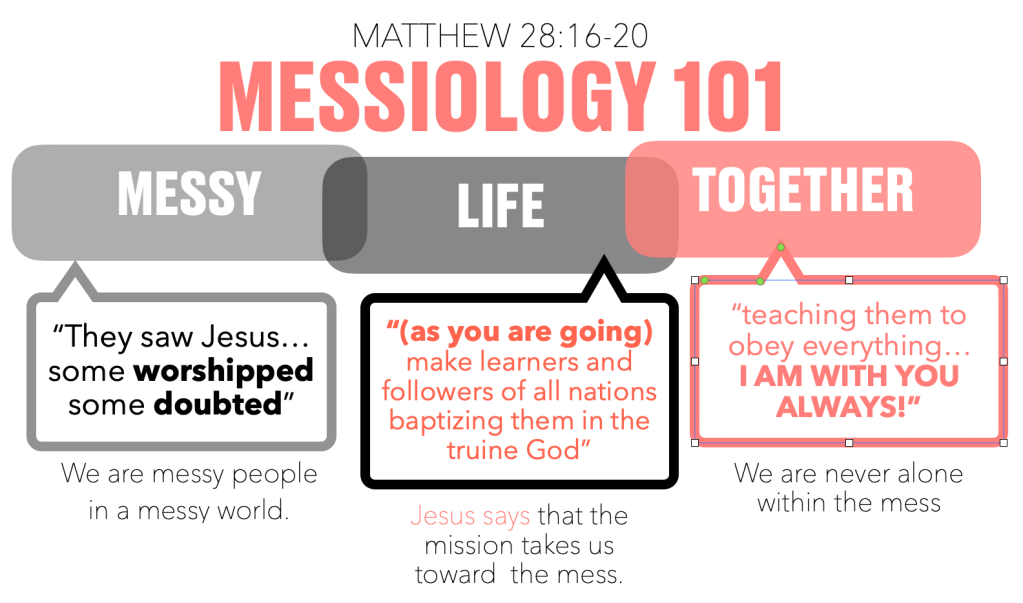
Our mission is to move/go towards the mess embodying God’s grace, proclaiming the mysterious gospel, and building up the Body.

We are in a World of a Mess. All arenas of life and every aspect of society are messy. Work. Politics. Marriage. Parenting. Life. Everything humans touch becomes messy.

Even the church is touched by human messes. You shouldn’t be surprised. Some people see the church and observe what you are like and say, “I don’t want any part of that.” Those who say this need to adjust their thinking to the real world that we live in. The church is made up of sinners—saved by grace, yes—but still sinners. How can one ever think you can have a church and not have a mess? That is ridiculous, unrealistic, and a destructive expectation. The church has messes. If your church isn’t messy then you’re probably new to the church or not well connected. The church is a mess hall—a place to gather, get fed, and get ready for battle.

This leads me to Paul’s letter to the Ephesians. To give a little history, Ephesus was a church planted by the missionary and famous preacher Apollos (Acts 18:24). Later Paul stopped through Turkey on his second missionary journey to visit this fledgling church plant of about 12 people. He stayed on for 3 months. In that 3-month visit he saw a dramatic encounter with the seven sons of Sceva and a mob scene (Acts 19:8ff). He extended his stay to 3 years. So 3 years Paul was in Ephesus, forming and fortifying the church. At one point, Luke described the church in Ephesus as a place where, “the word of the Lord grew and prevailed mightily” (Acts 19:20). That sums up the church’s beginning. Ephesus was a poster church..for a little while.

George Verwer the long-time director of Operation Mobilization said,

“Where two or three are are gathered in Jesus name. Sooner or later there will be a mess.”(Messiology)

And there was a mess in Ephesus. So much so that Timothy was sent to Ephesus—not to a cushy pastoral position, rather to do clean-up duty. We don’t know the exact nature of what went wrong in Ephesus as nothing is spelled out exactly. Paul’s two letters to Timothy give us glimpses of what happened. The church was on the brink of a breakdown. Timothy was called upon to deal with certain persons and behaviors that invaded the church.

Pause for a second. Any messes in your life right now? If you’re at all like me, this probably doesn’t require a lot of mulling over.

We Know How to Make a Mess (Ephesians 2:1-3)

Kids do not need to be taught how to make a mess. That comes naturally. Humans do not need to be taught how to make a mess. Look at what Ephesians says about the mess we were in (2:1-3): v.1) We were dead and disobedient. Living in sin like the rest of the world, v.2) We were fathered by the enemy and his spirit directed our hearts, and v.3) Our desires were unhinged. This describes a hopeless condition (sick/dead). We were stuck (in a snare) in our mess and there was nothing we would do about it. Now don’t equate the word sin with simply a mess, mistake, or oops, but it is cosmic treason (spiritual bankruptcy). 2:12-13, 17 “you were at that time separated from Christ, alienated … and strangers to the covenants of promise, having no hope and without God in the world,”

What we have seen when evangelizing Muslims in North Africa that they can see that they are sinners, but they don’t see that their sin is that big of a deal. They believe humans are born innocent and pure, their prophets are perfect and sinless, and can’t see how their sin affects others or get passed on. They minimize sin and rank it (i.e. piety, lying, arguing, domestic violence). It isn’t that different in other places with other people around the world—and it may sound like our modern world. We can’t expect unbelievers to believe any differently.

Now when we have seen Muslims come to faith in Christ they bring a lot of baggage into their new faith. They have a lot of spiritual hangovers from their old faith of trying to live holy (i.e. prayer/fasting forms, renouncing vows, relating to wife/kids, redeeming shame). The discipleship journey is messy and takes time, patience, and persistence to help them walk the right path. We can wrongly expect a new follower in Jesus to get overnight what has taken us years to know and grow into. And for some of us, we are still growing into years later.

Thankfully the story doesn’t end with verse 3. There is an amazing turn of events. ”But God…” All the best parts of the Bible come after BUT GOD. What John Stott calls the greatest two syllables ever spoken in the English language. BUT GOD. God comes to the rescue. God delivers. God gives us what we need to get unstuck. What God has given us: life (2:4-9). This new life give to us is—1) a God-initiated life (vs. 4-5), 2) a God-resurrected life (vs. 6-7), and 3) a God-gifted life (vs.8-9). It was a life undeserved. The word that is repeated over and over again in these verses that helps us to understand is grace.

We Must Grasp onto Grace that is Greater than Our Sin (2:4-9)

Grace isn’t an exclusively Christian concept. At the time Paul was writing his letter to the followers of Jesus who lived in the city of Ephesus, the idea of χάρις (grace) was well established. All the way back to folks like Aristotle and Plato, you see the term grace used to describe something that is given, absolutely freely, with no expectation of return. Everyone understood grace to be about a generous gift, something you received for no reason, and something you couldn’t pay back—even if you wanted to. So that was the scroll on which Paul sketched the Christian concept of grace.

You were dead in sin, but God gave you life because you couldn’t. That’s grace. You didn’t earn it, you can’t return it, and you can’t undo it. That’s grace. In Christ, God has seated you in His system of grace. The remedy for your mess is grace.

When you read the Gospels we see Jesus stepping into your mess (our world). He was grace on display. From his birth to his death on the cross he oozed grace to bring you peace. When you consider this you cannot help but sing: Marvelous, infinite, matchless grace. Freely bestowed on all who believe! All who are longing to see His face, Will you this moment His grace receive? Grace that will pardon and cleanse within; Grace that is greater than all our sin!

God is at work in the mess. God in his patience, grace, and passion brings men and women to himself often doing great things amid a mess. Yet in the mess is not where one is to remain …

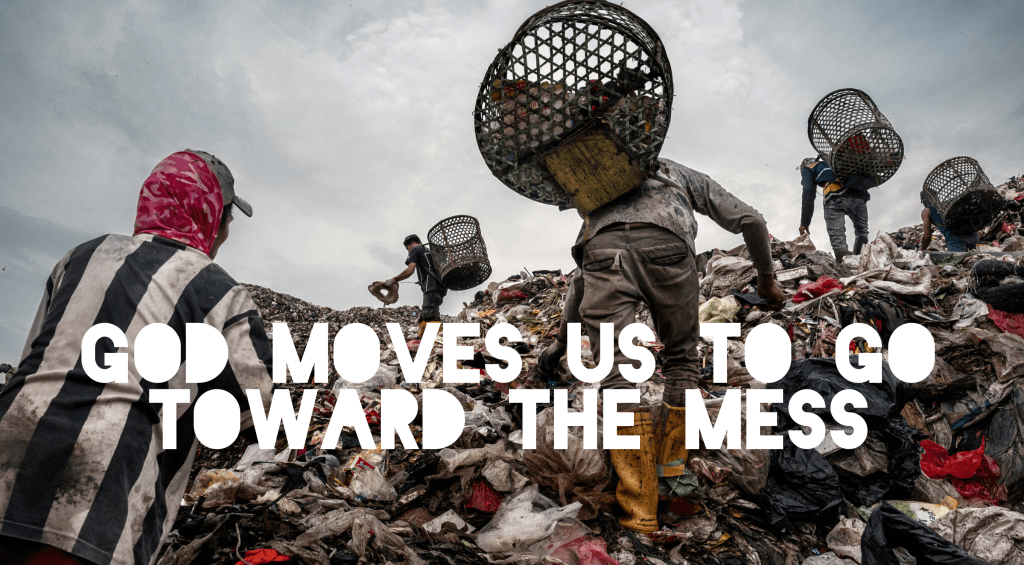
God Moves us to Go toward the Mess (2:10)

Grace is transforming. It changes you. It’s contagious. It moves your church. It has to be shared and spread. God has designed grace to be walked out (2:10). 1) You are a display of God’s workmanship. 2) God has prepared in advance. 3) God moves you to go towards the mess by embodying grace, proclaiming the gospel, and building up the Body.

Workmanship comes from the Greek word poema, which we get our word poem (handiwork, masterpiece, artistry, creativity, performed). Grace is an extension of God’s beauty and his beautiful plan. Grace in you is God’s artistry that he has designed from eternity past that you walk in it today. Walk is the action of going. God’s grace leads to action. Movement. Toward.

3 ways we extend (walk out) grace to others.

How can I show God’s grace to my family, friends, co-workers, or even strangers? 1) Extend forgiveness. First, we can forgive because we have been forgiven. “In [Christ] we have redemption through his blood, the forgiveness of sins, in accordance with the riches of God’s grace that he lavished on us.” (Ephesians 1:7) God is not a furrowed browed Father who says, “What’s wrong with you? Why can’t you get it right?” God is a tender Father who says, “I love you. You are forgiven. Get up and go at it again. I will help you!” Every day we experience God’s grace because every day we make messes. No mess is too much for God. And only God can forgive me, cleanse me, and redeem me from my mess.

Second, I can extend that forgiveness to others, “Be kind and compassionate to one another, forgiving each other, just as in Christ God forgave you.” (4:32) Messes must not separate us, but bring us together. Grace takes away judgment and leads to compassion. Grace creates a bond over our brokenness and the beauty that God makes of us.

2) Extend encouragement. Grace is constructive not destructive. “Do not let any unwholesome talk come out of your mouths, but only what is helpful for building others up according to their needs, that it may benefit those who listen.” (Ephesians 4:29) And this is echoes other one another’s in the letter, “bearing with one another in love” (Ephesians 4:2) “Be kind to one another, tenderhearted, forgiving one another, as God in Christ forgave you.” (Ephesians 4:32) “addressing one another in psalms and hymns and spiritual songs, singing and making melody to the Lord with your heart,” (Ephesians 5:19) “Submitting to one another out of reverence for Christ” (Ephesians 5:21) Waiting to encourage others until their life is cleaned up and less messy is like waiting to go to the ER when they’ve stop bleeding. God doesn’t love some future version of others. He loves in the mess.

Grace gets dirty. Sarah moved Sarah to step towards a boy chained up next door, suffering, and needing deliverance. For years he had been hurting himself and tormented by demons. Sarah asked to pray over him in Jesus’ name. With permission from the head of the household, she prayed over the boy and witnessed his healing and freedom.

3) Extend the hope of the gospel. Paul described his role as a “stewardship of God’s grace… that was given to me for you,” (3:2) which means you and I carry a responsibility (moreover privilege) to give out grace as freely as we have been given grace. In the Bible, stewards were the trusted managers of a household, palace, or large estate. Royal stewards were second only to the king and often had control over the king’s treasury, his palace, and some military assets. They were also representatives of the king, carrying out his work on his behalf until he returned. That’s you! Paul continues, “To me, though I am the very least of all the saints, this grace was given, to preach to the Gentiles the unsearchable riches of Christ, and to bring to light for everyone what is the plan of the mystery hidden for ages in God, who created all things.” (3:8-9) Whether you speak, love, or serve, you are to extend hope of nothing less than greatest news in the world. You are the King’s messenger.

Sarah was able to see a breakthrough in our crusty neighborhood. She began by reading Bible stories to a group of children at a Quranic School who couldn’t afford a teacher. She met with women and children to study and memorize the Scripture. She was able to pray over a young boy who was demonized. She was able to nurture orphan children from a mother who came to faith but died. We were able to see the formation and influence of a media project ministry that touched souls around the city and country with the good news. We were able to see the launch of two new teams in Chad among the unreached. We were able to experience a new dependence upon the Lord that we would not have but through the messes, we stepped back into.

Read any mission biography and you will see men and women going towards messes. David Brainerd served a few years among the native Americans and died of TB at 29, BUT GOD used Brainerd’s diary to stir a new wave of missionaries to the unreached. William Carey lost his life’s work of Bible translations in a tragic fire, BUT GOD caused the Bengali church to grow and spread. David Svea led one boy to Christ in the Congo before he lost his pregnant wife to malaria. He left his newborn daughter and the mission field never to return. He became a drunk, BUT GOD used that one boy to lead 600 others to Christ in his village and spread the gospel to hundreds of thousands of others. We have seen carnage in Chad due to marriage conflict, team implosions, unforeseen illnesses, and more. Our own family was on the cusp of being a statistic due to burnout, depression, and identity battles. BUT GOD is building His church in Chad! What is your BUT GOD story?

Three questions to ask yourself:

1) Am I going toward the messes within me? Are you allowing God’s grace to touch all areas of your soul and life? Has the gospel taken root in you?

2) Am I going toward the messes close to me? Are you seeing the messes in your community (or church) and stepping toward them rather than away from them? Are you bringing the gospel to those around you?

3) Am I going towards the messes into new places/nations? Am I asking the question, “Where next, God?” Or even, “Who next, God?”

Go towards the mess in you, others, and the world. Watch God’s grace shine!