from beggar to worshiper

While visiting the market in North Africa, especially in bigger towns, it does not take long before children come to you begging for money. It is hard to withhold helping them when they are so dirty, skinny and needy. However, to give them money is to give the mosque money. These boy and girl beggars are employees of the Imam. Therefore, we give them bananas or a drink of clean water. And what they really need money cannot buy; they need the riches of Jesus Christ.

As we arrive in Acts 3, we arrive to a church that is newborn. Peter has just preached his heart out, the Holy Spirit is at work, and thousands were added to the church. The infant church was booming with excitement. The day after Pentecost, Peter and John head to the temple for mid-afternoon prayer. On their way they pass by the local beggar. He’s in need of a turning point.

1. Everyday expect there to be unexpected opportunities to freely give out the gospel by introducing beggars to Jesus [Acts 3:1-10]

Doctor Luke gives careful details that this beggars been crippled since birth. He’s never walked. He probably slept near the gate and carried him up lots of stairs to his post at the gate each day where he hoped for a handout. He’s been doing this for 40 years. Isn’t it ironic that the beggar is by the beautiful gate? Can you see the contrast? The gate was a modern marvel and a symbol of wealth. It was an ordinary dirty bronze gate, but it was overlaid with silver and gold. In the light it glistened. And beggar sitting next to it as a stinky, dirty, and pitiful eyesore.

The two apostles make eye contact with the beggar. Have you ever made eye contact with a beggar? There is an unspoken vagabond code that says: ignore the beggar and he won’t bother you, but if you make eye contact expect to dish out. I have been around beggars. I am guilty of taking the long way around or looking the other way pretending to be fixed on something important. It is like being in class and your teacher asks a question that you do not know the answer therefore you dare not make eye contact lest you be chosen. Strangely Peter and John call the beggar to look at them.

Peter and John have literally sold everything they owned to serve Christ [2:44-47]. They do not have what the beggar wants, but they do have what he needs, “I have no silver and gold, but what I do have I give to you. In the name of Jesus Christ of Nazareth, rise up and walk!” [3:6] I am sure the man was disappointed or felt shortchanged at first, but Peter took his hand and helped him to his feet. The man not only began walking but also began jumping [Isaiah 35:6]. It’s something he’s never done before, even as a child. And like a child he’s not shy to show his joy in what God has done. He has just become a living, breathing, walking, and talking commercial of Jesus’ power and provision. I am sure he was an undignified spectacle within the temple.

I love the excitement of the beggar. He worships God and cares less what the crowd thinks. All the while the religious around him are thinking, “Settle down rookie. Your zeal will fade in time.” The religious are usually the most cantankerous. God detests the religious and their man-made rules and regulations. Long gone are the days their passion for God and joy in the transforming power of the gospel.

A similar event occurs in Luke 5:17-26. A crowd had gathered to see Jesus. A paralyzed man was lower through the roof of the packed house. Jesus healed the man. He got up from his mat, and walked home glorifying God. Imagine the reaction from his mother when he walked through the door that day! Not only was he healed, but also he forgiven by the Son of Man. The religious grumbled, but the crowd was amazed at what they saw and said; “We have seen extraordinary things today.”[1]

This story gives illustration to some biblical truths common to all. First, we are all beggars before we become Jesus worshipers. We are born beggars. We beg God to accept our good, which really is dirt and dung. “All of us have become like one who is unclean, and all our righteous acts are like filthy rags” [Isaiah 64:6] There is no good bone or blood in us. But those who humble themselves to Christ whose bones were crushed and blood was spilt for their sin will be healed. Jesus said, “Blessed are the poor in spirit, for theirs is the kingdom of heaven.” [Matthew 5:3]

Second, the way to Jesus is through a narrow gate, but the most beautiful gate. I used to have a poster that depicted this scene. “Enter by the narrow gate. For the gate is wide and the way is easy that leads to destruction, and those who enter by it are many. For the gate is narrow and the way is hard that leads to life, and those who find it are few.” [Matthew 7:13-14; cf. Luke 13:24; John 14:6]

Third, the riches of Christ are infinitely greater than the wealth of this world.[2] Salvation in Christ is the greatest rags to riches story of the universe. How amazing it is that God can rescue a soul signed to an unending lease within hell and pay his sin debt and freely offer him an opulent room and inheritance within His kingdom.[3]

When theologian Thomas Aquinas visited Rome he met with Pope Innocent II. Aquinas was amazed by the opulence of the Vatican in that day. And this was prior to the building of St. Peter’s, but even then it was a glorious headquarters for the Catholic church, filled with riches, and the pope was somewhat proud of the riches, and he said to Aquinas, “No longer do we say, ‘Silver and gold have we none.’” Thomas looked at the pope and said, “Maybe that is why we can no longer say, ‘Rise up and walk.’” Now the church’s riches were not why the church lost its power to heal people. The reason is that the power evidenced in the early days of the church was given by Christ to His Apostles to establish the church. Aquinas knew that, but I guess he did not want to miss the opportunity to jab the pope.[4]

Today the church has great wealth. Little of that wealth goes to global gospel ministry. In fact, 95% of the churches money, people, and resources go to Christians. All the while unreached worldwide remain heavily unreached.

Fourth, everyday you are surrounded by beggars who are unaware of their real need of Christ. As a Christ follower you have all they really need. Stop taking the long way around and quit looking the other way pretending to do something more important. Invite them to look into your eyes and say, “I have no silver and gold, but what I do have I give to you. In the name of Jesus Christ of Nazareth, rise up and walk!” [3:6]

I was confronted by this truth just this week. I attended a pastor’s conference with nearly 2000 pastors and missionaries. At the conference I met, Tyrone, an employee at the conference center. I watched as he opened doors for servants of God, but not one person acknowledged he existed. He was a beggar in our midst. You have beggars in your midst too.

2. Don’t neglect to share the transforming power of the gospel is faith in the name of Jesus and no other [Acts 3:11-16; 4:1-12]

Miracles make news travel fast. Soon a crowd gathers to see the healed man. He’s clinging to the apostles like a shadow. And the people are staring at Peter and John awaiting their next trick as if they were Penn and Teller. Since Peter’s got a crowd, why not preach? Peter is quick to deflect the attention, “Don’t look at me, look at Jesus!”

“The God of Abraham, Isaac and Jacob, The God of our Fathers who has glorified His servant Jesus” [3:13]. Just in case there was any doubt that Jesus is the focus of Peter’s message, the name of Jesus is named 9 times in chapters 3-4.[5] Peter lists five absolute exaltations of Jesus—that’s the essence of this sermon—to magnify Jesus. He is:

  1. the long-awaited servant of the Lord; [cf. Isaiah 52:13, suffering servant]
  2. glorified by God; [as He sits at the right hand of His Father]
  3. the Holy and Righteous One; [He’s not a criminal or blasphemer]
  4. the Author of Life; and [co-creator and Savior]
  5. raised by God from the dead. [the apostles saw Him with their own eyes]

The sermon was also a scorching indictment of all who gathered. It’s as if Peter points a finger in their faces saying (with three pointed back at him), “You are the very people who betrayed Christ, who delivered Him, screamed for His blood, and are guilty of His murder. By the power of that same Jesus, this man was made whole. It wasn’t me, but Jesus.”  Peter also a former denier acknowledges their ignorance [3:17], but they are no longer, so the only solution is to repent and turn to Jesus. Jesus on the cross, cried out, “Forgive them, for they do not know what they do” [Luke 23:34].

Doing ministry in name of Jesus is what got the apostles into trouble. Jesus and His growing group of followers were a sore subject for the Jews [4:2, 17; cf. Luke 20:27-40]. They thought Jesus was a joke, a fake, a blasphemer, and the same went for His followers. Earlier crowds convicted Jesus of a crime, which led to His death. Now the religious leaders threw the apostles in jail hoping they might think a bit. But the next day, they were brought out before the religious big wigs they did not back down from making Jesus known.

Jesus is the focus of the apostle’s ministry. So should yours. It’s not about the numbers in the crowd [cf. 4:4], coolness of the program, effectiveness of the event, or pat on the back for your faithful years of service. It’s about lifting high the majestic name of Jesus. This might not make you the most popular person, but it gives credit where credit is due. Peters words cut to the core of the issue: “Salvation is found in no one else, for there is no other name under heaven given to men by which we must be saved.” [4:12] These are not politically correct, tolerant, or sensitive words, but true words nonetheless. Christianity is exclusive: Jesus is the only way to God. But it is also inclusive: for all who would believe on Him.

There is even more here that you need to see. Sometimes people will say, “Yes, Jesus is the only source of salvation, but you don’t have to know Him in order to benefit from the salvation He offers.” In other words, “If you are a faithful Muslim or Hindu or Jew or animist, Jesus will save you. There is salvation in no one else, but you don’t have to believe on Him in order to be saved by Him.” That is modern day universalism. It’s heresy!

Is that what Peter said or meant? Peter focused on the name of Jesus, “There is no other name under heaven by which we must be saved.” He did not say there are some other names by which you can be saved and Jesus is one of them. “There is no other name,” and Jesus’ name is your only entrance into fellowship with God. Peter says in Acts 10:43, “Every one who believes in Him receives forgiveness of sins through His name.” The name of Jesus is the focus of faith and repentance. In order to believe on Jesus for the forgiveness of sins, you must believe on His name. That is, you must have heard of Him, know of His saving work on the cross, and understand He rose from the dead.

Paul echoes in Romans 10:13–15: “Everyone who calls on the name of the Lord will be saved. But how are men to call upon him in whom they have not believed and how are they to believe in Him of whom they have never heard? And how are they to hear without a preacher? And how are they to preach unless they are sent?” There is salvation in no one else—and that means there must be missionaries, who make Him known by name so that people can believe and call on His name for salvation. “Jesus is the way, the truth, and the life, apart from Him no one comes to the Father” [John 14:6].

Jesus is absolutely unique. He is absolutely supreme among all the gods and lords of the world religions. Knowing Him and believing on His name is absolutely necessary for salvation. Peter’s sermon is calling us to Christ.

It calls you to clarity.  It calls you to understand your faith. If all sincere roads lead to an afterlife, then understanding the road you are on to make sure it is the right one is not very important. If there are not many ways to God, but only one way, then the highest priority in life is to understand Jesus and follow Him. The supremacy of Christ as the only way to God calls for clarity. This is important in a world of universalism. Make the message of Jesus clear!

It calls for courage. There is no point in dying for your faith if another way will lead you to God. What gets you killed is to believe Jesus is the only way. Around the world Christians are being martyred, I met some former Muslims who became Christian in North Africa. In the early days they were beaten, threatened, kick out of their families, fired from their jobs, and ostracized from their communities. Living for the name of Christ is difficult. It takes courage. It takes courage to speak to the beggars. Are you courageous?

It calls for humility. Humble yourself to the name of Christ. What is the use of making your name great when in a few generations it will be forgotten? The name that will last forever is the name of Jesus. Fan the flame of His fame. Humble yourself and give the credit for the good in your ministry to Jesus. You cannot pack your credentials in your coffin when you die. Work hard to deflect attention off you onto Christ.

It calls for joy. Let us stand to our feet and leap for joy at the transforming work of Jesus Christ. Peter could have said to the people, “Why aren’t you in the temple jumping, leaping, and praising God like the healed beggar? It is your God, the God of your fathers, the God of your heritage, who is glorifying His Son.”

This is the response of a beggar turned worshiper. Today can be your turning point!


[1] Cf. Luke 4:36; 5:9, 26; 7:16

[2] 2 Corinthians 8:9; Ephesians 2:7; 3:8; Philippians 4:19; Colossians 1:27; Titus 3:6;  2 Peter 1:11

[3] Romans 8:17; Galatians 4:7; Ephesians 1:18; 3:6; Titus 3:7; James 2:5; 1 Peter 1:4;

[4] Sproul, R. C. (2010-11-03). Acts: St. Andrew’s Expositional Commentary (pp. 76-78). Good News Publishers/Crossway Books. Kindle Edition.

[5] Cf. 3:6, 16, 4:7, 8, 12, 17, 18, 30

how much does Jesus love the church?

hands

Enough to pay an unimaginable price to bring her into complete alignment with himself. His hands tell the story. They are wonderful hands. Hands that fashion the Universe. “All things were created through him and for him.” Hands that took on flesh and became tiny baby hands. Hands that became tough as he practiced a carpenter’s trade. Hands that healed lepers and gave sight to the blind. Hands that popped open the ears of the deaf and blessed little children. Perfect hands whose movements were always innocent and sinless. Hands that were nailed to a cross with nine-inch iron spikes. Bloody hands that ceased moving so that ours could move forever. That’s how much he loves the church. His hands bear the scars at this very moment as he sits at the right hand of the Majesty on High, pleading our case and praying for us and waiting eagerly for the big day. The day he takes our hand in his and makes us his Bride forever.

air

In the beginning through Jesus, God spoke air into existence. Then he formed man out of the dust of the dust and breathed into his nostrils the breath of life. But Jesus did not count his equality with God a thing to be grasped; he emptied himself and took on flesh and lungs and need for air to stay alive. The breathed out so many wonderful words. Words that thousands of years later still bring hope and meanings. One day he arched his back and breathed his last, screaming at the top of his lungs, “It is finished.” He suffocated to death so that we could live and breath forever. That’s how much he loves his Bride. When the awestruck centurion saw the way Jesus took his last breath he whispered, “Truly this man was the Son of God!” He was right. On the morning of the third day Jesus came out of the tomb, breathing. And later that night he breathed on his fallen-star, blockhead disciples and they received the Holy Spirit. The world has never been the same, because at that moment the church was born.

So when you walk out of your church feeling indignant, and justified at being disappointed or critical, remember–you, too, are a fallen star and a blockhead, just like every other person in that place. When you feel like keeping Jesus but quitting the church, remember who she is–the precious Bride of Christ. Can you really love him without loving her? Isn’t being a member of her the world’s highest privilege? Don’t miss out on the privilege just because she’s still imperfect.

Red Like Blood. Joe Coffey and Bob Bevington. Shepherds Press, Wapwallopen, PA. 2011. 189-190.

IMMANUEL: Jesus be incarnate in me

This week I swept my wife away for a romantic getaway in the woods of Milton, Ontario. We left our daughter in the delightful care of her grandparents. We ate dinner at a beautiful bistro, talked until twilight, and slept in a cozy B&B. My most favorite memory of out time together was snuggling close and enjoying one another’s presence. There is safety, comfort and love in the presence of the one you love.

So it is with God—our Heavenly Maker. There is comfort and security in His presence. Throughout Scripture the theme of God’s presence with His people is a thread that weaves through the pages of Scripture [138 X’s, through people and promises].

Now all this took place to fulfill what was spoken by the Lord through the prophet: “See, the virgin will become pregnant and give birth to a son, and they will name Him Immanuel, which is translated ‘God is with us.’” Matthew 1:22–23 [Read Matthew 1:18-25]

Does anything fill you with awe or wonder in those verses? The Incarnation is the noblest idea of any world religion. God did not watch human despair from the safety of heaven. He clothed Himself in humanity. He ceased watching the human war and became a soldier. Oh, the things that God experienced in becoming a man:

  • the blistering summer sun,
  • the shivering rains of winter,
  • the hunger and thirst when He fasted after His baptism,
  • the rejection of those who walked away in unbelief,
  • the sorrow when His earthly father died,
  • the pain of Peter denials,
  • the betrayal by His friend Judas,
  • the disappearance of all friends at His arrest in Gethsemane,
  • the horror of naked judgment with no one to speak on His behalf,
  • the empathy of a mother’s tears when she stood at the cross,
  • the torture of crucifixion although innocent and guiltless,
  • the agony of death,
  • the loneliness of being forsaken by everyone.

All these things—when compiled together-spell Immanuel. These things are what the God of all mercy took upon Himself.

But why did He do it? It’s because these sorts of things form the fabric of all of our living. We cannot live without scrapes and pains, without heartache and sadness, without mosquito bites and cancer. Immanuel was God saying, “You shall not bear such pain alone.” God became flesh to redeem. Jesus stepped onto His created soil stained with sin and became the living sacrifice taking upon Himself the scorching wrath of God to save you and me.

Let Jesus be incarnate in your life, and then maybe when you have stooped to serve the desperate and dying, you will hear them say the word Immanuel. When Christ becomes incarnate in your life, you will hear those you serve saying to you, “I cannot help but believe in Christ. I have seen Him in your life.”

And I, when I came to you, brothers, did not come proclaiming to you the testimony of God with lofty speech or wisdom. For I decided to know nothing among you except Jesus Christ and him crucified. And I was with you in weakness and in fear and much trembling, and my speech and my message were not in plausible words of wisdom, but in demonstration of the Spirit and of power, so that your faith might not rest in the wisdom of men but in the power of God. [1 Corinthians 2:1—5]

How does Immanuel give comfort/security when you receive bad news? Have a hard workweek? Deal with daily stress? In what ways can you counsel friends or family around you with the promise of Immanuel?

Lord, be incarnate in me. Make me an instrument of Your incarnation. Live in me until my life is so submerged in Yours that I am invisible. Wherever I go, whatever I do, may I hear those around me breathe the word Immanuel, suggesting that I am nothing and You are everything.

thumb licks [christmas edition]

Does X-mas really take Christ out of Christmas?

Jesus ripped up Santa’s list. Naughty or nice He can rip up yours too.

Christmas in a Nutshell.

10 Ways to bring the gospel home this Christmas.

Having trouble finding parking while Christmas Shopping? The science of parking.

The first Christmas: myths and realities.

Who were the magi? Maybe not what you think.

Will the real Saint Nick please stand up.

The Story. What the real Christmas is all about.

The Advent: resurrection, restoration & creation

The Incarnation [Odd Thomas]

Ditto. A classic Christmas lights photo that I’ve often thought about duplicating.

IMMANUEL: a God who is with people

This morning I was taking care of my baby girl while her mother was washing some dishes. She played with her stuff animal doggy for a few minutes, but she quickly gravitated over to where I was sitting in a chair reading. For the next 15 minutes she was content doing nothing but being near to me. That’s so childlike. As children we love to be near our parents. There is safety, comfort and love in the presence of your maker.

So it is with God. We long to be near to God. We crave his affection and presence. There is a desire innate within all people to want to be with God and for God to be with them. Such a promise like this from God is meant to stir within all a sense of security, comfort and love from God above. Throughout Scripture the theme of God’s presence with His people is a thread that weaves through the pages of Scripture:

God is with you

  • Immanuel, God with us (Isa. 7:14; 8:10; Matt. 1:23)
  • Its wings will fill the breadth of your land, O Immanuel (Isa. 8:8)
  • God is with us (2 Chr. 13:12)
  • The Lord is with us (Num. 14:9; 2 Chr. 32:8; Ps. 46:7, 11)
  • God is with you (Gen. 21:22; Isa. 45:14)
  • The Lord is with you (2 Chr. 20:17)
  • The Lord is with you when you are with him (2 Chr. 15:2)
  • The Lord is with Israel (Num. 23:21; Deut. 20:1, 4)
  • I am with you (Gen. 26:24; Hag. 1:13; 2:4)
  • Do not be afraid, for I am with you (Isa. 41:10; Isa. 43:5; Jer. 42:11; 46:28)
  • Those with us are more than those with them (2 Kgs. 6:16)
  • He is at my right hand (Ps. 16:8)
  • He who is with us is greater than the one with him (2 Chr. 32:7)
  • Men will hear that God is with a Jew (Zech. 8:23)
  • The Lord is with them (Zech. 10:5)
  • They will know that I am with them (Ezek. 34:30)
  • Is the Lord in our midst or not? (Exod. 17:7)
  • Is not the Lord with you? (1 Chr. 22:18)
  • You are with me (Ps. 23:4)
  • You know the Spirit, for he dwells with you and will be in you (John 14:17).

God always with you

  • You set me in your presence forever (Ps. 41:12)
  • I set the Lord continually before me (Ps. 16:8)
  • When I awake I am still with you (Ps. 139:18)
  • I am always with God (Ps. 73:23).

God with you to help

  • God stands at the right hand of the needy (Ps. 109:31)
  • With us is the Lord to help us (2 Chr. 32:8)
  • I am with you to deliver you (Jer. 1:8, 19)
  • When we pass through the waters he will be with us (Isa. 43:2).

God has been with you

  • God who has been with me wherever I have gone (Gen. 35:3)
  • I have been with you wherever you have gone (1 Chr. 17:8)
  • These 40 years the Lord has been with you (Deut. 2:7)
  • The Lord was with Judah (Judg. 1:19)
  • The Lord stood with me (2 Tim. 4:17)
  • I [Wisdom] was beside him (Prov. 8:30).

God be with you

  • May the Lord be with you (Ruth 2:4; 1 Sam. 17:37; 2 Sam. 14:17; 1 Chr. 22:11, 16; Amos 5:14)
  • The Lord be with you all (2 Thess. 3:16)
  • May the Lord be with you as he was with Moses (Josh. 1:17)
  • May the Lord be with you as he was with my father (1 Sam. 20:13)
  • May his God be with him (2 Chr. 36:23; Ezra 1:3)
  • The Lord be with your spirit (2 Tim. 4:22)
  • May the Lord be with us (1 Kgs. 8:57)
  • So may the Lord be with you if I allow this! (Exod. 10:10).

God will be with you

  • If God will be with me (Gen. 28:20)
  • Perhaps the Lord will be with me (Josh. 14:12)
  • I will go down with you to Egypt (Gen. 46:4)
  • I will be with you (Gen. 26:3; 31:3)
  • if you obey, I will be with you (1 Kgs. 11:38)
  • God will be with you (Gen. 48:21)
  • I will be with you (Exod. 3:12)
  • The God of love and peace will be with you (2 Cor. 13:11)
  • I will be with him in trouble (Ps. 91:15)
  • I will be with your mouth (Exod. 4:12)
  • I will be with your mouth and with his mouth (Exod. 4:15)
  • God will bring with him those who have fallen asleep (1 Thess. 4:14)
  • The God of peace will be with you (Phil. 4:9).

God with specific people

  • Abraham (Gen. 21:22)
  • Asa (2 Chr. 15:9)
  • David (1 Sam. 16:18; 18:12, 14, 28; 20:13; 2 Sam. 5:10; 7:3; 9; 1 Chr. 11:9, 17:2)
  • Gideon (Judg. 6:12–13, 16)
  • Hezekiah (2 Kgs. 18:7)
  • Isaac (Gen. 26:28)
  • Ishmael (Gen. 21:20)
  • Israel (Jer. 30:11)
  • Jacob (Gen. 28:15, 20; 31:5; 35:3)
  • Jehoshaphat (2 Chr. 17:3)
  • Jeremiah (Jer. 1:8, 19; 15:20; 20:11)
  • Job (Job 29:5)
  • Joseph (Gen. 39:2, 3, 21, 23; Acts 7:9)
  • The house of Joseph (Judg. 1:22)
  • Joshua (Deut. 31:23; Josh. 1:9; 6:27)
  • Joshua as with Moses (Josh. 1:5; 3:7)
  • Each judge (Judg. 2:18; 2 Chr. 19:6)
  • Mary (Luke 1:28)
  • Paul (Acts 18:10)
  • Samuel (1 Sam. 3:19)
  • Saul (1 Sam. 10:7; 20:13)
  • Solomon (1 Chr. 28:20; 2 Chr. 1:1, as with David 1 Kgs. 1:37).

God is among you

  • God in the midst of his people (Num. 14:14; 16:3; 35:34; Deut. 7:21; 23:14; Josh. 3:10; 22:31)
  • God is in the midst of her (Ps. 46:5)
  • The Lord your God in the midst of you (Deut. 6:15; Zeph. 3:15, 17)
  • I am in the midst of Israel (Joel 2:27)
  • Is not the Lord in our midst? (Mic. 3:11)
  • The kingdom of God is in your midst (Luke 17:21)
  • The Lord who is among you (Num. 11:20)
  • God is with the generation of the righteous (Ps. 14:5)
  • My Spirit is among you (Hag. 2:5)
  • God will dwell among them (Rev. 21:3)
  • He will declare that God is among you (1 Cor. 14:25).

God goes with you

  • My presence will go with you (Exod. 33:14)
  • The Lord goes with you (Deut. 31:6, 8 )
  • If your presence does not go with us, do not take us up hence (Exod. 33:15)
  • How can we know we please you if you do not go with us? (Exod. 33:16)
  • Go in our midst (Exod. 34:9).

Jesus is Immanuel, God with us

The greatest expression of God being with us is when He came in the skin of mankind through the person of Jesus Christ. Jesus is called Immanuel, which means God with us. He was with us for only 33-years. But those 3-decades of life impacted the world and the people of the world forever.

Indeed, the title Immanuel is appropriate for Jesus—He is “God with us.” Immanuel appears twice in the Old Testament (Isa. 7:14, 8:8) and once in the New Testament (Matt. 1:23). In the Old Testament, the name is given to a child born in the time of Ahaz as a sign to the king that Judah would receive relief from Syrian attacks. The name symbolized the fact that God would demonstrate His presence with His people by delivering them. But, this prophecy also foretold the birth of the incarnate God, Jesus the Messiah, as illustrated in the Gospel of Matthew (1:23).

More than seven hundred years passed after Isaiah’s prophecy until Jesus was born. Matthew cites Isaiah 7:14 as being fulfilled in the birth of Jesus (Matt. 1:23). Later in Matthew, Jesus told His disciples that where two or three gathered in His name He would be present with them (Matt. 18:20). At the very end of the Gospel, just before His ascension, Jesus assured them that He would be with them until the end of the age (Matt. 28:20).

Also after His death and resurrection Jesus did not leave us alone. He promised to send the Helper—the Holy Spirit—to indwell His children. Forever His Spirit with us always. The book of Revelation concludes with an affirmation that the One called “God with us” will be with us forever: “The tabernacle of God is among men, and He shall dwell among them, and they shall be His people, and God Himself shall be among them” (Rev. 21:3). What an amazing promise of security, comfort and love. God is with you! Let’s be like little children clinging to His cloak, waiting for His words, and resting in His presence.

what does Jesus say about your mission?

Now that we’ve discussed some of the common myths about missions, let’s hear from the Word of Truth Himself. Jesus has some words for us about your mission.

Missions is about JESUS and His POWER to save

“all authority in heaven and earth has been given to Me.” Do you remember your mother saying, “Hon, can you clean your room.” And you’d ask, “Why mom?” With a strong tone she’d respond, “Because I am your mom and I said so.” Jesus pulls the authority card, but He doesn’t lord it over He loves it over. He is the card club carrier to all the cosmic power of the universe. He has been delegated authority from the Father. Now that Jesus has your full attention, He takes no questions because He has the right and power to do as He pleases.[1] Today He rules over the earth. He has authority over politics and government, armies and military might, the stock market and your retirement, science and education, TV and Internet, natural disasters and natural phenomenon’s, He even has authority over your life.

Missions is about YOU

“Go and make disciples.” What is the command in Jesus’ word? Many often say it is “go”, but go is the action of the command. In other words it is as if Jesus says, “as you go” or “wherever you go” The command is to “make disciples.” A disciple is a follower or worshiper of Christ.  The instinct of a Jesus follower is reproducing followers of Jesus through the power and message of Jesus. To make Jesus followers is just a thing you do![2] As Jesus says, “Go into all the world and preach the gospel” [Mark 16:15] And as Paul echoes, “How beautiful are the feet of them that preach the gospel of peace” [Romans 10:15]. Missions is not missions without you making disciples as you go, as you live. Coming to Christ makes you a Christian. Obeying Christ makes you a missionary. As my missions professor in college use to say, “Every believer is an immediate missionary for Christ.”

Missions is about PEOPLE EVERYWHERE

“all the nations.” The mission is to make disciples of “all nations.” The word nation here is where you get the word ethnicity [ethnos, cf. Revelation 5:9]. You see, God loves all the people of the world.[3] He loves all ethnicities, nations, and races of people in the world. He does not see color, status or class. Since we are not God it is hard for me to love as broadly as God. I love the Green Bay Packers and mountain biking. I also love bratwursts and cheese. I really love my wife and family. As an “ambassador” of Jesus Christ [2 Corinthians 5:20] I am representative of a foreign land, a home I long for but have not arrived and whose ruler is my Savior. There is no culture or religion beyond the scope of the Great Commission, and Jesus wants to be exalted above every people, nation, and religion.

Missions is about CHANGED LIVES through the power of the gospel

“baptizing them in the name of the Father and the Son and the Holy Spirit, teaching them to observe everything I have commanded you.” Often these words of Jesus are known as the great omission of the great commission. The forgotten and forsaken part of the mission is to help people live in the power of the gospel. First, a changed life is willing to publically identify with Christ [and His death and resurrection] by walking through the waters of baptism. Second, a changed life loves to teach other about the words of Christ [Romans 1:16]. A changed life is one who is dying to self, bears his own cross [Luke 14:27], and is becoming alive to Christ. The road to Golgotha is tough, but people of the gospel count the cost and are willing to pay the price. But it is not a road we have to walk alone.

Missions is about living confidently within GOD’S MISSION

“And behold, I am with you always, to the end of the age.” Jesus begins His short sentence with a great claim and a great command, but He finishes with a great comfort. Who promises to be with you? Jesus—the One with all authority. He promises His presence [cf. Jeremiah 31:33; 32:40]. There is power in God’s presence. There is confidence and courage in His presence. How long does He promise His presence with you? Always, which can literally be rendered, “all the days,” or “until the end of time.” He will be with you without breaks [Hebrews 13:5]. God will not take a vacation from you or His redeeming purposes. God is on a mission. And Christianity is a missionary faith.

I want to hold out to you four ways that you can respond today:

First, make prayer commitment for the rest of this year for an unreached people group [go to Joshua Project] or a missionary—for your own soul and vocational change.

Second, get a loose change can or jar and let it remind you to pray as you give.

Third, buy a good missions biography or other book on missions. Be warned. It is one of the most wonderfully dangerous things you can do to undermine your addiction to the American dream.

Fourth, make a bold commitment and acknowledge that God has been awakening you in both a willingness to go and a desire to take practical steps to be prepared to go. And tell your pastor.

DON’T BE A MYTH. MAXIMIZE YOUR ROLE IN HIS MISSION.


[1] cf. Philippians 2:5-11; Daniel 7:13-14; Revelation 1:9-20

[2] John 14:15, 23-24, 15:10; 1 John 5:1-3, 2:3-6

[3] John 3:16; Psalm 46:10; Isaiah 52:10, 61:11

Jesus and Proverbs

The book of Proverbs is a unique book of the Bible. It is full of wisdom that will help you understand how to live a life for God. Knowing wisdom does not mean you will be wise, but application of wisdom puts you on the path towards wiser living. Proverbs offers future-oriented wisdom and guidance so you can make wise decisions and live in ways that please and exalt God. Hear are some helpful ways to read Proverbs rightly.

How to Read Proverbs Rightly

1. Use Basic Logic. Read according to the plain meaning of the words, limiting your focus to the central point.

2. Don’t read any Proverb in Isolation. Biblical Proverbs are not like fortune cookies. You must not look at individual proverbs as if they stand apart from the rest of the Bible. The Bible interprets itself, and no single verse or passage is self-contained.

3. Don’t Put God on Your Timetable. Many proverbs speak of certain actions drawing certain responses from God: rewards for obedience and punishment or discipline for disobedience. God’s timing is perfect. Thus, punishment or discipline does not always immediately follow sin, and reward does not always immediately follow obedience.

4. Make God the Goal of Your Obedience. At all times, we need to keep in mind the ultimate reason we read Scripture: To know and obey God. The goal of Proverbs is to grow ever closer to the God who is Wisdom. Learn the way of wisdom by watching Jesus.

Jesus lived Wisdom. Jesus personified the Proverbs-driven life. His life on earth demonstrated continual wisdom, even as a young boy [Luke 2:41-52]. Just as He was perfect in every other way, Jesus perfectly lived the wisdom of Proverbs.

Jesus is Wisdom. Jesus embodies and displays the wisdom which is inherent in the being of God, for Jesus is “wisdom from God,” [1 Corinthians 1:30] and the one in whom are “hidden all the treasures of wisdom and knowledge” [Colossians 2:3]. To see the perfect representation of the wisdom of God in flesh, look to Jesus [Hebrews 1:3].

Jesus is the Way of Wisdom. Because Jesus is wisdom, God calls us to choose His way rather than the foolish way of the world [1 Corinthians 2:6-8]. The wise man chooses Jesus, and the fool chooses the folly of this world.

Jesus supplies wisdom. Jesus promises to give wisdom to those who hear and receive His words [Luke 21:15]. As we live wisely according to Proverbs, we are living like Christ.

As the one who lived wisdom, the one who is wisdom, the one who is the way of wisdom, and the one who supplies wisdom, Jesus is present in Proverbs in the most profound way. the book of Proverbs will not allow you to be a passive learner, merely soaking up information. Proverbs is the 10-Commandments in shoe leather. Proverbs requires you to put God’s wisdom to work in your life.

Adapted from A Proverbs Driven Life, by Anthony Selvaggio, Shepherd Press, 2008. 17ff

a case for penal substitution

The cross work of Christ is not just a payment for the wages of sin, but it is man’s means for cleansing from and victory over sin and death. In essence, that is the doctrine of penal substitution. The doctrine of penal substitution is one of the glorious truth’s of the Bible.

First, the doctrine of penal substitution is biblical.

From beginning to end penal substitution is central to the message of the Bible [cf. Genesis 9:6; Exodus 21:24; Leviticus 1:4; 17:11; Isaiah 53:5-6; Hebrews 9:22]. The truth that Jesus Christ satisfied the justice of God and took upon Himself the wrath due sin.

Second, penal substitution is necessary for real forgiveness.

God cannot waive the wrath due sin. It is out of line with His character to do so. He cannot sweep sin under the rug. Justice demands a consequence. Sin robs the bank of God’s justice [Psalm 97:2; Proverbs 17:15]. The only remedy is to seek forgiveness, but forgiveness always has a cost. Injustice must be made right. For my sin the cost was the death of Jesus Christ. My cost is that without Christ I cannot escape death. He made up what I owed. I sinned, but Jesus suffered for it so I would not have to suffer the hellish consequences of my sin.

Third, the fame of God’s name is at stake.

An injustice against God unpunished with would make the nature untrue. If it were not true He would be a liar. His name would be tarnished. In my place condemned Jesus hung pun the cross to demonstrate the justice of God. Therefore my response is to put faith in my Merciful Justifier Jesus Christ [Romans 3:25-26].

Fourth, God cannot be untrue to His Word.

God has said that the the soul that sins must die [Genesis 2:17; Ezekiel 18:20]. Since He declared it, it is decreed. Therefore, from the beginning of man’s sin God has provided a sacrifice. For Adam God sacrificed an animal to cloth his shame. For Cain and Abe;, God honored the righteous sacrifice. For Abraham God provided a substitute sacrifice in the place of his son [Genesis 22]. For the sins of Israel God atoned through the blood of animals. For my sin and yours God sent the Lamb of God, Jesus Christ, to the cross as my sins sacrifice.

Glory to God for the gift of penal substitution. May it humble us to the core and motivate us to serve Him for life.

to all those who love Christ and His gospel

To all those who love Christ and his gospel,

Without the gospel

everything is useless and vain;

without the gospel

we are not Christians;

without the gospel

all riches is poverty,

all wisdom, folly before God;

strength is weakness, and

all the justice of man is under the condemnation of God.

But by the knowledge of the gospel we are made

children of God,

brothers of Jesus Christ,

fellow townsmen with the saints,

citizens of the Kingdom of Heaven,

heirs of God with Jesus Christ,

by whom

the poor are made rich,

the weak strong,

the fools wise,

the sinners justified,

the desolate comforted,

the doubting sure, and

slaves free.

The gospel is the Word of life.

– John Calvin [in his preface to Pierre-Robert Olivétan’s 1535 translation of the Bible.]

[HT]

God will provide

I love stories of people who finish the race with fortitude. Who doesn’t gain inspiration from stories that beat the odds? I think of Team Hoyt [father with his paraplegic son] who completed the iron man, or Kerri Strug who finish the Olympics hurt on the hurdles, or Lance Armstrong who won seven Tour De France bike races after battling cancer, or King George VI who fought through the fear of speaking to become a voice comforter during WWII, or Temple Grandin who persevered through autism to become a leading advocate for autism and the cattle industry. Each of these people fought with grit to the finish.

Abraham also had an incredible journey of faith to the finish. Throughout Abraham’s struggle of faith God provided in miraculous ways. Today we will see three specific ways God provided: 1) God provides a son, 2) God provides a sacrifice, and 3) God provides land. Each of these provisions was for promises given by God when he called Abraham [Genesis 12:1-3]. God says what He means, and means what He says. When He promises something, He means to fulfill those promises exactly as He promised, but not always exactly as we think He would do it.

God provides a SON [Genesis 21:1-7]

After 25 years of waiting and wondering God gives Abraham and Sarah a son. Abraham finally has his boy. They name him, Isaac, which means laughter—fitting for a boy born to an old granny [90 years old] and triple-digit pappy [100 years old]. Sarah laughed at Isaac’s birth, but this time in joyous worship for the grace of God, which brought her a son.[1] God miraculously provides Isaac, the promised seed. It is good to rejoice in God’s faithfulness to His promises by giving Abraham a son. God would echo this miracle 2000 years later, when the seed of Isaac was fulfilled in the promised seed born through a virgin girl in a small town named Bethlehem [cf. Matthew 1 & Luke 3].

How have you rejoiced in His faithfulness? This week, I rejoiced with my wife remembering how God had blessed her over the past 10 years. God has been faithful to provide for her in some miraculous and mysterious ways. To God be all the glory!

God provides a SACRIFICE [Genesis 22:1-19]

Soon after God provides Abraham with a son, God in climatic twist calls him to a final test of faith. Before I proceed, it is important to remember that God tests your faith so that it might grow, and Satan tempts you to sin in an attempt to destroy your faith. God never tempts [cf. James 1:13ff]; He only tests. Even when you blow the test God uses it to grow your faith. Abraham’s marathon journey of faith leads him to this last grueling mile and God will ask Abraham to sprint to the finish. God asks father Abraham to build an altar and sacrifice his one and only son.

I’ve got one child. She’s a baby girl. I thank God for her. If I just had one child, that child would be the center of my universe, and as a father, my whole life would be about protecting that child because that would be my only child. When God says, sacrifice this child “whom you love” it shows that Abraham has a deep affection for his boy. They went camping, they worked the field, they played ball, and they did devotions together. I could not imagine how difficult this would have been for Abraham.

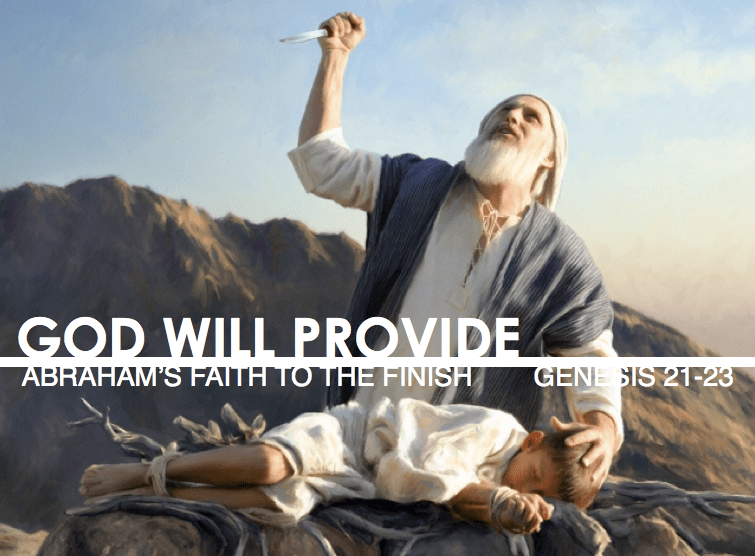
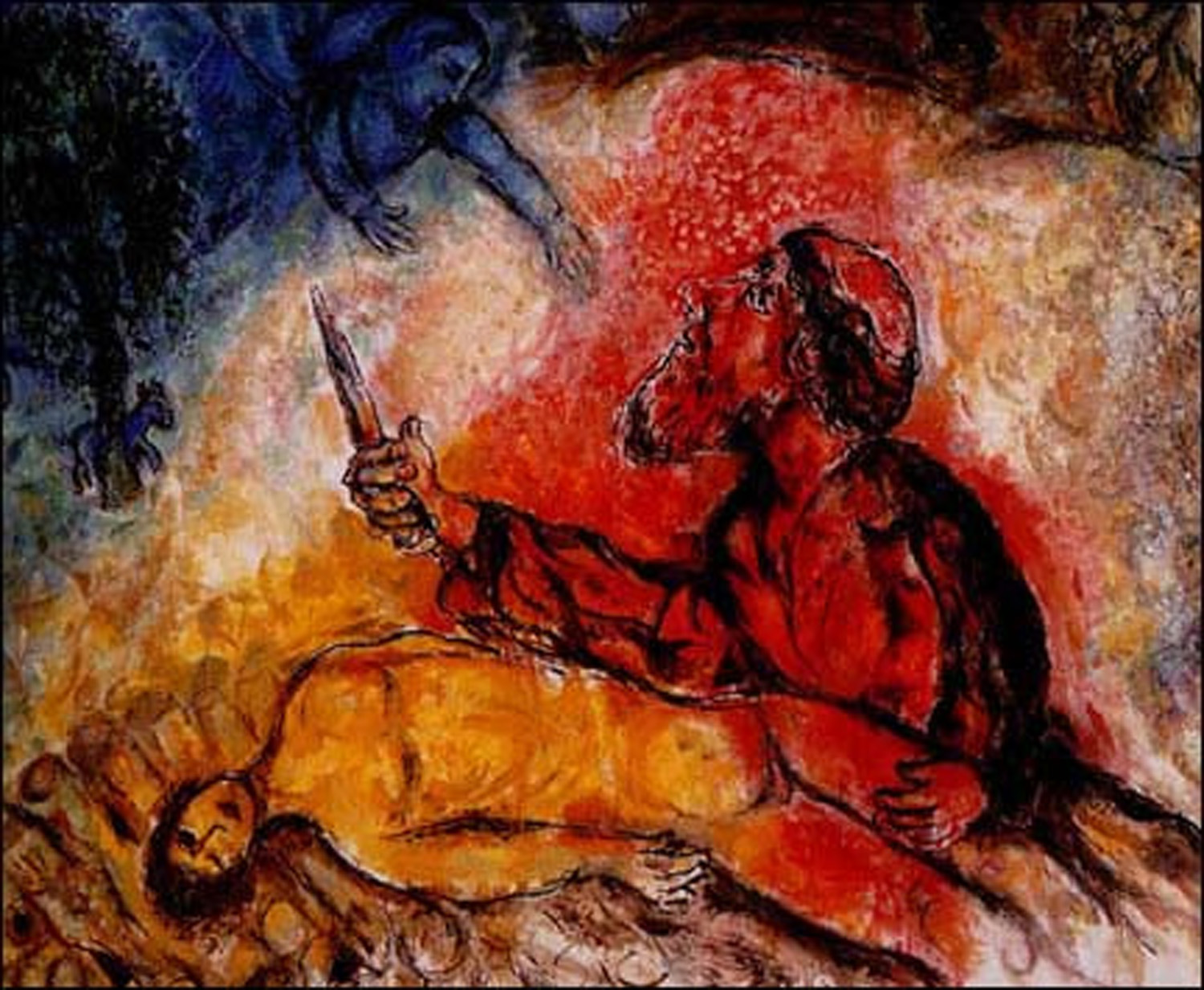
Without any deliberation or doubt Abraham awakes early in the morning, responds in faith, takes a 50-mile 3-day donkey ride, cuts wood for the altar [for this is no ordinary camping trip], binds up Isaac on the altar, and raises his knife to kill his son. Was he really going to kill his son on the altar? I think so. I think Abraham had seen God fulfill promise after unbelievable promise and made a womb that was dead-dead alive.

Now Isaac was no baby. He was probably between the ages of 15-35. He could have easily wrestled his 115-135 year old weak-boned dad to the ground. However, as Abraham’s son, he willingly submits himself to God’s plan too. He trusts his dad. I could image that Isaac had a terrified look on his face saying. “Dad, you want me to lay down on the altar? You want me to die here today?” “Yes, son, that’s what the Lord is saying.” “Okay. I trust you, dad.” Isaac willingly lies down on the altar, but God intervenes by providing an animal sacrifice for the burnt offering. The story that climaxes with Isaac, ultimately climax with Christ.

  • Isaac and Jesus were both sons promised many years before their birth.
  • Isaac and Jesus were both born to women who could not have conceived apart from a miracle.
  • Isaac and Jesus were both firstborn sons.
  • Isaac and Jesus were both loved by their father/Father.
  • Isaac and Jesus both carried wood to their sacrifice.
  • Isaac and Jesus both willingly laid down their lives to their father/Father.
  • Isaac and Jesus were both laughed at. One for being born, and the later for claiming to be king.
  • Isaac and Jesus both lay down as a burnt offering for sin [i.e. substitutionary atonement, 2 Corinthians 5:21].
  • Isaac was resurrected figuratively and Jesus was resurrected literally [1 Corinthians 15].
  • Isaac was just a man, but Isaac was the God/Man who came to save mankind.

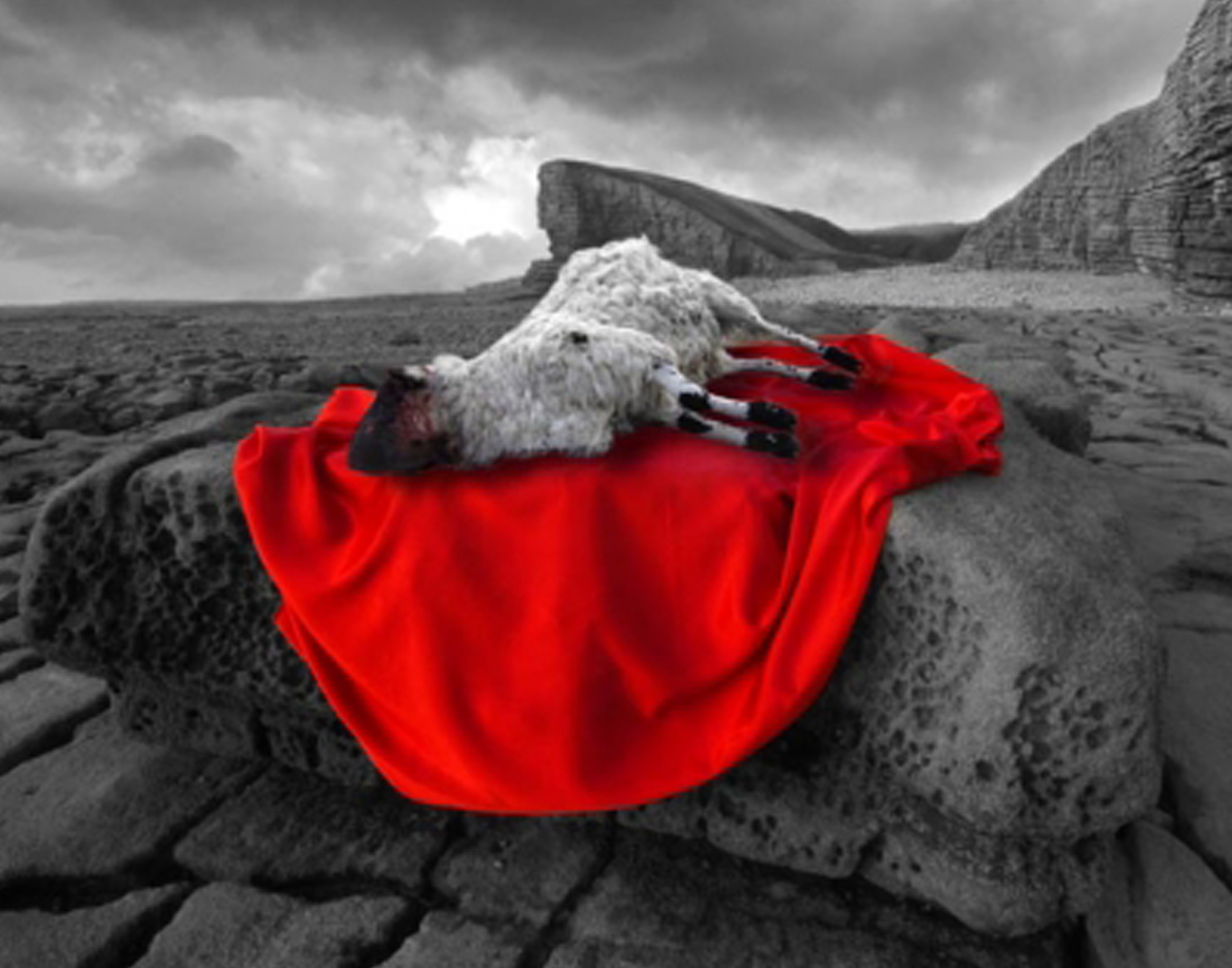
God provides the lamb for a burnt offering so that Isaac may live. Likewise, God provides the Lamb of God—Jesus Christ—as the sin offering so that those who believe in Him may live forever [cf. John 1:29; Mark 10:45]. God is faithful to provide the sacrifice for our redemption.

God provides SOIL [Genesis 23:1-20]

Remember, Abraham was a pagan living in Iraq who worked as a nomad. Now he is living many miles from his childhood home on the doorstep of the land God has promised him. He is old and his wife has just passed. In an obscure way, Sarah’s small and insignificant burial plot was the only property Abraham owned in the Promised Land. The land that was promised to his heirs would not arise as a nation until God would call another man, Moses, who would take God’s people to the Promised Land, but it took Joshua to finally bring the people across the river Jordan [21:43-34]. As the Hebrew people longed for their promised homeland [Hebrews 11:9-14] so followers of Christ long for their eternal homeland with Him [John 14:3; 2 Peter 3:13].

In conclusion, it is a worthwhile endeavor to think back on all the times God has provided. It is encouraging to journal or write a thank you letter to God for all that He has done. As I think back, he has provided in so many miraculous ways: He provided the means through jobs and mysterious donors to pay off my college education, He has provided friends who have given me timely and wise counsel from high school until now, He provided a beautiful and godly wife who has taught me much about God through the way she lives, and He has provided me with a gracious and generous church that has reinvigorated my passion for Christ and His Body. None of these provisions compare to those that the last leg of Abraham’s journey remind me of—God has provided me a Son who was the sacrifice for my sin and through faith in Him I have an eternal home with Him. God has provided far above what I could ever think or ask! It is enough to motivate me to fight the good fight of faith to the finish.


[1] Cf. Genesis 17:15ff, this was unlike Sarah’s previous laughter of unbelief that mocked the promises of God.

why did Jesus die?

Jesus lived to die. Jesus was a man on a mission. I believe Jesus Christ is the Son of God, the second person of the Trinity, who took on flesh so that He would become the complete and perfect God-man. His death is incredibly important.

Without the death of Christ man cannot live (Galatians 2:20-21; 1 Corinthians 15:16-17) Christ died to save lost and sinful me. Christ died to save sinful man from their hopeless state (Romans 3:21-26). In other words, Christ died in my place to satisfy the wrath of God on me in order to declare me innocent even through I was guilty (justification), He died to buy me off the slave market of sin (redemption), He died to make me friend even when I was an enemy (reconciliation), and He died so the Father would see me through the righteousness of Christ. Christ paid the penalty that He did not owe so that I might be freed from a penalty that I owed but could not pay.

Without the death of Christ He would not have glorified His Father (Luke 22:41-42; John 6:38; 17:1-5). Jesus was obedient to His father and did what He was commanded to do—be the sacrifice for mankind’s sin. Jesus fulfilled the Old Testament sacrificial promises and became our suffering servant (Isaiah 53). The death on the cross is what God wanted and the cross was the means by which Jesus glorified His father. Jesus Christ glorified God the Father in both His life and in His death.

Jesus lived to die. Without His death I could not live, forever. Without His death i could not glorify the Father. But Jesus did die, therefore I have eternal hope of glory. Thanks be to God.

For more, check out this video by Thabiti Anyabwile:

Melchizedek

Commercial breaks. They are moments in our TV watching when we go get a snack, run to the restroom, change the channel or tune out. Today, we are going to re-watch a commercial break that we skipped over that appears near the beginning of the Abraham narrative. This commercial break is too important to skip over for it concerns the man, the mystery, and important biblical character—Melchizedek.

The Bible’s First Throw-down [Genesis 14:1-16][1]

Genesis 14, interrupts with a great war breaking out—the first war of many recorded in the Bible—between four powerful regional rulers and five others fighting for control of trade routes, loot, influence, slaves and women in the land-between. Lot’s city is taken captive, and he becomes a POW. Word gets to Abram about Lot through an escapee. So Abram pulls together 318 of his own trained warriors. Once a homeless guy living in a tent, now he’s doing pretty well with his own personal posse. The rescue mission proves to be successful. Abram liberates Lot, the loot, the women, and even spares the wicked people of Sodom.

The Battle Belongs to the LORD [Genesis 14:17-24]

Do you see Abram’s faith in God put on display through the great battle? First, in faith, he graciously rescues his knucklehead nephew Lot living in the wicked and defeated Sodom by taking on the control-freak kings [v.14]. He gave them a good whipping dealing with them quickly and thoroughly. Not too mention he is nearly 75 years old.

Second, in faith, he honors God’s sovereignty [vs.21-24]. He could have taken the credit, but he recognized he was not alone in this battle. He ultimately won this battle by the blessing of God [cf. 12:1-3]. God blesses Abraham AS HE SAID. God blesses those who bless Abraham AS HE SAID. God curses those who cursed Abraham AS HE SAID. God made Abraham a great name AS HE SAID. God is beginning to let Abraham have an international influence AS HE SAID.

Third, he was a testimony of faith to those around him. Abram, the warrior-ruler, was gracious to the self-centered king of Sodom, and was praised by the priest-king Melchizedek. Melchizedek also recognized it was God who won the day [14:20]. Abram had a contagious faith. Now Abram’s faith was not perfect, but the object of His faith was.

Introducing Priest-King Melchizedek [Genesis 14:17-20][2]

Who is this man named Melchizedek? Melchizedek is a man of mystery to many. He has a curious resume and no recorded genealogy, which is odd for a major character in Genesis. The lack of details on Melchizedek has caused some Bible commentators to believe that he was a Christophony [cameo appearance of the pre-incarnate Christ], but he has no connections to YHWH. Instead his connections seem to lie with El [God Most High], the highest of the pagan gods in the Canaanite pantheon. Others believe Melchizedek was an angel, a type of Christ, or just a powerful man.

It appears from Genesis that Melchizedek is just a powerful man. First, he was the king of Salem [“peace”], which is likely Jerusalem. Second, he brought bread and wine to fellowship with Abram, not to be mistaken with communion, but simply to help out hungry and thirsty men that just finish trekking and fighting in a great battle. Third, he was a priest. At this time the priesthood from Aaron had not yet been established. Fourth, he blessed Abram like God had, and he blessed Abram’s God. Fifth, Abram recognized him by giving him a tenth of his possessions [note: this is where the church has often imposed the 10% tithing thing; cf. Numbers 18; Leviticus 27:30–33; 2 Corinthians 8-9].

Whoever Melchizedek was, Abram’s response to him is one of great faith. The powerful and wealthy Melchizedek offered Abram more great wealth, but Abram rejected the offering. He understood God had promised to bless him, protect him, and make him prosper. If Abram accepted wealth from Melchizedek it could conflict his loyalties to God. By faith Abram leaves his fate and future in God’s hands.

The Ballad of Melchizedek [Psalm 110][3]

This song of King David was written 1000 years after Abraham and 1000 years before Jesus. It gives more details about Melchizedek. How did David know about Melchizedek? He did his devotions [cf. Deuteronomy 17:14-20]. His song describes two oracles about the infamous priest-king [vs.1&4]. The first oracle declares the position of the Messiah as conqueror, “seated at the God’s right hand.” David acknowledges and anticipates his Messiah—the king who is to come after him. David points to Jesus who is greater king [Mark 12:35ff; Acts 2:34-36]. The Torah points to Jesus who fulfilled the Law, is greater than the priestly system, and is greater than the sacrificial system [Hebrews 1-13]. Heaven points to Jesus who is greater than angels and whom God exalts with a seat at His right side [the side of conquest, Acts 5:30-31; Hebrews 10]. It all points to Jesus.

The second oracle declares the position of the Messiah as priest, “you are a priest forever according to the order of Melchizedek.” The Law of Moses stated a king could not be a priest, and a priest could not be king. King Saul tried to be both, but God would not permit it. David did not want to make the same mistake. Only Jesus will be the ruler and priest over all [Revelation 19:11]. God used David to prepare the way. When he became king in Jerusalem he moved the tabernacle and priestly system there, and for the first time the king and priest are in the same town [2 Samuel 6-8].

Jesus Christ Compared to Melchizedek [Hebrews 5 & 7]

The author of Hebrews is teaching new Jewish Christians who are wrestling with the fact that Jesus was not from the tribe of Levi, so how could He be a priest? Therefore the author shares details that compare Jesus with Melchizedek. The purpose of the character Melchizedek is now clear; He points you to Jesus:

  1. His name means king of righteousness [7:2].
  2. There is value to his missing records of mommy, daddy, or genealogy [7:3a]. His Father and ancestry is God.
  3. He is like the Son of God, an eternal son [7:3b].
  4. He is a priest of his own order [7:4-12]. Jesus is a priest according to the order of Melchizedek. Jesus is not a priest according to Levi [like the priests under the Law] He is of the tribe of Judah [7:13-14].
  5. He took an oath unlike a Levite [7:20-21].
  6. He is the guarantor of a better and eternal covenant [7:22].
  7. He is a permanent priest who continues forever [7:23-24].
  8. He intercedes and saves completely [7:25].
  9. He is the perfect mediator between God and man [7:26].
  10. He sacrifices once and for all [7:27-28].

Hebrews 8:1-2 goes on to say, “Now the point in what we are saying is this: we have such a High Priest, One who is seated at the right hand of the throne of the Majesty in heaven, a minister in the holy places, in the true tent that the Lord set up, not man.” [cf.4:14-5:10]. His name is Jesus Christ. Do you know Him?

In conclusion, Melchizedek is probably the most important commercial breaks in Scripture. Abraham and Melchizedek are pointers to Jesus Christ [Genesis 14; Romans 4]. Abraham’s faith in God’s promises is a golden brick road that leads to Savior. Jesus, the priest-king, in the order of Melchizedek rules and intercedes for those who have faith in Him alone. If you have faith in Jesus Christ, He is your High Priest today.

I need a priest to sacrifice for me. Jesus sacrificed for my sins once and for all. He is my High Priest of priests.

I need a king to subdue me. Jesus is my sovereign ruler. He is my King of kings.

I need a prophet to speak truth to me. Jesus is the Word in flesh showing me God’s redemptive plan. He is prophet of prophets.

Jesus has done all for He is all.


[1] Here we are introduced to the continual battles that this piece of real estate would face [modern day, Israel, Jordan, Iraq, Iran, Egypt, and Turkey].  The piece of land that God would give to Abraham was the cross roads of the world at that time. Throughout the history of this piece of land there has been turf battles. Whoever, controlled this narrow strip of land and its trade routes, controlled the world at that time.

[2] Only 3 passages teach about the biblical character Melchizedek: Genesis 14; Psalm 110; Hebrews 5-7.

[3] Psalm 110 is quoted more times in the NT than any other psalm. For more on Psalm 110, check out D.A. Carson’s sermon, Getting Excited about Melchizedek.

journey of faith

Have you ever been on a road trip when you got lost taking a wrong turn? I remember back in college after finals I drive home for the holidays. Back then I did not have a GPS or cell phones. I had a few college buds with me along for the ride via Chicago. I drove while the 13-hour trek while the one sitting shotgun navigated with an old Randall McNally map. When we reach Indianapolis we got on the I-465 beltway. It was sometime after midnight, we were getting tired. With the windows cracked, Mountain Dew running through our veins, the music cranked to DC Talk, and sunflower seeds all over the car seats we made our way around the beltway. I do not think any of us were paying attention to the road signs and detours because of the construction on the beltway. We missed our exit. For the next 2-hours we drove around and around the Indy beltway before we realized that we were just going in circles.

I am sure you have been there, right? Sometimes life can be like that too. You seem to be going somewhere and then you find yourself lost, spinning in circles, and delaying the journey. Life is a journey, especially if you are living a life of faith. Abraham is on that journey of faith. His journey of faith might not be that much different than yours.

DIRECTION FROM GOD FOR THE JOURNEY: A Call to Faith [Genesis 12:1-9]

God calls Abram out of a sinful people and nation to go to a place he does not yet know. As Abram goes, God makes a promise to him that He will make him a great nation. At this moment Abram is 75 years old, without an heir because his wife is barren, and attached to his father’s possession. Abram does know how God is going to fulfill His promise, but in faith he goes. When he reaches Canaan [a dead end for a nomad] he sets up an altar of worship for God will give him this land. As Abram and his family settle in the land they face a series of obstacles that from the human perspective seem like major detours.

DETOUR #1: Making up your own story is not part of God’s story [Genesis 12:10-20]

As Abram settles in Canaan, another challenge arises for Abram and his family. There is no food. So Abram, being the man of his house, takes action and heads south to Egypt. Afraid that he will lose his beautiful wife he crafts a story, “Sarah, babe, those Egyptians are going to think you are a smokin’ hot! Surely they will kill me to get you. Let’s pretend you’re my sister.” Lying is never part of God’s plan; truth is always the best option. Truth is part of God’s plan.

Indeed, when Abram and Sarai roll through town, Pharaoh’s prince’s gawk at Sarai—like men whistling at a passing girl next to a construction sight. They ran back to the palace bragging about her beauty to Pharaoh. And what Pharaoh wants, Pharaoh gets. Lucky, for Abram, Pharaoh is feeling particularly nice and spares Abram’s head. Unlucky for Pharaoh, he and his house get stuck with a plague. Knowing something is wrong he calls for Abram, “You have some explaining to do? Everything was groovy around here until you can around. Is there something you want to tell me about this woman? Why did you lie to me?” God had his hand on Abram. He should have been executed for lying to the ruler of Egypt, but God had grace on him through Pharaoh. Abram must have learned a valuable lesson that day: speak the truth and let God deal with the possible obstacles.

DETOUR #2: Sometimes the most obvious choice is not the right choice [Genesis 13]

I am not sure Abram and Sarai did much talking on the way home from Egypt. So Abram worships at the altar [13:4, maybe seeking forgiveness; cf. 12:8] and then goes back to work with Lot among their herds. Both men have large herds. Their herds are so large that their workers were not getting along [over turf, pooper scooper duties, etc.]. As a peacemaker, Abram asks Lot to leave, but gives him first choice of the land. Lot chose the greener grass, eastward [towards Sodom].

I am sure this was a hard decision for Abram. God gives him a nephew—possible heir—but they are forced to separate. Could Lot be the seed God was promising? According to Abram, the choice was not working out as he planned. He sits and sulks about his conflicted family separation, but God is working out His plan. In fact God says to Abram, “Lift up your eyes and look from the place where you are, northward and southward and eastward and westward, for all the land that you see I will give to you and to your offspring forever. I will make your offspring like the dust of the earth [i.e. countless], so that if one can count the dust of the earth, your offspring can be counted. Arise, walk through the length and the breadth of the land, for I will give it to you.” [13:14-17; cf. 12:7] God has a different choice for Abram’s seed in mind, but He also reaffirms His promise to Abram it will happen,

DETOUR #3: Expect unexpected challenges with unexpected results [Genesis 14]

A great war breaks, Lot’s city is taken captive, and Lot becomes a prisoner of war. Word gets to Abram through an escapee, and he pulls together 318 of his own men who are trained warriors. This gives you an idea of the wealth of Abram that he had his own personal army and defeated those holding onto Lot. Abram was not alone in this battle. He ultimately won this battle by the blessing of God who promised to protect him and curse those who cursed him [cf. 12:3]. Abram then praised by kings [i.e. Melchizedek, more on him next week] who also recognized that it was God who won the day [14:20].

COURSE DIRECTION FROM GOD: The Seed will come from through Abram [Genesis 15]

Following these three divine detours God sheds some light onto the path for Abram. God tells Abram in a dream that the promised seed would come through his seed. There is just one major problem: Abram has no children and he’s really old. Notice For the first time Abram speaks up, and asks God a question, “What about Eliezer?” God responds and reaffirms His covenant with Abram, “I will not use Eliezer [a non-related heir], but one of your own children.”

Again, with radical faith, Abram believes God [15:6; cf.12:4], and God “counted it to him as righteousness.” Genesis 15:6, becomes central to Paul’s doctrine of justification by faith [Romans 4:3; Galatians 3:6]. Also, James quotes this verse to teach that true faith in God results in good works in life with God [2:23-24]. God’s covenant with Abram was confirmed with a sacrifice and the shedding of blood, which foreshadows the New Covenant confirmed with Jesus’ sacrifice of His own life on the cross and the shedding of His blood.

DETOUR #4: Ignoring the possibility of the impossible [Genesis 16]

Sarah is not mentiond in the promise [cf. 15:1-6]. Abram does not even consider Sarai. Sarah is old and barren, and too old for it to be humanly possible for her to carry a child. They had waited a long time on God to come through with His promises. What options did Abram have? Taking matters into his own hands, he logically concludes that Hagar—one of his servant girls—is a prime candidate to carry his seed. Of course, Sarai spearheaded the faithless idea. So Abram slept with Hagar and she bore him a son [Ishmael, the son of Islam].

Is Abram immoral? Is he doing what he thinks God wants him to do? Impatience on God is never right the option.[1] If you are unsure waiting on God is always the best option. Ironically, Sarai bitterly blamed Abram for the split in their family because he slept with Hagar, and Hagar flees from the Sarai’s fury. Again, God intervenes.

COURSE DIRECTION FROM GOD: God gives a sign and specifics to His covenant [Genesis 17:1-18:21]

God reaffirms who He is and how He will fulfill His promises through Abram. Abram immediately worships [17:3, maybe seeking forgiveness; cf. 12:8; 13:4]. First, God confirms his covenant by giving Abram a new name and give a symbol for the covenant between God and Abraham, circumcision.[2] Second, God confirms his covenant with Abraham through Sarai by giving her a new name and saying the promised seed will be born through her barren womb. In one moment, God’s promise becomes very specific to Abraham and Sarah. And with a miraculous divine intervention God will open Sarah dead womb at 90 years old and give her a son who will be the living Seed of Promise [cf. 21:1-7].

DETOUR #5: Failing to see trials that purify your faith [Genesis 19-21]

In short, God sends His wrath upon Sodom and Gomorrah for their perverse sexual sin, which leaves a salty crater where the cities once stood [Genesis 19]. Lot and his daughter are not much different than the community he lived and farmed [19:30-38]. Again, Abraham lies and gives Sarah away to another man, almost identical to the situation with Pharaoh [20:1-18; cf. 12:10-20]. God in His grace and sovereignty intervenes preventing Sarah from getting pregnant by another man. Then tensions stir between Hagar son, Ishmael, and Sarah’s son, Isaac. Ishmael is the one favored by everyone in the passage, except Sarah; however, God does not favor him in relationship to the covenant promise, but cares and provides for him. These detours are looking more like construction zones where God is at work growing your faith.

FINAL COURSE DIRECTION FROM GOD: God uses sacrifice as the proof of faith [Genesis 21-23]

25 years after the promise and nearly losing his wife twice, God gives Abraham and Sarah a son. He finally has his boy. They name him, Isaac, meaning laughter, which is fitting for a boy born from an old lady. Isaac is the promised seed. However, in a climatic twist God tests Abraham’s quarter century churned faith. God asks Abraham to sacrifice his one and only son.

Up to this point in the narrative, Abraham has seen God fulfill promise after unbelievable promise and made a womb that was dead-dead alive. Echoing his call [12:1-3], he immediately responded in faith. Was he really going to kill his son on the altar? I think so. I think he knew God would raise his son to life because He has already done it through Sarah’s dead womb.

God answers by providing a sacrifice caught in the thicket. In doing so He fulfills all His promises just as He said. What about the land? The last promise that we do not see fulfilled is the land promise. In an obscure way, Sarah’s small and insignificant burial plot was the only property Abraham own in the Promised Land [Genesis 23]. The land that was promised to his heirs would not arise as a nation until God would call another man, Moses, who would take God’s people to the Promised Land [cf. Exodus & Joshua].

In Hebrews 11:8-12, Abraham went where God asked, even though he did not know how God would work it out, but his faith believed God would work it out. God blessed his faith then and offers it to you now through His Promised Seed—His Son—Jesus Christ. The story that climaxes with Isaac, ultimately climax with Christ:

  • Isaac and Jesus were both sons promised many years before their birth.
  • Isaac and Jesus were both born to women who could not have conceived apart from a miracle.
  • Isaac and Jesus were both firstborn sons.
  • Isaac and Jesus were both loved by their father/Father.
  • Isaac and Jesus both carried wood to their sacrifice.
  • Isaac and Jesus both willingly laid down their lives to their father/Father.
  • Isaac and Jesus both laid down as a burnt offering for sin.
  • Isaac was resurrected figuratively and Jesus was resurrected literally.
  • Isaac was just a man, but Isaac was the God/Man who came to save mankind.

[1] Abram marries Hagar while married to Sarai. The result of this polygamy is truly tragic, as is the case with other instances of adultery and polygamy in Scripture. God’s intention is that each man would have one wife [Genesis 2:18; Matthew 19:4-6]. The first man to take more than one wife was the godless man Lamech [Genesis 4:19-24]. Two women is two too many. Polygamy is wrought with favoritism, fighting, jealousy, and mistreatment [i.e. Genesis 25:28, 27:1-45, 35:22, 38:18-28; 2 Samuel 3:2-5, 13:1-29, 15:1- 18:33; 1 Kings 11:1-4]. In the New Testament church elders serve as the pattern for Christian families are to be one-woman-men [1 Timothy 3:2,12].

[2] It is uncertain why God chose circumcision as the sign of the Abrahamic Covenant. Possibly the seed comes from the male organ and/or Headship is an important concept to God. God used symbols to convey his covenant with mankind [i.e. a rainbow was a sign of covenant between God and Noah; Genesis 9:14]. Throughout the rest of Bible the concepts of covenant and circumcision are built upon to include Christian who are the descendants of Abraham by new birth. Circumcision points to the circumcision that God brings to our hearts through His covenant relationship with us [Deuteronomy 10:16, 30:6; Jeremiah 4:4; Ezekiel 44:7-9; Romans 2:25-29; 4:1-12; Colossians 2:11; Galatians 3:6-8].

Jesus and the Gospel in the Old Testament


Are you a Sunday School teacher or lead an ABF, Bible Study or small group? Do you pastor or preach from a church pulpit? Do you enjoy leading devotions for your family and children from the Bible? Do you simply love studying the Scripture? Part of our duty when teaching, preaching or studying is to take notice of how Jesus and the Gospel are vivid in all of Scripture. I have recently come under great conviction concerning the way I teach and preach the Old Testament, and thought I would pass on some of these insights to you.

Jesus is the golden thread woven through the entirety of Scripture from Genesis 1:1 to Revelation 22:21. The Old Testament, like the New Testament, speaks and directs its listeners to the climatic redeeming work of Jesus Christ. The NT is the exclamation point on Jesus’ redeeming work.

How is Jesus Christ seen in the OT?

  • In Genesis, Jesus is involved in Creation, the promised seed after the Fall of Man, the only hope to escape the wrath of God, models our Great Patriarch.
  • In Exodus, Jesus is our Passover Lamb slain for mankind’s sin.
  • In Leviticus, Jesus is our sacrifice, temple, and High Priest.
  • In Judges, Jesus is our righteous judge.
  • In Ruth, Jesus is our Kinsman Redeemer.
  • In 1 & 2 Kings, Jesus is our King of kings.
  • In Psalms, Jesus is our Good Shepherd.
  • In Song of Solomon and Hosea, Jesus is our Bridegroom.
  • In Lamentation and Jeremiah, Jesus is out weeping Prophet.
  • In Daniel, Jesus is the fourth man in the fiery furnace.
  • In the major and minor prophets Jesus is our Restorer.

Thoughts on Preaching, Teaching, and Studying Jesus Christ in the OT:

  • Do not preach or teach from the OT simply as moralistic truth, teach also its overarching missional message in Christ. With that said, there are some great lessons on godly living from the characters in the OT and you would not be misusing OT texts when pointing these out. You can learn patience from Job, passion from David, the consequences of jealousy and disobedience from Saul, and perseverance from the prophets.
  • Alistair Begg comments about how to study the entire Bible, “Read the Bible traveling from the mouth of the river [NT] to it’s various tributaries [OT].”
  • Over 300 prophecies in the OT touch on the life and ministry of Jesus Christ.
  • Numerous types of Christ are seen in the OT: Adam [Genesis 2; Romans 5:9]; Melchizedek [Genesis 14:17-20; Hebrews 7]; Isaac [Genesis 22]; Passover Lamb [Exodus 12; 1 Corinthians 5:7-8]; High Priest [Exodus 28; Hebrews 4:14-15]; Sin Offering [Leviticus 1; Ephesians 5:2]; Atonement [Leviticus 16; Hebrew 9:28]; Kinsman-Redeemer [Ruth 4; Acts 20:28]; Suffering Servant [Isaiah 53; Mark 10:45]
  • Christ used the OT in His teaching and considered it the authoritative Word of God [Matthew 23:2-3; 22:29]. Jesus considered the OT as historic fact, not myth.
  • Jesus referred to OT characters as real people of real faith: Abel [Luke 11:51]; Noah [Matthew 24:37-39]; Abraham [John 8:56]; Lot [Luke 17:28-32]; Elijah [Luke 4:25]; Elisha [Luke 4:27]; Jonah [Matthew 12:9-41].
  • Jesus came to fulfill the OT Scripture [Matthew 5:17-20]

When preaching or teaching Christ and His gospel from the OT it needs to be the unhurried. Don’t by pass the opportunity to connect the OT to Jesus of the NT. The OT is like a dimly lit furnished room and the NT is the window that let’s the light shine in brightly.He is the ultimate climax of any message from any passage. This is consistent with how the NT authors used the OT and how Christ Himself used the OT. In Luke 22:27, it says, “And beginning with Moses and all the Prophets, He interpreted to them in all the Scriptures the things concerning Himself.”

For a really great message on “Studying the Scriptures and Finding Jesus” check out how Al Mohler explains how the Old Testament is just different. And this recap on Preaching Christ from the Old Testament.

thumb lick thursday [4.28.11]

Shifting Religious Identities

A new study shows American’s shifting spiritual choices, including rising numbers of people with no religion, within a generation.

The Discipline of Preaching to Yourself

Preaching to ourselves is the personal act of applying the law and the gospel to our own lives with the aim of experiencing the transforming grace of God leading to ongoing faith, repentance, and greater godliness. A good teacher or evangelist is first a good preacher to himself. [24] – Joe Thorn, Note to Self, Crossway, Wheaton, IL. 2011.

Preaching to yourself demands asking a lot of questions, both of God’s Word and especially of yourself. To preach to yourself is to challenge yourself, push yourself, and point yourself to the truth. It is not so much uncovering new truth as much as it is reminding yourself of the truth you tend to forget. [32] – Joe Thorn, Note to Self, Crossway, Wheaton, IL. 2011.

Simply Herald Christ

Paul, in his own estimation, was not a philosopher, not a moralist, not one of the world’s wise men, but simply Christ’s herald. His royal Master had given him message to proclaim; his whole business, therefore was to deliver that message with exact and studious faithfulness, adding nothing, altering nothing, and omitting nothing. And he was to deliver it, not as another of man’s bright ideas, needing to be beautified with the cosmetics and high heels of fashionable learning in order to make people look at it, but as a word from God, spoken in Christ’s name, carrying Christ’s authority, and to be authenticated in the hearers by the convicting power of Christ’s Spirit. – J.I. Packer, Evangelism and the Sovereignty of God. IVP, Wheaton, IL. 2008. 52.

Preach Christ [and conviction of sin]

It is not conviction of sin just to feel miserable about yourself and your failures and your inadequacy to meet life’s demands. Nor would it be saving faith it a man in that condition called on the Lord Jesus Christ just to soothe him, cheer him up and make him feel confident again. Nor should we be preaching the gospel (though we might imagine we were) if all that we did was to present Christ in terms of human’s felt wants. (“Are you happy? Are you satisfied? Do you want peace of mind? Do you feel that you have failed? Are you fed up with yourself? Do you want a friend? Then come to Christ; he will meet your every need”–as if the Lord Jesus Christ were to be thought of as a fairy godmother, or super-psychiatrist.) No; we have to go deeper than this. To preach sin means not to make capital out of people’s felt frailties (the brainwasher’s trick), but to measure their lives by the holy law of God. To be convicted of sin means not just to feel that one in an all-around flop, but to realize that one has offended God, flouted his authority, defied him, gone against him and put oneself in the wrong with him. To preach Christ means to set him forth as the One who, through the cross, sets men right with God again. to put faith in Christ means relying on him, and him alone, to restore us to God’s fellowship and favor. – J.I. Packer, Evangelism and the Sovereignty of God. IVP, Wheaton, IL. 2008. 69-70.

The Story of Jesus is True

Dr. Keller began his talk with listing three statements that he was going to prove. 1) Why it’s important that the story of Jesus is true. 2) Why it’s important the story of Jesus is about Jesus. 3) Why it’s important that the Gospel is not a set of bullet points, but rather a story. He spent the remainder of his message giving eight arguments that answered the above questions. After the talk, Keller stayed for a book signing. The event was sponsored by Lemuria Books, Reformed University Fellowship and Belhaven University.