Jesus Calls you to a Greater Faith

An arrogant Christian is an oxymoron. A Christian has no room to boast in himself. Rather that is reserved for Jesus.

There is little difference between arrogance and confidence. The difference is the attitude. An arrogant person boasts in his ability while a confident person simply acts.

A Christian can be confident because of Christ. The root of our confidence as a Christian is that we have unlimited and unhindered access to the Most Holy Place where Jesus reigns as a Great High Priest (vs.19-21). This should encourage us to look both upward and outward as we approach God. Upward with a sincere heart and full of faith and hold unswervingly to the hope we profess. Outward considering how best to stir one another towards love and good deeds (vs.22-25).

“Therefore, brothers and sisters, since we have confidence to enter the Most Holy Place by the blood of Jesus, by a new and living way opened for us through the curtain, that is, his body, and since we have a great priest over the house of God, let us draw near to God with a sincere heart and with the full assurance that faith brings, having our hearts sprinkled to cleanse us from a guilty conscience and having our bodies washed with pure water. Let us hold unswervingly to the hope we profess, for he who promised is faithful. And let us consider how we may spur one another on toward love and good deeds, not giving up meeting together, as some are in the habit of doing, but encouraging one another —and all the more as you see the Day approaching.” – Hebrews 10:19-25

We have power to forgive others because God has forgiven us of so much sin. If we go on sinning, we continue rebelling against God, stomping on the sacrifice of Christ, and insulting the Spirit of grace. Ultimately, if we go that route we reject the sole means for salvation through Jesus and what remains is fear of judgement without hope (vs.26-31).

The writer of Hebrews takes note of his readers confident faith in God even in their present difficulties. They knew that Jesus made it possible for them to inherit greater and lasting possessions and this gave them hope through their present circumstances (vs.32-38).

This hope multiplies our hope too. Through Jesus we have the means to keep on persevering, even in the face of temptations and persecutions. By enduring through public insults, humiliation and suffering, with others, we grow a full faith (v.39).


Questions for Reflection:

  • What is the difference between arrogance and confidence? How do verses 19-25 define confidence we have in Jesus?
  • What are some arrogant attitudes Christians can have towards God? What arrogant attitudes do you often exhibit?
  • Which of the three “let us” commands do you have a struggle walking in? (vs. 22-24)
  • How does one drift from their faith, waver in hope, or neglect loving others? What is the remedy for this according to the text?
  • What access do you have to God through the Most Holy Place and the Great High Priest? What is the benefit of this unlimited and unhindered access? Why are we prone to timidness rather than boldness?
  • How does faith go hand in hand with meeting together with other believers?
  • Why are you grateful we don’t have to endure this life and faith alone? Who do you have around you that you are meeting with that stir you to love and good works? Why is it difficult to stir others from a distance? Who are you stirring?
  • How do hard times draw us together and comfort often draws us apart? How do you see in verses 32-39 the power of remembering past hardships to bolster present faith? Do you have a similar remembrance?


12 Reasons Why Jesus is Greater

Here are 12 reasons why Jesus is greater from the book of Hebrews:

1. Jesus is the Greater Messenger than angels (1:2-14)

2. Jesus has the Greater Message than angels (2:1-4)

3. Jesus is Greater Prophet than Moses (3:1-6)

4. Jesus is Greater High Priest than Aaron (4:14-5:5)

5. Jesus is Greater priesthood than Melchizedek (5:6-10)

6. Jesus has the Greater ministry than the Levites (7:9-28)

7. Jesus is the Greater Servant (8:1-6; 9:1-5)

8. Jesus is the Greater Mediator (8:7-13; 9:6-10)

9. Jesus is the Greater Blood Sacrifice (9:11-28)

10. Jesus is the Greater Bodily Sacrifice (10:1-18)

11. Jesus is Greater Example of Faith (11:1-12:3)

12. Jesus has the Greater Origin (12:18-24)

Jesus is the Greater Eternal Sacrifice

Have you ever made shadow puppets on the wall? The shadows on the wall takes the shape of your hands. My children like to do this by making shapes of a bird, camel, turtle or rabbit. They can do it for hours.

In a similar fashion the law of God that was given to Moses was but a shadow (v.1). It represented something greater, particularly something that was to come.

“The law is only a shadow of the good things that are coming—not the realities themselves. For this reason it can never, by the same sacrifices repeated endlessly year after year, make perfect those who draw near to worship. Otherwise, would they not have stopped being offered? For the worshipers would have been cleansed once for all, and would no longer have felt guilty for their sins. But those sacrifices are an annual reminder of sins. It is impossible for the blood of bulls and goats to take away sins.” – Hebrews 10:1-4, ESV

Today there is no longer a need for animal sacrifices. Animal sacrifices were never met to be a permanent solution for man’s sin problem (v.11). The people knew that an animal sacrifice couldn’t be an equal substitute for another persons sin (vs.2-4) Thus Jesus came to earth, lived a sinless life and became the adequate substitute and sacrifice for sin. His sacrifice does away with once and for all the sacrificial system of the law (vs.5-10, 12-14). He is the eternal sacrifice.

“Day after day every priest stands and performs his religious duties; again and again he offers the same sacrifices, which can never take away sins. But when this priest had offered for all time one sacrifice for sins, he sat down at the right hand of God, and since that time he waits for his enemies to be made his footstool. For by one sacrifice he has made perfect forever those who are being made holy.” – Hebrews 10:11-14, ESV

The mind-blowing truth is that Jesus forgives sins completely (v.12), perfectly (v.14), and eternally (v.18). Jesus’ sacrifice on the cross is the reason there is no longer a need for daily or yearly sacrifices made by human priests. Jesus makes true and lasting forgiveness possible. And he writes the law on the hearts and minds of men (vs. 15-16).


Questions for Reflection:

  • What kind of sacrifices were offered under the law?
  • Why was a greater sacrifice needed than was provided under the law?
  • How can we discern when old ways are superior and when they are inferior? What are some good criteria for evaluating new versus old?
  • The Jews saw human sacrifice as a pagan abomination. How might this attitude have affected their response to the idea of Jesus as the sacrifice for their sins?
  • In our culture animal sacrifice is abhorrent, and human sacrifice even worse. How do you think that affects a modern person who reads Hebrews to understand what Jesus did?
  • How does Jesus’ complete sacrifice on the cross affect the way you live your life daily?
  • How might your life be different if the old covenant and the old way of sacrifice were still in effect today?
  • How does the phrase “I will remember their sin no more” give you encouragement to walk in freedom from sin today?

Jesus is the Greater Sacrifice

Everywhere you look there are symbols and icons. The symbols point us to something recognizable. For example, when a person hungry and driving through town they will look for their favorite icon that represents fast food. The icon may look like a girl in red pig tails, a bell, or even golden arches. Or when someone is needing medical attention they look for an “H” or red “+” which says a hospital is nearby. A person who wears a ring on their left hand shows they are married.

The tabernacle and sacrificial system that began with Moses (vs.1-8) and the children of Israel were also symbols. They pointed to a greater sacrifice that was to come (v.9a). Israel knew that no human agent or animal sacrifice could really pardon their sins completely (vs.9b-10). It was the system God had originated to give light to something greater yet to come.

When Jesus came to earth he embodied the symbol of the greater thing that was to come. He did what no man could do—live a perfect, sinless life. He sacrificed his life in the place of an animal. He pardoned mans sin once and for all (vs.11-14).

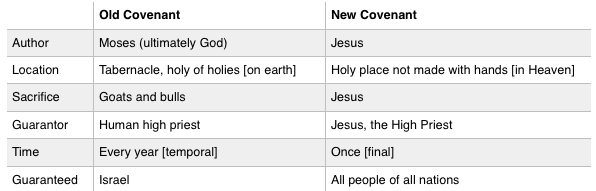
Jesus Himself mediated a new covenant, signed by his blood and sealed by his death (vs.15-23). He was both the mediator and guarantor of the New Covenant. His blood both covered and cleansed man’s sin. Also, his Covenant fulfills and superseded the old covenant Moses carried on tablet down the mount Sinai.

See how Jesus of the new covenant compares to Moses and the old covenant (vs.24-28):

old covenant vs. new covenant

In all aspects, Jesus is greater. Jesus is not a symbol or icon. He is the real deal. The old covenant did its job and pointed to Jesus—the great sacrifice for sin.


Questions for Reflection:

  • How does Exodus 25-26 and Leviticus 16 give definition to Hebrews 9:1-5?
  • How was the old covenant given to Moses ultimately from God?
  • What was the tabernacle, sacrificial system, and atonement meant to symbolize?
  • How do God already have both covenants in mind from before time and creation?
  • Why isn’t the blood of a goat or bull sufficient atonement for the blood of man?
  • Why wasn’t the high priest’s annual atonement sufficient enough for full atonement?
  • How intricate and beautiful is the symbol of Jesus New Covenant?
  • How does Hebrews 9 show two worlds colliding (heaven and earth)?
  • How do we walk in both worlds?
  • What “man-made things” do people often trust in more than God-made things?
  • What sacrifice are you making to try and earn salvation with God or to cover your sins?
  • How will you step boldly and confidently into the sanctuary of God today?

Jesus is the Greater Mediator

When God gives a gift, He gives his best. No one can out do or out give God. He tops the cake. He gives the greatest gift.

What gift could God give that would wow the world? The gift was himself.

The big idea of Hebrews from the beginning until now is that Jesus is the greatest. Above Jesus none is greater! In chapter 8, this idea continues, but focuses moves towards Jesus as the Great High Priest (v.1).

“Now the main point of what we are saying is this: We do have such a high priest, who sat down at the right hand of the throne of the Majesty in heaven, and who serves in the sanctuary, the true tabernacle set up by the Lord, not by a mere human being.

Every high priest is appointed to offer both gifts and sacrifices, and so it was necessary for this one also to have something to offer. If he were on earth, he would not be a priest, for there are already priests who offer the gifts prescribed by the law. They serve at a sanctuary that is a copy and shadow of what is in heaven. This is why Moses was warned when he was about to build the tabernacle: “See to it that you make everything according to the pattern shown you on the mountain.” But in fact the ministry Jesus has received is as superior to theirs as the covenant of which he is mediator is superior to the old one, since the new covenant is established on better promises.

For if there had been nothing wrong with that first covenant, no place would have been sought for another. But God found fault with the people and said:

“The days are coming, declares the Lord,
when I will make a new covenant
with the people of Israel
and with the people of Judah.
It will not be like the covenant
I made with their ancestors
when I took them by the hand
to lead them out of Egypt,
because they did not remain faithful to my covenant,
and I turned away from them,
declares the Lord.

This is the covenant I will establish with the people of Israel
after that time, declares the Lord.
I will put my laws in their minds
and write them on their hearts.
I will be their God,
and they will be my people.
No longer will they teach their neighbor,
or say to one another, ‘Know the Lord,’
because they will all know me,
from the least of them to the greatest.
For I will forgive their wickedness
and will remember their sins no more. ”

By calling this covenant “new,” he has made the first one obsolete; and what is obsolete and outdated will soon disappear.” – Hebrews 8:1-13, ESV

Think about it, at this very moment, Jesus is seated at the right hand of the throne of God. He is ministering in the true Holy of holies that the earthly tabernacle where priests ministered only represented (vs.2-5). Jesus stepped into the role of High Priest and sacrifice. A role only needed once for all.

Jesus ministers a greater covenant on greater promises (vs.6-7). Not only did Jesus minister the covenant, but he was its author, fulfiller, and mediator. The New Covenant that Jeremiah prophesied about was actualized with Jesus’ life and ministry (vs.8-12, cf. Jeremiah 31:31-34). Jesus makes the first covenant obsolete and the second one complete.

Through Jesus there is no need for another priest or covenant ever (v.13). For millennia God’s people had to access God through a middleman like a patriarch, prophet or priest. Jesus became that middleman and now we have forever access to God. What greater gift could God have given us than this?


Questions for Reflection:

  • What are some examples of things you’ve experienced that are “less than the best”?
  • What is a covenant? What covenant have you made? (i.e. family, work, society, etc)
  • What is the Bible’s understanding of a covenant?
  • Why is the first covenant obsolete? What does this mean for Israel?
  • What makes the New Covenant greater?
  • What do you learn about the New Covenant? (vs.8-12) What about the covenant is hard to understand?
  • Where is Jesus now? Why is that so important?
  • What is a mediator? How is Jesus a mediator?
  • Jesus is God’s Great High Priest, but is there anything that can minimize his greatness?
  • What are things you often make greater than Jesus?
  • How is God writing his law on your heart?

Jesus is Greater than Melchizedek

In God’s providence he chose the nation of Israel carry out his purposes and plans. Part of that plan was to give Israel the law and to help them it carry out the law God chose the tribe of Levi to be the priests. The Levite priests taught the people the law and they were responsible to offer sacrifices on behalf of the entire nation. Even though the Levite priests would offer sacrifices for the sins of the people, not one of the priests was without sin himself (v.11).

“If perfection could have been attained through the Levitical priesthood—and indeed the law given to the people established that priesthood—why was there still need for another priest to come, one in the order of Melchizedek, not in the order of Aaron? For when the priesthood is changed, the law must be changed also. He of whom these things are said belonged to a different tribe, and no one from that tribe has ever served at the altar. For it is clear that our Lord descended from Judah, and in regard to that tribe Moses said nothing about priests. And what we have said is even more clear if another priest like Melchizedek appears, one who has become a priest not on the basis of a regulation as to his ancestry but on the basis of the power of an indestructible life. For it is declared: “You are a priest forever, in the order of Melchizedek.”

The former regulation is set aside because it was weak and useless (for the law made nothing perfect), and a better hope is introduced, by which we draw near to God.

And it was not without an oath! Others became priests without any oath, but he became a priest with an oath when God said to him: “The Lord has sworn and will not change his mind: ‘You are a priest forever.’”

Because of this oath, Jesus has become the guarantor of a better covenant.

Now there have been many of those priests, since death prevented them from continuing in office; but because Jesus lives forever, he has a permanent priesthood. Therefore he is able to save completely those who come to God through him, because he always lives to intercede for them.

Such a high priest truly meets our need—one who is holy, blameless, pure, set apart from sinners, exalted above the heavens. Unlike the other high priests, he does not need to offer sacrifices day after day, first for his own sins, and then for the sins of the people. He sacrificed for their sins once for all when he offered himself. For the law appoints as high priests men in all their weakness; but the oath, which came after the law, appointed the Son, who has been made perfect forever.” – Hebrews 7:11-28, ESV

Melchizedek and Jesus show that there was the possibility of another priesthood.  Jesus changes things.  He was from a different priest than the former Levite priest of Israel.

Screen Shot 2017-11-25 at 8.02.00 AM

Jesus is unique and his priesthood is forever.  There is no need for another priest to offer sacrifices.  He stepped into the office of the priesthood though another way. When law was weak and made nothing perfect not even its priests, Jesus offers a better way of drawing near to God. Jesus is the greater hope. Jesus fulfills both the perfect priesthood and perfect sacrifice for sin. Jesus saves us forever, intercedes for us always, and offers complete salvation. This makes Jesus the Greater High Priest.


Questions for Reflection:

  • What was the job description of a Levite priest?
  • How was Jesus a priest? How is he a greater priest?
  • What is a covenant? How does Jesus fulfill all previous covenants?
  • How was Jesus a different priest than the Levite priest?
  • Why is it important that Jesus is a priest forever? What does that mean for you today?
  • Why do you need a high priest? How does Jesus minister to you as priest?

Jesus is a Priest in order of Melchizedek

Have you ever met someone you’ve never met before, but you swear you know them from somewhere? There is a mystery to them. There is an example of this in the Bible when Abraham met the king priest named Melchizedek (Gen.14:17ff). They had never met, but they did have in common a fear of God.

Melchizedek has been a mystery man throughout the centuries. Even Bible scholars are stumped because there isn’t a lot said about him. Some scholars say he was either an angel-man, Christophany, or simply a human.

“This Melchizedek was king of Salem and priest of God Most High. He met Abraham returning from the defeat of the kings and blessed him, and Abraham gave him a tenth of everything. First, the name Melchizedek means “king of righteousness”; then also, “king of Salem” means “king of peace.” Without father or mother, without genealogy, without beginning of days or end of life, resembling the Son of God, he remains a priest forever.

Just think how great he was: Even the patriarch Abraham gave him a tenth of the plunder! Now the law requires the descendants of Levi who become priests to collect a tenth from the people —that is, from their fellow Israelites—even though they also are descended from Abraham. This man, however, did not trace his descent from Levi, yet he collected a tenth from Abraham and blessed him who had the promises. And without doubt the lesser is blessed by the greater. In the one case, the tenth is collected by people who die; but in the other case, by him who is declared to be living. One might even say that Levi, who collects the tenth, paid the tenth through Abraham, because when Melchizedek met Abraham, Levi was still in the body of his ancestor.” – Hebrews 7:1-10

While no one is really sure who Melchizedek was we can conclude that he was a type. A type is an Old Testament person (or practice) that had a counterpart in the New Testament in Jesus Christ. Often times a type showed what the their counterpart would be like. Melchizedek is the OT example of what the NT Jesus would look like and he does “resemble the Son of God.” (v.3)

What is clear from Hebrews 7 is that while Jesus comes from the order of the priest-king Melchizedek, he is far superior. Below are a few ways Jesus is superior (vs.1-3):

Jesus and Melchizedek Comparison

It is interesting that the author of Hebrews doesn’t interpret the story of Melchizedek, but simply shows how Jesus is a priest in his order and that he is a far superior priest to any before him or after him. Through Melchizedek and the OT there is a shadow cast that Jesus brings light to. The entire OT points to Jesus.


Questions for Reflection:

  • Who was Melchizedek?
  • How are Jesus and Melchizedek similar? How are they different?
  • How is Jesus superior to Melchizedek?
  • Why is Melchizedek an important Bible character? Why is he important to understanding Jesus?
  • What do you learn about Jesus’ uniqueness and his unique role from this biblical text?

Jesus is the Greater Promise

When someone makes a promise they will often swear to keep that promised based on something like “my good name” or  “on my mother’s grave” (v.16). If they do not keep the promise then their name is on the line with the threat of their name being tarnished or trust in them diminished.

“For when God made a promise to Abraham, since he had no one greater by whom to swear, he swore by himself, saying, “Surely I will bless you and multiply you.” And thus Abraham, having patiently waited, obtained the promise. For people swear by something greater than themselves, and in all their disputes an oath is final for confirmation. So when God desired to show more convincingly to the heirs of the promise the unchangeable character of his purpose, he guaranteed it with an oath, so that by two unchangeable things, in which it is impossible for God to lie, we who have fled for refuge might have strong encouragement to hold fast to the hope set before us. We have this as a sure and steadfast anchor of the soul, a hope that enters into the inner place behind the curtain, where Jesus has gone as a forerunner on our behalf, having become a high priest forever after the order of Melchizedek.” – Hebrews 6:13-20

God is a promise keeper. When God makes a promise he swears by his own name because he himself is trustworthy and reliable (v.13, 17). He is the only one qualified to make an oath by himself because there is nothing greater to swear by than himself. He has never failed to keep a promise because he never lies or fails (v.18).

One of his most well known promises in Scripture was to given Abraham. God promised to bless Abraham’s lineage and multiply it (v.14). Abraham trusted God’s promise by doing what God asked even though the information Abraham had on hand was limited (v.15).

The promise given to Abraham finds its ultimate fulfillment in Jesus who was a high priest in the order of Melchizedek—a priest during Abraham’s day. Jesus is the sure and steadfast anchor for the soul (v.19). We can hope in Jesus because God has promised him to be our high priest. He has gone before us and sits at the right hand of God on high (v.20).

May you anchor your soul into the Rock called Jesus. Even in the stormy seas that batter you with doubts and despair, his promises are sure to the end. Remember, how he has been with you and has been faithful. As G. Campbell Morgan said, “I believe the promises of God enough to venture an eternity on them.”


Questions for Reflection:

  • What makes a promise valuable?
  • What promises did God make to Abraham? (see Genesis 12)
  • What are some promises from God that we have that Abraham didn’t?
  • What makes God and his promises so “sure and steadfast”?
  • How does the author of Hebrews describe the certainty of God’s promise— the anchor?
  • What are some of the anchors other than Jesus that people chain themselves to?
  • How can you encourage one another “to hold fast to the hope set before us”?

Jesus is the Greater Hope to the End

With the advent of the TV, computers, spectator sports, desk jobs and early retirement, we’re sitting down more than ever before in history. Researchers calculate the average person sits 9.3 hours a day, which is more time than the average person spends sleeping (7.7 hours). So that means 17 hours a day we are on our backs or behinds.

Laziness is one of those undiscussed sins. However, the author of Hebrews unashamedly discusses it. He particularly warns against spiritual laziness. Laziness is a form of pride that says, “I don’t care what others (including God) want me to do I am going to do what I want and sit right here.” Laziness is a regression of faith.

“Though we speak in this way, yet in your case, beloved, we feel sure of better things—things that belong to salvation. For God is not unjust so as to overlook your work and the love that you have shown for his name in serving the saints, as you still do. And we desire each one of you to show the same earnestness to have the full assurance of hope until the end, so that you may not be sluggish, but imitators of those who through faith and patience inherit the promises.” – Hebrews 6:9-12

A church or community of faith becomes lazy when we allow erroneous teaching to infiltrate the church and do nothing about it. While the church may have started strong, it slowly slipped into passiveness and procrastination. Spiritual laziness is not caring about the wonderful promises we have now and later through our salvation and not protecting or promoting it to the next generation.

The best way to progress in your faith and prevent spiritual regression is to serve one another. Help one another to stand, exercise your minds, and fight for truth. That takes effort, but in the long run it will guard you and the community from spiritual lethargy. Serving one another is a sure remedy, but not the sole remedy.

The author of Hebrews has no intention to scare his brothers and sisters into changing, but to assure them of the greater hope that is to come. Better things are to come. Better things for those who wait and hope in God’s promises from now until the end of time.

Jesus is a greater hope than my hope in leisure, ease, or unmet desires. Jesus not only redeems our souls from the pit, he also redeems all aspects of our lives—our time, our attitude, and our work ethic. Look to Christ and invite him to redeem your life and to redeem your time.


Questions for Reflection:

  • What are some ways Christians have become faith-lazy today? What are some examples of spiritual regression you’ve witnessed in the church?
  • What are the marks of spiritual “progression?
  • What can lead one to lack patience or lose assurance of hope until the end?
  • What “better things” or promises we will inherit in the end?
  • Who are some biblical examples worth imitating and that encourage you to have faith and patience to the end?
  • How does serving one another often remedy spiritual laziness?

Jesus is the Greater Hope

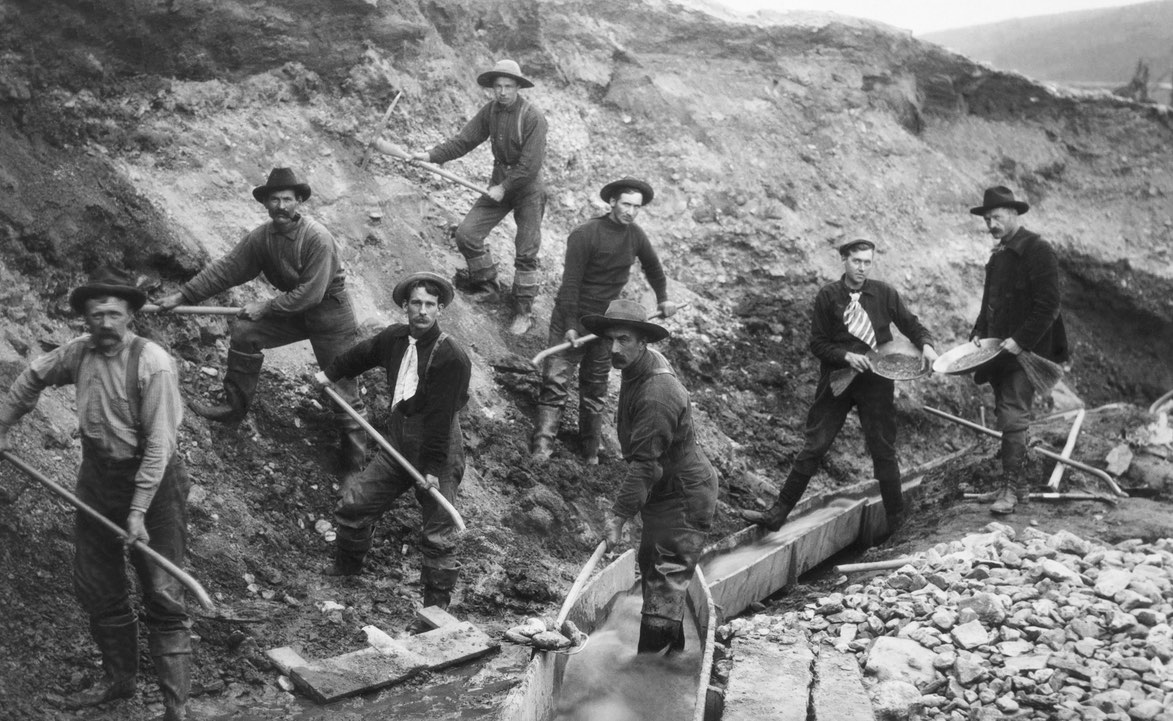
Before 1849 California was declared a waste land and said to have the least resources of any place on the North American continent. That was until the gold rush. Thousands of people left family and home in the hope of striking it rich. Some did, but most didn’t. The gold rush left many more impoverished and hopeless than before. For many California was indeed a waste.

Everyone is in search of hope. Yet we live in a world of pain, disappointment, doubt, and hardship. God may even seem distant and uninvolved. Hope in this world seems fleeting and lost. Where is lasting hope to be found?

Everyone places hope in people. We put our hope in parents, spouses, children, friends, teachers and leaders. We are in constant search for vibrant life-giving teaching that will wow our socks off and stir our affections. While that teaching can be found, its content must never compromise the truth (5:11-12a).

“About this we have much to say, and it is hard to explain, since you have become dull of hearing. For though by this time you ought to be teachers, you need someone to teach you again the basic principles of the oracles of God. You need milk, not solid food, for everyone who lives on milk is unskilled in the word of righteousness, since he is a child. But solid food is for the mature, for those who have their powers of discernment trained by constant practice to distinguish good from evil.

Therefore let us leave the elementary doctrine of Christ and go on to maturity, not laying again a foundation of repentance from dead works and of faith toward God, and of instruction about washings, the laying on of hands, the resurrection of the dead, and eternal judgment. And this we will do if God permits. For it is impossible, in the case of those who have once been enlightened, who have tasted the heavenly gift, and have shared in the Holy Spirit, and have tasted the goodness of the word of God and the powers of the age to come, and then have fallen away, to restore them again to repentance, since they are crucifying once again the Son of God to their own harm and holding him up to contempt. For land that has drunk the rain that often falls on it, and produces a crop useful to those for whose sake it is cultivated, receives a blessing from God. But if it bears thorns and thistles, it is worthless and near to being cursed, and its end is to be burned.” – Hebrews 5:11-6:8

In this, the third warning in the book of Hebrews, we warned to beware of false and flashy teaching that sweeps in and takes the place of true teaching. Our ears often are drawn to the newest self-help fad or smooth-talker. The author of Hebrews calls dull ears to listen and become wowed again by the basic teaching of God, discern what is true, then move on from those teachings to other doctrines (6:1-8).

When one starts primary school he will learn the ABC’s so that he might read words, sentences, books— in fact, anything in literature. The challenge is to renew a passion for basics of faith, which are the building blocks to a deeper hunger to know the wonders of God and be wowed again by him (vs.12b-14).

The greatest and lasting hope in this world is indeed found in a person—The Word who became flesh (John 1:14). Hope is found in Jesus. His teachings are richer than gold for the soul. Dig into his words and the deeper you go the more hope you will find.


Questions for Reflection:

  • What are the basics of faith?
  • How are the basics important to understanding the more complex issues of faith?
  • Where does our culture turn for help to grow wiser, stronger, and more mature?
  • What is the danger of becoming too familiar with the basic principles of God?
  • What is the opposite of dull hearing? How can you cultivate vibrant hearing? What illustrations in the passage help you understand the difference?
  • What wows you about God? What do you want to know more about him?
  • How can you stir others towards a greater hope in Jesus?

Jesus is the Greater Priest

Each of us carry a weigh of responsibility. Whether we are spouse, parent, student, or employee we have people around us or under us that can demand our care.

Up until 70 AD Israel had high priest who would bear the weight of responsibility of the entire nation of Israel and plead to God on their behalf for the forgiveness of their sins. What an enormous responsibility and yet he was just a mere man chosen among men to act on behalf of men (v.1).

“For every high priest chosen from among men is appointed to act on behalf of men in relation to God, to offer gifts and sacrifices for sins. He can deal gently with the ignorant and wayward, since he himself is beset with weakness. Because of this he is obligated to offer sacrifice for his own sins just as he does for those of the people. And no one takes this honor for himself, but only when called by God, just as Aaron was.

So also Christ did not exalt himself to be made a high priest, but was appointed by him who said to him, “You are my Son, today I have begotten you”; as he says also in another place, “You are a priest forever, after the order of Melchizedek.”

In the days of his flesh, Jesus offered up prayers and supplications, with loud cries and tears, to him who was able to save him from death, and he was heard because of his reverence. Although he was a son, he learned obedience through what he suffered. And being made perfect, he became the source of eternal salvation to all who obey him, being designated by God a high priest after the order of Melchizedek.” – Hebrews 5:1-10

Interestingly, every high priest was weak and inadequate for the job and needed to seek forgiveness for his sins before he could ask for the forgiveness of the sins of the nation (vs.2-3). No priest was perfect or chosen for the job because he was somehow super spiritual. The honor of the high priest, including Aaron (the first Levitical priest), was not earned, but given by God (v.4).

Jesus was also given the title of high priest (v.5). Unlike other priests, He obeyed God in all things and was sent to earth to be the sacrifice for sin (vs.5, 7-8). A sacrifice that was once and for all. Jesus is unique among high priests in that he did not need to atone for his own sins because he is sinless (v.9). This makes Jesus the greater high priest; your great high priest.


Questions for Reflection:

  • What was the job of the priest? How was this a compassionate job?
  • How did the priest prepare for his job? Why did he need to deal with his own weakness?
  • How is Jesus more compassionate and prepared for the job?
  • How does Jesus’ suffering and sympathy help you to have confidence in God?
  • How does Jesus’ example encourage you to show compassion to another sinner?
  • Dig Deeper: Who was Melchizedek? (Gen. 14:17-20; Ps. 110:4) What does it mean that Jesus is in the order of Melchizedek? What does the relationship between Jesus and Melchizedek tell you about God’s orchestration of history?


Side Notes: Scholars don’t know much about Melchizedek. He is a symbolic picture of Jesus Christ. Long before Moses, Melchizedek was a Canaanite priest-king in a city that centuries later became Jerusalem and he was the head of an order of Jerusalem priests older than Moses’ brother Aaron.

Jesus Gives Greater Access to God

I live only a few blocks from the sultan’s palace. The sultan is a king who rules over his tribe. Most days he is sitting in his palace, giving counsel, and ruling over matters concerning his people. When visiting the sultan there is a certain protocol. One cannot burst in and demand what he wants without consequences. In order to gain access to the king you first approach the palace and wait for permission to see him. If permission is granted you remove your shoes and hat and sit at a distance. If you wish to speak you wait until you are invited. The sultan is not always accessible. Some days you have to come back and try again.

When gaining access to the King of kings it is different. While he is holy and to be revered, he invites anyone to approach him anytime. He is never too busy to give ear to what you have to say. Isn’t that is incredible? The King of the universe is always accessible.

“Since then we have a great high priest who has passed through the heavens, Jesus, the Son of God, let us hold fast our confession. For we do not have a high priest who is unable to sympathize with our weaknesses, but one who in every respect has been tempted as we are, yet without sin. Let us then with confidence draw near to the throne of grace, that we may receive mercy and find grace to help in time of need.” – Hebrews 4:14-16

How is accessing God possible. First, Jesus makes accessing God possible through his sacrifice (v.14). Without Jesus access to God would be impossible because of sin I am too unholy to be in the presence of the King of kings in the holy of holies. Ironically, the high priest and intercessor for sin also became the sacrifice for sin.

Second, Jesus makes accessing God possible because he is my sympathizer (v.15). Jesus knows what its like to walk in my shoes. He knows the temptations I face, yet he never succumbed to them. Therefore he knows the full weight of temptation because he overcame temptation without sinning. Knowing that God is a sympathetic King means accessing him is a joyful thing not a fearful one.

Finally, Jesus makes it possible to stand before God’s throne with confidence, particularly in my time of need. I may be tempted to think I need a better something, but what I need most is a better Someone. I need Jesus.

One of the greatest stories in the Bible that shows the accessibility of God is in Luke 7:36-50. The main character is a woman who had a sinful reputation. When she learned that Jesus was eating at a Pharisee’s house she confidently enter the room with an alabaster jar of perfume. As she stood behind Jesus at his feet weeping, she began to wet his feet with her tears. Then she wiped them with her hair, kissed them and poured perfume worthy of a king on them. As the religious leaders balked, the woman bowed knowing who Jesus was. She knew Jesus was her forgiver and sympathizer. She needed Jesus and he was accessible. Through Jesus you too have unlimited access to God anytime, anywhere.


Questions for reflection:

  • What does God see as our greatest need if Jesus is given the title great high priest?
  • How is Jesus a greater high priest than the OT priests? How were OT priests inadequate? How does Jesus fulfill what they could not? (Leviticus 16)
  • How can Jesus be sympathetic towards our temptation yet never have succumb to it?
  • Where does the confidence come from to draw near to the throne of God?
  • Read Luke 7:36-50. What does this story teach you about what kind of King Jesus is? How will you approach the him today confidently?

Jesus is the Greater Rest

We are busier than ever. We think to ourselves, if only there was more hours in a day. If only rest or sleep weren’t so necessary. There is always pressure to do more, to work harder, and to rest less. Our egos are boosted by what we can get done but in the process we are sacrificing our souls. The busier we are the less we rest and the more we are exhausted by an always-demanding slave master.

Busyness isn’t a sin. Work is necessary and good. God is pleased by hard work. But being busy in an endless pursuit of things that leave us empty and unsatisfied cannot be pleasing to God. Sometimes the most godly thing we can to is stop and listen. We need to be still. We need to rest.

There is only One who never stops working. One who never tires. One who never takes a break. He is God. Even when he rested on the seventh day of creation it wasn’t because he was weary, but because he knew humans needed an example and would be exhausted from six days of hard work. God is wise. Rest is wisdom from God.

Rest for Israel was more than just sabbath rest or a much needed vacation in the Promised Land after wandering in the Wilderness for 40 years (Ex.34:6-7). It was a temporary rest that pictured a greater rest to come—an eternal rest with God forever. Rest ultimately is being with God, a heavenly rest.

There are five important times in history that God offered rest to humanity: 1) Creation (Hebrews 4:4; cf. Gen. 2), 2) David in the midst of battling (v.7), 3) Wandering in the Wilderness (v.5; Ps. 95:7-11), Joshua enters the Promised Land (v.8), and our Sabbath salvation (v.9). The final rest is ultimately secured for us in Christ. Jesus is the greater rest.

Therefore, while the promise of entering his rest still stands, let us fear lest any of you should seem to have failed to reach it. For good news came to us just as to them, but the message they heard did not benefit them, because they were not united by faith with those who listened. For we who have believed enter that rest, as he has said, “As I swore in my wrath, ‘They shall not enter my rest,’” although his works were finished from the foundation of the world. For he has somewhere spoken of the seventh day in this way: “And God rested on the seventh day from all his works.” And again in this passage he said, “They shall not enter my rest.”

Since therefore it remains for some to enter it, and those who formerly received the good news failed to enter because of disobedience, again he appoints a certain day, “Today,” saying through David so long afterward, in the words already quoted, “Today, if you hear his voice, do not harden your hearts.”

For if Joshua had given them rest, God would not have spoken of another day later on. So then, there remains a Sabbath rest for the people of God, for whoever has entered God’s rest has also rested from his works as God did from his.

Let us therefore strive to enter that rest, so that no one may fall by the same sort of disobedience. For the word of God is living and active, sharper than any two-edged sword, piercing to the division of soul and of spirit, of joints and of marrow, and discerning the thoughts and intentions of the heart. And no creature is hidden from his sight, but all are naked and exposed to the eyes of him to whom we must give account. (Heb. 4:1-13)

Rest is a means of showing God’s care and grace to his people. It bolsters our faith and trust in God, today.  It reminds us to realign our strength. When life punches us in the gut we can trust that God is faithful and we can trust and obey him, even when we feel like giving up in moments of exhaustion. Resting in King Jesus is the great remedy for the soul.


Questions for Reflection:

  • What is exhausting you right now? How is God calling you to rest as a result of this passage?
  • What do you fear the most? What do you fear that could reveal an unbelieving heart?
  • How is the illustration of Israel’s unfaithfulness and unbelief helpful for us?
  • How do you respond when life punches you in the gut?
  • What does it look like to get serious about your spiritual heart condition? (v.12-13)
  • How is the Word of God a powerful and penetrating scalpel to help expose the heart?
  • How is giving a heart check or exam a community process? (vs. 2, 11-13)

Jesus offers rest to rebels

Western culture has made rebellion an “in” thing. Just listen for a few seconds to the news media talk about the nations leaders or watch how Hollywood portrays the bad guy as the likable hero. Rebellion isn’t just the product of the Roaring 20’s or Rockin’ 50’s and 60’s, but youth and adult alike from every generation are prone to private and public disrespect of authority.

Israel had been slaves in Egypt for hundreds of years. Yet God did not forget them (Ex. 2:23ff). In fact, he showed them immense mercy by raising up Moses to lead the people of Israel out of Egypt through extraordinary miracles. It didn’t take long for the people of Israel to forget all the miraculous things God had done to free them from the hardships in Egypt. You’d think after all they saw God do it would be enough to keep them on the straight and narrow, but within three days they were already complaining. Their hearts became hard. And for 40 years they wandered in the Wilderness until they reached the border of the Promised Land. Many, including Moses, did not enter “[God’s] rest” because of the people collective rebellion (vs.7-11, 16-19)

Therefore, as the Holy Spirit says,
“Today, if you hear his voice,
do not harden your hearts as in the rebellion,
on the day of testing in the wilderness,
where your fathers put me to the test
and saw my works for forty years.
Therefore I was provoked with that generation,
and said, ‘They always go astray in their heart;
they have not known my ways.’
As I swore in my wrath,
‘They shall not enter my rest.’”

Take care, brothers, lest there be in any of you an evil, unbelieving heart, leading you to fall away from the living God. But exhort one another every day, as long as it is called “today,” that none of you may be hardened by the deceitfulness of sin. For we have come to share in Christ, if indeed we hold our original confidence firm to the end. As it is said, “Today, if you hear his voice, do not harden your hearts as in the rebellion.”

For who were those who heard and yet rebelled? Was it not all those who left Egypt led by Moses? And with whom was he provoked for forty years? Was it not with those who sinned, whose bodies fell in the wilderness? And to whom did he swear that they would not enter his rest, but to those who were disobedient? So we see that they were unable to enter because of unbelief.” – Hebrews 3:7-19

When the author of Hebrews says, “Take care,” it is meant to be a warning to all generations who follow Jesus (v.12). Like Israel, we are prone to wander. Our hearts gravitate towards hardness and anti-authority. We are bent towards unbelief in God’s character and promises. No one is exempt.

At the heart of every problem is the problem in the heart. The heart grows hard. Yet there is a cure: a tender teachable heart. Intentionally surround yourself with brothers and sisters who will frequently challenge and correct your heart and be open to changing the attitude of your heart (vs.13-14; 10:23-25). If not we will fall into the same mindset as Pharaoh, who heard from God’s servant and saw many supernatural wonders, but rejected God flat out and became hardhearted.

A rebels heart is never at rest. Rest is found when you joyfully trust God, willingly submit yourself to the community of faith, and lovingly exhort one another. Enter his rest.


Questions for Reflection:

  • What is the meaning of “rest” (v.11)?
  • Why are people, even Jesus followers, prone to wander, hardheartedness, and bent on unbelief?
  • What leads to a hard heart? What are the dangers of developing a hard heart?
  • Why is the responsibility of all Christians to share the load in encouraging one another to have a tender and teachable heart?  Who do you allow to ask tough questions of your heart?
  • How can we exhort one another every day, stir one another in their faith and confidence, and share the load of helping one another not to be hardened by sin?

Jesus is Greater than Moses

“Therefore, holy brothers, you who share in a heavenly calling, consider Jesus, the apostle and high priest of our confession, who was faithful to him who appointed him, just as Moses also was faithful in all God’s house. For Jesus has been counted worthy of more glory than Moses—as much more glory as the builder of a house has more honor than the house itself. (For every house is built by someone, but the builder of all things is God.) Now Moses was faithful in all God’s house as a servant, to testify to the things that were to be spoken later, but Christ is faithful over God’s house as a son. And we are his house, if indeed we hold fast our confidence and our boasting in our hope.” – Hebrew 3:1-6

Moses is a legend and hero among the Jewish people. In miraculous fashion, he led the children of Israel out of Egyptian slavery to the border of the Promised Land (v.2). God gave him the Law, he built the tabernacle marking the presence of God with his people, and he was an example of faithfulness (Num. 12:7; Heb. 11:26-29).

As much of a star Moses was in history and Scripture, Jesus is even more stellar. Consider Jesus. Take a good look at him. He became a servant and man. He was faithful to do all the Father sent him to do as Apostle and High Priest (v.1). Even Moses, prophesied about him, the Greater One who would come after him (v.5; Deut. 18:15-19).

Jesus is worthy of greater glory than Moses simply because Jesus is the Creator and center of all things (v.3), he is the builder and architect of the house in which Moses served, fulfiller of the Law (cf. 8:5; 10:1), he is the heir and ruler of all things (v.6), he is the master-servant, and he is the author salvation (v.4). There isn’t a man in all of history who can make that claim except Jesus.

We have no greater hope than Jesus. When you consider the greatness of Jesus it encourages and empowers your faithfulness to endure in your heavenly calling (v.1), which you share with other believers and members of the house of God (v.6) who are wandering this world eagerly awaiting the eternal Promised Land.


Questions for Reflection:

  • Why might Jews have thought Moses was greater than Jesus?
  • How are Jesus and Moses similar? How is Jesus greater than Moses?
  • What is your heavenly calling? (v. 3:1; Eph. 4:1; Phil. 3:14) How is it a shared calling?
  • How will you consider Jesus and hope in him today? In what areas is God calling you to be faithful?

Jesus is the Greater Savior

“For it was not to angels that God subjected the world to come, of which we are speaking. It has been testified somewhere, “What is man, that you are mindful of him, or the son of man, that you care for him? You made him for a little while lower than the angels; you have crowned him with glory and honor, putting everything in subjection under his feet.”

Now in putting everything in subjection to him, he left nothing outside his control. At present, we do not yet see everything in subjection to him. But we see him who for a little while was made lower than the angels, namely Jesus, crowned with glory and honor because of the suffering of death, so that by the grace of God he might taste death for everyone.

For it was fitting that he, for whom and by whom all things exist, in bringing many sons to glory, should make the founder of their salvation perfect through suffering. For he who sanctifies and those who are sanctified all have one source. That is why he is not ashamed to call them brothers, saying, “I will tell of your name to my brothers; in the midst of the congregation I will sing your praise.”

And again, “I will put my trust in him.”

And again, “Behold, I and the children God has given me.”

Since therefore the children share in flesh and blood, he himself likewise partook of the same things, that through death he might destroy the one who has the power of death, that is, the devil, and deliver all those who through fear of death were subject to lifelong slavery. For surely it is not angels that he helps, but he helps the offspring of Abraham. Therefore he had to be made like his brothers in every respect, so that he might become a merciful and faithful high priest in the service of God, to make propitiation for the sins of the people. For because he himself has suffered when tempted, he is able to help those who are being tempted.” – Hebrews 2:5-18

We live in a world fascinated by saviors. Every summer the masses cram into cinemas with bubbly drinks and buttery fingers to watch the next Marvel or DC hero duke out good versus evil. Yet no superhero or man in human history can touch Jesus’ feat.

Jesus was the founding member of the Universe Club. He was there. He spoke the universe into existence. He was not only the founder of creation, he was also the founder of salvation for all mankind (v.10). Wow. The always existing God stepped into time and skin to sacrifice himself for man’s greatest need: the curse of sin (vs.7-8).

What did you do to deserve such a heroic salvation? Not a thing. For a moment, think about all that Christ did for you. He became a man “becoming a little lower than the angels” by taking on human flesh like yours (vs.9, 14). He took your place on the cross. He tasted your death and curse. He restored your relationship to God. He led the way to your salvation through his suffering (v.10). He became your brother and sanctifier (vs.11-13). Ultimately, he succeeded where you failed (v.15, 17-18). And that’s a very good thing for if he didn’t save you nothing you do could save yourself.

Compared to Jesus all comic book characters or nonfictional heroes are piddly and have imperfections. Jesus is the perfect real-life Savior who he deeply cares for the downtrodden, distressed, and destitute (vs.5-6). No other Savior can fulfill the promise that Jesus can by becoming the curse for sin. He is truly heroic. That makes him your great Savior and worthy of your trust.


Questions for Reflection:

  • What makes Jesus the founder of our salvation?
  • How is our salvation made perfect through the suffering of Christ?
  • Why was it necessary for Jesus to come to earth to become your Savior?
  • How can Jesus free you from the fear of death? Or help you when tempted?
  • How does this passage funnel glory to Jesus the great Savior?
  • How can you make yourself lesser and Jesus greater? (Mt. 18:1-6; 23:11-12)