Oh, that I would decide to give thanks

by kylie j lloyd

“Thankfulness is the attitude that perfectly displaces my sinful tendency to complain and thereby release [God’s] joy and blessing into my life.” (James MacDonald, Lord Change My Attitude, p.45)

It is easy to shift from being thankful to being unthankful. For me, it only takes a moment. I’ve already caught myself saying, “I am tired of speaking in French today. I can’t even order the right thing at the restaurant. Am I ever going to see my wife and kids? It’s cold outside already? What? No appliances are provided from my friends new apartment! That’s bogus.”

But then God used a verse of a song written a few thousand years ago. Psalm 107:1, “Oh, that men would give thanks to the LORD for His goodness.” (cf. vs. 8, 15, 21, 31) God, like a master chef, using this verse to tenderize my heart with 3 important truths:

1) Thankfulness is a decision: “Oh, that men would give thanks…”

Notice that the psalmist did not say, “COULD”. What difference would it make if it said could? “Could” makes being thankful contingent on my ability, “I could if be thankful if my situation were better.” Would is a word used to agree or be okay or to be willing to comply. No matter my day, circumstance, or influences from people around me, I have the capability to be thankful. I have the responsibility to be thankful. I must decide to be thankful.

I remember the year after college I visited a friend in Ukraine. He took me to a small town where we popped in on a Sekret family to encourage them. I remember being greeted at the door by the Alexander and wife and their 7 children. Their home was a 1-bedroom shack that was cold and smelled musty. Immediately the husband excused himself and left the premises for about 10 minutes. When he came back, his wife excused herself and they were doing something in the kitchen for about 10 minutes. Meanwhile I was sitting on a wooden chair looking at the 7 children staring at me. Neither of us could speak each other’s language. After minutes of awkward silence Alexander and his wife entered with bread, spicy mustard, Russian sausage, cooked cabbage, and beets. They asked me to come to the table. I stood by a bed near the cramped table and Alexander prayed, I don’t remember much Ukrainian, but I do remember, “Slava Bog, doosha smachna” (meaning: Praise God for this food…) My friend told me after we left that the style of meal they made for us was equivalent to our Thanksgiving. I will never forget the spirit of thankfulness in the eyes of the Sekret family.

Why are we not more thankful? Could it be we are use to having so much? Emerson once said, “If the stars would come out only once a year, everyone would stay up all night to behold them.”

B.B. Warfield said,

“We are frequently told, indeed, that the great danger of (Christians) lies precisely in his constant contact with divine things. They may come to seem common to him, because they are customary. As the average man breathes the air and basks in the sunshine without ever a thought that it is God in His goodness who makes the sun to rise on him. Other men, oppressed by the hard conditions of life, sunk in the daily struggle for bread perhaps, distracted at any rate by the dreadful drag of the worlds work, find it hard to get time and opportunity so much as to pause and consider whether there be such a God, and religion, and salvation from the sin that compasses them about and holds them captive. The very atmosphere of your life is these things; you breathe them in at every pore; they surround you, encompass you, and press in upon you from every side. It is all in danger of becoming common to you! God forgive you, you are in danger of becoming weary of God!”

2) Thankfulness is a decision based on divine reality: “give thanks to the Lord for His goodness.”

“I will give thanks to the LORD because of his righteousness and will sing praise to the name of the LORD Most High.” (Psalm 7:17) “We give thanks to you, O God, we give thanks, for Your Name is near; men tell of Your wonderful deeds.” (75:1) Praise the LORD. Give thanks to the LORD, for He is good; His love endures forever.” (106:1)

Giving thanks is a decision based on Divine Reality. When I consider the character of God and believe He is true and acknowledge His ways are good, my perspective of the situation is different than the worlds. If you’ve read Robinson Crusoe you see how his perspective changes as He reads about the God of the Bible. His demeanor says, “I have been on this deserted island for 28 years…but it is beautiful. I am sick of these coconuts…at least it’s food! I am all alone…but at least I don’t have to worry about traffic or lines or loud neighbors.”

3) Thankfulness is a life-changing decision: “Oh…”

“Oh” is a word that comes “from the gut.” It’s a word you say when you really want to express deep emotion. Let’s say it together, Oh!” Say it like you mean it.

Moses said, “I will proclaim the name of the LORD. Oh, praise the greatness of our God!” (Deut. 32:3)
Isaiah said, “Oh, look upon us, we pray, for we are all Your people.” (64:9)
David sang, “Oh, how I love Your law! I meditate on it all day long.” Psalm 119:97
Job said, “Oh, how I wish that God would speak,” (11:5)
Elisha prayed, “Oh, my lord, what shall we do?” the servant asked.” (2 Kings 6:15)

I desire Psalm 107:1 and Psalm 105:1 be my prayer,“Oh give thanks to the Lord; call upon His name; make known His deeds among the peoples” Oh, that I be thankful for Your Word. Oh, that I be thankful for my salvation. Oh, that I be  thankful for Your provisions. And make it known to all how good You are.

the God who knows it all

Have you ever been called a “know-it-all”? If so, it’s usually not a compliment. When someone calls you a “know-it-all,” they are sarcastically saying, “You don’t know as much as you think you do and I hope soon realize how little you actually know!” Ouch.

Does anyone really know it all? Yes, in fact there is One: God. God knows it all. His knowledge is instantaneous, total, and completely retentive. God knows what He knows without any kind of research, education, or strenuous study. He never had to go to school, take a test, or be informed about anything. You will never surprise Him with some new fact or beat Him at Trivia Pursuit. You can never tell God something He doesn’t already know; He knows it all. He knows when a sparrow dies, and He knows the number of the hairs on your head (Matthew 10:29–30). Even the number of hairs I am losing by the minute! In short, He is omniscient. His knowledge is eternal and infinite.

“Oh, the depth of the riches and wisdom and knowledge of God! How unsearchable are his judgments and how inscrutable his ways! “For who has known the mind of the Lord, or who has been his counselor?” “Or who has given a gift to him that he might be repaid?” For from him and through him and to him are all things. To him be glory forever. Amen.” (Romans 11:33-36′ cf. Psalm 139:17-18)

He knows you, even better than you know yourself.

David is king over all of Israel. Every person in his kingdom knows him as king. Although he is king, he doesn’t know everyone in his kingdom personally. However, He does know and honor the One who does know all and He knows David. He is God and He is King of kings.

In Psalm 139, David composes a song that grapples with God’s omniscience. He brings God—who many want to put at a distance—close to home. God’s knowledge of you is personal as it gets. To David, God’s omniscience is not just theological or philosophical—it’s relational and personal. Notice the personal pronouns: “Lord, you have searched me and known me. You know my sitting down and my rising up. You understand my thought afar off” (vs.1–2).

God knows your thoughts even before you think them (vs.3-4). God knows what you really believe about Him, not just what you say about Him. He knows where you stand. He knows your real opinions. He knows your motives. He knows your heart (2 Chronicles 6:30). He knows the real you.

He knows you better than you know yourself. He can see your blind spots; sins of which you are unaware (v.3, 24), or for which you make excuses. Proverbs teaches that God’s knowledge is personal: “All the ways of a man are clean in his own sight, but the Lord weighs the motives” (16:2); “Every man’s way is right in his own eyes, but the Lord weighs the hearts” (21:2). There is also a positive aspect to God’s omniscience: God also sees and approves of your service, even if no one else notices (Hebrews 6:10).

You will never know-it-all, but that is reason to worship.

Do you mind God knowing everything about you? Or do you feel that’s awfully intrusive? When David says “Search me, O God, and know my heart” (Psalm 139:23), it’s a prayer inviting God to know more (even though that’s not possible). That’s a humble and vulnerable prayer. It’s giving Him the key to your darkest parts and inner chambers of your heart.

You might be intelligent. You might be a 4.0 student and aced your SAT. You might be a Ken Jennings and be the best at Jeopardy. The world might label you a genius and honor you with the Noble Prize, but compared with God, you know nothing. Your knowledge is never comprehensive. Nor do you know what is best for your own sake. Ask God to show you the truth about yourself so that He might make you wise (Psalm 139:23–24).

When trying to wrap my brain around God’s omniscience—and all His divine attributes—it it easy to blow a fuse. God’s ability transcends my reality, therefore, it’s best to just bow to His immensity. God is always greater than my present knowledge of Him. If God were small enough for my brains, He wouldn’t be big enough for my needs (cf. Matthew 6:8, 32).

God indeed “knows it all.” By His very nature, without having to learn anything, He already knows everything—past, present, and future. My response to His knowledge: worship and adoration,

“Such knowledge is too wonderful for me; it is high; I cannot attain it.” (Psalm 139:6)

“How precious to me are your thoughts, O God! How vast is the sum of them! If I would count them, they are more than the sand. I awake, and I am still with you.” (Psalm 139:17-18)

the God who is sleepless in Seattle

On Sunday afternoon I took a nap. I was not alone. My wife and two daughters also were tuckered out and took naps too. Sunday afternoon naps are almost traditions in our home. Some cultures have built-in siestas to rest midday. Scientists say I am asleep one-third of my our life.

God was the first Person to rest.

When God created the world He worked six-days and rested on the seventh. He rested not because He was tired or needed a day off to get His other work done, but set an example to His creation that would need rest. We humans are weak and need rest.

If it was up to mankind we would sleep less and work or play more. That’s why we say, “There are only 24 hours in a day.” But God knew our temptation would steer us into the direction of being either a workaholic or sloth, both being a distraction from true rest.

When God gave the Law to Moses, the fourth of the Ten Commandments said, “Remember the Sabbath day and keep it Holy.” Sabbath means rest. God knows we need a day of rest and refocus. Sometimes we think we might miss out on something in life if we do not cram-pack every minute of every day with something. Yet we can miss out on life itself if we do not obey this command.

Jesus confronted the religious leaders of His day about this very thing (Mark 2:27 “The Sabbath was made for man, not man for the Sabbath.”). They were so OCD about not working on the Sabbath that they wrote a ‘book of rules’ to protect themselves from disobeying the law, all the while they were missing the real purpose of the Sabbath: to worship God. We are over worked and under-worshipped. God created rest for worship.

Idols sleep, but God does not sleep.

In 1 Kings 18, there is a famous duel between the Prophet Elijah and hundreds of prophets of Baal. Elijah challenges the prophets to build an altar and call to their god to bring down fire upon the altar. The God who answers is God. Elijah urges the prophets of Baal to go first. They eagerly accept and spend all day trying to coerce their god into action. Nothing happens. Elijah cannot rest a poke: “Cry aloud: for he is a god; either he meditating, or he is pursuing, or he is away on a journey, or he is sleeping, and must be awakened.” When the prophets of Baal had given up Elijah stepped up to the altar, ordered it to be drenched with water, and then called to God prayerfully. Immediately God rocketed down flames of fire that utterly consumed the altar. The God of Israel reigned that day as the One True and Living God.

The idol Baal was asleep. Sooner or later the idols men create begin to mimic the men who created them; asleep. What’s the cure? Wake up and worship the One True and Living God. He has characteristics like men because men are made in His image. Yet He is not like men. Men are to be like Him.

God does not sleep. When the Scripture that God does not sleep it refers to His unceasing care for His people (Ps. 121:4). He does not grow weary or tired of passionately pursuing their hearts so that His people respond in faith (Isa. 40:28; 7:13; Mal. 2:17).

Jesus got tired and slept, but He was still sovereign.

Jesus was human. Therefore He was subject to human weaknesses like hunger (Mt. 4:2), thirst (John 4:7; 19:28), pain (1 Pt. 4:1), and weariness (John 4:6). When Jesus got tired He slept.

In Mark 4:35-41, Jesus and His discipled crawled into a boat after a long day of ministry. Jesus quickly found a spot to curl up and take a snooze. While crossing the Sea of Galilee a storm arose abruptly, which was common for this body of water, and their boat was being swamped by waves. The disciples were freaking out and could not understand why or how Jesus could be asleep.

I once was on a plane flying over the Sahara Desert at night. The plane was experiencing a lot of turbulence. Items were falling off tray tables and the stewardesses had worried faces. Across the aisle a man sound asleep like a baby being rocked by a giant 747. My stomach was in knots and I wondered, “How could this man be asleep?”

The disciples woke Jesus up and said, “Don’t you care? We’re going to die!” (4:39) Jesus did not say a word. What He did next did not need words. He immediately calmed the storm. Not only did it silence the wind and waves, but Jesus’ authoritative control over nature silenced the disciples. Though Jesus was sleeping in the torrent He still was sovereign over the storm.

There is a valuable truth to remember about God. Even when He seems to be resting or sleeping on the job, He is still in control of the world and your life. He never peters out. His tank does not get low on gas. He is not sleepless in Seattle, Singapore, Seoul, Sydney, Sudan or Sri Lanka. He does not rest from His sovereign work. He is always awake and alert to the affair of the universe and the actions on mankind.

After Jesus calmed the Sea He said to the disciples,“Why are you so afraid? Have you still no faith?” (4:40) At the moment they went from freaking from swallowing too of water in the storm to a holy fear because they were in the presence of the Son of God. When they could talk again they said to one another, “Who then is this, that even the wind and the sea obey Him?”

If you fear, fear the One True and Living God. Knowing that He never sleeps or slumbers, but is sovereign over all situations should bolster your faith.

the God who sees

I once had a friend who asked me, “If you were to lose one of your senses which one would you not want to lose?” At first I thought the question was quite strange, but the more I thought about it I realized how important all my senses are to me. To be blind to beauty, deaf to music, mute to saying simple words, or numb to touch would be an unpleasant transition.

I suppose if I could do without a sense it would be smell, but still I would for a lifetime miss the fragrance of spring flowers, my wife’s cooking, the forest after the rain, and countless other aromas. The sense I would least like to lose would be my sight.  I suppose I wouldn’t realize how valuable the eye organ is until I didn’t have it.

I have senses because God has senses. God hears, speaks, touches, enjoys sweet smelling aromas, and even sees (Ps. 94:9). Since He is an omnipresent God, He sees everything all the time. Nothing slips by His sight. And just knowing He watches over me can be a most fearful and wonderful thing all together.

God is Always Watching

There was a popular song iby Bet Milter in the 1990’s with the chorus, “God is watching us, from a distance.” I might contest the truth that God is not at watching us from a distance looking as if He were looking upon us through binoculars. But the truth that God is watching can bring an immense amount of safety and security especially in the midst of a world of ruin. His watchful eye reminds us He cares.

God sees all the earth.His eyes rove through the earth (2 Chr. 16:9; Zech. 4:10). He looks to the ends of the earth and sees everything (Job 28:24). There is no place on earth that is forgotten. His eye is on the desert and the jungle mountaintop, as it is on the rural village and densely populated metropolis. His eye is on all the earth at all times.

God sees all people. Job said, “you watcher of men.” (7:20). God’s eyes keep watch on the nations (Ps. 66:7), sees all a man’s steps (Job 34:21); and His eyes are on all their ways (Job 24:23). In Genesis 16, God promises Abraham’s servant Hagar will have a son. She responds by saying, “You are a God of seeing, truly here I have seen Him who looks after me.” She acknowledges He is the God who sees (El-Roi). She is shocked to have seen God and live, and is thankful and amazed that God cares for people in the most unexpected situations (cf. Ps. 139:1–12).

God doesn’t watch His people like an ogre or oppressive supervisor or parent waiting for His child to slip up, “I’m watching you!” When Isaiah was commissioned to speak on behalf of God the people of Judah were under the threat of attack. Within a matter of years Isaiah saw God’s people taken captive by the godless empire Babylon. While in captivity Isaiah encouraged the people to remember that God never relaxes; He is always watching them (40:27). God’s people should never think He has forgotten them even in uncomfortable or insufferable circumstance.

The Eye of God is upon you

An eye can often tell what someone is thinking or feeling. In other words, eyes speak. Eyes can smile, show tears of sorrow, and even glisten with deep concern or love. God’s eye(s) is often an image of His providential care over His people. He guides with His eye (Psalm 32:8) and gives counsel to those under His watch care.

The eyes of the Lord are inescapable. Proverbs 5:21 says, “a man’s ways are before the eyes of the LORD, and He ponders all his paths.” God sees all your wanderings. Some think they can run from God. Whatever you do or wherever you go you cannot escape His sight. Even when you feel as if He were far away His eye is still upon you.

The eyes of the Lord are focused towards His own. While God sees everything that happens on your street or the world at the same time, He pays special attention to His children. 1 Peter 3:12a says, “For the eyes of the Lord are on the righteous and His ears are open to their prayer.” If you are His child, He is all eyes and ears. He can pick out of the crowd. He never loses track of His children.

The eyes of the Lord are seeking what is right and good. Deuteronomy 6:18 says, “And you shall do what is right and good in the sight of the LORD, that it may go well with you.” When you read about the kings of Israel they are immediately labeled “did what was right in the eyes of the LORD,” or “did not do what was right in the eyes of the LORD.” The eyes of the Lord are constantly gazing on you and prodding you to move in the direction of what is good.

What about all the evil that God’s sees in the world? The eyes of the Lord do see the evil, wicked, and suffering. Nothing is hidden from God’s sight. He is the only one who can see through to a person’s heart. He has x-ray vision. All are naked and exposed to the eyes of Him to whom we must give account (Hebrews 4:13). And as Proverbs 15:3 says, “The eyes of the Lord are in every place, keeping watch on the evil and the good.”

The eyes of the Lord are gracious towards the righteous person. 2 Chronicles 16:9 says, “For the eyes of the Lord run to and fro throughout the whole earth, to give strong support to those whose heart is blameless toward Him.” An example is given in Genesis 6:8 when “Noah found grace in the eyes of the LORD.” This is both a great challenge and promise to live as though you know He’s watching. His watchful eye keeps you on mission.

Most people say they can’t imagine running for President, being a pastor, or holding a position of public leadership because of the kind of scrutiny you and your family receive from critical eyes of the public. And yet, all will face the most perfect, most thorough, most expert scrutiny of all time from God (Hebrews 9:27). We will have to account for every careless word we speak (Matthew 12:36). We may have habits hidden from our fellow man, but not from God.

God sees everything. He will lay everything bare. You will be laid bare.

God’s Son Sees too

What kind of eyes does God have? How does He see? Well, the answer is to simply look at His Son. He was 100% God and 100% man. Jesus, God’s Son, had human eyes. To better understand how God sees look at Jesus.

Jesus saw each of His disciples before they followed Him. He turned and looked at Peter (Luke 22:61; Matt. 4:18); Jesus looked at Simon Peter (John 1:42); He saw Nathanael coming to Him (John 1:47-48). His eyes were upon His own, even before they were upon Him. His eyes passionately pursue followers.

Jesus sees the heart. Jesus saw a man who had been disabled for 38-years and healed him (John 5:6). Often Jesus sees it is their faith that ultimately healed them. He sees the motives of our hearts. He not only sees open hearts, but also sees hard hearts (Mark 3:5).

Jesus saw the crowds and had compassion on them (Matt. 9:36) because they were like wandering sheep without a shepherd. When Jesus saw Jerusalem he wept over it (Luke 19:41) because of its impending destruction and its blindness to His purposes.

Jesus gives a hopeful promise to His followers. Though He would leave, they would see Him again, “You have sorrow now but I will see you again and your heart will rejoice.” (John 16:22) This is hope for all who put their faith in Christ. In response, we are to wait with watchful eyes for His return.

In His redeem act for mankind, Jesus had His eyes fixed upon the will of His Father. Nothing could thwart His vision and eternal focus. And, “Let us fix our eyes on Jesus, the author and perfector of our faith, who for the joy set before Him endured the cross, scorning its shame, and sat down at the right hand of the throne of God.” (Hebrews 12:2)

the God who reveals

Recently I visited Muir Woods just north of San Francisco. My wife and I were celebrating our third anniversary walking among God’s creation. As amazed as I was by the Redwoods, all the people taking pictures of the trees equally amazed me. If you think about it, doesn’t it seem weird that people are flocking to take pictures of big trees? Why do people take pictures of trees? Why is my brother in awe of the open horizon of New Mexico? Why does our jaw drop at the Grand Canyon or Teton Mountains? Simply, creation wows us and fills us with wonder. It’s amazing.

In the 1998 film The Truman Show, Jim Carrey plays Truman Burbank, a generally cheerful insurance adjuster in a cozy island town whose days run like clockwork—until the day a stage light falls out of the heavens and crashes near his car. Little by little his world begins to give him clues that later help him discover the truth about the world (stage) in which he is really living. Likewise, your world is giving you clues that tell you something about God. He is not hiding.

1. God reveals He is through creation (Psalm 19:1-6)

People often wonder, “Where did all this come from? Why are we here?” What are some of the hints and clues you see in creation that point you to the existence of a Creator? And what are some of the aspects of creation that cause some people to believe that no Creator exists? Whether we understand creation or not it continually shouts out that God exists (1 Chronicles 16:31-34). Creation never presses pause on praise God. The picture you receive from this psalm is that the world acts as a loudspeaker, a stage, and an art gallery—all pointing to God’s glory.

However, man’s response to creation can be foiled (Psalm 19:3). First, people ignore the communication of creation (Isaiah 6:9-10; Matthew 13:15). Second, people can miss or not hear God through creation because the communication of creation is not audible. In other words, general revelation (i.e. creation) is indirect communication unlike special revelation, which is written Scriptures or spoken through the God-Man Jesus Christ.

Think about the ways people attempt to guard themselves from God’s revelation. What are some of the most common ways we try to hide from God’s voice? What are some of the common ways we try to drown it out? God wants to be heard. General revelation goes further than just telling us that God exists. It also tells us what kind of God exists.

2. God reveals who He is through creation (Romans 1:19-20)

Suppose you came home one day to find a box at your door with a note attached: “These are the personal belongings of your twin brother.” Once you got over the initial shock of having a twin brother you never knew about, you’d open the box and look inside, hoping the contents might tell you something about him.  If the package contained keys to a Harley Davidson, a knife, and a tin of chewing tobacco, that wouldn’t tell you everything about your brother, but it would certainly give you an impression. But if the box contained a set of watercolor paints, a beret, and a tin of organic breath mints, that might give you an entirely different impression, wouldn’t it? The box’s existence would tell you that you had a brother, but the box’s contents would tell you a bit about him.

In the same way, the created world says you have a God, and what you see in the created world tells you some general things about Him. By seeing the general revelation of “the heavens” and the rest of the world, you can get a sense of God’s glory, the sum of His attributes. What knowledge of God’s attributes do you gain by looking at creation? The universe shows His eternality. The sun and rain show His goodness and grace. A volcano and hurricane show His power. When we look at His creation we see who He is and who we are too. Matt Chandler says, “Nobody stands at the base of the Rocky Mountains and says, ‘Remember that time I benched 300 pounds in high school?’”

Nor can anyone say, “I have never heard the gospel before. No one told me I am sinful and God is holy.” His attributes are seen in all humanity—sense of fairness, longing for justice, compulsion to create, etc. But what can and cannot God’s general revelation do? Romans 1:19-20 teaches about responsibility. General revelation is sufficient to hold us accountable for our sin, but not able to save us.

3. God reveals what His plans are through creation (Acts 14:11-18)

What did Barnabas and Paul want the people of Lystra to know? As the pagan demand for more sacrifices to a dead god continued, Barnabas and Paul desperately wanted these people to know the good news that Jesus has made the sacrifice to end all sacrifices, and He did so to honor the will of a Heavenly Father who had been far better to the unsaved people of Lystra than Zeus had been. The missionaries pointed to the evidence: “You have a witness that this is true!” they cried. “He has given you rain and harvest and good food and happiness.”

Acts 14:17 gives you an aspect of the gospel story. When looking at the world around you it is easy to recognize that this place is broken but there are visible aspects of God’s grace. In Matthew 5:45: “For He causes His sun to rise on the evil and the good, and sends rain on the righteous and the unrighteous.” The benevolent heart of God is made visible through common grace, which is available to every man on this planet. God intends for the happiness you experience in marriage, parenting, and His other good gifts to point you back to Him. The gifts everyone enjoys lead to the Giver.

In Romans 8:22, Paul writes, “For we know that the whole creation has been groaning together with labor pains until now.” The image is that of the earth giving birth, but the focus is on the pain as it gives way to newness. We look forward to the return of Christ and the new heavens and the new earth (2 Peter 3:13). The brokenness we see in “the whole creation,” is signaling to us that something is wrong and there is something better beyond this.

In conclusion, the world is a grand theater in which God showcases His glory. One thing we must say about this theater, of course, is that it is not itself the story but the stage for it. Like a good stage set, it tells us something of the story before the players even enter and begin reciting their lines. But it is the script (i.e. the Bible and Jesus) that really reveals. God is not hiding. He is in plain sight.

the God who is (eternal and existent)

How would you describe eternity? Eternity is one of the most difficult concepts to understand. The best description of eternity is, God. His name is El Olam (Genesis 21:33). His beginning and end are infinite. Whether you look His past or His future you will see that He is permanent and everlasting. That is difficult for our finite minds to wrap its brain around. Try, and you will be boggled, wowed, and flat out stumped. And that’s ok.

When considering the existence or eternality of God you must peer into His past, present and future. Together let’s wade into the mysterious depths of the God’s character. My aim is to stir your affections towards Him. To worship God is an act of hope—participation in the future, the eternal—and a look outside the cave.

“Suppose a man is born in a cave and spends his entire life tied to a post, facing the wall at the rear of the cave. He cannot look to the right or the left, only forward. The light from the outside shines from behind him on the wall he faces. Occasionally people and animals walk by the cave’s entrance and, as they do, their shadows are cast on the wall. These shadows and the dim light on the wall are all he ever knows of reality. To him they are reality. To speak of a world outside the cave, made of color and three dimensions, would be incomprehensible and unbelievable to him. But what would it mean if a mirror were held up to him, in which he could get a glimpse of the world outside the cave? Everything would change! He would then see the shadows in the context of a larger and deeper reality of depth and color.”[1]

The mirror is the Scripture. In His Word, you get a glimpse of God in all His eternal glory. It is there that you see yourself with the tens of thousands of angels in heaven around the everlasting God worshiping Him “who was, and is, and is to come” (Revelation 4:8).

the God who was

God has always existed. Before anything was He was. Before there was a created universe, before the planet earth was formed, or before the first human being walked on the earth, God was. The first information you read about God in the Scripture is straight to the point; “In the beginning, GOD” (Genesis 1:1). The verse is not a long drawn out argument, but simply a statement of fact that God was and is.

God said to Job, “Where were you when I laid the foundation of the earth? Tell Me, if you have understanding.” (Job 38:4ff) And king David sang to God, “Before the mountains were brought forth, or ever You had formed the earth and the world, from everlasting to everlasting You are God.” (Psalm 90:2)

Even Jesus always was, “In the beginning was the Word, and the Word was with God, and the Word was God. He was in the beginning with God. All things were made through Him, and without Him was not any thing made that was made.” (John 1:1-3) “Jesus is the same yesterday and today and forever.” [Hebrews 13:8]

When John wrote the seven churches in Asia, he greeted them saying, “Grace to you and peace from Him who is (Exodus 3:14) and who was (John 1:1) and who is to come…” (Revelation 1:4)[2] Then John tell us whom “who” is, “I am the Alpha and the Omega,” says the Lord God, “who is and who was and who is to come, the Almighty.” (1:8; Cf. 4:8)

The Godhead has existed for a long time—like forever. He always existed in eternity past. Just thinking about eternity past makes my melon hurt. But for God, forever is who He is. He has no beginning. He always was.

the God who is

Although the Scripture says God exists, does not mean everyone believes He is still intimately involved within the affairs of mankind or creation. Some think that God is distant or has taken a hands-off approach towards dealing with the universe. What if someone says to you, “God is not real!” How would your respond? What if someone else says to you, “God does not care about me. He is distant from my world and this world.” What would you say? These kinds of statements are common in today’s culture, but they are not new; people have made these statements for millenniums.

The ancient God-fearer, Job said confidently, “For I know that my Redeemer lives, and at the last He will stand upon the earth.” (Job 19:25) The Bible portrays a God orchestrating history, sovereignly working out His purposes among humanity, and sacrificially stepping onto the planet to redeem mankind. God is not dead nor is He distant. Jesus is not buried is some tomb like so many great men of the past. He lives (Matthew 28:6; 1 Corinthians 15) and He intercedes on behalf of redeemed mankind, even at this moment (Hebrews 7:25), “We know that Christ, being raised from the dead, will never die again; death no longer has dominion over Him. For the death He died He died to sin, once for all, but the life He lives He lives to God. So you also must consider yourselves dead to sin and alive to God in Christ Jesus.” (Romans 6:9-11)

Why would you want to worship a God or a guy who claimed He was God if He were dead? After Jesus’ death an angel (and many others) declared, “He is not here; He has risen, just as He said. Come and see the place where He lay.” (Matthew 28:6) And He is still transforming lives today. There is great encouragement, knowing Jesus still lives and His Spirit dwells within the redeemed (John 15:26-16:15). As the old hymn sung at Easter trumpets,

Verse 1: I serve a risen Savior; He’s in the world today; I know that He is living, whatever men may say; I see His hand of mercy, I hear His voice of cheer, and just the time I need Him He’s always near.

Chorus: He lives, He lives, Christ Jesus lives today! He walks with me and talks with me along life’s narrow way. He lives, He lives, salvation to impart! You ask me how I know He lives? He lives within my heart.[3]

Verse 2: In all the world around me I see His loving care, and tho my heart grows weary I never will despair; I know that He is leading thru all the stormy blast; the day of His appearing will come at last.

Verse 3: Rejoice, rejoice, O Christian, lift up your voice and sing eternal hallelujahs to Jesus Christ the King! The hope of all who seek Him, the help of all who find, none other is so loving, so good and kind.

the God who is to come

God was and is and will always be. Christ promises to come back and rule all eternity as the King of kings and Lord of Lords. When Revelation 4:8 says, “Holy, holy holy, is the Lord God Almighty, who was and is and is to come,” the last three words certainly include an anticipation of God’s future coming to earth to fill it with His glory in an unprecedented way (Cf. Isaiah 6:3).[4]

So God was and is and is to come, what does that mean for me today?

First, God created you an eternal being too. You are not meant to live in the back of the cave in the dark. If you repent of your sin and believe on the name of Christ you will live forever with the Light of the world. If not, you will forever be separated from God in eternal torment (Matthew 25:41-46; Revelation 14:11). And this leads to a serious question; will you forever live with Him?

“Whoever believes in the Son of God has the testimony in himself. Whoever does not believe God has made him a liar, because he has not believed in the testimony that God has borne concerning His Son. And this is the testimony, that God gave us eternal life, and this life is in His Son. Whoever has the Son has life; whoever does not have the Son of God does not have life.” (1 John 10-12; Cf. John 3:16; 17:3)

Jesus will be glorified throughout all eternity—His kingdom is forever (2 Peter 1:11; Revelation 11:15), “Now to Him who is able to keep you from stumbling and to present you blameless before the presence of His glory with great joy, to the only God, our Savior, through Jesus Christ our Lord, be glory, majesty, dominion, and authority, before all time and now and forever. Amen.” (Jude 24-25; cf. 2 Peter 3:18)

There is not only a future hope of eternity for followers of Christ, but there is a present hope too. You do not have to wait to be blessed by the eternal God; you can be secure in His presence now. Isaac Watts in His great hymn, O Go, Our Help in Ages Past wrote, “Oh, God our help in ages past, Our hope for years to come, Our shelter from the stormy blast, And our eternal home. Within the shadow of Thy throne, Still may we dwell secure. Sufficient is Thine arm alone, And our defense is sure. Before the hills in order stood, Or earth received her frame, From everlasting Thou art God, To endless years the same.”

Second, God is always present and always is working out His purposes within your life for your good and His glory. Even in the difficult parts of life, God is orchestrated His purposes. Suffering always precedes glory; just look at the way of the cross. Paul shared to young Timothy,

“But share in suffering for the gospel by the power of God, who saved us and called us to a holy calling, not because of our works but because of His own purpose and grace, which He gave us in Christ Jesus before the ages began,and which now has been manifested through the appearing of our Savior Christ Jesus, who abolished death and brought life and immortality to light through the gospel.” (2 Timothy 1:9-10)

God’s eternal existence may be a truth that is almost impossible to grasp from inside the cave, but it is one amazing truth that should cause us to be in awe of His awesome attributes seen in the mirror of His Word. He never ceases to exist nor will He ever fade from existence. Our God was and is and is to come.


[1] Ben Patterson and David L. Goetz, vol. 7, Deepening Your Conversation With God, The pastor’s soul series; Library of leadership development (Minneapolis, Minn.: Bethany House Publishers, 1999), 99.

[2] Cf. 21:6; 22:13; [Isa. 41:4; 43:10; 44:6]

[3] Kenneth W. Osbeck, Amazing Grace : 366 Inspiring Hymn Stories for Daily Devotions (Grand Rapids, Mich.: Kregel Publications, 1990), 128.

[4] Note: The Lord comes to judge the earth (1 Chr. 16:33; we made known to you the power and coming of our Lord Jesus Christ (2 Pet. 1:16); the coming of the Lord (1 Thess. 5:23; 2 Thess. 2:1); when our Lord Jesus comes with all his saints (1 Thess. 3:13); where is the promise of his coming? (2 Pet. 3:4); Maranatha – our Lord, come! (1 Cor. 16:22); I am coming to you (Rev. 2:5); him who is and was and is to come (Rev. 1:4; Rev. 1:8; Rev. 4:8); you proclaim the Lord’s death until he comes (1 Cor. 11:26); come, Lord Jesus! (Rev. 22:20).

God’s purpose from the beginning

I was struggling to keep up with my high school chemistry class. I just wasn’t getting it. I was too proud to ask the teacher for help. I was failing. When it was time to take midterms I looked at the exam and thought, “Am I in the wrong class, this looks like German?” I turned in the exam disheartened. A few days later I got my graded exam back and in big red letters the teacher wrote on it, “PLEASE SEE ME TO RETAKE!”

Wouldn’t it be nice to retake life, start over a bad relationship, remake a painful experience, or to rewrite the past? Sometimes you have to live with the pain of the past or deal with hurtful relationships. And it is common to ask, “What is the purpose of suffering in our life? Is God really in control of every situation?” You may not get a second chance or an opportunity to retake the test, but your perspective of the situation may need to change. I trust the text today will answer these questions and more.

1. You can live free of regrets and unforgiveness despite all the hurts [Genesis 50:15-21]

In an important scene that closes Genesis, Joseph’s father Jacob dies. Joseph’s brothers fear he will hold their past hurts over their head since dad is not around anymore, but Joseph calms them with words of grace and forgiveness, “You intended to harm me, but God intended it for good to accomplish what is now being done, the saving of many lives.” [Genesis 50:20] Joseph has a unique perspective of God’s sovereignty played out amidst his brother’s actions.

If you were to step back and look at Joseph’s life, it would look more like a roller coaster ride than a cushy bed of roses. His life is a series of ups and downs mostly at the hands of others:

That’s quite the ride! Most people strapped in a seat similar to Joseph would live with loads of bitterness, unforgiveness, regrets, or a desire to get even. Is Joseph superhuman? Or does he have a thick shell? I don’t think so. He simply shows fruit of a godly perspective of man’s attempt to hurt, but God’s heroic hand. He did not hold on to the hurts. Nor do you have to. Be free.

2. God works all things together for His glory and for your good [Genesis 50:19-21]

Joseph is the Romans 8:28 of the Old Testament, “For God works everything together for good to them that love God and are called according to His purposes.” The story of Joseph is a lesson of God’s sovereignty and human responsibility. His brothers are responsible for the actions they inflict on Joseph, but God uses it for His purposes in Joseph [cf. Ephesians 1:11]. In other words the brothers tried to put hurdles and hindrances in their brother’s path, but God used the hard road to prepare and strengthen Joseph for a position He had planned for him. The brothers had their purposes, but God also had His.

Through the way of suffering, by the hand of God, Joseph was being prepared for a position that led him to become the 2nd in command over Egypt [50:22, 26] and he served in that position with humility and integrity. Through Joseph millions of lives were saved across the region [50:20] and God’s people were preserved [45:7]. And ultimately, God gets the glory for fulfilling all of His promises [cf.15:13-14, Hosea 11:1; Matthew 2:15].

This is how the sovereignty of God works and how you can have hope through trials. God knows first hand how suffering and His sovereignty go hand in hand. A good, wise, and sovereign God brought about pain in the life of Jesus [Isaiah 53:10]. Jesus’ unimaginable pain and suffering lead to unimaginable joy and glory. You and I reap the rewards of His sufferings. He suffered a great evil so that you might be gifted a great good.

There is an uncanny connection between Genesis 1 and 50. The God who created the universe continues to rule over the affairs of His creation. He is not distant from His creation, nor is His creation autonomous and self-sufficient from his Creator. I can plant a healthy tree in my yard, but if God doesn’t send rain and sunshine the tree will whither and die. Likewise, I am utterly dependent upon God for life and breathe. He oversees my ups and downs. Even the droughts and floods have their purpose—they can bring me to my knees. He works all things together for His glory and your good.

3. Your life is too short to waste away [Genesis 50:22-26]

Chariots of Fire is a movie known more for its sound track than its main character. The one running in slow motion on the beach is Eric Liddell, Olympic Champion-turned-missionary to China. In a gripping scene in the movie, Liddell falls to the ground just a few strides into a 440-yard race. The crowd gasps. His hopes for any medal seem dashed. But to everyone’s amazement, he rises to his feet, leans back his head with mouth wide-open, strides with supernatural speed, and catches his opponents from twenty yards back to win the race.

The lesson learned from Liddell, “It’s not how you begin the race but how you finish that is important.” How true that is in life. As humans, we don’t begin well. We begin as sinners, desperately needing God’s grace. But even when we come to Christ, receive His grace and forgiveness, and begin running the race set before us [Hebrews 12:1] our race is often characterized by fits and starts. The way we run the race is important, but it is most important how we finish.

When you consider Joseph lived to be 110 you would think you would have a lot of time to waste. But 110 years compared to eternity is still extremely short. King Solomon lived life to the fullest, but described life as a vapor that appears for a second and is gone the next second [cf. Ecclesiastes]. James echoes, “You are just a vapor that appears for a little while and then vanishes away.” [4:14b]

Joseph lived long enough to bounce his great-grandsons on his knee. And before he was about to die he told his family one last story—a true story about his faith in God’s promises to Abraham [Genesis 15:13]. About four hundred years later his family would leave Egypt under God’s mighty hand and return to the Promised Land. On that day, Joseph requested his bones to be carried back and buried with his dad, granddad and great granddad [cf. Joshua 24:32]. Joseph finished well. He did not consider the ups and downs a waste.

25, 50 or 100 years from now will you be able to say, “I have trusted in God’s purposes all the way”? After this life is over there is no retaking the course or rescheduling the exam. There is no more time to improve your grade from a “D” to and “A”. There is no restarting to the race. This life ends at death. Joseph gives you and a glimpse of God’s purposes for living with purpose this side of eternity. He also gives us a glimpse of something else.

Joseph gives you an Old Testament glimpse of the redemptive qualities seen in Jesus Christ

Like Joseph, Jesus loved those who hated him and suffered unjustly at the hands of those who were jealous of His fame and glory.

Like the days of Joseph, God used what sinners meant for evil for good as He originally intended creation to be, and the saved of many lives through Jesus.

Like the end of Joseph’s life, Jesus spoke words of kindness, blessing, and forgiveness from the cross to His enemies thereby making them friends and brothers.

Like Joseph, Jesus was buried in a tomb. But, unlike Joseph who remains buried today, Jesus rose from dead victorious over sin. He became the second Adam who redeemed all that the first Adam had lost. And Jesus fulfilled the covenant promise given to Abraham, Isaac, and Jacob. And one day soon, Jesus will return as the King of Kings from the line of Judah with the scepter of sovereignty in His hand [cf. Genesis 49:10]. On that day, He will call His covenant people home to the Promised Land forevermore.

Since God is in control let’s live like it.

the God who writes

Unique among others religions of this world our God wrote a book. God is a writer. He is a prolific non-fiction writer who writes in various genres from narrative, poetry, song, proverbs, to letters. He loves to write. And He writes to be understood. He used many men, languages, and historical settings, over a long period of time to do it. He inspired some forty writers breathing His words into theirs.

God often wrote with His finger. The finger of God is a picturesque expression of God at work. His finger chiseled the Ten Commandments [Exodus 31:18; Deuteronomy 9:10],[1] created the heavens [Psalm 8:3; Isaiah 48:13; 64:8], sent miraculous plagues upon Egypt [Exodus 8:19], drew judgment on the wall [Daniel 5:5, 22-28], and empowered Jesus. And He said, “If I drive out demons by the finger of God, then the kingdom of God has come to you” [Luke 11:20].

Jesus is endowed with the title “Author and Perfecter of our faith” [Hebrews 12:2]. In other words, He is the pioneer and perfect example of the faith we too are to express in our lives. He has the faith that endures, even to the cross with such shame and scorn. Jesus writes with His life a biblical definition of faith

God wrote the Bible through the Spirit and lived it out through the Word in the flesh, Jesus Christ. Jesus wrote too. There is really only one occasion and it occurs when an adulterous woman is condemned. [John 8:1-11] Jesus stoops to the ground and wrote something on it. I wonder what Jesus wrote on the ground? Maybe He wrote the crimes or judgments of the condemners, or maybe He simply did a divine doodle. We don’t know. It’s a wonder we do not have any other writings from pen of Jesus Himself, unlike Buddha, Muhammad. Jesus’ followers recorded what we do have. And more writings have been written about Jesus than any other man many in human history.

Although God has never won the Pulitzer Prize or a Gold Medallion has never been placed on the Bible, it has sold more copies that any book in history, even to this day. If God writes then your highest aim must be to read what He has said. You can still read His writings today through His Bible. It is a life-transforming Book. And it is still transforming lives through the power of Christ. The book that God wrote is timeless truth. Pick it up and expect to be changed.

2 Timothy 3:14 But as for you, continue in what you have learned and have firmly believed, knowing from whom you learned it 15 and how from childhood you have been acquainted with the sacred writings, which are able to make you wise for salvation through faith in Christ Jesus. 16 All Scripture is breathed out by God and profitable for teaching, for reproof, for correction, and for training in righteousness, 17 that the man of God may be complete, equipped for every good work.


[1] Exodus 32:16—“The writing was the writing of God”, cf. Deuteronomy 10:2, 4; Exodus 24:12; 34:1

the God who speaks

The first information we have about God is obvious, God is [Genesis 1:1]. There is not a long argument, just a statement of fact, “In the beginning, GOD.” He is. God exists as He is. He always was and is. God simply is.

Shortly after God’s statement of existence we hear from God Himself, “Let there be light” [Genesis 1:3a]. God speaks. God speaks His creation into existence with the power of His words. God said and it was. He speaks first.

God is verbal. He is a God of language. God uses language to communication with His creation. It is clear that God uniquely gave language for mankind. Since God spoke we can understand Him, relate to Him, and plainly know is purposes for man. But what God intended to be a beautiful expression of His character man abused. Instead of praising their Creator with their lips, man curses Him with their lips.

But God in His creative redemptive plan entered our soil as the Word in flesh [John 1:1]—Jesus—God with skin on. If we want to see and hear what God is like, look at Jesus. When Jesus’ ministry began God spoke from the heavens, “This is my son in who I am well pleased.” [Matthew 3:17; 17:5] Jesus said, “I am the Light of the world. Whoever follows me will not walk in darkness, but will have the light of life.” [John 8:12] With words He was mocked, scoffed, scorned, and slandered, but from the cross with three simple words He redeemed sinful man, “It is finished.” [John 19:30]

All this is written about in the Word of God—the Bible. From the beginning to end the Bible records the written words and spoken words of God. It opens with “and God said” and closes with “I, Jesus have sent my angel to give you this testimony for the churches.” [Revelation 22:16]

Stop to reflect on the wonder of having a God who speaks—not just a distant deity who thunders orders from heaven, but one who actually wants to speak with you! Why would the God of all creation go to such lengths to communicate personally with each of us?

In our wordy world, it’s easy to take for granted the invaluable privilege of communication with God. If we are too busy or distracted to hear, His voice will not stop—but we’ll miss out on the riches of an intimate relationship available only to those with receptive ears.

If God has speaks then your highest aim must be to hear what He has said. You can hear Him today through His Word by His Spirit. Be still and listen.

Father, anoint my lips with praise. Use my words as an anthem of worship. Use me as a light to the nations drawing the darkened to the glory of Christ. I anticipate the day when I will gather before your throne hearing your beautiful voice and the voices of redeemed from every tribe and language and people and nation, praising your name.


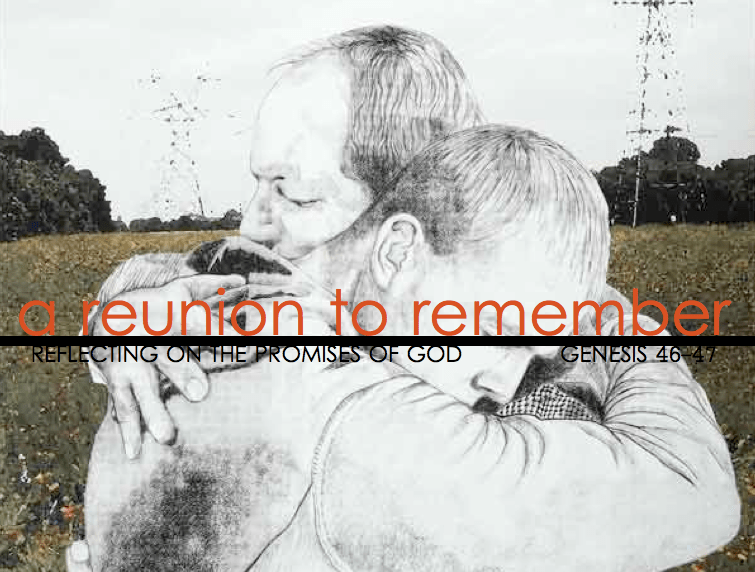
a reunion to remember

Have you ever been to a reunion for family or school? I have been to a few. There is usually some anxiety at first, since you have not seen these faces for eons and time hasn’t made you younger, flashier, or skinnier. Usually within minutes the awkwardness fades through the laughs and retelling of old memories.

The reunion of Joseph and his father is one of the most memorable of Scripture. However, at a quick glance what we do not catch is that this story is more about Jacob remembering His God and reunited with His promises.

REUNITED WITH THE GOD WHO CARES [Genesis 46]

Jacob is now an old man. He probably has some wrinkles and walks with a bowed leg. He has a few less hairs and it is clear from his eyes that he’s weathered life. He’s been asked to do something rather challenging even for someone half his age or tenth his age. In faith he is leaving his home, farm of his youth, and comforts. Like his great grandfather Abraham before him, in faith he’s trusting God to bless him in a new land.

Along the way Jacob stops to worship God in Beersheba. It’s a landmark site for his family. This was the same place where his father Isaac and grandfather Abraham, also worshiped God [21:33, 26:23-25]. There, God speaks to Jacob and gives him a command and promise. The command is the most common command in the Bible, “I am God, the God of your father. Do not be afraid to go down to Egypt, for I will make you in a great nation there.” [Genesis 46:3] Hear this sampling of other occasions throughout the Bible when God says the same 4-words:

  • Abraham. “The word of the LORD came to Abram in a vision: “Do not be afraid, Abram. I am your shield, your very great reward.” [Genesis 15:1]
  • Isaac. “That night the LORD appeared to him and said, “I am the God of your father Abraham. Do not be afraid, for I am with you.” [Genesis 26:24]
  • Moses.Do not be afraid of him, for I have handed him over to you, with his whole army and his land.” [Numbers 21:34]
  • Elijah. “Go down with him. Do not be afraid of him.” [2 Kings 1:15]
  • Jehoshaphat. “Listen King Jehoshaphat and all who live in Judah and Jerusalem! This is what the Lord says to you: “Do not be afraid or discouraged because of this vast army. For the battle is not yours, but God’s.” [2 Chronicles 20:15]
  • Isaiah. “Be careful, keep calm and don’t be afraid.” [Isaiah 7:4] “Do not be afraid, O worm of Jacob, O little Israel, for I myself will help you,” declares the LORD, your Redeemer, the Holy One of Israel.” [Isaiah 41:14; 44:8; 54:4]
  • Jeremiah.Do not be afraid of them, for I am with you and will rescue you,” declares the LORD.” [Jeremiah 1:8]
  • Daniel.Do not be afraid Daniel. From the first day that you set your mind to fain understanding and to humble yourself before you God, your words were heard, and I have come in response to them.” [Daniel 10:12]
  • Jesus to followers.Do not be afraid, I am with you.” [Matthew 28:10, 19-20; 10:28; 14:27; John 14:27]

When God says, do not be afraid. It is nothing like if I were to say the same thing. When I say, “Do not fear,” it sounds generic, even uncaring. God never says anything He doesn’t mean. He doesn’t say anything to get you off His back. Fears are not trivial to God. The sheer number of times He speaks to your fears is proof enough that He cares much more than you know.

Many wonder if God really cares. Past hurts still have a hold on you. You feel like you’ve been fooled once and you won’t be fooled again, so you trust no one but yourself. Or you believe that what God says is too good to be true. You feel unworthy of His care. In the midst of doubt God reveals more of Himself to you.

God is repetitive. He is happy to do so. Repetitive is supposed to aid learning. Ask the oral speaking Hebrews and they’d agree. Think of God repeating Himself like a parent daily telling His children, “Take your vitamins,” or “I love you.” God follows His command, “Do not be afraid” with one of the most precious promises of the Bible, I myself will go down with you to Egypt, and I will also bring you up again, and Joseph’s hand shall close your eyes.”

When God ask you to do something He’s not going to leave you hanging. He has given you good reason to not be afraid. He will be with you no matter how difficult. I am certain Jacob remembers the stories from his childhood of God’s presence with Adam in the Garden [Genesis 2], with Noah in the Ark [Genesis 6-9], with Abraham [12:1-3], and with his father Isaac [26:24]. The ruler of the universe will accompany Jacob to a strange land. He promises his son Joseph will be there when he breathes his last breath. And God will see to it that he is buried back in the Promised Land.

When God says He will be with you He means it. You have all proof in the span of Scripture. Just look at the stories of Moses [Exodus 33:12-17; Deuteronomy 31:6], David [Psalm 23:4; 118:6-7], Isaiah [49:14-15], Haggai [2:4-5], Paul the apostle [Philippians 4:5-6], and Jesus and the Spirit [John 17:20-24; Matthew 29:19-20]. Jesus says, “And I will ask the Father, and He will give you another Counselor to be with you forever—the Spirit of truth. The world cannot accept Him, because it neither sees Him nor knows Him. But you know Him, for He lives with you and will be in you. I will not leave you as orphans; I will come to you.” [John 14:16-18]

Despite fears, Jacob obeys God in faith and moves to Egypt with his family. And, in one of the most touching occasions in the entire Bible, Joseph reunites with his father Jacob. The two men embrace and weep for a long time. It’s a reunion to remember.

REUNITED WITH THE GOD WHO REIGNS [Genesis 47:1-12]

Up to this point, Joseph has not asked for any sympathy, apologizes, or favors from his brothers. Even from a high position of authority in Egypt, he has the power to snap his finger or whisper a quick word and his brothers would instantly be lynched, enslaved, or tried for their dodgy past. But Joseph did none of it. Instead he demonstrates divine grace and unforgettable forgiveness.

Joseph takes five of his brothers before the Pharaoh to ask a favor on their behalf. As anticipated Pharaoh inquires about the kind of work his brothers did back home. They reply, “Shepherds.” To be a shepherd was like being a garbage man or burger flipper. It was a lower class job, especially to an Egyptians. Remarkably Pharaoh blesses them as Joseph’s brothers, and gives them the best grazing land amidst the famine. God uses the ruler of the known world to be a blessing. God holds the heart of the king in His hand.

Then, Joseph brings his 130-year old gray-haired father to meet the mighty Pharaoh. Jacob opens his mouth before the king. You never know what an old guy might say. But He doesn’t say anything brash or embarrassing. He gives Pharaoh two patriarchal blessings (47:7,10). In other words, he stands before the king and gives glory to the King of kings.

God ultimately sits on the throne and rules. He places those who reign over peoples and nation. God even uses unregenerate Pharaoh to carry out His purposes in preserving His people. Proverbs 8:15, God’s wisdom declares, “By me kings reign, and rulers decree justice.” This gives me a lot of comfort around election time. No matter who is in office or soon to be God is still on the throne. He is in control.

The last shall be first and the first shall be last. You see this without a doubt in Joseph’s story, which seems more like a rollercoaster ride than smooth sailing in a convertible Cadillac. Through it all, Joseph maintains an attitude of servanthood. He goes from favored son to slave to favored house servant to jail chains to second in command of the most powerful nation on earth. That just doesn’t happen. God makes it happen with his humble servant. God orchestrates these events because he reigns over humans, nations, and history.

REUNITED WITH THE GOD WHO KEEPS HIS WORD [Genesis 47:13-31]

Why Egypt? Aren’t Jacob’s people supposed to live in the Promised Land? Why would God take them from the land and bring them to a place where they would soon be slaves? Does God not remember His word to Abraham in Genesis 12:1-3 to bless him with a nation and land?

Earlier in Genesis God clearly gave Isaac the command to not leave the land. Here God clearly gives Jacob the command to leave the land. Is God playing games? Does he like to move his people around for fun? God is not a jester or monster. He has a loving purpose behind everything He does.

What we fail to see is that God is blessing Jacob and is keeping his word. The blessing comes from his obedience to God’s commands. It is not uncommon for people to reduce their faith to a series of rules and steps by which they live. Therefore, the Bible often confuses such people. They are prone to not recognize the difference between universal and particular commands.

The universal commands are applicable to everyone everywhere at all times, such as the command for us to love people and love God.  However, the particular commands are applicable to a particular person or group of people in a particular place at a particular time in history, such as God’s command for Noah to enter the Ark with his family.

In Genesis 47:13-31, we see the results of both God’s blessing upon Pharaoh and Egypt because of Joseph. Joseph’s wise business dealings made the Pharaoh really rich during the seven years of famine. In this we see that God blesses His covenant people and blesses those who bless them.

Also during the time Joseph is in Egypt, Jacob’s family is growing to seventy people. This too is God’s covenant blessing of many children. The stage is now set by God’s providential hand to fulfill the prophecy God had given to Abraham. In Genesis 15:12-14, God had promised Abraham that his descendants would spend four hundred years enslaved in Egypt before God liberated them as a great nation. All of the prophecies given by God to Abraham are in the process of being fulfilled. In His unique ways, God is protecting and preserving His people. His providence in the matter will be clearer in the days of Moses [cf. Exodus 12:40].

God got the family to Egypt through Joseph and the famine. And, this small family will become a nation of a few million people some four hundred years when God crushes the Pharaoh in that day for mistreating His covenant people in accordance with His promise to Abraham to not only bless those who blessed His people but also curse those who cursed them.

Jacob remembered what God said to his grandfather Abraham. Therefore he calls his son Joseph to his side. And he makes Joseph promise not to leave his bones in Egypt, but carry them back to the land God had promised and bury him there together with Abraham and Isaac [47:29-31]. What we see is an amazing transformation in the life of Jacob. He was once the young trickster, but now he is an old God-fearer. As he looks back on his life he has seen and heard how the word of the Lord has come to pass. Keep has first hand proof that God keeps His word.

What a wonderful reunion this is for Jacob. Do not wait until you are old before you realize that God cares, reigns and keeps His word. Treasure these promises from our youth and may they spare you from many messes and uneasy days ahead. If you are having a hard time believing God look at His Son. All roads in Scripture lead to Jesus. And all of God’s promises and guarantees are fulfilled in Jesus [Hebrews 7:22; 2 Corinthians 1:20].

Jesus cares. He has compassion for all including the sick and sinner [Matthew 14:14; Mark 6:34; Luke 7:13]. “Cast all your cares upon Him because He cares for you” [1 Peter 5:7; cf. Matthew 6:25]. The greatest proof of Jesus care is shown on the cross, which paved the way toward the forgiveness of your sin [Hebrews 8:12].

Jesus reigns. He sits at the right hand of His Father. It is a seat of authority. What is He doing from the throne? He is interceding on behalf of His brothers [Mark 14:62; 16:19; Acts 7:55; Romans 8:34; Hebrews 12:2].

Jesus keeps His word. He is the Word that became flesh [John 1:1-17; Revelation 22:6-21]. His words are trustworthy and true. He is the Word. He is the truth.


IMMANUEL: Jesus be incarnate in me

This week I swept my wife away for a romantic getaway in the woods of Milton, Ontario. We left our daughter in the delightful care of her grandparents. We ate dinner at a beautiful bistro, talked until twilight, and slept in a cozy B&B. My most favorite memory of out time together was snuggling close and enjoying one another’s presence. There is safety, comfort and love in the presence of the one you love.

So it is with God—our Heavenly Maker. There is comfort and security in His presence. Throughout Scripture the theme of God’s presence with His people is a thread that weaves through the pages of Scripture [138 X’s, through people and promises].

Now all this took place to fulfill what was spoken by the Lord through the prophet: “See, the virgin will become pregnant and give birth to a son, and they will name Him Immanuel, which is translated ‘God is with us.’” Matthew 1:22–23 [Read Matthew 1:18-25]

Does anything fill you with awe or wonder in those verses? The Incarnation is the noblest idea of any world religion. God did not watch human despair from the safety of heaven. He clothed Himself in humanity. He ceased watching the human war and became a soldier. Oh, the things that God experienced in becoming a man:

  • the blistering summer sun,
  • the shivering rains of winter,
  • the hunger and thirst when He fasted after His baptism,
  • the rejection of those who walked away in unbelief,
  • the sorrow when His earthly father died,
  • the pain of Peter denials,
  • the betrayal by His friend Judas,
  • the disappearance of all friends at His arrest in Gethsemane,
  • the horror of naked judgment with no one to speak on His behalf,
  • the empathy of a mother’s tears when she stood at the cross,
  • the torture of crucifixion although innocent and guiltless,
  • the agony of death,
  • the loneliness of being forsaken by everyone.

All these things—when compiled together-spell Immanuel. These things are what the God of all mercy took upon Himself.

But why did He do it? It’s because these sorts of things form the fabric of all of our living. We cannot live without scrapes and pains, without heartache and sadness, without mosquito bites and cancer. Immanuel was God saying, “You shall not bear such pain alone.” God became flesh to redeem. Jesus stepped onto His created soil stained with sin and became the living sacrifice taking upon Himself the scorching wrath of God to save you and me.

Let Jesus be incarnate in your life, and then maybe when you have stooped to serve the desperate and dying, you will hear them say the word Immanuel. When Christ becomes incarnate in your life, you will hear those you serve saying to you, “I cannot help but believe in Christ. I have seen Him in your life.”

And I, when I came to you, brothers, did not come proclaiming to you the testimony of God with lofty speech or wisdom. For I decided to know nothing among you except Jesus Christ and him crucified. And I was with you in weakness and in fear and much trembling, and my speech and my message were not in plausible words of wisdom, but in demonstration of the Spirit and of power, so that your faith might not rest in the wisdom of men but in the power of God. [1 Corinthians 2:1—5]

How does Immanuel give comfort/security when you receive bad news? Have a hard workweek? Deal with daily stress? In what ways can you counsel friends or family around you with the promise of Immanuel?

Lord, be incarnate in me. Make me an instrument of Your incarnation. Live in me until my life is so submerged in Yours that I am invisible. Wherever I go, whatever I do, may I hear those around me breathe the word Immanuel, suggesting that I am nothing and You are everything.

IMMANUEL: a God who is with people

This morning I was taking care of my baby girl while her mother was washing some dishes. She played with her stuff animal doggy for a few minutes, but she quickly gravitated over to where I was sitting in a chair reading. For the next 15 minutes she was content doing nothing but being near to me. That’s so childlike. As children we love to be near our parents. There is safety, comfort and love in the presence of your maker.

So it is with God. We long to be near to God. We crave his affection and presence. There is a desire innate within all people to want to be with God and for God to be with them. Such a promise like this from God is meant to stir within all a sense of security, comfort and love from God above. Throughout Scripture the theme of God’s presence with His people is a thread that weaves through the pages of Scripture:

God is with you

  • Immanuel, God with us (Isa. 7:14; 8:10; Matt. 1:23)
  • Its wings will fill the breadth of your land, O Immanuel (Isa. 8:8)
  • God is with us (2 Chr. 13:12)
  • The Lord is with us (Num. 14:9; 2 Chr. 32:8; Ps. 46:7, 11)
  • God is with you (Gen. 21:22; Isa. 45:14)
  • The Lord is with you (2 Chr. 20:17)
  • The Lord is with you when you are with him (2 Chr. 15:2)
  • The Lord is with Israel (Num. 23:21; Deut. 20:1, 4)
  • I am with you (Gen. 26:24; Hag. 1:13; 2:4)
  • Do not be afraid, for I am with you (Isa. 41:10; Isa. 43:5; Jer. 42:11; 46:28)
  • Those with us are more than those with them (2 Kgs. 6:16)
  • He is at my right hand (Ps. 16:8)
  • He who is with us is greater than the one with him (2 Chr. 32:7)
  • Men will hear that God is with a Jew (Zech. 8:23)
  • The Lord is with them (Zech. 10:5)
  • They will know that I am with them (Ezek. 34:30)
  • Is the Lord in our midst or not? (Exod. 17:7)
  • Is not the Lord with you? (1 Chr. 22:18)
  • You are with me (Ps. 23:4)
  • You know the Spirit, for he dwells with you and will be in you (John 14:17).

God always with you

  • You set me in your presence forever (Ps. 41:12)
  • I set the Lord continually before me (Ps. 16:8)
  • When I awake I am still with you (Ps. 139:18)
  • I am always with God (Ps. 73:23).

God with you to help

  • God stands at the right hand of the needy (Ps. 109:31)
  • With us is the Lord to help us (2 Chr. 32:8)
  • I am with you to deliver you (Jer. 1:8, 19)
  • When we pass through the waters he will be with us (Isa. 43:2).

God has been with you

  • God who has been with me wherever I have gone (Gen. 35:3)
  • I have been with you wherever you have gone (1 Chr. 17:8)
  • These 40 years the Lord has been with you (Deut. 2:7)
  • The Lord was with Judah (Judg. 1:19)
  • The Lord stood with me (2 Tim. 4:17)
  • I [Wisdom] was beside him (Prov. 8:30).

God be with you

  • May the Lord be with you (Ruth 2:4; 1 Sam. 17:37; 2 Sam. 14:17; 1 Chr. 22:11, 16; Amos 5:14)
  • The Lord be with you all (2 Thess. 3:16)
  • May the Lord be with you as he was with Moses (Josh. 1:17)
  • May the Lord be with you as he was with my father (1 Sam. 20:13)
  • May his God be with him (2 Chr. 36:23; Ezra 1:3)
  • The Lord be with your spirit (2 Tim. 4:22)
  • May the Lord be with us (1 Kgs. 8:57)
  • So may the Lord be with you if I allow this! (Exod. 10:10).

God will be with you

  • If God will be with me (Gen. 28:20)
  • Perhaps the Lord will be with me (Josh. 14:12)
  • I will go down with you to Egypt (Gen. 46:4)
  • I will be with you (Gen. 26:3; 31:3)
  • if you obey, I will be with you (1 Kgs. 11:38)
  • God will be with you (Gen. 48:21)
  • I will be with you (Exod. 3:12)
  • The God of love and peace will be with you (2 Cor. 13:11)
  • I will be with him in trouble (Ps. 91:15)
  • I will be with your mouth (Exod. 4:12)
  • I will be with your mouth and with his mouth (Exod. 4:15)
  • God will bring with him those who have fallen asleep (1 Thess. 4:14)
  • The God of peace will be with you (Phil. 4:9).

God with specific people

  • Abraham (Gen. 21:22)
  • Asa (2 Chr. 15:9)
  • David (1 Sam. 16:18; 18:12, 14, 28; 20:13; 2 Sam. 5:10; 7:3; 9; 1 Chr. 11:9, 17:2)
  • Gideon (Judg. 6:12–13, 16)
  • Hezekiah (2 Kgs. 18:7)
  • Isaac (Gen. 26:28)
  • Ishmael (Gen. 21:20)
  • Israel (Jer. 30:11)
  • Jacob (Gen. 28:15, 20; 31:5; 35:3)
  • Jehoshaphat (2 Chr. 17:3)
  • Jeremiah (Jer. 1:8, 19; 15:20; 20:11)
  • Job (Job 29:5)
  • Joseph (Gen. 39:2, 3, 21, 23; Acts 7:9)
  • The house of Joseph (Judg. 1:22)
  • Joshua (Deut. 31:23; Josh. 1:9; 6:27)
  • Joshua as with Moses (Josh. 1:5; 3:7)
  • Each judge (Judg. 2:18; 2 Chr. 19:6)
  • Mary (Luke 1:28)
  • Paul (Acts 18:10)
  • Samuel (1 Sam. 3:19)
  • Saul (1 Sam. 10:7; 20:13)
  • Solomon (1 Chr. 28:20; 2 Chr. 1:1, as with David 1 Kgs. 1:37).

God is among you

  • God in the midst of his people (Num. 14:14; 16:3; 35:34; Deut. 7:21; 23:14; Josh. 3:10; 22:31)
  • God is in the midst of her (Ps. 46:5)
  • The Lord your God in the midst of you (Deut. 6:15; Zeph. 3:15, 17)
  • I am in the midst of Israel (Joel 2:27)
  • Is not the Lord in our midst? (Mic. 3:11)
  • The kingdom of God is in your midst (Luke 17:21)
  • The Lord who is among you (Num. 11:20)
  • God is with the generation of the righteous (Ps. 14:5)
  • My Spirit is among you (Hag. 2:5)
  • God will dwell among them (Rev. 21:3)
  • He will declare that God is among you (1 Cor. 14:25).

God goes with you

  • My presence will go with you (Exod. 33:14)
  • The Lord goes with you (Deut. 31:6, 8 )
  • If your presence does not go with us, do not take us up hence (Exod. 33:15)
  • How can we know we please you if you do not go with us? (Exod. 33:16)
  • Go in our midst (Exod. 34:9).

Jesus is Immanuel, God with us

The greatest expression of God being with us is when He came in the skin of mankind through the person of Jesus Christ. Jesus is called Immanuel, which means God with us. He was with us for only 33-years. But those 3-decades of life impacted the world and the people of the world forever.

Indeed, the title Immanuel is appropriate for Jesus—He is “God with us.” Immanuel appears twice in the Old Testament (Isa. 7:14, 8:8) and once in the New Testament (Matt. 1:23). In the Old Testament, the name is given to a child born in the time of Ahaz as a sign to the king that Judah would receive relief from Syrian attacks. The name symbolized the fact that God would demonstrate His presence with His people by delivering them. But, this prophecy also foretold the birth of the incarnate God, Jesus the Messiah, as illustrated in the Gospel of Matthew (1:23).

More than seven hundred years passed after Isaiah’s prophecy until Jesus was born. Matthew cites Isaiah 7:14 as being fulfilled in the birth of Jesus (Matt. 1:23). Later in Matthew, Jesus told His disciples that where two or three gathered in His name He would be present with them (Matt. 18:20). At the very end of the Gospel, just before His ascension, Jesus assured them that He would be with them until the end of the age (Matt. 28:20).

Also after His death and resurrection Jesus did not leave us alone. He promised to send the Helper—the Holy Spirit—to indwell His children. Forever His Spirit with us always. The book of Revelation concludes with an affirmation that the One called “God with us” will be with us forever: “The tabernacle of God is among men, and He shall dwell among them, and they shall be His people, and God Himself shall be among them” (Rev. 21:3). What an amazing promise of security, comfort and love. God is with you! Let’s be like little children clinging to His cloak, waiting for His words, and resting in His presence.

secrets of success [part 2]

We are people who collect. Some collect memorabilia. As a kid I collected thousands of sports cards and now I have boxes in storage gaining dust and I hope values. Some people collect knick-knacks. I’ve seen curio cabinets chalked full of tiny elephants, Boyd’s Bears, teacups, old books, even spoons or thimbles. Others collect compliments, cash, or cachet. While others collect power, prestige, or popularity. In all our collecting we feel like have accumulated success, status, or blessings.

So is there a secret to success? Success or blessing is not simply measured by money or stuff. Much of what you think is blessings can actually be curses. Too much a good thing left unchecked can be a really bad thing. Mass amounts of money can lead to greed. The fight for fame and fortune can leave you bruised and battered by the never-ending saga of pleasing people. Piles of possessions can lead to obsessions. Just watch an episode of Hoarders and you will see how controlling stuff can be. According to the Bible success’ source is in the immeasurable riches of God’s presence and wisdom.

KEY TO SUCCESS #1: GOD’S PRESENCE [Genesis 39]

What seemed like a series of unfortunate events for Joseph actually is a series of divine events preparing him for the next level of spiritual success. Joseph is not wasting away the best years of his life imprisoned in Egypt. God is at work. The unseen hand of God’s providence is always at work. Even when Joseph is far away from his home, betrayed by his brothers, a slave in a strange land, convicted of a crime he never committed, and ended up in prison: still the Lord was with him. “His feet were hurt with fetters; his neck was put in a collar of iron; until what he had said came to pass, the word of the LORD tested him.” Psalm 105:18-19

There is no question that one of the main themes of Joseph’s life is the presence of God. In fact, God’s presence is repeated eight times in chapter 39 alone:

  • “the Lord was with Joseph, so he became a successful man” (39:2)
  • “the Lord was with him” (39:3)
  • “the Lord caused all that he did to prosper in his hand” (39:3)
  • “the Lord blessed the Egyptian’s house on account of Joseph” (39:5)
  • “the Lord’s blessing was upon all that he owned” (39:5)
  • “the Lord was with Joseph and extended kindness to him” (39:21)
  • “the Lord was with him” (39:23)
  • “whatever he did, the LORD made to prosper” (39:23).

It should be noted, all of Joseph’s prosperity is funneled into the hands of other people. Joseph’s success made Potiphar wealthy [39:5], saved Pharaoh’s kingdom [Ch.41], and rescued Joseph’s family through famine [Ch.42ff]. God blessed Joseph so that he could be a blessing to others. Furthermore, God prospered Joseph so that he might have a testimony for the Lord in high places. Because of his success as a manager, Joseph was able to influence Potiphar, the chief jailer, and eventually Pharaoh himself for the Lord!

Joseph is a preincarnate picture of Jesus who was also unfairly convicted of a crime He did not commit [cf. Isaiah 52:13-53:12]. Like Joseph, He did not protest or complain, but lovingly sacrificed His life for all taking upon Himself the wrath of God and the penalty for your sin. And through it all, God was with Him.

You might think, “I’m certainly no Joseph.” He served in high places, worked among the social elite, impacted nations and governments. For many, the blessings of God do not come in this world. You might feel like God is distant or has forgotten you. I hope you see from the life of Joseph that even in the meekest of situations God is present.

KEY TO SUCCESS #2: GOD’S WORKMANSHIP [Genesis 40]

God is at work. God is at with in and through Joseph. In prison he meets two interesting inmates—a cupbearer and chief baker. The cupbearer must have mixed a bad drink and the chief baker must have made some low-carb sawdust flavored bran muffins to end up in the can. Both work for Pharaoh—the most powerful man on the face of the earth.[1] He used his authority to throw two men in prison that so happen to be in the same prison as Joseph and now placed under his authority. This is not random chance, luck or happenstance. The man with a god-complex seen as a mediator to the gods is a pawn in the hands of the One True God who is at work in the subtle details.

God gave Joseph a gift to interpret dreams. His brothers called Joseph the “master of the dreams” [37:18].  In Genesis 40, God gave a dream to his two cellmates that they could not interpret. So they asked Joseph. God helped Joseph to interpret their dreams. There was good news and bad news. Good news—for the cupbearer—meant he would live and return to his previous post in honor. Bad news—for the baker—meant his head would hang in a noose from a tree. Three days later on Pharaoh’s birthday Joseph’s interpretation of the dream came to pass just as God had revealed.

Joseph could have buried his gift in the ground and kept the meaning of the dreams to himself. He could have thought, “I’m not going to going to help these two numbskulls. Nobody appreciates me around here, anyway. Potiphar wouldn’t listen to me. His wife set me up. These Egyptians are all cut from the same cloth. Why should I go out of my way to help these two criminals?”

Perhaps this is precisely where you are in your church, small group, career or family—disillusioned, discouraged, or annoyed. You have decided that you will no longer serve on the committee, no longer speak up on that issue, no longer be a member of the team, or no longer teach the class. If that describes you, take a long look at Joseph. Lying in that jailhouse he had every excuse in the world just to roll over and play spiritually dead. He had every excuse to hoard his gift. But he didn’t. Instead, he stayed committed to the Lord; he used his gift; and eventually God used that gift to get him into the royal palace of Pharaoh! God works through people—like you. “For we are His workmanship, created in Christ Jesus for good works, which God prepared beforehand so that we would walk in them” [Ephesians 2:10].
What could God do through you if you would only serve him without losing heart? What would you have done if you were in Joseph’s chains? Unfortunately, the immediate result of Joseph’s interpretation got the chief cupbearer restored, but left Joseph in the joint. The cupbearer went back to his work forgot about Joseph even though he had specifically requested that he not be forgotten. But, God did not forget about Joseph nor leave him abandoned in prison. God is at work in and through Joseph to accomplish His purposes. With each “random” incident and the forgetfulness of humans, it is wise to remember with God nothing is accidental or purposeless.

KEY TO SUCCESS #3: GOD’S WISDOM [Genesis 41]

Two years pass and Joseph is still in chains forgotten by his freed inmate. That was until God gave Pharaoh troubling dreams. He was frustrated and tired because he could not understand their meaning. So he called all his pagan magicians and interpreters, but they could not understand the dream. Only God knew the meaning. It was then that God enabled the chief cupbearer to remember how Joseph had correctly interpreted his dream and the dream of the now deceased baker in prison.

Joseph was immediately summoned from his cell. He was bathed, shaved, and clothed in a matter fit to meet the king. Standing before the Pharaoh, Joseph in astounding humility gave all credit to God for his gift, “It is not in me; God.” [41:16]. Joseph told the king that he could not interpret the dream, but that God could and would through him. He then interpreted the dream according to God’s wisdom. In the dream the king would soon have seven years of fruitfulness in the fields, but would be followed by seven years of severe famine.[2] Indeed, God was showing mercy to Pharaoh through Joseph. It was a divine dream with a divine plan to save a region in the years of severe famine.

What an amazing plan. Where did Joseph get his agricultural wisdom? How did he acquire his engineering genius? Did he learn from his father? Or take classes at the local technical college? Did he pick it up in the midst of all his work as a slave? The Bible does not say. What we are sure of is that Joseph relies heavily upon God. He realized that true wisdom comes from above, “With God are wisdom and might; He has counsel and understanding.” [Job 12:13] God blessed Joseph with farming and engineering wisdom to the rescue of many people [41:54].

God is wise. He knows all things. He shares that wisdom with His people to help them and show them His mercy and grace. But this begs a question. How do I apply the wisdom of God to my life like Joseph?

First it is good for you to excel in all kinds of wisdom—agriculture, medicine, science, history, arts—and use that wisdom to bless other, but give glory to God who has given you the wisdom. Joseph’s life teaches you to use your career, role, skills, and gifts to serve the God by serving others.

Second, there is another kind of wisdom that may be used to rescue the perishing, eternally. Paul calls it “the wisdom that leads to salvation through faith which is in Christ Jesus,” It is a wisdom found only in “the sacred writings” of Scripture [2 Timothy 3:15]. Thus, learning the message of the Scripture—the gospel—and expressing the ability and willingness to share the good news of Jesus clearly, fully, and accurately through your words and actions. Speaking and living out the gospel is sharing the wisdom of God with others. Who knows what position God may put you in, even this week, to rescue someone from spiritual famine! Will you have acquired the wisdom from God to do so?

Who’s the Main Character in this Story?

It is clear the main character in Genesis 39-41—though not explicitly seen—is God. Joseph’s God was in fact supreme because He alone could give dreams, He alone could interpret those dreams, and He alone held the future that He promised could not be altered by anyone, including the powerful Pharaoh. God sent Joseph to Egypt as a sort of missionary to bless that nation according to His covenant promise to bless the nations of the earth through His people whom He blessed [cf. Genesis 12:1-3].  Also setting the stage for God to use another man [Moses] to lead God’s children from Egypt to the Promised Land.

God blessed God with a wife and two sons. In honor of his God and a fitting conclusion to this narrative Joseph give beautiful and thoughtful names to his two sons, “Before the year of famine came, two sons were born to Joseph. Asenath, the daughter of Potiphera priest of On, bore them to him. Joseph called the name of the firstborn Manasseh. “For,” he said, “God has made me forget all my hardship and all my father’s house.” The name of the second he called Ephraim, “For God has made me fruitful in the land of my affliction.” [41:50-52]

It is good to acknowledge sooner than later that success in this life and eternity is found in the presence, workmanship, and wisdom of God. He rules. He is supreme. He is sovereign over all nations and the events of your daily life. He uses events big and small, miraculous and ordinary, easy and hard to accomplish His purposes in the earth in you and through you.

God is a collector too. He has a collection of stars, angels, and created things. He desires to collect the praises of all people and all nations. One day you will all stand before the throne of God with a collection of people from ever tongue, tribe and people group, who will all be bowing their knees and singing praises to the God who is all in all and over all. Success that last has roots in God. All other success is fleeting.


[1] Politically, the Egyptian empire was the most powerful on earth for an amazing 1300 years, twice as long as the famed Greek and Roman empires. Geographically, Egypt was a long and narrow country of about 13,000 square miles isolated by the surrounding deserts, mountains, sea, and valley. Theologically, Egypt was ruled by a succession of mighty Pharaohs who were worshiped as a sort of mediator god who connected life on the earth to life in the spirit realm and alone walked between the two worlds. As deity, the Pharaohs had their pyramids built to ensure their safe passage from this world to the next, and viewed the pyramid as a sort of ladder transporting their soul into the next world. Simply, there was no nation on earth more powerful than Egypt, and there was no man in Egypt more powerful than the Pharaoh whose will was supreme.

[2] According to the dream, the famine would affect both the farm fields [grains] and ranches [livestock] in Egypt. A seven year famine would be devastating for Egypt and surrounding countries that relied upon them as the breadbasket of the world.

faithful deception: Judah & Tamar

It is easy to be confused by the events in this world. You can wonder until you are dizzy-in-the-head if there really is a God who controls this mixed-up world where natural disasters, broken and battered families, rape and child molestation, and murder are common chaos’ that make the news. It can be difficult to see how God is still in control. If only God would spell out the meaning to the mixed-up events of our lives and add clarity to the confusion when He seems absent. Can you fully trust God among the chaos? Has He forgotten His plan and purpose to save? Can you prove to me that He is really at work in this wicked world?

Just as the story of Joseph gets under way [cf. Genesis 37] it is stopped by a short story of his brother Judah. At first it appears to be an unnecessary and untactful interruption. However when you take into account the remaining chapters of Genesis are about the sons of Jacob [mostly Joseph] it fits. The redneck soap opera of Jacob’s family takes a Jerry Springer Show twist in Genesis 38 with the sinfulness of Judah following in his father’s footsteps. In God’s grace He will transform Judah as He did his father Jacob from a godless goober to a godly man fit to be a patriarch carrying the covenant promises of God to future generations.

You would think Jacob would learn from his father and grandfather, Abraham and Isaac, who dreaded the thought of their sons intermarrying with Canaanite women because they knew it would cause them to wander from God [24:3, 28:1; cf. Proverbs 1:10-19, 5:1-23]. Judah did not heed the advice. He fathered three sons [Er, Onan, and Shelah] with a Canaanite woman and then he arranged his eldest son Er to marry Tamar, who was also a Canaanite woman. We do not know much about Er other than he was a wicked man that God simply killed. This left Tamar a widow.

According to the customs of the day a widow would normally marry her husbands brother. He would care for her, protect her, and give her sons to keep the family inheritance alive. Since the ancients did not have elderly living facilities their children would naturally care for their aging parents [Deuteronomy 25:5-6]. Onan happened to be the lucky guy to get Tamar as a wife. He was happy to have sex with her, but misused her and refused to care for her much less see that she bore children. He disobeyed God by not fulfilling his obligation to care or provide for Tamar. Like his brother Er, God killed Onan too. Again Tamar was left a widow.

So Tamar moved into her father-in-law, Judah’s house [cf. Exodus 21:7-11]. He promised to take care of her and give her his youngest son, Shelah. He was too young to marry and he asked her to wait until he grew up. He was afraid to lose yet another son. However, years later when Shelah had grown up, Judah did not keep his promise to give Tamar to him as a wife. So, like Eve who ruled over Adam [3:16], Sarah who gave Abraham her maidservant Hagar to sleep with [16:1-16], and Rachel who gave Jacob her maidservant Bilhah to sleep with [30:1-8], Tamar also took matters into her own hands rather than trusting God by faith.

Timid Tamar transitioned into bold Tamar. While Judah was weak after the death of his wife, Tamar dressed up like a prostitute [cf. Deuteronomy 22:23-24] and stood on the street corner where she knew Judah would pass by and see her winking eyes. Judah took the bait not knowing it was his daughter-in-law because she veiled her face. Judah had sex with her, but did not have the cash on hand to pay for the trick so as collateral he gave her the equivalent of his credit card and drivers’ license. She accepted. After the deal was done Tamar snuck into her widow clothes as if nothing ever happened, but she couldn’t hide for long. God was growing a baby in her belly and conviction in her soul.

As soon as Judah round up some cash to pay for his one-night-stand he sent a servant to find her but she could not be found. In fact, when he asked the other men in town they did not know of any prostitutes in the area. Judah seemed to think he’d been swindled. As time passed, it was revealed that Tamar was being immoral. So Judah [mister morality himself]] following customs of the day sent for her to be burned. To save her life she confessed to being pregnant and had the proof that the daddy was Judah. No DNA results were needed, she had his property in her hands.

Judah was caught red handed. While blushing he also confessed, “ She is more righteous than I, since I did not give her to my son Shelah.” [38:26] And he stayed pure from her the rest of his life. Tamar later gave birth to twin boys [cf.25:19-28, Psalm 127:3] naming them Perez and Zerah. The two boys possibly replace the two sons Judah lost. Ironically Jacob—the trickster—had been tricked into believing his son Joseph was dead [instead sold into slavery] by his son Judah who was also trickster like his father who was then tricked by Tamar into becoming the father of his daughter-in-law’s children.

What is the point of Judah and Tamar’s immoral interruption included within the story of Joseph? Like a chaotic commercial break at the beginning of Joseph’s story, it is there to teach you many things about God and man [as is the point of all Scripture]. What do you learn about man and God from the story of Judah and Tamar?

First, you cannot escape the sight of God. God sees everything. He even sees what you think you can keep secret. “The eyes of the Lord are in every place.” [Proverbs 15:3] You might be able to keep your life tucked away and tidy from those around you, but there is nothing you can keep covered from the eyes of God.

Second, what you cover God uncovers, but what you uncover God covers in His mercy [Proverbs 28:13]. God has His ways of uncovering your dirt and exposing your sin—as He did with Judah and Tamar. This can lead to serious embarrassment, shame, and guilt. There are no secret sins. God sees them all and He will bring them out into the open, if necessary, to call you to repent. “Be sure your sin will find you out” [Numbers 32:23].It is better to shed light on your sin before He does. If you do, He will cover you with His mammoth mercy. In the midst of misery God’s mercy is marvelous.

Third, God can even use your sinful messes for your good and His glory. Like father like son, both Jacob and Judah are sinners. And Tamar who takes matters into her own hands like other leading ladies before her is a sinner. God has to intervene for this story to be straightened out and make sense. And God in His grace and glory will prepare Judah to become a covenant patriarch as He did with his father, Jacob. Sin does have consequences—sometimes immediate, other times eternal—but God works them out for His good and yours too [Romans 8:28-29].

In God’s providence, faithfully uses the deception of Judah and Tamar to keep Jacob’s family line alive through their scarlet threaded twin Perez. And Perez paves the way to the lineage of king David [Ruth 4:18-22; 1 Chronicles 2:5, 9-15] and ultimately the King of King—Jesus Christ [Matthew 1:1-6]. The Messiah was to be “the Lion…from the tribe of Judah” [Revelation 5:5]. It was God’s plan that the Savior of the world would come through the family line of sinful Judah and his Canaanite daughter-in-law. And as part of God’s plan He would also be deceived before His death by a close companion [Matthew 26:4, 57-66; 27:24-26]. As Kurt Strassner says in his commentary on Genesis 38,

“Do you see? God is in control; and Jesus is the goal of all human history! God was determined that his Son should be glorified as king! And God was determined that we should have a Savior. Nothing and no one was going to thwart his plan! Not Judah’s sin; not anyone’s sin against us; not even our own sin. God will work all things for the good of his people and the glory of his Son!”[1]


[1] Kurt Strassner, Opening Up Genesis (Leominster: Day One Publications, 2009), 146.

just your average Joe

Have you ever wondered what it would be like to grow up in a family—wealthier or better known—than your own? Do you daydream about the day you break free and become noticed or distinguished? Do you feel like an average Joe or ordinary Jane? You are not alone. The majority of people and families you meet are just like you.

I grew up in what many would call a dysfunctional family. My teenage parents divorced before I could remember them together. I did not like my lot in life for the better part of my childhood. I would daydream about the day my mom and dad would get back together and our family would be normal, which did not happen. I wondered whether or not I was the cause of my parent’s divorce, which was unfair. And I wondered what it would be like to live in a normal family, but defining normal is impossible. Since those early days, I have learned to love my God-given family for reasons I will describe later.

I love the Bible because it is filled with examples of imperfect families just like mine that He uses for His purposes. From the beginning of the story of Joseph—which will carry us through the remainder of Genesis—we learn four truths that are common to human including you and me.

1. I do not choose my family [Genesis 37:1-4]

From the outside looking into Joseph’s home life you would think they were quite redneck. His father, Jacob, had thirteen children with four women, two were maidservants and two were wives. He loved his wife Rachel and hated her older sister Leah. Jacob also played favorites with his children loving his first son with Rachel, Joseph [cf. Gen 30:24-25], more than his other sons. Jacob did not hide his favoritism for Joseph. He adorned him like a king in an expensive coat of many colors. All who met Joseph knew he was his daddy’s favorite dressed up in his Hebrew bling from Burlington Coat Factory.

Jacob also favored hardworking Joseph by giving him authority over his older brothers and sent him out to the fields while his brothers worked to supervise and report back to their father.[1] The brothers view Joseph as a spoiled rotten tattletale, “When his brothers saw that their father loved him more than any of them, they hated him and could not speak a kind word to him.” [37:4] The brother’s anger sounds a lot like Cain’s boiling anger towards Abel’s sacrifice that God had favored [cf. Genesis 4].

Joseph is only seventeen. Most teenagers his age have issues with their parents and siblings. It is easy for us to wonder, “Why did God give me this family?” Maybe you’re a child of divorce, abuse, or neglect. Maybe conflict is all too common in your home and you can relate to the sibling rivalry, favoritism or ungodly habits of Joseph’s home. Remember you did not choose your family, but God chose your family for you. This can be a hard truth to swallow depending on the degree of difficulty you have with your family. As difficult as your family may be they are still and always will be your family.

It is interesting how important the family unit is to God. God uses the family analogy to describe Christ’s relationship with the church [Ephesians 5:22ff], the relationship of the Trinity with one another [i.e. Father and Son], and uses family to describe His relationship with those He adopted into His eternal family through faith [Romans 8:14-17]. God promises to create a people for Himself to use for His purposes. Joseph’s dysfunctional family was surviving only by the mercy of God, but He will use them for His divine purposes to shape the character of the youngest son, Joseph.

2. I am mostly responsible for my messes [Genesis 37:5-17]

Compounding matters for Joseph and his already ragged relationship with his brothers, God had given Joseph dreams in which his whole family was bowing down to him in homage. When the dreams should have been kept private he made them quite public. This did not help Joseph build a bridge of bonding with his perturbed older brothers. ”His brothers were jealous of him, but his father kept the matter in mind.” [37:11] Jacob rebukes what he thinks is a ridiculous dream and didn’t do anything more than keeps the matters to himself. Then he sent Joseph out into the field to supervise his brother’s work [37:12-17].[2] The one quality character we see in Joseph that will come into play later in his life is his willingness to obey authority.

How should Joseph have responded to these dreams? Perhaps he should have taken them as a subtle warning about the place of pride in his life and began cultivating humility. Or maybe he should have taken the details about the future as an opportunity to wisely prepare for the leadership role that God was going to give him. Instead, he used the dreams as hot air to further inflate his already puffed-up opinion of himself. It’s a recipe for a messy situation.

As people we are also prone to take the good gifts of God—our positions, our possessions, our intelligence, our education, our sexuality, our ability to pray—and use them, not for the benefit of others and the glory of God, but only to make ourselves feel better. Think about it. What good gifts has God given you that you are tempted to use solely for yourself?[3]

3. Life is not always fair [Genesis 37:18-35]

The brothers grew jealous of Joseph and stripped him of his regal robe and tossed him into a waterless well. There they conspired whether or not they should kill him [cf. Genesis 4] or sell him into slavery. Rueben tries to reason with his brothers, when he should have stood up and said, “Listen, I know Joseph has been a pain in the keester, but we’re not going to do anything to harm him” Instead, Rueben along with Judah who led the brothers to spare Joseph’s life, but make some money selling him into slavery. ”So when the Midianite merchants came by, his brothers pulled Joseph up out of the cistern and sold him for twenty shekels” [37:28].[4] Joseph was taken to Egypt.

The brothers mean-spirited prank was well planned, but they were missing one detail, how would they inform their dad what happened to his darling son? To cover up their sin the brothers slaughtered a goat and sprinkled its blood on Josephs coat. They took the blood soaked coat back to their father and they tricked the trickster [cf. 25:26ff] into believing their lie. Jacob mourned bitterly believing that his most beloved and irreplaceable son had been ripped apart by animals. The guilt of this prank would haunt the brothers the rest of their lives.

Last summer I took a hiking trip with my wife through Rocky Mountain national park. She was 5 months pregnant and thought that climbing a 6 mile hike up a mountain to over 14,000 feet elevation would be a good idea. Halfway through the climb I ended up carrying most of the backpack weight and coaching Sarah up the mountain. Needless to say we made up the mountain, but I wasn’t a happy camper. Life is like a hiking trip through the mountains. In life you have a number of peaks to climb. Some steep and some slick. Some reasonable and others seem ridiculous. Some fun and others seem unfair.

Joseph is experiencing a rocky road hiking through mountains [grand dream] and valleys [sold as slave], which seems to be out of his control.[5] I wonder what he is thinking as he’s being sold into slavery? Is he taking it in stride? Does he doubt God’s fairness? Is God even on his radar? Young Joseph’s may have been dealt an unfair set of cards. He’s been snookered and shackled. Life at times is unfair to our eyes, but God is not distant He is at work.

4. Sometimes I am blind to what God sees [Genesis 37:36]

Can you imagine what is going through Jacob’s mind as he is being carted of to Egypt as a slave? What would you be thinking? “Why me God? This is so unfair. Why did I have to be born into my family? I am only a runt. What about that dream you gave me? Like that will ever happen. Now nobody will ever notice me.”

God seems to be completely absent from the brains of the brothers. However this by no means indicates that God is absent or not actively involved in what is happening. God, in fact, is superintending everything that is happening in Joseph’s life as He does with you too.

In the last verse we have an amazing setup to Joseph’s future, ”Meanwhile, the Midianites sold Joseph in Egypt to Potiphar, one of Pharaoh’s officials, the captain of the guard.” [37:36] What this verse hinting at after an unfair handling of Joseph is that his dream does have some significance. In spite of the persecution and the deception, God’s program will continue. God is sovereign! When your life seems out of control God is still in control. You might be blind to the next step, but God sees the course of your path.

God truly does cause “all things”—including those seemingly random things like sins against you and even your own sins—“to work together for good” [Romans 8:28]. If you really believe that, then you won’t feel the need to throw others into the pit when they hurt you—and you will also have hope in the midst of guilt and regret over your own personal sins.

Maybe you weren’t the faithful parents you should have been. Maybe you wasted your youth in self-centered living not content to be just an average Joe. Maybe you didn’t speak up for Jesus when you should have. If you are God’s child, you need to know: God works all things—even your failures—for the good of His people. He will work something beautiful out of the mess that you have made.God is big enough to forgive your sins through Jesus Christ [1 John1:8-10]. He is big enough to help you overcome your sins [1 Corinthians 10:13]. And He is even big enough to use your sins as part of His bigger plan. Even though you may have meant it for evil, God will work it for good! That is God’s sovereignty at work!

All these facts combine to make the account of this unusual family not a story of godly heritage so much as a story of mercy! Thank God that, in His Son, He is just as merciful to irresponsible, stumbling sinners today! God uses imperfect nobodies as examples to everybody that reflect the character of the Perfect Somebody He has chosen.

It was my normal dysfunctional American family that I thought was unfair as a child that drew me to Christ as a teenager, that taught me about my unreasonable expectations for my parents, that led to reconcile with my mother as a college student, and that has given me motivation to lead my own family to follow Jesus as an adult. I am so grateful for the family that God has chosen for me. God has given me many opportunities to minister to countless others who are struggling with understanding God’s purposes and goodness. I’ve encouraged them to look to Jesus who takes average Joe’s and invites them to a lifelong relationship as children of God.


[1] Note: this will not be the first time Joseph is elevated to a position of authority. A theme this narrative is how God empowers people despite the circumstances. The lesson is timeless: God will choose a faithful, righteous person for a position of leadership in spite of the jealousy of others.

[2] The fields are about 64 miles away. This is an early indicator that famine was coming since they were going so far away to find ground for gazing. The ground is also surprisingly in Schechem where two brothers shed blood [cf. 34:25-31].

[3] Now difficulty in our life can happen even when we are living in humility and integrity. Jesus does promise that living for Christ can be followed by intense hardship and suffering [2 Corinthians 1:3-7].

[4] An amazing archeological fact that corresponds to the reliability of the Bible is that 20 shekels [est. $2000] was the going rate for slaves during this time period.

[5] The choices Joseph makes at this period of his life are critical and life altering. Joseph is only seventeen, but in the next 10 years he will make the biggest decisions of his life. What are some decisions you make between the ages of 15-30 years old? You solidify personal habits, moral habits, and spiritual habits. You turn the pages to monumental chapters in your life such as: graduation from high school and college, make career choices, may enter marriage and have children. Joseph is entering the period of his life where he will make some of the most important decisions of his life.

boiling point: anger

Just like water comes to a boiling point and steams, so does a mans emotions. Anger is a God-given emotion intended to help one solve problems. There are many examples where people use anger to solve their problems in a godly way (Galatians 2:11; 2 Samuel 12; John 2:13-18). The Bible describes anger as a passion (orge, Ephesians 4:26; James 1:20; Mark 3:5) and an agitation boiling within with an outward result (thumos, Luke 4:28; Acts 19:28; Ephesians 4:31).

According to the Bible, anger is not a sin: God becomes angry (Psalm 7:11; Mark 3:5; John 3:36), and believers are commanded to be angry and not to sin (Ephesians 4:26). Anger is good, since it is manifested righteously by God. However, anger is an emotion that mankind can selfishly abuse, therefore, anger becomes a sinful response to problems in our lives.

There are many ways in which people deal with anger sinfully. Some do not admit that there is a problem and they clam up (Ephesians 4:26-27). Some lash out in rage and they blow up (Proverbs 6:34; 14:17). Some stir up anger and strife in others (Proverbs 15:1, 18). Some become destructive and destroy anything that gets in their way (Proverbs 22:24-25; Proverbs 27:4). Some retaliate by getting even (Romans 12:17-21). Anger becomes sinful when it is motivated by selfish desires, when God’s goal becomes distorted (1 Cor.10:31; Rom.8:28-29), when the emotion lingers (Eph.4:26-27), and when it attacks a person rather than the problem (Eph.4:15, 29). These are all ways that one can deal with anger in a way that is not God’s way.

What is God way of dealing with anger?

  1. Admit that you are not handling anger biblically and confess it to God and others involved (Proverbs 28:13).
  2. See God in the problem (Genesis 50:20; Romans 8:28-29; James 1:2-4).
  3. Make room for God’s wrath, and do not play God (Genesis 50:19; Romans 12:19).
  4. Communicate to solve your problems (Romans 12:18; Ephesians 4:15, 25-32; Proverbs 15:1).
  5. Act to solve your part of the problem (Romans 12:18).

By dealing with your anger in God’s way you become God’s kind of person.