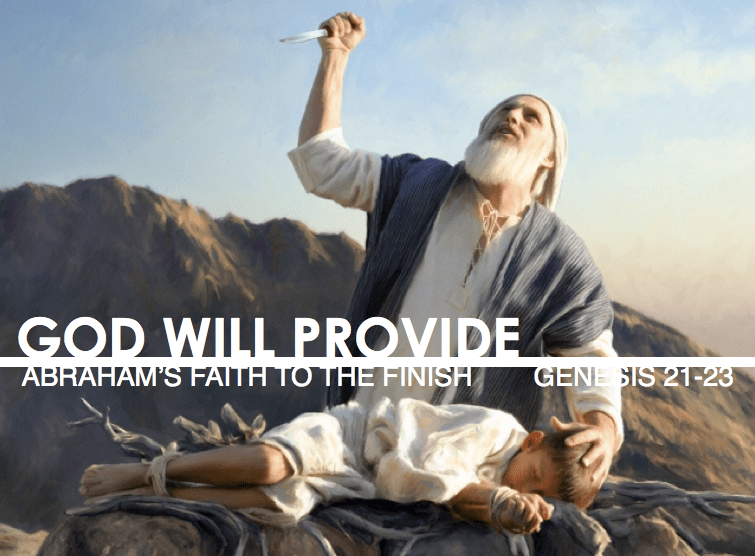
God will provide

I love stories of people who finish the race with fortitude. Who doesn’t gain inspiration from stories that beat the odds? I think of Team Hoyt [father with his paraplegic son] who completed the iron man, or Kerri Strug who finish the Olympics hurt on the hurdles, or Lance Armstrong who won seven Tour De France bike races after battling cancer, or King George VI who fought through the fear of speaking to become a voice comforter during WWII, or Temple Grandin who persevered through autism to become a leading advocate for autism and the cattle industry. Each of these people fought with grit to the finish.

Abraham also had an incredible journey of faith to the finish. Throughout Abraham’s struggle of faith God provided in miraculous ways. Today we will see three specific ways God provided: 1) God provides a son, 2) God provides a sacrifice, and 3) God provides land. Each of these provisions was for promises given by God when he called Abraham [Genesis 12:1-3]. God says what He means, and means what He says. When He promises something, He means to fulfill those promises exactly as He promised, but not always exactly as we think He would do it.

God provides a SON [Genesis 21:1-7]

After 25 years of waiting and wondering God gives Abraham and Sarah a son. Abraham finally has his boy. They name him, Isaac, which means laughter—fitting for a boy born to an old granny [90 years old] and triple-digit pappy [100 years old]. Sarah laughed at Isaac’s birth, but this time in joyous worship for the grace of God, which brought her a son.[1] God miraculously provides Isaac, the promised seed. It is good to rejoice in God’s faithfulness to His promises by giving Abraham a son. God would echo this miracle 2000 years later, when the seed of Isaac was fulfilled in the promised seed born through a virgin girl in a small town named Bethlehem [cf. Matthew 1 & Luke 3].

How have you rejoiced in His faithfulness? This week, I rejoiced with my wife remembering how God had blessed her over the past 10 years. God has been faithful to provide for her in some miraculous and mysterious ways. To God be all the glory!

God provides a SACRIFICE [Genesis 22:1-19]
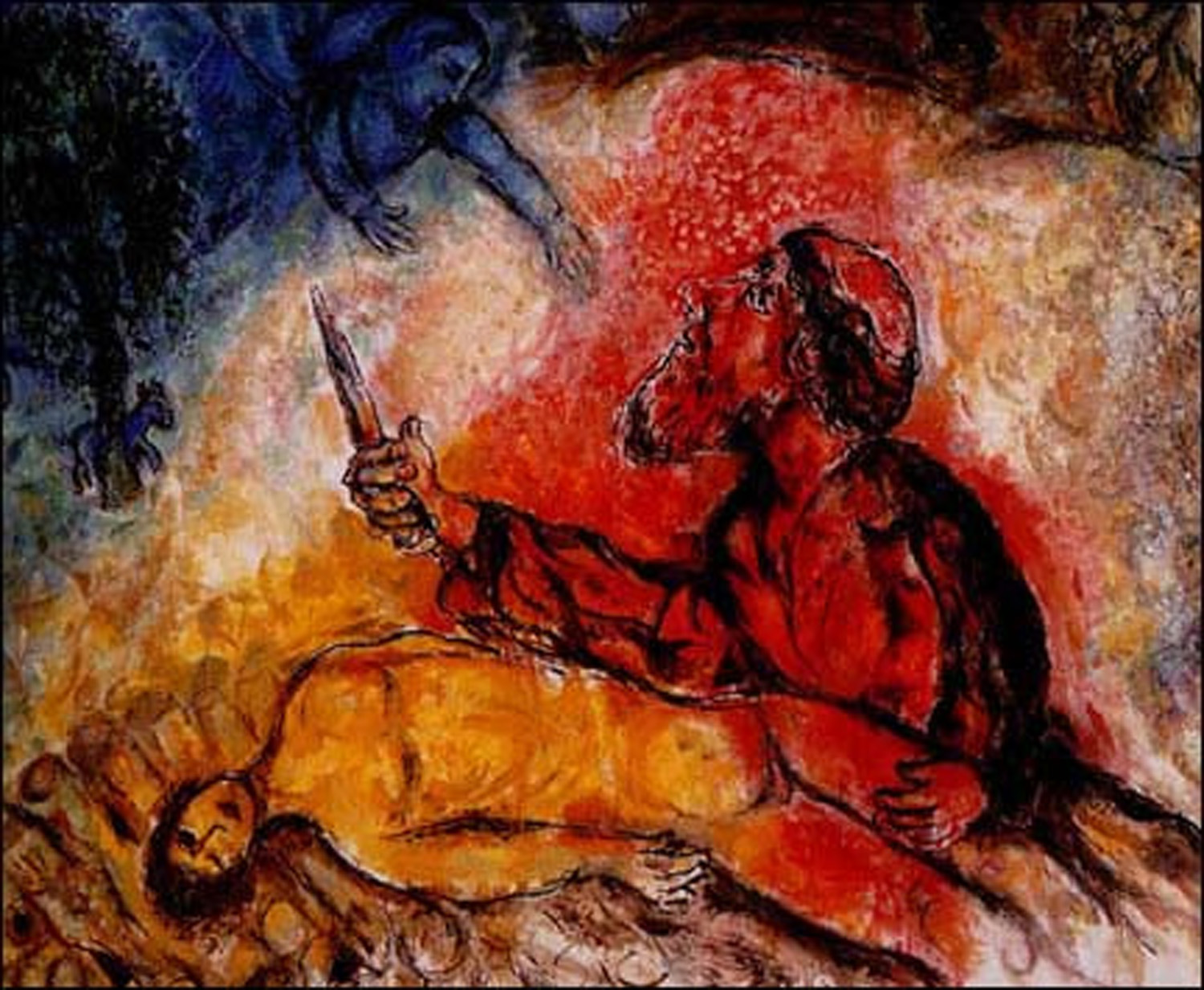
Soon after God provides Abraham with a son, God in climatic twist calls him to a final test of faith. Before I proceed, it is important to remember that God tests your faith so that it might grow, and Satan tempts you to sin in an attempt to destroy your faith. God never tempts [cf. James 1:13ff]; He only tests. Even when you blow the test God uses it to grow your faith. Abraham’s marathon journey of faith leads him to this last grueling mile and God will ask Abraham to sprint to the finish. God asks father Abraham to build an altar and sacrifice his one and only son.

I’ve got one child. She’s a baby girl. I thank God for her. If I just had one child, that child would be the center of my universe, and as a father, my whole life would be about protecting that child because that would be my only child. When God says, sacrifice this child “whom you love” it shows that Abraham has a deep affection for his boy. They went camping, they worked the field, they played ball, and they did devotions together. I could not imagine how difficult this would have been for Abraham.

Without any deliberation or doubt Abraham awakes early in the morning, responds in faith, takes a 50-mile 3-day donkey ride, cuts wood for the altar [for this is no ordinary camping trip], binds up Isaac on the altar, and raises his knife to kill his son. Was he really going to kill his son on the altar? I think so. I think Abraham had seen God fulfill promise after unbelievable promise and made a womb that was dead-dead alive.

Now Isaac was no baby. He was probably between the ages of 15-35. He could have easily wrestled his 115-135 year old weak-boned dad to the ground. However, as Abraham’s son, he willingly submits himself to God’s plan too. He trusts his dad. I could image that Isaac had a terrified look on his face saying. “Dad, you want me to lay down on the altar? You want me to die here today?” “Yes, son, that’s what the Lord is saying.” “Okay. I trust you, dad.” Isaac willingly lies down on the altar, but God intervenes by providing an animal sacrifice for the burnt offering. The story that climaxes with Isaac, ultimately climax with Christ.

  • Isaac and Jesus were both sons promised many years before their birth.
  • Isaac and Jesus were both born to women who could not have conceived apart from a miracle.
  • Isaac and Jesus were both firstborn sons.
  • Isaac and Jesus were both loved by their father/Father.
  • Isaac and Jesus both carried wood to their sacrifice.
  • Isaac and Jesus both willingly laid down their lives to their father/Father.
  • Isaac and Jesus were both laughed at. One for being born, and the later for claiming to be king.
  • Isaac and Jesus both lay down as a burnt offering for sin [i.e. substitutionary atonement, 2 Corinthians 5:21].
  • Isaac was resurrected figuratively and Jesus was resurrected literally [1 Corinthians 15].
  • Isaac was just a man, but Isaac was the God/Man who came to save mankind.

God provides the lamb for a burnt offering so that Isaac may live. Likewise, God provides the Lamb of God—Jesus Christ—as the sin offering so that those who believe in Him may live forever [cf. John 1:29; Mark 10:45]. God is faithful to provide the sacrifice for our redemption.

God provides SOIL [Genesis 23:1-20]
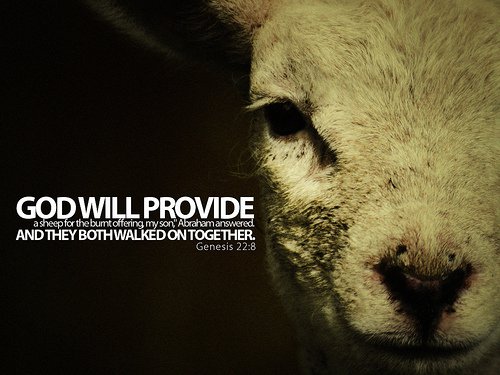
Remember, Abraham was a pagan living in Iraq who worked as a nomad. Now he is living many miles from his childhood home on the doorstep of the land God has promised him. He is old and his wife has just passed. In an obscure way, Sarah’s small and insignificant burial plot was the only property Abraham owned in the Promised Land. The land that was promised to his heirs would not arise as a nation until God would call another man, Moses, who would take God’s people to the Promised Land, but it took Joshua to finally bring the people across the river Jordan [21:43-34]. As the Hebrew people longed for their promised homeland [Hebrews 11:9-14] so followers of Christ long for their eternal homeland with Him [John 14:3; 2 Peter 3:13].

In conclusion, it is a worthwhile endeavor to think back on all the times God has provided. It is encouraging to journal or write a thank you letter to God for all that He has done. As I think back, he has provided in so many miraculous ways: He provided the means through jobs and mysterious donors to pay off my college education, He has provided friends who have given me timely and wise counsel from high school until now, He provided a beautiful and godly wife who has taught me much about God through the way she lives, and He has provided me with a gracious and generous church that has reinvigorated my passion for Christ and His Body. None of these provisions compare to those that the last leg of Abraham’s journey remind me of—God has provided me a Son who was the sacrifice for my sin and through faith in Him I have an eternal home with Him. God has provided far above what I could ever think or ask! It is enough to motivate me to fight the good fight of faith to the finish.


[1] Cf. Genesis 17:15ff, this was unlike Sarah’s previous laughter of unbelief that mocked the promises of God.

thumb licks [6.2.11]

Why not Go?

And Jesus came and said to them, “All authority in heaven and on earth has been given to me. Go therefore, and make disciples of all the nations.” There is a single word in this command of Jesus which continually haunts me: the word “go.” It never seems to leave me alone. It forces itself into my brain at the most inopportune times, and it weighs upon my soul with tremendous gravity. It grabs my attention when I am occupied with other thoughts, and it refuses to release its grip on my conscience no matter how I try to ignore it. I find it singularly upsetting and exceedingly uncomfortable. It is a nuisance. “Go.”

The Art of Apologizing

“I’m sorry.”  We hear that so often. Do we even stop to think: “What does it mean?” or “Where did that phrase come from?” Even if you have not spent any length of time dealing with those questions, at the very least you have formed an opinion about what a good apology should look like. All too often do you hear a celebrity or politician on camera apologizing for something they did wrong (or at least got caught doing).  But, rarely do we believe them. Why is that? What makes an apology a sincere one? How should we respond to an insincere one? How can we avoid giving an insincere apology?

Alzheimer’s and Gospel Transformation

I currently work in the activities department of an Alzheimer’s special care unit.  This translates into the fact that I spend eight hours per day in a room with 20-30 people who are experiencing moderate to severe dementia from Alzheimer’s disease or another cause.  Revealing this usually opens up interesting avenues of conversation.  One sentiment that I hear often from people who talk to me about my job is this one: “I’d rather be dead than go through that.” People have a variety of ways of expressing this feeling, and most often I just nod and say something like, “It is a difficult situation for people and their families.”  There are very few ways to accurately communicate anything about Alzheimer’s without becoming too intense for a “Hi! I just met you” conversation…

Obedience is Possible

I believe with all my heart that we can do nothing to merit eternal life. We are justified by grace alone through faith alone in Christ alone. God accepts and declares us righteous not because of our good deeds, but because of the life, death, and resurrection of Jesus Christ. We cannot earn God’s favor. We depend entirely on his gospel grace. We can also be obedient.

Your kid’s an All Star? Wow! Someday he’ll be average like the rest of us

The church in America is puzzled. Young adults are leaving in droves. Magazines, books and blogs are wagging the finger of blame to point out who is responsible. Some say it is a failure of youth ministry, some point to church budgets and some nail the blame on outdated, unhip worship services. We parents are shocked that our kids just really aren’t all that into Jesus.

The 50 Best/Worst Childhood Fads

They were the best of fads, they were the worst of fads—all at the same time. The faddish objects of our childhood were sometimes loved and sometimes hated but they were hard to ignore. Here are a list of the 50 best/worst from the 1960s to today…

‪Shallow Small Group Bible Study‬

why did Jesus die?

Jesus lived to die. Jesus was a man on a mission. I believe Jesus Christ is the Son of God, the second person of the Trinity, who took on flesh so that He would become the complete and perfect God-man. His death is incredibly important.

Without the death of Christ man cannot live (Galatians 2:20-21; 1 Corinthians 15:16-17) Christ died to save lost and sinful me. Christ died to save sinful man from their hopeless state (Romans 3:21-26). In other words, Christ died in my place to satisfy the wrath of God on me in order to declare me innocent even through I was guilty (justification), He died to buy me off the slave market of sin (redemption), He died to make me friend even when I was an enemy (reconciliation), and He died so the Father would see me through the righteousness of Christ. Christ paid the penalty that He did not owe so that I might be freed from a penalty that I owed but could not pay.

Without the death of Christ He would not have glorified His Father (Luke 22:41-42; John 6:38; 17:1-5). Jesus was obedient to His father and did what He was commanded to do—be the sacrifice for mankind’s sin. Jesus fulfilled the Old Testament sacrificial promises and became our suffering servant (Isaiah 53). The death on the cross is what God wanted and the cross was the means by which Jesus glorified His father. Jesus Christ glorified God the Father in both His life and in His death.

Jesus lived to die. Without His death I could not live, forever. Without His death i could not glorify the Father. But Jesus did die, therefore I have eternal hope of glory. Thanks be to God.

For more, check out this video by Thabiti Anyabwile:

Melchizedek

Commercial breaks. They are moments in our TV watching when we go get a snack, run to the restroom, change the channel or tune out. Today, we are going to re-watch a commercial break that we skipped over that appears near the beginning of the Abraham narrative. This commercial break is too important to skip over for it concerns the man, the mystery, and important biblical character—Melchizedek.

The Bible’s First Throw-down [Genesis 14:1-16][1]

Genesis 14, interrupts with a great war breaking out—the first war of many recorded in the Bible—between four powerful regional rulers and five others fighting for control of trade routes, loot, influence, slaves and women in the land-between. Lot’s city is taken captive, and he becomes a POW. Word gets to Abram about Lot through an escapee. So Abram pulls together 318 of his own trained warriors. Once a homeless guy living in a tent, now he’s doing pretty well with his own personal posse. The rescue mission proves to be successful. Abram liberates Lot, the loot, the women, and even spares the wicked people of Sodom.

The Battle Belongs to the LORD [Genesis 14:17-24]

Do you see Abram’s faith in God put on display through the great battle? First, in faith, he graciously rescues his knucklehead nephew Lot living in the wicked and defeated Sodom by taking on the control-freak kings [v.14]. He gave them a good whipping dealing with them quickly and thoroughly. Not too mention he is nearly 75 years old.

Second, in faith, he honors God’s sovereignty [vs.21-24]. He could have taken the credit, but he recognized he was not alone in this battle. He ultimately won this battle by the blessing of God [cf. 12:1-3]. God blesses Abraham AS HE SAID. God blesses those who bless Abraham AS HE SAID. God curses those who cursed Abraham AS HE SAID. God made Abraham a great name AS HE SAID. God is beginning to let Abraham have an international influence AS HE SAID.

Third, he was a testimony of faith to those around him. Abram, the warrior-ruler, was gracious to the self-centered king of Sodom, and was praised by the priest-king Melchizedek. Melchizedek also recognized it was God who won the day [14:20]. Abram had a contagious faith. Now Abram’s faith was not perfect, but the object of His faith was.

Introducing Priest-King Melchizedek [Genesis 14:17-20][2]

Who is this man named Melchizedek? Melchizedek is a man of mystery to many. He has a curious resume and no recorded genealogy, which is odd for a major character in Genesis. The lack of details on Melchizedek has caused some Bible commentators to believe that he was a Christophony [cameo appearance of the pre-incarnate Christ], but he has no connections to YHWH. Instead his connections seem to lie with El [God Most High], the highest of the pagan gods in the Canaanite pantheon. Others believe Melchizedek was an angel, a type of Christ, or just a powerful man.

It appears from Genesis that Melchizedek is just a powerful man. First, he was the king of Salem [“peace”], which is likely Jerusalem. Second, he brought bread and wine to fellowship with Abram, not to be mistaken with communion, but simply to help out hungry and thirsty men that just finish trekking and fighting in a great battle. Third, he was a priest. At this time the priesthood from Aaron had not yet been established. Fourth, he blessed Abram like God had, and he blessed Abram’s God. Fifth, Abram recognized him by giving him a tenth of his possessions [note: this is where the church has often imposed the 10% tithing thing; cf. Numbers 18; Leviticus 27:30–33; 2 Corinthians 8-9].

Whoever Melchizedek was, Abram’s response to him is one of great faith. The powerful and wealthy Melchizedek offered Abram more great wealth, but Abram rejected the offering. He understood God had promised to bless him, protect him, and make him prosper. If Abram accepted wealth from Melchizedek it could conflict his loyalties to God. By faith Abram leaves his fate and future in God’s hands.

The Ballad of Melchizedek [Psalm 110][3]

This song of King David was written 1000 years after Abraham and 1000 years before Jesus. It gives more details about Melchizedek. How did David know about Melchizedek? He did his devotions [cf. Deuteronomy 17:14-20]. His song describes two oracles about the infamous priest-king [vs.1&4]. The first oracle declares the position of the Messiah as conqueror, “seated at the God’s right hand.” David acknowledges and anticipates his Messiah—the king who is to come after him. David points to Jesus who is greater king [Mark 12:35ff; Acts 2:34-36]. The Torah points to Jesus who fulfilled the Law, is greater than the priestly system, and is greater than the sacrificial system [Hebrews 1-13]. Heaven points to Jesus who is greater than angels and whom God exalts with a seat at His right side [the side of conquest, Acts 5:30-31; Hebrews 10]. It all points to Jesus.

The second oracle declares the position of the Messiah as priest, “you are a priest forever according to the order of Melchizedek.” The Law of Moses stated a king could not be a priest, and a priest could not be king. King Saul tried to be both, but God would not permit it. David did not want to make the same mistake. Only Jesus will be the ruler and priest over all [Revelation 19:11]. God used David to prepare the way. When he became king in Jerusalem he moved the tabernacle and priestly system there, and for the first time the king and priest are in the same town [2 Samuel 6-8].

Jesus Christ Compared to Melchizedek [Hebrews 5 & 7]

The author of Hebrews is teaching new Jewish Christians who are wrestling with the fact that Jesus was not from the tribe of Levi, so how could He be a priest? Therefore the author shares details that compare Jesus with Melchizedek. The purpose of the character Melchizedek is now clear; He points you to Jesus:

  1. His name means king of righteousness [7:2].
  2. There is value to his missing records of mommy, daddy, or genealogy [7:3a]. His Father and ancestry is God.
  3. He is like the Son of God, an eternal son [7:3b].
  4. He is a priest of his own order [7:4-12]. Jesus is a priest according to the order of Melchizedek. Jesus is not a priest according to Levi [like the priests under the Law] He is of the tribe of Judah [7:13-14].
  5. He took an oath unlike a Levite [7:20-21].
  6. He is the guarantor of a better and eternal covenant [7:22].
  7. He is a permanent priest who continues forever [7:23-24].
  8. He intercedes and saves completely [7:25].
  9. He is the perfect mediator between God and man [7:26].
  10. He sacrifices once and for all [7:27-28].

Hebrews 8:1-2 goes on to say, “Now the point in what we are saying is this: we have such a High Priest, One who is seated at the right hand of the throne of the Majesty in heaven, a minister in the holy places, in the true tent that the Lord set up, not man.” [cf.4:14-5:10]. His name is Jesus Christ. Do you know Him?

In conclusion, Melchizedek is probably the most important commercial breaks in Scripture. Abraham and Melchizedek are pointers to Jesus Christ [Genesis 14; Romans 4]. Abraham’s faith in God’s promises is a golden brick road that leads to Savior. Jesus, the priest-king, in the order of Melchizedek rules and intercedes for those who have faith in Him alone. If you have faith in Jesus Christ, He is your High Priest today.

I need a priest to sacrifice for me. Jesus sacrificed for my sins once and for all. He is my High Priest of priests.

I need a king to subdue me. Jesus is my sovereign ruler. He is my King of kings.

I need a prophet to speak truth to me. Jesus is the Word in flesh showing me God’s redemptive plan. He is prophet of prophets.

Jesus has done all for He is all.


[1] Here we are introduced to the continual battles that this piece of real estate would face [modern day, Israel, Jordan, Iraq, Iran, Egypt, and Turkey].  The piece of land that God would give to Abraham was the cross roads of the world at that time. Throughout the history of this piece of land there has been turf battles. Whoever, controlled this narrow strip of land and its trade routes, controlled the world at that time.

[2] Only 3 passages teach about the biblical character Melchizedek: Genesis 14; Psalm 110; Hebrews 5-7.

[3] Psalm 110 is quoted more times in the NT than any other psalm. For more on Psalm 110, check out D.A. Carson’s sermon, Getting Excited about Melchizedek.

myths regarding Christians and work

Myths regarding Christians and work:

1. Going to work in a standard job makes you a “missionary.”

2. Being a vocational Christian means you’re in “the center of God’s will” (which also means nothing bad will ever happen to you.)

3. Engaging the culture means opening a fair-trade coffee shop in your city (usually called “Ekklesia”), doing something in the inner city, painting pictures, making short films, or starting a band.

4. Christians always like their jobs and always feel “called to their careers.

Lessons from Christians who do something:

1. God wants you to do something [1 Thessalonians 4:11-12].

2. God sometimes uses your vocations to humble you [Genesis 3:17-18].

3. God wants you to use the talents He gave you [Proverbs 12:14].

4. God wants you to be excellent at what you do [Proverbs 22:29].

Outline taken from chapter 11: “It’s Sometimes a Wonderful Life, Evangelicals and Vocation” by Ted Kluck in Don’t Call It A Comeback. Crossway, Wheaton, IL. 2011. 143-154

journey of faith

Have you ever been on a road trip when you got lost taking a wrong turn? I remember back in college after finals I drive home for the holidays. Back then I did not have a GPS or cell phones. I had a few college buds with me along for the ride via Chicago. I drove while the 13-hour trek while the one sitting shotgun navigated with an old Randall McNally map. When we reach Indianapolis we got on the I-465 beltway. It was sometime after midnight, we were getting tired. With the windows cracked, Mountain Dew running through our veins, the music cranked to DC Talk, and sunflower seeds all over the car seats we made our way around the beltway. I do not think any of us were paying attention to the road signs and detours because of the construction on the beltway. We missed our exit. For the next 2-hours we drove around and around the Indy beltway before we realized that we were just going in circles.

I am sure you have been there, right? Sometimes life can be like that too. You seem to be going somewhere and then you find yourself lost, spinning in circles, and delaying the journey. Life is a journey, especially if you are living a life of faith. Abraham is on that journey of faith. His journey of faith might not be that much different than yours.

DIRECTION FROM GOD FOR THE JOURNEY: A Call to Faith [Genesis 12:1-9]

God calls Abram out of a sinful people and nation to go to a place he does not yet know. As Abram goes, God makes a promise to him that He will make him a great nation. At this moment Abram is 75 years old, without an heir because his wife is barren, and attached to his father’s possession. Abram does know how God is going to fulfill His promise, but in faith he goes. When he reaches Canaan [a dead end for a nomad] he sets up an altar of worship for God will give him this land. As Abram and his family settle in the land they face a series of obstacles that from the human perspective seem like major detours.

DETOUR #1: Making up your own story is not part of God’s story [Genesis 12:10-20]

As Abram settles in Canaan, another challenge arises for Abram and his family. There is no food. So Abram, being the man of his house, takes action and heads south to Egypt. Afraid that he will lose his beautiful wife he crafts a story, “Sarah, babe, those Egyptians are going to think you are a smokin’ hot! Surely they will kill me to get you. Let’s pretend you’re my sister.” Lying is never part of God’s plan; truth is always the best option. Truth is part of God’s plan.

Indeed, when Abram and Sarai roll through town, Pharaoh’s prince’s gawk at Sarai—like men whistling at a passing girl next to a construction sight. They ran back to the palace bragging about her beauty to Pharaoh. And what Pharaoh wants, Pharaoh gets. Lucky, for Abram, Pharaoh is feeling particularly nice and spares Abram’s head. Unlucky for Pharaoh, he and his house get stuck with a plague. Knowing something is wrong he calls for Abram, “You have some explaining to do? Everything was groovy around here until you can around. Is there something you want to tell me about this woman? Why did you lie to me?” God had his hand on Abram. He should have been executed for lying to the ruler of Egypt, but God had grace on him through Pharaoh. Abram must have learned a valuable lesson that day: speak the truth and let God deal with the possible obstacles.

DETOUR #2: Sometimes the most obvious choice is not the right choice [Genesis 13]

I am not sure Abram and Sarai did much talking on the way home from Egypt. So Abram worships at the altar [13:4, maybe seeking forgiveness; cf. 12:8] and then goes back to work with Lot among their herds. Both men have large herds. Their herds are so large that their workers were not getting along [over turf, pooper scooper duties, etc.]. As a peacemaker, Abram asks Lot to leave, but gives him first choice of the land. Lot chose the greener grass, eastward [towards Sodom].

I am sure this was a hard decision for Abram. God gives him a nephew—possible heir—but they are forced to separate. Could Lot be the seed God was promising? According to Abram, the choice was not working out as he planned. He sits and sulks about his conflicted family separation, but God is working out His plan. In fact God says to Abram, “Lift up your eyes and look from the place where you are, northward and southward and eastward and westward, for all the land that you see I will give to you and to your offspring forever. I will make your offspring like the dust of the earth [i.e. countless], so that if one can count the dust of the earth, your offspring can be counted. Arise, walk through the length and the breadth of the land, for I will give it to you.” [13:14-17; cf. 12:7] God has a different choice for Abram’s seed in mind, but He also reaffirms His promise to Abram it will happen,

DETOUR #3: Expect unexpected challenges with unexpected results [Genesis 14]

A great war breaks, Lot’s city is taken captive, and Lot becomes a prisoner of war. Word gets to Abram through an escapee, and he pulls together 318 of his own men who are trained warriors. This gives you an idea of the wealth of Abram that he had his own personal army and defeated those holding onto Lot. Abram was not alone in this battle. He ultimately won this battle by the blessing of God who promised to protect him and curse those who cursed him [cf. 12:3]. Abram then praised by kings [i.e. Melchizedek, more on him next week] who also recognized that it was God who won the day [14:20].

COURSE DIRECTION FROM GOD: The Seed will come from through Abram [Genesis 15]

Following these three divine detours God sheds some light onto the path for Abram. God tells Abram in a dream that the promised seed would come through his seed. There is just one major problem: Abram has no children and he’s really old. Notice For the first time Abram speaks up, and asks God a question, “What about Eliezer?” God responds and reaffirms His covenant with Abram, “I will not use Eliezer [a non-related heir], but one of your own children.”

Again, with radical faith, Abram believes God [15:6; cf.12:4], and God “counted it to him as righteousness.” Genesis 15:6, becomes central to Paul’s doctrine of justification by faith [Romans 4:3; Galatians 3:6]. Also, James quotes this verse to teach that true faith in God results in good works in life with God [2:23-24]. God’s covenant with Abram was confirmed with a sacrifice and the shedding of blood, which foreshadows the New Covenant confirmed with Jesus’ sacrifice of His own life on the cross and the shedding of His blood.

DETOUR #4: Ignoring the possibility of the impossible [Genesis 16]

Sarah is not mentiond in the promise [cf. 15:1-6]. Abram does not even consider Sarai. Sarah is old and barren, and too old for it to be humanly possible for her to carry a child. They had waited a long time on God to come through with His promises. What options did Abram have? Taking matters into his own hands, he logically concludes that Hagar—one of his servant girls—is a prime candidate to carry his seed. Of course, Sarai spearheaded the faithless idea. So Abram slept with Hagar and she bore him a son [Ishmael, the son of Islam].

Is Abram immoral? Is he doing what he thinks God wants him to do? Impatience on God is never right the option.[1] If you are unsure waiting on God is always the best option. Ironically, Sarai bitterly blamed Abram for the split in their family because he slept with Hagar, and Hagar flees from the Sarai’s fury. Again, God intervenes.

COURSE DIRECTION FROM GOD: God gives a sign and specifics to His covenant [Genesis 17:1-18:21]

God reaffirms who He is and how He will fulfill His promises through Abram. Abram immediately worships [17:3, maybe seeking forgiveness; cf. 12:8; 13:4]. First, God confirms his covenant by giving Abram a new name and give a symbol for the covenant between God and Abraham, circumcision.[2] Second, God confirms his covenant with Abraham through Sarai by giving her a new name and saying the promised seed will be born through her barren womb. In one moment, God’s promise becomes very specific to Abraham and Sarah. And with a miraculous divine intervention God will open Sarah dead womb at 90 years old and give her a son who will be the living Seed of Promise [cf. 21:1-7].

DETOUR #5: Failing to see trials that purify your faith [Genesis 19-21]

In short, God sends His wrath upon Sodom and Gomorrah for their perverse sexual sin, which leaves a salty crater where the cities once stood [Genesis 19]. Lot and his daughter are not much different than the community he lived and farmed [19:30-38]. Again, Abraham lies and gives Sarah away to another man, almost identical to the situation with Pharaoh [20:1-18; cf. 12:10-20]. God in His grace and sovereignty intervenes preventing Sarah from getting pregnant by another man. Then tensions stir between Hagar son, Ishmael, and Sarah’s son, Isaac. Ishmael is the one favored by everyone in the passage, except Sarah; however, God does not favor him in relationship to the covenant promise, but cares and provides for him. These detours are looking more like construction zones where God is at work growing your faith.

FINAL COURSE DIRECTION FROM GOD: God uses sacrifice as the proof of faith [Genesis 21-23]

25 years after the promise and nearly losing his wife twice, God gives Abraham and Sarah a son. He finally has his boy. They name him, Isaac, meaning laughter, which is fitting for a boy born from an old lady. Isaac is the promised seed. However, in a climatic twist God tests Abraham’s quarter century churned faith. God asks Abraham to sacrifice his one and only son.

Up to this point in the narrative, Abraham has seen God fulfill promise after unbelievable promise and made a womb that was dead-dead alive. Echoing his call [12:1-3], he immediately responded in faith. Was he really going to kill his son on the altar? I think so. I think he knew God would raise his son to life because He has already done it through Sarah’s dead womb.

God answers by providing a sacrifice caught in the thicket. In doing so He fulfills all His promises just as He said. What about the land? The last promise that we do not see fulfilled is the land promise. In an obscure way, Sarah’s small and insignificant burial plot was the only property Abraham own in the Promised Land [Genesis 23]. The land that was promised to his heirs would not arise as a nation until God would call another man, Moses, who would take God’s people to the Promised Land [cf. Exodus & Joshua].

In Hebrews 11:8-12, Abraham went where God asked, even though he did not know how God would work it out, but his faith believed God would work it out. God blessed his faith then and offers it to you now through His Promised Seed—His Son—Jesus Christ. The story that climaxes with Isaac, ultimately climax with Christ:

  • Isaac and Jesus were both sons promised many years before their birth.
  • Isaac and Jesus were both born to women who could not have conceived apart from a miracle.
  • Isaac and Jesus were both firstborn sons.
  • Isaac and Jesus were both loved by their father/Father.
  • Isaac and Jesus both carried wood to their sacrifice.
  • Isaac and Jesus both willingly laid down their lives to their father/Father.
  • Isaac and Jesus both laid down as a burnt offering for sin.
  • Isaac was resurrected figuratively and Jesus was resurrected literally.
  • Isaac was just a man, but Isaac was the God/Man who came to save mankind.

[1] Abram marries Hagar while married to Sarai. The result of this polygamy is truly tragic, as is the case with other instances of adultery and polygamy in Scripture. God’s intention is that each man would have one wife [Genesis 2:18; Matthew 19:4-6]. The first man to take more than one wife was the godless man Lamech [Genesis 4:19-24]. Two women is two too many. Polygamy is wrought with favoritism, fighting, jealousy, and mistreatment [i.e. Genesis 25:28, 27:1-45, 35:22, 38:18-28; 2 Samuel 3:2-5, 13:1-29, 15:1- 18:33; 1 Kings 11:1-4]. In the New Testament church elders serve as the pattern for Christian families are to be one-woman-men [1 Timothy 3:2,12].

[2] It is uncertain why God chose circumcision as the sign of the Abrahamic Covenant. Possibly the seed comes from the male organ and/or Headship is an important concept to God. God used symbols to convey his covenant with mankind [i.e. a rainbow was a sign of covenant between God and Noah; Genesis 9:14]. Throughout the rest of Bible the concepts of covenant and circumcision are built upon to include Christian who are the descendants of Abraham by new birth. Circumcision points to the circumcision that God brings to our hearts through His covenant relationship with us [Deuteronomy 10:16, 30:6; Jeremiah 4:4; Ezekiel 44:7-9; Romans 2:25-29; 4:1-12; Colossians 2:11; Galatians 3:6-8].

thumb lick thursday [5.19.11]

hospitality and small children

I’ve been thinking about the joys and challenges of being hospitable with small children at home. Having toddlers afoot amid home and meal preparations, while expecting a large or small gathering of people, can be a challenge. So much so that many people just don’t do it much at all. But it can also be a great joy and delight.

Transforming Neighborhoods by Transforming Public Schools

Despite our history of antagonism toward public schools, especially as a cultural darkness seems to have settled on them, it’s intriguing to wonder: what if Christians flooded public schools with practical help? What if Christians became more willing to enroll their children in public schools? And what if the lines between public and private educations began to blur?

Where the Twelve Apostles Died

Geographic Travels has put together a map of locations identifying where, according to tradition, the 12 Apostles of Christ died. Blue markers represent commonly accepted death locations while yellow markers represent disputed locations.

On Being Better Bereans

So how can we be better Bereans? Most Christians are eager to receive the word, especially when we get new insights and background information, but how many go the extra step and examine the Scripture to see if the new nugget is actually true (Acts 17:11)? Here are a few things to keep in mind when we hear an exciting new teaching or connection…

Warfare Causes Suffering

“Warfare causes suffering, spiritual warfare being no exception. Those who take up the mission of God’s people by simply living, working and witnessing in the public square so dominated by the gods of this world, who choose to live by the distrinctive ethical standards that flow from their biblical worldview, who confess Jesus as Lord, and not Caesar or Mammon – such people will suffer in one way or another” – Christopher Wright in The Mission of God’s People

Spring Rains

“This song that I wrote is a reflection of what happened in the Garden of Eden. It is an expression of longing and aching for what was lost and looking for what is to come. In his book, Dr. Kapic talks about the moment that Adam and Eve “first began to doubt God’s generosity.” I was overwhelmed with this idea that Dr. Kapic presents in his book, that God, in response to our sin, gives more to us and pours out himself for us. God delights in giving to me and that is just one way in which he shows his love.”  – Esther Ellis

a concise theology of art

Art moves. Art has the innate ability to captivate your thoughts and stir your emotions. Art encompasses all of your life and the world in which you live. You cannot step outside your home or inside your home without taking in some kind of artistic expression. What is art? What is good art? What is the origin of art?

creativity and beauty is in the eye of the Beholder

Have you ever thought about art being a biblical concept? Have you thought about art origins being God—the first artist? And His Creation and created beings reflect His creativeness? God is an artistic God. He has created a wonder of colorful marvel. From the tiny microbe to the massive mountain ranges to the myriads of stars that glitter the night sky, God is a masterfully skilled artisan. Creativity and beauty reflects your Creator. Art in the Bible can be any creative medium to express God’s character: music, songs, poetry, prose, dance, fashion, sculpting, architecture, interior design, graphic design, drawing, carpentry, even teaching and preaching.

I would define art simple as creating beauty for God’s glory. Man has the ability to create and be creative because he mimics his Creator. The Creator has given His creation the ability to create. Creating for the glory of God is art at its chief and highest purpose.

Francis Schaeffer, the apologist and cultural critic, says art is a reflection of God. He believed that Christian art had a minor theme–the abnormality of the revolting world—and a major theme—the meaningfulness and purposefulness of life. By this definition an artist doesn’t necessarily have to be a Christian in order to produce “Christian art.”

twisted creativity and beauty

“GOD was pleased to make man, and GOD made man with creative capacities. Apart from GOD, man would not be, nor would man have any artistic, creative ability. Therefore, to engage in any artistic expression of man as being apart from GOD, is to both dishonor GOD, the Author of man and artistic expression, and to deny ourselves the full pleasures that GOD has intended for our enjoyment in art; culminating in our enjoyment in Him, through JESUS CHRIST.” – Artist’s Creed

God defines artistic beauty and creativity, but man has perverted and distorted art through sinful intentions and expressions. Any art that does not adhere to biblical guidelines is not for the glory of God. Here are four examples of sinful art.

First, graffiti without permission is lawless. Law considers defacing public property with graffiti vandalism. Now I have seen a lot of graffiti that makes an ugly wall beautiful, but without adhering to the law it is still sinful. Get permission before you paint graffiti.

Second, pornography is not biblical art. There are numerous rationalizations for nakedness being a genuine art form. Yes, man once walked naked in the Garden of Eden, but since the fall of mankind nakedness was synonymous with shamefulness. God, as the first fashion designer, made man clothing to cover their nakedness and shame. What is beautiful about nakedness according to the Bible is sexual intimacy in the context of committed marriage. For more on this check out a great article called, “Art, Nakedness and Redemption”.

Third, blaspheming God in art is more than irreverent it’s unregenerate. Can artists go too far? Absolutely, creating blasphemous or ironic religious imagery crosses biblical standards. In the Law of God given to Moses it says, “You shall not make for yourself a carved image, or any likeness of anything that is in heaven above, or that is in the earth beneath, or that is in the water under the earth. You shall not bow down to them or serve them.” [Exodus 20:4-5] Then Leviticus 26:1, goes on to say, ”You shall not make idols for yourselves or erect an image or pillar, and you shall not set up a figured stone in your land to bow down to it, for I am the Lord your God.” What is being forbidden is not the creation of all representational art, but what is forbidden is the worship and praise of graven images. When God commanding Moses to create the tabernacle and decorate it with imagery it included representations of “anything that is in heaven” [i.e. cherubim] and of that which is “in the earth beneath” [i.e. flowers and pomegranates). If God were prohibiting the creation of all representational art He would order Moses to disobey his command.

Fourth, artists do not create the rules. The underlying assumption in modern art is that artists are allowed to “create their own rules.” It is a common standard in Western culture that the artist, as an individual creative genius, stands apart from or outside of culture. In other words, the artist has taken the role once reserved for the prophet. However, according to the Scripture we are not autonomous individuals, but persons bound in community. God’s Word is not a private message given to us as individuals to interpret as we choose. It is a guiding text that is given to the church in order that we may live, work, and breathe as the beautiful Bride of Christ. The artist is in the same position as teachers and preachers, who are held to a higher standard because they are entrusted with communicating the truth.

Sin has a tendency of distorting really good things that God intends for His glory. All art must have a biblical standard and framework. This does not mean all art must have be pictures of Jesus or clouds with rainbows, but art must reflect the redemptive purpose of Christ and the creative glory of God [Romans 11:36]. All people should be encouraged to create art that is creative, beautiful, displaying truth. Just as all truth is God’s truth, all beauty is God’s beauty.

“The artist is called and gifted by God—who loves all kinds of art; who maintains high aesthetic standards for goodness, truth, and beauty; and whose glory is art’s highest goal. We accept these principles because they are biblical, and also because they are true to God’s character. What we believe about art is based on what we believe about God. Art is what it is because God is who He is.” – Philip Ryken

creating beauty for the glory of God

Since, a child I have loved art. I learned a lot about art from watching my dad paint and carve wood. My favorite classes in school were art, not because it was an easy A. Even now, I enjoy drawing in my idea book, make a hobby out of writing, dabble in graphic design, and marvel at architecture and nature when I travel. I love to dance, and am moved when I hear my wife sing or play the guitar. Art moves me.

For all eternity, we will be awed by the creative genius’ God has displayed in His creation. I still think the best is yet to come. God will reveal to us the beauty and creativity of the heavens, which captivates our imaginations. God has wired us to enjoy creativity and beauty.

BOOKS ON ART FOR GOD’S GLORY:

ARTICLES ON ART FOR GOD’S GLORY:

SERMONS ON ART FOR GOD’S GLORY

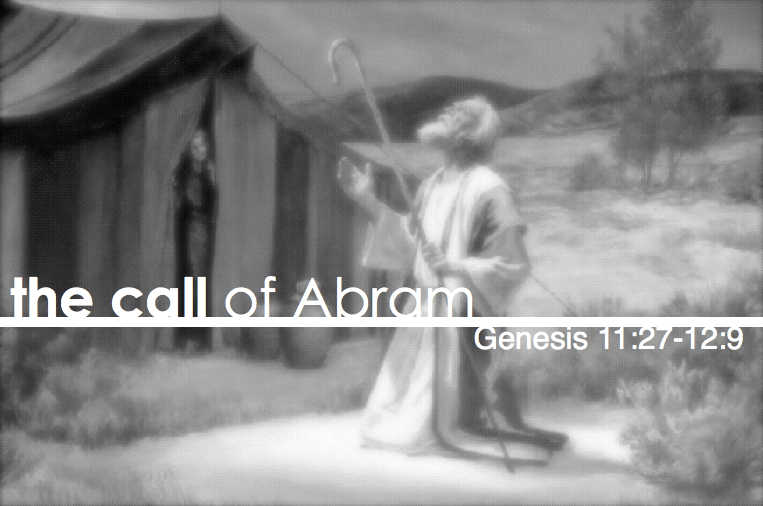
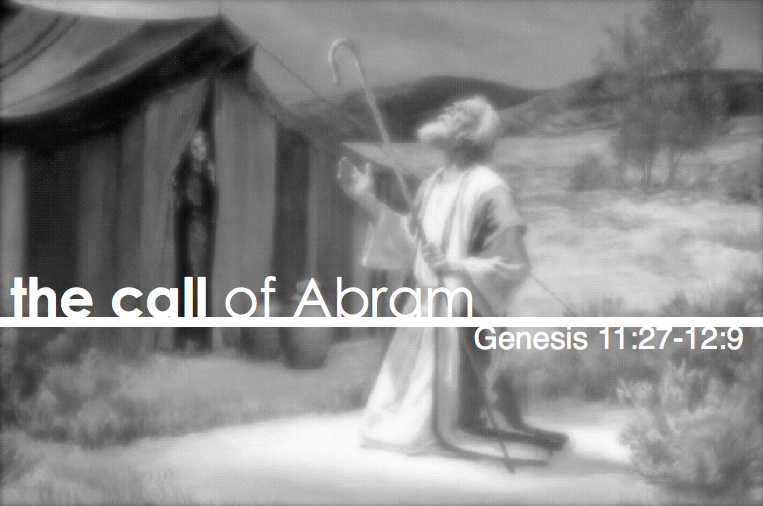
the call of Abram

A few years ago Sarah and I began to grow a garden. Gardens do not just grow over night by mere happenstance. You have to till the ground, plant seeds, water, and harvest. It takes work and a lot of initiative. In Genesis 12, God takes the imitative to nurture the seed of humanity; He readies the land and blesses the growth. He does it all through an ordinary man named Abram.

An Unexpected Call: God intersects with man [Genesis 12:1-3]

Can you image the day, Abram is out in the field tending to his herds and he hears a strange voice calling to him. Remember, God had not spoken verbally His covenant with Noah. It is God, again, who initiates a covenant relationship. Like Noah, Abram was a sinner living with sinners, but found favor [grace] in the eyes of God from among all the scatter people on the earth.

What was God calling Abram to do? First, Abram was called to leave the land that he was used to traveling around. Second, he was to leave his family and specifically his father’s house. Third, he was to go to a strange land that is not specifically named. God simply calls Abram to leave his homeland to journey to a new land that God would show him. Do you sense the radical measure of this call and the details left out? Put yourself in Abram’s sandals. How would you respond to such a radical call?

Why was Abram called to do something so radical? God promised to bless Abram’s faith and obedience beyond just him and his tribe. Abram was called by God to become the father of a new nation, become an example of living faith, and become one of the Bibles most mention patriarchs of Gods promise [i.e. over 300 times in the OT & NT].

Here in this short, three verse—text message sized—call, God rehearses some of the major themes of Genesis. First, God promises land [12:1b]. Second, God promises seed [12:2a; cf. 4:25-26; 6:5; 9:20ff; 11:4]. God says later his seed will be like the dust of the earth [13:16; 28:14]. In a real sense God promised Abram he would be a father and through his son a great nation blessed by God would be a blessing to all nations.[1] Third, God promises blessing [12:2b; cf. 22:17; 26:3; 28:3] of His presence, protection and covenant. Fourth, another theme arises that has not been mentioned until now, nation [12:3; 18:18; 22:18; 26:4; 28:14]. God promises to make Abram’s name great,[2] which ironically is the same thing the Babylonians failed to achieve for they pursued it apart from God.

Abram Answers the Call: a faith that grows on [Genesis 12:4-9]

You don’t see a long deliberation in between the call of God and the answer of Abram. You do not see him lying in his bed at night thinking about his conversation with God, or talking with his wife over dinner, or asking God some clarifying questions like, “Where did you say I was going?” The amazing fact is: Abraham believes God and goes [12:4]. No questions. No hesitations. He goes, in spite of leaving everything he knew behind and not knowing specifically how God was going to do all that He promised. It is as if he says to God, “Alright, God, I’ve got nothing else to lose.” At 75 ears old, a guy who at his age should be enjoying retirement and grandchildren takes his wife, their household, and his Nephew Lot to an unknown land.

This is the first step of faith in Abram’s life. It is a step that will affect not only him but also all of mankind. God will use Abram’s mustard seed sized faith. Have you ever been where Abram is in your life?  You decide to trust God, doing things His way, even in the face of the impossible. Abram starts off his journey with faith. No excuses, like “I forgot to lock the front door honey?” No turning back to feed the goats and camels, he takes them all with them.

As Abram goes, he comes to a land where people are living; a brick wall for a nomad. What does Abram do? Does he decide to go back home deciding this must be a dead end and not a part of God’s plan? No. Abram reacts by trusting God. He owns his faith and praises God on this blind journey of faith. His faith in the One True God is coming alive. For the first time Abram is offering praise to a God who speaks and is loyal to those trust in Him. He dedicates the land to God [cf. Leviticus 20:22-24; Psalm 72:8, 17-19]. By worshiping Abram is saying, “There is no other god, but You!”[3]

From this point forward, the lens of Genesis focuses in on the descendants of Abram as God’s covenant people raised up to be blessed nation and a be blessing to all other nations and people who follow. If you contrast Abram with Babylon, both the story, which preceded his call and the city that was the location he was called from [Genesis 11]. The Babylonians sought to be a great nation, blessed people, and great in name, but they pursued this apart from faith and apart from God. So, God called one of them, Abram, out from the land and into covenant with Himself and promised to give to Abram all that the Babylonians had strived for by His gracious provision. Therefore, God is demonstrating that our hope is not in the efforts of sinners who save and bless themselves, but only in entering into covenant relationship with God by faith.

What lessons about faith do we learn from Abram? How does his faith point us to Jesus?

First, your obedience to God is always connected to your faith in God. If you trust God you will obey God. The more you obey God the greater your faith will grow. Though Abram’s faith is incredible it is not complete. Only Jesus’ faith and obedience were complete.

Second, any time you obey God expect opposition through seeming dead ends, speed bumps, or foggy roads ahead. Faith helps you press on when the road ahead is hard or uncertain. The disciple’s obedience led to persecution [Matthew 5:3, 5, 10]. Jesus obedience led to a suffering cross.

Third, God calls ordinary people to carry out His extraordinary plans. Abram was a sinner, but God’s grace was upon him. The covenant promises carried out by Abram’s faith point to the New Covenant in Christ.

Finally, the seed of Abram that will bless all nations points to Jesus, the promised seed, who will redeem the sinfulness of mankind [Matthew 1:1; 24:14; Romans 4:13]. Those who obey and have faith in Him will live with him in the Promised Land in the Eternal Kingdom [Hebrews 11:10; Revelation 22:1-4].


[1] This promised seed is singular, which points to Jesus [cf. Genesis 3:15; Matthew 1:1, 1:17; Galatians 3:16].

[2] Abram was also told he would that his descendants would receive the Promised Land if he in faith go from the land God called him to. Reaching the Promised Land was not fulfilled in Genesis because Genesis ends with Joseph requesting his bones to be taken from Egypt to the Promised Land in the day that God’s people finally entered that place. Also, Exodus ends with the expectation that one day the Promised Land will be entered [Exodus 40:34-38], which is not realized until after the death of Moses [cf. Joshua 1-4].

[3] Abram responds by worshiping God in faith by building an altar other times in Genesis [12:7, 8, 13:18, 22:9].

the great disconnect

When Sunday comes around it is good to be ready to hear the Word of God so it can be maximized in your life. The Great Disconnect is a sermon preached by our Pastor Kenny on how to listen with more than your ears to the Sunday sermon. You can download the manuscript here: the great disconnect [James 1.19-27]

thumb lick thursday [5.12.11]

You Might Be an Idolater if…

How do we know if we love something too much? Where is the line between a healthy enjoyment and an idol? Idolatry is often subtle. It can creep up on us in the form of good desires, like getting married or excelling in the work place. You may have created idols for yourself if… [The Greener Grass Conspiracy]

Parenting 001

Does it seem like parenting has gotten more complicated? I mean, as far as I can tell, back in the day parents basically tried to feed their kids, clothe them, and keep them away from explosives. Now our kids have to sleep on their backs (no wait, their tummies; no never mind, their backs), while listening to Baby Mozart surrounded by scenes of Starry, Starry Night. They have to be in piano lessons before they are five and can’t leave the car seat until they’re about five foot six.

Eating with a Mission

How we eat and who we eat with can communicate quite a bit about what we believe. Something as simple as eating not only creates natural opportunities to be intentional, loving, and missional—but meals can also be a reflection of our theology.

45 Stunning Examples Of Bird’s Eye View Photography That Captured The Beauty Of Earth

Here is an awe-inspiring collection of Bird’s Eye View photography that is a special technique of capturing photographs from an elevated location. This gives the bird’s eye view of the object being photographed. In Bird’s Eye View Photography, the camera is usually not supported by land based structure rather it is hand held or mounted and photographs are taken through triggering the camera either remotely or automatically.

What Love Wins Tells Us About Christians

Everyone knew in advance that Rob Bell’s next book, Love Wins, would surely raise eyebrows and create some debate. But no one, including the author and his agent, expected what did happen. Scot McKnight give “10 [interesting & insightful] things we can learn from one of Christianity’s biggest controversies.”

uMove

the role of the sent one

BRIEF HISTORY OF THE HUTTS: Before coming to BGBC, I spent a year in South Africa doing a church planting apprenticeship. There I gained a vision for the church, church planting, global mission, and a heart for Africa. Coming to BGBC I sought a church that loved church planting and global missions. It has been a joy the last 8 years to watch this church with a long history of missions-mindedness send out missionaries to the foreign field. Sarah and I will be the next ones sent out from this church.

BRIEF HISTORY OF SENT ONES IN THE NT: We see 4 examples of churches in the New Testament that sent people out for Christ’s mission. First, Jerusalem was hub of the first church where gospel preaching, fellowship, and suffering together led to remarkable growth and expansion of the church. Second, Antioch a hub of missions to the north and west because the church was well-mixed ethnically and well-led spiritually. Third, Philippi was a church that financially supported and encouraged Paul. His letter to them is more of a thank you letter for their support. Paul brings up an important principle in the mission of the church: the mission is a partnership in the gospel. Finally, we see a community [near Ephesus] tucked away at the end of the Bible in 3 John.

BRIEF HISTORY OF JOHN AND THE SENT ONES: The church to which the apostle John wrote seems to have problems and divisions [what church doesn’t?]. John sent messengers of the gospel to the church and they were met with a mixed reception. Gaius welcomed and supported them [vs.1-5], while Diotrephes [a self-appointed leader; false teacher] thwarted and evicted them [vs.9-11]. 3 John could be a case between two types of missionaries. I will place most of my emphasis on Gaius. What John says to Gaius is informative and is a biblical model for what [TO ME] is the mission of sending out.

1) SENT ONES ARE SENT OUT THROUGH THE CHURCH [3 John 6]

The church is the hub of Jesus’ missions. Missions and sent ones must be doing ministry through the church, for the church, by the church, in the church, because of the church, for the sake of Christ’s glory who is the Head of the church. If sent ones are doing anything other than planting the church, they are parachurch [i.e. alongside the church; orphanage, bookstores, seminaries, etc]. Sent ones are faithful to the mission of the church.

3 WAYS FAITHFUL FOLLOWERS ARE SENT OUT:

By the Holy Spirit. According to Acts 13:1-3, the Holy Spirit of God sends out qualified servant-leaders from local churches to plant new churches in new lands. God’s Spirit gives witness of this calling both to the sent one and the sending church. In recognizing how God wants to use the sent one, the church then “releases” them.

Through the call of Christ. In John 20:21, Jesus says to all his disciples, “As the Father has sent me, so I am sending you.” Jesus was sent into the world to become the Savior. You are sent into the world to proclaim what Christ has done and call people to faith in Him. Therefore, every Christian should evangelize locally and, if possible, support the work of bringing the gospel globally.

Through local churches. The local church, again, is the vehicle God uses to send out people to preach the gospel with the goal of establishing new local churches wherever they go [Acts 13:4-5; Acts 14:21-23]. This means that local churches are responsible to raise up, send out, and support missionaries whose goal is not merely to see individuals come to Christ, but to see local churches established in regions where there are none.

The church “does well to sends them on their journey in a manner worthy of God.” What does that mean? It could mean cutting them checks, it could mean having a beautiful commissioning service, or waving good-bye at the airport. However, I would hold that it means more than that! To send one in a manner worthy of God is to support them in such a way that God would approve: Arrange all hospitality with lodging and meals while home [Romans 15:24; 1 Corinthians 16:6-11; 2 Corinthians 1:16], offer transportation and accompaniment [Acts 20:38; 21:5], and freely give resources and encouragement [Titus 3:13; Acts 15:3]. Servants of Christ should be treated like we were sending Jesus on His journey. When a missionary calls your church asking for support do you hear their story, encourage them, and pray with them even if you know you cannot support them financially? You do well to send them on their journey in a manner worthy of God.

2) SENT ONES GO OUT FOR THE SAKE OF THE NAME [3 John 7]

Most missionaries tend to be Type-A kind of people. When sending out people from your church aim to cultivate character over mere skills. The person you are considering might be gung-ho, super-skilled, have a sweet resume, look like leadership-material, wears Christian T-shirts and is quite evangelistic, but he or she could be corrupt in their core. Spend time with them in the testing fields, before you unleash them to the mission field. Sent ones spent a long time with their sending church serving [Acts 18:22-28].

ESSENTIAL EXPECTATIONS [AS ONE BEING SENT] CONCERNING HOW MY CHURCH PREPARES ME:

Surrendered.  Look for one overwhelmed by their own salvation, committed to Christ, consumed by the message of His gospel, and championing the One Name [Philippians 2:9; Romans 1:5; Acts 5:40-41]. Period. [Galatians 2:20; 6:14; Colossians 1:24-27]. The power, authority, and glory for the mission is in the name of our Lord Jesus Christ!

Servanthood. Do they choose the towel over the robe? Giving one a robe is a special honor [Luke 15:22]. When one was given an important task or office they received a robe. The disciples often aspired for the robe, but Jesus sought the towel [Matthew 20:20-28]. The greatest missionary is a one who takes the position of the least [Luke 22:24; Matthew 20:26]. Sent ones are servants of Christ first and foremost.

Humility. This is the posture of a servant. They “accept nothing from the Gentiles.” This was not arrogant humility or false humility; rather they only accepted support from Christians and churches that understand the mission. Humble servants understand the results in ministry come from God, not from the human instrument. “I planted, Apollos watered, but God gave the growth. So neither he who plants nor he who waters is anything, but only God who gives the growth” [1 Corinthians 3:6-7].

Full of Integrity. God expresses far more interest in what we are than in what we do or where we go. Here are some good questions to pry into the life of new or old missionary: Are they financially responsible? Are they pure of heart and mind? Do they have a pattern of good relationships? Do they deal with conflict biblically? Are they faithful to their family? Ministry should not destroy the family and the family should not destroy ministry. Integrity is important at home, work and the ministry. Since, distance makes it easier to hide, as one sent, I am responsible to be proactively communicating with my sending church with openness and honesty.

Faithfully Bearing Fruit. [vs. 3-4, faithful to the church & others] If someone wants to evangelize in China, are they already evangelizing Chinese people? If someone wants to be a Bible translator, are they already studying the biblical languages? Sending someone out to minister on behalf of a church is a serious matter. “So then, men ought to regard us as servants of Christ and as those entrusted with the secret things of God. Now it is required that those who have been given a trust must prove faithful” [1 Corinthians 4:1-2]. In Acts 13:1-3, the church sends out only those who have proven themselves in godly character and ministry effectiveness, who are sound doctrinally and equipped for ministry, who show the fruit of the Spirit, and who have remained steadfast under trial. Consequently true success in missions is measured by faithfulness to the task, not by immediate, visible results.

Biblically Minded. A missionary will face all kinds of new challenges and unorthodox beliefs/worldviews. He or she will need to be able to confront these unexpected challenges biblically. Sometimes they return from the field tired, discouraged and depressed, and a biblical framework would be helpful. Also, on the field, exegetical skills are important for training church leaders, counseling, planning, team working, evangelizing, discipling, spiritual warfare, and so much more.

Love for the church. According to the Scripture there is no such this as a rogue missionary, Lone Ranger Servants, Christians Tourists or Commercial Travelers/Charlatan. The missionary represents the church and its mission. A sent one should willingly submit to the elders of the local church that sends him [1 Peter 5:1-5; Hebrews 13:17], and more importantly they submit to Christ who is over the church [Ephesians 5:21; 1 Corinthians 11:3]. Remember, missionaries are sinners too. They need accountability and counsel. It is important the missionary be a member of the church. Not just a member, but also an active member, a fruitful member, and a theologically and methodologically minded member. Your sent one is part of the mission of your church, planting like-minded churches through your church.

3) SENT ONES HAVE THE SUPPORT OF THEIR SENDING CHURCH [3 John 8]

“We ought” is rather weak. It would be better translated, “we are obligated to support people like this.” The church and the ones they send are partners [i.e. fellow workers] in the gospel of Jesus Christ [i.e. truth]. Therefore, together we must do all we can to support one another in the growth of the church and the continuance of the gospel message. It is not about what the church does for the missionary, but what it does through the missionary. Likewise, It is not about what the missionary does for the church, but what he does through the church.

In conclusion, as one who is being sent from the church I recognize first of all that it is the church that sends me out. Second, I must go out for the sake of the name and no other. My character as an ambassador of Christ and representative of His church seriously matters. Third, I must encourage the support [receive] and be willing to support [give] the church sending me out. Together, the sent one and the senders lift high Christ and His church.

This is how we do missions as a church. John helped start all these churches, and then, he sends people and money to go to those churches to get more people and more money to go start yet more churches. When they are up at that church, who greets them? Gaius, Gaius is the guy that John will send a letter ahead and say, “I’ve got Missionary Mike and I’ve got Servant Sally and I’m sending them down, and they’re going out from Fellowship Bible Church, and they’re going go plant New Bible Church, and here they come, and Gaius, you know they’re coming.”

So then, Gaius waits, and here comes Mike and his wife, and they show up, and Gaius says, “Hey, good to have you. Come stay at my house. Have some soup. You guys need money? Let me get my checkbook. How can we be praying for you? My Bible study gets together every week, and if you could let us know what to pray for, we’ll pray for it.” That’s Gaius. Gaius gets behind their work, and is really happy to be involved, and John says why, “So that we may work together for the truth.”

Don’t be a Diotrephes.

Let’s go Gaius!

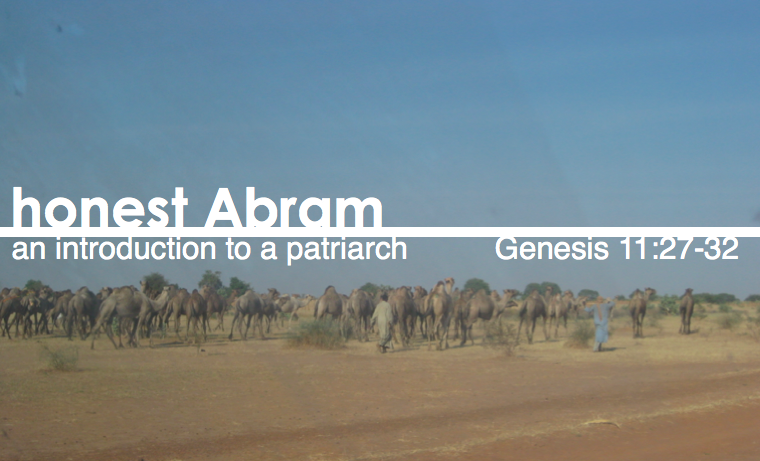
honest Abram: an introduction to a Patriarch

Abram worked as a nomadic herdsman [Genesis 11:31-32]. Abram’s family settles in Haran, which is in modern day Iraq, near the tower of Babel [Genesis 11:1-9].[1] As a nomad, he did not have permanent property;[2] instead he would live with his herds of camels, cattle, and goats that moved around to new land to graze [Genesis 12:10; 13:2, 5-6]. Nomads took all their possessions—family, houses, and servants—with them wherever they traveled [12:5]. Nomads can have great power and influence because they own many animals, which are lucrative for trading. Yet God will call them from this land to travel to an unknown land of promise and blessing!

Abram worshiped as pagan idolater [Genesis 11:27-29]. Say it is not so? According to Joshua 24:2, “Thus says the LORD, the God of Israel, ‘Long ago, your fathers lived beyond the Euphrates, Terah, the father of Abraham and of Nahor; and they served other gods.” Surely, this is some other guy named Abraham? Nope. Abraham’s daddy and brother are named with him too. When we first meet Abram he is an ordinary godless Babylonian.[3] Yet God will draw them out of this land into a new land with a new God!

Abram’s wife was barren and broken [Genesis 11:30]. Barrenness might not sound like a big deal. Today, some women chose not to have children, and even if they are barren they can visit the doctor to get fertility treatments or consider adoption. However, barrenness in Abram’s day was much different. Barrenness was thought of as punishment or curse from a pagan god. With bareness came personal humiliation and community pressure because no children meant, no power to invent a future [i.e. no family lineage].[4] In Abram’s day there were no 401K retirement accounts or nursing homes to take care of the elderly. You either had your family care for you or you died alone. Barrenness is a picture of hopelessness in the ancient world. Yet God will use her barrenness to lead their family to a fruitful future of faith!


[1] Nehemiah 9:7 and Acts 7:2-3 seem to indicate that God in fact called Abram in Ur of the Chaldeans he may have even been called out of Babylon as a Babylonian that perhaps even sought to help build that great city which God judged as the key city of the Chaldeans was Babylon [i.e. Isaiah 13:19, 48:14; Jeremiah 24:5, 25:12, 50:1; Ezekiel 1:3, 12:13, 23:15].

[2] The only property Abraham ever owned was the property he bought for Sarah’s grave [Gen 23:1-20].

[3] Even Abram’s relative’s names have pagan roots: Terah [Hb: yerah; moon], Sarai [Hb: princess; Akkadian: Sharratu, name of wife of moon god Sin], and Milcah [Akkadian: Ishtar, daughter of moon god Sin] have pagan roots.

[4] Children are a mark of God’s blessing. God shares many examples of barrenness in the Bible [25:21; 29:31; 1 Samuel 1:2; Isaiah 54:1].

dear mom, love Justus

Dear mom,
You’re great.
You da’ bomb!
There’s more, wait…

Six months ago
You carried me
Head to toe
You delivered me.

When it’s just us together
I hear you sing.
What a wonderful mother
God did bring.

You feed me
close to you everyday
You even teach me
While we play.

You read me the Bible
Every single morn
Your prayers so reliable
Since I was born.

I cant’ wait to grow
And watch what you do
To learn what you know
‘Cause I want to be like you.

My mom is,
a lot like Jesus.
I love you,
Your daughter Justus

How should I pray during the church’s search for a new pastor?

1. Pray for your search committee.

  • Pray for patience. Pray that the committee would wait upon God’s timing. Pray that your search committee will have the mind of Christ and agree.
  • Much of the process is subjective. Personal opinions and preferences are involved. Differences can divide. Ask that the search committee would heed Paul’s advice for unity, having the humble attitude of Jesus Christ [Philippians 2:1-12].
  • Pray for wisdom to choose the right man. Pray the search committee will renew their minds in the Bible so that they can have Word-centered wisdom [Romans 12:1-2].
  • Pray for discipline for your search committee and other church leaders. The search process will require a great deal of follow-through on the parts of individuals.

2. Pray for your next pastor.

  • Pray that God would increase his passion for the Word of God.
  • Pray that God would give him a love for you church and the strength to leave his current position.
  • Pray that he would begin new relationships at your church in the right way.
  • Pray that God would prepare him to shepherd your church through the trials and blessings he has faced and currently faces.
  • Pray for his family.

3. Pray for your church.

  • Pray for patience. The search process can go longer than expected. It is hard work for those doing the search process. Pray for trust in the leadership.

  • Pray that your church would learn to place a high priority on the Word of God, the glory of Christ, and a love for His church. It is easy to gravitate towards personality, programs, or an ideal when calling a new pastor. Pray we focus on what matters: a man who loves Christ, His Word, and His church. Pray the new pastor will be a man of Christ-like character.
  • Pray that your church would not react to your previous pastor. You will not get a pastor like your old one, nor should you expect to. Pray he will be loved by your church.

Adapted from When the Word Leads Your Pastoral Search. By Chris Brauns. Moody Publishers, Chicago, IL. 2011. Pgs. 28-31.

thumb lick thursday [5.5.11]

What if I have a conflict with my spouse Sunday morning before church?

I wish I could answer this from a hypothetical perspective.  I cannot.  In fact, I have fresh experience from which to write this post. There are significant implications for the pastor and his wife who have a conflict that goes unresolved leading into the Sunday morning service.  Ours started on a Saturday night.  In a rare moment in our marriage, the hurt and frustration went unresolved and carried over into Sunday morning.  We drove to church still struggling.  We both chose not to go to Sunday school, but to go off separately to think, pray, and try to figure out how we each contributed to this rare circumstance of lingering conflict.

How Are Mac & PC People Different?

In an infographic that’s bound to cause arguments and perhaps fistfights, researchers at Hunch placed data from about 700,000 of its website visitors onto a deep illustration that shows just how different users of Macs and PCs are. They came up with interesting correlations between users’ chosen computing platforms and their demographics and personalities, as well as tastes in food, fashion and media.

The 4 P’s of Business

Many Christians inhabit the world of business, a realm that pastors frequently berate and misunderstand. There are dilemmas faced in the business world that go unnoticed by other Christians. This post is a sermon on business ethics from Proverbs that touched on some of those issues. It is structured around four priorities of business and a concise vision for business ethics.

DA Carson on Biblical Exegesis

Trail Guide: a global journey for God’s Glory