thumb licks [03.09.13]

The case for early marriage. How to train youth to tie the knot.

Jesus Plus.

Amazing images of earth from space.

Are you being a burden?

How do I evangelize if I’m an introvert?

How China plans to wipe out house churches.

Like elephants, search engines never forget.

7 ways to do bad word studies.

How is your Bible reading going?

Advice for parenting young children.

What is love?

Jesus breaks the rules

breaking the rules

Rules. Rules. Rules. They are everywhere. There are rules for school, rules for the road, rules for table manners, rules for marriage, rules for parents and children, rules for governing, rules for meetings, rules for church, written rules, unspoken rules, and even rules for rules.

Sometimes rules can seem nettlesome when we don’t understand their purpose. Like, why can’t we use #1 or #3 pencil for tests? Now, rules aren’t all bad. Think of a world without rules. It would be chaos. Rules are good. Rules are meant to protect us and help us. This is the heart behind a parents saying to their children, “Look both ways before crossing the street.” It’s a rule that could save ones life.

God has made rules too. His rules perfectly and lovingly protect us and help us. However, some people have seen God’s rules as overbearing or unreasonable and choose to rebel. Rebellious people break the rule by ignoring them altogether. Others have seen God’s rules as insufficient and needing additions to fit their religious system. Religious people make rules for God, themselves and others.

So is it ever okay to make or break the rules? In Luke 6, Jesus will answer this question as He’s being accused of breaking their rules. What rules does Jesus break? Certain religious leaders accuse Jesus of breaking the Sabbath rules.

What is the Sabbath? Literally, it means “rest” and is rooted in the seventh day of creation when God rested after six-days of creating (Genesis 2:2-3). God did not rest because He was tired, but He set an example for mankind (Mark 2:27-28). God knew in His infinite wisdom that man would be weak and need to take a day off from work and enjoy the day of rest. The Sabbath is a day dedicated to God (Exodus 20:9-11). So how do the religious leaders think Jesus breaks the rules of the Sabbath?

1) Jesus breaks the rules by helping His hungry friends (Luke 6:1-5)

no_food_or_drinkJesus and His disciples were hungry and there was no McDonald’s drive-thru available to get a quite bite to eat. In accordance with the law (Deuteronomy 23:25), they go into a field, pick grain, crush it with their hands, and eat it. The Pharisees catch wind of this and cry foul. They ask, “Why are you sinning on the Sabbath?” (v.2) Why do they assume Jesus and His followers are sinning? The Pharisee’s saw this as harvesting and threshing, and accuse Jesus of doing work on the Sabbath. Sounds like a stretch, eh?

The Pharisees were sticklers for law keeping. The took God’s law and added to it a man-made framework to give them the appearance of righteousness. So with such laws like, “Remember the Sabbath and keep it holy,” (Exodus 20:8ff) they made-up a list of rules to look really holy, but the Sabbath became just another religious activity.

Isn’t that easy to do? Have you ever made the Sabbath a religious activity to boast in yourself? It is easier to keep your own rules of righteousness than measure yourself by God’s rules. According to their rules, Pharisees were on the Varsity Team and everyone else was on warming bench.

How does Jesus respond to the Pharisees accusation? First, He compares the situation to the example of David and his soldiers eating the bread of Presence from the temple, which was only to be eaten by the priests (1 Sam.21:1-6). Jesus points to the fact that God is more concerned about the person and the motivation of their heart than the particulars of the law. Jesus could see through to the hearts of the Pharisees and they were evil.

Second, Jesus doesn’t appeal to the religious leaders authority or accept their theology, instead He claims, “I am Lord over the Sabbath” (v.5). In other words, Jesus says, “I wrote the law and the Sabbath was my idea. Stop arguing with Me and start listening. Don’t fight Me, follow Me. Since I made the Sabbath, He define it.” Not only does He define it, He lives and fulfills it before their very eyes.

Sabbath is a wonderful gift from God to be enjoyed. Religious people suck the joy, passion, and purpose out of it (and everything they add rules to). They make the Sabbath as fun as going to the dentist on a free day. This particular Sabbath should have been the most unique, memorable, and joyful ones of their lives because they were in the presence of the Son of God.

2) Jesus breaks the rules by healing a man’s hand (Luke 6:6-11)

no peopleOn the Sabbath, Jesus goes to the synagogue for worship. He’s teaches. And Luke, the doctor, tells us there is a man present who has a withered hand. The Pharisees and scribes are listening critically to Jesus words and waiting with baited breath to see if He will heal the man. Like wolves ready to pounce on their prey, they were salivating at the opportunity to catch Jesus doing something they thought offended the law. Religious people are quick to tear apart and devour others.

This time Jesus asks the question, “I ask you, is it lawful on the Sabbath to do good or to do harm, to save life or to destroy it?.” (v.9) No response is given because the answer is obvious. Jesus then has the man to stretch out His hand, in faith, he does what Jesus says, and Jesus heals him. In that moment, Jesus showed the religious people that helping someone in need trumps holding tightly to your rules. Jesus transforms this man life. Forever will he remember this Sabbath as the day Jesus healed His hand and healed his heart.

Religious people are not ruled by loving God or loving people, they ruled by a love for rules. Loving rules is legalism. Legalism is when people take the Bible and add to it. They make rules outside of the Bible that are equal to the Bible. Legalism is unbiblical, unloving, moralistic, man-pleasing, compromising, critical, judgmental, arrogant, self-righteous, and godless.

Legalism is an enemy of Jesus and His Word

Legalism is a dangerous enemy; it adds to the Bible and rejects Jesus as the only sufficient means to righteousness. Legalism denies something called sola scriptura, where Scripture alone are our highest authority. Sola Scriptura was first coined by the Protestant Reformers. All other authorities, like other books, teachers, rules, and leaders, are under, not equal to, Scripture. Religious people tend to elevate teachers and also other lists, and rules, and books equal to Scripture.

So dangerous is legalism that it kills Jesus. The Pharisees were so angry that they connived a plan to get rid of Him, “But they were filled with fury and discussed with one another what they might do to Jesus.” (v.11) Religious legalist don’t lose because they make their enemies pay. When they are angry they attack. Luke 6:11 will lead to Luke 23:46, which is the murder of Jesus.

Jesus summarizes the rules with two rules

Jesus doesn’t break any of the Bible’s rules, but He breaks certain religious rules. He does so because He values helping people more than following others expectations, traditions or religious rules. He knows that religious legalism is the default setting of every human being. So in Matthew 22:37-40, Jesus shares the two most important rules, often known as the greatest rules,

“You shall love the Lord your God with all your heart and with all your soul and with all your mind. This is the great and first commandment. And a second is like it: You shall love your neighbor as yourself. On these two commandments depend all the Law and the Prophets.”

These rules show God’s heart for giving the law: love. God intends the law to protect and help you love Him and others around you. It’s not about loving the rules or loving to rebel against them. It’s about loving the God and others. As Jesus said, “The Sabbath was made for man, not man for the Sabbath.” (Mark 2:27-28)

Some of you need to repent of your religion. Enough with the legalism. Enough with the rule making. Enough adding to the Bible. Enough with the self-righteousness. Enough with the boasting and bragging. Enough with the criticizing and judging. Repent of your religion and come to Jesus. You can’t have Jesus and religion. It’s just Jesus.

Some of you also need to repent of your rebellion against Jesus’ rules. Enough with rebellion. Enough with rule breaking. Enough ignoring the Bible and subtracting from it. Enough with bashing the religious. Enough with reverse legalism. Enough with lawlessness and licentiousness. Repent and follow Jesus.

Come to Jesus. Receive His death for your sin, His righteousness for your unrighteousness, let Him do the work of grace and transformation in you. The truth is Jesus lived the perfect life. He died a substitutionary death, and He rises to give you the gift of righteousness. Stop trying to be righteous on your own and receive the righteousness of Jesus, and share that message of grace with those around you who need it too.

Jesus eats with sinners

bar

Most religious people would not catch themselves in a biker bar or talking with pimps and prostitutes, but when reading through the Gospels we catch Jesus talking to these kinds of people in these kinds of places often. Why does Jesus hang with sinners? Well, in Luke 5:27-32, Jesus eats with a tax collector and his companions, and it is here you get the answer.

What’s with the tax collector?

I-love-tax-collectorsIn Jesus day, tax collectors were hated. Some things don’t change! They were especially hated then because Israel was under Roman oppression. Certain Jews got the job of collecting taxes for Rome. They were viewed as a traitor or enemy who cheated their own people to get rich. For that reason, they were commonly avoided or the punchline of many bad jokes.

Who are the “tax collectors” in your life? Think of the person you avoid or talk bad about. Is it your beer drinking neighbor who parties too loudly, even on weeknights? Is it girl who is known by her second-rate reputation at your office. Is it the politician you love to bash?

Levi is a tax collector. He’s the guy you love to hate. But he’s also the guy Jesus loves to love. Jesus finds him. He doesn’t avoid him like someone with a virus. He finds him at the tax office counting his coins. Jesus doesn’t come in and blast his character or belittle his profession. He simply says a simple statement expecting a simple answer, “Follow Me.” Amazingly, Levi leaves everything and follows Jesus.

Who’s sick?

Levi’s life changed the day Jesus intersected him at his office. He’s so excited he throw a party. Since tax collectors don’t have many friend their friends are usually other tax collectors. The guest of honor at Levi’s party is Jesus.

Word spread faster than a British tabloid. The religious leaders came to Jesus’ disciples with their list of gripes and complaints. As the Pharisees see it, Jesus is in a lose-lose situation. Sinners are following Him. But Jesus sees it as a win-win. Sinners are following Him. Jesus defends Himself by saying, “Those who are well have no need of a physician, but those who are sick.” (5:31) What did Jesus mean by this?

Jesus directs his words towards the religious leaders. They are (spiritually) sick and don’t even know it. They are like a man who will not admit that he is sick and refuses go to a doctor for help. In their pride, they will suffer defiantly, if not die. Jesus came to bring healing our sin sickness that leads to death. Pride leads to death, but humility leads to the cross.

Will you repent?

Jesus follows up his first statement by saying, “I have not come to call the righteous but sinners to repentence.” (5:32; cf. 13:3-5; 15:10; 24:47; Mark 1:15; Acts 5:31) He’s not called to the righteous because they don’t think they have a need for Christ (when they really do!).

Jesus is called to the sinner who knows he is in need of Christ (cf. 1 Tim. 1:15) and humble enough to come to Him for a life transformation. To repent is to humbly turn away from your sin and your self-righteousness and turn towards Jesus and His righteousness. It’s a life-transforming turn.

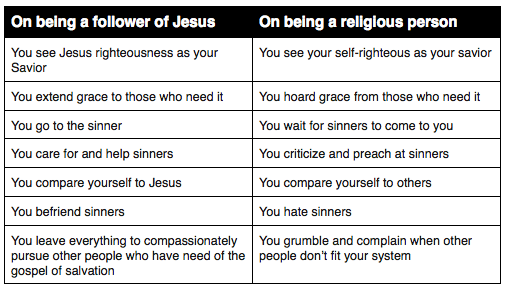
Do you see the contrast between Levi’s response to Jesus and the religious leaders response to Jesus? Levi follows immediately and throws Jesus a feast. The religious leader grumble, question, and judge. Levi wants Jesus to transform him, but the religious people want Jesus to conform to them. Levi has an attitude of repentance, while the religious leaders think they have no need for repentance. The religious leaders measure their goodness among themselves, while Levi measures His goodness against Jesus. The religious leaders follow their code of conduct, while Levi simply follows Jesus. Being a follower of Christ is much different than being a religious person.

follower of Jesus vs religious person

A good question to ask yourself when reading this text is, Who do I respond like more often Levi or the Pharisee? If I were honest, I would have to say I respond more like the Pharisee. How about you?

So how do I change and love like Jesus loves? First, I must remember I was once like the tax collector to God. I lived the most unlovely life yet I was unconditionally loved by Him. I was infected by the most destructive disease known to man, sin.  I can love my enemies because I was once God’s enemy and He loved me.

Second, repent and run to Jesus Christ. Repentance is your only means of healing. Repent of your pride, repent of hoarding God’s grace, and repent of your hateful attitude towards the tax collectors in your life. When you repent don’t expect life or loving others easier. Sometimes it can be harder. Jesus got Himself killed because of the way He ate.

Third, with the remaining days of your life make it my aim to follow Him, which means eating with sinners too. Extend to all the life-transforming eternity-giving message of the gospel of Jesus Christ. No one, including you or the tax collectors in your life, are too sinful to enjoy the pleasure of sitting at Jesus’ table.

Lessons for parents from Jesus’ parents

Screen Shot 2013-02-09 at 3.52.06 PM

We don’t often think of Jesus being a child, teenager, or even a tween, but He was one. I suppose the reason is that there isn’t a lot of material written about Jesus’ childhood between His birth and late-twenties. What was it like to parent a young Jesus? Perfect right? No tension, no discipline, no disappointment. Well, not exactly. Jesus had a moment of tension, but the tension was only there from the perspective of His parents.

The situation occurred following a family trip to Jerusalem (Luke 2:41ff). Jesus’ family annually observed the Feast of the Passover. It is here that we see some valuable lessons for parents from Jesus’ parents.

1. Godly parents’ obey God first (Luke 2:41-42).

In celebrating Passover, Jesus’ parents were not just taking a fun trip to see local attractions, they were showing their appreciate for the Law and their love for God. Mary and Joseph were living their faith openly before Jesus. This is not the first time we see this young couple loving God and obeying Him (cf. 2:22-24, 39).

Parents who obey God first will often have children who follow closely behind. Children learn by what they see, not just what they hear. Parents who allow their children or society dictate their mode of parenting will be frustrated and disillusioned as will be their children. Put God first before your children. Even when you blow it, let your children see you bend your knees back to Him.

“You shall love the LORD your God with all your heart and with all your soul and with all your might. And these words that I command you today shall be on your heart. You shall teach them diligently to your children, and shall talk of them when you sit in your house, and when you walk by the way, and when you lie down, and when you rise. You shall bind them as a sign on your hand, and they shall be as frontlets between your eyes. You shall write them on the doorposts of your house and on your gates.” (Deuteronomy 6:5-9)

Note Jesus’ timing in Jerusalem. He is 12 years old, the age that marked the final year of preparation for a son before he entered full participation in the religious life of the synagogue. Up until this point his parents, especially his father, would teach him the commandments of the law, which were completed with a ceremony where he formally became a “son of the commandment” (bar mitzvah). It was this moment Jesus chose to stay behind in the temple. Perhaps, He wants to demonstrate that He is more than an ordinary Jewish bar mitzvah.

2. Godly parents entrust their children to God early in their childhood preparing them for adulthood (Luke 2:43–50).

Jesus’ family likely traveled in a large group with other relatives, friends, and neighbors. “And when the feast was ended, as they were returning, the boy Jesus stayed behind in Jerusalem. His parents did not know it, but supposing him to be in the company they went a day’s journey.” (vs.43-44) Now the journey from Jerusalem to Nazareth was 153 kilometers (95 miles), and traveling by foot was probably more than a day trip.

Then it happened—a Home Alone moment. In the commotion of leaving the celebration Mary and Joseph didn’t account for their most precious cargo: their son, Jesus. Think about that moment as a parent. Immediately they check every person for details, “When did you see him last?” No quick flights. No cellphones. No 911 or Amber Alert. Quickly they traced their steps back Jerusalem probably checked every town and wayside along the road back.

Do you feel Joseph and Mary were neglectful to leave Jesus behind? There are two interesting things happening here that seem inconsistent. First, Jesus’ seems to disrespect his parents’ time and feelings. Second, there seems to be an implicit faith Mary and Joseph have in their young son. He was not an irresponsible boy nor was He rebellious. They trusted Him and knew He had wisdom. This suggests that Jesus’ motive in staying behind was not carelessness or disrespectful, rather it was purposeful.

After 3-days in Jerusalem, Mary and Joseph finally find Jesus. Where was He? He’s in the temple of all places talking, listening, and asking question of the teachers. He was not like other 12-year old boys who’d probably be at the pool or arcade! Joseph and Mary were beside themselves, frustrated at the circumstances separating them from Jesus. They responded as most parents would, “Why would you do this to us? We’ve been worried sick!”

Jesus’ response is astounding. No doubt this is the point to Luke’s inclusion of this story in his gospel, “Why were you looking for me? Did you not know that I must be in my Father’s house (or doing my Father’s business)?” And they did not understand the saying that he spoke to them.” (Luke 2:49-50) Mary and Joseph’s human emotions clouded their understanding that Jesus is God and Savior. They saw themselves as parents and Jesus as their son. And the lack of understanding Jesus’ word showed that there was more going here than meets the eye (cf. Luke 18:34).

Jesus chose this crucial stage in his life, on the brink of manhood, to tell his parents in an unforgettable fashion that He now knows whom His real Father is and what His mission is. In a real sense Simeon prophecy to Mary and Joseph in Luke 2:33-35 was already coming to pass, “a sword will pierce through your own soul also.” The time will come when Jesus will be killed in Jerusalem, 3-days rise from the dead, and that will be a great pain to Mary. And the past 3-day for Mary and Joseph foreshadow that pain.

Joseph and Mary probably saw their parenting role in transition that day. Sometimes the biggest pain in parenting is the pain of having to cut the strings of ownership over the lives of your children. Yet that is the goal of parenting. From the very moment your child enters the world, you are preparing them to live outside your roost and walk in loving obedience to God’s commands. As painful as it is to cut the ties it is even more hurtful to keep them tied. Godly parents entrust their children to God in childhood preparing them for adulthood.

3. Godly parents help their children learn to be obedient to God and to them (Luke 2:51–52).

Following this tense situation Jesus “went down with them and came to Nazareth and was submissive to them. And his mother treasured up all these things in her heart. And Jesus increased in wisdom and in stature and in favor with God and man.” (Luke 2:51-52) Jesus understands who He is in God (the Son of God), and man (submissive to His parents). Jesus continued to be under the authority of His parents, but He also recognizes His unique sonship to God and that His mission will require of him a devotion to God’s purposes even if it brought pain and misunderstanding from those closest to Him. In the end, Mary rejoices and treasures this situation in her heart.

Luke now sets the stage for Jesus’ adult ministry as the Son of God. 18 years later, when perhaps some of these very same teachers who marveled at Jesus’ understanding would mock and murder Him. He came to do His Father’s business even if it cost Him His life.

Parents, when teaching your children obedience it must first be modeled by your obedience to God and other authorities over you. I’ve counseled many parents with rebellious teens. Rather than dealing with their children right away I usually have a few questions for the parents, “How do you talk about your boss at the dinner table? How do you talk about the President while watch the news? Or what do you say about the pastor after the service in the car on the way home?” It’s then that the light bulbs turn on for the parents.

Obedience to authority is a milestone of maturity first modeled in parents then followed by their children. When disciplining your children to obey authority it is important to discipline rebellion against it rather than immaturity in it. This teaches children that maturity is a process, but rebellion is direct disobedience that not only has consequences in childhood that if not dealt with will have even severer consequences in adulthood.

What are the defining marks of a disciple?

discipleship

Recently, I was asked this question by a friend, “What are the defining marks of a disciple of Jesus?” That’s a really good question. How would you answer that question?

At its core, the word disciple means follower or more specifically a follower who is a learner. A disciple learns and never stops learning the ways of his teacher or master. He learns by watching, listening, and mimicking his master.

The New Testament is chalked full of examples of men and women who who were called disciples of Jesus. The examples include people who followed Jesus both before and after they committed to follow Him completely (Jn.6:66; Acts 11:24). That’s interesting.

When it comes to being a disciple of Jesus, it is probably important to understand what Jesus expects of a disciple. John, a close disciple of Jesus, records a message given by Jesus that clearly outlines defining marks of a disciple,

“This is my commandment, that you love one another as I have loved you. Greater love has no one than this, that someone lay down his life for his friends. You are my friends if you do what I command you.” (John 15:12–14)

In Jesus’ own words, we have three defining marks of a disciple of Jesus:

1) A disciple loves like Jesus.

Notice, a disciple is not marked by his knowledge of Jesus (which is important) nor the good things he does for Jesus (which is also important). A disciple is moved to act upon what He knows about God. As Jesus says, “you love one another as I have loved you.” (cf. John 13:35, 15:9, 12, 17). This is not an option, it is an order. A disciple is primarily and distinctively marked by the love he shows another.

You can manufacture this kind of love for a moment, but Jesus demonstrated it throughout His entire life. Jesus had an amazing capacity to love people. He loved the unlovely and His enemy. A disciple loves God and others, like Jesus, by learning from Jesus Himself.

2) A disciple is willing to sacrifice his life for the sake of Jesus.

The words that came out of Jesus’ mouth next are words I am sure you agree are true, “Greater love has no one than this, that someone lay down his life for his friends.” Yes! To that I heartily say, “Jesus, you’re right on! The highest level of love is a willingness to give your life for someone you really care about.” However, Jesus is not just sharing a truism. His intention is that you would connect this truth to the way you love Him (Eph.5:1-2).

Jesus had no shortage of followers. He wasn’t interested in crowds of followers, He was focused on the core of the follower. Some followed just to catch His next miracle, others followed to hear His earth shaking stories and sermons, while others followed for reasons both good and bad. Not everyone that followed Jesus loved Him, some hated His guts.

Jesus had a radical way of separating true followers from bandwagoners. Frequently He had crowd reduction sermons and say things like,

  • “Sell everything that you have…and come, follow Me” (Mk.10:21)
  • “Forsake your life and follow Me” (Mk.8:34-38)
  • “Want to be great? Be a servant” (Mt.20:26-28)
  • “If anyone does not carry his own cross daily and follows Me” (Lk.9:23)
  • “If anyone comes after me and does not hate his own father and mother and wife and children and brothers and sisters, yes, and even his own life, he cannot be my disciple.” (14:27)

Afterwards, many would go home saying “Jesus, you’re just asking too big a sacrifice from me.” Others would mock His words saying, “You think your God or something?” And others continued to follow. They weren’t many, but they were committed because they counted the cost.

When Jesus said, “Greater love has no one than this, that someone lay down his life for his friends” he was looking for a radical response. It’s as if He says, “If you are really My follower, then you will be willing to go to the grave for Me.” Wow. Let the words of Jesus sink into your skull for a moment. Did you think about that before you committed to follow Jesus?

A disciple dies to self. A disciple is willing to sacrificially lay down his life for Jesus, like Jesus went to the grave for yours.

3) A disciple obeys Jesus’ commands.

One who sacrificially loves, like Jesus, also joyfully obeys His words. Have you joyfully responded to His invitation? What invitation, you ask? Jesus gives you an invitation to be His close companion. This is more than an invitation to be buddy’s, pal, or homeboy. Jesus says, “You are my friends if you do what I command you.” This is not a manipulative or coercive invitation, rather it’s a mark of a follower. A disciple is willing to follow whatever His teacher or master has asked Him to do.

This is good news. Jesus is the earth shaking good news. He followed every one of the defining marks of a disciple. He lived the words He preached. He mimicked His Heavenly Father. So much so, that if you want to know what God is like, look at Jesus. No one could find a fault in Him. He went to the grave an innocent man. He did not die a fatalist, a moralist, or the most liked by the populist. He obeyed His Father joyfully, even when it cost Him His earthly life. He loved sacrificially, so that by His grace you could live eternally with Him. That’s the kind of friend, teacher, master, God He is.

Jesus last words to His disciples after His resurrection were, “teach them [all future disciples] to observe all that I commanded you.” A disciple learns to live obediently to the teachings of Jesus and joyfully seeks to reproduce the same characteristics in others until He returns.

So what are the defining marks of a disciple of Jesus? Well, in Jesus own words, a disciple is one who loves like Jesus, sacrifices His life for the sake of Jesus, obeys Jesus’ commands, and helps others to do the same. What say you? Do you bear these marks?

Question every disciple should ask himself:
Do I love people more and more?
How do I love those I least like?
What is the motive behind my love for God and others?
Is my love coming from duty or delight?
In what ways am sacrificing my life for the sake of Christ?
What commands of Jesus do you have a hard time obeying?
How are you learning to follow more like Jesus today?

thumb licks [1.15.13]

Bible reading plans for the year.

Junk with a purpose.

I will get back to you after I find the answer and other stupid statements.

Bible 101.

Dealing with life’s interruptions.

Our generations acceptable sin.

Paper computer. This is too cool.

Training your child to leave home.

The biggest structure in the universe. I feel so small.

I don’t believe in grace.

“Nanicabo”(Family) – The Next Chapter

walking in forgiveness

Screen Shot 2013-01-07 at 2.10.26 PM

When I was 10 years old I shared the school bus with a stoutly loud-mouthed bully. He knew just the buttons to push to make me blow: comments about the size of my nose. The other kids on the bus would snicker, mostly because they didn’t want to be his next verbal target. I thought to myself, “Isn’t anyone going to do anything about this kid?” I did not have any soap or earplugs, but I did have a plan.

I was as skinny-as-a-toothpick, but I was significantly taller than him by a mere foot, which at 10-years old says a lot. I also watch a lot of batman cartoons. I stood up and stare him down. I could beat a blind man in a staring contest. My plan did not work and I didn’t have a plan-B. I had to think quickly because I could see he was about to take a crack at me. I could turn my other cheek by sitting down in defeat or I could wipe the smirk off his cheek. I chose the later. I charged to the back of the bus and gave him a knuckle sandwich. Immediately the bus driver slammed on the breaks. I flew forward. The bus driver marched to the back, grabbed us both by our shirts and ushered us to the front of the bus. We didn’t make it to our homes that day; instead, we both pouted as we waited for our parents at the bus barn. Not only did my fists hurt, but my pride took a hit too. And it wasn’t the last time.

Have you felt the cut of a sharp word, been scalded by a heated exchange, or battered by abusive comments? The hurt from these kinds of situations should not be belittled. Nor should you exaggerate your response to these kinds of offenses. The top two responses are, first, hiding the hurt by stewing it into secret places. If you are this type of person you keep your relationships under serious surveillance cautious to not get burned again.

The second response to an offense is like a volcano spewing the hurt back in hell-fury. If you are this type person you pursue payback by inflicting more punishment fitting for the crime hoping your offender feels your pain. Have you ever played the board game Battleship? No one likes getting hit, but we like to do the hitting. This is the reason why many are glued to reality TV shows. They are built on the premise of backstabbing, one-upping, reckoning, and revenge seeking. Now, I am a fan of some reality TV shows too, however, retribution on your terms more than likely turns sinful. Only God can best play the part of God. Only God should take out vengeance.

There is another way since stewing or spewing is not helpful for the one offending or offended. What is the other way? Forgiveness is the only means to unleash an offense. To not forgive in a sense makes you like a dog on chain and your master is the one who has offended you. Forgiveness does not have leashes attached; rather it is a willingness to treat the offense as if it never happened. A mark of new life in Christ is walking in forgiveness [Ephesians 4:24] and Christ is your example [v.32]. Here are four practical truths on how to walk in forgiveness from Paul to the church at Ephesus who like most churches were having relational struggles:

1. Speak the Truth [4:25].

Unforgiving people love to latch onto lies like a leech, especially if you’ve been offended. People would rather risk covering their tracks with a well-choreographed lie, than humbly speaking the truth. Unforgiveness sucks the truth out of people. That is the way of the father of lies [Genesis 3:1-4; John 8:44].

There are three roots behind each lie: 1) to get something you want, 2) to enhance who you are, 3) or to protect yourself. And people who do not put off falsehoods will exaggerate by saying, “You always ____. You never _____. Every time I ____, you ____ everything.” Speaking in absolutes is a sign of a liar.  Now truth speakers gather the facts. They never assume anything. They always ask for what is true [cf. 1 Corinthians 2:11; Philippians 2:1-3]. They “speak the truth in love” and the Truth sets free [cf. 4:15; John 8:32].

2. Solve Today’s Situations Today [4:26-28].

When you “let the sun go down on your anger” you do not deal the situation. Not dealing with anger is not a way of dealing with it. The tendency is to hold off until a better day when it feels right or the timing is right. However, digging up the past should be left to archeologists. And adding time to anger only multiplies the problem, since sin loves to multiply itself with more sin. Unresolved anger leads to the sins of bitterness, rage, and wrath, which can continue to snowball down the mountain until an angry avalanche has left mass devastation.

Question, is all anger sinful? No. For the verse says, “be angry and do not sin.” [cf. Psalm 4:4] God created anger and has a good use for anger. Righteous anger is having a deep seeded conviction about evil [v.27]. In other words, righteous anger doesn’t add time to the situation, it seeks to solve as soon as possible after the offense before unrighteousness sets into the place anger. Those who walk in new life are timely problem solvers.

3. Slay the Problem not the Person [4:29-30].

Words can pierce people to their core. Words have caused wars and killed million [Proverbs 18:21, cf. Matthew 5:21-26]. And “corrupting talk” is the means by which we use words to disintegrate others [v.29]. Remember Goliath? He is a biblical example of corrupting talk. He had a big mouth and was all talk, but David championed over Goliath by letting God fight for him. David attacks the problem by trusting in the strength of his God, and God comes through with vengeance upon Goliath’s injustice.

Hurtful, harmful and hateful words do not only grieve you [Matthew 15:11], but also God [v.30]. Why? Each person is made in the image of God. When you murder another persons character it tarnishes the God who created them [cf. Isaiah 63]. You will have to stand before the throne of God and give an account of how you treat one another. Those who walk in new life in Christ build up, speak grace, rather than tear down what Christ, the Word, came to redeem.

In the book/movie, How to Train a Dragon, Vikings made a living slaying the dragons and the dragons lived to slay Viking villages. The key character Hiccup, a boy Viking, in the story wounds a dragon, but does not have the heart to slay it. Thereafter a friendship between the boy and the dragon begins. What they both come to learn through their friendship is that the slaying between the Vikings and dragons was a misunderstanding. This is also true in the arena of anger—the issue is not the one attacking you, but your self-controlled response to the attack. A gentle answer does turn away wrath, and an attitude of grace can keep you far away from messy misunderstandings.

4. Seek to be Proactive, not Reactive [4:31-32].

It is easy to justify your primary sin with a secondary sin [i.e. Genesis 3:8-13]. Fire does not put out fire; it just makes a bigger fire. When someone offends you firing back in anger declares the offender as the winner and leash holder. Do not hand over the leash so easily. Replace old reactions with pro-actions. In other words, act—don’t react. Have a Plan-B, C, D, X, Y, and Z.

Fifteen years after the school bus brawl I had another situation occur, but this time it was on a larger scale within my church. Someone raised false accusations against my biblical teaching and in their anger they publicly slandered my character. I was hurt. I was tempted to prove myself right and the other them wrong. No knuckle sandwich this time. Instead, I was convicted to extend forgiveness to the offender as if their offense never happened. It was something I could not do on my own power, but the kindness of the God and the forgiveness that God had given me was used as an instrument in my accusers life. Forgiveness is a mighty weapon of restoration in the hands of our powerful God [Romans 12:21].

Walking in forgiveness follows the example of Christ [v.32] by speaking the truth, solving today’s situations today, slaying the problem not the person, and staying proactive not reactive. Walking in forgiveness shines the light of the gospel to an unforgiving world [Luke 6:45], including your marriage, your children, your parents, your friends, your coworkers, your church, and your neighbors.

What is a Christian’s motivation to forgive one another? In Christ, you have the only pure motive to forgive one another and His death paves the way saying, “Forgiveness is available to all!” When Jesus was ushered to His death sentence as an innocent man He never defended Himself. It is not that He was a weenie or wimp, or that He was too cowardly to stand up to His accusers. He was, in fact, more courageous because He did not retaliate. He let God fight for Him. In the midst of unfair and unforgettable circumstances He remained kind, compassionate and forgiving [i.e. Isaiah 53:4-12]. Even Jesus’ last words were, “Father, forgive them for them know not what they are doing.” [Luke 23:34]

God has forgiven your sins as far as the East is from the West. When you don’t extend forgiveness what you are really saying with the hurt or offense done to you is far greater than the offense you have done to God. The comparison is incomparable [Isaiah 55:8-9].

Who do you need to unleash forgiveness to today? Walk in forgiveness.

the gift that keeps on giving

These are some beautiful reflections by my wife Sarah on Christmas.

I can only imagine that both Mary and Joseph were exhausted. For the last 5-9 months as people learned of her pregnancy, Mary had lost friends.  Even her family frowned.  “Really?  You didn’t do anything wrong but you’re pregnant?  An angel you say?  Ok Mary, well, let’s not talk about it.”

If you’ve never had close friends turn their back on you, then you probably don’t know what Mary felt like. And this wasn’t one friend, this was like maybe ALL but one or two.  Mary and Joseph were alone.  Who was going to cook for her after the baby was born?  Who was going to be there to be excited about how cute he was?

Eight days later, there was one person who would be excited.  He had read the ancient writings and he knew that God had promised to come to earth in Bethlehem.  This was the One. The One who would pay.

In that moment, God began to pay for the wrongs that we do every day.  It wasn’t about being “good.”  Nothing that was simply “good enough” could stand in the presence of God.  He is GLORY itself.  Nothing with even one little spot can be allowed there, because there is ONLY goodness there.  Otherwise, we could still hurt each other in God’s presence.  No, he can’t let it be like that.  It WILL be perfect.  Perfect peace.

In that one moment, a sheltered life inside of the womb was born into a dirty room with animals, into the hands of people who had hurt and stolen and even killed with those hands.  A baby.  A baby who could only cry for milk.  Why would God come like that?  He chose it. He chose to be normal. Except for one thing: He would pay.

But Mary and Joseph believed.  They believed that God had a holy perfect place which was the only thing that made sense in a world filled with disappointment and apathy.  They were not born only to suffer with age and die.  No, they were born to see the perfect face of God, but they could not get there with “good enough” actions.  Someone must remove every last action that was not done out of love and thankfulness to God.  How could you erase the past?  It was too big to pay for.

But, maybe you HAVE had someone turn their back on you.  The first time it is simply excruciating.  The one and only person you love with all your heart.  On that last day of Jesus’ physical life, the first day began to make sense.  On that last day, the Father that had looked down with love on his Son, turned his back on him and the Son’s heart literally broke with blood and water mingling.  Why would the Father do that?

Until that moment, as God in the flesh, Jesus was perfect and without even one action of selfishness.  But, in that moment, His destiny was realized – to take all the sins of the world and their punishment onto Himself.  God then turned his back and poured out His wrath and death into the body and heart of Jesus. Jesus paid for you.  Every action that is not pure, was put on Jesus.  It wasn’t a symbol or a legend.  He died. And he didn’t deserve to.  We deserve it.  And we will face a physical death, but after that . . .

God wants once again to be with us.  Emmanuel.  His life. His gift.

waiting (a story of a boy and Christmas)

615074_10151224829851700_28214084_o

A real-life story of a boy and Christmas from Ben Houchen, a shepherd and my best bud since middle school.

Waiting.

Nikki took Cynnan to the Surgeon today and had the pre-op consultation. Everything went well with that and the Doc said he would have time to do the surgery tomorrow. This got us excited, but as the day wore on and we got no confirmation of a Tuesday surgery we started to have doubts about our excitement. Sure enough, at around 5pm tonight we got the call to confirm the surgery time. Thi
s Thursday at 5pm.

AAAHHHHHHH, I hate all this waiting. I just hate it. And yet, the reality is, this is the season of waiting.

Advent is a season filled with waiting, with anticipation. And because we so closely associate the Advent season with the Birth of Christ and that picture of a baby in a manger, it is tempting for us to think that the spirit of Advent is a purely joyous one. But think for a moment about the people of Israel, at the time of the Birth of Christ.

Times for these people were not good. Israel was held under Roman occupation, and while this was better than the many exiles Israel had experienced prior to this point, it was by no means a good experience. The Romans knew how to subdue a people, and while they allowed Israel to worship her God, they also demanded taxes (an ancient form of worship) be paid to Creaser, and they subjected the people to many humiliating and dehumanizing practices. The people were waiting, but they had no certain hope of what they waited for, or how long they would have to wait to get it. We see evidence of how hopeless and unresponsive the people of Israel had become in the Gospel of Matthew. Just look at who all notices the birth of the messiah, The Maji and King Herod are the first people of any notoriety to even care that this child had been born. No one in the Jewish Community takes any notice of this boy until he is old enough to amaze them during a visit to the Temple. People were losing, or had lost hope. The waiting, it seems, was just too much for many of them to bear.

Advent is a joyous time for us because we are looking backward on a time of anticipation. We know the ending, we see the story, not as it is unfolding, but as it did. The concept, the spirit of advent then, is not one of purely joyous expectation. Advent includes a spirit of anticipation that is laced with negative emotions as well; fear, worry, even hopelessness, these are all part of the spirit of the Advent season. And it is important to realize that, because our understanding of those portions of the Advent season gives us the grace and peace to handle the Advent’s of our own present lives. I once read that Advent is essentially about learning to wait. It is about not needing to know the precise details of what is coming, only that, whatever it is, it is of the essence of sanctification for us. Every piece of it, some hard, some uplifting, signifies the work of God alive in us. We learn in Advent to stay in the present, knowing that only the present, well lived, can possibly lead us to the fullness of life. You see, as humans, we are not complete, we do not arrive, no, we are becoming as we go. Our lives are not meant to be escaped, or avoided. Life is meant to be perused, to be excavated, We are meant to taste and to touch and feel all that there is in life, the good alongside the bad. All of these things are then meant to culminate in our lives in a way that we come to know that the God who created us is with us still. Unto us a child is born, unto us a hope is given, not a hope of ease and indulgence, but of life, life to the fullest!

Would you like to enter into that full life with me? Then please, pull up a chair, wait with me a while.

We will become as we go.

You can read more about Cynnan’s story and how God is using a son to draw his parents nearer to Him.

thumb licks [12.17.12]

Rachel weeping for her children and the massacre in CT.

Newsweek vs. New Testament.

What to do when Christmas has been diagnosed with multiple personality disorder.

Thoughtful Christmas ideas for husbands.

The Hobbit: a dwarf flow chart.

School shootings and spiritual warfare.

Who was St. Nicolas?

The Golden Gate guardian.

How to watch the Hobbit.

How to guard the Sabbath for your children?

And slew the little childer.

An interesting Hobbit review.

let there be light

christmas-star

This message is used by permission from my good friend Brian. Brian is a former physicians assistant and shepherd. Now Brian is serving the gospel to the least reached. He is living the Words he wants you to hear. Be a light in darkness this Christmas…

2 Corinthians 4:6 “For God, who said, “Let light shine out of darkness,” has shone in our hearts to give the light of the knowledge of the glory of God in the face of Jesus Christ.”

For the first time in my life I made the connection between this passage and the creation account in Genesis 1.  The opening verses of Genesis are some of the most well known verses in all of scripture, right up there with John 3:16.  And we’ve probably heard or read these words at least 100 times before. But now I was beginning to make the connection between God’s strategy for saving the world and that which He was breathing into a visible and tangible form at creation.

Genesis 1:1-5 “In the beginning, God created the heavens and the earth. The earth was without form and void, and darkness was over the face of the deep. And the Spirit of God was hovering over the face of the waters. And God said, “Let there be light,” and there was light. And God saw that the light was good. And God separated the light from the darkness. God called the light Day, and the darkness he called Night. And there was evening and there was morning, the first day.”

Every time I’ve read this or heard it, I always thought, Wow, God is a powerful God.  He is amazing.  He is a creative and awesome God.  For by the breath of His mouth, the universe and all of creation was called into existence.

But there is something even more amazing being spoken of in this passage.  Something  that I had never seen before.  Something that pulses deeper than even the glory and majesty of creation.  And its something that existed long before Genesis 1 ever did.

And that was God’s plan for redeeming the rebellion of humanity and winning His bride back to Himself.  I want you to see that when God called forth light out of the darkness, it was pointing to Jesus.  But not only was it poetically prophesying the coming of Christ, it was manifesting God’s design and call upon all those who would follow Him.

So I think there are 2 vitally important things we need to learn from this passage that relate directly to our lives as we pursue after God and seek to be imitators of Christ.

Light Shines in the Darkness

The first is that light was created to shine in the darkness.  Genesis 1 paints such a clear picture of this.  It starts out by saying that darkness covered the face the deep.  In other words, it was crazy dark.  You know, the kind where you can’t see your hand when it is right in front of your face.  And it was into this that God says: “Let there be light.”

Now I want to be clear about this because the practical applications of this are costly.  Its fun to talk about and intellectualize, but to change our lives to bring them in alignment with the truth of what this teaches is a whole other story.  So I want to make sure we are all on the same page here.

God did not call forth light to shine in the light.  It wasn’t because “light” covered the face of the deep that God says “Let there be light.”  It was because there was darkness.  God said, “Let light shine out of darkness.” Light has a created purpose and was designed to exist and shine in the darkness.

So now we have to begin to deal with the implications of this for our lives.  Because we are that light.  We are the light that was redeemed to shine in the darkness.

Matthew 5:14-16 says “You are the light of the world. A city set on a hill cannot be hidden. Nor do people light a lamp and put it under a basket, but on a stand, and it gives light to all in the house. In the same way, let your light shine before others, so that they may see your good works and give glory to your Father who is in heaven.”

Now I just want to make one clarification.  We are not the Light capital “L.”  When this passage says that “you (and I) are the light of the world,” it means we are the light of the world like the moon is the light of the night.  The moon is just a big round pile of dirt.  It has zero ability of producing light.  But when you go outside on a dark night and look up into the sky, the moon’s brightness can light up the night.

And we say, look at the moon. Look how bright the moon is shinning.  And in doing so, we ascribe or we attribute the ability to produce light to the moon, when in reality, it is only reflecting the light of the sun.  It can’t make one tiny shred of light itself.  And so it is no different for us.

In this passage and anywhere else in Scripture for that matter, when you see it referring to us as the light, just know that it is not us that is the light.  We only shine when we are reflecting the Son, “S-O-N.”  And just as the moon was created to shine in the darkness by reflecting the sun’s light, so we were made to do the same.

So the first issue we have to deal with is where are we shinning? I have to tell you.  I was so convicted by this, that as a youth leader I had the audacity to be so excited about taking our students on summer mission trips.  And I would get so excited about being this great beacon of light in those dark areas for one glorious week every year, but I did little to nothing to shine in the darkness the rest of the time.

And now Becky and I find ourselves living in the very neighborhoods that we served on our mission trips to those places and all I could think about is moving somewhere else.  It was good enough to do for a week on a mission trip, but to actually live there and start to raise our family in such a place was hard to come to grips with.

God is not calling us to have an experience every now and then when we shine in the darkness.  Its not about having this special little time in our lives once a week every year where we turn the light on for a little while and pretend this is how we live all the time or this is how we would live all the time if we only had the opportunity.  Because we do have the opportunity.  It just takes sacrifices that if we admit it, are probably not willing to make.

Now don’t get me wrong.  I’m not saying we shouldn’t do these things.  Engaging in short term missions is absolutely necessary.  I’ll be the first one in line when given the chance and I’ll be the biggest cheerleader encouraging anyone and everyone to go.  All I’m saying is that what happens in the that week should simply be a reflection of what happens in our lives every single day.

You see, I have come to the humbling place in my life where I began to realize I was doing all this “stuff” for the Kingdom, but it was all being done in the light.  I was involved in this and I was involved in that, and it was all good and worthy stuff, but it wasn’t about shining in the darkness.  I found I was just fooling myself behind this disguise of advancing God’s Kingdom without actually setting foot in the darkness.

His Kingdom is a Kingdom of Light.  No matter how hard we work or what great things we accomplish in the light, His Kingdom is already present there.  And if we are going to be a people who are about advancing His Kingdom, it can only be done in the darkness.

We were called into His marvelous light in order that we might shine in the darkness.   This means that our lives must be lived out in the those places.  Now I’m not saying that everyone needs to move to the inner city, but some of you might.  Some of you may need to go home and start packing boxes.  And don’t be looking round at your neighbor right now, cause I’m talking to you.  And maybe its not about where your home is, but where you work or where you go to school.

What I am saying is that we need to take a good hard look at where we are shining.    And we need to stop making excuses for keeping our distance from the darkness.  Its not comfortable.  Its too hot.  Its not safe.  The school district isn’t good enough.  Its too far.  Its too hard.  Its too costly.  It takes too much time.  It doesn’t align with our goals, or our family or our future.

To be a light in the darkness is costly.  It is not safe.  It is not always comfortable.  It is certainly not the easy way to live.  But why would be dare be content with anything else?  Don’t settle to be a light among lights.  Don’t compromise for the sake of safety or comfort.  We have but one candle to burn, and I’d rather burn it out where people are dying in darkness than in a place that is flooded with lights.

God Separated the Light from the Darkness

The second thing I want us to see is that God separated the light from the darkness.  That is, God set apart the light to be different.  While the light was created to exist and shine in the darkness, it was made to be fundamentally different from it.  When God created the light, there was no question as to which one was which.

God didn’t make a light that most days of the week looks like darkness except on Sundays.  Or one that maybe shines all week except for Friday and Saturday night.  And He didn’t make a light with a motion detector so that when left alone it was identical to the darkness, but as soon as somebody came around, it would turn on as if it had always been on.

Light doesn’t look anything like the darkness.  And there are some pretty hefty ramifications for our lives because of that.  It doesn’t walk the same.  It doesn’t talk to the same.  It doesn’t act the same.  It doesn’t spend its money the same.  It doesn’t have the same goals or values.  It is different from the darkness in every way, but yet was created uniquely to exist in beautiful harmony with it.

And this separation in essence is why we exist.  Because this is what distinguishes light from the darkness.  This is what separates believers from everybody else on the face of the planet.  Because the goal of the darkness is to make much of itself, but the purpose of the light is make much of Christ.

How is it then that the lives of sinful humans can display the glory of our Almighty God to the world?  How is it that we who are so little can make much of One who is so great?  I believe the answer is to echo the cry of John the Baptist found when he said in John 3:30, “He must increase, but I must decrease.”

John Piper said this: “This is why we exist – to display the glory of God… It is our created nature to make much of God.  Not to fulfill this purpose… is to be a mere shadow of the substance we were created to have. Not to display God’s worth by enjoying Him above all things is to be a mere echo of the music we were created to make. It is to be a mere residue of the impact we were created to have.”

The overriding thing that separates the light from the darkness is an unbalanced passion for the glory of God and the Kingdom of heaven.  And I realize that for some of you that may make the hairs on the back of your neck stand up.  Because a lot of times in our culture we associate unbalanced to mean unhealthy.

We talk about the need for balance in our lives all the time, right?  Balance, balance, balance.  We have to have balance.  We don’t want to be too far one way or too far the other.  And at times this is true, but I think sometimes we have watered down Jesus for the sake of balance.

There was a man by the name of Nee To-sheng, otherwise known as Watchman Nee.  He was born in communist China in 1903.  He came to know Christ at the age of 17 and spent the next 30 years traveling throughout China planting churches and shinning the Light of Christ in some of the darkness places on earth.  But in 1952 he was arrested for his faith in Christ and leadership among many of the local churches in China.  He sentenced to 15 years in prison,  although he was never let go and died in his cell 20 years later. Some of his teachings have been complied together into a profoundly powerful book called “The Normal Christian Life.”

Average and normal are not the same.  You see, average just means we look like everyone else.  Normal means we look the way Jesus expected us to look.  It means we shine the way Jesus expected us to shine.

Did Jesus really mean to love Him with ALL our heart, soul, mind, and strength?  Did Jesus really mean to love our neighbor as ourself?  Did Jesus really compare the Kingdom of heaven to finding a treasure in a field and selling everything for that field?  Because that doesn’t sound very balanced.

There is a word for someone who becomes that fixated on someone or something, but it isn’t balanced.  Its obsessed.  It is being driven by an all consuming passion to the point that none of what Jesus taught even sounds remotely crazy.  Quite frankly, it makes perfect sense.

If there is anything in life we need to be obsessed with.  If there is anything in life we need to be consumed by.  If there is anything in our lives that we need to be unbalanced about, it is the Jesus Christ.  It is the glory of God.  It is the Kingdom of heaven.

The more our lives display Christ’s worth above all things, the brighter He will shine in us.  This is why it is so fundamentally important for the light to be separated from the darkness.

Because when we look like we care about the same things they do.  When we look like we hope in the same stuff they do.  When we look like our values are the same as theirs, Christ will never look great in our lives.  Our lives must show that Christ is more precious than life.

To do this, we must make sacrificial life choices knowing that magnifying Christ is more valuable and more satisfying than protecting and preserving our own personal comfort or agenda.  So we may need to start asking ourselves some tough questions.  Questions that we may very well not want to know the answers to.  Because I think all to often we are far more content desiring to justify our actions instead of seeking to magnify Christ with them.

Now this is the part of the message where I would normally tell you some inspiring story about a missionary in Africa or Asia or something who is living this out.  The problem is, most of us really can’t relate very much to that.  So let me give another example that may hit a little closer to home.  Its a story about a guy who asked the right questions.

There is a pastor by the name of Francis Chan, maybe some of you have heard of him.  He has a love and devotion for God that you will rarely find anywhere.  He also happens to be an incredible speaker and when you put those 2 qualities together, it makes for a very dynamic pastor.  Thus the church he started in California grew like mad quickly topping 3000+ people.

They were making plans for building a 50 to 60 million dollar facility when he took a little trip to Uganda that changed his life forever.  He saw poverty first hand like he had never imagined.  And it got real personal for him when he saw little girls the age of his young daughters rummaging through garbage for food.

And all of a sudden it hit him, what does it mean to love my neighbor as myself?  Cause you know, Jesus said that.  In fact, He said it was so important, it was only second to loving God first.  So one of the first things he did upon returning to the states was to move his family of four out of their 2,000-square-foot house into one half that size so they could give more to missions and to the poor. He said: “I couldn’t reconcile how I could live in such a nice house while others were starving.”

The very next church board meeting Chan showed up with a one track mind.  When their church, (Cornerstone) first started and for many years there after, they gave away 4% of their budget.  Chan now walks in in the door and asked them to give 50% away.  His salary was slashed along with all other staff taking pay cuts and serious sacrifices in their programs were made.  But in less than 1/2 hour their budget was flipped on its head.

Instead of building a massive multimillion dollar building, they built an outdoor amphitheater saving countless of millions of dollars.  They have worship outside every Sunday, rain or shine.  And if it happens to rain on a Sunday morning, they get wet, but they know it is for the sake of Christ and His Kingdom.

Now here is a guy, living in the United States with the exact same pressures, the exact same influences, and exact same struggles that we face, but yet consciously and intentionally positioned his life to be separated from the darkness.  While the rest of America chases after it’s illusive dream, he has refused to be seduced by it.  Instead, his heart, mind, his soul and wallet are fixed on heaven.

C.S. Lewis wrote, “If you read history you will find that the Christians who did most for the present world were precisely those who thought most of the next.  It is since Christians have largely ceased to think of the other world that they have become so ineffective in this.”

My prayer is that Christ would be so prized in your lives that you would blaze so brightly it would fry the retinas right out of the eyeballs of those who look upon you.  That your  hearts be so fixed on Christ that everything else would pale in comparison.

My goal isn’t that you be moved by the stories of those people who are living radical lives for Christ, yet do nothing to act yourself.  But instead, that you would earnestly seek the face of God for where and how He would have you to shine.

I don’t claim by any stretch of the imagination to be living this perfectly.  That’s precisely why I had to preach it.  Because this message is for me as much as it is for any of you.  It is time we be the light we were created to be.  Its time we let our light shine in the darkness.  And its time that the only thing people see when they look at us is a life obsessed with Jesus Christ.

thumb licks [12.05.12]

Good News of Great Joy, a FREE e-book for this advent.

Anti-Santy Ranty, comparing Jesus and Santa.

Why we should rejoice when God blesses others.

I once made an origami frog, but these paper animals are amazing.

Why don’t men read books?

How to read the Bible with a non-Christian.

Have you ever wondered about the origins of breakfast, lunch and diner?

7 important event in history that paved the way for the Reformation.

If you were to add up the 12-days of Christmas, this is what it would cost.

The Story of the Innkeeper:

the God who hears

Does God hear when I call on Him in prayer? If I don’t get an answer is God just hard of hearing? Somewhere we’ve acquired an illusion that God as a toothy grinned grandfatherly figure straining to hear through his old-fashion ear horn. This leaves us with an idol-god who is finite and rather creepy when you think about it.

Take a quick glance at Scripture and it will debunk any myth of a God who is decrepit or hard of hearing. Surely He is kind, slow to anger, full of all-consuming joy, spoils His children with indefeasible grace and generosity. But He does not have a cane or have need of hearing aides.

God hears.

Do you realize how important it is that God hears? The God of the universe hears the prayers of all His children (Ps. 65:2; 4:3; Jeremiah 29:12). The gods made with the hands of man cannot hear,[1] but human hands do not make God. He made man. And He made man with a mouth that are able to speak. With the psalmist, use your mouth to joyfully sing, “I love the Lord for He hears my voice” (Ps. 116:1)

Jesus after He raised Lazarus from the dead prayed and thanked God, “I knew that You always hear me” (John 11:41-42). Jesus prayed knowing that He was praying to His Father who listened.

“Because I have listened definitely to one thing from God, it does not follow that I will listen to everything He says. The way in which I show God that I neither love nor respect Him is by the obtuseness of my heart and mind towards what He says. If I love my friend, I intuitively detect what he wants, and Jesus says, “Ye are My friends.” Have I disobeyed some command of my Lord’s this week? If I had realized that it was a command of Jesus, I would not consciously have disobeyed it; but most of us show such disrespect to God that we do not even hear what He says, He might never have spoken.”[2] – Oswald Chambers

God hears more than words.

He knows the motivation behind my words. He sees my words straight through to my heart. He knows what I really want. Now God does meet wants, even needs. He demonstrates over and over His sensitive ears to the cry of the orphan and widow (Exodus 22:23); the plea of the poor (Exodus 22:27); the cry of the needy (Ps. 69:33). However, God does just give me whatever I want whenever I want it. Thankfully.

God has selective hearing.

God is not a passive dad that tunes out His children for no good reason. He hears the prayer of the righteous God-fearer,[3] and often He ignores the cries of the unrighteous sinner.[4] It is not that God is insensitive to the cries of sinners; it’s that sinners are not sensitive towards listening and obeying God. Their judgment is God replicating the treatment they are giving Him.

God has spoken many words, 774,746 to be exact.[5] Start by listening closely to those words. As Jesus said, to each of the believers in the seven churches of Turkey, “He who has ears let him hear.” (cf. Revelation 3-4)

My daughter Justus is 2-years old. She has good ears. Still she has a natural inclination to ignore the authority God has put over her like Charlie Brown listened to his teacher at school. For the most part, she hears the words of her parent’s say and eagerly listens. I want to have eager ears toward my authority, God, like my daughter.

A child’s attitude is “Speak, Lord, for Your servant hears.” (cf. 1 Samuel 3:10) If you have not cultivated this devotion of hearing, you can only hear God’s voice at certain times; at other times you are taken up with things—things which you say you must do, and you become deaf to Him, you are not living the life of a child. Have you heard God’s voice today, moreover, have you listened to God’s voice today?


[1] Cf. 1 Kings 18:26-27; Psalm 115:6; 135:17; Isaiah 46:7

[2] Oswald Chambers, My Utmost for His Highest : Selections for the Year (Grand Rapids, MI: Discovery House Publishers, 1993).

[3] Cf. Prov. 15:29; Psalm 34:15; 145:19; John 9:31

[4] Cf. Isaiah 59:1-2; cf. Psalm 66:18; Isaiah 1:15; Jeremiah 11:11,14; Ezekiel 8:18; Amos 5:23; John 9:31

[5] This number is a guesstimation taking an average among English Bible translations.

a biblical theology of the book of Revelation

The book of Revelation has been studied by all generations of Christians with various interpretations of the book.  Often the studies have focused solely upon its Apocalyptic nature, seeking to interpret the prophetic messages of the book.  Yet Revelation has a vast theological message that has been largely ignored.

Within a three part series and two guest bloggers we will attempt to trace the theological themes of the book of Revelation through the lenses of

1) the glory of God,

2) suffering and victory, and

3) redemption.

Theology of Redemption from the book of Revelation

This article was written by my friend Jeremy Oliver. Jeremy is an Assistant Pastor at Battle Ground Bible Church since August 2011. Previously he taught Bible and ran the Spiritual Life at a Christian academy in Phoenix, Arizona, where he also served in the biblical counseling program and led a small group at Harvest Bible Chapel North Phoenix. After earning a BA in History from Indiana University and a Master of Arts in Liberal Studies concentrated in History from Valparaiso University, he completed a Masters of Divinity from Faith Bible Seminary in 2010. He and his wife, Jen, have been happily married since November 2006. They have a beautiful boy named, Charlie.

One of the great questions that loom in the mind of individuals is, “How can a loving and all-powerful God allow evil in the world?”  If God is so concerned for humanity and even died to redeem it, how is it that evil exists in the world?  Grant Osborne notes that Revelation serves as a theodicy of God, continuing in the line other biblical literature which “refers to the justification of God in two directions: the seeming triumph of the wicked and the suffering of the innocent.”[1]  Revelation continues in this tradition, prophesying of the culminating redemption of creation and the defeat of evil.  It is in this horrid picture of judgment upon the world that ultimate redemption is found for those who hold fast to the redemptive work of Jesus Christ.  In the final vision (Revelation 21:9-22:9) God has defeated the forces of evil and His redemptive work is completed.  It is in the context of Revelation that the answer to the problem of evil is finally answered and God responds to so many who have echoed the cry of those slain on behalf of God, “O Sovereign Lord, holy and true, how long before you will judge and avenge our blood on those who dwell on the earth?” (Revelation 6:10). In this section, the theme of redemption will be traced through the book of Revelation.

In the prologue of this book, John admonishes the reader to hold fast to Christ because the events flowing out of these visions are imminent and the consummation of redemption is ‘near’.   Beale notes, “The main goal of the argument of John’s Revelation is to exhort God’s people to remain faithful to the calling of following the Lamb’s paradoxical example and not to compromise, in order that they may inherit final salvation.”[2]  Following this admonition is John’s vision of the risen Christ as he views the church in the world.  This vision contains seven letters to contemporary churches of John’s day from Jesus (1:5), who has provided redemption “from our sins by his blood and made us a kingdom of priests to his God and Father” (1:5).

After the initial greeting to these churches, Jesus observes their activities, bringing attention to their strengths and weaknesses.  Yet within these letters there are promises of final redemption for those who repent and hold fast to Jesus Christ (2:7, 11, 17, 28; 3:5, 11-12, 21).  Repentance is crucial to the people of God in Revelation and it is stubborn refusal to repent that precedes the judgments of God.  Osborne notes, “It is clear that the judgments of the trumpets and bowls are not just the over-reaction of a vindictive God who wreaks vengeance on all his enemies but a last call to repentance while there is still time.”[3]  Jesus is calling them to repent and stand, which in turn is setting the stage for what one should stand firm for, namely, the consummation of redemption at the end of human history as we know it.  The return of Christ is certain and imminent; they will be affected by it, whether it occurs in their lifetime or in the distant future.

Upon the close of these seven letters John is brought to heaven for a vision of the coming judgment (4:1-11:19).  In transition to the impending judgment by God comes a glorious scene of the risen Jesus Christ as one who is worthy to bring that judgment (5:3-5).  In Christ’s death and resurrection, he is the redeemer who alone is worthy to judge the sinfulness that has permeated the world.  Beale notes, “God and Christ are glorified because Christ’s resurrection demonstrates that they are sovereign over creation to judge and to redeem.”[4]

Chapters 4 and 5 are central to the book of Revelation as they show the sovereign hand of the God, the only one worthy to bring both judgment upon sin and the fulfillment of redemption.  What a horrible scene of mass destruction; yet God is worthy in his holiness to bring such judgment.  In his holiness he is praised by those who follow him because they know that such destruction is part of his plan of redemption for those who follow him.  The second vision ends with this sobering reminder of this contrast of judgment and reward, all at the hand of God,

“We give thanks to you, Lord God Almighty, who is and who was, for you have taken your great power and begun to reign. The nations raged, but your wrath came, and the time for the dead to be judged, and for rewarding your servants, the prophets and saints, and those who fear your name, both small and great, and for destroying the destroyers of the earth” (11:17-18, ESV).

The next stage in this progress of redemption is battle between God and Satan.  It is Satan who is ultimately behind this rebellion against God and who battles greatly against God’s people on the earth (12:17), knowing that his time is limited (12:12).  In his battle against God’s people, Satan calls the Beast and the False Prophet to cause men to reject God (13:4, 14) and brutally hunt and massacre the people of God in the world (13:7, 15).  But even in the midst of this ghastly scene, there is hope for those who choose God over this rebellious onslaught (13:7-10).  In this is the hope of that final destruction of evil by God and the consummation of redemption.

In response to this great atrocity God does not idly allow evil to continue unrestrained.  He is patient with humanity, warning them of the coming judgment (14:6-13) before his final and horrific judgments and the millennium in which he will rule upon the earth (15:5-18:24).  Here God continues his process of defeating evil and progressing towards the pinnacle of redemption.  Again God is praised for his just and sovereign dealings with evil and rebellion (19:1-2) and calls his people to himself where they will commune with him, in contrast to the destruction of those who are conquered with the Beast and the Prophet.

After this thousand year reign the ultimate defeat of evil comes as Satan is cast into the Lake of Fire and all those who followed this rebellion with him.  It is here that evil is ultimately defeated and God wholly brings redemption to the world and all those who follow him (21:1-22:5).

The overarching theme of this consummation of redemption is marked by the new heaven and earth (21:1).  There are three specific elements of this redemption that will be examined further: Jerusalem, the Temple, and the people of God.

Jerusalem

Jerusalem is a place of great significance throughout Israel’s history and is, as Isaiah noted, “Yahweh’s holy hill, the place where he lives (4:5; 8:18; 10:12; 12:5-6; 14:32; 24:23; 30:19; 31:9)”.[5]  This city was established under the reign of David as the capital of Israel; it is here in the Tabernacle and eventually in the Temple that Yahweh dwelt.  Sadly, sinful Israel mistook this presence of Yahweh for unconditional protection, which was shattered with the Babylonians in 587 B.C. and the unimaginable scene of the removal of Yahweh’s presence from Jerusalem’s Temple in Ezekiel (8:1-3).  It was because of sin that Jerusalem never attained the status intended for it as the city of the Great King (Psalm 48:2).

Jerusalem, which was intended to be a place of great worship of Yahweh, became a place which “kills the prophets” (Luke 13:33) and would eventually murder the one who came to redeem it, Jesus Christ.  This city lost its status as the dwelling place of God and instead received condemnation from the Savior (Luke 19:41-44).

It is in Revelation 21-22 that Yahweh redeems Jerusalem from its sinful past so that it lives up to its potential as the city of the Great King (Psalm 48:2).  The description that John gives is fantastic, recording a place of immense glory and the dwelling place of the glorious One.

The Temple

The Temple was the center of Jewish worship of Yahweh.  After the Fall of Adam and Eve in the Garden, Yahweh was not able to dwell directly with his people due to their sinfulness and his holiness.  Yet, desiring a relationship with his people he had the Israelites, under the leadership of Moses, construct the Tabernacle as a place of worship in which this was possible.  Even this interaction between God and man did not compare to the harmonious relationship in the Garden, as sacrifices had to be offered continually and the people were removed from direct presence of God in his dwelling place, the Holy of Holies.  Once the permanent settlement of the Temple was constructed, this same basic structure remained in place for Jewish worship.  It was in the holy city of Jerusalem that the Temple was erected and viewed as being protected because it was the dwelling place of God.  However, with the destruction of Jerusalem and the Temple in 587 B.C., all of Israel was distraught and confused.  McKelvey notes, “This meant nothing less than the loss of God’s presence (Ezek. 9:3; 10:4-5; 11:23).”[6]  The Temple was restored under the leadership of Ezra and Nehemiah, but this did not last either.

As history progressed, Jesus Christ came upon the scene making Messianic promises of worship that would not take place at the Temple (John 4:21-24).  Jesus would later cleanse the Temple and reject the people who rejected him and, as McKelvey notes,

“The consequences of Jesus’ rejection and death for the Temple of Jerusalem are nowhere more in evidence than in Mark’s statement that at the moment Jesus died the veil of the Temple was torn apart (15:38)…the meaning is not in doubt; the death of Jesus stands for the removal of the Temple of Jerusalem and its replacement by a new means of forgiveness…”[7]

Later in the New Testament Paul would describe the believer as “God’s Temple” (1 Corinthians 3:16-17).  No longer did the believer have to offer sacrifices to Yahweh as a means of blood manipulation; rather, through the death of Jesus Christ, sin was atoned for and a new era of communion with Yahweh was brought forth.  The nullification of Temple worship became even more apparent with the destruction of the Temple in A.D. 70.  However, believers are still sinful beings and do not yet know the promise of ultimate fulfillment of dwelling with Jesus.  In Revelation 21-22 the realization of this is seen in the structure of the New Jerusalem.

Revelation 21:22 gives the key to the Temple in the New Jerusalem, “and I saw no Temple in the city, for its Temple is the Lord God Almighty and the Lamb” (ESV).  What an amazing picture in which communion with God is fully realized, without the need of sacrifices or the veil of the Holy of Holies. It is here in the New Jerusalem that God and humanity will dwell together as was intended in the Garden of Genesis 2.

The People of God

Lastly, the people of God are fully redeemed as well.  Since the Fall of Adam and Eve humanity has lived under the effects of the sinful nature.  In the atoning work of Jesus Christ, redemption was made possible, yet the indwelling of sin still existed.  Revelation echoes this great truth in victory songs, recalling imagery of redemption throughout human history.  Hubbard notes,

“The Lamb is worthy of praise because its shed blood ransomed `believers from all nations (5:8-9).  The language appears to compare Christ to the Paschal lamb whose blood delivered the Israelite firstborn (Exod. 12; Mark 14:12-25, par.; cf. John 1:29) and to the lamb (i.e., the Suffering Servant) whose atoning death purchases believers from eternal death.”[8]

In Revelation 21-22 redemption is fully realized as this communion occurs between humanity and God.  Revelation 21:3 gives such a vivid picture of this ultimate goal of Yahweh’s sovereign plan of redemption, “Behold the dwelling place of God is with man.  He will dwell with them, and they will be his people, and God himself will be with them as their God” (ESV).  What a glorious picture of the hope which all believers should long for.  Ladd notes, “This feature – the fact that God will be God to his people – is the central element of God’s covenant with his people throughout the entire course of redemptive history…Now, at last, this covenant promise finds its perfect fulfillment in the new earth of the Age to Come.”[9]  Finally, it is this hope that is the motivation for John’s benediction (Revelation 22:6-21).


[1] Grant R. Osborne, “Theodicy in the Apocalypse,” Trinity Journal 141:1 (Spring 1993), 64.

[2] G.K. Beale, New Dictionary of Biblical Theology, 356.

[3] Osborne, “Theodicy in the Apocalypse”, 69.

[4]Beale, G. K. The Book of Revelation: A Commentary on the Greek Text. (Grand Rapids: W.B. Eerdmans Publishing Co., 1999), 173.
[5] P.W.L. Walker, “Jerusalem”, in New Dictionary of Biblical Theology, ed. by T. Desmond Alexander, Brian S. Rosner, D.A. Carson, and Graeme Goldsworthy (Downers Grove, IL: Inter-Varsity Press, 2000), 589.

[6]  R.J. McKelvey, “Temple” in New Dictionary of Biblical Theology, ed. by T. Desmond Alexander, Brian S. Rosner, D.A. Carson, and Graeme Goldsworthy (Downers Grove, IL: Inter-Varsity Press, 2000), 807.

[7] Ibid, 808.

[8]  R.L. Hubbard, Jr., “Redemption” in New Dictionary of Biblical Theology, ed. by T. Desmond Alexander, Brian S. Rosner, D.A. Carson, and Graeme Goldsworthy (Downers Grove, IL: Inter-Varsity Press, 2000), 720.

[9]  George Eldon Ladd, A Theology of the New Testament, (Grand Rapids: Wm B. Eerdmans Publishing Co., 1974; revised edition, Grand Rapids: Wm B. Eerdmans Publishing Co., 1993), 682.