Jacob’s Journey—from recluse to reconciliation [part 2]

Jacob’s journey is a lot like watching WWE [Royal Rumble]. Jacob’s life is a total man soap opera. We have already learned that Jacob—the trickster—gets tricked into working 20 years for his uncle [Laban] and tricked into marrying his two daughters. The elder sister [Lazy-eye Leah] is named cow and looks the part, while the younger sister [Red hot Rachel] is cute as a lamb. Sibling rivalry between the sisters lands Jacob with 12 children. Jacob’s home looks a quite redneck, but in the sin-spiraling drama God sovereignly keeps His promise to Jacob and calls him back to the Promised Land.

Jacob heads home and gives his brother a heads-up [Genesis 32:1-8]

After being away from mommy [Rebekah] and his ticked-off brother [Esau] for two decades Jacob decides it is time to pack up his family and journey home. On his way angels meet him at the border of the Promised Land. They are a sure sign of God’s protection and presence upon Jacob [cf. 28:15].

Jacob then realizes at his homecoming he will have to face his brother Esau whom twenty years early he had ripped of his birthright and father’s deathbed blessing. So Jacob sends messengers to Esau giving him a happy, “Hello, I’m coming home bro!” The message is simple: I am coming soon and I got gifts. Jacob was seeking peace and desired to bless Esau with gifts hoping make up for the blessings he stole from Esau. The messengers did their duty and returned to tell Jacob that Esau was coming with four hundred men who were either an entourage to welcome Jacob or an army to thump him. Thinking the worst, Jacob splits his people and animals into two groups hoping that at least one could flee and survive if attacked.

Jacob comes to God in faith [Genesis 32:9-21]

Jacob faith seems to be growing slowly since he first encountered God in a dream [28:10ff]. In a short prayer we learn a lot about his faith and his view of God.[1] First, he remembers God’s promises to his dad and grandpa. Second, he confesses his sin to God. Third, he thanks God for His faithfulness and steadfast love. Fourth, he acknowledges his fear and admits his utter dependence upon God for deliverance.

Jacob’s prayer teaches us a lot about prayer. If I were Jacob I would be pleading God for mercy with a mountain of requests, “God can’t you see I am about to die? Won’t you do something? You promised! Help!“ However, Jacob doesn’t freak out, rather he comes to God with prayers of worship and thanksgiving. How often do you come to God with praise and “thank you” for what you do have before you ask for what you do not have?

Before Jacob met his brother he packaged a very large gift for Esau, wrapped each with a shiny bow, and had them delivered one by one. It was like a parade minus the clowns and candy. He did all this with the hope of winning over his brother’s affection to wipe the slate of offense clean. There is a sense that the motive of Jacob’s heart is fear of what his brother will say and do. It is no less appropriate to pacify an offended brother than to appease an offended God.[2]

Jacob gets thrown down and in the ring with God [Genesis 32:22-32]

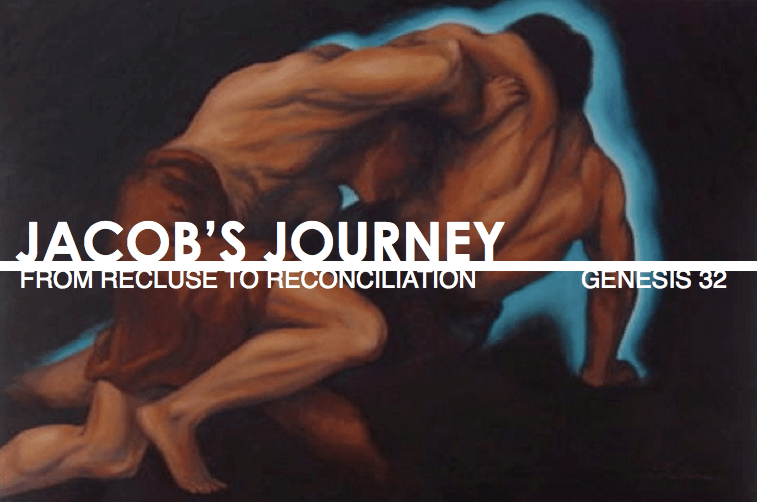
The same night, Jacob and his family cross over the border into the Promised Land. Once they crossed over safely Jacob was left alone without bodyguards or protection. A man comes to Jacob and whacks him. The man initiates a physical struggle, but Jacob’s strength is regarded and he would not give up until the man gave him a blessing.

At dawn [cf. Exodus 33:20; Numbers 12:8], the two men stopped wrestling and the man changed Jacob’s [meaning trickster] name to Israel [meaning wrestles with God and perseveres]. He transitions from a one who tricked to get ahead to a man of faith who trusted God to bless and protect him according to His covenant promises.

For a one hundred year old man it is fitting that the other man would strike Jacob on the hip and throw it out of joint. This wound would mark Jacob for the rest of his life with a limp. Everyone who saw Jacob limping around would know it was God that fought him and blessed him. Jacob’s journey with God climax that night, but he came out a God-worshiper. I would rather limp with my dignity than walk without it. And I would rather limp with a blessing than skip without one.

This could be one of the strangest stories in the Bible because it leaves us puzzled and asking, who is this unnamed man who wrestles with Jacob? The struggle is not elaborate, but it is certainly deliberate. The man’s identity is reveal—He is God [or pre-incarnate Christ, 32:28; cf. 16:7; Hosea 12:2-6]. Through the wrestling match Jacob grows in faith to the level that he becomes a servant of God and is ready to reenter the Promised Land as a new man with a new name. The point of Jacob’s journey is not that he was wrestling with Laban or Esau, but rather he was wrestling with God. A lot like you and me, don’t you think? There is a lot from Jacob’s journey that we can learn about God and how He interacts with you and me.

First, just like Jacob, we wrestle with God [vs. 24-26]. There are a lot of ways we can wrestle with God other than a physical fistfight. Like Jacob you have been warring and striving against God from birth. You might be wrestling with God’s calling upon your life (i.e. which school, what job, who to date/marry), with difficult truths and doctrines (i.e. God’s Sovereignty, human responsibility), with the difficulties or tragedies of life (i.e. death, health, family struggles), with personal struggles with sin (i.e. repentance, confession, freedom), and with your salvation. Jacob’s struggle began when he stepped into the border of the Promised Land. When you push the boundaries with God get ready for a wrestling match.

Second, just like Jacob, when God touches you, you are never the same again [vs. 25, 31]. Third, just like Jacob, God is still in the name changing business [v.28]. In the Old Testament, one’s name and one’s nature were synonymous. Jesus name was given to Him because he saved people from their sins [Matthew 1:21]. Jesus changed Peters name, which changed the course of his life from fish to people [John 1:42]. Jesus promises all who follow Him a new name [Revelation 2:17; 3:12]. You need to have your ‘name changed’ and live out of the right one, “So if anyone is in Christ, there is a new creation; everything old has passed away; see, everything has become new.” [2 Corinthians 5:17] “Clothe yourself with the new self, created according to the likeness of God in true righteousness and holiness.” [Ephesians 4:24] Which name are you living out of today?

Fourth, just like Jacob, God does not let self-serving, self-sufficient, independent people into the Promised Land [v.30]. Only they who depend on God in faith get to go and rest in Him. You can strive to get there by your own goodness or good deeds, but as Jesus says, “Strive to enter through the narrow door; for many, I tell you, will try to enter and will not be able” [Luke 13:24] and “Truly I tell you, it will be hard for a rich person to enter the kingdom of heaven. Again I tell you, it is easier for a camel to go through the eye of a needle than for someone who is rich to enter the kingdom of God.” [Matthew 19:23-24]


[1] This is the first recorded prayer and only extended prayer in Genesis.

[2] The pericope of Proverbs 16:1-15 joins together pacifying God (16:6) and pacifying the king (16:14). Bruce Waltke, Genesis. Zondervan, Grand Rapids, MI. 2001. P. 444.


guilt [and false guilt]

The gavel slams and the judge declares, “Guilty as charge!” Someone you did not expect over hears your gossip and confronts you. You are caught with your hand in the cookie jar just moments after mom told you no more cookies. Guilt. What is it? What if you got it?

God is offended by sin. Sin is personal opposition to God and makes us legally guilty before God. Guilt is culpable for sin. It is not the greatness of the law that makes sin worthy of punishment, but the greatness of the Lawgiver.  “No sins are small when committed against a great and generous God.”[1] Paul affirms, “the judgment followed one sin and brought condemnation (Roman 5:16, cf. James 2:10-11).”

God desires us to change from our sin, the guilt of our sin, and back in his glorious grace. There is a great sadness that comes from not being saddened by knowing our sin. As observed in the first narrative in the Bible (Gen.3:1-13), Adam and Eve desire the fruit of the forbidden tree and disobey God to have it. Their disobedience leads to guilt and a cover-up. Rather than disobedience and covering up sin the Bible is clear on how one should deal with the guilt of sin.

Guilt is a close companion for a Christian because it points us to our need for Christ. Guilt is a real reminder that I must not sin anymore, and that I need to follow Christ (Gal.3:24; Rom.5:8). Like stated above: guilt is good.

How does one deal with guilt biblically? First, acknowledge your specific sin (Prov.28:13; Ps.51:4; 1 John 1:7-9). Second, confess to God that you have sinned. Confession is simply agreeing with God. Calling your sin, sin.  Third, if the person is unsaved they must confess Christ as their Savior and forgiver of their sins (Rom.10:3-10). Finally, if the person is saved they must confess to God their sinfulness and continual need for God’s grace. Now there is so-called false guilt, which is disobeying what one thought was God’s Word and continuing on in their same sinful patterns. This is a misuse of what God’s Word says about guilt, and this one needs to confess their sin.

What about false guilt? Guilt is guilt. True guilt or false guilt it is culpable for sin. False guilt has nothing to do with what’s true and accurate, nor is it related to true repentance, but is still must be dealt with as a sinful response to what is false. For example, a girl could have been molested as a child and respond in guilt over a situation in which she committed no identifiable sin. Even though she committed no sin, her guilt is a sinful response to the situation. The Scriptures say that “Whatever is not of faith is sin” (Rom. 14:23). This girl may have been blamed or punished for things that she didn’t do, or been told she was worthless. A person with extreme guilt over something that was not a sinful act needs to work on viewing their behavior with the truth as revealed in Scripture so that they can live in peace and experience freedom in Christ.

Guilt caused by sin requires an understanding of confession and forgiveness. The Holy Spirit working in the conscience triggers this kind of guilt. The individual should desire to do something about the sinful behavior. By resting in the grace of God and seeking His forgiveness and restoration I can experience freedom from guilt. Guilt must be dealt with, otherwise it begins to distort other problems in our lives (Gen.4:11; Prov.28:1; Eph.4:26-27). I do not deal with guilt by dealing with the feelings of guilt, though I do not discard the feelings guilt may bring (Ps.32:1-5; Prov.14:30; Ps.38:1-8). The feelings are rooted in the problem that made one guilty; therefore the problem is what needs to be dealt with. When we deal with guilt biblically God promises us restoration (Lk.15:11-32; Mt.5:23-38). We also are seeking to be God’s kind of people by changing our thinking and behavior (Rom.6:11; 1 Cor.6:9-11; Eph.4:22-24).


[1] J.I. Packer, Christianity Today (January 2005), p. 65.


homerun

Two words. Home run. On Monday night I hit a home run in softball over the big fence. And no, it was not a little league field.

It was my last game in a BGBC uniform, the last inning, my last at bat. I stepped up to the plate and one of my shoes was untied. The umpire said, “Do you want to tie that?” I responded with a grin of embarrassment, “Yeah, just incase I need to run around all the bases!”

The next pitch my bat made contact with the ball and the ball blasted over the left field fence. The home run did not matter much since we were already 10-runs behind the other team. As I ran around the bases I felt like Robert Redford in The Natural. Good thing I was sweating so much from the 100-degree day that no one could see the tear in my eye!

I love playing softball with the men of our church.

Jacob’s Journey—from recluse to reconciliation [part 1]

Jacob is not the poster child for godly examples to emulate. He is 70 years old, single, jobless, a total momma’s boy, and is now homeless on the run from his brother because he ripped off his birthright and father’s deathbed blessing. Jacob is literally between a rock and a hard place, but mostly from his own trickster tactics. The only glimmer of hope is a dream he is given from God on his first night alone away from the comforts of home. In the dream, God passes the torch of covenant promises given to Abraham and Isaac to Jacob and also promises to be with him until he comes back to the Promised Land.

Today we are going to walk in Jacob’s sandals and see how he moves from being a recluse to reconciling with his brother. Jacob’s journey is Hollywood script or screenplay material. His story is full of adventure, romance, drama, and with twists and turns has sort of a happy ending. We begin immediately following Jacob’s dream as he enters the land of Laban, his uncle [Rebekah’s brother].

Sowing and Reaping: Jacob—the trickster—gets tricked into marrying two sisters [Genesis 29:1-20]

As Jacob arrives at Laban’s sheep farm, he gets a glimpse of the beautiful bombshell, named Rachel [which just so happens to be Jacob’s first cousin]. Immediate Jacob gets to work to impress this gal. Since, Jacob comes to Laban empty handed he is asked to work. In exchange, Jacob bargains for a bride—the beautiful Rachel [meaning lamb/ewe].

Now Rachel had an older sister, named Leah [meaning wild-cow]. She had a crazy lazy eye. Both girls were unmarried probably because Leah was not much of a looker. And Jacob, like all the other guys in town, wanted to marry red-hot Rachel. Laban made Jacob work for seven years to earn the right to marry Rachel. And in one of the most romantic verses of Scripture, “Jacob served seven years for Rachel, and they seemed to him but a few days because of the love he had for her.” Isn’t that so sweet and sappy?

Ironically, Jacob reaps what he sows [cf. Galatians 6:7-8]. After tricking his brother Esau he seems to think his life is prospering: he has escaped the hand of his brother, God promises to bless him, and he is about to marry the woman of his dreams. The big day arrives and Laban throws a wedding feast. Obviously, Jacob has a few too many glasses of wine at the wedding to notice that Laban pulled a switcheroo and gives away Leah rather than Rachel. The next morning when Jacob rolls over in bed he stares into the wandering eyes of his new wife Leah. I can only imagine Leah smiling at Jacob with a crooked buck-toothed grin.

Jacob confronts Laban deceptive plan, but Laban gives a lame yet legitimate reason, “It is customary for the oldest child to be provided for before the younger.” Though true, it is still a low blow. Jacob, the persevering romantic, loved Rachel so much that he was will to work seven more years for Laban. God is using Laban to chisel at Jacob’s character. When Jacob finally works fourteen years to marry Rachel he expresses his love for her over Leah. This begins another sad story of favoritism that will rip apart this family.

A Family Fiasco: 12-Tribes of Israel are Born [Genesis 29:31-30:24]

Jacob gets what he wants—Rachel, but as soon as he marries her God closes her womb. Like Jacob’s mother and grandmother, Rachel is barren. Since, Rachel is barren, Leah sees this as her gateway to Jacob heart. Leah gets pregnant, all the while hoping, Jacob would finally love her because she would make her hubby a daddy. It did not quite work out as she planned. Three baby boys later she was sure Jacob would fall for her. Yet Jacob had no love for Leah. She has four-and-no-more until she gives praise to God. It took four pregnancies for God to finally get a hold of Leah’s heart.

Rachel, like any sibling wants babies too. She sees her sister and becomes jealous. So in an overdramatic outburst she demands Jacob, “Give me children or I shall die.”[1] Jacob responds in anger that it is God whom controls her womb. Could Jacob be growing in his faith? I think not! For immediately, like Sarah giving her servant Hagar to bear child, Rachel gives her servant Bilhah to Jacob. It does not look like Jacob is trusting God as his father Isaac did by turning to God in prayer. Rachel also takes matters into her own hands and Jacob did nothing about it. In fact, he went along with the adulterous sin. Rachel’s servant Bilhah gives birth to two boys, Dan [meaning judge] and Naphtali [meaning wrestle]. Their names are fit to Rachel’s sibling jealousy and lack of trust in God.

Not to be outwitted, outplayed or outsinned Leah in turn gives Jacob her servant Zilpah to sleep with. Leah brags about it when Zilbah who gives birth two boys and names them Gad [meaning luck] and Asher [meaning happy]. Leah, like Rachel, forgets to see that the blessing of children is from God. Doesn’t this family seem a little redneck? They would more accurately be dubbed, rebellious. The story gets stranger as Jacob’s firstborn son Reuben finds some mandrakes [an herbal aphrodisiac]. He gives them to his mother Leah. Rachel is a freak for mandrakes and she trades bedtime with Jacob to Leah—paying her as like a prostitute. Jacob-the-pimp doesn’t question the ethics of his wives and sleeps with Leah. She gives birth to two more sons, Issachar [meaning hire/wages] and Zebulun [meaning honor].

Somehow Leah resorts back to having babies out of jealousy—always a bad idea. And somewhere Rachel prays to God, He graciously answers, opens her dead womb, and gives her a son. They name him Joseph [meaning may he add]. Joseph was the youngest boy until Rachel later had Benjamin [cf. 35:18]. Add up all the boys from four momma’s and Jacob is the proud papa to a bakers dozen—12 boys + 1 girl, Dinah.

Through this dysfunctional, jealousy-ridden, polygamist family, God would safeguard His covenant in Jacob’s sons. This family would become the initial branches of the twelve tribes of Israel through whom Jesus would be born and heal the human sin problem, which was so evident in Jacob’s family. By God’s grace alone He saves this family from themselves. Revelation 21:1-14 reveals how these twelve sons who came from the four conniving women in Genesis will mark the gates of heaven where Jesus is awaiting those He has also saved by His grace.

It Never Fails: God keeps His promises [Genesis 30:25-31:55]

According to Jacob, it was about time to move out on his own. He is 90 years old, has two wives, and twelve children from four different women. What his mother thought might be a few day flee from Esau ended up being twenty years working for free for Laban [his father-in-law]. He built for Laban a sizeable ranch that pulled in some fat-cash.

Through demonic divination Laban learns that he has been blessed with wealth and power because Jacob has the covenant blessing of God upon him. Jacob desires to return home to the Promised Land to his father Isaac, however, Laban like a crooked used car salesman seeks to keep Jacob around the ranch by offering to finally pay him a reasonable salary. Jacob, like his father [Isaac] and grandfather [Abraham] rejects the gift and entrusts himself to God in faith. God honors Jacob’s faith and makes him a very wealthy man. Though it may seem like Jacob is taking advantage of Laban the truth is God is making right a wrong by giving Jacob what he earned during twenty years of faithful and fruitful labor for Laban.

God is big on keeping His promises. He has promised to be with Jacob and get him back to the Promised Land. God calls, “Return to the land of your fathers and to your kindred, and I will be with you.” [31:3; cf. 12:1] Jacob responds immediately in faith. His wives also respond in faith [note: Rachel steals the household idol]. Jacob loads up the kids in the camel caravan and leave Laban’s home in secret while he is out giving the sheep a haircut. They leave undercover possibly out of fear that Laban would come up with a sly way to keep Jacob working around the ranch.

When Laban finally found out that his daughters and grandchildren were gone he and his relatives pursued Jacob for seven days until they caught up with him. Ironically, the same Laban who tricked Jacob into marrying both of his daughters became rich because of God’s blessing upon Jacob. He cheated Jacob by changing his wages ten times and complained that Jacob had been deceptive with him. However, God protected Jacob by appearing to Laban in a dream and commanding him not to harm Jacob in any way. Laban only accuses Jacob of stealing his household idol, but he was unaware that his wife Rachel stole them and was sitting on them.

Jacob honors God by praising Him for all blessing he and Laban have received [31:42]. Then Jacob and Laban shake hands and agree Jacob will take no more wives. They built a monument to remember the covenant. Laban kisses his daughters and grandchildren goodbye and the men part—Laban went back home and Jacob to his old home in the Promised Land. This set the stage for a story for Jacob to meet his brother Esau for the first time in twenty years [come back next week to find out what happens].


[1] These words would later proved to be prophetic and tragic; Genesis 35:16-19.

is the Bible sufficient for life?

According to 2 Timothy 3:16-17 “all Scripture is inspired.” I believe that “all scripture is inspired” means that the Bible comes from God. Every word from Genesis to Revelation is the very word of God. The implications of the inspiration of the Bible are huge since the Holy Spirit is the author of scripture.[1] Therefore, the Bible is true (Ps. 119:142) and altogether reliable (Heb. 6:18). It is powerful, working its purpose in our hearts (1 Thess. 2:13) and not returning empty to the One who sent it (Is. 55:10-11). It is pure like silver refined in a furnace seven times (Ps. 12:6). It is sanctifying (John 17:17). It gives life (Ps. 119:37, 50, 93, 107; John 6:63; Mt. 4:4). It makes wise (Ps. 19:7; 119:99-100). It gives joy (Ps. 19:8; 119:16, 92, 111, 143, 174) and promises great reward (Ps. 19:11). It gives strength to the weak (Ps. 119:28) and comfort to the distraught (Ps. 119:76), and guidance to the perplexed (Ps. 119:105), and salvation to the lost (Ps. 119:155; 2 Tim. 3:15). The wisdom of God in Scripture is inexhaustible.

Successful living means obeying the Scripture. The Scriptures are intended to impart truth in such a way that the reader is moved in a Godward direction. Not only is the Bible clear in what it affirms, but it is also self-authenticating in nature.[2] The Bible way of counseling is radically dependent on the work of the Holy Spirit to apply the Word of God to people’s lives. Our agenda in counseling is the Bible; the change comes through the agent of the Holy Spirit.

The Bible is most certainly sufficient for all of life. The Bible deals with the heart of man and says that the heart is wicked. The Bible exclaims that sin is man’s main problem, and the Bible has the answers to man’s sinful heart problem. The gospel of Jesus Christ is the answer to man’s sin. In Christ we have forgiveness and the ability to change into His image (Colossians 1:28). Why do we need the gospel? Without it we are dead in our sin without a hope of salvation [life in Christ].

Since, the Bible reveals man for who he is, effect by sin, therefore, the Bible is sufficient and must have active functional control in one’s life through the work of Christ and the power of the Holy Spirit. The Word of God offers grace to the sinner, encouragement to persevere, edification, and hope through sanctification (Acts 20:32).


[1] John Piper, The Holy Spirit: Author of the Scripture, 1984

[2] John MacAuthur, Biblical Counseling, p.24

Jacob’s Dream

The story of Jacob’s ladder is well known by many who do not know the Bible. Jacob is depicted in song lyrics from Led Zeppelin to U2 to Rush to Huey Lewis and the News. Jacob is also a topic for motivational speakers communicating ones ability to climb the ladder of personal success because “the skies the limit”. The story of Jacob’s ladder has taken on varying shades of meaning and interpretation, which are a stretch from its original biblical context.

The story of Jacob’s ladder dream appears at the beginning of Jacob’s narrative. Jacob had just deceived his twin brother Esau by ripping off his birthright and lying to get his father’s deathbed blessing. Therefore Esau is out to get Jacob’s head and see him dead. So Jacob flees the Promised Land and the momma’s boy who once loved staying home was now driven from his home. He becomes a fugitive from his family fearing his brother’s ferocious rage.

The tension in the story rises as Jacob comes to a certain place at the sunsets. He spends the night out in the elements alone. Without protection in an unknown place Jacob finds a sandy spot to sleep with a rock for his pillow. The tension continues to rises as he nods off to sleep and dreams a strange dream about a ladder that the angels of God ascend and descend upon. God comes to Jacob in a dramatic dream in the middle of the night. For the first time in his life, Jacob encounters God.

How in the world is God going work with this guy?

At this point in Genesis, the covenant promises of God have been applied to the less than perfect people—from Abraham to Isaac to sinfully deceptive Jacob who stole both the birthright and blessing from his older brother Esau. Jacob possesses the covenant blessing, but lacks faith-driven relationship with God like that of Isaac and Abraham. Jacob is not a God-pursuer [worshiper, believer]; he is a man-pleaser and self-gratifier. For the first time, Jacob is not living under the faith of his parents, but begins his own relationship with God.

So how does he go from Jacob to Israel? From trickster and deceiver to a worshiper of God? From a total goober to a godly guy? Jacob is probably in his 70s, still living with his parents, mom still washes his whitie-tighties, and has her pack his lunch box with PB & J. He’s totally a late bloomer with no wife, no job, allowed to underachieve, enjoys being spoiled, and has inconstant God-following parents.

The story climaxes as Jacob sees God in his dream. And no, it wasn’t a dose of spicy chili the night before. God speaks to him and promises to be everything that He was to Jacob’s dad [26:3-4] and grand-dad [12:2-3; 15:1-6]. The God of Abraham and Isaac will also be known as the God of Jacob. The Lord not only extends patriarchal promises [i.e. land, descendants, and blessing] but also adds a special promise—His presence—that the Lord will always be with him [and Israel] wherever he goes. The symbol of His presence is the ladder in his dream, which connects heaven with earth.

If I were Jacob, I would have wet my pants seeing God, especially after his sinful escapade. Jacob should have been cursed for all his sin, however God has grace on him and blesses him. In holy fear, Jacob awakes from his dream awed by the Lord. The change in Jacob’s heart turning toward God arises in his commitment to tithe to God as an act of worship to God [cf. 26:25]. Above all it is God who seeks out a covenant relationship with Jacob, which is the pattern continued for all believers throughout human history.

How do we get from Jacob to Jesus?

As Jacob leaves the Promised Land, God promise to be with Jacob wherever he goes. This is an important redemptive theme that progresses throughout the history of Israel to those who follow Jesus.

As Moses is called out of Egypt—leading the Hebrew people to the Promised Land—God promises His presence [Exodus 3:12; Deuteronomy 31:6]. He proves His presence with a pillar of clouds by day, a pillar of fire by night, and His glory in the tabernacle. As Joshua carries the torch of Moses and enters the Promised Land, God assures His presence [Joshua 1:5]. God promises His presence with Israelites kings [1 Kings 8:57]. And when Israel is cast int0 exile God promises His presence with His people [Isaiah 43:2; 41:10].

The culmination of the promise of God’s presence came when He was born as a babe with human skin and walked among His people. His name is Jesus. He is also known by the name, “Emmanuel,” which means, “God with us.” [Matthew 1:23; John 14:9-10; Colossians 2:9; cf. Isaiah 7:14]. After Jesus rises from the dead He promises His presence with His followers [Matthew 28:20; Hebrew 13:5] and His Spirit dwells in His people [Acts 2:33; 1 Corinthians 3:16; 6:19]. On the last day, when Jesus comes again, He promises to dwell with His people forever in the divine Promised Land of His eternal presence [Revelation 21:3].

The promise give to Jacob by God was fulfilled when God brings him back to Canaan, when God returns the Israelites from Egyptian slavery, and when God returns the remnant from exile in Babylon, but promise is ultimately fulfilled through Jesus Christ the Son of God. The ladder Jacob sees in his dream is a picture of God promise “to be with you.” God is not absent from His creation or His covenant people. He is intimately connected with His creation. The ladder represents His mediation between heaven and earth. Jesus even makes this correlation between the ladder and Himself [John 1:49-51]. Jesus is the mediator between heaven and earth—God and man [1 Timothy 2:5; John 14:6]. Jesus is the ladder; He is the connection between heaven and earth.

The purpose of Jacob’s strange ladder dream was to get his attention. Once God got his attention, He promised to be with Him always wherever he would go. That promise would ripple to His holy people [Israel] and also in the Scripture later to His church. The promise of God’s presence is one of the most precious and assuring promises of the Scripture. This promise is meant to be a source of comfort for all His followers. God knows that His people sometimes feel forsaken. However, remember as Jesus said, “I am with you always, to the end of the age.” [Matthew 28:20]

thumb licks [7.7.11]

God’s Beautiful, Holy, Good—and Crushing—Law

The apostle Paul, a Jewish rabbi who had extensive respect for and acquaintance with God’s law (Acts 22:3) had some very shocking thoughts about it once he came to faith in Christ. Although he heartily agreed that it was “holy and righteous and good” (Rom. 7:12), and although he knew the beautiful nature of God’s law, he also knew that the law could never bring sinners to life because no one could obey it. He confessed that all his obedience (and it was extensive) had no more value than a pile of manure (Phil. 3:8). He wrote: “By works of the law no human being will be justified in his sight.” (Rom. 3:20) What then? Are we Jews [who have the written law] any better off [than Gentiles who didn’t]?

Hijacked by the Gospel

While studying Galatians 1:11-24, I am struck once again with how utterly supreme God’s loving plans are for us in Christ. Paul, captured always by the vision of the original capturing vision of Jesus on the Damascus road, appeals again to the singular transforming power of the gospel by appealing to the way it powerfully transformed him. He was headed one direction, resting in his own sovereignty over his life. But the One who had set Paul apart before his life story even began called him in grace and was pleased to reveal the Son to him (Gal. 1:15-16). His life was never the same. Paul was writing his own life story, but Jesus stole his pen… He got hijacked by the gospel.

Find Out Right Now Whether You Have a Pride Problem

When’s the last time you crept out of your house to worship at the feet of a sculpture created in your own image?  Never, right?  While you probably haven’t done that, it’s likely that you’ve asserted your claim to the title of “Center of the Universe” in other, sometimes subtler, ways. Ever honk at another car while driving because you thought it was slowing you down?  Ever neglect a household responsibility because you thought someone else ought to do it?  Ever dwell on a compliment someone paid you? If we take an honest look at our lives, we’re likely to find evidence of pride under every rock and around every corner.

Worship God by Serving the Poor

The words in chapter 58 of the book of Isaiah have affected me for years. In that Scripture, God tells us the Father sees our relationship with the poor (or lack of it) as something serious. It is impossible to serve God with all our hearts and at the same time miss out on God’s call to care for the needy. The Scriptures say the way we care for the poor is tantamount to the way we see God. The prophet makes it clear that we must have a relationship with the poor if we hope to please God with our lives. 

But in today’s church, most of us don’t know a single person who is needy. How can we obey God if we aren’t connecting with the poor on a regular basis? We can’t. 

Something needs to change. We need to hear the call of God to those in need.

Texting Teens: Typing Replaces Talking [INFOGRAPHIC]

Has texting taken over as the primary form of communication for today’s teens? We found our answer with this Infographic from Lab 42, which polled 500 social-networking Americans aged 13 to 21.

How Important is the Bible?

tale of twin brothers

I am one of six. I have three brothers and two sisters. I am at least 10-years older than my closest sibling. If you have siblings then you know what it is to have a rival. Since most of my siblings are much younger than I am our battles were either unfair or annihilation’s. I was more of the big-brother-built-in-babysitter, but now as my siblings are getting older I get my fair share of beat downs. Mostly verbal onslaughts related to my balding scalp and growing belly.

Today we will peer under the roof of a family with twin brothers who were all boy and at times bad to the bone. Most siblings can relate to these two dudes. However, what their story unfolds is a story that opens up a greater story of redemption and reconciliation, which we will discover over the next few weeks.

Two boys are born [Genesis 25:19-28]

Isaac [the promised son] married Rebekah [the prayed for wife], but come to find out she is barren. This is not a good thing for a family that is promised to bear the Seed of Hope [the promised Son—Jesus]! However, Isaac learned from the story of his mother and father. Instead of taking matters into his own hands he prayed to God who can open wombs as He did with his mother’s womb. God answered with a miracle bringing to life Rebekah’s dead womb.

Rebekah was blessed with not just one, but with two rambunctious boys. Even before her boys breathed their first full breath of oxygen they were picking on each other. Inside their mother’s belly the boys were like to UFC brawlers throwing fists and feet, but instead of a rope and ring they were using the walls of their mothers womb. I have seen my wife’s reaction when our little girl got moving. I could not image two burly boys bouncing around.

Rebekah does not understand why this is happening so she asks God. Isn’t this family something great? Two parents seeking God on behalf of their children. God responds to Rebekah’s inquire with historic news. The two boys within her would be two nations, two divided people, one [Jacob] stronger and the other [Esau] a servant to the younger [cf. Romans 9:10-13; 2 Samuel 8:13]. This is an incredibly important oracle, which would come to play later in the life of the twin brothers.

The first boy to be born was Esau [also called Edom]. He was red and hairy with a coat of fur like Elmo or Clifford the big red dog. The second boy to be born was not far behind. In fact, on the way out he was holding onto his hairy brother’s heel. They named their heel grabbing son heel [or trickster], which in our language is translated Jacob. As they grew Esau became the man’s man always out in the field hunting and gathering trophy game, while his brother Jacob was more of the homebody hanging out with his mommy.

As great as this family started out to be—building a foundation of prayer and faith—there was another foundation being laid of partiality and favoritism. Since, Esau hunted meat his dad favored him, and since Jacob was at home cooking and cleaning with his mom, she favored him. This unbalanced foundation, if left unchecked, will lead to some major conflict in the home, which we are about to see [cf. 37:3].

Buying his brother’s birthright outright [Genesis 25:29-34]

Esau is the firstborn son. There are major perks for being the firstborn. Being the first born Esau was entitled to the family birthright, which would make him the inheritor of a double portion of his father’s estate, leave him as the head of the family when his father passed away, as well as enable him to receive a special blessing from his father. In Abraham and Isaac’s case the one who possesses the birthright inherited the Abrahamic covenant. Esau wielded a lot of power and promise as the firstborn son.

However, Esau did not treat his birthright with that kind of importance. On an ordinary day,  Esau, probably after a long day of hunting came hungry to his brother Jacob who was cooking a yummy smelling pot of stew or spaghetti. Esau was exhausted and wanted something to eat. So Jacob being the trickster got his brother to trade his birthright for a meal. Quite the unfair trade, but as crazy as it was Esau accepted. At the bottom of Esau’s trade was an indifference towards God’s covenant promise to bless all nations through the descendants of his grandfather Abraham, which would ultimately bring forth Jesus Christ. Instead in a moment of flippancy he gave up God’s covenant for the munchies.  Later when he realized what a dumb and dishonoring thing he did it was too late [cf. Hebrews 12:16-17].

It is interesting to note this struggle between two brothers in the womb would continue well into the future. In fact, many years later it reached its climax when King Herod—a descendant of Esau—sought to slaughter all firstborn sons, which included Jesus Christ—a descendant of Isaac [Matthew 1:1-2, 2:13].

God reaffirms promises to the twins father [Genesis 26:1-5ff]

Similar to God speaking to Abraham, God speaks to Abraham’s son Isaac. The major similarities are God’s covenant promise to be with Isaac, bless him, and give him descendants and land. God blesses Isaac because his father Abraham “obeyed My voice and kept My charge, My commands, My decrees, and My laws.” [26:5; cf. Deuteronomy 11:1ff]

Throughout the rest of Genesis 26 are a number of similarities between Abraham and Isaac unfold:
•    Both men received God’s call and promise. Both lived during a period of famine.
•    Both men dwelt in Gerar both men had lovely wives. Both men were cowards in the face of possible harm.
•    Both men lied and said their wife was their sister. Both men were spared the consequences of their sin by God’s mercy.
•    Both men were rebuked by good Gentiles for their lying schemes. Both build altars to worship God.
•    Both men were pursued by Abimelech for a covenant [two different Abimelech’s but both related].
•    Both men were a blessing to their neighbors. Both men trusted God and lived peacefully with their neighbors.

Like Abraham, God redeemed Isaac’s unbelief. Isaac was blessed only because of God’s grace to him. God uses imperfect people and keeps His covenant promises. The chapter concludes with a brief note about Esau. Like Isaac, Esau marries at the age of 40. However, unlike Isaac he married two godless women without the counsel of his father, which following the birthright fiasco shows his foolish heart. Esau is a type of prodigal son who becomes a “source of grief to Isaac and Rebekah.”

Blindsiding big brother to get father’s blessing [Genesis 27:1-28:9]

Isaac was becoming old and senile. Therefore he called for his eldest son to give him a blessing. This is an important moment in the life of a son—often a life-changing and course-directing moment. Before Isaac offers Esau the blessing he sends him out to hunt a juicy steak.

Rebekah, like Eve and Sarah, took matters into her own hands. Since she favored Jacob over Esau she devised a deceitful plan to rob her son Esau of his blessing. Could this be where Jacob learned his trickery? So Rebekah cooks up some goat meat to Isaac’s liking and dresses Jacob in Esau’s hunting clothes and pads his neck and hands with fur to match to texture of his brother’s man-sweater. Then she sends Jacob into Isaac’s tent and unbelievably the sinful scheme works as schemed. Isaac is duped and Jacob steals Esau’s special deathbed blessing.

Esau comes to his father shortly after with his hunt, but learns he is late and missed the blessing because of his younger brothers trickiness. Isaac becomes furious. Esau weeps, turns bitter towards his brother, and plans to comfort himself by killing him [cf. Genesis 4]. Rebekah catches wind of Esau’s plan and sends Jacob to Laban until Esau cool’s down out of fear that she might lose her both sons over her sin, but a few days ended up being 20-years. This family’s firm foundation of faith and prayer is quickly crumbling, and beginning to look more like an episode of the Maury Povich Show.

Before leaving for Laban’s, Jacob is blessed by his father and commanded to marry only a woman who belongs to God so that the promises of the covenant would continue through his family line. To spite his parents, Esau intentionally marries another godless wife in addition to his other wives that had brought nothing but grief to his parents. Both boys do not appear very godly or worthy of the family blessings promised through Abraham.

Jacob, Jacob, Jacob…How does his story fit into the “Big Story?”

First, a look at Jacob gives you a glimpse of yourselves. He was struggling for power, even from birth through lies and strategic steals. Showing how sly and stealthy we are at sinning to get ahead. Second, his story gives us unusual insight into the Gospel and how God works. Despite his sin and imperfection God uses Jacob as the “covenant carrying” son of Isaac. Just like he uses sinful Jesus-followers to bear the message of good news to a darkened world. God is gracious and merciful!

a bride for Isaac

Genesis 24:67 “Isaac brought her into the tent of his mother Sarah, and he married Rebekah. So she became his wife, and he loved her; and Isaac was comforted after his mother’s death.”

Genesis now begins to focus not just on the God of Abraham, but also the God of Isaac and Jacob as Jesus taught in Matthew 22:32. Genesis 24 tells us that Abraham was old and had been blessed by God in every way as God had promised. And to ensure that his son Isaac would marry a woman who would worship his God by faith Abraham sent his servant back to his home to find a wife for his son. Abraham did this trusting that the God who had blessed him would be faithful to now provide for Isaac by sending an angel ahead to arrange the details.

Abraham’s faithful servant did as he was told and went to the region of Abraham’s brother Nahor. Stopping at a spring the servant prayed for God to provide. Before he had finished his prayer God had already answered it, sending the lovely virgin Rebekah to the spring. Rebekah drew water for Nahor and his animals. When the servant inquired of her family she said her father was Nahor and that he was welcome to stay at their home. The servant was so overjoyed at God’s perfect provision that he bowed down and worshiped the Lord for answering his prayer.

Rebekah agreed to go with Abraham’s servant to be Isaac’s wife. Upon arriving at Abraham’s household Rebekah was brought into the former tent of Isaac’s mother Sarah and married her. Isaac and Rebekah’s marriage ends with the beautiful words that “he loved her” and she was such a fitting bride that he was comforted by her love after the death of his mother.

We learn a great deal about God from the Genesis 24 narrative. God does not speak, but is silent in the narrative. However, God’s unseen hand of providence moves the story along showing Himself to be faithful to Abraham and Isaac. God also answers prayer and can be trusted to provide even when he has not spoken but has been spoken to in prayer.

There are some great applications from the story of Genesis 24 that are truths to take home. I will praise God for his faithfulness and steadfast love [24:12, 27]. I will remember my future is in God’s hands. I will encourage young men to pray and wait for a godly brides and encourage them to listen to their parents wisdom. I will pray to God with sincerity believing He does provide and keep His promises. I will trust God even when life does not make sense. I will serve God and others with expedience and efficiency.

I remember when I was a single man praying for God to provide a godly wife. What a joy it is to wait for His timing and to pursue His will. The wait was long and hard, but it was well worth the wait!

Keys to Genesis 24: bless [1, 27, 31, 35, 48, 60], prosper the way [12, 21, 27, 42, 56]