
WHEN HARDSHIP HAPPENS
Suffering weaves its way into the life of a pioneer worker on the mission field from every direction. Some pain is visible and relentless, showing up day after day, while other wounds are self-inflicted. Whether it is the relentless heat, lingering illness, waves of discouragement, sharp words from neighbors, spiritual battles, or the daily grind of living off-the-grid, suffering wears many faces.
Zaki was beaten and rejected by his closest family members, forfeited his inheritance, was cursed by his local imam, received numerous death threats, and, eventually, was driven into the desert and left to die for daring to follow Christ. Fatima’s family was so ashamed that their son had become a follower of Jesus, and their only way to make it right was to get rid of him and erase him from their bloodline. Zaki has now fled to another nation where he lives like a refugee and yearns to be back with his people.
It is sobering to bring the good news to the unreached, see the Lord open blind eyes, and then observe a new believer experience suffering because of their new faith in Jesus. The joy of salvation is often accompanied by pain and persecution.
BIBLICAL REFLECTION ON SUFFERING
Suffering is to be expected. The Scriptures don’t shy away from the reality of suffering; rather, they show suffering as an expected part of the Christian life, especially for those who faithfully proclaim the gospel in a fallen world that is hostile towards God.
- Jesus explicitly warns His disciples of coming trouble. (John 16:33)
- Jesus suffered; so will His followers. (1 Peter 4:13)
- Don’t be surprised that persecution is an inevitable outcome of godly living in this world. (2 Timothy 3:12; 1 Peter 4:12)
God is sovereign over suffering. While suffering is a consequence of sin in this world, God is not absent or powerless within it. He is sovereign over all suffering, meaning He permits it, orchestrates it, and works through it for His wise and good purposes, even when we cannot understand them. Suffering is never meaningless; it is purposeful in the hands of a sovereign God.
- God works even in suffering for the ultimate good of His people. (Romans 8:28)
- Job declares that God is absolutely sovereign in suffering. (Job 42:2)
- Suffering can be a tool for learning and spiritual growth (Psalm 119:71)
- Suffering can be a process (Romans 5:3-4; James 1:3-4; Psalm 119:59-72)
God uses suffering as His instrument. God uses suffering as a powerful instrument to achieve several divine purposes:
- Sanctification of the pioneer and church: Suffering refines character, deepens faith, produces perseverance, and conforms believers more closely to the image of Christ. It strips away self-reliance and fosters greater dependence on God. (Romans 5:3-5; James 1:2-4; Hebrews 11:1ff; 12:10-11; 2 Corinthians 1:8-9; 4:10-12)
- Advances the gospel: Paradoxically, suffering accelerates the spread of the gospel. Persecution can scatter believers, leading to new mission fields. The faithful endurance of suffering by missionaries can be a powerful witness, drawing people to Christ. (Philippians 1:12-14; Acts 8:1-4; 11:19-21)
- Display of God’s power and comfort: God’s strength is made perfect in human weakness. When believers endure suffering with grace, it highlights God’s sustaining power and His ability to comfort. (2 Corinthians 1:3-4; 12:9-10)
Suffering is not good in itself. It is the result of sin and brokenness in our world. Yet God promises to weave dark threads of affliction and trial into the tapestry of His ultimate saving plan. He is a sovereign God, but His ways involve suffering. With wisdom, love, and goodness, He designs our difficulties and assigns our afflictions to conform us to the character of Christ.
Reasons for suffering vary. There isn’t one main reason that we suffer. It comes from different angles:
- Suffering can be a result of sin. A lot of our sinning is our faulty way of avoiding some kind of suffering. There’s a problem with sin. It always damages both the one who is sinning and others. Sin is never a good “solution”. It just causes more suffering. If we choose not to give in to the sin, then that doesn’t mean we simultaneously choose to experience the pain we want to avoid. (Galatians 6:7-9)
- God Himself suffered because of sin. God experienced sorrow and agony because of our sin. Plus, all He is, and feels, and does is infinite! He was the Great Sufferer of the universe. His response was to redeem us via the path of increased suffering. He suffered well.
- Suffering can be a means of sifting our faith. God can allow suffering to test our faith or persecution because of our faith. (Hebrews 11:1-12:6; 2 Timothy 3:12; Philippians 3:12-14)
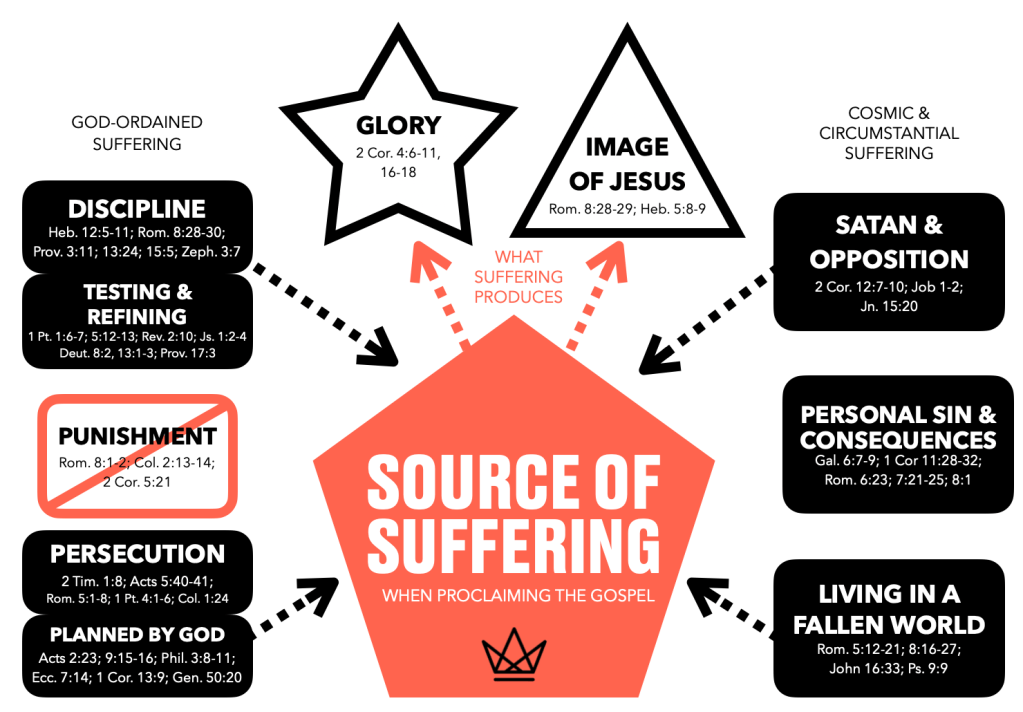
Sometimes God is silent when we suffer. God’s promises that sustain us even when He seems silent through suffering. (Psalm 88-89) God answers our cries, “Why, O Lord?” not by explaining His providence but by giving us a deeper understanding of His person. In other words, when we cry, “Lord, why are you doing this?” He often answers by saying, “Let me show you who I am.”
Suffering can be painful. Suffering is hard. It is never easy. Regardless of what we know and how hard we apply the principles, it is going to hurt (1 Peter 1:6)
- What other Scriptures or biblical aspects come to mind when you consider “suffering”? Take a few moments to look up a few of these verses and journal what the Lord highlights for you.
“Not only so, but we also glory in our sufferings, because we know that suffering produces perseverance; perseverance, character; and character, hope. And hope does not put us to shame, because God’s love has been poured out into our hearts through the Holy Spirit, who has been given to us.” — Romans 5:3-5
THE IMPORTANCE OF SUFFERING (WELL)
Suffering is inevitable, but how we suffer is a choice that has profound implications for our spiritual growth, our witness, and God’s glory. (1 Peter 2:20-21; 1 Peter 5:10)
Suffering well means:
- Trusting God’s sovereignty: Believing He is in control and has a good purpose.
- Maintaining hope: Fixing our eyes on Christ and the eternal glory that awaits.
- Responding with faith, not fear: Allowing pain to draw us closer to God, not away from Him.
- Seeking God’s comfort: Leaning on the Holy Spirit and the community of believers for strength.
- Using it for witness: Allowing our endurance to point others to Christ.
See suffering not as a detour, but as the path of following Jesus. We see this in the life of Paul, his imprisonments and persecutions. Suffering was not a distraction, inconvenience, or detour, but a breakthrough for what the disciple cared most about: the spread of the gospel and the glory of Jesus. (Philippians 1:12; 1:20)
Learn to suffer well from the early church letters. Consider reading through 1 Peter and learn how the early church endured suffering and grew in their faith while under fire. This was a letter to those who suffered, written to a dispersed church that was scattered everywhere because of the mass persecution. Peter wrote this letter (in part) to encourage them and to give them a vision of the way God uses hardships and trials to bring about His ultimate good.
Don’t ever give up. Psalm 88 teaches us a number of important lessons about God and hard times. Not everyone gets a happy ending in a fallen world—and that includes even godly believers. Unrelieved suffering sometimes continues even until the very end of our lives. Mature believers can experience profound dissatisfaction with life. We also learn that some believers endure enormous suffering and still maintain their commitment to the Lord. God’s grace sustains us, even in the darkest hours, so that we never give up. Consider the Psalms and how they give vocabulary to how we feel amid suffering.
Suffering in this life is the worst that it gets if you’re in Christ. Take comfort from the fact that the sufferings of this life are the worst you will ever endure. If you know Christ and have come to him in faith and repentance, then your suffering has an end. The trials of this life are the worst things you will ever endure. (2 Corinthians 4:17-18; Romans 8:17-18)
Suffering on the mission field can take many forms, both overt and subtle:
Physical Hardship: Illnesses, lack of adequate medical care, poor sanitation, extreme climates, lack of clean water, and dangerous travel conditions.
Spiritual Opposition and Persecution: Direct demonic attacks, intense spiritual warfare, hostility from religious leaders, threats, imprisonment, physical violence, martyrdom, and the spiritual burden of living in darkness.
Slow Progress and Lack of Visible Fruit: Years of diligent ministry with seemingly no conversions, no church growth, or facing persistent apathy, leading to deep discouragement.
Emotional and Mental Strain: Profound loneliness, cultural shock, constant pressure to perform, isolation from family and friends, difficulty processing trauma (personal or observed), chronic stress, depression, and anxiety.
Relational Challenges: Team conflict, betrayal by trusted local contacts, misunderstandings due to cultural differences, rejection by the community, and the pain of seeing disciples fall away.
Financial Strain: Living on limited support, fundraising stress, unexpected expenses, and economic instability in the host country.
Family Challenges: Children struggling with cultural adjustment, educational limitations, health issues, or parents neglecting family needs due to ministry demands.
In all these forms, suffering on the mission field is an arena where God’s power is displayed, character is forged, and the gospel advances, often in ways that would not be possible without the crucible of affliction.
PRAYER ACTION
Consider the Scriptures you cling to above. Consider the sufferings of Jesus. Write a prayer for the kind of person you want to be during seasons of suffering.
REFLECTIONS ON BUILDING A PRACTICAL MINI-THEOLOGY OF SUFFERING
Take some time to prayerfully draft your practical mini-theology of “suffering” by responding to these questions:
- What do you think about God allowing Christians to suffer who are obediently walking in his will? What is the purpose of ordained suffering? Share examples of Scriptures that support your answer.
example: God is… We are the kind of people who… It is most like us/me to… We/I will… We/I hold to…
- How have you seen the Jesus Way as the way of suffering? What do you believe is the value and outcome of suffering in the life of a follower of Jesus?
- What Scriptures and biblical truths will you cling to while suffering? What Scriptures can you call others to cling to while suffering?
- What is the practical outworking of this theology of suffering in your relationship with yourself, your marriage, your family, and local relationships?
- Once you finish, share your responses with your mentor. Ask for feedback. Adjust your draft as needed.
- Complete a one-page practical mini-theology.
RESOURCES FOR GOING DEEPER:
- Why Missionaries Need a Theology of Suffering?
- Filling Up the Afflictions of Christ, by John Piper
- The Scars that have Shaped me, by Vaneetha Risner
- Born for Adversity, from Barnabas International
- Suffering: God’s Mysterious Means for Spreading the Gospel, by Jen Oshman
- When Suffering on the Field Takes Your Faith Under, by Gala Dallmann
- John Newton’s Theology of Suffering and Its Application, by Keith Palmer


