gospel gumbo

This week Louisiana celebrated Mardi Gras. When I think of New Orleans and Bourbon Street I can almost smell Gumbo. Mmm. Just thinking of it makes my mouth water and forehead sweat. There are myriads of recipes for make a good gumbo. Some add unique ingredients because they like it spicy, others like it soupy, while others like it meaty. The gospel on the other hand has only one recipe. It is important to get the recipe for the gospel right. There are essential ingredients that make up the gospel and without them there is no gospel. Here are good questions to ask to make sure you have the right gospel:

Am I sure of the seriousness of my sin?
[Romans 3:21-23] The doctrine of sin is serious stuff. Life and death hang in the balance depending on how you deal with this doctrine. We often have a low view of sin, though we sin it so often we struggle to accept that we are sinners. We become so familiar with sin that we come to accept it.

The Bible is realistic about my condition: I am rebellious to the core. Just ask my wife. I am selfish. I am gravitated toward sin more than obedience to God. My heart is utterly wicked. God does not want to just change my behavior, He wants to change me from the inside out. Lasting and permanent change comes from the heart, the hub and control center of the human soul [Proverbs 4:23].

Am I awestruck by the substitutionary atonement of Christ?
[Romans 3:24-25] There is so much wrapped up this theological statement. The substitutionary atonement of Christ is the biblical truth that Jesus made the only sufficient sacrifice for sin to appease my sinful state. Jesus Christ and His work are the essence of hope. This hope is not in my theological knowledge or experience, but it is in the awesome bloodshed of my Savior [Galatians 2:20]. It is He that desires to rule in my heart this moment and forever [Ephesians 2:22-23].

Am I really aware of my need to repent of my sin? And am I aware of my need to follow through with real faith in Christ? [Romans 3:26; cf. Acts 26:20; Galatians 3:11] I put repentance and faith together because they really do go together. With all that God has done for me I cannot simply be passive. The gospel calls me to action. A gift so great doesn’t deserve just a “thank you,” it desires, “I can never repay you God, but I will do whatever you ask from now on and forever more.” The gospel not only affects the moment I commit my life to Christ, but also my walk with Him thereafter. The struggle of sin never ceases until I leave this sod, so I need His grace daily [Titus 2:11-13].

Without a submission of your spirit to the Scripture behind these questions, there is no gospel. The gospel is different than gumbo. The gospel is not just a mishmash of facts or a buffet of manufactured ideas, rather it is the life-transforming truth of Jesus’ death, burial and resurrection that will forever change you. That is good news!

I have adapted this post from Is It Soup Yet?

can you rewind the tape please?

I used to live with my grandparents during my elementary years. I remember my reward for good behavior was a trip with grandma to the mall and visit to McDonalds. Now McDonalds back in the day was not like the massive metro-play-lands that they are today. It was just a sit-down meal in a box with a toy, commonly known as a Happy Meal. I would always get the fish filet, fries, with orange High-C. I loved those Happy Meals with grandma.

The Bible talks about another Happy Meal [John 6:1-14]. Jesus had performed a fish filet and French fry Hebrew Happy Meal miracle for 5000 people. His popularity was at an all-time high. After this miracle everyone wanted to crown Jesus King [not the burger King, v.15]. Jesus had something else in mind. How about taking a boat trip? What? So Jesus’ 12-followers boarded a boat across the Sea of Galilee to Capernaum and Jesus meets them later taking a stroll on the water [6:16-24].

Meanwhile all the people who received the Happy Meal were looking for Jesus. What about another free meal? The crowds caught up with Jesus on the other side of the sea. Jesus was not looking to draw a big crowd. When crowds showed up Jesus would get all OCD [Operation Crowd Deduction]. Jesus says something really strange, “I know why you are here. You want another free meal.” [6:25-26] I could imagine what the disciples were thinking, “Jesus cool it. You got all these crowds captivated and you go ahead and say something crazy like this?” Jesus continues to talk about food, rather spiritual food and what really matters is relying on eternal food that on He can offer [6:27-29]. This brings about some serious questions in their minds:

“What miraculous sign then will you give that we may see it and believe you? What will you do? Our forefathers ate the manna in the desert; as it is written, ‘He gave them bread from heaven to eat.’” [6:30-31] This brings up a Hebrew History 101 lesson. Do you remember the Sunday School lesson when the people of Israel were wandering in the wilderness and God miraculously feed them? The manna miracle proved to the Jewish people that Moses was their leader. The people were making the same connection with Jesus, but wanted more proof. However, Jesus was not interested in being some miracle producing David Copperfield, rather he answered their doubts and corrected their wrong thinking [6:32-33]. Doubts or questions either draw us to God or away from Him.

Jesus now gets controversial by removing the cape from a Jewish superheroes: Moses. And makes one of the most radical claims of all that either labels Him a lair, lunatic and/or Lord: He says He is the cosmic carbohydrate [6:35]. The disciples must have thought He flipped out. He even goes on to say cannibalistic things like, “eat my flesh and drink my blood.” Surely Christ’s career is over.

Sometimes it would be nice if life and God’s plans were recorded on DVD. Could I have season 8 please? There are times when watching a movie that I miss an important line or did not completely understand something. It is easy to rewind and replay. At times you want to fast forward to the good part. What happens when God does something you do not understand? What on earth are you doing here God? How should we respond?

Don’t press pause [6:60]. Don’t get all bent out of shape over unanswered questions. For Jesus’ followers it was a tough day. They had a lot of questions. I have felt like that after reading some of Jesus’ words. Pausing in our questions and doubts can handicap us. If you are in a boxing match and you pause for a moment you will become a TKO. Why pause? Is it because you do not want God to look under your hood and see all that is broken?

Don’t push eject [6:66-67]. Many bailed on Jesus even after they saw His miracles and heard His teachings. They were not ready to commit after counting the cost. Stay to the course.

Press fast forward [6:68-69]. Look ahead. Consider the long-term benefits of following Christ: Life eternal. What are the alternatives? “The only thing more difficult than having a personal relationship with an invisible God is having no such relationship”—Phillip Yancey. Is it a personal relationship? Yes, really personal.

Press rewind. Look back. Remember what God has done. He has a proven track record. For Peter the changes were dramatic—from fish to following Jesus. What is your story? How has God changed your story? [ie. David; 1 Sam.17:37 & Ps.77:11-12]

Push play. Press on. The best remedy for questions and doubt is “faith.” In the boxing match and blows to your faith, when you are against the ropes faith is the where we can regain strength. Sometimes God and our faith are difficult to understand. Like many who have gone before you and will come after have said, “God this is hard for me to accept, but I have faith you are who you say you are and you will do what you say you will do because you have already done so much.”

Does God really care for me? Even when my life seems to be falling apart? He cares more about me than I care about myself [1 Pt.5:7]. During my freshmen year of college I had major doubts. Why am I here? Does it really even matter? I have distant friends, my grades are collapsing, my family is splitting again, and God seems distant. I was to the point of taking my own life to escape the misery. I was at a crossroads: I am either going to throw away my faith and life or come running to God. I had a heart to heart with a professor. In that moment, my pride crumbled, I didn’t have the answers. I wept in relief, broken before God. God has given us the church to encourage our faith, to ask questions to one another and build on our faith.

a plastic faith

Doubt can be a good thing. Some are taught never to question God or their faith. That is silly. Even Billy Graham had doubts. Doubt can strengthen and secure your faith. They can also drive you away if you are unprepared. Stats say that 50% of Christian teens will abandon their faith by the end of college. Jesus was more comfortable with doubt than most Christians are.

You can take some major blows your can take for your faith. Like a boxing match we can take intellectual upper cut, this is when you are sitting in science class at school and your view of creation is challenged, or in philosophy faith is reasoned as irrational, or spirituality is stated as not for the smart. Then there are psychological gut checks, which can happen when you experience a flawed view of fatherhood, have a bad church situation, or observe hypocritical Christians. The most common is the sinful right and left hook. By its very nature sin separates us from God. Sin fuels pride, arrogance, or invincibility from God.

When we receive these blows it can leave our faith damaged, bruised, and scarred. When I was in high school I took a baseball to the face. My nose was even more crooked and broken than it was today. I visited my doctor Rocky, and the he said the only way to fix my face was through plastic surgery and a face-lift. When we take blows to our faith we need a faith lift. As a messenger of truth I need to help bandage and repair sagging faith and God’s Word comes into your life like a surgical knife. How do I know if I need a faith lift? Can you answer ‘yes’ to any of these questions?

Are you convinced God doesn’t listen to doubters? God never says doubting is dumb. He never calls us stupid for using our brains to question or consider our faith and relationship with God. It really takes faith to enter a relationship with Him. God is more comfortable with our doubts than many Christians are. Take the example of Thomas from the Bible [John 20:24-27]. Thomas had good reason to doubt. His friend, teacher and Savior had been unrecognizably beaten to death and executed on the cross. People were saying Jesus was alive. How could he believe that after all we saw? Jesus didn’t give Thomas all the answers for how He rose from the grave, but He did give Thomas enough to believe and relieve him of doubts.

Are you searching for absolute proof? You want every questioned answered to satisfaction before you make the leap of faith. Truth is, having every questioned answered removes the need for faith. Jesus did not answer all of Thomas’ questions [John 20:28-29]. Doubt and faith go hand in hand. If you have no doubt, you have faith. If you doubt, you do not have faith. [note: Abraham had endless examples faith mixed with doubt.]

Faith is attached to trust. I have faith every day and I often take it for granted: I have faith my alarm will wake me up in the morning because the electricity works. I have faith my car will start. I trust my office chair will keep me sitting up straight. All of these have failed me from time to time, but over time they have been faithful. I do not understand electricity, mechanics or the engineering behind an office chair, but I trust they will work. I do not have to have all the proof before I trust. That is faith.

We may not have proof that Jesus rose from the grave, but we do have evidence. What is some of the proof or evidence we have that Jesus rose from the grave? Christianity has some very compelling evidence, but what it comes down to is do you have faith that it is all truth? What I have found is that sometimes people can have all the facts before them, all the proof and evidence to their questions, but they still doubt because they want to keep their lives hidden from God. They do not want to change their lives because they are too comfortable in their sin and keeping God distant.

Are you waiting for a miracle? You say, “If God would just speak to me, or write it in a book, or come down here to my level, then I would believe.” Do you really? People posed that same question in Jesus’ day. God did speak to them, He did write them a Book and He did come down to their level, and many did not believe [note: miracle of Lazarus; John 12:9-11]. A miracle does not guarantee faith, but assists it [John 20:30ff].

Are you waiting until it feels right? You might think to yourself, “It just doesn’t feel right. I will know in the moment. If Jesus is really for me then I will feel it.” As a good friend once told me, if you are looking for a warm and fuzzy feeling, wet your pants. Feelings are often a byproduct of faith, but not always. Feelings can be freaky. There are some songs and movies that really move me, but they do move me the same as my wife. The other night I was watching Rudy with Sarah, I was in tears at the end, Sarah said with a straight face, “He should have quit the team.” Does that mean I have more feelings than her? No. We are all wired differently. God is emotional and emotions are not wrong, but faith is not anchored in feelings.

Are you bargaining with God? You might think that if you have faith you will get everything and more from God. Just because you have faith doesn’t mean you will all of a sudden ace all your future exams, your family will be pieced back together, you will never again struggle with sin, and a new car will show up in the driveway with you name on it. You cannot use faith to bully God to get what you want. So what is in faith for me? Life. Eternal life. Being with God forever, and being spared from His ferocious wrath that would shun me out of His presence forever.

So tell me what I need to do to get a faith lift? Get off the couch of doubts and talk to someone who has a strong faith. Get into good books: Bible, apologetics, and more. Go to church and immerse yourself into some good teaching and relationships. Faith is a gift [Eph.2:8-9]. You do not earn it or deserve it. God gives it to you because He infinitely loves you. From God it is a gift, but for us the decision is to take it or leave it, to receive it or reject it, to give up on trying yourself, and give your life over to God in faith. Is your faith borrowed from your parents? Is your faith real? Do you see your faith lived out everyday? Do you love the world more than your faith? Will you keep your faith?

faith TKO

Do you ever feel like your faith is getting a gut check? Or that doubts and question plague your mind? I like to ask questions. When I was younger my mom would get so annoyed with all my questions, “Why…?” “What if….?” “How come…?” At times she would pleasure me by giving answers, but when it just got to be too much 20-Questions she would say, “That’s enough.” I still ask a lot of questions. Just ask my wife and she will agree. I am curious.

I am glad that God does not say, “That’s enough,” when we come to Him with questions. He doesn’t get annoyed or have a question quota. He welcomes our questions and doubts. The older I get I ask God more and more questions. Truth be known, many of our heroes of faith in the Bible had serious questions and doubts they poses to God. If you were honest, I would guess you struggle with doubts at times. What are your biggest doubts?

There are different levels of doubters. First, there are doubters with the little “d” who do not have major doubts they are fight with at the moment, but they might one day. Second, there are Doubters with a big “D” who actively doubt, doing battle with nagging questions that come in like a ferocious front line attacking over and over again. Third, there are those who are dead. The only way to not have doubts is when you kick the bucket.

Since God is invisible we bound to have periods of doubt. We will have times in our life when our have has gone flat like a 2-liter bottle of Coke or when our faith has the full-blown flu. We ask questions like: Does God really love me? Can He really forgive the bad I’ve done? Why does He allow such pain and suffering? How can evolution and biblical creation be at odds? What about other gods from other religions? What if I were born somewhere else in the world? These are real and good questions.

Overcoming doubt is all about what we do with our questions and where we take our questions. Dealing with doubt can electrify our faith. Here are some truths about doubt:

Doubt is different than unbelief. Doubt does not mean you do not believe. I seriously believe in a God that saves, but I do have some serious doubts about God at times. The word doubt comes from the Latin, “dubet re” which means wavering between two issues or bouncing back and forth between two options. The word, believe means to be in one mind about something I agree or trust. The words are different in nature.

Doubts can become unbelief. If we do not deal with our doubt in the right way it can become unbelief. Doubts can become like bunnies, you might have two today, but tomorrow you will have a thousand if not deal them urgently. Doubts can choke out your faith like an uncontrollable weed. Remember, it is where we take our doubts. If all your questions were answered there would be no need for faith. Faith says, “I do not have all the answers, but I know One who does.” [Mark 9:24, “Immediately the boys father exclaimed, “I do believe; help me to overcome my unbelief!”]

Doubts are not a cosmic crime. Doubting is not the same as sinning. When John the Baptist saw Jesus he said, “Look, the Lamb of God who takes away the sins of the world.”  He saw the Holy Spirit descend like a dove. Later he was thrown into prison. For Johnny-B this is where the rubber met the road. How did the baptizer of Jesus respond? He doubted [Luke 7:18-19]. I love the way Jesus responded to John’s questions [7:28]. Note where John goes with his doubts and questions, to Jesus. Remember, it is what we do with our doubts that matter. Who do you go to?

Doubts can distance us from God or can draw us to Him. I love my wife. I definitely take her for granted when we are together. I do not concentrate on her character, voice, beauty, her sweet spirit, and all that has drawn me to her. I do not fully appreciate her until we are apart. It is when I am sitting in my office working or away on a trip and she is not there, then I appreciate her fully. It is the same way with doubt. When we feel distant from God, He uses those times to draw us near to Him.

What are you doing with your doubts? Are you allowing them to defeat you? Or are you allowing God to deepen your faith? How can you win the bout with doubt when your faith fizzes flat? First, Go to God. Ask God, “What is my driving doubt?” Admit you do not understand, but are willing to listen. Second, if you have not already, receive Jesus Christ. Beginning a relationship with God brings you close to Him. Sin separates you from Him, but forgiveness brings you freedom. Third, get off the island. Don’t doubt alone. As a kid I would watch Gilligan’s Island. It was the same story every week. Even thought the Professor could build satellite dishes our of bamboo and radios with coconuts they could not get off the island. They tried too much on their own. Do doubt in church, small group, with others you trust in the faith.

If you don’t deal with doubt it will deal with you. The result will be a TKO punch to your faith.

real questions: faith?

question-mark1Ned Anzers: Isn’t faith a psychological crutch?

To answer this question we must answer a series of questions:

What is faith?

Faith is the believing in the unknown. Heb.11:1 says, “Now faith is the assurance of things hoped for, the conviction of things not seen.” We all show faith each day in things that are unknowable. You have put faith in your car that it will get you from point A to B. You have faith that George Washington was really the first President of the USA. You put faith in the fact that the very chair you are sitting in will hold you up.

What is our basis of faith?

The Bible was written that we might have faith. John 20:30-31 says, “Now Jesus did many other signs in the presence of the disciples, which are not written in this book; but these are written so that you may believe that Jesus is the Christ, the Son of God, and that by believing you may have life in his name.”

Faith has a source, which is His Word: the Bible. The Bible never encourages us to have faith in someone or something we can know nothing about. Rather it does the opposite, it asks us to have faith in One we can know. The Bible helps us know and examine the life and teachings of Jesus Christ.

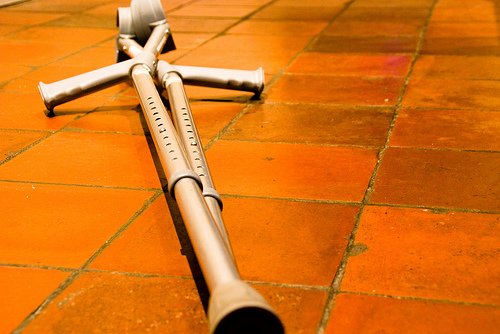
crutch-crossWhy do I need faith?

Faith fills what is lacking in my life. Jesus says inMatt. 9:12, “But when he heard it, he said, “Those who are well have no need of a physician, but those who are sick.” I am spiritually sick and faith is for the weak. When you look at the world can you honestly say everything is alright. A person that believes that is more blind that a person who has faith in God.

Since I am sick I need spiritual help. In Matt. 11:28-29 Jesus meets this need by saying, “Come to me, all who labor and are heavy laden, and I will give you rest. Take my yoke upon you, and learn from me, for I am gentle and lowly in heart, and you will find rest for your souls.”

So isn’t faith for the weak?

Faith calls you to die to yourself. Now Jesus gives a unique challenge in Luke 9:23-24: “And he said to all, “If anyone would come after me, let him deny himself and take up his cross daily and follow me. For whoever would save his life will lose it, but whoever loses his life for my sake will save it.” God calls a person of faith to a radical life. He doesn’t promise that faith in Him is an easy-cheesy life, rather it will be difficult. Imagine what the image of the cross brought to mind of a person in Jesus day. It would be like a noose or electric chair to us today. Yikes. [Note: The example of Paul (2 Cor.11:24-27), no he is not insane (Acts 26:24-29).]

Faith in Christianity is not blind faith at all. In fact, it is faith in the knowable and personable Jesus Christ that was a real historical figure, really written about and really is who He says He is. Faith is not a psychological crutch. Faith is for the weak and the doubter, the skeptics and the atheist.

real questions: God?

We as human beings have questions. Big questions. Significant questions. Questions about life, God, and the future. As a pastor, I often get questions from people inside and outside our church. These questions are real and expect real answers. I will begin a series of blog-entries that show some of these questions and seek to provide them with biblical answers.

Ned Anzers: I think that the largest reason I believe in God is because I was taught to. If I were born in an Islamic, Jewish, or atheistic family I think it is safe to say I would be what I was taught. Surely this is not what God wants my faith in him to be founded. In the past I have asked myself why I believe in God and have found ‘answers’ but after deliberating on them I no longer feel they  hold any weight. My question is this: Why do you believe in God?

This is a very good question. Can I ask you a question in return?

How is your belief in God different than your relationship with God?

To answer your question, I will give you both a short and a long answer.

Why do I believe in God? In short, I choose to believe in God. That’s my snapshot answer. If it is not satisfying I will try to give you a clearer panoramic picture of why I choose God. Actually, it is more like He chose me

The long story:

I grew up in a home that believed and taught about God. We were Catholic (by title and church attendance). My priest baptized me as a baby, yet I don’t remember a thing because I wasn’t even old enough to eat smashed carrots. I went to Catholic mass every week because my grandparents took (and sometimes dragged) me there. I went to Catholic Sunday School (called Catechism), and had my first communion. We called ourselves Christians, but I had no understanding what that meant. I believed in God too.

As I grew older church became less satisfying. God was still real, but less desirable. There was this disconnect between God and me. God was like some cosmic grandfather that I never talked to or understood. He was like some story my family told me, but almost like He was an ancestral fairytale. Little did I know this was a very small and insignificant view of a very big God.

I was a troubled kid. I had an appetite for attention. I didn’t “feel” like I received it at home, so I was sort of a class clown around school. I was well liked by my peers. I was a friend to all kinds of people. I truly treasured the attention I received from my peers. When the attention would wear off, I would do something wild and crazy to get attention. It would draw a crowd and satisfy my tastes buds for a bit, but more often I would get into trouble.

My quest for attention led me to friends that were bad influences and not law abiding. I found myself doing things I never intended or desired to do just to be around people that I thought cared. These friends introduced and diverted my attention to girls, pornography and vandalism. Note: I was still involved in church and considered a rather good kid. Overall, inside and out, I was left feeling empty, lost, confused, full of questions, needing hope, and handicapped by my guilt. I was to the point of thinking suicidal thoughts. God seemed even more distant.

My parents took me to see a local psychologist. This ended up being a waste of money. The school enrolled me in special classes. The only thing this meant was getting picked up early for school by the short-bus. I was both embarrassed and frustrated with my life.

In junior high, my mom and step-dad moved. I lived further away from my dad, which really broke my heart. Life seemed like it couldn’t get any worse.

We started going to a different kind of church because my mom and step-dad were dissatisfied with the churches of their youth. I did what most kids do: went to church because I had to. There was something about this Wausau Bible Church that was different than St. Al’s. First, most everybody had a Bible. Second, most everybody was friendly. Third, most everybody talked about God or with God as if He was a close companion. This all seemed very strange to me. On the other hand, I was quite curious. We continued to go. We bought Bibles, even though I could not understand it. I got plugged into the youth group and learned new things about God that I never knew before.

I remember clearly some of the lessons from my junior high boys Sunday School class. Here are 3 that I challenged my thinking and ripened my heart:

Judges 3:1-15

Not only a weird story about a fat king, but a lesson on Idolatry. The people are testing God. God is ready to hear their cries and deliver, but there is a need for a deeper deliverance than they desire. They desire deliverance from their situation, when God desires they to have a spiritual Deliverer. This passage gave me a radical view of Gods purposes. I need Him. I need a Deliverer. I have idols in my life that have taken His place.

Psalm 27

This song of David is a BIG picture view of life, not just reactive living. David is incredibly honest with God. He is living in a world of trouble [enemies, rejection, fear, etc]. Yet among all the trouble he is God centeredness [v.4, 14]. That is incredibly weird. I had to ask myself the question: when trouble comes where does my heart go? Not to God, but my attention in stuff or silliness that did not satisfy.

Colossians 2:1-15 

This passage hit me square between the eyes and stuck my heart with the present active benefits of God here and now. It showed me how a life without God is foolishness [vs.1-5]. I am victimized by my own foolishness. It showed me the power I have over sin in Christ [v.9]. The indwelling presence of God is given to do what He has called me to do. It is no longer I who live but Christ who lives in me…and gave Himself for me. It shows me the freedom of having a relationship with Christ [v.13-14]. I do not have to hide, live in shame, worry about exposure, because Christ forgives all my sin, weakness and guilt. No more fatalism.

I was left with God, I thought “I really didn’t know Him,” but ached in my heart to have a relationship with Him.  I did not treasure Him, but knew only He could satisfy my loneliness and desire for attention. Instead of seeking His attention, I sought to put my attention on Him. It was then I fully understood I needed a Redeemer/Deliverer/Savior. I was lost, but now He found me. Thus, in July 1992, I humbled my view of self and my view of God. No longer did I believe in Him, but I began a relationship with Him.

Well, that’s the long version of His Story with me. Like you, I wonder what if I was born into a Hindu, Muslim, or Jewish family. Would I believe the Truth? Would God in His grace rescue me from a bogus view of God? Then I wonder, why did He choose me? All I can answer is, “Alleluia!!” I thank God that He did! I pray that I would be used to help others see God is real and that He desires a relationship with them.

I would encourage you to take ownership of your belief in God [Acts 16:31]. Take your parents teaching on God and make it your own.


quit church

Why do so many young adults quit church? 
 
Three out four young adults walk away from the church. Their is a laundry list of reasons why they walk away from the church: they want a break (27%), church is too judgmental (26%), they move away to college (25%), busy with work (23%). And I would add to this list that churches today lack a ministry that reaches out to young adults. So no wonder they wander off to find something else that will cater to their “needs”.
 
On the positive side, the 30 percent who kept attending church cited solid spiritual reasons, including: “it’s vital to my relationship with God” (65%) and church “helps guide my everyday decisions” (58%)
 
Quiting church during your college and early career years can cause a lot of problems in ones future life. The years between 18 and 25 young adults are making some of the biggest decisions of their lives: living on your own, college, marriage, family, etc. If God is not in these decisions, it is a recipe for hardship. Not to mention, the future of the church is weakened without the involvement of today’s young adults. When you remove the Solid Rock foundation it is difficult to lean on anything else.
 
I want to make a plea to all young adults: don’t be a quiter. I want to take liberty in quoting a popular rapper from the 1980’s: Church, it’s  “too legit, too legit to quit”-M.C. Hammer
 
Stats taken from USA Today newspaper August 6, 2007 

He can do…

God is incredably awesome. So much bigger than anything or anyone. I really needed to hear this today…”Anything GOD has ever done, HE can do now. Anything GOD had ever done anywhere, HE can do here. Anything GOD has ever done for anyone, HE can do for you.” – A.W. TozerOh, how I give up so easily and too quickly. “Ye of little faith” can be my motto. Sad, but true. May your prayer for me be this week to be an I CAN DO person because HE CAN DO.