Do I feel a lack?

Screen Shot 2013-11-13 at 10.02.45 AM

This post is from my thoughtful and beautiful wife, Sarah.

Do I feel a lack?  Yes, I do.  A lack that is blessed by the God of the universe.  He blesses it because He gave His Son this lack as well.  This is a lack of total goodness.  I have many good things, but all things that I have are not good. Yet.  I have many friends, but not all are near to me. Yet.  I have food and rest, but I am not totally filled or perfectly rested. Yet.

I am waiting.  Waiting for my Savior.  He is coming without delay.  “Even so, come quickly Lord Jesus.”

How can I glory in this lack?  How can I despise the shame and take up my cross?  I cannot with these hands.  These hands want security and comfort.  They want pleasure and entertainment.  I must instead pour out my soul and entrust it to my Creator. I must ask God for strength to lay down my life.  I must remember Jesus.  My God, grow this in me.

My Savior is walking with me.
It doesn’t matter how far I walk.
My Savior is speaking to me.
It doesn’t matter how fast I talk.
My Savior is out to heal others.
In places that I cannot see.
My Savior is sleeping through wind storms.
I wonder if He’s in the boat with me?

My Savior is praying on mountains.
I whisper a thanks for my food.
My Savior is playing with children.
But I’m really not in the mood.
My Savior is feeding the thousands.
Did I grudge just one boy a meal?
My Savior is eating with sinners.
Do I care how others would feel?

But wait! Now my Savior is bleeding!
Do I share the pain of His gaze?
He is mocked and betrayed by those closest.
And my want is to slip by – ungrazed?
Will I give Him what never had value?
Will I fling at His feet “all the rest?”
Or die with my Savior on Calvary
And hourly give Him my best?

Jesus, lion and lamb

Screen Shot 2013-06-24 at 9.14.10 PM
Let’s say that the end of your life was in front of you. You knew it wasn’t years or months or weeks or even days, but it was hours, and your life would be over. You knew you were going to die, and you were right on the threshold of death, and it was going to be a painful, brutal, difficult, tortuous, public, shameful death. What would you be thinking about? What would you be talking about?

In Luke 22, Jesus is hours away from of His own murder. It is the dark season of His life (cf. v.53). He’s going to die soon. He knows it. And what does He talk about? What is He thinking about? The Scriptures. What gives Him confidence, what gives Him courage, what gives Him clarity? It’s the Scriptures.

One of the statements coined from the Protestant Reformation was tota sola Scriptura. It’s a Latin phrase that means all of Scripture is alone our highest authority. God’s Book is better in every way than every other book. His Book is a perfect Book. Even the best books that men write don’t compare to the book that God wrote. Scriptures are the standard to measure other books.

Now, what Jesus is going to do in Luke 22 is give a test in tota sola Scriptura. And He actually begins in Luke 22 by referring back to Luke 10. Remember, the person of peace passage, where Jesus told his disciples not to take anything, but rely upon God for provisions as they journeyed from town to town? Now Jesus will say something interesting almost seemingly contradictory,

“35 And he said to them, When I sent you out with no moneybag or knapsack or sandals, did you lack anything? They said, Nothing. 36 He said to them, But now let the one who has a moneybag take it, and likewise a knapsack. And let the one who has no sword sell his cloak and buy one. 37 For I tell you that this Scripture must be fulfilled in me: And he was numbered with the transgressors. For what is written about me has its fulfillment. 38 And they said, Look, Lord, here are two swords. And he said to them, It is enough.”

Well, which is it, Jesus? Pack supplies or don’t pack supplies? Be ready or don’t be ready? Wear shoes or don’t wear shoes? Pack weapons or don’t pack weapons? Which is it? It all depends on the mission. Jesus says, “On this mission, take nothing; on this mission, take everything.”

On a side note, as I read this I thought, “What does ‘sword’ mean?” Well I looked it up in my super nerdy Bible dictionary and “sword” means sword. Certainly, Jesus didn’t say pack a weapon. Oh, but he did. Fourteen verses later, Peter is going to grab a sword and will cut a guy’s ear off (v.50). Ironic?

Commercial over. The truth is, sometimes you should raise money. Sometimes you shouldn’t. Sometimes you should pack supplies. Sometimes you shouldn’t. Sometimes you should defend yourself. Sometimes you shouldn’t. Sometimes you should rely solely on God your provider. Sometimes you should have a plan and be prepared. It all depends on the mission. So, consider what God is calling you to in that moment.

Jesus is going deeper than talking about material you need for you mission, but the mindset you have while on mission. In Luke 10, Jesus encourages His disciples to be like a lamb and let God be your shepherd who provides everything you need. But in Luke 22, Jesus encourages the disciples to be tough. Not just Ford tough, but ninja fighter tough. Get your supplies, money secured, boots polished, sword in sheath, off to conflict, kind of tough. Tough like a lion.

There is no contradiction between Luke 10 and 22. Jesus is both lamb or lion. When you read through all of Luke you see that Jesus is lamb and lion or both at the same time. Check it out:

Luke 4: Jesus is tested by Satan and uses the Scripture to His defense. He’s LION.
Luke 5: Jesus heals a paralytic and leper. He’s LAMB.
Luke 6: Jesus heals man with withered hand despite the religious critics. He’s LAMB and LION.
Luke 7: Jesus heals servant girl and widow. He’s LAMB.
Luke 8: Jesus casts out legion. He’s LION and LAMB.
Luke 9: Jesus feeds 5000. He’s LAMB.
Luke 11: Jesus preaches the woes. He’s LION.
Luke 13: Jesus heals disabled woman. He’s LAMB.
Luke 14: Jesus heals man on the Sabbath despite religious critics. He’s LAMB and LION.
Luke 18: Jesus lets the children come to Him. He’s LAMB.
Luke 19: Jesus confronts money changers in the temple. He’s LION.

Do you see a pattern here? Jesus is tough and tender. He is servant and sovereign. He is lamb and lion.

Back to the Reformers tota sola Scriptura. The Scripture is about totally about Jesus. All the people, stories, and principles are part of the subplot connecting to the main storyline of Jesus’, the Savior of the world. The Book doesn’t make any sense unless it’s all connects to Jesus.

On Sunday, I was had lunch with Mark and his family. They’ve lived in Africa for over two decades. There youngest son was born there and is now a young man. Mark shared how his first few years in Africa were tough, but as he saw the Word of God transform lives he has become more tender to God’s calling him there. He’s seen many Muslims respond in faith to the Book that points to Jesus from beginning to end.

In Luke 22:37, Jesus says. “For I tell you that this Scripture must be fulfilled in me: ‘And he was numbered with the transgressors.’” He quotes Isaiah 53:12. Jesus says the the whole book is now being fulfilled in His life. He came fulfilling everything that is written in the book that God wrote. Even on the brink of torture and death Jesus understands He is to fulfill what God has said. He came as the lamb of God slain for the sins of the world. And He has promised to come back as the Lion of Judah to restore the world. The Book says so. Tota sola Scriptura.

Questions for Reflection: How has Jesus made provision for you in your life? How does the fulfillment of the cross make provision for your sin? In what ways do you lack nothing and have everything? How does your worldly perspective affect your view of provision? In what ways have you submitted to the truth and power of Scripture in your life? What does it look like for the Scripture to be your tota sola Scriptura?

warnings to religious people

woe to you

“No one after lighting a lamp puts it in a cellar or under a basket, but on a stand, so that those who enter may see the light. Your eye is the lamp of your body. When your eye is healthy, your whole body is full of light, but when it is bad, your body is full of darkness. Therefore be careful lest the light in you be darkness. If then your whole body is full of light, having no part dark, it will be wholly bright, as when a lamp with its rays gives you light.” (Luke 11:33-36)

Religious people close their eyes to Jesus (the Light of the world). In Luke 11, the Pharisees and lawyers had such eyes. They eyes were darkened. On the outside they appeared holy and righteous, but the opposite was true about their insides. Their insides were without light, full of pride and unbelief (vs.37-41). Therefore Jesus gives some serious warnings to religious people. In fact, he gives six warnings:

WARNINGS AGAINST STEALING PRAISE THAT GOD DESERVES.

1) Do not brag about what you give to God (v.42, i.e. tithes & services). Religious people don’t care for people or God, the care about how holy people think they are.

2) Do not love the good seats in God’s house (v.43). The Pharisees paid good money for the good seats—the seat where everyone had a good view of them.

3) Do not love titles. The Pharisees were more concerned about their name than the name of God (v.44). Their fame will die with them in the grave, but God’s fame lasts forever.

Jesus trumps the Pharisees. Jesus is title is: Son of God, King of Kings, and Savior of the world. He is seated: at the right hand of the Father, the seat of supreme authority. His fame will stand the test of time and one day all will bow at His feet.

WARNINGS AGAINST GUARDING YOUR IDOLS TOO TIGHTLY.

4) Do not burden (intimidate/bully) people with rules stacked upon rules (v.46). The lawyers made their living studying the law and enforcing them upon others. They don’t love Jesus or people, they only love being in control of rules and making sure others are keeping them.

5) Do not kill the prophet who calls you to repent (vs.47-51). In the Old Testament, Israel killed the prophets they did not like. The religious people will kill Jesus too.

6) Do not make the Scripture to fit your agenda (v.52). Instead, search the Scriptures to understand God’s plan. The only way to God is not religion, it’s Jesus. Religion gets in the way of redemption. Not only do religious people not understand they prevent others from understanding too.

Jesus trumps the lawyers. He is the author and perfecter of the law. He willingly dies a sinless servant so that the unrighteous could have His righteousness. Jesus is the key to Scripture. He is the Door (cf.11:9-10). Knock and you have eternal life.

In conclusion, each of these warnings has something in common: They show the condition of man’s heart, which is full of pride and idols. Now, it’s easy to point fingers at religious people, but if you were honest, you and I can be just like Pharisee or lawyer? Where has religious thinking distorted your heart? What sins of religious belief or action do you need to repent of? What does repentance look like in those areas of your life? Will you let Jesus’ light shine inside out?

Jesus redefines your “neighbor”

2326732718_0bd842314c_z

“Like a good neighbor, State Farm is there.” It’s a catchy little jingle, eh? Did you know that Barry Manilow wrote that for State Farm back in 1971? What this slogan implies is that people can have certain qualities that make them a good neighbor. What qualities make a person a good neighbor? Jesus gave meaning for the word, but probably broader than you might think. Consider the significance between the meanings of the word neighbor as a noun and as a verb.

The Good Samaritan is probably one of the most widely recognized Bible stories. When we hear it used in newscasts, the stories surrounding it usually give us a warm and fuzzy feeling. But what was Jesus really trying to teach when He told that story? Was He encouraging us to do random acts of kindness or was He implying something more?

Going to the Scriptures to find answers is the right place (Luke 10:25–28)

In Luke 10:25–28, we meet a lawyer. The title lawyer indicates that he was an expert in the law. In particular, this lawyer was a student of the Mosaic Law. We don’t know his name, but what we know is that he comes to Jesus with a question to test Jesus’ understanding of the law, “Teacher, what shall I do to inherit eternal life?” (v.25; cf. Deuteronomy 6:16).

Jesus does not give an answer; instead He deflects the lawyer back to the Scriptures. Jesus knew the lawyer knew the answer, since the man spent his entire life searching the law for answers. Jesus simply wanted to hear from his own lips what his understanding of the law said about eternal life.

After the lawyer answers correctly, with a clip on his shoulder he asks Jesus another question. This time his question reveals the condition of his heart, “And who is my neighbor?” (v.25). It’s already clear the lawyer is trying to test Jesus (cf. 7:30), not learn from Him. Also, he is trying to justify himself before men by asking smart questions to appear “wise and understanding” to those listening (cf. 10:21).

The lawyer does what is wise even though he doesn’t acknowledge it. By coming to Jesus, he is coming to the One who authored the law. Jesus understands the law in its purest form. Jesus not only affirmed the law (v.26), He brings a clearer understanding and application to it. Jesus desired the lawyer to see the purpose of the law pointed to his need of Jesus.

Where do you run when you need answers? Do you search on Google or Wikipedia? Do you reference the newest self-help book or horoscope? Do you seek the advice of a friend or family member? Do you come to God in prayer? There are many places people run for answers. If Jesus went to the Scriptures, how much more should you?

Asking who qualifies as my neighbor is the wrong question (Luke 10:29–35)

What’s the lawyer really asking? He’s trying to exclude responsibility for others by making some people “non-neighbors.” It’s like he’s saying, “Who deserves to receive my kindness?” His religious and social status has clouded his understanding of his own kindness. Though smart, he’s super insensitive. A more appropriate question would’ve been, “Jesus, how can I be a loving neighbor?”

good-samaritanSince the lawyer does not understand, Jesus will help him understand by telling a story of a man robbed, beaten and left to die. As the story goes three men walk down the same road where the man is laying, a priest and a Levite “pass by” the man, but a Samaritan stops and has compassion on the man. Like a good neighbor, the Samaritan is there.

This story would have seriously challenged the worldview of the lawyer. Jesus’ use of a Samaritan as the hero would be quite a shock to His listeners because of the longstanding hatred between Jews and Samaritans. Culturally, it would have been unthinkable for a Samaritan to help a Jew (cf. John 4:4, 9; 8:48). Not only does the Samaritan help, he shows compassion to a neighboring enemy. Thus Jesus makes the point that to love one’s neighbor involves showing care and compassion even to those with whom one would not normally have any relationship (cf. 6:27, 35).

Boundaries exist between the Jews and Samaritans (vs.30–33). And Jesus intentionally expands “neighbor” to mean more than people like us who live near to us. He says they are people who we consider enemies who live on the other side of the tracks. It’s not so much who our neighbor is, but how we are demonstrating concern for neighbors (vs.34–35). Jesus eliminates any excuse not to take care of a neighbor.

Being a merciful neighbor is the right action (Luke 10:36–37)

With the story told, Jesus asks the lawyer ,”Which of the three men was the neighborliest (v.36)?” The answer of course was obvious.

Jesus’ story forced the lawyer to reconsider the condition of his heart. It forced him to compare the actions he considered righteous with those he considered unrighteous. The story reveal how far his interpretation of the law had moved from the law’s true meaning. God gave the law to encourage His people to love Him and others,

“You shall love the Lord your God with all your heart and with all your soul and with all your might. And these words that I command you today shall be on your heart. You shall teach them diligently to your children, and shall talk of them when you sit in your house, and when you walk by the way, and when you lie down, and when you rise. You shall bind them as a sign on your hand, and they shall be as frontlets between your eyes. You shall write them on the doorposts of your house and on your gates.” (Deuteronomy 6:5-9; cf. Isaiah 49:6)

The command to love others is a continuation of loving God. Jesus is concerned that we are to be merciful neighbors to those across the street and across the globe because He desires all to see His love and mercy through us.

Jesus’ last statement is the most challenging, “Go and do likewise,” (v.37; cf. 1 John 3:16-18), but the promise He gives earlier is most encouraging, “Do this and you will live [eternally].” (v.28) The way we love one another reflects the way we love God. Who is the neighbor  you have difficulty showing mercy and love? Is he a Muslim, a criminal, a beggar, or a homosexual? How will you act neighborly, showing the compassion of Christ? Like a good neighbor, will you be there?

black friday

Screen Shot 2013-03-29 at 2.14.20 PM
There are two Fridays that people reference frequently: Black Friday and Good Friday.

How did Black Friday get its name? “Black Friday” had an early meaning of referring to the day that normally retailers “sell in the black” or make a profit from their sales for the year. Religiously, the day after Thanksgiving, we make a mad rush to stores long before they open to get bargains before Christmas.

ap_black_friday_21_dm_121123_wg

More important is “Good Friday.” It was the first Black Friday. Good Friday is ironically named. It’s good because something horrific happen, a death. How can a death be called good? It’s who died and why He died. Jesus died. And when he died, on Friday, He carry the weight of our sin on the cross, bore the wrath of God, and paid the price for our sins!

Isn’t it ironic we call it “Good” when Jesus suffered incomprehensibly for us? As horrific as it is, it’s Good News! Jesus took our place! Without Good Friday we have no eternal profit, rather we are bankrupt. We would be in the red.

christ_adp

Who has believed what he has heard from us?

And to whom has the arm of the Lord been revealed?

For he grew up before him like a young plant,

and like a root out of dry ground;

he had no form or majesty that we should look at him,

and no beauty that we should desire him.

He was despised and rejected by men;

a man of sorrows, and acquainted with grief;

and as one from whom men hide their faces

he was despised, and we esteemed him not.

Surely he has borne our griefs

and carried our sorrows;

yet we esteemed him stricken,

smitten by God, and afflicted.

But he was pierced for our transgressions;

he was crushed for our iniquities;

upon him was the chastisement that brought us peace,

and with his wounds we are healed.

All we like sheep have gone astray;

we have turned—every one—to his own way;

and the Lord has laid on him

the iniquity of us all.

He was oppressed, and he was afflicted,

yet he opened not his mouth;

like a lamb that is led to the slaughter,

and like a sheep that before its shearers is silent,

so he opened not his mouth.

By oppression and judgment he was taken away;

and as for his generation, who considered

that he was cut off out of the land of the living,

stricken for the transgression of my people?

And they made his grave with the wicked

and with a rich man in his death,

although he had done no violence,

and there was no deceit in his mouth.

Yet it was the will of the Lord to crush him;

he has put him to grief;

when his soul makes an offering for guilt,

he shall see his offspring; he shall prolong his days;

the will of the Lord shall prosper in his hand.

Out of the anguish of his soul he shall see and be satisfied;

by his knowledge shall the righteous one, my servant,

make many to be accounted righteous,

and he shall bear their iniquities.

Therefore I will divide him a portion with the many,

and he shall divide the spoil with the strong,

because he poured out his soul to death

and was numbered with the transgressors;

yet he bore the sin of many,

and makes intercession for the transgressors.

– Isaiah 53

Jesus forgives risky women

Lightbulb

A few years ago, my wife served at Vision of Hope, a residential treatment center for women at risk. During her time on staff, we met many gals from backgrounds of horrific abuse, numbing addictions, and life-debilitating decisions. These gals came wrecked and desperate for change. Miraculously many of those gals intersected with Jesus, began listening to the Bible, and transformed from inside out. You would never know today the history many of these gals had because Jesus had forgiven them and set them free. Jesus loves rescuing risky women.

In the gospel of Luke, we see Jesus mingling with some risky characters like Levi the tax collector who invites Jesus to a party with his buddies (5:27-32), a leper (5:12-26), and a crazed demon possessed man (4:31-44). Jesus reaches out to people most would consider keeping at a distance. In Luke 7:36-50, Jesus intersect with a risky woman in the oddest of places, a religious leaders home. This story begs us to ask the question, which character do I most resemble?

Let’s meet Simon. Simon is a Pharisee. He’s an elite Jewish leader who is known for being a stickler about the law, sort or like the religious rules police. For an unknown reason he invites Jesus over to his house for a meal. Jesus accepts. As Jesus arrives Simon insults Jesus by ignoring to greet Him or give Him water to wash His feet. Simon has a some chip on his shoulder.

It’s not just Jesus he disrespects, he labels a woman. Sure, she’s an unexpected guest and a ‘woman of the city’ who would never be invited to Simon’s house or these kind of parties. He makes a rash judgment about the woman saying, “She is a sinner.” (v.39) Simon has no sympathy for sinners.

Religious people are slow to see others needs, but they are quick to spot others sins before their own

Simon thinks that since he keeps the rules he’s a good man. Compared to his uninvited guest he appears pretty good. Simon is good; good at seeing the flaws in others. He can spy a sinner miles away, all the while camouflage his soul to the public. He does not see himself as a sinner nor his own need of forgiveness. However, Jesus has x-ray vision and sees the condition of Simon’s heart. It’s inhospitable, unloving, irreverent, and unforgiven.

In what ways are you like Simon the Pharisee? Be honest. Is your standard of goodness comparing yourself to others? Have you held back the gospel from ‘sinners’? Are you quick to judge and slow to compassion? If you answered ‘yes’ to any of those questions you have some similarities to Simon.

Simon blew an opportunity to show grace and compassion to this woman. He could have said, “Welcome! I want to be the first to introduce you to Jesus!” Instead, he labels, judges, and belittles her. He despises both woman and Jesus. He despises her despicable reputation and Jesus’ growing reputation. He despises the way the woman worships Jesus because he doesn’t know who Jesus really is.

Those who know who Jesus really is are not ashamed to respond to Him with humble, generous, repentant worship

luke7This woman has a lot to be ashamed about, but she unashamedly approaches Jesus at Simon’s house. She risks her pride and already diminished reputation to see Him there in public, of all places. It is obvious she put thought her actions. She kisses Jesus’ feet, washes them with her tears, and puts ointment on them (vs.37-38). It might appear to be an awkward or offensive situation, but to Jesus it’s beautiful, generous, humble, repentant worship.

Jesus does not rebuke the woman, instead He approves of her humble extravagance. Jesus loves worship. The only thing that matters in worship is God’s approval. He created you for His glory and praise. “For of Him and through Him and to Him are all things, to whom be glory forever.” (Romans 11:36) “For by Him all things were created that are in heaven and that are on earth…All things were created through Him and for Him.” (Colossians 1:16) “Everyone who is called by My name, Whom I have created for My glory.” (Isaiah 43:7)

In response to the woman, Jesus shows love and gives her the most hopeful words, “Your sins are forgiven” (v.48). Can you imagine what those four words meant to her? How life-altering they would be?

In what ways are you like the woman of the city? She does not hold back from worshiping Jesus. She knows who Jesus is and what He can do for her. What she needs is forgiveness. She faces her sin. She does not run or hide. She finds forgiveness in Jesus.

Jesus came to earth to challenge the religious status quo and transform you from the inside out

As I said in the beginning, this story begs us to ask the question, which character do I most resemble? It is common to compare yourself with Simon or the woman, but in what ways are you like Jesus? Jesus is the main character of this story. He’s the star of the whole Bible. In this particular story there is a lot to be learned from Jesus. He accepts both the sinner and the saint. He gives both what they need. To the sinner He gives her forgiveness and assurance. To the one who thinks he’s a saint he gives truth in love. Jesus challenges the the religious status quo. Here’s how:

First, Jesus challenges our flawed perception of our own goodness (vs.41-42). Simon thought he was a good man, especially compared to the woman, but compared to Jesus he looked quite putrid. Jesus reveals the condition of Simon’s heart: polished on the outside, but tarnished on the inside. By the worlds standard’s the Simon is a good man and the woman is bad, but Jesus sees them both equally as sinful and needing forgiveness. Remember, Jesus is our standard of goodness not another sinner.

Second, Jesus challenges our shallow values (vs.44-47). The Pharisee sees himself as an important person. In contrast, the woman humbles herself to show what she deems important. The woman gives Jesus her most precious object in the world because she believes Jesus is the gift of forgiveness will be the most precious gift to her. By breaking the alabaster flask, she is handing over everything that is important to her. Jesus becomes her most valued treasure.

Third, Jesus challenges our sense of safety and certainty (vs.48-50). Simon finds safety and security in his religious system. Following rules is the easy part, but it settles for a lesser status quo than following the way of Jesus. Jesus sets the bar. He shows how you can love the law, yet love others who don’t measure up to it. Jesus’ love for the woman trumps the label Simon puts on her.

If you are into safety and certainty, you will miss God and will miss an opportunity to speak the gospel into a persons life. Religious systems call for conformity to the system, but the gospel calls for transformation through Christ alone. The one thing that is certain in this world is Jesus. He is the way, the truth, and the life. No one gets to God but by Him. He is the standard of goodness. And no one measures up. But by His grace you can be saved because Jesus took all your badness on the cross. Come to Him and be forgiven. Let Him change you from the inside out.

Who do you most resemble in this story? You are the pharisee when you forget you are like the woman. Do you believe you are a sinner, or do you think you’re basically a good person? Do you know that Jesus has forgiven your sins? If so, how can you be loving and serving Jesus, at home, at school, in your neighborhood?

Jesus breaks the rules

breaking the rules

Rules. Rules. Rules. They are everywhere. There are rules for school, rules for the road, rules for table manners, rules for marriage, rules for parents and children, rules for governing, rules for meetings, rules for church, written rules, unspoken rules, and even rules for rules.

Sometimes rules can seem nettlesome when we don’t understand their purpose. Like, why can’t we use #1 or #3 pencil for tests? Now, rules aren’t all bad. Think of a world without rules. It would be chaos. Rules are good. Rules are meant to protect us and help us. This is the heart behind a parents saying to their children, “Look both ways before crossing the street.” It’s a rule that could save ones life.

God has made rules too. His rules perfectly and lovingly protect us and help us. However, some people have seen God’s rules as overbearing or unreasonable and choose to rebel. Rebellious people break the rule by ignoring them altogether. Others have seen God’s rules as insufficient and needing additions to fit their religious system. Religious people make rules for God, themselves and others.

So is it ever okay to make or break the rules? In Luke 6, Jesus will answer this question as He’s being accused of breaking their rules. What rules does Jesus break? Certain religious leaders accuse Jesus of breaking the Sabbath rules.

What is the Sabbath? Literally, it means “rest” and is rooted in the seventh day of creation when God rested after six-days of creating (Genesis 2:2-3). God did not rest because He was tired, but He set an example for mankind (Mark 2:27-28). God knew in His infinite wisdom that man would be weak and need to take a day off from work and enjoy the day of rest. The Sabbath is a day dedicated to God (Exodus 20:9-11). So how do the religious leaders think Jesus breaks the rules of the Sabbath?

1) Jesus breaks the rules by helping His hungry friends (Luke 6:1-5)

no_food_or_drinkJesus and His disciples were hungry and there was no McDonald’s drive-thru available to get a quite bite to eat. In accordance with the law (Deuteronomy 23:25), they go into a field, pick grain, crush it with their hands, and eat it. The Pharisees catch wind of this and cry foul. They ask, “Why are you sinning on the Sabbath?” (v.2) Why do they assume Jesus and His followers are sinning? The Pharisee’s saw this as harvesting and threshing, and accuse Jesus of doing work on the Sabbath. Sounds like a stretch, eh?

The Pharisees were sticklers for law keeping. The took God’s law and added to it a man-made framework to give them the appearance of righteousness. So with such laws like, “Remember the Sabbath and keep it holy,” (Exodus 20:8ff) they made-up a list of rules to look really holy, but the Sabbath became just another religious activity.

Isn’t that easy to do? Have you ever made the Sabbath a religious activity to boast in yourself? It is easier to keep your own rules of righteousness than measure yourself by God’s rules. According to their rules, Pharisees were on the Varsity Team and everyone else was on warming bench.

How does Jesus respond to the Pharisees accusation? First, He compares the situation to the example of David and his soldiers eating the bread of Presence from the temple, which was only to be eaten by the priests (1 Sam.21:1-6). Jesus points to the fact that God is more concerned about the person and the motivation of their heart than the particulars of the law. Jesus could see through to the hearts of the Pharisees and they were evil.

Second, Jesus doesn’t appeal to the religious leaders authority or accept their theology, instead He claims, “I am Lord over the Sabbath” (v.5). In other words, Jesus says, “I wrote the law and the Sabbath was my idea. Stop arguing with Me and start listening. Don’t fight Me, follow Me. Since I made the Sabbath, He define it.” Not only does He define it, He lives and fulfills it before their very eyes.

Sabbath is a wonderful gift from God to be enjoyed. Religious people suck the joy, passion, and purpose out of it (and everything they add rules to). They make the Sabbath as fun as going to the dentist on a free day. This particular Sabbath should have been the most unique, memorable, and joyful ones of their lives because they were in the presence of the Son of God.

2) Jesus breaks the rules by healing a man’s hand (Luke 6:6-11)

no peopleOn the Sabbath, Jesus goes to the synagogue for worship. He’s teaches. And Luke, the doctor, tells us there is a man present who has a withered hand. The Pharisees and scribes are listening critically to Jesus words and waiting with baited breath to see if He will heal the man. Like wolves ready to pounce on their prey, they were salivating at the opportunity to catch Jesus doing something they thought offended the law. Religious people are quick to tear apart and devour others.

This time Jesus asks the question, “I ask you, is it lawful on the Sabbath to do good or to do harm, to save life or to destroy it?.” (v.9) No response is given because the answer is obvious. Jesus then has the man to stretch out His hand, in faith, he does what Jesus says, and Jesus heals him. In that moment, Jesus showed the religious people that helping someone in need trumps holding tightly to your rules. Jesus transforms this man life. Forever will he remember this Sabbath as the day Jesus healed His hand and healed his heart.

Religious people are not ruled by loving God or loving people, they ruled by a love for rules. Loving rules is legalism. Legalism is when people take the Bible and add to it. They make rules outside of the Bible that are equal to the Bible. Legalism is unbiblical, unloving, moralistic, man-pleasing, compromising, critical, judgmental, arrogant, self-righteous, and godless.

Legalism is an enemy of Jesus and His Word

Legalism is a dangerous enemy; it adds to the Bible and rejects Jesus as the only sufficient means to righteousness. Legalism denies something called sola scriptura, where Scripture alone are our highest authority. Sola Scriptura was first coined by the Protestant Reformers. All other authorities, like other books, teachers, rules, and leaders, are under, not equal to, Scripture. Religious people tend to elevate teachers and also other lists, and rules, and books equal to Scripture.

So dangerous is legalism that it kills Jesus. The Pharisees were so angry that they connived a plan to get rid of Him, “But they were filled with fury and discussed with one another what they might do to Jesus.” (v.11) Religious legalist don’t lose because they make their enemies pay. When they are angry they attack. Luke 6:11 will lead to Luke 23:46, which is the murder of Jesus.

Jesus summarizes the rules with two rules

Jesus doesn’t break any of the Bible’s rules, but He breaks certain religious rules. He does so because He values helping people more than following others expectations, traditions or religious rules. He knows that religious legalism is the default setting of every human being. So in Matthew 22:37-40, Jesus shares the two most important rules, often known as the greatest rules,

“You shall love the Lord your God with all your heart and with all your soul and with all your mind. This is the great and first commandment. And a second is like it: You shall love your neighbor as yourself. On these two commandments depend all the Law and the Prophets.”

These rules show God’s heart for giving the law: love. God intends the law to protect and help you love Him and others around you. It’s not about loving the rules or loving to rebel against them. It’s about loving the God and others. As Jesus said, “The Sabbath was made for man, not man for the Sabbath.” (Mark 2:27-28)

Some of you need to repent of your religion. Enough with the legalism. Enough with the rule making. Enough adding to the Bible. Enough with the self-righteousness. Enough with the boasting and bragging. Enough with the criticizing and judging. Repent of your religion and come to Jesus. You can’t have Jesus and religion. It’s just Jesus.

Some of you also need to repent of your rebellion against Jesus’ rules. Enough with rebellion. Enough with rule breaking. Enough ignoring the Bible and subtracting from it. Enough with bashing the religious. Enough with reverse legalism. Enough with lawlessness and licentiousness. Repent and follow Jesus.

Come to Jesus. Receive His death for your sin, His righteousness for your unrighteousness, let Him do the work of grace and transformation in you. The truth is Jesus lived the perfect life. He died a substitutionary death, and He rises to give you the gift of righteousness. Stop trying to be righteous on your own and receive the righteousness of Jesus, and share that message of grace with those around you who need it too.

Jesus eats with sinners

bar

Most religious people would not catch themselves in a biker bar or talking with pimps and prostitutes, but when reading through the Gospels we catch Jesus talking to these kinds of people in these kinds of places often. Why does Jesus hang with sinners? Well, in Luke 5:27-32, Jesus eats with a tax collector and his companions, and it is here you get the answer.

What’s with the tax collector?

I-love-tax-collectorsIn Jesus day, tax collectors were hated. Some things don’t change! They were especially hated then because Israel was under Roman oppression. Certain Jews got the job of collecting taxes for Rome. They were viewed as a traitor or enemy who cheated their own people to get rich. For that reason, they were commonly avoided or the punchline of many bad jokes.

Who are the “tax collectors” in your life? Think of the person you avoid or talk bad about. Is it your beer drinking neighbor who parties too loudly, even on weeknights? Is it girl who is known by her second-rate reputation at your office. Is it the politician you love to bash?

Levi is a tax collector. He’s the guy you love to hate. But he’s also the guy Jesus loves to love. Jesus finds him. He doesn’t avoid him like someone with a virus. He finds him at the tax office counting his coins. Jesus doesn’t come in and blast his character or belittle his profession. He simply says a simple statement expecting a simple answer, “Follow Me.” Amazingly, Levi leaves everything and follows Jesus.

Who’s sick?

Levi’s life changed the day Jesus intersected him at his office. He’s so excited he throw a party. Since tax collectors don’t have many friend their friends are usually other tax collectors. The guest of honor at Levi’s party is Jesus.

Word spread faster than a British tabloid. The religious leaders came to Jesus’ disciples with their list of gripes and complaints. As the Pharisees see it, Jesus is in a lose-lose situation. Sinners are following Him. But Jesus sees it as a win-win. Sinners are following Him. Jesus defends Himself by saying, “Those who are well have no need of a physician, but those who are sick.” (5:31) What did Jesus mean by this?

Jesus directs his words towards the religious leaders. They are (spiritually) sick and don’t even know it. They are like a man who will not admit that he is sick and refuses go to a doctor for help. In their pride, they will suffer defiantly, if not die. Jesus came to bring healing our sin sickness that leads to death. Pride leads to death, but humility leads to the cross.

Will you repent?

Jesus follows up his first statement by saying, “I have not come to call the righteous but sinners to repentence.” (5:32; cf. 13:3-5; 15:10; 24:47; Mark 1:15; Acts 5:31) He’s not called to the righteous because they don’t think they have a need for Christ (when they really do!).

Jesus is called to the sinner who knows he is in need of Christ (cf. 1 Tim. 1:15) and humble enough to come to Him for a life transformation. To repent is to humbly turn away from your sin and your self-righteousness and turn towards Jesus and His righteousness. It’s a life-transforming turn.

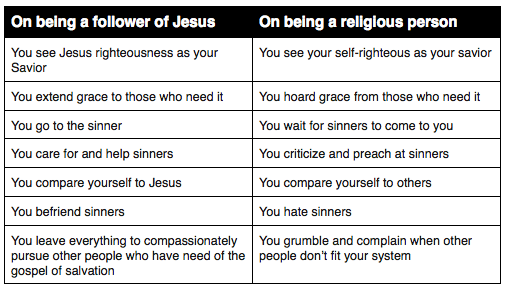
Do you see the contrast between Levi’s response to Jesus and the religious leaders response to Jesus? Levi follows immediately and throws Jesus a feast. The religious leader grumble, question, and judge. Levi wants Jesus to transform him, but the religious people want Jesus to conform to them. Levi has an attitude of repentance, while the religious leaders think they have no need for repentance. The religious leaders measure their goodness among themselves, while Levi measures His goodness against Jesus. The religious leaders follow their code of conduct, while Levi simply follows Jesus. Being a follower of Christ is much different than being a religious person.

follower of Jesus vs religious person

A good question to ask yourself when reading this text is, Who do I respond like more often Levi or the Pharisee? If I were honest, I would have to say I respond more like the Pharisee. How about you?

So how do I change and love like Jesus loves? First, I must remember I was once like the tax collector to God. I lived the most unlovely life yet I was unconditionally loved by Him. I was infected by the most destructive disease known to man, sin.  I can love my enemies because I was once God’s enemy and He loved me.

Second, repent and run to Jesus Christ. Repentance is your only means of healing. Repent of your pride, repent of hoarding God’s grace, and repent of your hateful attitude towards the tax collectors in your life. When you repent don’t expect life or loving others easier. Sometimes it can be harder. Jesus got Himself killed because of the way He ate.

Third, with the remaining days of your life make it my aim to follow Him, which means eating with sinners too. Extend to all the life-transforming eternity-giving message of the gospel of Jesus Christ. No one, including you or the tax collectors in your life, are too sinful to enjoy the pleasure of sitting at Jesus’ table.

opulence, philanthropy, and giving

Image from Forbes.com

In the photo above you have a gathering of $126 billion dollars. It is probably the single richest gather in modern history. These men and women have given money and time to make the world a better place. These peoples lives are marked by giving rather than receiving.

It is indeed honorable what these billionaires have done with their pocket books. You truly see what one values by the way they spend their money and time. These billionaires have set a high standard for those of us who have less to consider.

As I pursued Forbes 400 Summit articles a few questions teetered in mind: Is he who give the most always the most honored? What about the little old lady who lives below the poverty line that gives kisses and cookies to cheer children? Is giving money the most helpful solution to the worlds issues? What does money buy? What is the definition of “better” in making the world a better place?

When I consider the most opulent Giver of all time, he was not rich with monetary wealth, he did not own a large corporate empire, he was not well liked even by religious persons. Rather, he lived a frugal life, the son of two teenage parents. His hands were calloused from carpentry. He did draw crowds and heal many sick. He did make outrageous claims, like, being God and the universe was his inheritance. He was considered a criminal and blasphemer. Ultimately he sacrificed his life, ending it in public humiliation, giving it up for the sake of the name and glory of His Father’s.

His name: Jesus. Without his divinely foreordained gift to humanity, no one in the world would have enough brains, bucks or brawn to conger up a better solution to the problems created by sin. His gift of forgiveness and reconciliation is free for all who believe. It won’t cost you 99% of your accumulated wealth, but it might just cost you to die to yourself.

I am not sure I’d ever see Jesus picture or name mentioned in Forbes, but I will surely hear and see Him worshiped throughout eternity.

clean

Clean.
Clean.
How beautiful. How free.
Jesus Christ dying on a tree.
Lonely. Lowly. Clean.
Red blood dripping. Purity.
Soldiers spitting mockingly.
Black sky darkening soberly.
Death of purity.
Blood. Water.
Clean.
Hear the women crying.
Thunder – paralyzing.
Death purifying.
Washing me
clean.

Poem by my wife Sarah

who?

Who?
Who made the flowers white – more white than morning snow?
Who made the sound of water and the fireflies to glow?
Who put the brightness in the sun and made the moon to shine?
Who put the faith that saved my soul into this heart of mine?
Who shakes the mountains? Who quiets the seas?
Who whispers tales to tall, shivering trees?
It is my Jesus – strong and meek.
The One who washed disciples feet.

Poem by my wife, Sarah Hutts

Artwork used with permission from Calvin Carter Art.

Jesus is

He is.
Jesus holds me closer than a friend.
He is my defender – Whose love will never end.
He is all my smiles.  He is all my tears.
Jesus is the truth that swallows all my fears.
Jesus is my light. Jesus is my path.
He it is Who carries me and pacifies God’s wrath.
Jesus is the merciful. Jesus is the law.
Both now and through eternity, He remains my All.

by my wife, Sarah

How does Jesus fulfill the 10-Commandments?

“Do not think that I have come to abolish the Law or the Prophets; I have not come to abolish them but to fulfill them.” (Matthew 5:17; Cf. Rom. 10:4; Gal. 3:24).

Jesus said these words. He has come to fulfill the Law and the Prophets. He has come to to bring about that to which Bible pointed in the Old Testament, and that is what Jesus has done. The word fulfill means “to fill out, or expand.” It does not mean to bring to an end. Jesus was not taking away from the Law, contradicting it, nor was He adding to it. The Law remains wholly authoritative and demands the fullest respect of all followers of Christ (5:18–19).

Jesus came and clarified the Laws original meaning and goal. After all, He was its author. And we must not forget that Jesus, as a Jew, related well to the Law. Through His teaches and example He also clarifies God’s eternal desire for His people be characterized by obedience and holiness from the inside and out. Fulfilled Law is written on the heart (Jer. 31:31–34; Ezek. 36:26–27). Jesus Himself fulfilled the law in several ways: by keeping it perfectly; by fulfilling the Old Testament messianic types and prophecies; and by providing the way of salvation that adheres to all the righteous requirements of the Law.

When we think about the Law, our mind often jumps to the 10 Commandments, which are a summary of all of God’s Law as is Matthew 22:37-40, “Love the Lord your God with all your heart and with all your soul and with all your mind.’ This is the first and greatest commandment. And the second is like it: ‘Love your neighbor as yourself.’ All the Law and the Prophets hang on these two commandments.”

How does Jesus fulfill the 10 Commandments?

As you read the 10 Commandments given to Moses recorded in Exodus 20:1-17 and read the New Testament there is evidence from the life and work of Jesus Christ that points to His fulfilling all of the Law. Notice how Jesus is seen in the Commandments from first to last:

1. Jesus is the Way, the Truth and the Life (John 14:6; cf. 8:58).

2. Jesus is the exact image of His Father (Col. 1; Heb. 1:1-3). If you want to know what God looks like, look at Jesus.

3. Jesus is the Word in flesh (John 1:1). He says what comes out of your mouth reveals your heart (Mt.15:18) be careful what promises you make because God keeps His promises (Mt.5:34-35; James 5:12).

4. Jesus is the Head of the Church (Col. 1:18). He is our Sabbath Rest (Mk. 2:27).

5. Jesus honored His Father. The Trinity submits to authority too (John 4:34; 5:30; 6:38; cf. 1 Cor. 3:23; 15:24–28).

6. Jesus creates life (Col. 1:16-17) and ordains life and death (Acts 3:15). He also gives eternal life (John 10:10). He has sanctity for life.

7. Jesus demonstrated His unadulterated love for the church (Eph. 5:22-33), which is like a husband loving his wife.

8. Jesus is the Great Provider (Mt. 6:11; John 6:30-58; Cf. Ex.16:32-35). He does not take, but gives.

9. Jesus is the Truth, and the Truth sets you free (John 8:32). He commands you to love your neighbor as yourself (Mt.22:39Rom.13:9).

10. Jesus desires to be the treasure of your heart (Mt. 6:19-21; Heb.13:5).

Jesus is seen in all Law, even the 10 Commandments. The Law, bears witness to the grace of God, pointing ahead to its fulfillment, and climaxing in the gospel of Jesus Christ. The gospel does not abolish the Law, but fulfills it, by allowing it to be seen in its proper light.

“Don’t suppose for a minute that I have come to demolish the Scriptures—either God’s Law or the Prophets. I’m not here to demolish but to complete. I am going to put it all together, pull it all together in a vast panorama. God’s Law is more real and lasting than the stars in the sky and the ground at your feet. Long after stars burn out and earth wears out, God’s Law will be alive and working. Trivialize even the smallest item in God’s Law and you will only have trivialized yourself. But take it seriously, show the way for others, and you will find honor in the kingdom. Unless you do far better than the Pharisees in the matters of right living, you won’t know the first thing about entering the kingdom.” (Eugene Peterson, The Message)

is it better to know Jesus or love Jesus?

I grew up in central Wisconsin. As a teenager, I was a big fan of Brett Favre (along with 5 million other people in the State). I know his stats starting from 1992 to present. I would pretend to throw like him my backyard. I’ve read all his Sport Illustrated cover stories. I worked at a Sporting Goods store so I could collect his memorabilia. I can even tell you the name of the town he lives in down south (Kiln, Mississippi). I have never met Brett, yet I feel like we’re buds. I know a lot about Brett Favre (probably more than most of you), but I really don’t know him. I love to watch him fling a football, but I don’t really love him like those closest to him.

Sadly, some in the church think of Jesus like I thought of Brett Favre. Now I am not comparing Jesus to Brett Favre (although I know some fanatics who might). You can be just a fan of Jesus. You can know a little about Him, and love things about Him. But you might not really know Him or love Him as He desires. This leads to the question in the title: Is it better to know Jesus or love Jesus? No, it’s not a trick question, but the answer may surprise you.

When Jesus came He called for faith and followership from the least to the greatest, the poor to the rich, the sinner and the religious. Jesus came to save the good, bad, and ugly. We see this in Luke 7. As we step into the story it begs us to ask another question: Who am I most like in the story?

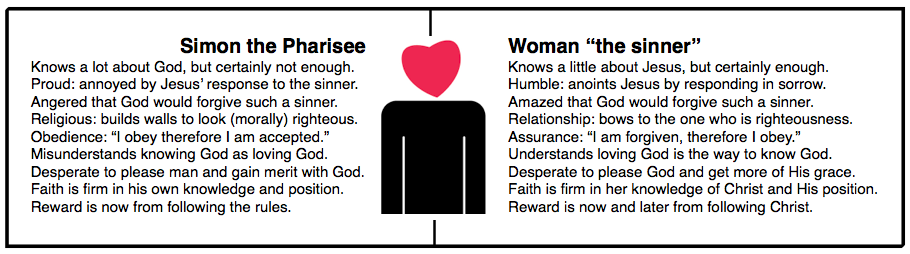
1. Am I like Simon the Pharisee? He’s got a lot knowledge of God, but no intimacy [Luke 7:36].

In Luke 7, Jesus is invited over for dinner by a Pharisee named Simon [v.36]. Ironically, Simon invited Jesus over just after He scolded the Pharisees for not accepting either John or Himself. And the Pharisees just accused Him of being a party boy with the tax collectors and sinners [7:34]. But Jesus didn’t play favorites. He accepted dinner invitations from the Pharisees too, without asking about their motives [cf. 11:37; 14:1].

What is a Pharisees? In the Bible, they are a group of Jewish religious leaders. In its title, Pharisee, means, “separated ones.”  They built ‘fence laws’ (traditions) around God’s law to help them keep God’s law and to protect their personal image so that they appeared holy and separate from the sinful world. They hung holiness around their neck like Mt. T wore gold chains. Their fence laws were often stricter than God’s law. They were good law keepers and made sure others saw it. Their fence was painted and polished on the outside, but inside it would not meet any inspection codes. Pride and hypocrisy are the failures of fence law’s. They knew a lot about God, but they really didn’t know Him. In Matthew 15:8. Jesus describes the Pharisees as “people who honor Me with their lips, but their hearts are far from Me.”

Simon invitation to have the traveling rabbi over for a meal would have been considered a religious brownie point. Jesus should have been considered the guest of honor. In the Middle East during those days there were certain rules of etiquette. First, a customary greeting would be given of a kiss on the cheek or hand. To neglect the kiss of greeting would be like having a person come into your home and not saying, “Hello!” or shaking their hand. Second, in a shoeless culture, the washing of feet was mandatory before meals. Normally the host or his servant would wash the feet or at the very least they would give water to the guests to wash their own feet. Third, for an especially distinguished guest, some (inexpensive) olive oil was given for anointing their head.

When Jesus comes to the house of Simon, there is no kiss (greeting), no washing of feet, and no oil for his head. The reason is not certain why Simon did not do these courteous gestures. But from Jesus’ words later on, Simon didn’t really know Him. If Simon really knew who He was he would have honored Jesus more extravagantly.

It’s not that Simon did not know God. He knew a lot about God. As a Pharisee, he spent his life studying the Scriptures. By the age of 12 he had memorized the first 12 books of the Bible. He would squash the kids in your AWANA ministry! By the age of 15 he had memorized the entire Old Testament. Sadly, he committed to memory more than 300 OT prophecies about the coming Messiah, yet he didn’t even realize it is the Messiah who sat at his dinner table. He knew about Jesus, but he didn’t know Jesus.
He’s all knowledge, but no intimacy.

When I graduated from Bible College I had quite the chip on my shoulder. I read the Bible backwards and forwards many times for class. The Bible became a textbook. I knew enough Greek and Hebrew to look smart. I knew the Bible, but my head was the size of a hot air balloon and it was filled with pride. God used a lot of patient people in my first ministry to chisel away at my pride. And it’s still a temptation.

Pharisees often confused knowing God for loving God. In church, it is easy to get this confused too. We build systems that cater towards knowing about God, but not necessarily loving God. We have endless Bible studies with workbook and Bible curriculum with homework. Sermons notes with fill in the blanks. If you grew up in the church, you probably go to Sunday school, where you have a teacher. In the summer the kids may go to Vacation Bible school. All these programs help you know, but not always love God.

Hear me out (before you throw stones); I wholeheartedly encourage studying, teaching, and preaching God’s Word. It is a biblical mandate. It’s my calling. Even our example, Jesus, read and quoted Scripture as proof that He knew God’s Word. The problem isn’t knowledge. The problem is that you can have knowledge without having intimacy. In fact, knowledge can be a false indicator of intimacy. Obviously where there is intimacy there should be a growing knowledge of God, but too often there is knowledge without a growing intimacy.

Think about it this way, the proof that I love my wife is how much I know her. I know what kind of deodorant she uses. I know her favorite kind of Thai food. I know what makes her laugh or cry. So knowledge is part of intimacy, but just because there is knowledge doesn’t mean there is intimacy.
Probably the best biblical word for intimacy is the word “know.” But this knowing goes much deeper than knowledge. The Bible first uses this word to describe a relationship in Genesis 4:1, “Adam knew Eve his wife.” The Hebrew word for “knew” here is the word yada, which means ‘to know completely and to be completely known.’ Unabashedly, Genesis 4:1 is an intimate moment between a husband and wife. It’s a beautiful picture to help see what it really means to know God.

In Psalm 139, David uses this word yada to describe how God knows us, “O Lord, you have searched me and known me! You know when I sit down and when I rise up; you discern my thoughts from afar. You search out my path and my lying down and are acquainted with all my ways. Even before a word is on my tongue, behold, O Lord, you know it altogether. You hem me in, behind and before, and lay your hand upon me. Such knowledge is too wonderful for me; it is high; I cannot attain it.”

So the word used to describe a husband and wife is also used to describe how God knows you and wants to be known by you. This changes the way I think about knowing God. He’s not interested in a let’s-just-be-friends relationship; a noncommittal dating relationship; or a relationship where you define the terms; He is seeking the kind of commitment and intimacy best illustrated in a marriage relationship. Do you just know about Jesus or do you really know Him? Are you like Simon the Pharisee? He’s got a lot of knowledge of God, but no intimacy

2. Am I like the woman?  She’s got little knowledge of Jesus and lot’s of love [Luke 7:37-38].

While Jesus is eating at Simon’s house a woman comes on the scene. She comes uninvited. To better comprehend the awkwardness of this moment, you must understand that she wasn’t just any woman. She’s “a woman of the city, who was a sinner.” [vs.37] Her reputation negatively precedes her. She’s done bad things that have damaged her reputation. Maybe she slept with her boyfriend, cheated on her husband, is in a same-sex relationship, or was a prostitute in the small town.

We are uncertain the specifics that drew her to Jesus. But in desperation she came to Him at Simon’s dinner party—a dinner she would never be invited to attend nor would she have interest in attending anyways. As she wandered in she felt the condemning glares from “holy men”. Nervous as she might be, she brushes off the glares and stares at Jesus.

Apparently she had heard Jesus teaching, maybe earlier that day. What about Jesus teaching made such an impact? Was it forgiveness? Perhaps while listening to Jesus she thought, “Can He really forgive my shameful past?” Was it redemption? Maybe as Jesus spoke she realized that only He could put back together the broken pieces of her life and make her whole. Was it love? Maybe she wondered, “Certainly Jesus knows how messed up I am; how the guilt of my sin stains me so deeply. Could He love me too?”

What she does next is impulsive, extravagant, and culturally unthinkable, especially to someone who did not know Jesus [v.38]. Can you feel the tension? The woman approaches the dinner table and stands at the feet of Jesus. The table is silent. Everybody is watching. Everybody knows who she is. They are thinking, “What is she doing here?” She looks around at the guests. She gets glares of judgment. She looks at Jesus. He looks at her. She looks to Him in faith seeking forgiveness for her shame. He looks back with a loving smile. She says nothing. Nothing needs to be said.

She is so overwhelmed, tears of repentance rain down. She falls and begins to kiss Jesus’ feet. Her tears begin to drip onto the dirty feet of Jesus. She sees the muddy streaks and suddenly realizes that His feet haven’t been washed. She can’t ask for a towel, so she lets down her hair. The dinner guests gasp out loud at her disgrace. Then she takes a costly alabaster jar of ointment. Perhaps in the past she used it drop-by-drop for many men. But now she empties it. She will not need it anymore. She pours out, her life, on His feet, and she kisses them over and over.

The woman does a gutsy and glorious thing, all at the same time. She faced her sin. Rather than running from it she runs to the only one who can forgive her. She is broken, grieved, and repentant. Her offering of worship is a sweet smelling aroma. In a moment, she moved from a life of shame to a member of the Fellowship of the Unashamed.

When is the last time you had a moment with Jesus like this woman? Repentant? Broken? Honest before God? When’s the last time you’ve poured yourself out before Him? When is the last time the shed tears over your sin and shame? When is the last time you demonstrated unashamed and extravagant worship?
Can you relate to this woman?

This sinful woman is a mentor to us all of a repentant heart and worshipful response towards Jesus. Unlike the Pharisee, who loves himself too much, she sees herself for who she is—a sinner needing forgiveness. Do you remember who you were before Christ? Do you see the seriousness of your sin? The closer I get to Jesus, the more sinful I recognize myself as being. I am the Pharisee when I forget I am like the woman. The woman didn’t know a lot about Jesus, but she knew He could forgive her sins. She didn’t love a bunch of things about Jesus. She really loved Him. Proof of her love was over-the-top worship. Do you love things about Jesus or do you really love Him?

3. Am I like Jesus? He’s got unbiased love and unconditional forgiveness [Luke 7:39-50].

It is easy to look at the two characters of the story and say, “I definitely don’t want to just know God like the Pharisee. I want to love God like the woman.” But you can assume or zoom by the third character in the story—He’s most important. His name is Jesus. He is the main character of not just this story but also the Bible. He is the one you most need to emulate. “Therefore be imitators of God, as beloved children. And walk in love, as Christ loved us and gave himself up for us, a fragrant offering and sacrifice to God.” [Ephesians 5:1-2]

Notice how Jesus responds to Simon’s statement whispered under his breath [v.39 “If Jesus were a prophet He would know what kind of woman this sinner she is]. Jesus doesn’t blast him out of his boots by saying, “I heard that! Why would you say such a stupid thing, Simon! How dare you judge me? I am the Judge here.” No. But He doesn’t ignore Simon either. Listen to the tenderness in His voice: “Simon, I have something to say to you…” [v.40] In answer to Simon’s statement, Jesus uses His prophetic powers to read Simon’s heart. He told him a short parable. It is one of the smallest parables of Jesus (only two verses long), but it is hugely significant [vs.41-42].

In summary, a banker loans money to two men, one receives two year’s wages and the other receives two month’s wages. Neither man can pay back the banker. Unexpectedly, the banker shows grace and removes the debts from both their records. When each man should be bankrupt and file chapter 7 they are given a new start to life. Obviously, both gain new affection for the banker. But Jesus asks a crucial question, “Which man loved the banker the most?” Simon being no intellectual slouch has a ready answer [v.43]: “the one with the larger debt.” And Jesus acknowledged Simon has the right answer as a religious person would, but it did not mean he saw he was the one with the small debt.

Jesus’ story is not just for Simon, but it’s for all the ears at Simon’s table (including you and me). What is your place in the parable or Simon’s table? How would you respond to Jesus’ story? Would you sit beside Jesus and acknowledge only a small debt, or would you fall down at His feet and, in tears, begging for the forgiveness you do not deserve?

Now Jesus is ready to make His point [vs.44-47], “Do you (even) see this woman?” Jesus did not dispute the woman’s condition. They both agreed she was sinful. That’s not the point. The point: how acceptable is she before God? Simon is disgusted with her. He is also inhospitable with Jesus. But Jesus lets her touch, kiss, and wash His feet. Why? She loved much. She was a human in need of divine grace. She needed what only Jesus had to give—forgiveness and salvation. Ignoring any reply or reaction from Simon, Jesus spoke to the woman, “Your sins are forgiven.” [v.48]

Can you hear the dinner party guests gasp again? They began chattering around the table, “How could He forgive sins? That is God’s job. Who does this man Jesus claim to be?” [v.49] Precisely! God. As God, He can forgive. And Jesus’ words here are ultimately what get Him hung on the cross by religious people, like Simon. Again Jesus ignores them, and focuses solely on the woman, “Go on without worry. Live a new life. Your faith has saved you.” [v.50]

Jesus’ words are an invitation to Simon, and us all, to open our eyes to people around us who have been marginalized or ostracized. Before this moment, Simon failed to really see anything at all; he saw neither Jesus nor the woman. He was blind to her act of repentance and love. He only saw her sin. We don’t know if Simon changes. But we do know Jesus loves Simon as much as He loves the woman. He longs for Simon to see her not as a category (sinner) but as a person who, above all else, needs God’s love and forgiveness, “He who is forgiven little, loves little.”

The question of this text remains still remains, who am I most like? Simon? The woman? Jesus? The Pharisee and the woman are both sinners on opposite extremes of the pendulum. And Jesus gives them both what they need. The Pharisee needed truth in love. The woman needed forgiveness and assurance of His love. Jesus’ call to faith reaches out to people society deems as despicable (even the rapist, molester, cereal killer, stripper, or terrorist). But the church, unlike society, must show the sinner the way to Jesus and show His forgiveness and unconditional love. What can we do as a church or followers of Christ?

First, understand that faith often appears in the most unexpected places. It could be at your Sunday lunch and your waitress at Red Lobster, or the guy outside the bar, or the young pregnant gal walking to the clinic, or the uncomfortable and awkward outcast sitting in the pew near you. Let God bring salvation the way He chooses to the people He chooses. God can transform the worst of sinners and the greatest of the religious [cf. 8:1-3].

Second, beware of religious taboos such as never associating with sinners or shooing them away from the church. Yes, there is a place for protecting your church from false teachers, confronting sin, and “being in the world, but not of the world.” But how will they know unless you show love and forgiveness of the Light of the world? Our church creed must read: we are all equal in Christ who is our Head, though messy and sinful we are still His glorious Bride, everyone is welcome, for we are One in Him.

Third, cherish the truth that no one is worthy to receive what Jesus offers the woman. Know your place among the unworthy. What if God sent you a bill every month for your sin, what would you owe God? What would your debt be? Too much! Thank God, He sent Christ to forgive your debt. If you are in Him, He’s paid it all. Don’t you think that Jesus’ coming to earth, being obedient to the Father, even to the point of death on the cross is rather extravagant? My response is to pour out over-the-top gratitude. Be proud to be a member of the Fellowship of the Unashamed.

Fourth, believe Jesus alone has the power and authority to forgive sins and offer salvation. You can be the most religious or most sinful. The distance between you and God is repentance. Respond to Jesus in humble faith and accept His forgiveness and salvation. Today.

Is it better to know Jesus or love Jesus? It is best to know and love Jesus from your head all the way to your heart. Jesus said when asked by a Pharisee the greatest commandment, “Love the Lord your God with all your heart and with all your soul and with all your mind.’ This is the first and greatest commandment. And the second is like it: ‘Love your neighbor as yourself.’ All the Law and the Prophets hang on these two commandments.” [Matthew 22:37-40]

the God who speaks

The first information we have about God is obvious, God is [Genesis 1:1]. There is not a long argument, just a statement of fact, “In the beginning, GOD.” He is. God exists as He is. He always was and is. God simply is.

Shortly after God’s statement of existence we hear from God Himself, “Let there be light” [Genesis 1:3a]. God speaks. God speaks His creation into existence with the power of His words. God said and it was. He speaks first.

God is verbal. He is a God of language. God uses language to communication with His creation. It is clear that God uniquely gave language for mankind. Since God spoke we can understand Him, relate to Him, and plainly know is purposes for man. But what God intended to be a beautiful expression of His character man abused. Instead of praising their Creator with their lips, man curses Him with their lips.

But God in His creative redemptive plan entered our soil as the Word in flesh [John 1:1]—Jesus—God with skin on. If we want to see and hear what God is like, look at Jesus. When Jesus’ ministry began God spoke from the heavens, “This is my son in who I am well pleased.” [Matthew 3:17; 17:5] Jesus said, “I am the Light of the world. Whoever follows me will not walk in darkness, but will have the light of life.” [John 8:12] With words He was mocked, scoffed, scorned, and slandered, but from the cross with three simple words He redeemed sinful man, “It is finished.” [John 19:30]

All this is written about in the Word of God—the Bible. From the beginning to end the Bible records the written words and spoken words of God. It opens with “and God said” and closes with “I, Jesus have sent my angel to give you this testimony for the churches.” [Revelation 22:16]

Stop to reflect on the wonder of having a God who speaks—not just a distant deity who thunders orders from heaven, but one who actually wants to speak with you! Why would the God of all creation go to such lengths to communicate personally with each of us?

In our wordy world, it’s easy to take for granted the invaluable privilege of communication with God. If we are too busy or distracted to hear, His voice will not stop—but we’ll miss out on the riches of an intimate relationship available only to those with receptive ears.

If God has speaks then your highest aim must be to hear what He has said. You can hear Him today through His Word by His Spirit. Be still and listen.

Father, anoint my lips with praise. Use my words as an anthem of worship. Use me as a light to the nations drawing the darkened to the glory of Christ. I anticipate the day when I will gather before your throne hearing your beautiful voice and the voices of redeemed from every tribe and language and people and nation, praising your name.