unstoppable

Have you ever sung a song dozens of times in church it became old? Or sung a song enough to forget the meaning of the song because you are too familiar with the lyrics? Today I was singing a song I’ve sung many times before, but became enraptured by on of the words in the song. The word was unstoppable. It stuck and pierced me to the soul. The object of the song is a beautiful lover. Not any ordinary lover, but a Lover who defines and exemplifies love.

There is no one like our God. Many have come to the realization that God is God and we are not. Moses warned [Exodus 8:10], Hannah prayed [1 Samuel 2:2], David worshiped [1 Chronicles 17:20; Psalm 86:8], Asa reformed [2 Chronicles 14:11], and Jeremiah challenged [10:6-7]. That is why people consider who God is they tend to use absolute terms to describe Him.

He is indescribable, incomparable, unchangeable, uncontainable, unshakeable, and utterly unstoppable. God is as passionately romantic and relentlessly pursues you with His love for His Creation. He bears patiently with tireless compassion despite the ways you ignore His love or neglect to show love for Him. The greatest example of His love is when His Son came down from Heaven as a human to die in my place [Romans 5:8], bearing my wrath, taking my shame, and giving me a new name.

God’s like a freight train with no brakes. He has more compassion than I could ever imagine or comprehend barreling down on us. Whether you acknowledge it now or later. Sooner or later all will know who is greater. His name is above every name, and at His name every knee will bow [Philippians 2:9-11]. There is no like Him. He is unstoppable.

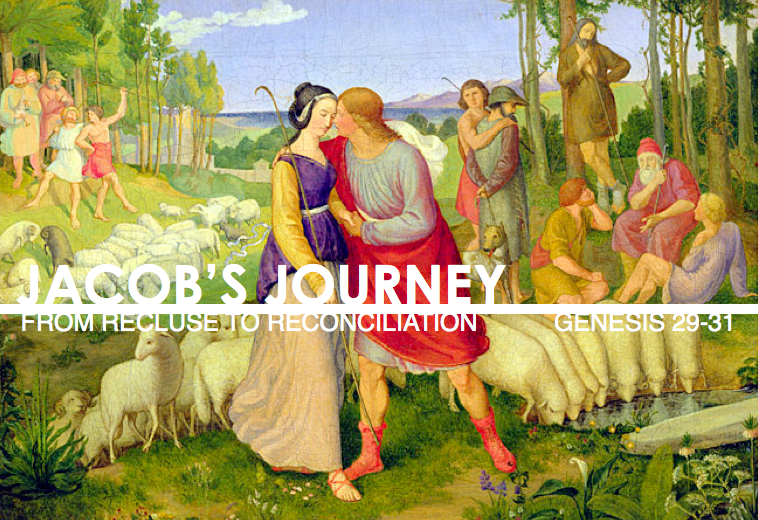
Jacob’s Journey—from recluse to reconciliation [part 1]

Jacob is not the poster child for godly examples to emulate. He is 70 years old, single, jobless, a total momma’s boy, and is now homeless on the run from his brother because he ripped off his birthright and father’s deathbed blessing. Jacob is literally between a rock and a hard place, but mostly from his own trickster tactics. The only glimmer of hope is a dream he is given from God on his first night alone away from the comforts of home. In the dream, God passes the torch of covenant promises given to Abraham and Isaac to Jacob and also promises to be with him until he comes back to the Promised Land.

Today we are going to walk in Jacob’s sandals and see how he moves from being a recluse to reconciling with his brother. Jacob’s journey is Hollywood script or screenplay material. His story is full of adventure, romance, drama, and with twists and turns has sort of a happy ending. We begin immediately following Jacob’s dream as he enters the land of Laban, his uncle [Rebekah’s brother].

Sowing and Reaping: Jacob—the trickster—gets tricked into marrying two sisters [Genesis 29:1-20]

As Jacob arrives at Laban’s sheep farm, he gets a glimpse of the beautiful bombshell, named Rachel [which just so happens to be Jacob’s first cousin]. Immediate Jacob gets to work to impress this gal. Since, Jacob comes to Laban empty handed he is asked to work. In exchange, Jacob bargains for a bride—the beautiful Rachel [meaning lamb/ewe].

Now Rachel had an older sister, named Leah [meaning wild-cow]. She had a crazy lazy eye. Both girls were unmarried probably because Leah was not much of a looker. And Jacob, like all the other guys in town, wanted to marry red-hot Rachel. Laban made Jacob work for seven years to earn the right to marry Rachel. And in one of the most romantic verses of Scripture, “Jacob served seven years for Rachel, and they seemed to him but a few days because of the love he had for her.” Isn’t that so sweet and sappy?

Ironically, Jacob reaps what he sows [cf. Galatians 6:7-8]. After tricking his brother Esau he seems to think his life is prospering: he has escaped the hand of his brother, God promises to bless him, and he is about to marry the woman of his dreams. The big day arrives and Laban throws a wedding feast. Obviously, Jacob has a few too many glasses of wine at the wedding to notice that Laban pulled a switcheroo and gives away Leah rather than Rachel. The next morning when Jacob rolls over in bed he stares into the wandering eyes of his new wife Leah. I can only imagine Leah smiling at Jacob with a crooked buck-toothed grin.

Jacob confronts Laban deceptive plan, but Laban gives a lame yet legitimate reason, “It is customary for the oldest child to be provided for before the younger.” Though true, it is still a low blow. Jacob, the persevering romantic, loved Rachel so much that he was will to work seven more years for Laban. God is using Laban to chisel at Jacob’s character. When Jacob finally works fourteen years to marry Rachel he expresses his love for her over Leah. This begins another sad story of favoritism that will rip apart this family.

A Family Fiasco: 12-Tribes of Israel are Born [Genesis 29:31-30:24]

Jacob gets what he wants—Rachel, but as soon as he marries her God closes her womb. Like Jacob’s mother and grandmother, Rachel is barren. Since, Rachel is barren, Leah sees this as her gateway to Jacob heart. Leah gets pregnant, all the while hoping, Jacob would finally love her because she would make her hubby a daddy. It did not quite work out as she planned. Three baby boys later she was sure Jacob would fall for her. Yet Jacob had no love for Leah. She has four-and-no-more until she gives praise to God. It took four pregnancies for God to finally get a hold of Leah’s heart.

Rachel, like any sibling wants babies too. She sees her sister and becomes jealous. So in an overdramatic outburst she demands Jacob, “Give me children or I shall die.”[1] Jacob responds in anger that it is God whom controls her womb. Could Jacob be growing in his faith? I think not! For immediately, like Sarah giving her servant Hagar to bear child, Rachel gives her servant Bilhah to Jacob. It does not look like Jacob is trusting God as his father Isaac did by turning to God in prayer. Rachel also takes matters into her own hands and Jacob did nothing about it. In fact, he went along with the adulterous sin. Rachel’s servant Bilhah gives birth to two boys, Dan [meaning judge] and Naphtali [meaning wrestle]. Their names are fit to Rachel’s sibling jealousy and lack of trust in God.

Not to be outwitted, outplayed or outsinned Leah in turn gives Jacob her servant Zilpah to sleep with. Leah brags about it when Zilbah who gives birth two boys and names them Gad [meaning luck] and Asher [meaning happy]. Leah, like Rachel, forgets to see that the blessing of children is from God. Doesn’t this family seem a little redneck? They would more accurately be dubbed, rebellious. The story gets stranger as Jacob’s firstborn son Reuben finds some mandrakes [an herbal aphrodisiac]. He gives them to his mother Leah. Rachel is a freak for mandrakes and she trades bedtime with Jacob to Leah—paying her as like a prostitute. Jacob-the-pimp doesn’t question the ethics of his wives and sleeps with Leah. She gives birth to two more sons, Issachar [meaning hire/wages] and Zebulun [meaning honor].

Somehow Leah resorts back to having babies out of jealousy—always a bad idea. And somewhere Rachel prays to God, He graciously answers, opens her dead womb, and gives her a son. They name him Joseph [meaning may he add]. Joseph was the youngest boy until Rachel later had Benjamin [cf. 35:18]. Add up all the boys from four momma’s and Jacob is the proud papa to a bakers dozen—12 boys + 1 girl, Dinah.

Through this dysfunctional, jealousy-ridden, polygamist family, God would safeguard His covenant in Jacob’s sons. This family would become the initial branches of the twelve tribes of Israel through whom Jesus would be born and heal the human sin problem, which was so evident in Jacob’s family. By God’s grace alone He saves this family from themselves. Revelation 21:1-14 reveals how these twelve sons who came from the four conniving women in Genesis will mark the gates of heaven where Jesus is awaiting those He has also saved by His grace.

It Never Fails: God keeps His promises [Genesis 30:25-31:55]

According to Jacob, it was about time to move out on his own. He is 90 years old, has two wives, and twelve children from four different women. What his mother thought might be a few day flee from Esau ended up being twenty years working for free for Laban [his father-in-law]. He built for Laban a sizeable ranch that pulled in some fat-cash.

Through demonic divination Laban learns that he has been blessed with wealth and power because Jacob has the covenant blessing of God upon him. Jacob desires to return home to the Promised Land to his father Isaac, however, Laban like a crooked used car salesman seeks to keep Jacob around the ranch by offering to finally pay him a reasonable salary. Jacob, like his father [Isaac] and grandfather [Abraham] rejects the gift and entrusts himself to God in faith. God honors Jacob’s faith and makes him a very wealthy man. Though it may seem like Jacob is taking advantage of Laban the truth is God is making right a wrong by giving Jacob what he earned during twenty years of faithful and fruitful labor for Laban.

God is big on keeping His promises. He has promised to be with Jacob and get him back to the Promised Land. God calls, “Return to the land of your fathers and to your kindred, and I will be with you.” [31:3; cf. 12:1] Jacob responds immediately in faith. His wives also respond in faith [note: Rachel steals the household idol]. Jacob loads up the kids in the camel caravan and leave Laban’s home in secret while he is out giving the sheep a haircut. They leave undercover possibly out of fear that Laban would come up with a sly way to keep Jacob working around the ranch.

When Laban finally found out that his daughters and grandchildren were gone he and his relatives pursued Jacob for seven days until they caught up with him. Ironically, the same Laban who tricked Jacob into marrying both of his daughters became rich because of God’s blessing upon Jacob. He cheated Jacob by changing his wages ten times and complained that Jacob had been deceptive with him. However, God protected Jacob by appearing to Laban in a dream and commanding him not to harm Jacob in any way. Laban only accuses Jacob of stealing his household idol, but he was unaware that his wife Rachel stole them and was sitting on them.

Jacob honors God by praising Him for all blessing he and Laban have received [31:42]. Then Jacob and Laban shake hands and agree Jacob will take no more wives. They built a monument to remember the covenant. Laban kisses his daughters and grandchildren goodbye and the men part—Laban went back home and Jacob to his old home in the Promised Land. This set the stage for a story for Jacob to meet his brother Esau for the first time in twenty years [come back next week to find out what happens].


[1] These words would later proved to be prophetic and tragic; Genesis 35:16-19.

Jacob’s Dream

The story of Jacob’s ladder is well known by many who do not know the Bible. Jacob is depicted in song lyrics from Led Zeppelin to U2 to Rush to Huey Lewis and the News. Jacob is also a topic for motivational speakers communicating ones ability to climb the ladder of personal success because “the skies the limit”. The story of Jacob’s ladder has taken on varying shades of meaning and interpretation, which are a stretch from its original biblical context.

The story of Jacob’s ladder dream appears at the beginning of Jacob’s narrative. Jacob had just deceived his twin brother Esau by ripping off his birthright and lying to get his father’s deathbed blessing. Therefore Esau is out to get Jacob’s head and see him dead. So Jacob flees the Promised Land and the momma’s boy who once loved staying home was now driven from his home. He becomes a fugitive from his family fearing his brother’s ferocious rage.

The tension in the story rises as Jacob comes to a certain place at the sunsets. He spends the night out in the elements alone. Without protection in an unknown place Jacob finds a sandy spot to sleep with a rock for his pillow. The tension continues to rises as he nods off to sleep and dreams a strange dream about a ladder that the angels of God ascend and descend upon. God comes to Jacob in a dramatic dream in the middle of the night. For the first time in his life, Jacob encounters God.

How in the world is God going work with this guy?

At this point in Genesis, the covenant promises of God have been applied to the less than perfect people—from Abraham to Isaac to sinfully deceptive Jacob who stole both the birthright and blessing from his older brother Esau. Jacob possesses the covenant blessing, but lacks faith-driven relationship with God like that of Isaac and Abraham. Jacob is not a God-pursuer [worshiper, believer]; he is a man-pleaser and self-gratifier. For the first time, Jacob is not living under the faith of his parents, but begins his own relationship with God.

So how does he go from Jacob to Israel? From trickster and deceiver to a worshiper of God? From a total goober to a godly guy? Jacob is probably in his 70s, still living with his parents, mom still washes his whitie-tighties, and has her pack his lunch box with PB & J. He’s totally a late bloomer with no wife, no job, allowed to underachieve, enjoys being spoiled, and has inconstant God-following parents.

The story climaxes as Jacob sees God in his dream. And no, it wasn’t a dose of spicy chili the night before. God speaks to him and promises to be everything that He was to Jacob’s dad [26:3-4] and grand-dad [12:2-3; 15:1-6]. The God of Abraham and Isaac will also be known as the God of Jacob. The Lord not only extends patriarchal promises [i.e. land, descendants, and blessing] but also adds a special promise—His presence—that the Lord will always be with him [and Israel] wherever he goes. The symbol of His presence is the ladder in his dream, which connects heaven with earth.

If I were Jacob, I would have wet my pants seeing God, especially after his sinful escapade. Jacob should have been cursed for all his sin, however God has grace on him and blesses him. In holy fear, Jacob awakes from his dream awed by the Lord. The change in Jacob’s heart turning toward God arises in his commitment to tithe to God as an act of worship to God [cf. 26:25]. Above all it is God who seeks out a covenant relationship with Jacob, which is the pattern continued for all believers throughout human history.

How do we get from Jacob to Jesus?

As Jacob leaves the Promised Land, God promise to be with Jacob wherever he goes. This is an important redemptive theme that progresses throughout the history of Israel to those who follow Jesus.

As Moses is called out of Egypt—leading the Hebrew people to the Promised Land—God promises His presence [Exodus 3:12; Deuteronomy 31:6]. He proves His presence with a pillar of clouds by day, a pillar of fire by night, and His glory in the tabernacle. As Joshua carries the torch of Moses and enters the Promised Land, God assures His presence [Joshua 1:5]. God promises His presence with Israelites kings [1 Kings 8:57]. And when Israel is cast int0 exile God promises His presence with His people [Isaiah 43:2; 41:10].

The culmination of the promise of God’s presence came when He was born as a babe with human skin and walked among His people. His name is Jesus. He is also known by the name, “Emmanuel,” which means, “God with us.” [Matthew 1:23; John 14:9-10; Colossians 2:9; cf. Isaiah 7:14]. After Jesus rises from the dead He promises His presence with His followers [Matthew 28:20; Hebrew 13:5] and His Spirit dwells in His people [Acts 2:33; 1 Corinthians 3:16; 6:19]. On the last day, when Jesus comes again, He promises to dwell with His people forever in the divine Promised Land of His eternal presence [Revelation 21:3].

The promise give to Jacob by God was fulfilled when God brings him back to Canaan, when God returns the Israelites from Egyptian slavery, and when God returns the remnant from exile in Babylon, but promise is ultimately fulfilled through Jesus Christ the Son of God. The ladder Jacob sees in his dream is a picture of God promise “to be with you.” God is not absent from His creation or His covenant people. He is intimately connected with His creation. The ladder represents His mediation between heaven and earth. Jesus even makes this correlation between the ladder and Himself [John 1:49-51]. Jesus is the mediator between heaven and earth—God and man [1 Timothy 2:5; John 14:6]. Jesus is the ladder; He is the connection between heaven and earth.

The purpose of Jacob’s strange ladder dream was to get his attention. Once God got his attention, He promised to be with Him always wherever he would go. That promise would ripple to His holy people [Israel] and also in the Scripture later to His church. The promise of God’s presence is one of the most precious and assuring promises of the Scripture. This promise is meant to be a source of comfort for all His followers. God knows that His people sometimes feel forsaken. However, remember as Jesus said, “I am with you always, to the end of the age.” [Matthew 28:20]

a bride for Isaac

Genesis 24:67 “Isaac brought her into the tent of his mother Sarah, and he married Rebekah. So she became his wife, and he loved her; and Isaac was comforted after his mother’s death.”

Genesis now begins to focus not just on the God of Abraham, but also the God of Isaac and Jacob as Jesus taught in Matthew 22:32. Genesis 24 tells us that Abraham was old and had been blessed by God in every way as God had promised. And to ensure that his son Isaac would marry a woman who would worship his God by faith Abraham sent his servant back to his home to find a wife for his son. Abraham did this trusting that the God who had blessed him would be faithful to now provide for Isaac by sending an angel ahead to arrange the details.

Abraham’s faithful servant did as he was told and went to the region of Abraham’s brother Nahor. Stopping at a spring the servant prayed for God to provide. Before he had finished his prayer God had already answered it, sending the lovely virgin Rebekah to the spring. Rebekah drew water for Nahor and his animals. When the servant inquired of her family she said her father was Nahor and that he was welcome to stay at their home. The servant was so overjoyed at God’s perfect provision that he bowed down and worshiped the Lord for answering his prayer.

Rebekah agreed to go with Abraham’s servant to be Isaac’s wife. Upon arriving at Abraham’s household Rebekah was brought into the former tent of Isaac’s mother Sarah and married her. Isaac and Rebekah’s marriage ends with the beautiful words that “he loved her” and she was such a fitting bride that he was comforted by her love after the death of his mother.

We learn a great deal about God from the Genesis 24 narrative. God does not speak, but is silent in the narrative. However, God’s unseen hand of providence moves the story along showing Himself to be faithful to Abraham and Isaac. God also answers prayer and can be trusted to provide even when he has not spoken but has been spoken to in prayer.

There are some great applications from the story of Genesis 24 that are truths to take home. I will praise God for his faithfulness and steadfast love [24:12, 27]. I will remember my future is in God’s hands. I will encourage young men to pray and wait for a godly brides and encourage them to listen to their parents wisdom. I will pray to God with sincerity believing He does provide and keep His promises. I will trust God even when life does not make sense. I will serve God and others with expedience and efficiency.

I remember when I was a single man praying for God to provide a godly wife. What a joy it is to wait for His timing and to pursue His will. The wait was long and hard, but it was well worth the wait!

Keys to Genesis 24: bless [1, 27, 31, 35, 48, 60], prosper the way [12, 21, 27, 42, 56]

Noah (Part 2): God is faithful through the flood

Without God’s grace on Noah and his family, you and I would not be here today. Remember, the reason God chose to save Noah is given in Genesis 6:8, “But Noah found favor [grace] in the eyes of the LORD.” Noah did not begin his life a blameless [6:9], righteous man [7:1], “walking with God,” but he began a sinner. The only difference between Noah and the other sinners who drowned in the flood was that God was gracious to Noah. God choose undeserving Noah to be an object of His grace. This is the first time in the grace appears in word form in the Bible.[1] God is so faithful to mankind despite their flagrant sin.

The time has come [Genesis 7:1-5]

God calls Noah to enter the ark. Final preparations from God arrive about the ark and the future flood. There are two very interesting items to note. First, God asks Noah to gather seven pairs of clean animals, and a pair of unclean animals. In God’s wisdom, the mixed genders of the animals give the ability for the animals to procreate after the flood, but what is the deal with the clean and unclean animals? At this point, there was no law [cf. Leviticus 11; Deuteronomy 14:3-12], nor any recorded conversation with Noah concerning the difference between pure and impure animals. In the context of the first chapters of Genesis, I tend to lean towards the belief that the distinction of clean and unclean animals was for the purpose of sacrifice. Sacrifice and worship were already a big part of God’s created order [cf. 3:21; 4:3-5; 9:20ff].

Second, God’s patience for man’s sin extended for 1600 years [Genesis 5], He allowed 120 years for people to repent [6:3], but no one did. The time has come and Noah has only one week to gather two of every kind of animal.[2] This is totally an impossible task for one family to accomplish on their own, unless they have divine help [cf. 7:16; 2:19]. And again, Noah obeys all that God commands Him to do [cf. 6:22]. God’s sovereign rule and His expectation for man’s obedience run parallel to each other. God requires Noah to build the ark—taking 120 years—possibly showing the diligence of Noah’s obedience.

Put your feet in Noah’s Nike’s [Genesis 7:6-24]

Noah builds a big boat in a desert, for 120 preaches with no one listening only mocking, and God gives him 7 days to gather all the animals of the field and air before the flood walls burst [note: water came from above and below]. The decree of God comes to pass just as He promised. His sovereignty is displayed in His wrath against sin.[3] This is one of the most sobering passages in all the Bible. The destruction was all encompassing and annihilating to every living thing on earth [7:19-23], except for what was in the ark of His grace. Doesn’t that sound like a great way to celebrate your 600th birthday? I am sure Noah was flooded with emotion.

What would you be thinking? Could you image what Noah and his family was thinking as the storm clouds move in, as he notices neighbors and friends working the field, as he hears the voices of children and mothers in their homes, as they stand in the ark during the flood? “What about the other people who do not get into the boat? Is it fair that they are out there and we are in here? Has God left us alone? Will this boat stand the strength of this storm? Will we ever be able to get out of this boat? Will we have enough food?” We do not know what they were thinking, maybe fear, doubt, or loneliness.

I remember as a child, I would hide from my mother in the clothing racks while shopping. She did not like that very much. One time we were in JC Penny’s and I thought it would be fun to hide extra hard and extra long. So I hid in the center of a tall rack of jean. I could hear my mother saying, “Justin, where are you? Come out this minute!” I waited until I couldn’t hear her anymore. I peaked out from the clothes and she was gone. I was alone. For a split second, I was excited because I lost her, but then I was filled with fear because I didn’t want to live in JC Penny’s the rest of my life. I loved my mom and didn’t want to lose her. I searched throughout the store yelling her name, but could not find her. Until I heard a voice from above say, “This is the costumer service counter. Would Justin Hutts please report to the service counter immediately.” The voice said it again. I ran to the front of the store. There was my mother with a look anger mixed with an embrace of grace.

God has already shown Himself faithful. He is in the storm. His sovereignty is displayed as He fills the ark, He shuts the door on time, and He unleashes the flood re-creating of all He created. Holding the boat afloat and by His grace filled it with 8 people and enough animals to replenish the earth. God’s progress of redemption again takes chaos and shows His absolute control. The same language in Genesis 7 is used in the initial act of creation [Genesis 1; Note: Creation and Re-creation Comparison chart].

God Remembers Noah [Genesis 8:1-19]

Even in the floods of judgment, when God seems most distant to our eyes, He is faithful to remember His own [8:1]. Noah is not forgotten. God gives Noah a glimmer of hope amidst the stormy seas. The word “remembrance” is found twice in this passage and only two other times in Genesis in relation to God and man.[4] This word is used primarily to speak of a covenant God makes with His people, thus recalling a promise made by God to sustain man.  In Exodus, this word used again, as God recalls the covenant relationship between Abraham and His children as they are living in Egypt [Exodus 2:24; 6:5]. This is the kind of remembrance that God has for Noah and his family in the ark. God is faithful in carrying out His plan and executing His promises to Noah [cf. 6:18].

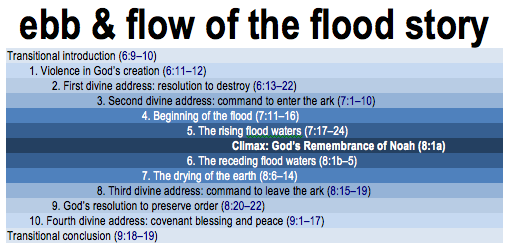
It only took forty days for the waters to rise and destroy the earth, but it took about 5 months for the waters reside.  What is Noah doing during this time? He patiently waits [8:10, 12]. How many of you would be willing to wait on God like Noah? How many of you when bad things happen with impatience plead with God for immediate relief? Noah simply waits. He waits for a word from God before leaving the ark [8:15, 18]. God speaks; Noah obeys. Noah knew God was at work. The rain stopped and the waters began to reside. Do you see the sovereignty and faithfulness of God at work? Do you see the rhythmic ebb and flow of the flood story?

In conclusion, the flood flexes the character of God as sovereign dealing with sin [death, Romans 3:23; 6:23], and faithful to His own through the flood. We are also confronted with the patience of God and how He is offended by sin. We are encouraged by Noah’s faithful obedience. Noah was particular, not partial, in following God’s instruction. ‘Cutting corners’ would mean the destruction of his family too. God expects lifelong obedience. Noah is an example to all of us not just of obedience but also the faithfulness of God in the midst of the fierce flood.

Questions for Reflections and Application: In light of Genesis 6:5-7 and 2 Peter 2:4-9 why did God send the flood? What does the flood reveal about the fate of those who continue in sin without repentance? According to Romans 3:21-28,  how is the Old Testament act of atonement ultimately applied to Jesus Christ? According to I John 4:7-21, how is Jesus’ atonement related to Gods love and ours?


[1] Later, Paul the apostle carries this word in his New Testament teaching on salvation ”by grace through faith alone”. Noah was a favored because God saved him by grace and he had faith in God alone.

[2] Is God just to send the flood? Yes. Why didn’t He give them more time? He gave them 1600 years, plus 120 years of warning, and 7 final days to turn. Why didn’t he send a preacher? He did. Noah preached for 120 years, but no one repented. He was the Billy Graham of his day. Why didn’t God let them sin? You would curse God for His injustice. Why didn’t God save them? He did. He had Noah build a boat. No matter all that God does to people still choose not to heed God.

[3] The flood was a day of judgment, which would be echoed in God’s prophets as they foretold the Day of the Lord,  “The prophets also appealed to the imagery of creation’s reversal to depict the day of the Lord’s judgment [i.e. Isaiah 24:18b; Jeremiah 4:23-26; Amos 7:4].” (cf. Bruce Waltke, Genesis: A Commentary. Zondervan, Grand Rapids, MI. 2001. 139.) This type of imagery is not seen until the end of time, which is prophesied in the Book of Revelation.

[4] Cf. 9:14-15; 19:29; 30:22; Exodus 2:24; 6:5; 32:13; 1 Samuel 1:19; Judges 16:28; Job 14:13; Psalm 8:4; 9:12; 74:1-3; 98:3; 105:8; 106:45; 111:5; Jeremiah 15:15.

Hell, Rob Bell, and reviews of the book Love Wins

There has been much stir over Rob Bell’s new book Love Wins: A Book about Heaven, Hell, and the Fate of Every Person Who Ever Lived. Bell will tell you he does not want to be labeled a universalist [check out Bell’s interview’s with MSNBC and Relevant], however his book seriously and dangerously advances the cause of universalism from a popular and influential level.

Yesterday, I perused Love Wins at a local bookstore because I was unsure I wanted to buy it. To say it simply, Bell promotes an unbiblical picture of a God without wrath and a skewed portray of His love and justice. He gives unclear indication that man needs salvation from God’s wrath now, nor faith in Jesus Christ in this life to have salvation in eternal life. Bell states his beliefs in heaven, hell, judgment, the cross, and salvation, but takes a quasi-philosophical approach rather than biblical approach to Jesus’ teaching on the subjects.

Bell historically likes to ask questions and create discussions, but again leaves you unsatisfied with answers and in this book leaves you with more questions about God, salvation, and His understanding of the authority of God’s Word. I am not one to bash people particularly other pastors, however, as a pastor it is my obligation to protect Christ’s church from potential false teaching that could distract His sheep. Rather than writing another review, I thought I’d pass along some great reviews already circling around from faithful followers of Christ and intricate exegetes of God’s Word.

Great Reviews of Rob Bell’s, Love Wins:

Great article on Hell:

Great Books on Hell:

your prayers prove you believe God is sovereign

People pray recognizing God’s sovereignty when they pray. When on your knees you know that you are not in control of the results of your prayers. Even if you deny God’s sovereignty and only embrace human responsibility, you still believe God is sovereign when you pray.

Here are three specific prayers followers of Christ pray that prove you believe God is sovereign:

1. You simply pray. Why do you pray? You pray because you either want something that you cannot have in your own strength or want to show your appreciation to God for what you have been given.

2. You give thanks to God for your salvation. You realize deep down that God is entirely responsible for the faith that drew you to your Savior.

3. You pray for the salvation of others. When you pray for the unsaved, you assume that it is God who brings them to faith.

Prayer, therefore proves that you believe God is sovereign. Indeed, God is in control and you pray because you know you are not.

If you want to know more about your prayers, the sovereignty of God, and evangelism read, J.I Packer, Evangelism and the Sovereignty of God. IVP Books, Downers Grove, IL. 1961.

the goodness of God

The Goodness of God

A book review of The Goodness of God by Randy Alcorn

Why is there pain and suffering in the world? Why would a good God allow such evil to transpire on His watch? These are difficult questions that have drawn people to God or repelled them from Him. These difficult questions have even sifted out Christians from among the ranks, “Evil and suffering have a way of exposing our inadequate theology. When affliction comes, a weak nominal Christian often discovers that his faith doesn’t account for it or prepare him for it.” [5]

In his book, The Goodness of God, Randy Alcorn practically, personally and biblically addresses common misunderstandings about why a good and sovereign would allow or permit suffering and evil to affect His creation. He points out the flawed thinking of many world views [i.e. relativism, buddhism, pantheism, atheism, dualism, open theism, gnosticism, etc.] that seek to diminish and deactivate God’s goodness in the face of pain and suffering in the world. Here are some of the questions covered in the book that aim to give you assurance in the midst of suffering.

If God is really good why is their evil?

Evil cannot exist without the good it opposes. It’s not so much the removal of good as it is the corruption of good. As metal does not need rust, but rust needs metal, so good doesn’t need evil, but evil needs good [10]. From the beginning God intended the permission of evil, but to turn it on its head and show His highest good in the midst of it. The ugliness of evil demonstrates the beauty of God’s goodness.

If God is good why all the suffering and pain?

Evil is the source of suffering. Suffering would not exist if there were no evil. With the Fall of man came suffering and pain as a righteous consequence man’s sinful disobedience. God allows and permits suffering and pain as part of His divine plan. Though God is not the causer of evil, but he is the author of the story that includes it [15].

If God is good why doesn’t he deal with evil?

He will. No evil will ever go unpunished [61]. Where is the justice? Sometimes God’s delay in our finite mind and time frame seems unjust, but “God delays justice not to make our lives miserable, but to make our lives possible.” [62] God’s delay is actually good, it allows for His grace to give us time to turn back to Him.

“Grace isn’t about God lowering His standards. It’s about God fulfilling those standards through the substitutionary suffering of Jesus Christ. Grace never ignores or violates truth. Grace gave what truth demanded: the ultimate sacrifice for our wickedness.” [24]

The problem is, “we want selective justice, not true justice. We cry out for justice when we really want vindication and special treatment–relief from injustice done against us, without being judged for injustices done by us. Since God is just, he cannot always give us the justice we want without also giving us the justice we deserve.” [62-62]

Our problem is further amplified because “we are utterly unqualified to assess how often we sin and how bad our sins are. Sin mean nothing to those who are riddled with it.” [85]

If God is good what is the purpose of evil?

Evil is never good, yet God can use any evil to accomplish good and sovereign purposes [34]. We would much rather have suffering and pain disappear and go away. However, is for our good and God’s working in us. What glorifies God is good for us [103],

“Suffering exposes idols in our lives. It uncovers our trust in God-substitutes and declare our need to transfer our trust to the only One who can bear its weight. We imagine God as our genie who comes to do our bidding. Suffering wakes us up to the fact that we serve Him, not He us.” [100]

In conclusion, there are more biblically satisfying answers to the questions above, which I did not mention along with encouraging and challenging stories of many who have walked through the fires of suffering and pain, but came through refined.

My only beef with the book is that it is too short. There is a practical solution. Get the bigger book. The Goodness of God is a snapshot of the panoramic taken from Randy Alcorn’s bigger treatise on the goodness of God in, If God is Good: Faith in the Midst of Suffering and Evil (2009, Eternal Perspective Ministries). The appetizer is a tasty teaser that makes you hunger for the main course.

the beginning word on God

The theme Genesis is God, “In the beginning, God.” The book is about God. All the books of the Bible are about God. All of history is about God. Everything is about God. Genesis is not exhaustive; it does not tell us everything about God. The book of Genesis covers about 2,000 years of human history. It covers as much history as all of the rest of the Bible combined.[1] Genesis is a selective telling of history by Moses. He gives the things that you need to know because they are most important and most related to our understanding of God. This leads you to what Genesis tells you about God.

The first information we have about God from Genesis is obvious:

God is [1:1]

There is not a long argument, just a statement of fact, “In the beginning, GOD.” He is. God exists as He is. He always was and is. God simply is.

However, God is not just simple, He is also complex. God is One [1:1, 26]. The Christian doctrine of the Trinity is that there is one God,[2] and this one God is three equal persons—Father, Son, and Spirit [cf. Isaiah 48:16; Matthew 3:16-17, 28:18-20]. Although Moses might have understood the Trinity concept completely because of progressive revelation, therefore, the rest of Scripture teaches that each member of the Trinity was involved in Creation: the Father created 9Psalm 19:1; Acts 17:28; 1 Corinthians 8:6], the Son created [John 1:1-3, 10, 14; Colossians 1:16-17], and the Spirit created [Genesis 1:2; Job 26:13].

God did not keep silent about His creation and plans with creation. God is a talker [1:3a]. God spoke His creation into existence with the power of His words. God said and it was. God created light, stars, planets, plants and animals all by saying so. He spoke to His creation and charged them on how to live. God is verbal. If God talks, you must listen.

God make everything [1:3-25]

The question is not often whether God created everything [Hebrews 11:3], rather how did He create everything. For the sake of time and space, I will not indulge in a scientific treatise of Genesis and creation. Yet I will give you a few thoughts to chew on. First, there are differences in opinion among Christians as to whether God created a young earth [7 literal days] or old earth [i.e. gap between Genesis 1:1 and 1:2]. There are tensions because in Genesis 1-2 there is a mixture of history and symbols. Second, there are even more differences in opinion in the claims of science. Scientists have wrestled with the origins of the universe and human kind for millennia’s [i.e. Darwinism, atheism, intelligent design, irreducible complexity, etc.]. The theories and hypothesis among scientists come in all shades of colors, sizes and textures.

Let it be known, Genesis is not a scientific textbook, but what Genesis does tell us is enough—God created everything. This must be clear or Genesis 2 and following do not make any sense. Galileo said it well, “The Bible is not preeminently concerned with telling us how the heavens go. The Bible is, instead, most concerned with telling us how to go to Heaven.”

When God made everything He made it good [1:25]. God openly says, “Let there be this, and let there be that,” not half-heartedness or with reckless speediness. He did not make cheap trinkets that would easily fall apart. He created everything good. In the beginning there was no need for a policeman, fireman, garbage man or handy man. Everything was created good—without death, defect, or decay.

God rests after making everything [2:1-3]

Why did God rest? Did He get tired from using all His creative juices? No God is limitless in His creative powers. He does not need a break because of tiredness or vacation from stress. He rested the seventh day because He knew in His infinite wisdom that His created man would need this as an example to live by. Man is a finite creature and needs to rest weekly in order to remain sane and Sabbath. Rest is something God models and makes for man. Rest is best for mankind.

God gets glory for His greatness

Every molecule, ameba, moth, mosquito, Madagascar hissing cockroach, muskrat, monkey, moose, mouse, mountain lion, manatee, and man were created to give back praise to their Creator. God made creation to glorify Himself [Psalm 19:1]. God made creation to pour forth His love [Psalm 136]. God made creation for Himself [Colossians 1:16]. God made creation to show you His attributes [Romans 1:20]. And God made creation to worship Him [Revelation 4:11]. Everything was made by God and for God. Only “the fool says in his heart, ‘There is no God.’” [Psalm 14:1]


[1] Just Genesis 2, 3, 4, and 5, alone covers 1,656 years in a couple chapters.

[2] Cf. Deuteronomy 6:4; 2 Chronicles 15:3; Jeremiah 10:10; John 17:3; 1 Thessalonians 1:9; 1 John 5:20-21

Temple Grandin and God’s view of disabilities

Sarah and I watched Temple Grandin. I would highly recommend you seeing it too. The movie is based on the life of Temple Grandin a child born in an era when people with mental or physical disabilities were institutionalized. The story traces the hard work of raising Temple to use her “different, but not lesser” brain that sees in pictures for extraordinary things. Her autism did not stop her from learning, overcoming challenges, and excelling in education. She has become an innovator in the farming industry and a spokeswoman from autism.

It is amazing how God hardwired our brains and bodies! However, this begs a good question: Is God in control of mental and physical disabilities? In short, yes He is. He tells us: “Who has made man’s mouth? Who makes him mute, or deaf, or seeing, or blind? Is it not I, the Lord?” [Exodus 4:11] In Jesus’ ministry to a blind man He says to His followers, “It was not that this man sinned, or his parents, but that the works of God might be displayed in him.” [John 9:1-3] God intends our disabilities both for His glory and for our good.

My sister Samm was born with Spina-Bifida. I remember as a young teen visiting the Children’s Hospital of Milwaukee and spending long weekends at the Ronald MacDonald House wondering what the fate of my little sister would be. I am certainly glad that my mom and step-dad said “no” to the recommendation of abortion. Instead they sacrificed much to raise a wonderful and beautiful woman who has championed through her disability. If you would talk to my sister, you would not hear one who is weakened because she is in wheels, but one who strengthens all around her through her determination to use her disability as a platform for good. We are incredibly proud of the woman she is becoming.

I came across this rendering of Psalm 139:13-16 that adds description of what it really means to believe that God is sovereign over disability:

For you formed my inward parts with Down syndrome;
you knitted me together in my mother’s womb without eyes.
I praise you, for I am fearfully and wonderfully made with cognitive challenges.
Wonderful are your works in creating me without limbs;
my soul knows it very well though my ears will never hear a sound.
My frame was not hidden from you as you made me with Apert syndrome,
when I was being made in secret with autism,
intricately woven in the depths of the earth without Hexosaminidase A.
Your eyes saw my unformed substance with spina bifida;
in your book were written, every one of them,
the days that were formed for me with cerebral palsy,
when as yet there was none of them.

If you would like to learn more biblical and visual truth about God’s sovereignty and good in disability, check out Krista Horning’s new book Just the Way I Am, and watch this inspirational message by Joni Erickson Tada:

spreading the fame

It is unbelievable to think that there are hundreds of people groups around this planet that do not know the name of Jesus or bowed their knee to His name. Unreached people are all around you. They might be in your family, at your work, next door to your home, or even in your church.

In our nation you do not have as many unreached as you do have unengaged. Unengaged are people who do not hear or see a gospel. Instead, you see people busy building their names and kingdoms. Personal fame is the name of their game. However, what you observe from history is that it takes one to two generations before your name disappears and becomes forgotten. This land has acres of rectangle lots where people are buried, but few know anything about those 6 feet below those tombstones. What will be remembered about you 100 years from now? Where will you be 100 years from now? That’s what matters. There is One whose fame will last the test of time. Do you know Him?

In Psalm 145, we hear a majestic masterpiece. It is a song that is composed of beautiful Hebrew acrostic hidden to our English eyes.  This psalm is what is called a doxology. A doxology is praise based on doctrine—worshiping God from in spirit and truth. People praise God based on what they know about Him. What you can know about Him is revealed to you in His Word through His Spirit.

This is David’s last psalm recorded in the Book of Psalms. It is his crescendo of praise—his swan song. It is like that of a powerful rock ballad that hammers an explosive ending that just when you think it is coming to an end there is encore multiplied by encore. Praise [Heb.Hallel] means to radiate and shine—boast and brag. This is a song needs to be integrated in our souls and ringing in our ears. No matter where you are at today—discourage, overwhelmed, confused, bored, ready to worship—this song is for you.


Prelude [1-2]: David begins his song with a high and low. In the high David says to God, “I extol You, my God and King.” To extol means to lift high. It is to make God’s name the highest, greatest, best, most known and most famous. In the low he says, “Bless Your name” To bless [Heb. barak] means to make low—to literally bow the knee. It is an expression of humility to God’s authority. This reverent kneeling is not just a one-time deal. David says, “I will bless You everyday… forever and ever” Now not everyday is the same. Some days are harder than others. Some days have challenges. He says, “I will bless God no matter the circumstances.” The idea of praising God is to lift Him higher and bow me lower. This is worship. How do we spread the fame of God’s name? Note these 5 stanzas of praise to God:


Stanza 1: Greatness of God [3-7]. God’s greatness is seen in His power and authority. His greatness cannot be contained. His greatness is limitless and awe-inspiring. Even your greatest thought about God is puny compared His reality. He cannot be fully realized or comprehended. He boggles our minds. His greatness is unsearchable and indescribable [v.3]. Trying to comprehend Him is like floating on a raft in the middle of the ocean. You can not know its depth, width, breadth or height. So it is with God.

The greatness of God is spread by “One generation shall declare your mighty acts to another.” [v.4] Do you share what God has done in and through you? There is a mandate for parents in these verses—that parents would declare God’s mighty acts to their children. Do you tell your children about the great things God has done? This fires me up about being a parent. Tell and retell God’s great works. Don’t be the last link in your family. Pass the spiritual torch to the next generation. What is the greatest inheritance you can give to your children?

There are many ways we can declare God’s greatness. You can begin by declaring it to yourself [v.5]. Meditate means to ponder, to converse aloud with yourself, to remind yourself, to stir up your memory, to preach to yourself. The idea of meditation is to hear your own thoughts make statements about God. Take a moment to think about His greatness. What does David meditate upon? The “glorious splendor of God’s majesty.” [vs.6-7] He weighs in on the worthiness of God’s greatness. Do you need peace and comfort for your soul, counsel through a tough marriage, rough workweek or nagging sin issue? Meditate upon God’s great power and work.

The more I know about God the more I amazed that I do not know very much about God. Getting my Masters Degree taught me that I could spend the rest of my life just scratching the surface of God’s greatness. As I learn about God it cannot keep silent. The greatness of God is too exciting to keep secret. David needed to talk about God. It was on the tip of his tongue Does your conversation lead to God? If you were to map out your talk do they funnel towards God? This is the basis of our fellowship in this church. Our unity and community is in our talk about the greatness of God.


Stanza 2: Grace and Mercy of God [8-9]. These verses are a classic expression of praise for God’s character.[1] God’s grace is His favor that He gives to those who do not deserve it. His mercy is withholding of His wrath from those who do deserve it. He is patient with those who arouse His anger with their sin. He is loyal with a long-lasting love. God is a good King. He does not rule with dread to those who are in His kingdom and escape His wrath by the blood of His Son. God’s grace is not cheap little gifts from the dollar store, but priceless gifts poured out from a warehouse stocked full to the ceilings. In response, all of His works and all His people will praise Him [v.10].

Stanza 3: Sovereignty of God [10-13]. God is enthroned in the heavens and His kingdom remains forever. He rules over all things. He has the authority to do as He pleases. He has the power to carry out all He promises to do. Does that bring comfort to your soul? God is not a maverick. He is not random. He doesn’t second-guess Himself. He does not make mistakes. He holds all things together.

The sovereignty of God is key to evangelism. Since, God is your Creator that makes Him your absolute authority. You are responsible to Him. He owns you. Stop your rebellion and return to Jesus Christ. You will stand before Him as your King. That is the essence of the gospel.

Stanza 4: Faithfulness of God [14-16]. God is generous. God is a provider. He comforts those in need [v.14]. He nourishes the needs to those He has a covenant relationship [vs.15-16]. Considering the faithfulness of God can be the greatest counsel to your needy, broken, and empty spirit. He will fill your hand and satisfy the hunger in your soul. As I think about the people of North Africa and reaching them with the gospel I am overwhelmed by their physical needs. However, the gospel will provide them more satisfaction than drilling a well for fresh water, protecting from radicals, rapists and terrorists, or reforming nations with decent dictators who will care for their own people. The gospel changes somebody from the inside out, forever.

Stanza 5: Righteousness of God [17-20]. God is working all things together for your good and His glory [cf. Romans 8:28-29]. There are many people around the world that consider their current circumstances: sisters and mothers raped, families displaced by genocide, immense poverty and suffering at the hands of tyrants, “Is there any justice?” Does it seem like Satan is winning the war? In the Lord, justice is at home in His righteousness. Everything the Lord does is right [v.17]. His righteousness looks for your sincerity [18], your reverence [19], and your love [20] even in the face of worldly danger. God’s righteousness will deal with injustice.

Coda [21]: The coda is the final movement of a musical piece. The coda of David’s psalm answers the question: How do we spread the fame of God’s name? By proclaiming His praise to every person [v.21; cf. Revelation 5:6-10]. How will they believe if no one tells them?

So this is why our hearts are set the unreached. Why not stay in North America? Good question. The answer from Psalm 145 is simple; Have a passion for God and compassion to make the name of Jesus famous to the forgotten and unengaged peoples of the world. 100 years from now we will not be remember, but God’s name will still remain. Will they know Him?


[1] Cf. Exodus 34:6; Nehemiah 9:17; Psalm 86:15; 103:8; Joel 2:13; Jonah 4:2.

man is responsible to God

There are many different views about what God is like. He can be depicted as a nice old man upstairs or an ogre under the toll bridge. We often make God what we want Him to be like rather than who He really is. The God of the Bible is often different than the popular persona of Him. The way we—including many Christians—like to picture God is not the way God. What is God like to you? Here are some common views of God voiced by people today:

God is like a Grandpa. The grandpa-God is popular, forgiving, and a generous giver. Whenever we do something wrong he smiles and says, “It’s okay, I understand, don’t worry, I love you. Here’s some ice cream.” He is positive and reluctant to punish—sometimes forgetful. Grandpa God loves to spoil and send home his grandchildren satisfied.

God is like Santa Claus. Some think God is like a Cosmic Easter Bunny, Mr. Rogers, or jolly old St. Nick. “He sees you when your sleeping, He knows when your awake, He knows if you’ve been bad or good, so be good for goodness sake.” He likes to give lots of gifts; blessings to all good kids and coal to the bad kids. All we have to do is ask and He will give us whatever we desire, like a genie in a bottle. The problem with the Santa Claus God is that the older we get the harder it is to believe that He is real.

God is like my Buddy. Some think God is like a casual friend. We go together like milk and cookies or macaroni and cheese. We text and Facebook each other often, but it is nothing more than casual and fun conversation. We like to call on Him when we need a friend because he is non-judgmental and low-maintenance. He will look out for us, but doesn’t interfere with our personal business.

God is like an Unfair Judge. Some think God is commonly known as the overbearing, always anger judge. He wears a long flowing judicial robe and carries a gavel waiting to inflict punishment and pain on sinners. He keeps a list of our tardies and demerits. This God is overly involved in our daily lives and world events. He is angry at sin and rightfully punishes the unfaithful. Feeling guilty?

Is God like some of these characteristics? God is loving, forgiving, and blessing. He is a friend. He is just and angry at sin. God is very different—compared to you and than most popular concepts of Him. As we read through the Bible we see that God is not like us. We have already discussed that I believe the Bible is absolutely true, which includes what that Bible says about God. He is set apart. He is in a class of His own. He is not untouchable or unattainable; rather He is distinct in His divine attributes. Here is what the Bible says God is like and humanity’s responsibility to Him:

Man is responsible to God because He is an indefatigable Creator

In the first verse of the first book of the Bible it declares, “In the beginning God created the heavens and the earth.” [Genesis 1:1] Everything exists [i.e. mountains, mammals, microorganisms, Milky Way] because God is—including you and me [cf. Genesis 1:26-27]. God spoke and it was. The Bible says that the creation itself sings of it Creator, “The heavens declare Your glory” [Psalm 19:1; cf. Romans 1:19-20].

God is a beautiful Creator. As the Creator of the universe and everything He does not get tired, “Have you not known? Have you not heard? The everlasting God, the Lord, the Creator of the ends of the earth, neither faints nor is weary.” [Isaiah 40:28] It is true God rested the seventh day of creation not because He was tired, but as a model for His creation who is not omnipotent. As Creator, there is not a job God cannot handle, “Ah, Lord God! Behold, you have made the heavens and the earth by your great power and outstretched arm. There is nothing too hard for you.” [Jeremiah 32:17]. The affairs of seven billion people on this planet are not outside His job description either.

Now there are some people that argue, “So what if God made all that is and me? That doesn’t mean He is intimately involved in the affairs of His creation nor govern over it? Even if He is governing, He is not doing a very good job!” This is easily debunked when we look at the remainder of the Scripture that follows Genesis 1. From Genesis 2 through Revelation 22—even now—God is intimately involved in the lives of His people. God is alive and at work. Since He is my Creator and Originator, He owns me and expects me to obey.

Man is responsible to God because He is infinitely Holy

Not only is God a Creator—He is infinitely holy. In other words, God cannot sin. It is not that He doesn’t know the nature of sin; rather His holy character prevents Him from sinning. When getting a glimpse of God, Isaiah see angelic beings praising God saying, “Holy, holy, holy is the Lord of hosts; the whole earth is full of his glory!” [6:3] God is holy, which means He is sinless. When Isaiah saw God for who He was [holy], he also saw himself for who he was [unholy].

Since God is sinless He cannot be prejudiced [Acts 10:34-35]. He cannot break a promise [Psalm 89:34]. Therefore, He does not know of a sin He cannot not forgive nor think of a better plan of salvation than His own [Exodus 34:6-7]. God is who He says He is—perfect and infinitely holy. Since God is holy, He expects holiness from His creation. There is no sin in His heaven. Those whose sin is not covered by the blood of Christ will not be in heaven either.

God is not a garbage man throwing out our sinful trash without a cost and delivering to the local dump never to be recovered again. Our sin does have a severe cost: death [Romans 3:23]. Sin must be judged. Yet in God’s grace He sent Jesus Christ to pay the ransom for my sin and He stands as my advocate before the throne. When I commit my life to Christ His blood declares me, “Not guilty!” He loves righteousness and justice.

In Summary, what is God like? He is not like us. He is Creator and Holy. He is perfect and without sin. Since God is my holy Creator I am responsible to Him. He owns me. I report to Him. He is the standard by which I live by and will be judged. If you want to know about what God is like look at Jesus [Read the accounts of Matthew, Mark, Luke, and John]. Is this your God? Do you know Him?

no more ties for fathers please

Happy Fathers day. This is the day when we honor our dads by giving they ties, gift cards to Menards, and cooking them brats or steak on the grill. We are thankful for our dads. Dad’s have a huge influence over the lives of their kids. This year more than ever the reality of becoming a father is hitting home. With my wife approaching 5-months of pregnancy, I am thinking seriously about being a dad.

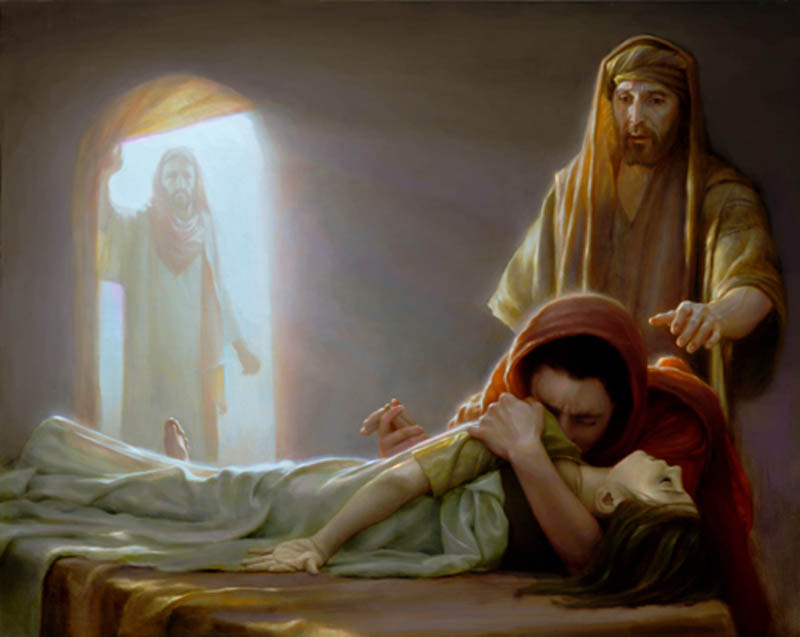
The name of the father in the story we are going to look at today is Jairus. He had quite the rap-sheet: he was a spiritual man being the “ruler of the synagogue.” He was a big cheese among the Jewish community. He possibly heard Jesus speak in the synagogue at Capernaum. But more importantly for this story he was a Dad.

We do not know the name of his daughter, but we do know that she was an only child (“only” cf.Jn.3:16), about 12 years old and was suffering a deadly illness. What do you suppose she saw in her dad? I wonder if she thought of him as being old-fashioned and out-of-touch like many today’s pre-teen daughters? I want to assume that she thought of her dad as a faithful man. What are the marks of a Faithful Father (Follower)?

Faithful fathers [followers] are not ashamed to worship Jesus [Luke 8:40-41]

“There came a man…and falling at Jesus feet.” Jairus approached Jesus during the day while many people were out and about [cf. this is opposite of Nicodemus who comes to Jesus in the middle of the night]. Jairus comes to Jesus because his daughter is sick. It is a hard thing for a father to see their children suffer. He approached Jesus without reservation and fell down at His feet [not out of exhaustion, but begging]. Matthew 9:18 “there came a certain ruler, and worshiped him” Notice: Jairus went himself. He did not send his wife, he didn’t send a servant, rather he went to Jesus Himself.

Oh, that dads would seek Jesus without shame. That they would take their priestly responsibility in the home. That they would seek Him without reservation. That they would seek Him boldly. A faithful father knows he has a faithful God.

Faithful fathers [followers] are not ashamed to invite Jesus to the house [Luke 8:41b-48]

“begged Him to come to his house.” Notice that the event that followed was “as He went,” the entire crowd followed on their way to Jairus’ house. Can you imagine that phone call? “Honey, everyone is coming over to the house.”

Oh, that God would give us Dads who would bring Jesus into the house. Men who would stand with Joshua and declare to the world, “as for me and my house, we will serve the Lord.” Men who would lead their families in prayer, speaking the truth of God’s Word, worshiping and living out their faith.

On the way to heal Jairus’ daughter, Jesus is touched by a woman suffering from a long-lived physical ailment that caused her to be ostracized by her community. According to Leviticus 15, she would have been labeled “unclean” and anyone who would touch her would also be unclean. In the crowd she rushed to Jesus, and believed that if she simply touched Jesus she would be healed. In that moment, Jesus stopped. He draws attention to the woman. She confesses. And Jesus comforts her by saying, “daughter,” (only time Jesus ever uses these words) “it was your faith alone that saved you.”

This parenthesis miracle was a tremendous lesson on faith for both the crowds and Jairus. Not only did Jesus’ healing of this woman stall the situation to heal Jairus’ daughter, but paved the way for His words. Jesus miracle now shifts from public to private. While Jesus was still speaking to the woman a messenger can to Jairus to let him know that his daughter died and not to bother coming home.

Faithful fathers [followers] are not ashamed to put the welfare of their child in the care of Jesus [Luke 8:49-56]

“Do not fear, only believe…” When Jairus received the news that his daughter was dead, he didn’t dismiss the Lord, rather he gave her into Jesus’ care. This reminiscent of Abraham’s willingness to sacrifice Isaac on the altar. Jesus’ response to the father, “Do not be afraid. Only believe.” [Note: aorist imperative tense, literally, act in belief, “trust me,” “hey you, have real faith!”] Jairus completely put his daughter in the hands of God’s care.

Faithful followers of Christ are not afraid. They completely entrust their children to God. Ungodly fears are directly linked to things we are thinking [Proverbs 4:23; Philippians 4:8). Oh that God would give us Dad’s who would commit their children into the hands of Christ.

As I think about being a father, I want to be a worshiper modeling a love for God to my children. I do not want to be ashamed to invite Jesus into our house. He is our special guest, always welcomed and honored. I also want to sacrificially give my children over to the care of their God who is ultimately their Creator and Sustainer.

God Is

Part 1 of 3 Why Worship Matters

We live in a culture [as others before us] willing to worship anyone and anything. We will pack arena’s to sing our favorite songs from our favorite band. We will be first in line at the movie theatre to see the next biggest summer blockbuster. We will pack sports stadiums and worship teams and players with loud cheers and waving our banners. Last December Sarah and I went to our first fridged Packer game at Lambeau Field. There was some worship going on that day! Later we thought, as great as the game was, “Heaven is going to be awesome!”

We are about all worship. It is not easy to define real worship in a culture that readily worships anyone or anything. Worship is about what we live for [who we are]. Every day, all day, everywhere you go, you worship. It’s what you do. It’s who you are. You can’t stop it or live without it. Worship is a way of life. It is a whole-life response to God’s greatness and glory. You are a worshipper before you are a father, mother, sister, brother, boss, employee or student. Worship is simply about value. Worship is our response to what we value most.

Why does worship matter? Why must worship matter to me? Why is it so important? Worship matters because GOD IS and His character demands my worship [Isaiah 6:1-3].

God is alive.

Isaiah says, “I saw the Lord.” Uzziah is dead, but God still lives. “From everlasting to everlasting, You are God” [Psalm 90:2]. God has no beginning or end. He does not depend anything or anyone to exist. God was alive when this universe banged into existence. He was alive when the Buddha and Muhammad walked the earth. He was alive when JFK was shot. He was alive when a tsunami sweep away Indonesia, and earthquakes rocked Haiti and Chile. He will be alive ten trillion ages from now when all the puny people in power are long forgotten. But not God, He always has been and always will be alive.

God is authoritative.

“I saw the Lord sitting upon a throne.” He is the Supreme Court, the Legislature, and the Chief Executive. Heaven is not coming apart at the seams. He holds it together. He sits on a throne. He rules with peace and control. He has authority over our lives even though we may never acknowledge Him.

God is omnipotent.

“I saw the Lord sitting upon a throne high and lifted up.” God’s throne is higher than every other throne signifies God’s superior power to exercise His authority. No opposing authority can nullify the decrees of God. What He purposes, He accomplishes. “My counsel shall stand, and I will accomplish all my purpose” [Isaiah 46:10].

God is majestic.

“I saw the Lord sitting upon a throne high and lifted up, and the train his robe filled the temple.” You have seen pictures of brides whose dresses are gathered around them covering the steps and the platform. What would the meaning be if the train filled the aisles and covered the seats and the stage, woven all of one piece? That God’s robe fills the entire heavenly temple means that he is a God of incomparable splendor and honor. His creative fullness spills over in excessive beauty. God loves to wow us.

God is revered.

“Above him stood the seraphim; each had six wings: with two he covered his face, and with two he covered his feet, and with two he flew.” No one knows what these strange six-winged creatures are [not some chubby winged angel babies], and they never appear again in the Bible. When one of them speaks, the foundations of the temple shake [v.4]. These are magnificent creature that most of us would be wowed by, but God wows them.

God is holy.

“And one called to another, ‘Holy, holy, holy is the Lord of hosts!” God is in a class by Himself. When asked for His name in Exodus 3:14, He said, “I am who I am.” What is God’s holiness? [Hebrew Qadesh, Greek Hagios, separate/different] 1 Samuel 2:2, “There is none holy like the Lord, there is none besides You.” Isaiah 40:25, “To whom then will you compare me, that I should be like him? says the Holy One.” Hosea 11:9, “I am God and not man, the Holy One in your midst.” And repeated throughout the Scripture is the theme: “YHWH alone is God” [Ex.22:20; 34:14; 20:5].

God is incomparable, unfathomable. It determines all that He is and does and His ways are not determined by anyone. His holiness is what He is as God, which no one else is or ever will be. Getting a glimpse of God’s holiness will rock your world to the core. There is no way to scale mountain and heights of God’s holiness [not even in this message or our lifetime]. “The Lord is in his holy temple; let all the earth keep silence before him” [Habakkuk 2:20].

God is glorious.

“Holy, holy, holy is the Lord of hosts, the whole earth is full of his glory.” The glory of God is the seen of God’s holiness. God’s holiness has gone public in His glory. When God shows himself to be holy, what we see is glory. In Leviticus 10:3 God says, “I will show Myself holy among those who are near Me, and before all the people I will be glorified.”

Worship matters because GOD IS. His character demands my worship.

jealousy

Jealousy is as old as Cain and Abel (cf. Genesis 4). Man has often displayed jealous behavior to get what he wants, when he wants it; usually in spite of a person or situation. Jealousy is a strong response that can be used for extreme harm or extraordinary good. The letter of James (4:5) touch’s on the topic of jealousy with reference to a certain Old Testament quotation. What is jealousy? Is jealousy godly? Is the jealousy of God in the OT the same or different as that seen of God when mentioned in the New Testament?

James 4:5 says, “Or do you suppose it is to no purpose that the Scripture says, “He yearns jealously over the spirit that He has made to dwell in us”?” James 4:5 specifically states he is quoting Scripture, but when scanning the OT, one observes there is no passage that it directly quotes. However, there are many OT texts that it could be alluding or echoing.

The God of the Bible is a jealous God. Theologically speaking, the theme of God’s jealous love for His people is tied to the exclusiveness of his claims like the exclusiveness of a spouse’s claims in marriage. This claim is ratcheted up because God is not only the metaphorical husband of His people but also their God. He alone is God. Since He is personal, God is jealous when His followers commit adultery because of the betrayal of idolatry. God longs for His follower’s faithfulness with a jealous longing.

Teaching God’s Jealous Character from Exodus 20:5 & 34:14.

From the decalogue and the Law we see teachings of a jealous God (Exodus 20). God is jealous within a concrete context of covenant infidelity (Exodus 34). James describes a jealous God who has not changed in His demand of absolute devotion to Himself by obedience to His commandments. The Hebrew word for jealous [קַנָּא] is used only of God with the focus on punishing those who hate Him (Ex 20:5; 34:14; Dt. 4:24; 5:9; 6:15) and demanding exclusive service (Ex 34:14).

The second Commandment expands and explains the first commandment. It deals with the heart, rather than the object of worship. This commandment becomes the gauge that measures the spiritual vitality of God’s people. God desires worship above all else. Commands against idols and pagan gods appear throughout the OT. Although James is so practical in structure, the doctrine of God is vital to the teaching of the letter. Throughout James’ letter there is an emphasis on a monotheistic God who is One (cf. 2:19). Within the doctrine of God is the doctrine of His character. James emphasizes His jealousy. God is jealous because He desires His people to adhere to the law and likewise abstain from being worldly. God’s jealousy is seen in the Law and through James’ command to His people to obey Him exclusively through their faithfulness and denial of worldly pleasures.

Analogy of Worldly Friendship from Deuteronomy 6:14-15.

The character of a jealous God who desires faithfulness in His people continues throughout the OT Torah. God is jealous for His people and desires them to worship Him exclusively. In the Septuagint [LXX] the word for jealousy is ζηλωτής–where we get our English word ‘zealous,’ or better translated ‘envy’. Within James 4:4-5, a discussion exists of worldly attitudes rooted in fights and quarrels among believers. These attitudes were from envy and selfish ambition in the pursuit of worldly pleasures (cf. James 4:2a, ζηλοῦτε). These selfish motives led to worldly lifestyles (cf. James 3:14-16). Selfish living is the antithesis of a faithful relationship with God. Selfish ambition is considered rebellion and adultery against God (Deut. 6:14-15).

The call to reject pagan idolatry in the OT was primarily against the cultic worship and gods of other nations like Babylon and Assyria. However, the idolatry in the NT brings friendship with the world to the level of being an enemy of God. Worldly living is against that which God teaches and expects of His people. One either loves God or loves the world. Loving the world to James means not only that you don’t love God, it means you are His enemy

The idea of friendship in OT and NT culture was not the shallow depiction that we see in today’s culture. God intended friendship to encourage spiritual unity and accountability against idolatry and worldliness. With a deeper understanding of friendship it becomes clear that—as James says—love for God and love for the world are mutually exclusive (cf. Luke 16:13; 1 John 2:15-16; Matthew 6:24). To be friends with the world is to be God’s enemy. Love for the world or other gods is treason toward God. God is a jealous God and does not tolerate compromising relationships, especially with the gods and idols of this world.

Analogy of Adultery from Ezekiel 16:38, 42.

Ezekiel continues the theme of the Law by echoing that God is jealous for His own honor. Ezekiel compares the rebellion of his day to that of the Exile during Moses’ day (cf. 20:1-26). Ezekiel pleads for God’s grace and restoration in the light of His jealous dealings throughout time (20:42-44). Ezekiel also touches on the adultery of his people and the jealousy of a God who desires their faithfulness (16:38, 42). God keeps His covenantal wedding vows and expects His bride—the nation of Israel—to uphold them too.

Ezekiel continues in the vein of James by relating God’s jealousy to that of an adulterous relationship. It is very likely James is thinking of the OT view that God—the jealous lover—is married to His people and His bride is adulterous and unfaithful. The reference to women in Ezekiel adheres to God’s people being His bride. James’ readers are the church, which is the Bride of Christ. Jesus also used this marriage analogy to call His followers to faithfulness.

In a godly marriage, there is a healthy form of jealousy which a husband should have for his wife. If he found out that she was having affections for another man he would rightly be jealous of her love. If he did not, one would question the husband’s love for his bride. James and the OT reinforce this analogy. God loves His people though they have committed spiritual adultery. God is gracious to restore them if they repent and turn back to Him.

James 4:5 demonstrates in the NT that God desires total allegiance as He did in the OT. God is a righteously jealous Husband who tolerates no rivals. We cannot be friends with the world without provoking the jealousy of God. We cannot claim to be the bride of Christ and then run to the worldly “man next door” for comfort. James supports the OT texts that command His people to turn from all spiritual adultery and be exclusively devoted to God. Living for self and seeking pleasure apart from God is to commit spiritual adultery. To James, active faith is tested by the world and God expects His followers to be faithful to Him alone.

To view a more technical paper with sources see JEALOUSLY intertextuality paper [James 4.5]

anything, 5 stones, and whiners

Lick it, flip it, clip it, quote it. A thumb lick is a term used to describe the action taken when turning the page of a book. Have you ever know someone who licks their thumb to grip the pages of a new book? While reading I often find great one-liners, statements and paragraphs that are golden nuggets of biblical wisdom. These thumb licks are quotes that must be shared:

anything

“Anything God has ever done, He can do now. Anything God has ever done anywhere, He can do here. Anything God has ever done for anyone, He can do for you.”- A.W. Tozer, What do you want God to do for you today?

5 stones

“There are five stones that will bring down any giant. They are: God is, God has, God can, God will, God does.” – Charles Fox

a nation of victims and whiners

“We are a nation of victims and whiners and pouters to a large degree. That is, if someone says something negative about us—no matter how constructive they may try to be—we either slump into a fit of self-justifying woundedness, or we file a harassment suit. We are a very thin-skinned people in America these days. Easily offended and easily provoked.

This is not good. And followers of Jesus Christ should be different. We don’t need to be thin-skinned and vulnerable. We are chosen by God, loved by God, forgiven by God, accepted by God, indwelt by God, guided by God, protected by God, strengthened by God—and God is more important than anyone else in the universe. We do not have to feel vulnerable or insecure. We do not have to be self-justifying or self-defensive or self-pitying. We can be quick to listen, slow to speak, slow to anger, as James says [James 1:19]. We can be like Paul who said, ‘When we are reviled, we bless; when we are persecuted, we endure; when we are slandered, we try to conciliate’ [1 Corinthians 4:12-13].” – John Piper