One day I was invited to visit the family village of a good friend, I drove a few kilometers outside the city on what was nothing more than a bumpy dirt path for donkeys. In the middle of nowhere, we came upon a cluster of small African huts. The dwellings were made of mud bricks and thatched roofs.
As I approached one of the huts, I could hear the hum of a small diesel generator. When I stepped inside the abode there was a group of men who were all watching WWE. I never expected to be in one of the remotest places on earth and see that. It was surreal. One of the young men proceeded to turn to me and ask, “How do these wrestlers not get hurt?” It wasn’t the place to explain (spoiler alert!) that those wrestlers were part of an act and it was not real.
There is something even more amazing that sometimes feels unreal: God dwells among us and abides in us! Where God is, is where we want to be. We often wrestle with this reality.
BIBLICAL REFLECTION ON DWELLING
The story of the Bible reveals a progressive unfolding of God’s desire to dwell with His people. This theme culminates in the New Testament reality that believers themselves, individually and corporately, are His dwelling place. However, let’s back up the story a bit.
God dwelled in the Garden. God has always been. When He created the world and breathed life in Adam and Eve, He walked among them. He was present and actively connecting with them. When they sinned it severed their connection with God and mankind who have been longing for intimacy with God like Eden ever since. (Genesis 2:8-15; Isaiah 51:3, Ezekiel 36:35)
God dwelled in a pillar and tent. In the Old Testament, God chose to dwell among His people in the Tabernacle and later the Temple. The sign of his presence was a pillar of cloud by day and fire by night. These physical structures symbolized God’s presence, holiness, and accessibility (albeit with limitations). This established the foundational truth that God desired to be with His people. (Exodus 13: 21-22; 25:8-9; 29:45-46; Numbers 9:15-23; 1 Kings 8:27)
God dwells among us. Jesus Himself is the ultimate “tabernacling” of God among humanity. In Him, the fullness of God dwelt bodily, making God intimately knowable and accessible. (John 1:1-5; 1:14; Isaiah 7:14; Matthew 1:18-25)
God dwells in us. Through the indwelling Holy Spirit, individual believers become temples of the Holy Spirit, and the collective body of believers—the church—becomes a spiritual house and God’s dwelling place on earth. This means that wherever pioneer workers go, and as they gather believers, they are carrying and establishing God’s presence.(John 14:15-17; 1 Corinthians 3:16-17; 6:19-20; Ephesians 2:19-22)
God dwells in His city. The future dwelling place of God with humanity is depicted in Revelation 21, where the new heaven and new earth are seen as the temple, and God will fully dwell with His redeemed people. This provides enduring hope for the pioneer, reminding them of the glorious end goal of their work. (Revelation 21:1-3; Colossians 3:1-2)
God calls us to spread His dwelling around the world. As new believers are gathered and discipled, forming new communities in Christ, they are literally building God’s dwelling place in new lands. This transforms a remote outpost into a spiritual epicenter.
What other Scriptures or biblical aspects come to mind when you consider an abiding in Christ and God’s dwelling place? Take a few moments to look up 1-2 of these verses and journal what the Lord highlights for you.
“And I heard a loud voice from the throne saying, “Look! God’s dwelling place is now among the people, and he will dwell with them. They will be his people, and God himself will be with them and be their God.” — Revelation 21:3-4
THE IMPORTANCE OF ABIDING
When you have confidence and comfort that God is with you and that you are near to Him, then you have indescribable joy. Connection with God is an utter delight. Pioneer mission work can be lonely, demanding, and often discouraging. In environments where spiritual support is scarce and visible fruit is slow to appear, the temptation to rely on one’s own strength or strategies is great. There are two foundational truths for each pioneer: the need to abide with Christ and the reality of God’s dwelling place. These truths are lifelines that sustain, empower, and bear fruit in the most challenging mission fields.
Abiding Defined: The word “abide” (Greek: meno) signifies remaining, dwelling, staying, or continuing in a close, intimate, and dependent relationship. Jesus Himself uses the powerful metaphor of the vine and branches to illustrate this vital connection. (John 15:1-11)
Necessity for Life and Connection: Just as a branch cannot produce fruit apart from the vine, a mission worker cannot truly live or be fruitful apart from Christ. This isn’t merely about occasional connection, but a continuous, moment-by-moment reliance. Pioneer contexts often strip away human comforts and resources, making the need for divine life even more stark. (1 John 2:24-28; Galatians 2:20)
Source of Nourishment and Direction: Abiding in Christ means drawing all our spiritual nourishment, strength, wisdom, and direction directly from Him. It frees us from the burden of self-sufficiency and the exhaustion that comes from trying to accomplish God’s work in our own strength. (Colossians 2:6-7)
LastingFruitfulness: True, lasting fruit in mission— gospel seed scattering, discipleship, church planting, transformation—flows from Christ’s life through us, not from our own efforts. Abiding ensures that our work is Spirit-led and God-honoring. This is crucial for pioneers who may see little “visible” fruit and need to trust God for the deeper, unseen work.
Peace Amid Chaos: A deep, abiding relationship with Christ provides an unshakable inner peace, even when external circumstances are chaotic, dangerous, or discouraging. This peace is a powerful witness in its own right.
Accepting the invitation to abide: In isolated and challenging fields, the pioneer is never truly alone. The God who dwells in them is present, providing comfort, guidance, and power. More than any strategy or skill, simply abiding with Christ is non-negotiable.
Expanding Mission: The central storyline of the entire Bible revolves around God’s purpose to dwell with his people, and this dwelling place is meant to expand to fill the entire earth. God’s presence with us is a comforting and empowering as we pioneer the gospel among the nations and unreached. As we go, even if it be the most challenging location, He goes with us. (Matthew 28:18-20)
PRAYER ACTION
Consider the Scriptures you cling to above. Consider the dwelling place of God. Write a prayer for the kind of person you want to be who abides with Christ and spreads His dwelling place among the unreached and unengaged.
BUILDING A PRACTICAL MINI-THEOLOGY OF DWELLING
Take some time to prayerfully draft your practical mini-theology of “God’s dwelling” by responding to these questions:
Where is God’s dwelling place? Why does this matter for me and the mission?
example: God is… We are the kind of people who… It is most like us/me to… We/I will… We/I hold to…
What does it mean to abide with Christ? What can it look like to abide with the Lord anywhere, even in isolated locations?
Once you finish share your responses with your mentor. Ask for feedback. Adjust your draft as needed.
When I walked into the sultan’s courtyard it was my first time visiting someone who would be considered a king. We were welcomed by his assistant who led us to a waiting area where we’d get to meet his excellence. Before we stepped up towards the veranda of the sultan’s palace, we removed our shoes. As we entered the room where the sultan sat, we bowed our heads and continually faced his direction. Even though we were in rural and dusty Chad, Africa there was a regality and reverence to the occasion that I will never forget.
It is way too easy to forget that I am consistently in the presence of royalty. God is King. The King’s Spirit resides in His people. My body is more than a sultan’s palace, it is a holy temple. Wherever I go, He goes too. When I think about what drew me to the nations, it was a sense of wanting to spread the fame of God’s name to places and people where He was not yet named or worshiped.
Human’s are hardwired for awe. We can awe people, money, power, and stuff. You can have it all and miss awe. We can become awe forgetful, awe discouraged, awe empty, awe seduced, awe kidnapped, awe numb, and awe weary.
God is truly the most awesome. To awe is to have a passion for God. A passion for God is not merely a fleeting emotion; it’s a deep-seated, all-consuming devotion that permeates every aspect of a believer’s life. It’s an active, vibrant love for God that expresses itself in various ways. It is a Soli Deo lifestyle that seeks to live unto God alone.
In essence, a passion for God is the heartbeat of a living faith. It’s a spiritual fire that needs tending and spreading, and the benefits of doing so are immeasurable, for your own good, for the good of others, and most importantly, for the glory of God.
Fanning a passion for God into flame is not about striving to earn His love or perform for Him. It’s about experiencing the fullness of life He offers and being an instrument in His hands who passes that awe down to the generation that follows.
BIBLICAL REFLECTION OF AWE
Pioneer mission work is inherently challenging, often characterized by isolation, resistance, and a constant need for resilience. In such demanding contexts, a deep-seated awe of God is not merely a pleasant sentiment but a foundational necessity. It provides perspective, fuels endurance, and empowers effective ministry. This brief theology explores the biblical concept of awe and its practical implications for those pioneering God’s kingdom.
Awe defined: Biblical awe (aka: “fear of the Lord”) isn’t a cowering dread, but a profound reverence, wonder, and respect for God’s infinite majesty, power, holiness, and love. It’s a recognition of God’s utter transcendence and immanence, His absolute otherness, and His intimate presence. This awe transforms the way we understand of ourselves, the world, and the mission. (Psalm 33:8; 66:5; 89:7; Hebrews 12:28)
God’s Transcendence: Awe grasps the vastness of God’s being, His uncreated nature, His eternality, and His sovereign control over all things. This understanding humbles us, reminding us that our plans and efforts are ultimately dependent on Him. For the pioneer, this means trusting God’s overarching plan even when immediate results are unseen or obstacles seem insurmountable. (Psalm 33:8-9; Isaiah 40:12-17; Job 37:22-24; Revelation 15:3-4)
God’s Immanence: While transcendent, God is also intimately involved in His creation and the lives of His people. Awe acknowledges His presence, His unwavering faithfulness, and His active working in and through us. This encourages the pioneer, assuring them that they are never truly alone and that God is at work even in the most barren of lands. (Isaiah 57:15; Acts 17:27-28; Matthew 1:23)
God’s Holiness and Righteousness: Awe recognizes God’s absolute purity and perfection. This prompts repentance, confession, and a desire to live lives that honor Him. For the pioneer, this means a commitment to personal integrity and ethical conduct, understanding that their lives are a testimony. (Leviticus 10:3; 1 Samuel 2:2; Psalm 99:3-5)
God’s Love and Mercy: Perhaps the most profound aspect of biblical awe is the wonder at God’s boundless love and mercy, especially as revealed in the cross of Christ. This love, extended to undeserving humanity, evokes deep gratitude and motivates compassionate service. For the pioneer, this fuels a self-giving love for the unreached, mirroring God’s own heart. (Psalm 103:8-14; John 3:16; Romans 5:8)
Cultivating a deep, abiding awe of God is not an optional extra. It aligns our hearts with God’s, empowers us to overcome adversity, and transforms us into vibrant witnesses of His awesome reality to the unreached peoples of the nations.
What other Scriptures or biblical aspects come to mind when you consider an awe for God? Take a few moments to look up 1-2 of these verses and journal what the Lord highlights for you.
“Awe means that you will look at everything in your life through the lens of God’s Existence and Glory, and you will surrender all your life to His purpose.” — Paul Tripp, Awe
THE IMPORTANCE OF AWE
Nothing but awe of God will sustain someone on the field. If it is not awe of God, then the heart will gravitate towards substitute awes. When awe of self or something else supplants awe of God, God ceases to be King and He is reduced to being your servant. When the mission doesn’t produce vertical awe of God, something is amiss. When an awe of God fuels the pioneer in the mission field several outcomes emerge:
Humility and Dependence: Awe reminds me of my smallness and God’s greatness, fostering a spirit of complete dependence on Him for wisdom, strength, and guidance. This counters self-reliance and burnout.
Courage and Boldness: When God is seen in His awesomeness, fear of humans diminishes. The pioneer, filled with awe for God, can face persecution, opposition, and daunting challenges with supernatural courage. They will even pray for boldness (Acts 4:23-31).
Resilience and Endurance: Awe provides a deep well of motivation that sustains through hardship and discouragement. Knowing the awesome God is with them, pioneers can persevere even when the fruit is slow in coming.
Worship and Joy: Awe naturally leads to worship, even in difficult circumstances. This worship fuels joy, which is a source of strength and a vital witness to others (Matthew 9:8).
Effective Witness: A life lived in awe of God is a contagious and compelling testimony. One’s awe and connections with God can be more effective than words alone.
Spiritual Discernment: Awe cultivates a sensitivity to God’s presence and leading, enabling pioneers to discern His will and walk in obedience amid complex cultural and spiritual landscapes.
PRAYER ACTION
Consider the Scriptures you cling to above. Consider your awe of God. Write a prayer for the kind of person you want to be who fans into flame a passion of God in yourself and others.
BUILDING A PRACTICAL MINI-THEOLOGY OF AWE
Take some time to prayerfully draft your practical mini-theology of “awe” by responding to these questions:
What is awe and/or a passion for God? Why is this needed to go to hard places?
example: God is… We are the kind of people who… It is most like us/me to… We/I will… We/I hold to…
What does it look like to live a Soli Deo lifestyle? How does this kind of lifestyle relate to surrender?
Why not just fan your flame for God, but start mini fires wherever you go? What does it look like to fan into flame a passion for God?
Once you finish share your responses with your mentor. Ask for feedback. Adjust your draft as needed.
Each of the “one another” is challenging, even controversial. Consider how you respond when someone is encouraging, loving, bearing, forgiving, serving, or greeting someone else that you don’t like. None is more challenging and controversial than the one we will look at today.
Last month, I listened to the London Symphony at St. Paul’s Cathedral playing Handel’s Messiah. It was on YouTube, but wow, still. Just listen to the Overture. What instruments did you hear? Can you pick out any one instrument? With 106 musicians it isn’t easy. The beauty of a symphony is that each musician doesn’t showboat their individual talents; instead, they showcase their collective talent. Like today’s text, they are submitting to one another.
Submit to one another out of reverence for Christ. (Ephesians 5:21) I don’t need to take a poll to know that this is NOT your life verse, even one of your favorites, probably not in your Top 100. It’s certainly not a coffee cup verse.
Let’s talk about the elephant in the room. This word—submit—gets people riled up. It has been the brunt of church controversy and filled biblical commentary. The word can carry negative baggage. How many of you right now have a tinge of discomfort? Like when someone says the word Mufasa? At the least, you likely wonder where I will take this text today.
The word submit combines two Greek words hupotasso, which literally means to put under. It’s used around 40 times in the Bible and carries a metaphor of a battalion voluntarily serving under a commanding officer. The heart of submission aims to make someone else’s thing a way bigger thing than my thing. In other words, to submit is the spiritual discipline of letting go of my addiction to have my own way, knowing if I continue to act that way, then it’ll kill me and destroy my connection with others near me. It’s the practice of putting death to self and living out the prayer “not my will but Yours.” To submit, I am willing to give up my seat (of comfort, power, prestige) for someone else without expecting more.
Let’s be honest, it’s a struggle to submit to anyone, let alone, one another. It doesn’t come naturally, especially coming from individualistic cultures. I submit to no one. I am born with a Wild West mentality. At the root of it, I buck against submission because I think I know those around me…and I know me. I see someone who is flawed and selfish. Who wants to submit to that?
It’s important to consider how the phrase “submit to one another” sits within its context. It is preceded by and connected to a list of qualities of one who is ”filled with the Spirit” (Eph. 5:18b-21). Notice the worship-filled language? Then it flows into three examples that show what Spirit-filled submission to one another looks like in real life:
Marriage (5:22-33): Wives submit to husband. Husbands submit to Christ. Spouses try to outdo one another in a submission competition—“No, you first!” even when it’s inconvenient and my partner wants me close. Pointer: Jesus is the Groom and we are His Bride.
Family (6:1-4): Children submit to parents. Parents submit to the needs of their kids even if it’s the middle of the night and it’s the fifth time my child needs me. Pointer: God is our Father and we are all His kids.
Workplace (6:5-9): Employees speak well of their leader. Leaders care for those they lead. Pointer: God is our boss and He sits atop the org chart of the cosmos.
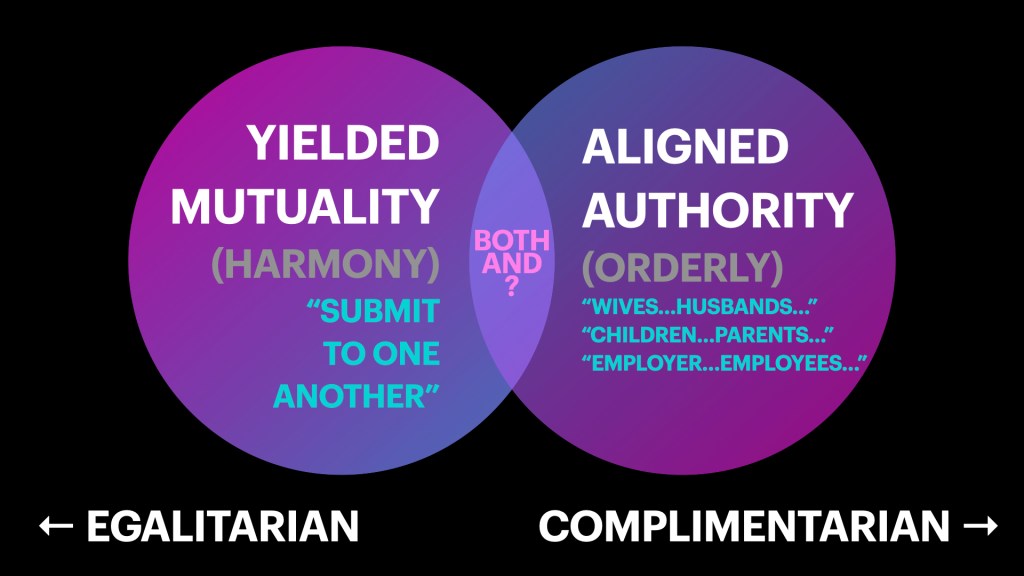
Submission in marriage tends to take the spotlight, v.21 gets glanced over, and the emphasis becomes out of balance. What happens is an overemphasis on v.21 and under-emphasis on v.22, or the opposite, an under-emphasis on v.21 and overemphasis on v.22. Now, before you throw stones, I am simply presenting the issue and will leave you to wrestle with it. What I find peculiar, is that the issue is usually presented as an either/or interpretation. Either we submit under an yielded mutuality or we submit under an aligned authority. It is easy to see how those who emphasize harmony push for egalitarianism and those who emphasize order push for complimentarianism. Oh, boy, there’s so much to say there! I will give my three brief observations.
First, I will propose that the interpretation might not be either/or but both/and. Could mutuality and authority co-exist together and not be a cop-out interpretation? When one takes the Meaning of “submit” + Meaning of “one another” + Examples in the Text = Yes, it appears to be both/and!
Second, I have observed how fear pushes both interpretations. Fear pushes egalitarians to defend injustice, demand freedoms, and protect abuses, while fear pushes complimentarians to retain authority, demand rights, and guard weaknesses. These are noble acts when balanced with the character of Christ, but undoubtedly they get pushed to extremes. When submission becomes destructive or fear-based, then it violates the royal law of love.
Third, the Pattern of Paul in Ephesians 5 encourages each member of the church to say No to self-indulgence, self-service, self-centeredness, and self-aggrandizement and to say Yes to self-sacrifice (like Jesus). In other words, we have a growing 🩶-centered commitment to submit to one another. Rather than saying “I’ve got it all together,” I’m becoming more prone to saying “We are better together”. Let’s turn back to our text for today.
Submit to one another = We humbly yield & align to the interests of those around us.
The heart of submission is humility. This is seen all over the Scripture (cf. Micah 6:8; 1 Cor. 4:7, Gal. 5:13-14, Phil. 2:3-5, 1 Peter 5:5b). In 1 Peter 5:5 both submission and humility are contrasted with pride, which is a theme also seen in James 4:6, “God resists (antitassō, to put away or against) the proud but gives grace to the humble.”
Relationships flourish when clothed with humility rather than hierarchy. Submission is ultimately a posture of the heart. When I cease to submit, when I wait for others to serve me first, and when I feel superior to others, it says more about my heart. My heart is misaligned to the heart of God towards others.
Truth is, your church (team) is likely full of people that you wouldn’t go on vacation with, but you find a way to make it work—putting up with one another, putting yourself under one another—for the greater good. If you took this matter of humbling yourself towards one another seriously, what might it look like in your marriage, family, workplace, team, and church?
What we see throughout the Bible is that humility is not for the other person first, but it is for you. So important is humility that Jesus modeled it. Let’s see how Jesus submitted (humbly yielded and aligned)
his Father: he surrendered his plans and words, for greater glory.
his parents: he was dependent from birth through adolescence.
his disciples: he leaned on them and many of them weren’t even believers yet!
his creation: he took on a human body and he felt hunger, thirst, tiredness, and pain.
his govt authorities (law of the land): he rendered to Caesar what was Caesars.
his religious leaders: who didn’t “do justice, love kindness, and walk humbly with their God.”
your need, he took your cup of wrath (sin), he humbled (lowered) himself to death.
We expect humility from Jesus, but what about me? As I gave ‘mutual submission’ some thought, what came to mind was my relationship with Blue. I am Blue’s appointed leader. I also lead a media project, and with that, I am under Blue’s authority as he serves as leader of the team with the media project. It’s not complicated. We just have to determine who is wearing what hat. On top of that, Blue and I are brothers in Christ. Almost every Wednesday, I meet with Blue and a band of warriors to pray and submit to one another through accountability. In that space, these men have the authority to speak into my life.
Another example of mutual humility was when Bob Shankly retired from Liverpool Football Club in 1974 with a showcase of 10 trophies. He handed the reigns of the team to a reluctant Bob Paisley. Shankly wrote a letter to Paisley and left it on his desk. It read, “Bob Shankly says Bob Paisley is the best manager in the game.” Paisley took the letter, added two commas, and sent it back to Shankly. It read, “Bob Shankly, says Bob Paisley, is the best manager in the game.” Paisley built on Shankly’s success and added 20 trophies (x2 Shankly). In his biography, The Quiet Genius, it was said that Paisley was a shy and thankful fellow who gave others confidence. His genius was being an ordinary man who fostered an extraordinary team.
Out of reverence for Christ = We rally together around the Greatness of Jesus.
Greatness is not achieved through power or prestige. Greatness is not won by force of arms or superior intellect. Greatness is not showing that I got it all together. Greatness comes through humble reverence. It comes when we rally together around the Greatness of Jesus.
Jesus turns upside-down the way the world measures greatness. Remember the mom who begged Jesus to give her two boys the best seats in heaven? When other disciples caught wind of it they were miffed, but they also wanted their shot at the special seats too. So Jesus got them together to settle things down. He said, “You’ve observed how godless rulers throw their weight around, and how quickly a little power goes to their heads. It’s not going to be that way with you. Whoever wants to be great must become a servant…That is what I have done. I came to serve, not be served. I came to give my life as a ransom for many.” (Mt. 20 cf. Phil. 2:7-11; Col. 1:15-18)
Herein is my power and motive to submit—I revere Christ (phobos, awe-inspired love). When I submit to Jesus first, from that flows a heart willing to submit to others. Submission to others is not based on worth—whether they earned it or deserved it, but solely on seeing Jesus is worthy and everyone that he created is made in His image. How does a reverence for Christ make a difference in your relationships? Your family? Your workplace? In your community? Among members of your church? What might it look like for you to submit? To one another? To a Chadian brother or sister? To the Chadian govt? I’m just putting it out there.
One of the most irony-filled stories in Scripture about submission is in the garden of Gethsemane (John 18). There we see Judas submitted to the will of the enemy. He turned Jesus over to the authorities. When the authorities arrived (who themselves submitted to religious leaders), they asked Jesus to identify himself. Jesus stepped forward and said, “I AM He.” At that moment, the guards fell on their faces in fear and submission. Peter decided submitting was for him, so instead he got out his sword and cut off the guard’s ear. In the end, Jesus silently yielded himself both to local authority and divine authority (“not my will but Yours be done.”) Thank God, for our sake, Jesus submitted to Father!
How often have you regretted yielding to your own way? My guess is a lot. How often have you regretted submitting to the Lord? Maybe never. What do you need to yield to the Lord today?
The distinguishing feature of a Spirit-filled follower is their growing reverence for Jesus’ greatness AND humbleness towards others around them. The temptation of power is greatest when intimacy is feared. When I bow my knee to Jesus, I can also bend to the interests of others. This isn’t self-deprecation. Rather, like Jesus, it’s self-sacrifice.
Imagine you’re a violinist and a conductor approaches you and says, “I want you to play in the first chair.” It would be self-deprecating to respond by saying, “No way! I don’t play. I’m no good at all,” when everyone knows that you’re an able and gifted musician. On the other hand, it would be self-sacrificing to respond by saying, “Absolutely, I can play! And I will play my best. I will make this orchestra and everyone around me better.”
I remember hearing Handel’s Messiah being played in an open city square by a university orchestra. I didn’t know about it beforehand, but the concert was free of charge. It was the harmony and authority of the music that drew me to want to stop and listen.
So it is with us. Think about it. You and I are members of a world-renowned orchestra. Each of you has a part to play. You didn’t come to the stage with your own gifts but supernaturally given to you. Being Spirit-filled, it is like you to humbly yield and align to the interests of those around you. With Jesus as your conductor, you rally together around His Greatness to make him shine. When you do it testifies to the mysterious way He brings such a motley crew together.
Lord, You are Great. There is not like You. Help us to rally around Your greatness. We need Your help. Please help us put off our pride and rebellion and put on humility. Teach us to live in submission—by putting ourselves under You and seeking to put the interest of others above our own. Make us servant-leaders like You. In the name of Jesus, amen.
I don’t know what’s occupying your mind right now. Maybe you’re replaying a chat in the car with your spouse or child. Maybe a situation back home or on your team. Maybe something ahead of you this week. Or maybe an anxious thought. I have the task to enter that space with the lyrics of Psalm 2. If you give me a few minutes, I promise this psalm won’t disappoint.
Psalm 2 is a song that David penned as a coronation anthem for the future kings of Israel. It was a reminder to earthly kings that there exists a heavenly king. It was a prophetic vision of God as the King of kings who rules His kingdom and therein is a hope that God would set his True King in Zion. The context and themes might seem foreign, abstract, or outdated—from another culture or time. Yet may you get a refreshed vision of who God is through this psalm.
Psalm 2 was used throughout church history to soothe God’s anxious people when it seems like the world was out of control. Do you ever feet that things in this world are shaky? Like the world is on the edge of chaos? Like the future of our well-being and our children’s is in the hands of very unstable or untrustworthy leaders? Have you felt like this? If not, that may mean you haven’t scanned the news lately. I can summarize the global headlines for you by saying that things are going particularly well. Why is there never peace? Why are people so angry? When will the war in Gaza and Israel end? These questions are not unique to us today (though you and I certainly feel it)—they are questions felt across history and every generation.
Psalm 2 begins with poignant questions, “Why do the nations rage?” and “Why do kings and rulers counsel against the Lord and His Anointed?” Nations rage because nations seek peace through war. Kings and rulers plot because by playing god they seek peace their way. Psalm 2 sums up all of history to the present day It’s a summary of the entire Bible in a gospel song. Here are my 3 points—We don’t want a King, We are given a King, and We need this King.
1) We don’t want a King (vs.1-3)
It is in our human nature refuse a king. It is in our genetic code, since Eden to push back against authority and resist the kingship of God. At our core, we are repelled by being ruled. Within every heart there is a war—we want a king and we don’t want a king. When presented with a king we aren’t happy about it because of what it means for us. We want a king we can submit to when he fits or supports our agenda, our vision, or our wants.
Consider the American mindset. As an American, I represent a people who rebelled and rejected the rule of a king (and there were good reasons for that). What my forefathers did was divorce themselves and declare independence from a king that they called “unfit to be the ruler of a free people.” One could make the case that most Americans resist most kinds of authority (like king, president, boss, parent). I’m not anti-American. I love my country. Yet as much as we Americans abhor royalty or ruler, we have an incurable curiosity for the crown…at least from a distance. How many of you watched the coronation of King Charles? 10 million Americans watched the coronation of King Charles while only twice as many Britons tuned in. As Americans, we are fascinated by royalty—it’s wealth, fashion, spectacle, and soap operas.
I could make a case that within all humans is a memory trace to a true, good, and wise king. From birth, we’re raised with heroic legends and folklore like Richard the Lionheart or Arthur and his Knights of the Round Table. We flock to cinema to see the romanticized stories of Disney princesses like Cinderella and Elsa [I have three girls who all played dress up]. We dream of fantastical kingdoms like Middle Earth and Narnia or the real kingdom conquests of the Roman Empire or the British Empire on which the sun never set.
The world’s history of monarchs (even in the Bible) has been overall terrible. We are familiar with the truism coined by Lord Acton, “absolute power corrupts absolutely.” Today in our modern world, since the Enlightenment, most monarchies have toppled and become democracies (or voices of the people). Royalty seems to be a thing of the past. Yet one could argue that today there is a new kind of royalty that goes by other names—celebrities, sports stars, billionaires, politicians, and influencers (rulers of public opinion). We adore them, we give them riches, we treat them as kings, and we secretly fantasize about their fame.
As the story goes, nobody wants a king, therefore, everybody wants to be king. Not much has changed about us. It has been this way since the Garden. After God created the world, he said to mankind, “Be fruitful and multiply and fill the earth and subdue it, and have dominion over the earth.” (Genesis 1:28) God created us to be dominioneers, but the thought that God still has his hand in things doesn’t sit well with us. Like the kings and rulers of Psalm 2:3, we think of God’s rule as a “chain” or “restraint”. We see God as a chain-maker, not a chain breaker. He feels like an unnecessary weight or choking burden.
I can think to myself, “I don’t want God’s cords wrapped around my life. Get it off me!” I feel owned and used. I feel like God is meddling and toying with me. I am repulsed by the notion that I am someone’s possession, certainly not God’s (v.8). In my being, I buck against this. And God can sometimes give me exactly what I want, like Westley from the Princess Bride who always said to Princess Buttercup, “As you wish,” but what he meant by that was “I love you.”
In rebelling against God, we believe we are creating freedom and peace for ourselves. Yet when we remove ourselves out from under God’s power, protection, and peace, the opposite is actually true. It becomes a hell. George MacDonald, a mentor of C.S. Lewis, had said, “The central conviction of hell is, I AM MY OWN. This will create a living hell for you.” This mindset dominates most humans’ worldviews. And we wonder why the nations rage and peoples plot.
There is war within me. I know my mutinous heart and the misery it brings me. Deep down, I don’t like being told what to do and I rebel. And there, I do the same thing as the people who plot against the Lord’s anointed. I want all the blessings and benefits of the kingdom, but I don’t want to listen to the instruction of the King. When Jesus says love your neighbor as yourself it can feel to me like a chain. Whose my neighbor, I ask? Jesus says your worst one—your enemy. That seems a bit over the top Jesus! Then Jesus says I’m to live pure and holy. And that feels so restrictive. Or Jesus says to be generous and give to everyone who asks of you. Come on? Really? I can’t do that. Maybe when I have a little extra or they pay me back. But then Jesus says forgive as you’ve been forgiven. What!? That surely doesn’t apply to me. The bitterness I have is the only power I can hold onto. I don’t think that God has in mind the level of hurt that I have endured. Except, yes. He does. He wants my freedom and yours.
I still rage against God like this every time I sin. I am in my mid-40’s and have walked with Jesus for 3 decades. And I am alarmed that I still sin so frequently. Every time I do I am making a trade. I say to God, my way looks more free—more joyful. I am a better manager of my human flourishing than you. My path looks more promising and productive. What I don’t realize, in that moment, is that I am raging and plotting against the Anointed.
Charles Spurgeon said, “To a graceless neck, the yoke of Christ is intolerable, but to the saved sinner, it is easy and light. We may judge ourselves by this—Do we love that yoke or do we wish to cast it from us?” To be honest, I often want to cast off the lightest of yokes in exchange for something that looks lighter, but more often then not ends up being a bigger burden too heavy for me to carry. Listen, I have never once regretted obeying God…and yet I still rage.
You and I are called to fight back against the rage and plots by submitting ourselves to the Good King who says, “Come to me, all who labor and are heavy laden, and I will give you rest. Take my yoke upon you, and learn from me, for I am gentle and lowly in heart, and you will find rest for your souls. For my yoke is easy, and my burden is light.” (Matthew 1:28-30)
2) We are given a King (vs.4-6)
How does God respond to the rebel heart? “He who sits in the heavens laughs” (v.4). That’s an interesting image. What does it mean that God laughs? Like an adult chuckling at the feeble effort of a kid. Who scrunch their faces, fold their arms, stomp around in angst, and say boldly, “No!” Sometimes as a parent, it’s hard not to laugh. We laugh and say, “Aw. How cute. Jimmy is pretending to be a totalitarian dictator. Sorry son, but resistance is useless.”
According to Psychology Today, laughter is “one of the distinguishing features of human beings” and maybe “the most contagious of all emotional experiences”—yet “little is known about the mechanisms behind it.” Laughter is social. It’s an effort to communicate to others.
We get laughter from God. And when he laughs, he does so for our sake, to communicate to us. He laughs to give off signals—that are horrible to his enemies and wonderful to his friends. As God laughs his enemies are terrified and cower in fear. But his friends, rise in comfort and he quiets their fears. God’s laughter warns those who commit cosmic treason of their impending doom. But to his friends, his laughter reminds them that the best is yet to come.
God laughs because his plan was already coronated as He says, “I have set my King on Zion, my holy hill.” (v.6) There is no need to crown him as he has already been crowned before the world was created. Whether you acknowledge it or not, you have been given a king. You’ve always had a King. His name is Jesus (Matthew 3:17). He is a good, gracious, gentle, humble, and kind King. When the time was right, God sent his Son to earth—to live among us. He had no beauty or earthly majesty (Isaiah 53:2). He was accepted and then rejected as king. He was plotted against by the kings and rulers of the day. He was mocked. He was clothed in weakness and shame—dressed in a royal robe and twisted a crown of thorns on his head. He was despised and the people pulled a mutiny and sought to unseat Jesus. They marched him to a hill outside the city and hung him on a criminal’s cross. They slapped a little sign above his head that read, “Here hangs the king of the Jews.” (Mark 15:17) They laughed. And Psalm 2 was being fulfilled. But God would have the last laugh. As the Son of God breathed his last breath the earth shook. Nothing would defeat the Son of Man who came to seek and save the lost. Three days later, Jesus rose from the dead as a conquering king, and sits to this day at the righthand of the throne of God readying the day when he will come back and establish his eternal kingdom and call us home.
As Spurgeon put it so poetically, “God’s anointed is appointed and shall not be disappointed!” When you are distressed by the chaos of the world. Look to the holy hill. When you feel defeated by the rebellion in your own heart. Look to the holy hill. When you are tired and things seem outside of your control. Look to the holy hill. When you are weary of your own ability to do the things you know you ought not to do and fail to do the things you ought to do. Look! On the hill is Jesus who loves you. Who defeated, even your rebellion (and love you still). Who is currently standing on your behalf. And will never ever be moved.
3) We need this King (vs.7-9)
You need this King to conquer your enemies. The King is not the enemy (as is common for me to think); he is the enemy crusher. When kings of old were crowned, they were given a scepter (authority) and orb (wisdom). Then the names of the enemies of the kingdom were written on shards of pottery and placed at the king’s feet. The king in symbolism would crush the shards to dust and the people would cheer.
This is what happens to the enemies of God’s people. Jesus is not intimidated by your enemies. They are already defeated. Compared to Christ, your enemies are fragile and impermanent like a shard of pottery. What an image of our Lord! And if that’s your King, what are you so afraid of? This picture speaks to the certainty of what Christ has done, who Christ is, and what he is doing in the world. Don’t declaw the lion of Judah. With the great multitude we can say, “Hallelujah! For the Lord our God the Almighty reigns…On his robe and on his thigh he has a name written, King of kings and Lord of lords.” (Rev. 19:6,16) When I hear Jesus like this, it right-sized my image of him, his power, and his authority. It also right-sizes my enemies and my rebel heart. “To be intimated by the world is as spiritually fatal as being overly attracted to it.” Tim Keller
You need this King for true peace and joy. His yoke is your freedom. Jesus came to save you from you. Rather than you owning you, God considers you his treasured possession. I bring good news of great joy… for all people…the Savior of the world, from the royal line of David, the promised Messiah, the prince of peace, wonderful counselor, and Mighty God—has come for you! I don’t know what the next year holds for you, your family, your ministry, or your work in Chad. It will likely be difficult. I promise Jesus has the nations of the earth as his possession. Do not fear!
In the final stanza of Psalm 2, King David gives us a powerful application (vs.10-12). That is comes from David himself is significant. Remember, he is the king, yet he understands who is the True King. He acknowledges that God is his +1. He decrees these final words to all the kings and rulers of the earth—all peoples—you and me. He begins by saying, “O”. That’s a hard word to translate because it’s from the gut (it comes out of the mouth, down the vocal cords, into the diaphragm, and deep from the gut). Say it. Feel it? David begs for a response…
3 Responses: 1) “Serve the LORD with fear,” Give yourself to the One—Most High King—who rules over all. 2) “and celebrate his rule with trembling,” Laugh out loud with comfort and peace…because in Christ, you’re the freest of all people. 3) “Kiss his son…” This is an ancient sign of reverence…bowing low…bending the knee…of tender and intimate obedience.
1 Result: “Blessed are those who take refuge in him.” To think this King is also … a mighty fortress…a strong tower…a hiding place…and a safe refuge.
Listen, brothers and sisters, there is no refuge from the King. There is refuge in the King.
In the early church, the world was raging against Jesus’ servants. Kings and rulers were counseling together against the Lord’s anointed. His people felt threatened. Their faith was being challenged. Yet let’s take comfort and strength in how they took refuge in the God-King,
“When [Peter and John] were released, they went to their friends and reported what the chief priests and the elders had said to them. And when they heard it, they lifted their voices together to God and said,
“Sovereign Lord, who made the heaven and the earth and the sea and everything in them, who through the mouth of our father David, your servant, said by the Holy Spirit,
“‘Why do the nations rage, and the peoples plot in vain? The kings of the earth set themselves, and the rulers were gathered together, against the Lord and against his Anointed’—
for truly in this city there were gathered together against your holy servant Jesus, whom you anointed, both Herod and Pontius Pilate, along with the Gentiles and the peoples of Israel, to do whatever your hand and your plan had predestined to take place. And now, Lord, look upon their threats and grant to your servants to continue to speak your word with all boldness, while you stretch out your hand to heal, and signs and wonders are performed through the name of your holy servant Jesus.”
And when they had prayed, the place in which they were gathered together was shaken, and they were all filled with the Holy Spirit and continued to speak the word of God with boldness.”
Acts 4:23-31
As come to the Lord and take refuge in Him, may he vanquish your anxious thoughts and give you courage and boldness.
Sing: O Come let us adore him (x3), Christ the Lord. / For He alone is worthy (x3), Christ the Lord. / We give him all the glory (x3), Christ the Lord.
Why do most people not ahead church? Do people that don’t go to church believe in God? Some often assume that just because someone doesn’t go to church that they do not believe in God. The fact is, many do not understand the unchurched. If you were to interview an unchurched you would come to understand:
1. Unchurched believe that any religion is okay, as long as it helps you.
We live in a universalistic world that thinks it is sophisticated and politically correct to say that all roads lead to God. I hear the masses say, “You can believe what you want, I will believe what I want, and we are all okay.” The fastest growing religion in America and the world is tolerance which has the motto’s: “everything can be right” or “nothing is certain.”
Is that really true? Can anyone make that claim? What we understand from each of the major religions of the world is that everyone thinks they are right and others are wrong, even those who claim to be agnostic or atheist. Can they all be right or wrong when they are all truly different at their core? No.
2. Unchurched are curious about the spiritual, but put off by religion.
People are generally fascinated and intrigued by the spiritual. However, they do not want to be tied down by any one belief or give up control to God. As I talk to many unchurched youth I am overwhelmed by their desire to know about God, faith, and the afterlife, but not commit to it. 4 out of 5 American’s call themselves deeply spiritual [Aug.26, 2002 Barna Update], but base their faith on their circumstances not on absolute truth or formal religion. People do not want a religious system running their lives, telling them to stop sleeping with their partner, to obey “stupid” moral standards, to quit abusing substances, or to start forgiving their parents.
3. Unchurched do not know what Christianity really is all about.
A few weeks ago I was meeting someone for lunch. While waiting I was talking to another person waiting for a friend too. This person began to complain about their work and how they were glad to be on lunch break. Every other word that came out of their mouth was an expletive. When they were finished venting they asked, “What kind of work do you do?” I have to laugh inside when people ask this question. Mostly for the response that follows, “I am a pastor”. He just looked at me with that I-am-embarssed-for-cussing-like-a-sailor-in-front-of-a-minister-look.
After an awkward pause he said, “Oh, you know, I am a Christian too!”
I did not doubt him, but I did question, “That’s great. Where do you go to church?”
“Oh, I do not go to church.”
“Why is that?”
“Well you do not have to go to church to be a Christian,” was his dogmatic reply.
Many consider themselves Christian by default because they live in America, their mom was a Christian, or because they went to a denominational church sometime in the past. Two-thirds of people who do not go to church say that they are Christians [Barna, 2000], while half of those same people do not celebrate Easter which is a big Christian holiday. It doesn’t take you long to learned that not everyone who says their a Christian really believes that Jesus Christ can save them from all their sins or that He is the only way to eternal life.
4. Unchurched do not know what to believe for certain.
Many who claim that they are Christians in the previous point are uncertain about one thing: where will I go in the afterlife? That is the age old question. The common answer is, ” I do not know. Does anybody? I think I am good enough.” Today, there are many unfounded theories about God and His plan for life after death. Some will say, “God is a good God and will be gracious to me. Of course, He will forgive everybody.”
5. Unchurched are searching to fill an empty void.
How good is good enough? Who sets the standard of the scale of goodness? We like to set the standard by weighing our goodness against anthers goodness. I might think, “Well, I am not as bad as Hitler or that molester I heard about on the six o’clock news.” Who says you are not as bad? We like to project upon God our good standing and impose upon Him mercy.
I would like to propose that when reading the Bible from cover to cover it is clear–I do not deserve His mercy, I am not a very good person at all, I desperately need God’s grace to cover my sin, and belief in God’s Son is the only means to an afterlife of peace. I absolutely believe that a daily relationship with Jesus Christ is what will fill the empty void and longing of our heart. Jesus is certain, poses great questions to the ultra-religious [John 8:54-59], and claims to be the way truth and life [John 10:20]. Nobody goes to heaven but through Him [John 14:6].
Have you ever had to tell the truth to someone and what you had to tell them was not the greatest of news? Not that they have a boogey hanging from their nose, but a bad behavior that needs changing. You finally muster up the courage to tell them. You share this truth with them because you care, love and help them. Sometimes the truth might scare you out of your pants. Today Jesus is going to tell us the truth on some facts that might make you fear.
Jesus’ talks a lot about eternity. 2/3 of all parables were about heaven and hell issues. At the end of His greatest message ever preached, the Sermon on the Mount, He talked clearly about the reality of heaven and hell. We do not like to think about the reality of hell. Many believe that there is no such thing as hell. They say, “How could a loving God send anybody to hell?” Hell is more of a swear word than a real place in the minds of many. This is not a hell fire and brimstone message, but cutting to the heart of the issue like Jesus did:
1. Not everyone is going to heaven [Matthew 7:13]. You might be able to handle this first fact thinking to yourself, “Well, murders, molesters and rapists definitely deserve to go to hell. I am not like them. At least not AS bad.”
When I was in South Africa I observed gated communities. I would pass by the gate and the guard would nod or wave me in. Everyday was the same. He let everyone in. I suppose that is why homes got broken into so many times!? When it comes to heaven we want a guard gate kind of God. ”If you are sincere; if you are basically good; if you believe in a god…just drive up to Him and he’ll nod, wink and wave you on through.” God does not care only if you are a good boy or girl. He doesn’t grade on a cosmic curve. He just doesn’t let anyone in to His heaven. Heaven and hell are gated communities.
If I were ask you t call your mother you could not use just any number in the phone directory to call her. You got to call mom’s specific number. Likewise we cannot just try any way to God. There is only one way to God that is through Jesus Christ.
2. More people will go to hell than heaven [Matthew 7:14]. There is a truth to the two popular songs by AC/DC Highway to Hell and Rascal Flatts cover of Life is a Highway. Life is a highway that barrels by at a blazing speed and there is a road that leads to hell. The Bible says it is a broad road and well traveled. Like I-65 at rush hour. Many people think that they can make it to heaven on their own. However, self-reliance merges into self-deception, and self-deception dead ends into self-destruction. In another popular song Only the Good Die Young by Billy Joel, he says, “I’d rather laugh with the sinners than cry with the saints.” Hell is no laughing matter. Jesus says it is eternal torment. A place of isolation and darkness, and a place of “weeping and gnashing of teeth.”
Jesus is the definite article. This takes you back to English Grammar class [the=definite article]. That means He is absolutely the way, the truth and the life, nobody goes to the Father but through Him [John 14:6]. This is exclude 376 million Buddhists living in Asia, 900 million Hindus in India, 1.3 billion Muslims throughout the world, and…
3. Many who think they are Christians aren’t [Matthew 7:15-23]. God doesn’t send people to hell. We volunteer. Our sin condemns us to hell. Keeping God at a distance in this life will continue more of the same in the next. Just because you say, “I’m a Christian because you go to church, FUEL or pray.” Doesn’t mean you are a Christian any more than saying you are nut makes you a Snickers Bar.
You can tell a Christian by the fruit they bear. Apple trees bear apples, grapevines bear grapes, and Christians look like Christ. When people look at your life can they see clearly that you are a Christ follower because you act like it, talk like it, smell like it?
4. You will not get another opportunity after you die. Hebrews 9:27 says, “it is appointed men once to die, but after this the judgment.” Death is an appointment you are not going to be late for. You are going to die! God will look at you life and see if you received His Son. He will either say, “Well done. Welcome. Paid for by the blood of the cross” [Matthew 25:21-23] Or “I don’t know you. Where you come from?” [Luke 13:25] There is no second chance on the other side of this life, thus…
5. This could be your last chance. What you do on this side of the grace will affect where you spend eternity. If you are a procrastinator by nature this is not something you want to put off until later. Commit to Christ before it is too late. You do not know the date when you will stand before God’s gate!
Will you come to Christ today? Will you commit to live for Him? Will you prove it through your life?
It is really embarrassing to strike out in slow pitch softball. The ball comes in nice and SLOW, not to mention a softball is twice as big as a baseball.The night was going great. I had a double and an in the park homerun. Our team was winning. All was about to change, for me. I suppose it all went to my head, I thought I could crush every ball to the fence. The only thing that got crushed was my pride. Whiff! The next 5 at-bats I struck out. Sure I could make the excuse that it was one-pitch league, that I was tired, or that the pitcher was good (throwing them low and short, which really gets me drooling). I was so frustrated with myself. I wanted to throw the bat, curse like a sailor, and sit on the bench in a pout. But the team wouldn’t let me…The other players on my church softball team came along side me and saught to encourage me. Rollie, the coach, gave me some back-to-the-basics pointers like, “Keep your eye on the ball…follow through with your swing…step-up in the box…forget about your last up-to-bat” He really encouraged me.I was having what baseball calls a slump. I was determined to shake this slump with the encouragement of my teammates. My next at-bat I step up to the plate, took my stance in the front of the batters box, picked up my elbows, looked to the sky for strength from my God, and then watch the pitch slowly reach the plate. I swung. Crack! The ball made contact with the bat and rifled over the shortstops head. Base hit. You would have thought I won the game. I almost cried. My teammates were cheering, and I was relieved because the strikeout slump was over. Slumps happen in others places than softball or baseball. They can happen in life. Have you ever been in a spiritual slump? I know, I have. How do you get out of a spiritual slump? The same way you get out of a sporting slump…by getting back to the basics, by surround yourself with teammates that will cheer you on and encourage you to get back to the plate and hit that ball. Nothing is more satisfying that sticking to the game through the slump, stepping up the the plate, and keeping your eye on the Prize–JesusChrist.






















 spreading the fame